
Kaynes vs Cyient DLM vs Syrma SGS: EMS Stocks Compared
Kaynes Technology, Cyient DLM and Syrma SGS are three listed Indian electronics manufacturing services (EMS) companies. All three build circuit boards, cables and finished electronic boxes for other companies' products, and all three report in the same months. But they serve very different customers, and their latest quarter, to 30 September 2026, pulled them further apart than ever.
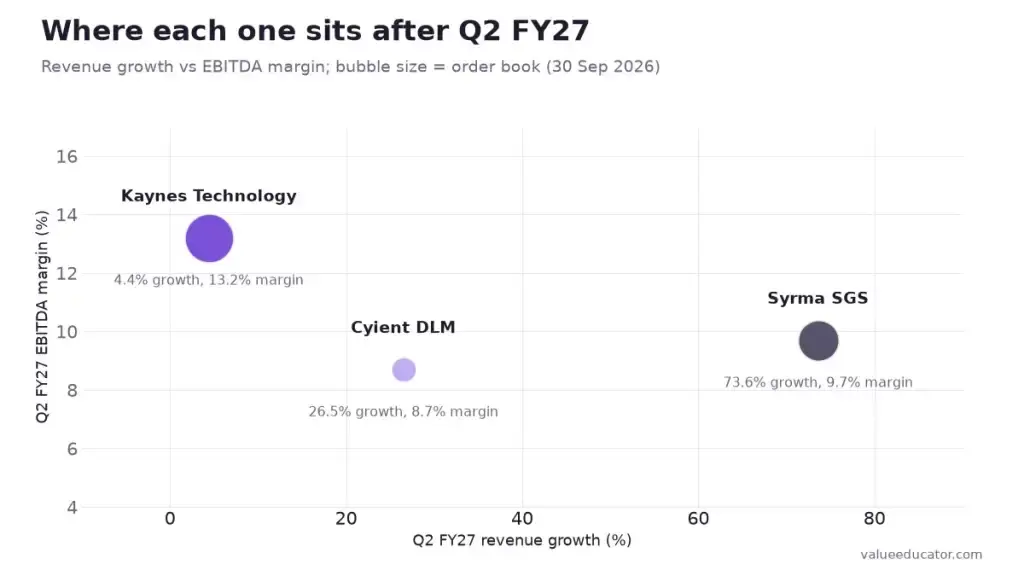
Syrma SGS grew revenue by 73.6% in that quarter. Cyient DLM grew by 26.5%. Kaynes grew by only 4.4%, its profit fell by 65.6%, and on 14 November 2026 it restated its earlier accounts to correct errors. That is why investors searching "Kaynes vs Syrma" or "Cyient DLM vs Kaynes" now need a fresh, side-by-side view. This page compares the three on business, growth, margins, order books, debt and cash flow, using the same period for each in every row.
Figures as of 20 November 2026. This page is research, not a recommendation to buy or sell any stock.
Kaynes vs Cyient DLM vs Syrma SGS at a Glance
| Measure | Kaynes Technology | Cyient DLM | Syrma SGS |
|---|---|---|---|
| Business | EMS for industry, auto, rail, aerospace and smart meters; building chip-packaging (OSAT) and circuit-board (PCB) plants | Electronics for aircraft, industrial, medical and defence customers, mostly abroad | EMS and own-design (ODM) products for consumer, auto, industrial, rail, IT and medical customers |
| Plants | 18 manufacturing facilities | Four plants in India and one in the USA | 17 operational facilities, 1.27 Mn sq ft |
| Revenue, FY26 | ₹3,680.9 Cr (restated) | ₹1,261.5 Cr | ₹4,819.1 Cr |
| EBITDA margin, FY26 | 14.2% (restated) | 10.1% | 11.3% |
| Profit after tax, FY26 | ₹391.5 Cr (restated) | ₹73.3 Cr | ₹345.8 Cr |
| ROCE, FY26 (as each company reports it) | Not disclosed on restated figures | 11.4% | 16.9% |
| Net debt (+) or net cash, 30 Sep 2026 | Net debt ₹1,703.1 Cr | Net cash ₹22.6 Cr | Net cash ₹258 Cr |
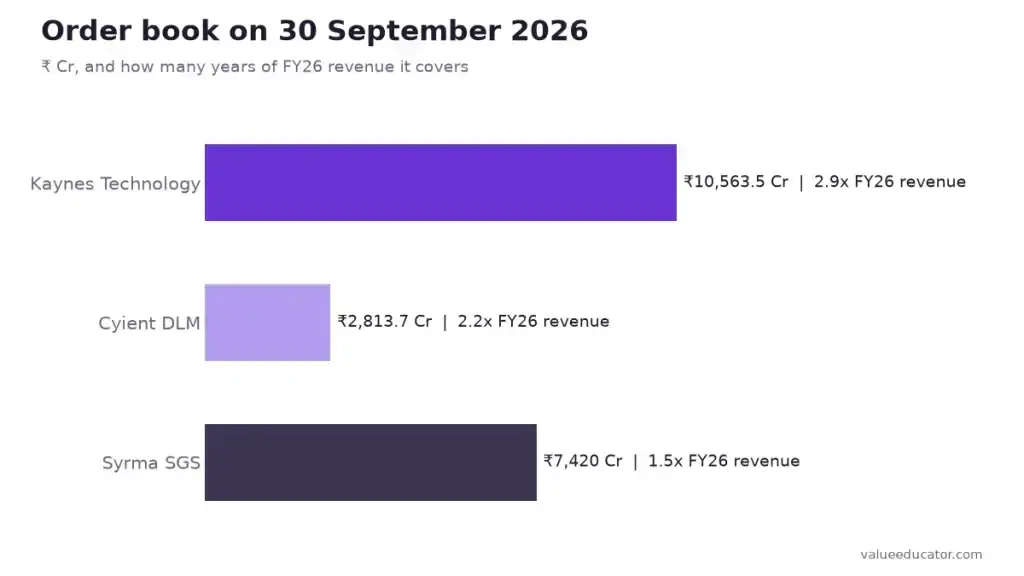
| Order book, 30 Sep 2026 | ₹10,563.5 Cr | ₹2,813.7 Cr | ₹7,420 Cr |
| Revenue growth, Q2 FY27 | 4.4% | 26.5% | 73.6% |
| Customers | 500+ customers in 30+ nations; largest about 24% of FY26 sale of goods | Customers above 10% each gave 70.5% of FY26 standalone revenue | 350+ customers; top 5 about 38% of H1 FY27 revenue |
| Key risk | Restated accounts, negative cash flow and high receivables | Few large customers and a thin margin | Low-margin consumer work and a large new PCB plant |
The table shows three different shapes. Syrma SGS is the largest by revenue and the fastest-growing right now. Kaynes has the largest order book and the highest margin, but it now carries debt and is burning cash. Cyient DLM is the smallest, with almost no debt and most of its revenue from abroad.

Business Models: Who Builds What, and for Whom
All three are EMS companies, which means they manufacture electronics designed by, or for, their customers. The differences lie in which industries they serve, how much design they own, and what they are building next.
Kaynes Technology: EMS plus chips and circuit boards
Kaynes builds circuit-board assemblies, cables and complete boxes for industrial, automotive, railway, aerospace and medical customers from 18 facilities. Of its FY26 revenue of ₹3,626.4 Cr as first reported, core EMS was about ₹2,655 Cr and its smart-meter subsidiary was ₹971 Cr. That meter business supplies electricity meters to large state rollouts, and it is where most of Kaynes's receivables have built up.
Kaynes is also moving down the value chain into parts that India mostly imports. Its chip-packaging plant at Sanand, an OSAT (outsourced semiconductor assembly and test) unit, was inaugurated on 31 March 2026. A separate plant will make bare printed circuit boards with up to 74 layers. Kaynes has the widest plan of the three, and also the most money still to spend.
Cyient DLM: aircraft electronics, built mainly for export
Cyient DLM makes boards, cable harnesses and boxes for aircraft makers, industrial firms, medical device makers and defence companies. In Q2 FY27, aerospace gave 47% of revenue, industrial 31%, medical 14% and defence 7%, and 93% of revenue came from customers outside India. It works from four plants in India and one in Connecticut, USA.
Most of its work is still build to print, where the customer supplies the design. The company is trying to grow build to spec work, where it also designs the product, which usually pays better and lasts longer. Aerospace qualification takes years, so new customers arrive slowly, but they also tend to stay.
Syrma SGS: broad EMS with its own designs
Syrma SGS has the broadest customer list of the three, with 350+ customers. In Q2 FY27 its revenue came from consumer products (₹572.7 Cr), automotive (₹516.9 Cr), industrial (₹493.5 Cr), IT and railways (₹272.7 Cr) and healthcare (₹134.0 Cr). Exports were 26% of revenue.
Part of Syrma's business is ODM, where it sells products it has designed itself. It also bought 60% of Elcome, a marine electronics company, in December 2025, which added ₹135 Cr of revenue in H1 FY27. Like Kaynes, Syrma is now building a plant to make bare printed circuit boards.
Latest Quarter: Q2 FY27 Side by Side
Q2 FY27 is the quarter to 30 September 2026. All three have reported it. For Kaynes, the year-ago figures below are the restated ones it published on 14 November 2026.
| ₹ Cr, Q2 FY27 | Kaynes Technology | Cyient DLM | Syrma SGS |
|---|---|---|---|
| Revenue | 952.5 | 393.1 | 1,989.7 |
| Revenue, Q2 FY26 | 912.1 | 310.6 | 1,145.9 |
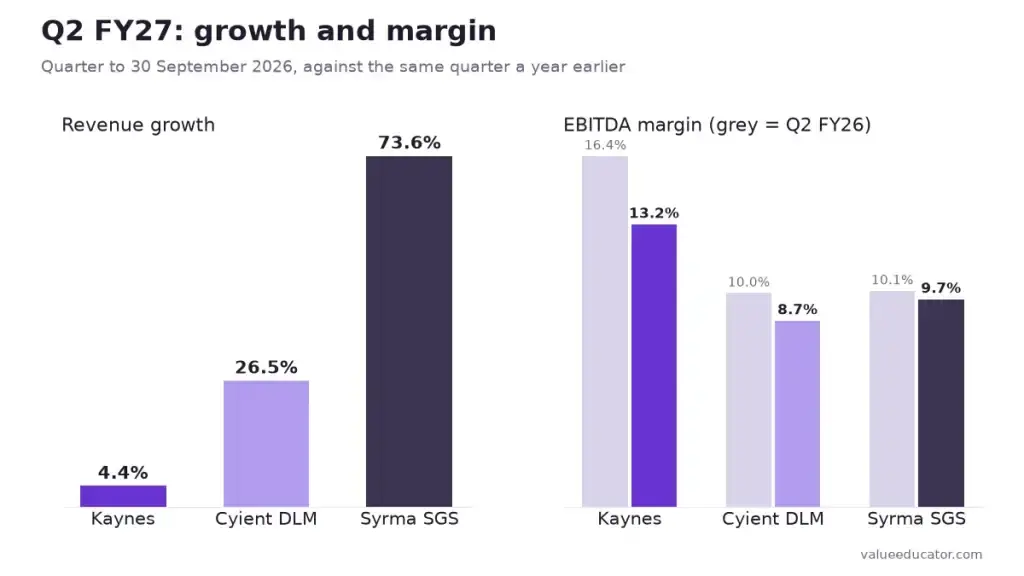
| Revenue growth | 4.4% | 26.5% | 73.6% |
| EBITDA | 125.6 | 34.2 | 193.3 |
| EBITDA growth | -16.2% | 9.5% | 67.8% |
| EBITDA margin | 13.2% | 8.7% | 9.7% |
| EBITDA margin, Q2 FY26 | 16.4% | 10.0% | 10.1% |
| Profit after tax | 39.8 | 34.0 | 124.2 |
| Profit after tax, Q2 FY26 | 115.7 | 32.1 | 66.3 |
| Revenue growth, H1 FY27 | 17.9% | 30.2% | 71% |
EBITDA for Kaynes is profit before tax, finance costs and depreciation, minus other income, worked out from its filed results. Syrma's figure is its reported operating EBITDA.
Kaynes had a weak quarter. Revenue of ₹952.5 Cr was only 4.4% above a year earlier, against 17.9% growth over the half year. EBITDA fell 16.2% to ₹125.6 Cr, and the margin dropped from 16.4% to 13.2%. Profit fell more sharply, from ₹115.7 Cr to ₹39.8 Cr, a fall of 65.6%. Finance costs rose to ₹38.7 Cr from ₹13.3 Cr as borrowings went up, depreciation rose to ₹34.7 Cr from ₹19.9 Cr as new plants started, and other income fell to ₹18.6 Cr from ₹34.1 Cr. The weakness came from smart meters: their revenue fell to ₹54 Cr from ₹228 Cr as Kaynes held back supplies while installations were slow, while core EMS revenue grew 34% to ₹799 Cr from ₹595 Cr. Management expects a stronger second half, as OSAT revenue has started and the PCB unit adds revenue from Q3.
Cyient DLM grew revenue by 26.5% to ₹393.1 Cr, but its EBITDA margin slipped to 8.7% from 10.0% as material and staff costs rose faster than sales. Reported profit of ₹34.0 Cr included a one-off gain of ₹18.2 Cr from reversing an earn-out, a payment it had set aside for the sellers of its US plant. Without that gain, normalised profit was ₹15.8 Cr, up 25.8% from ₹12.6 Cr.
Syrma SGS nearly doubled its quarter. Revenue rose 73.6% to ₹1,989.7 Cr, operating EBITDA rose 67.8% to ₹193.3 Cr, and profit after tax rose 87.2% to ₹124.2 Cr. Its margin dipped to 9.7% from 10.1%, and its gross margin fell to 21.1% from 23.8%, as a larger share of lower-margin work came through. Part of the growth came from Elcome, which it did not own a year earlier.
Five-Year Financials
The table below uses each company's figures for FY22 to FY26. Kaynes's FY26 numbers are the restated ones; its FY22 to FY25 numbers are as first reported, since the November 2026 restatement covers FY26, later quarters and the opening balances of FY26, not the earlier profit figures. Syrma's FY22 numbers exist only on a pro forma basis, from the year it merged with SGS, so they are not shown.
| Year | Kaynes revenue (₹ Cr) | Kaynes EBITDA margin | Kaynes PAT (₹ Cr) | Cyient DLM revenue (₹ Cr) | Cyient DLM EBITDA margin | Cyient DLM PAT (₹ Cr) | Syrma SGS revenue (₹ Cr) | Syrma SGS EBITDA margin | Syrma SGS PAT (₹ Cr) |
|---|---|---|---|---|---|---|---|---|---|
| FY22 | 706.2 | 13.3% | 41.7 | 720.5 | 11.7% | 39.8 | Not comparable | Not comparable | Not comparable |
| FY23 | 1,126.1 | 14.9% | 95.2 | 832.0 | 10.6% | 31.7 | 2,055.6 | 9.5% | 123.1 |
| FY24 | 1,804.6 | 14.1% | 183.3 | 1,191.9 | 9.3% | 61.2 | 3,171.0 | 6.9% | 124.3 |
| FY25 | 2,721.8 | 15.1% | 293.4 | 1,519.6 | 9.0% | 68.1 | 3,787.2 | 8.6% | 184.5 |
| FY26 | 3,680.9 | 14.2% | 391.5 | 1,261.5 | 10.1% | 73.3 | 4,819.1 | 11.3% | 345.8 |
Over the same three years, FY23 to FY26, Kaynes's revenue grew 3.3x, Syrma's 2.3x and Cyient DLM's 1.5x. Profit grew 4.1x at Kaynes, 2.8x at Syrma and 2.3x at Cyient DLM.
Each company had a different path. Kaynes grew fastest of the three in each year from FY24 to FY26 and kept its margin around 13% to 15%. Before the restatement, its FY26 revenue was ₹3,626.4 Cr with a 15.8% margin; the restated figures are ₹3,680.9 Cr and 14.2%. It had also guided for ₹4,500 Cr of FY26 revenue and cut that to at least ₹4,000 Cr in February 2026, so it delivered less than it promised.
Cyient DLM's revenue fell 17% in FY26 after a large defence order ended, though its margin recovered to 10.1%. Syrma's margin fell to 6.9% in FY24, when low-margin consumer work was a large part of sales, and then rose to 11.3% in FY26 as the mix improved.
Order Book and Growth Plans
An order book is the value of firm orders not yet delivered. It tells you how much work is lined up, though not how profitable it will be.
| ₹ Cr | Kaynes Technology | Cyient DLM | Syrma SGS |
|---|---|---|---|
| Order book, 31 Mar 2026 | 8,366.3 | 2,416.6 | 6,400 |
| Order book, 30 Jun 2026 | 8,903.8 | 2,598.9 | 6,770 |
| Order book, 30 Sep 2026 | 10,563.5 | 2,813.7 | 7,420 |
| Order book as a multiple of FY26 revenue | 2.9x | 2.2x | 1.5x |
Kaynes's order book rose 30.4% from ₹8,099.4 Cr a year earlier, and Cyient DLM's rose 22.8% from ₹2,291.1 Cr. Cyient DLM booked new orders worth 1.6 times its Q2 FY27 revenue. Syrma's book is shorter, about 1.5x FY26 revenue, but it turns into sales faster: only ₹1,200 Cr of it falls due after 12 months.
Kaynes: OSAT and PCB plants
Kaynes plans to spend about ₹3,200 Cr in total on its OSAT plant, with 50% of the eligible cost paid by the central government and 20% by the state. Phase 1 of its PCB plant is a ₹1,400 Cr investment. For FY27 it planned to spend about ₹300 Cr on OSAT, ₹300 Cr on PCB and ₹250 Cr on EMS, and in August 2026 it aimed for ₹450-500 Cr of OSAT and PCB revenue in FY27, starting from Q3. In November 2026, US component maker Vishay agreed to take 49% of an existing Kaynes subsidiary.
Cyient DLM: more design work, little new capex
Cyient DLM says its existing plants can support about 1.75 times today's revenue, so it does not need large new factories. It expects a book-to-bill of about 1.5 in FY27 and aims for an EBITDA margin of roughly 11-13% between FY27 and FY29, helped by more build-to-spec work.
Syrma SGS: scale plus a PCB plant
Syrma raised its FY27 guidance to 40-45% revenue growth, about ₹7,000 Cr, at an EBITDA margin of 10-10.5%, and aims for $1 billion of revenue in FY28. Its PCB plant is planned at about ₹1,600 Cr in phases over 3-5 years, backed by a ₹765 Cr investment approval under the government's components scheme, with PCB revenue of ₹700-800 Cr hoped for in FY29. In FY26 it targeted ₹1,100 Cr of exports and delivered more than ₹1,200 Cr.
Balance Sheet and Cash Flow
This is where the three differ most. Growth in EMS uses cash, because a company buys components months before it is paid. How each one funds that gap matters.
| 30 Sep 2026 / H1 FY27, ₹ Cr | Kaynes Technology | Cyient DLM | Syrma SGS |
|---|---|---|---|
| Borrowings | 1,809.8 | 132.0 | 745.8 |
| Cash and bank balances | 106.7 | 154.6 | 1,003.4 |
| Net debt (+) or net cash | Net debt 1,703.1 | Net cash 22.6 | Net cash 258 |
| Inventory | 1,279.0 | 701.0 | 1,578.9 |
| Operating cash flow, H1 FY27 | -278.4 | 14.8 | 119.7 |
| Capex, H1 FY27 | 556.4 | 14.3 | 535 (capex and investments) |
| Net working capital days, 30 Sep 2026 | 169 (rolling 12 months) | 153 | 63 |
Kaynes went from net debt of ₹738.2 Cr in March 2026 to ₹1,703.1 Cr in September 2026, about 0.35 times its equity of ₹4,908.3 Cr. Operations used ₹278.4 Cr of cash in H1 FY27 while it spent ₹556.4 Cr on plants. Trade receivables, including those due after a year, were ₹2,061.5 Cr, which is about 198 days of its H1 FY27 revenue on a yearly basis. Net working capital on a rolling 12-month basis rose to 169 days from 163 days in June. Smart-meter receivables did come down, to ₹1,091 Cr from ₹1,402 Cr in June. Part of the rise in borrowings is a reclassification: after the restatement, bank-funded receivables and supplier financing are now counted as borrowings. Read more on why this matters in our guide to the cash flow statement.
Cyient DLM is almost debt-free, with net cash of ₹22.6 Cr. Its weak spot is inventory: net working capital was 153 days in September 2026, as it stocked components ahead of customer programmes. Inventory rose to ₹701.0 Cr from ₹647.3 Cr in six months.
Syrma SGS had net cash of ₹258 Cr, helped by a share sale in 2025, even though its debt rose to ₹745.8 Cr from ₹353.1 Cr in March 2026. It runs the tightest working capital of the three, at 63 days, and generated ₹119.7 Cr of operating cash in H1 FY27. Its inventory still rose to ₹1,578.9 Cr from ₹1,061.6 Cr as sales grew. For how to judge borrowing against equity, see our guide to the debt to equity ratio.

Risks for Each Company
Kaynes Technology
- Restated accounts. On 14 November 2026, Kaynes restated FY26 and earlier quarters to correct material prior period errors. These included revenue booked before goods had passed to customers, inventory overstated by overheads and a change in accounting for one smart-meter contract. Restated FY26 profit rose to ₹392 Cr from ₹364 Cr first reported, and the new auditor's review reports carry an emphasis of matter on the restatement. Investors will want to see a few clean quarters before trusting the trend.
- Cash flow and receivables. Operations used cash in H1 FY27, receivables are high, and net debt has more than doubled in six months.
- Execution. The OSAT and PCB plants are new businesses for Kaynes, and their revenue targets are still ahead.
- Concentration. Its largest customer gave about 24% of FY26 sale of goods.
Cyient DLM
- Few large customers. Customers above 10% each gave 70.5% of FY26 standalone revenue, so one customer's delay moves the whole year, as FY26 showed.
- Thin margin. An EBITDA margin of 8.7% in Q2 FY27 leaves little room for cost increases.
- Working capital. At 153 days, a lot of cash is tied up in inventory.
- One-off gains. Earn-out reversals of ₹19.6 Cr in FY26 and ₹18.2 Cr in Q2 FY27 lifted reported profit.
Syrma SGS
- Low-margin mix. Consumer products were 29% of Q2 FY27 revenue and carry lower margins, and gross margin fell to 21.1% in the quarter.
- Rising inventory and debt. Fast growth has pushed up inventory and borrowings.
- New plant. The PCB plant is a large, multi-year project in a new business.
- Acquired growth. Part of the recent growth came from Elcome, which will not repeat once it is in the base.
Which Is Stronger on Each Measure?
| Measure | Stronger on this measure | Figures |
|---|---|---|
| Size (FY26 revenue) | Syrma SGS | ₹4,819.1 Cr vs ₹3,680.9 Cr (Kaynes) and ₹1,261.5 Cr (Cyient DLM) |
| Latest growth (Q2 FY27 revenue) | Syrma SGS | 73.6% vs 26.5% (Cyient DLM) and 4.4% (Kaynes) |
| Margin (Q2 FY27 EBITDA margin) | Kaynes Technology | 13.2% vs 9.7% (Syrma SGS) and 8.7% (Cyient DLM) |
| Profit (FY26 PAT) | Kaynes Technology | ₹391.5 Cr vs ₹345.8 Cr (Syrma SGS) and ₹73.3 Cr (Cyient DLM) |
| Return on capital (FY26 ROCE, as reported) | Syrma SGS | 16.9% vs 11.4% (Cyient DLM); Kaynes has not disclosed ROCE on its restated figures |
| Order book (multiple of FY26 revenue) | Kaynes Technology | 2.9x vs 2.2x (Cyient DLM) and 1.5x (Syrma SGS) |
| Balance sheet (30 Sep 2026) | Syrma SGS | Net cash ₹258 Cr vs net cash ₹22.6 Cr (Cyient DLM) and net debt ₹1,703.1 Cr (Kaynes) |
| Cash flow (H1 FY27 operations) | Syrma SGS | ₹119.7 Cr vs ₹14.8 Cr (Cyient DLM) and -₹278.4 Cr (Kaynes) |
| Customer spread | Syrma SGS | 350+ customers, top 5 about 38% |
| Export share (latest quarter) | Cyient DLM | 93% of Q2 FY27 revenue from outside India vs 26% (Syrma SGS) |
No single company leads on every measure. Syrma SGS leads on size, current growth, cash and customer spread. Kaynes leads on margin, profit and order book, but trails on cash flow and debt and now carries restated accounts. Cyient DLM is the smallest, with a clean balance sheet and an export-led, aerospace-heavy business, but the thinnest margin.
Explore our Products
Research Framework

Emerging Titans
Combination of quantitative analysis, industry tailwinds, and management assessment - SPRINT investment philosophy

Tiny Titans
Heavy emphasis on scuttlebutt research, plant visits, and early on-ground signals
Read our full company report: Kaynes Technology: EMS, Chip Plants and ₹10,563.5 Cr Orders.
Conclusion
Kaynes, Cyient DLM and Syrma SGS all sit in India's EMS industry, but they are three different businesses. Kaynes is the most ambitious, adding chip packaging and circuit boards to its EMS work, with the largest order book of ₹10,563.5 Cr. Its latest quarter, the restatement of its accounts and its negative cash flow mean the next few quarters will show whether that order book turns into profit and cash.
Cyient DLM suits a reader who wants to follow a focused aerospace and industrial exporter with little debt. Its story depends on winning more design work and lifting margins towards its 11-13% aim. Syrma SGS is the largest and fastest-growing of the three right now, with net cash and the broadest customer base, and its story depends on holding margins as it grows and building its PCB plant on time.
Which one fits depends on what a reader values more: order book and plans (Kaynes), focus and a clean balance sheet (Cyient DLM), or scale and cash generation (Syrma SGS). For the full sector, see our list of EMS stocks in India. The full company stories on Cyient DLM and Syrma SGS go into each business in more depth.
FAQs
Kaynes vs Cyient DLM vs Syrma SGS: which is better?
+None is stronger on every measure. Syrma SGS is the largest, grew revenue 73.6% in Q2 FY27 and had net cash of ₹258 Cr on 30 September 2026. Kaynes has the highest margin and the largest order book, at ₹10,563.5 Cr, but its profit fell 65.6% in Q2 FY27, it had net debt of ₹1,703.1 Cr and it restated its accounts. Cyient DLM is the smallest, with net cash of ₹22.6 Cr and 93% of revenue from abroad, but a thinner margin.
Which is the largest EMS company of the three?
+Syrma SGS, with FY26 revenue of ₹4,819.1 Cr, followed by Kaynes Technology at ₹3,680.9 Cr (restated) and Cyient DLM at ₹1,261.5 Cr.
Which has the biggest order book?
+Kaynes Technology, with ₹10,563.5 Cr on 30 September 2026, about 2.9 times its FY26 revenue. Syrma SGS had ₹7,420 Cr and Cyient DLM ₹2,813.7 Cr.
Why did Kaynes Technology restate its results?
+In its Q2 FY27 results on 14 November 2026, Kaynes restated FY26 and earlier quarters to correct material prior period errors. These included revenue recorded before goods passed to customers and inventory overstated by capitalised overheads. Restated FY26 revenue was ₹3,680.9 Cr and the EBITDA margin was 14.2%, against 15.8% first reported.
Which of the three has the highest margin?
+Kaynes Technology, with an EBITDA margin of 13.2% in Q2 FY27, down from 16.4% a year earlier. Syrma SGS was at 9.7% and Cyient DLM at 8.7%.
Which has the strongest balance sheet?
+Syrma SGS had net cash of ₹258 Cr on 30 September 2026 and Cyient DLM had net cash of ₹22.6 Cr. Kaynes had net debt of ₹1,703.1 Cr, up from ₹738.2 Cr in March 2026, and its operations used ₹278.4 Cr of cash in H1 FY27.

High growth stock specialist, Value Educator
Shashank Mahajan is an equity research professional with over 12 years of experience in identifying high-potential SME and micro-cap stocks at an early stage. He follows a rigorous scuttlebutt research–driven approach, combining on-ground insights with deep financial analysis. Shashank specializes in uncovering under-researched and under-owned companies with strong management quality and long-term growth potential. Through disciplined research and early identification, he focuses on spotting tomorrow’s market leaders before they enter the mainstream investor radar.
More about Shashank Mahajan →
PCBL Chemical: Carbon Black Margins and Battery Materials

KEC International: Record Orders, Weak Margin, High Debt

Sona BLW: EV Revenue Now Tops Half of Its Auto Sales

HPL Electric & Power: Smart Meters, Wires and Two Engines

Kaynes Technology: EMS, Chip Plants and ₹10,563.5 Cr Orders

Sterlite Technologies: Glass Rods to Hyperscaler Deals
Explore our Products
Research Framework
Emerging Titans
Combination of quantitative analysis, industry tailwinds, and management assessment - SPRINT investment philosophy
Tiny Titans
Heavy emphasis on scuttlebutt research, plant visits, and early on-ground signals



India's Aerospace Opportunity
Global Demand. Supply Bottlenecks. Opportunities Ahead.
Don't Miss This Exclusive Webinar!
Join Value Educator to decode the key trends shaping India's aerospace sector and learn how to identify tomorrow's potential leaders in the space.
- How the aircraft value chain works, layer by layer
- Indian companies supplying global aircraft makers
- A framework to judge any aerospace company

 Orders
 Subscription
 Share with friends


Required Details
₹23999.00
(12 month subscription)
As per SEBI regulations, all users are mandated to complete the KYC that is validated for 1 year. Post payment, you will be redirected to the KYC screen


No comments yet. Be the first to comment!