
Syrma SGS: Less Consumer Work, ₹7,420 Cr of Orders

In the April to June quarter of 2025, consumer products made up 34% of an Indian electronics maker's revenue. A year earlier, the same products had made up 53%. Over that year, its gross material margin went from 15% to 24%, and its EBITDA margin went from 5.2% to over 10%. The company had not stopped making consumer goods. It had grown everything else faster.
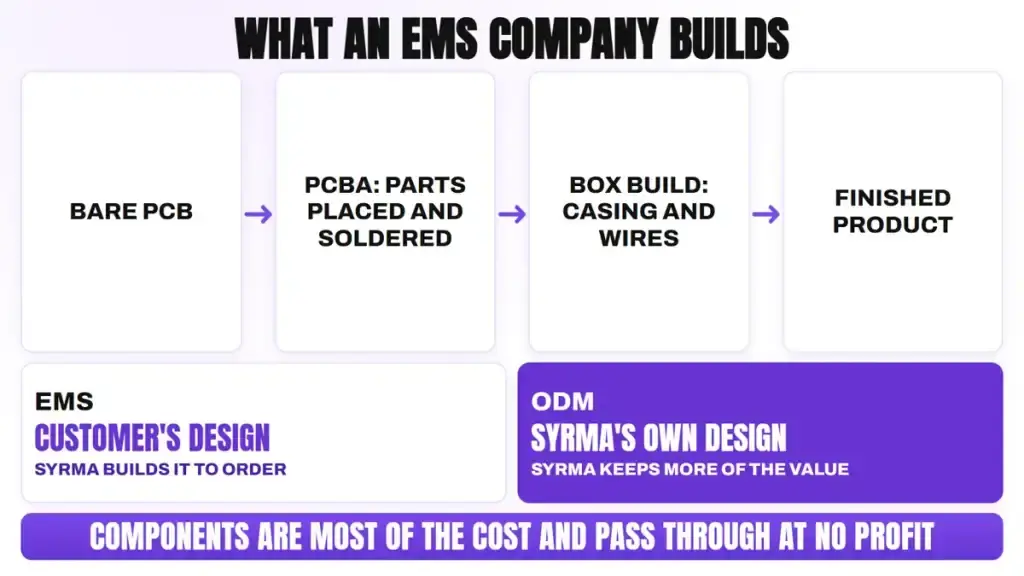
That mix matters because of how this business earns its money. The company works in electronics manufacturing services, or EMS, which is the business of building the electronic boards and devices that other brands design and sell. Its core job is printed circuit board assembly, or PCBA, which means placing chips, resistors and connectors onto a bare board and soldering them in place. A step further is box build, where the finished boards go into a casing with wires and a display to make a complete product.
In this business, components are most of the cost of a board. When a board for a set-top box or a Wi-Fi router costs more because chips cost more, that cost is passed on to the customer at no profit. So the EMS company earns only on the work it adds. On simple, high-volume consumer boards that added work is small, and many factories can do it.
That is where high-mix work comes in. High-mix means making many different products in smaller batches, each built to a customer's strict standards. A brake controller for a car, a power supply for a factory or a board for a medical device fits that description. These buyers test a supplier for months before they place volume orders, and they value that reliability.
That electronics maker is Syrma SGS Technology Ltd (NSE: SYRMA). It runs 17 operational manufacturing facilities with about 1.27 Mn sq ft of plant area, and it has design centres in India and in Stuttgart, Germany. It serves more than 350 customers and exports to more than 35 countries. In FY26 its revenue was ₹4,819.1 Cr, up 27.2%.
That shift is now showing up in every number. Exports were about a quarter of FY26 revenue, and the company has started building India's next big piece of electronics supply, a plant for bare circuit boards.
Syrma SGS in five numbers
- Q2 FY27 revenue of ₹1,989.7 Cr, up 73.6%
- An order book of ₹7,420 Cr in September 2026
- Consumer products at 30% of FY26 revenue, against about 40% in FY24
- Q2 FY27 exports of ₹513.8 Cr, 26% of revenue
- A multilayer PCB plant costing ₹800-900 Cr, set for trial production in 2027
So a company that once leaned on consumer boards now earns most of its money from cars, factories and hospitals. How did that show up in its numbers? Let's first understand the company, and then look at the latest quarter.
Syrma SGS Technology: Company Overview
Syrma SGS Technology Ltd was incorporated in 2004 and has its registered office in Mumbai. It designs and makes electronics for other brands: printed circuit board assemblies, box builds, RFID tags and solutions, magnetics and electro-mechanical parts. It listed on the NSE and BSE in August 2022. Today it runs 17 operational manufacturing facilities with about 1.27 Mn sq ft of plant area, at places such as Chennai, Bargur, Bengaluru, Gurugram, Manesar, Bawal, Baddi, Jodhpur and Pune, and it has four R&D centres, including one in Stuttgart, Germany. It employs more than 10,000 people, over 195 of them in engineering and design, and women make up over 40% of its workforce. Sandeep Tandon is the Executive Chairman, J.S. Gujral the Managing Director and Jaidit Singh Brar the Chief Executive Officer. Revenue from operations was ₹4,819.1 Cr in FY26, and the company held net cash of about ₹258 Cr in September 2026. Read this EMS Stocks in India 2026: Electronics Makers and Order Books
"The stock market is a device for transferring money from the impatient to the patient."
— Warren Buffett
Syrma's shift away from consumer work took two years to show in its margins. In a business where customers take one to two years to qualify a supplier, patience is built into the model.
The Quarter All Five Verticals Grew More Than 55%
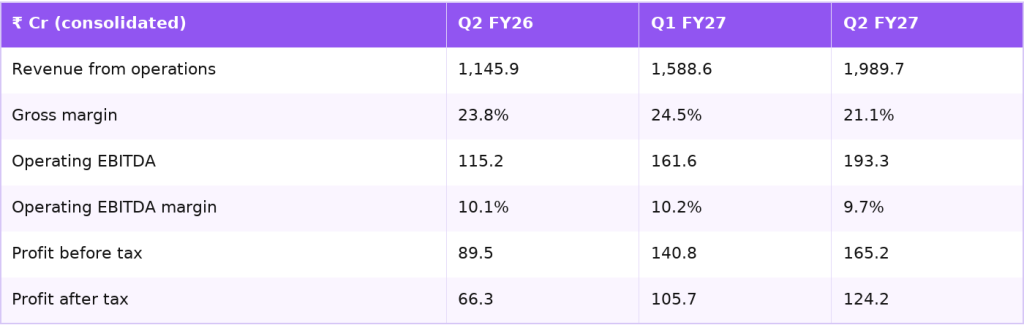
Let's look at Q2 FY27, the July to September quarter in which all five verticals grew, which the company reported on 30 October 2026. Revenue from operations was ₹1,989.7 Cr, up 73.6% from ₹1,145.9 Cr a year ago. It was also 25.2% higher than the ₹1,588.6 Cr of Q1 FY27. The company says it was its highest quarterly revenue, EBITDA, profit before tax and profit after tax.
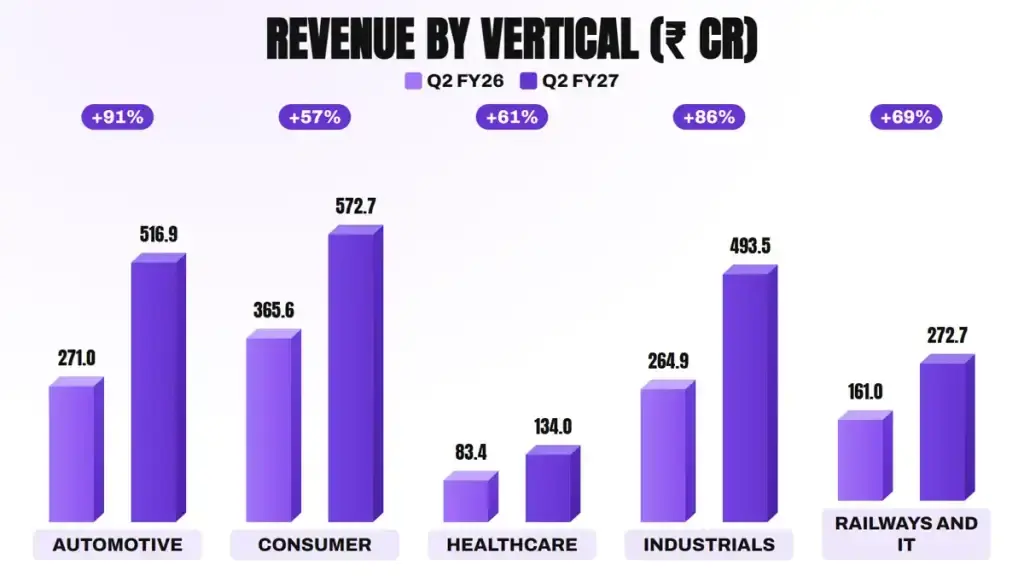
As we can see, that growth came from all five verticals together. Automotive revenue rose 91% to ₹516.9 Cr, and industrial revenue rose 86% to ₹493.5 Cr. Healthcare grew 61% to ₹134.0 Cr, while railways and IT grew 69% to ₹272.7 Cr. Consumer grew too, by 57% to ₹572.7 Cr, but its share of revenue was 29%, against 32% a year ago.
That share shift also shows in the gross margin, which tells a second part of the quarter. It was 21.1%, against 23.8% a year ago. Management says chip and component prices have risen by about 5% because supply is tight across the industry. Those higher costs are passed to customers, but without any profit on top. So the same added work now sits on a larger revenue base, and the margin percentage looks smaller even when the rupees earned are higher. Management puts the cost push at roughly ₹50-70 Cr of the quarter's revenue. The rest is volume.
Yet the operating EBITDA margin stayed close to its level, at 9.7%, and you can see why in the cost lines. Read this EBITDA Explained: Uses and Limits Overheads grew far more slowly than sales. Operating expenses rose 43.4%, while revenue rose 73.6%. So overheads came to about 11.4% of revenue, against about 13.8% a year ago. Below that line, depreciation rose only 3.8%. That is why profit after tax grew 87.2%, faster than revenue, and the profit margin rose to 6.2% from 5.7%.
That same pattern shows in the first half, at a larger scale. H1 FY27 revenue was ₹3,578.3 Cr, up 71%. That is close to the ₹3,787 Cr the company made in all of FY25. Operating EBITDA for the half was ₹354.9 Cr, already more than the ₹324 Cr of FY25, and profit after tax was ₹229.9 Cr, up 97.7%.
Beyond the totals, two higher-value parts of the business grew fastest. Exports were ₹513.8 Cr in the quarter, up 91%, and ₹901.2 Cr in the half, up 80%. Revenue from ODM work rose 117% in the half, to ₹591 Cr from ₹273 Cr. ODM means original design manufacturing: Syrma designs the product itself and then makes it for the customer, so it owns more of the value.
That growth did not stretch the balance sheet. Net working capital came to 63 days in September 2026, against 71 days in June and 73 days a year ago. Operating cash flow for the half was ₹119.7 Cr, about 33.7% of operating EBITDA. Read this Cash Flow Statement Explained Inventory rose to ₹1,578.9 Cr from ₹1,061.6 Cr in March, which is still about 71 days of sales, the same as in March. The company held net cash of about ₹258 Cr, with cash and investments of about ₹1,003.4 Cr. India Ratings upgraded its bank loan rating to IND AA/Stable in May 2026.
The Orders Behind the ₹7,420 Cr Book
Now let's look at the orders, because they show how much of this growth is already booked. The order book stood at ₹7,420 Cr at the end of September 2026. It was ₹6,400 Cr in December 2025 and ₹6,770 Cr in June 2026. So it rose about 9.6% in the latest quarter alone, even as the company shipped a record ₹1,989.7 Cr of goods.
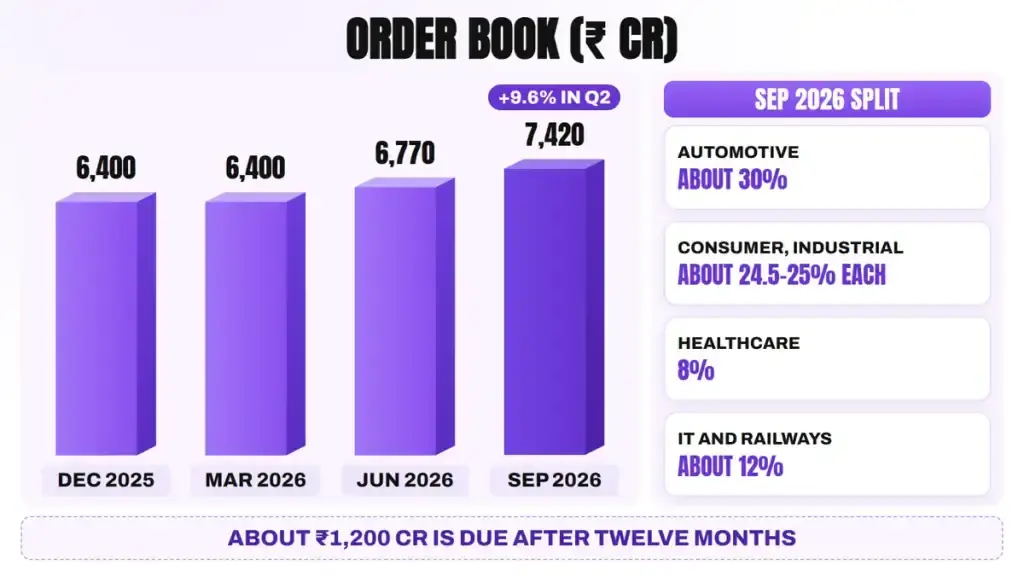
That book is spread across verticals much like revenue. Automotive is about 30% of it, consumer and industrial are about 24.5-25% each, healthcare is 8% and IT and railways about 12%. Of the ₹7,420 Cr, about ₹1,200 Cr is for delivery more than twelve months out. Car makers in particular now place longer orders because components take so long to arrive.
That book also understates what customers have promised, as we will see. Syrma counts only firm purchase orders, not the rolling forecasts that car makers share each quarter. A car maker may give a full year's forecast, but it issues the actual order only at the start of each month. That is why revenue has grown faster than the order book over the last few quarters.
What the order book says: ₹7,420 Cr is about eleven months of revenue at the Q2 FY27 rate of about ₹7,959 Cr a year. And it excludes the rolling forecasts and multi-year agreements on which much of the next year's revenue is planned.
One such agreement came in FY26, when Syrma signed its first multi-year, multi-product framework agreement, with a revenue potential of about USD 250 million. The customer works in industrial products, power management, power distribution and data centres. All the new product introductions and early production runs are done, and a ramp-up plan is agreed. Management expects revenue of at least ₹500-1,500 Cr a year from it to start with, mostly from FY28.
Its customer list is also wider than before. The top five customers made up about 38% of H1 FY27 revenue, the top ten about 50% and the top twenty about 66%. One customer is about 12-14% of revenue, and every other customer is below 10%. In FY26 the company onboarded 32 new customers, and it added about 18 more in H1 FY27.
How Syrma Brought Its Consumer Share Down
Now that we have seen the quarter, let's go back and see how the consumer share came down. Syrma listed on the NSE and BSE in August 2022. At that time it had 12 manufacturing facilities and three R&D centres. It had also combined with SGS Tekniks, the company its managing director J.S. Gujral helped found.
After the listing, consumer work grew fastest for two years. Consumer revenue nearly doubled in FY24, to ₹1,260.8 Cr from ₹659.7 Cr. Its share of revenue went from about 32% in FY23 to about 40% in FY24. Over the same year the operating EBITDA margin went from 9.5% to 6.9%. That one year showed management what a heavy consumer mix does to margins.
"Know what you own, and know why you own it."
— Peter Lynch
Syrma's revenue grew in every year, but the margin did not move with it until the mix changed. Knowing which vertical brings in the revenue is the first step to understanding this company.
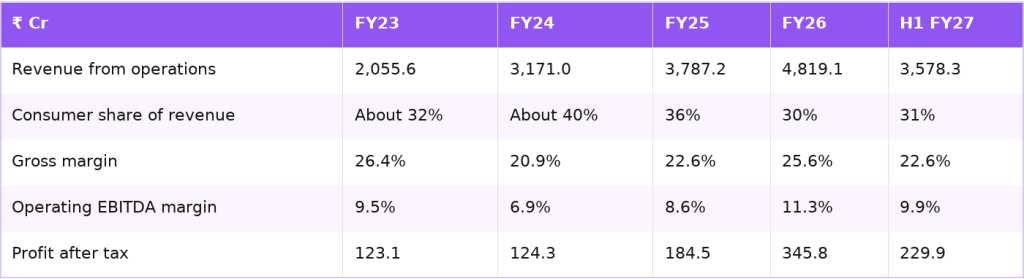
After that year, the company set itself a ceiling in FY25. It said it would keep consumer work below 35% of revenue and grow the other verticals faster. Consumer revenue still grew, but only by 8% in FY26, while automotive grew 39%, healthcare 36%, industrial 30% and railways and IT 74%.
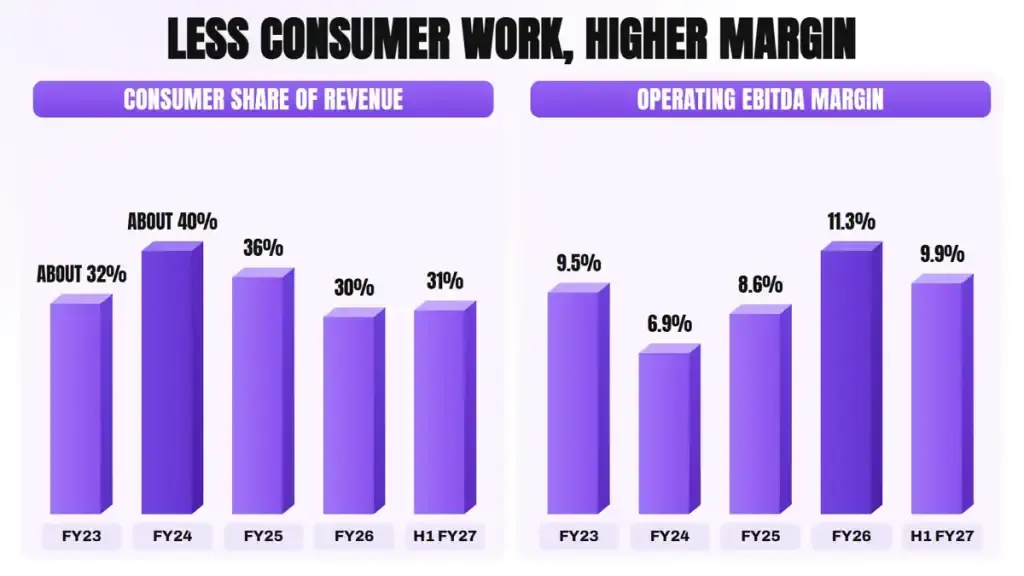
That mix change shows clearly in the margins. Gross margin rose to 25.6% in FY26 from 22.6% in FY25. The operating EBITDA margin rose to 11.3% from 8.6%. Profit after tax almost doubled, rising 87.5% to ₹345.8 Cr, on revenue that grew 27.2%. Leaving out consumer work, FY26 revenue grew 38%.
That FY26 record also brought money in. In August 2025 the company raised ₹1,000 Cr through a qualified institutional placement. At the end of March 2026 it had moved from net debt of about ₹263.9 Cr a year earlier to net cash of about ₹467.2 Cr.
That money also went into buying and building new lines. In December 2025 Syrma bought 60% of Elcome Integrated Systems, a maker of maritime and naval electronics, for about ₹235 Cr. It also set up three joint ventures. Shinhyup of Korea joined it to make bare circuit boards, and Elemaster of Italy to make high-reliability rail and industrial boards. Kaga Electronics of Japan joined it to serve Japanese car and air-conditioner makers.
"Healthcare, railways have a smaller base. Even if they grew at 100%, 120%, they would not form a significant impact on my overall top line; but being high margin products, they will be adding accretive to the margin profile of the company." - J.S. Gujral, Managing Director, November 2026
Five Verticals With Five Different Margins
Now let's split the business into its verticals, because each one earns a different margin. Syrma reports one segment, EMS, but it shows revenue for five end markets every quarter. The table below adds the margin profile each one has in management's own words. Read this Segment-Wise Revenue Analysis Explained
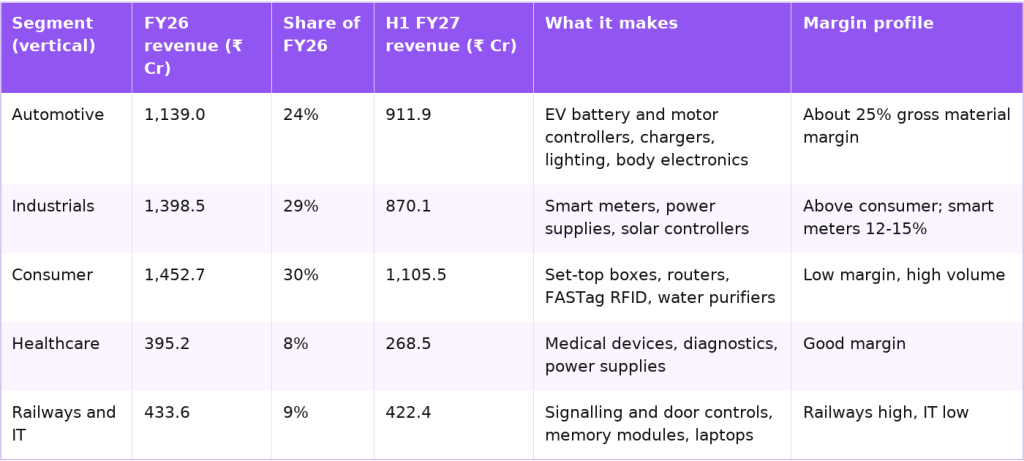
These verticals sound alike, but as you will see, each one asks for something different. Consumer and IT work is about speed and cost on large volumes. Automotive, healthcare and railways are about passing a customer's quality tests and then making the same part without fault for years. That difference is what decides the margin.
Automotive and Electric Vehicles
Let's start with automotive, the vertical with the largest order book. The company's investor deck projects India's auto electronics market to grow about 22.3% a year from CY24 to CY29. It also projects electric vehicles rising from about 6% of sales in FY25 to about 30% by FY30. The electronic content in each vehicle keeps climbing as cars go electric, so every step in that shift adds boards per vehicle.
Syrma makes many of those boards. Its list runs from battery management systems and motor controller units to on-board chargers, engine control units, dashboards, lamp controllers, airbag and door controllers. A battery management system is the board that watches each cell in an EV battery and keeps it within safe limits. The company holds IATF 16949, the quality standard that global car makers ask of their suppliers.
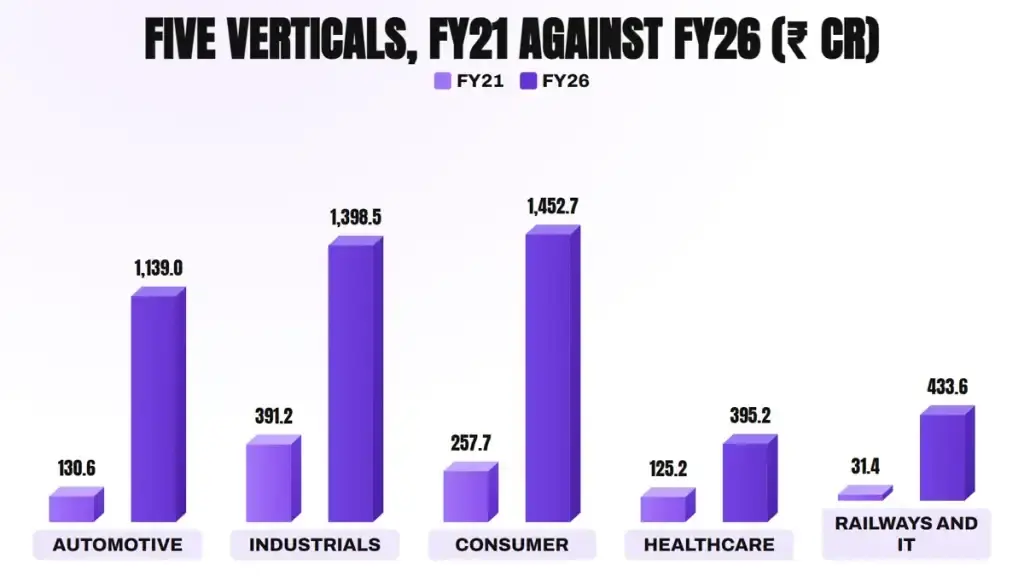
That work has grown about nine times in five years. Automotive revenue was ₹130.6 Cr in FY21 and ₹1,139.0 Cr in FY26. In H1 FY27 it was already ₹911.9 Cr. Automotive exports crossed ₹125 Cr in FY26.
Beyond today's work, the next leg comes from two new projects. The Kaga joint venture at Bawal, in Haryana, will make boards for Japanese car and air-conditioner makers; Syrma holds 60% and Kaga Electronics India 40%. Kaga has been a customer for over five years, and the venture will take all of Kaga's India EMS work. Management expects ₹100-150 Cr of revenue from it next year. Syrma is also building a camera module line for cars, with a first investment of about ₹25-30 Cr. It expects ₹50-100 Cr of revenue from that line to start with.
Industrial Electronics and Smart Meters
Next, let's look at the industrial vertical, the second-largest by revenue. India plans to roll out about 250 Mn smart meters, an opportunity the company puts at over ₹1 lakh crore from FY25 to FY30. European industrial buyers are also moving supply away from China, and the India-EU trade agreement of January 2026 makes Indian factories cheaper to buy from.
Syrma makes smart energy meters, industrial power supplies, solar controllers, cleaning equipment electronics and connectivity boards. A smart meter is an electricity meter that sends its readings to the power company over a network. Industrial revenue grew from ₹391.2 Cr in FY21 to ₹1,398.5 Cr in FY26. In Q2 FY27 it grew 86% to ₹493.5 Cr.
Not all industrial work earns the same. Smart meters brought in about ₹250-260 Cr in FY26, at a gross material margin of 12-15%, which management places at the lower end of the vertical. So the company is now choosing its smart-meter customers carefully, and its plan for the vertical puts exports first. Most of its industrial exports go to Europe, and its Stuttgart unit gives European customers quick prototypes and repair support.
The Elemaster joint venture adds to that export push. Elemaster is an Italian electronics maker with more than 200 European customer relationships. The 60:40 venture runs a 20,000 sq ft plant at Bommasandra, near Bengaluru, which opened in September 2026. Its first surface-mount line, the machine line that places components onto boards, is running, and a second is due in FY27. Management expects ₹150-200 Cr of revenue from it in FY28, once rail and quality certifications are in place.
Consumer Electronics and RFID
Now let's move to consumer, the vertical the company is keeping in check. The company's deck projects India's consumer electronics market, excluding mobile phones, to grow about 25.1% a year from CY24 to CY29. BharatNet, the national rural broadband network, is adding demand for fibre modems, RFID and smart devices.
Syrma's consumer work covers power supplies, modems, hybrid set-top boxes, Wi-Fi routers, BLDC fan motors and water purifiers. It also makes RFID modules for FASTag and logistics. RFID, or radio frequency identification, is a small tag with a chip and an antenna that a reader can identify without touching it. A FASTag on a car windscreen is the most familiar example. The company makes RFID tags and labels at Gurugram, and proximity cards and tags at Chennai and Bargur, in Tamil Nadu.
That RFID line is also where consumer work moves up in value. Syrma designs some of these tags itself, so they count as ODM work, along with its own water purifier designs. It also sells RFID solutions to hospitals and medical device makers for tracking and patient safety, and that healthcare RFID business grew strongly in Q1 FY27.
All of this consumer work brought in ₹1,452.7 Cr of revenue in FY26. In H1 FY27 it brought in ₹1,105.5 Cr, as some customers placed orders earlier in the year. Management expects that share to taper in the second half while other verticals take a larger part.
Healthcare and MedTech
Next, let's look at healthcare, a small vertical with some of the best margins. The global medical technology market was about $810 bn in 2025, and the company's deck projects it at about $1 trillion by 2030. India is pushing local medical device making through its PLI scheme and device parks, and more diagnosis is moving into homes and clinics.
Syrma makes personal healthcare devices, precision dispensers, digital X-ray parts, muscle-toning and diagnostic devices, and power supplies for medical equipment. Much of this runs through Syrma Johari MedTech, its medical device subsidiary. The company has FDA and MDSAP approvals in place for its MedTech facility in Pune. MDSAP is a single audit of a medical device maker that regulators in several countries accept.
These healthcare lines brought in ₹395.2 Cr of revenue in FY26 and ₹268.5 Cr in H1 FY27. Syrma Johari alone brought in about ₹140 Cr in the half. Management expects about ₹300 Cr from it in FY27, against about ₹210-220 Cr in FY26. The unit also opened a medical-grade plastics plant at Jodhpur, for moulded, extruded and blown parts. Its MedTech exports go mainly to the US, and healthcare made up about ₹500 Cr of the June 2026 order book.
Railways and IT
Now let's look at railways and IT, two businesses that sit together in reporting but earn very different margins. On the railway side, the government allocated ₹2.62 lakh crore of capital spending for FY26, its highest ever. The Kavach train protection system is being rolled out across more than 10,000 km. Kavach is India's own system that applies a train's brakes on its own when a driver does not obey a signal.
Syrma makes railway signalling systems, door controllers, braking electronics, cab equipment and HVAC controls. Railway work earns a margin equal to or better than industrial work. It holds IRIS ISO 22163, the railway industry's quality standard.
Next to railways, the IT side is different. Here Syrma makes memory modules, motherboards and gaming laptops for MSI and other brands. This is a low-margin business, close to consumer, and it does not get PLI incentives because the customer assembles the final computer. But it needs almost no working capital. In Q2 FY27 the combined vertical grew 69% to ₹272.7 Cr.
Defence and Maritime Through Elcome
Finally, let's look at the newest line, defence and maritime electronics. India's marine electronics market is about ₹10,000-11,250 Cr, and the part that serves the navy and coast guard is about ₹6,000-6,700 Cr. The navy has a pipeline of more than 200 vessels by 2037, and about 75% of defence buying now goes to Indian suppliers.
Elcome has supplied the Indian Navy and Coast Guard for more than 47 years. It makes ship bridge systems, communication and display systems, surveillance and safety systems, and platform automation modules. About 60% of its products use its own designs, so it earns the margins of a product company, not a contract maker. Management describes it as a very high-margin business, which offsets its long working capital cycle.
That business brought in about ₹135 Cr of revenue in H1 FY27. Management expects ₹300-350 Cr from it in FY27, growing about 20-25% a year. Syrma also supplies a wide range of boards to several units of Bharat Electronics.
Why a Global Customer Takes Years to Qualify a Supplier
Now that we have seen all the verticals, let's understand the moat. A car maker, a medical device company or a railway does not switch board suppliers easily. A failed board can force a car recall, stop a train or harm a patient. So these buyers qualify a supplier slowly, and once a supplier is qualified, they rarely move.
"In business, I look for economic castles protected by unbreachable moats."
— Warren Buffett
For an electronics maker, the moat is the approval list: a car maker's tested supplier base, a medical device certificate and a railway quality standard, each earned over years.
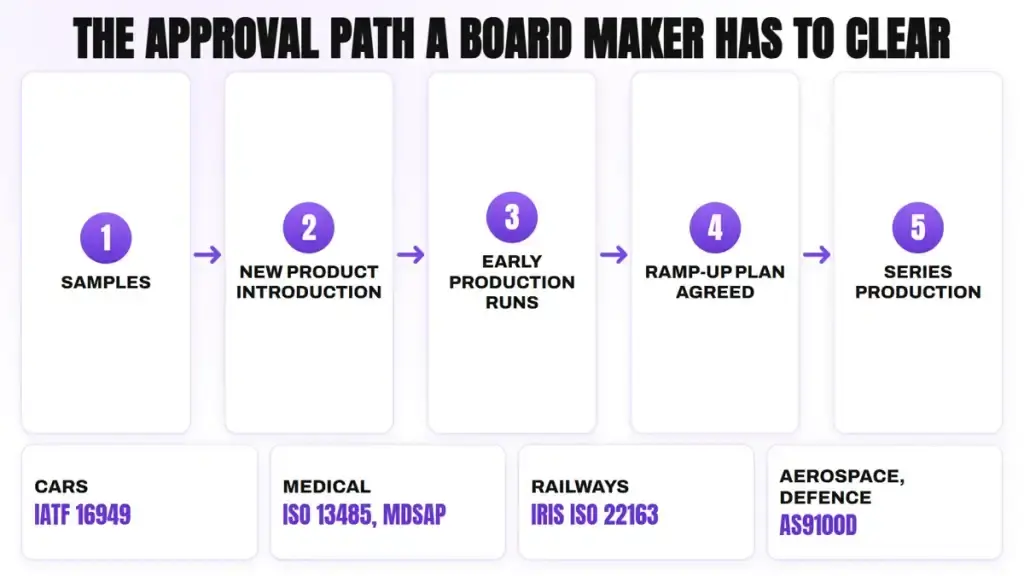
That qualification has several steps. First the supplier builds samples, then it runs new product introductions and early production batches. Only then does the customer agree a ramp-up plan and move to series production. We can see that path in Syrma's framework customer, which has followed it step by step. Management says customers onboarded in FY24 and FY25 are giving full volumes only now, and those added in FY25 and FY26 will give serious revenue in FY28.
Each vertical also needs its own certificate. Syrma holds IATF 16949 for cars, ISO 13485 and MDSAP for medical devices, IRIS ISO 22163 for railways and AS9100D for aerospace and defence. It also has a US FDA registered facility and TISAX, the car industry's information security label. A new competitor would need years to collect the same set across six end markets. Read this Economic Moat Explained
That approval also follows the product. If Syrma makes a board for a Suzuki model, the board has to be approved whether Syrma sells it to Suzuki's supplier or uses it in-house. That is why the company plans to start its new PCB plant with boards for its own ODM designs, where it holds the design and does not wait for a customer's approval.
Design work adds a further layer. Syrma has four R&D centres, at Gurugram, Pune, Chennai and Stuttgart, with more than 195 people in engineering and design. When a customer uses a Syrma design, moving to another supplier means redesigning the product as well. That is part of why ODM revenue can grow from ₹825 Cr in FY26 to ₹1,000-1,100 Cr in FY27, as management expects.
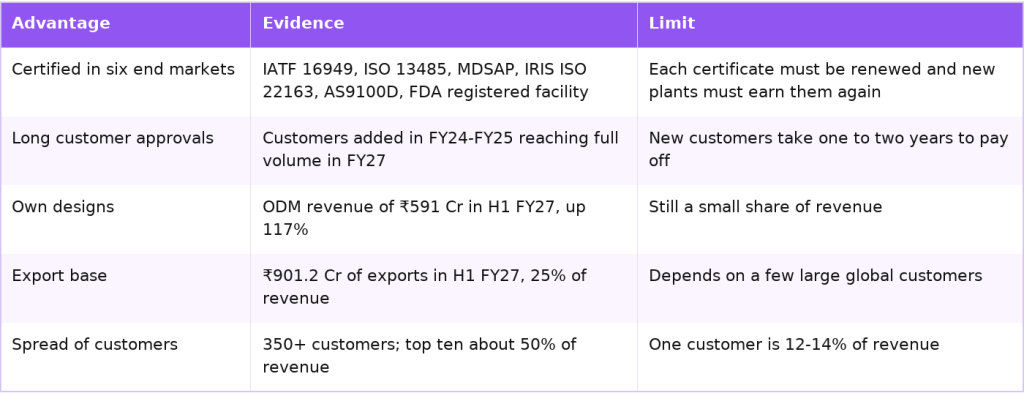
That table shows us why margins are the real test of the moat. If customers value the approvals, the margin should rise as the mix moves away from consumer. It did, from 6.9% in FY24 to 11.3% in FY26. The next test is whether it holds as the bare-board plant comes up.
The PCB Plant Behind the ECMS Approvals
Now let's look at the PCB plant, the biggest project in the group, because it changes what Syrma makes. A bare printed circuit board is the flat board of copper tracks and insulating layers on which all the components sit. Today Syrma buys these boards from outside suppliers. The company says India imports more than ₹80,000 Cr of PCBs a year and meets only about 10% of its demand at home.
That gap is what the government's ECMS aims to close. ECMS, the Electronics Components Manufacturing Scheme, pays incentives to companies that make components in India, not just assemble them. On 27 October 2025, Syrma's PCB subsidiary got ECMS approval for multilayer PCB making. The approval covers an expected investment of ₹765 Cr over six years, to FY32, and incentives of 4% to 10% of the subsidiary's revenue over that period.
This PCB plant is being built at Naidupeta in Andhra Pradesh, on a campus of about 24 acres. The company holds 75% of the venture and Shinhyup Electronics of Korea, an experienced PCB maker, holds 25%. Phase 1 has a capacity of about 1.2 Mn sq m of board a year: 7,20,000 sq m of multilayer board and 4,80,000 sq m of single-layer board. Most of the output will be two-layer to six-layer boards, with some up to eight layers and above.
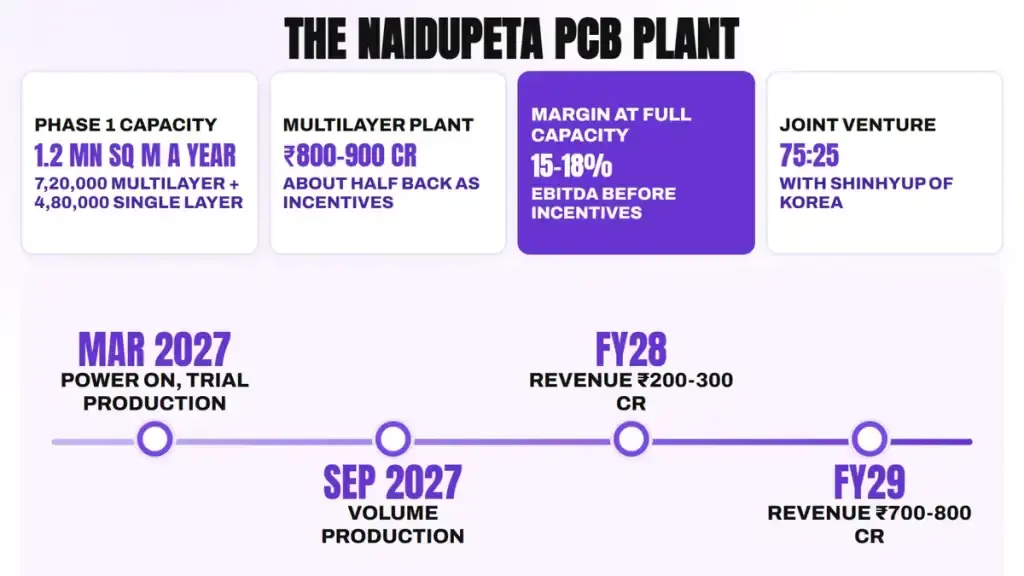
That plant needs a lot of money for a company of this size. The multilayer plant needs about ₹800-900 Cr, of which Syrma had spent over ₹200 Cr by September 2026 and plans another ₹200 Cr by March 2027. A second phase of ₹600-700 Cr for flexible boards, high-density boards and copper clad laminate, the raw sheet a PCB is cut from, would take the total to about ₹1,600 Cr over three to five years. The company expects about half of the capital cost back as government incentives, including about ₹200 Cr of capital subsidy on its first ₹400 Cr.
Its timeline is set in steps. The plant powers on and starts trial production around March 2027. Customer approvals and quality certificates take another three to six months, so volume production should start around September 2027. That gives FY28 about six months of output and FY29 a full year.
That is why we think of this plant as a margin project, not just a capacity project. Management expects PCB revenue of about ₹200-300 Cr in FY28 and ₹700-800 Cr in FY29. At full capacity, with about 1.5 times asset turns, revenue could reach ₹1,200-1,350 Cr. Its EBITDA margin at full capacity should be 15-18% before incentives, or 17-20% with them, against a group margin of 9.9% in H1 FY27.
Why the PCB plant matters for margins: Syrma's group operating EBITDA margin was 9.9% in H1 FY27. A business guided at 15-18% before incentives, and worth up to ₹1,200-1,350 Cr of revenue at full capacity, would lift the group mix the same way the shift away from consumer did.
This PCB plant is one of five or six ECMS applications. Copper clad laminate has its own application, planned for FY29. High-density and flexible boards have another. A fourth covers camera modules for cars, where building work has started. The last is a small project for magnetics, the coils and transformers inside power supplies. Management expects $10-20 Mn of magnetics revenue at very high margins.
Financials: Five Years of Revenue, Margins and Profit
One quarter can mislead in a business where customers move orders between quarters, so let's look at five full years together. FY22 is the proforma figure the company presents after combining with SGS Tekniks. Revenue here is total revenue, including other income, and EBITDA also includes other income.
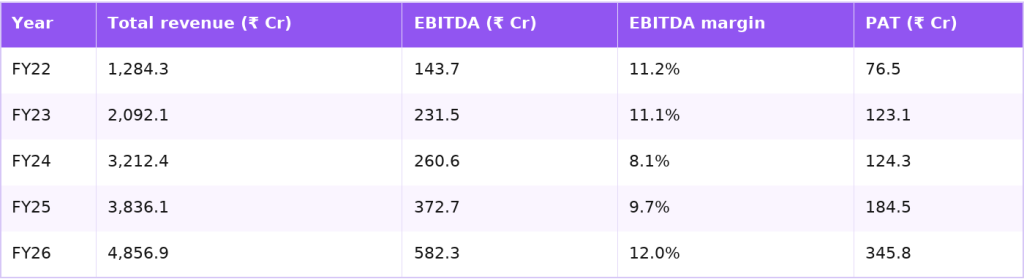
Total revenue grew about 3.8 times in four years, from about ₹1,284.3 Cr in FY22 to about ₹4,856.9 Cr in FY26. Profit grew faster, about 4.5 times, but not in a straight line. In FY24, when consumer work rose to about 40% of revenue, revenue grew about 54% while profit after tax barely moved. The margin came back only after the consumer share was brought down.
Cash flow followed the same path. Operating cash flow was negative in FY23 and FY24, at about ₹70.3 Cr and ₹109.1 Cr, as working capital grew with revenue. It turned positive at about ₹176.5 Cr in FY25 and about ₹289.6 Cr in FY26. Over the four years from FY23, operating cash flow added up to about ₹286.6 Cr, against about ₹777.7 Cr of profit after tax.
The balance sheet carried that growth with equity rather than debt. After the ₹1,000 Cr share placement in August 2025, the company moved from net debt of about ₹263.9 Cr in March 2025 to net cash of about ₹467.2 Cr in March 2026. The PCB plant will now test that balance sheet again.
"In the short run, the market is a voting machine but in the long run, it is a weighing machine."
— Benjamin Graham
Syrma's five-year table shows why: revenue rose every year, but what it earned on that revenue depended on the mix. Over time, the margin and the cash flow are what get weighed.
What FY28 Could Look Like on Management's Numbers
So where does the group go from here? On 2 November 2026 management raised its FY27 revenue growth guidance to 40-45%, from 35%. That would take revenue to about ₹7,000 Cr. For FY28 it expects to cross $1 billion of revenue.
Now let's put that revenue guidance against the first half. H1 FY27 revenue was ₹3,578.3 Cr. Reaching ₹7,000 Cr needs about ₹3,421.7 Cr in H2. That is about 25.5% more than H2 FY26, against 71% growth in the first half. Management explains the gap by consumer orders that came early in the year and by component shortages it expects to last until April to June 2027.
Beyond revenue, margins have their own path. Management expects an EBITDA margin of 10-10.5% for FY27, against 9.9% in H1. For FY28 it expects 10.5-11%, or a little above 11%, as exports, ODM, the PCB plant and the joint ventures add higher-margin revenue.
Exports carry much of that plan, as we saw in the first half. Management expects exports above ₹1,700 Cr in FY27, against about ₹1,200 Cr in FY26, and about ₹2,000 Cr in FY28. Exports grew 31% in FY25, 41% in FY26 and 80% in H1 FY27, mostly because new global customers moved into volume production.
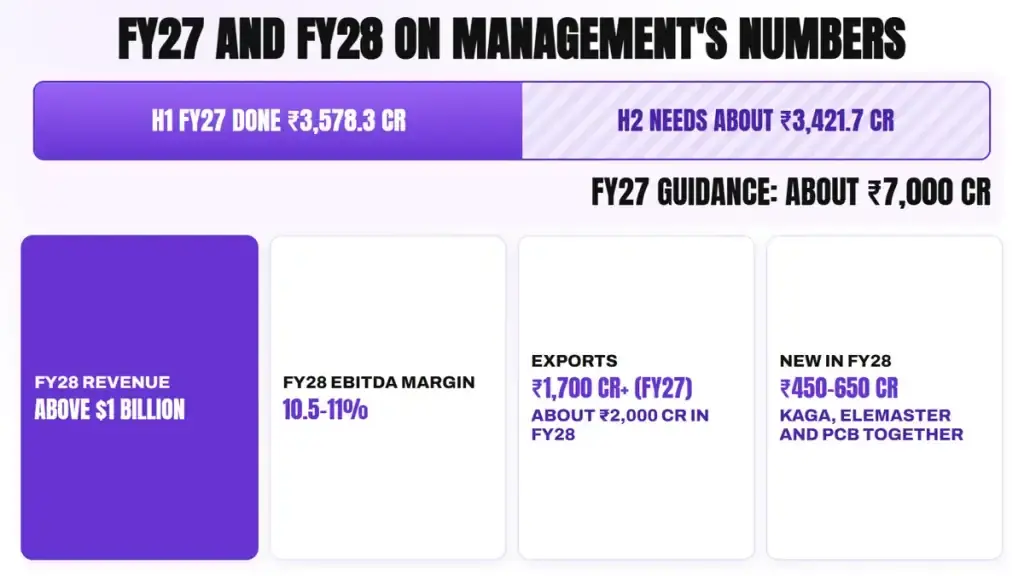
Alongside exports, new businesses add to that plan. In FY28 management expects ₹100-150 Cr from the Kaga venture, ₹150-200 Cr from the Elemaster venture and ₹200-300 Cr from the PCB plant. Over five years, it expects each such partnership could reach ₹500-800 Cr of revenue.
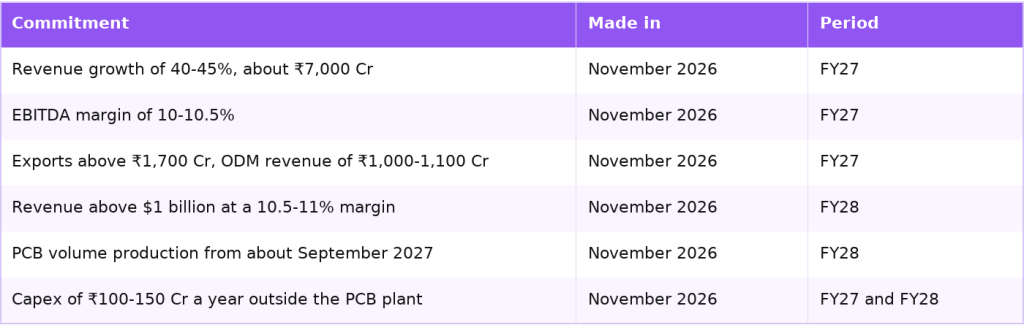
Those commitments are easier to judge against the past. So let's check what management said before against what it delivered.
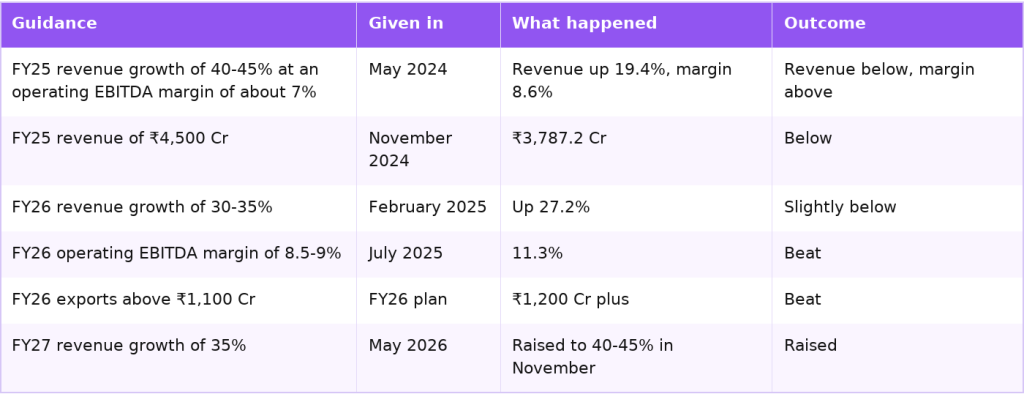
That record shows us a clear pattern. Revenue targets set in 2024 were too high, partly because the consumer business was kept in check on purpose. But margin, export and cash targets have been met or beaten for two years. That makes the margin guidance the number to watch from here.
Key Risks
Now let's look at what could go wrong for Syrma SGS, because the latest half year has already shown some of these risks.
- Component shortages: lead times for some chips have stretched to 36-42 weeks, and management does not expect relief before April to June 2027. If Syrma's customers miss a part, they cannot sell their product, and Syrma's sales fall with theirs.
- Margin pressure: the gross margin fell to 21.1% in Q2 FY27 from 23.8%, as cost increases passed through at no profit. In August 2026 management guided an FY27 margin of 10.5-11%; it now guides 10-10.5%, and H1 was 9.9%.
- Slower second half: the FY27 guidance implies about 25.5% growth in H2, against 71% in H1. Consumer orders were brought forward into the first half and may taper.
- Cash and borrowings: capex and investments took ₹535 Cr in H1 FY27, against operating cash flow of ₹119.7 Cr. Borrowings rose to ₹745.8 Cr from ₹353.1 Cr in March 2026, and inventory rose by about ₹517.3 Cr in six months.
- The PCB project: PCB making is new to Syrma, and the plant must win customer approvals before volume production. At about 40% use in its first year the margin will be lower, and incentive money can arrive 6-12 months after it is earned.
- Customer concentration: one customer is about 12-14% of revenue, and the top ten are about 50%. A delay at one large customer would show in Syrma's numbers.
- Low-margin IT and consumer work: IT work earns a margin close to consumer work and gets no PLI incentive. If these two grow faster than planned, the mix gains of the last two years could reverse.
- Partners and minorities: minority holders in Elcome and Syrma Johari will take about ₹30-45 Cr of FY27 profit. A planned solar inverter acquisition with Premier Energies was dropped in May 2026 after its conditions were not met.
- Geopolitics and trade: management named the outcome of the US midterm elections and the Middle East situation as unknowns for demand and supply.
"I may be ready with the product, but my customer may not have a component so his sale may not happen. If his sale doesn't happen, it has a ripple down effect on me." - J.S. Gujral, Managing Director, November 2026
"All I want to know is where I'm going to die, so I'll never go there."
— Charlie Munger
For Syrma, the places to avoid are clear from the list above: component shortages, a new PCB technology and too much weight on a few large customers. The tracking list below shows how to see which way each one goes.
Explore our Products
Research Framework

Emerging Titans
Combination of quantitative analysis, industry tailwinds, and management assessment - SPRINT investment philosophy

Tiny Titans
Heavy emphasis on scuttlebutt research, plant visits, and early on-ground signals
What to Track Next
If you follow Syrma SGS, these are the signals that will show where it goes next.
- H2 FY27 revenue against the ₹7,000 Cr guidance, and the consumer share of revenue
- The operating EBITDA margin against 10-10.5% for FY27, and the gross margin after 21.1%
- The order book after ₹7,420 Cr, and revenue from the USD 250 million framework agreement
- Power-on of the Naidupeta PCB plant around March 2027 and the first customer approvals
- Exports against ₹1,700 Cr for FY27, and ODM revenue against ₹1,000-1,100 Cr
- Net working capital days after 63, and operating cash flow in H2
Conclusion
Let's put it all together. Syrma SGS has grown from ₹2,055.6 Cr of revenue in FY23 to ₹4,819.1 Cr in FY26, while the consumer share went from about 40% in FY24 to 30%. Its operating EBITDA margin rose from 6.9% to 11.3% over the same two years, and its first half of FY27 was its largest ever. The cautious thread is the second half, where the guidance implies much slower growth, and the gross margin, which is under pressure from component costs. The next two quarters will show which thread is stronger.
Still, the next step is bigger than a mix change. What happens next depends on whether the new global customers keep ramping up, whether component shortages ease in 2027, and whether the Naidupeta plant turns India's PCB import gap into a higher-margin business for Syrma.
FAQs
What does Syrma SGS Technology do?
+Syrma SGS is an electronics manufacturing services company. It builds printed circuit board assemblies and finished products for automotive, industrial, consumer, healthcare, railway and IT customers, and it makes RFID tags and maritime defence electronics through Elcome. FY26 revenue from operations was ₹4,819.1 Cr.
How did Syrma SGS do in Q2 FY27?
+Revenue from operations rose 73.6% to ₹1,989.7 Cr, and all five verticals grew more than 55%. Operating EBITDA was ₹193.3 Cr at a 9.7% margin, and profit after tax rose 87.2% to ₹124.2 Cr. Exports were ₹513.8 Cr, 26% of revenue.
Why is Syrma SGS reducing its consumer business?
+Consumer boards are high-volume, low-margin work. When consumer work rose to about 40% of revenue in FY24, the operating EBITDA margin was 6.9%. After the share came down to 30% in FY26, the margin rose to 11.3%.
What is Syrma SGS's order book?
+The order book was ₹7,420 Cr in September 2026, against ₹6,770 Cr in June 2026. Automotive was about 30% of it, consumer and industrial about 24.5-25% each, healthcare 8% and IT and railways about 12%.
What is Syrma SGS's PCB plant?
+Syrma is building a multilayer PCB plant at Naidupeta in Andhra Pradesh with Shinhyup of Korea, costing about ₹800-900 Cr, with ECMS approval received in October 2025. Trial production is planned around March 2027, and management expects ₹200-300 Cr of revenue in FY28 at an EBITDA margin of 15-18% before incentives at full capacity.
What are the main risks for Syrma SGS?
+Component shortages have stretched lead times to 36-42 weeks and pushed the gross margin to 21.1% in Q2 FY27. The FY27 guidance implies about 25.5% growth in the second half, the PCB plant is new technology for the company, and one customer makes up about 12-14% of revenue.

High growth stock specialist, Value Educator
Shashank Mahajan is an equity research professional with over 12 years of experience in identifying high-potential SME and micro-cap stocks at an early stage. He follows a rigorous scuttlebutt research–driven approach, combining on-ground insights with deep financial analysis. Shashank specializes in uncovering under-researched and under-owned companies with strong management quality and long-term growth potential. Through disciplined research and early identification, he focuses on spotting tomorrow’s market leaders before they enter the mainstream investor radar.
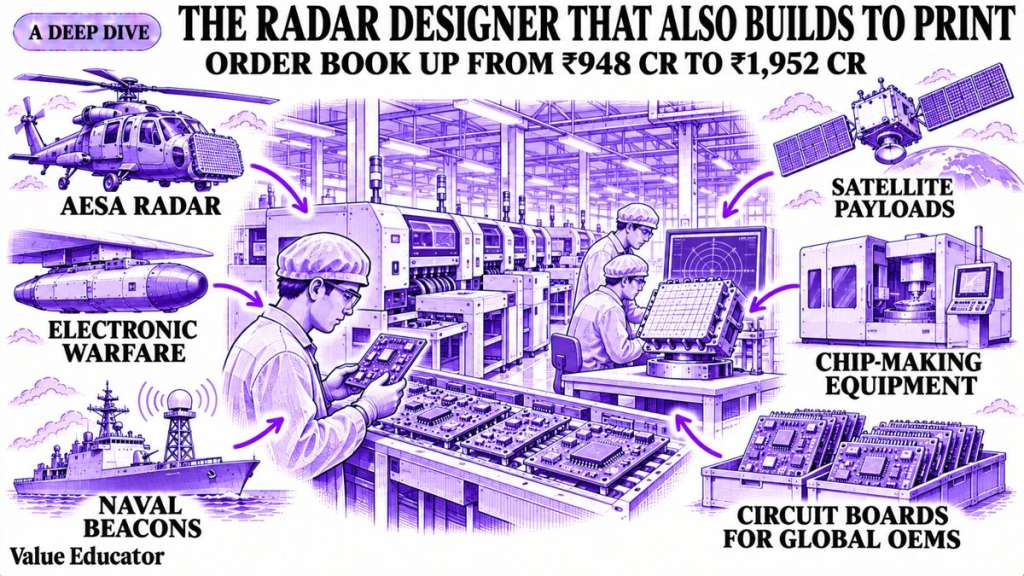
Centum Electronics: Radar, Space Electronics and EMS

Anup Engineering: Heat Exchanger Maker for Refineries
Highest Order Book Stocks in India 2026: Ranked List
Aerospace Stocks in India 2026: Suppliers and Order Books
EMS Stocks in India 2026: Electronics Makers and Order Books
Data Centre Stocks in India 2026: Suppliers and Operators
Explore our Products
Research Framework
Emerging Titans
Combination of quantitative analysis, industry tailwinds, and management assessment - SPRINT investment philosophy
Tiny Titans
Heavy emphasis on scuttlebutt research, plant visits, and early on-ground signals



Modern Warfare to Multibaggers
Key Trends. Strategic Shifts. Opportunities Ahead.
Don't Miss This Exclusive Webinar!
Join Value Educator to decode the key trends shaping India's defence sector and learn how to identify tomorrow's potential leaders in the space.
- In-depth research on India's defence sector
- Live Q&A session
- Actionable takeaways for long-term investors

 Orders
 Subscription
 Share with friends


Required Details
₹23999.00
(12 month subscription)
As per SEBI regulations, all users are mandated to complete the KYC that is validated for 1 year. Post payment, you will be redirected to the KYC screen


No comments yet. Be the first to comment!