
EMS Stocks in India 2026: Electronics Makers and Order Books
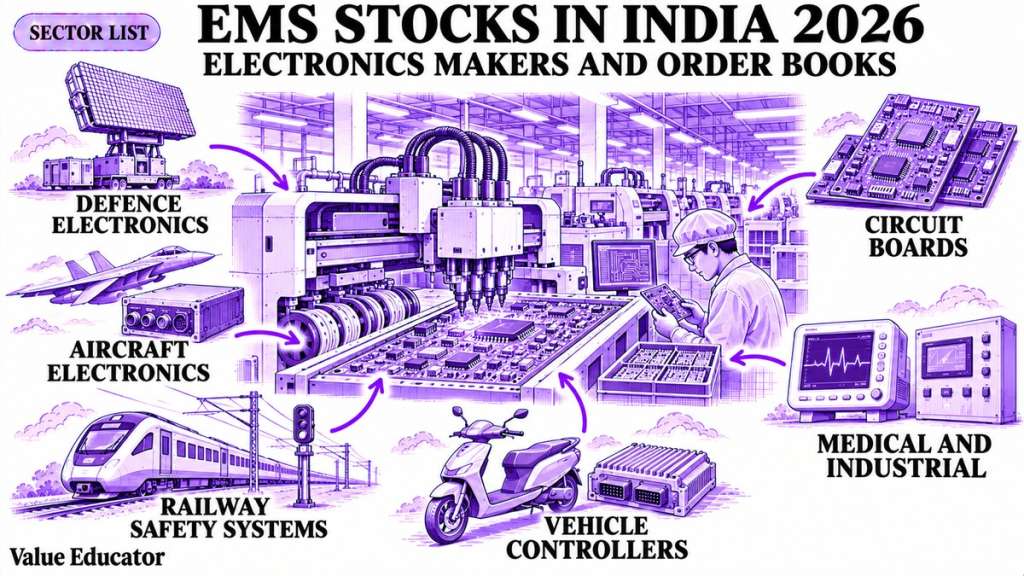
India now makes far more of its own electronics than it did a decade ago. Electronics production rose from ₹1.9 lakh Cr in 2014-15 to ₹11.32 lakh Cr in 2024-25, almost six times in 11 years. In Budget 2026-27, the government raised the allocation for its scheme to make electronic components in India from about ₹22,000 Cr to ₹40,000 Cr, after the scheme received 149 applications.
Much of that work is done by contract makers, the companies that build electronics for other brands. This page lists the listed electronics makers we have studied in depth, with each one's latest order book and how many years of revenue it covers. Each row links to our full research on that company.
Figures as of 13 November 2026. This page is research, not a recommendation to buy or sell any stock.
EMS Stocks in India at a Glance
The order book is the value of contracts a company has signed but not yet delivered. Dividing it by a year's revenue shows how many years of work are already in hand, if the company delivers on time.
| Company | What it builds | Main end markets | Order book or key figure (date) | Order book ÷ FY26 revenue |
|---|---|---|---|---|
| Astra Microwave | Radio-frequency and microwave electronics, radar antenna units (own design) | Defence radars, electronic warfare, space, weather | about ₹4,300 Cr (Jul 2026) | about 3.7x |
| Cyient DLM | Circuit board assemblies, cable harnesses and box builds, mostly to the customer's design | Aerospace, industrial, medical, defence | ₹2,813.7 Cr (30 Sep 2026) | about 2.2x |
| Apollo Micro Systems | Onboard computers, guidance units and actuators (own design) | Missiles, naval mines, defence | ₹1,765 Cr (30 Sep 2026) | about 2.0x |
| Rossell Techsys | Wire harnesses, electrical panels and test equipment, built to print | Military aircraft, chip-making machines, satellites | ₹900 Cr confirmed (30 Sep 2026), plus over ₹3,100 Cr of long-term agreements | about 1.9x (confirmed) |
| HBL Engineering | Kavach train-protection electronics, electronic fuzes, defence batteries | Railways, defence | about ₹5,902 Cr (Sep 2026) | about 1.8x |
| Data Patterns | Radar, electronic warfare and avionics electronics (own design) | Defence | ₹927.7 Cr firm (30 Jun 2026); ₹2,654 Cr incl. July and agreed orders | about 1.0x firm; 2.9x incl. agreed |
| Axiscades | Radar, missile and electronic warfare subsystems (own design) | Defence | Assured visibility of ₹4,557 Cr to FY30 (not an order book) | not comparable |
| Sedemac Mechatronics | Engine and motor control units (own design) | Two- and three-wheelers, EVs, generators | 14,52,867 control units sold in Q2 FY27; FY26 revenue ₹1,058.38 Cr | no order book (sells to vehicle makers' schedules) |
About 75% of HBL's order book is Kavach and train-management systems; its electronics segment earned ₹1,626.25 Cr of its FY26 revenue of ₹3,251.80 Cr. Astra's figure is the order book after the ₹2,205.23 Cr Uttam radar order of July 2026. Apollo's ratio uses consolidated FY26 revenue of ₹904.32 Cr.
What EMS Means
Electronics manufacturing services, or EMS, simply means building electronic boards, cables and complete units for a company that owns the product and its brand. The global market for this work was about $649 Bn in 2025 and is expected to reach about $853 Bn by 2030 in a base case. Most of it makes phones and laptops in huge volumes. A smaller part, about $230 Bn by 2030 on one estimate, builds high-reliability electronics for aircraft, defence, medical and industrial use.
An EMS company can do three kinds of work:
- Printed circuit board assembly (PCBA): placing and soldering chips and parts on a bare board.
- Cable and wire harnesses: bundles of wires and connectors cut and tied to the exact path a machine needs.
- Box build: putting boards, cables, a casing and software together into a finished, tested unit.
Design or Build to Print: The Margin Gap
The biggest difference between these companies is who owns the design.
Build to print means the customer hands over the drawings and the EMS company builds them. Cyient DLM and Rossell Techsys do mostly this kind of work. Build to spec means the customer gives only the specification, and the supplier designs the electronics as well. Data Patterns, Astra Microwave, Apollo Micro Systems, Axiscades and Sedemac own the designs of what they sell.
That choice shows up in the margins. Centum Electronics, which does both, puts its EMS business at an EBITDA margin of about 9-10% and its build-to-spec business at about 18-20% or more. EMS orders take about 6-9 months to execute, against 2-2.5 years for build-to-spec work. In our coverage, Cyient DLM's EBITDA margin was 8.7% in Q2 FY27, while Data Patterns earned 40.1% in FY26.
Cyient DLM is trying to close that gap. Build-to-spec work was 6% of its FY26 revenue, and management says more of it can lift margins to roughly 13% to 18%. Build-to-spec contracts can run for 9-20 years, because a customer would have to redesign its product to change supplier.
Why EMS Stocks Are Growing
India makes more of its own electronics. Electronics production grew from ₹1.9 lakh Cr in 2014-15 to ₹11.32 lakh Cr in 2024-25, helped by production-linked incentive (PLI) schemes for phones, components and IT hardware. A PLI scheme pays makers a share of their extra sales made in India.
Components are next. The Electronics Components Manufacturing Scheme (ECMS), launched in 2025, supports printed circuit boards, camera modules and other parts. Against expected investment proposals of ₹59,350 Cr, it received proposals of ₹1.15 lakh Cr. Its allocation was raised from about ₹22,000 Cr to ₹40,000 Cr in Budget 2026-27.
Chips are coming to India. India had 12 approved semiconductor projects with about ₹1.64 lakh Cr of investment by June 2026, and Semicon India 2.0 was approved in July 2026 with an outlay of ₹1,27,500 Cr. Local chips and boards shorten the supply chain for every EMS company.
Defence buys Indian electronics. Roughly 75% of India's defence capital acquisition budget is reserved for Indian makers, and defence production reached a record ₹1.78 lakh Cr in FY26. Radars, missile computers and electronic warfare systems were long imported, so this rule matters most for electronics.
Global customers want a second supplier. Aircraft, industrial and medical companies are moving work out of single-country supply chains. In Q2 FY27, 93% of Cyient DLM's revenue came from customers outside India, and in FY26, 99% of Rossell Techsys's revenue came from exports.
Other Listed EMS Companies in India
These companies also build electronics in India but are not yet covered in our in-depth research. The details come from their own annual reports and websites.
| Company | What it builds |
|---|---|
| Kaynes Technology | Board assemblies, box builds and design-led products for industrial, EV, automotive, railway, aerospace and space customers; moving into printed circuit boards and semiconductors |
| Syrma SGS Technology | Design and manufacturing for automotive and EV, industrial, healthcare, consumer, railway and IT customers, plus RFID tags |
| Centum Electronics | Build-to-spec radar, electronic warfare and space systems, plus high-reliability EMS for global equipment makers |
| Avalon Technologies | Board and cable assemblies, sheet metal and box builds for rail, aerospace, industrial, clean energy and medical customers in India and the US |
| Dixon Technologies | High-volume contract manufacturing of mobile phones, IT hardware, televisions and home appliances; mobile phones and EMS are most of its revenue |
| Amber Enterprises | Room air-conditioner parts, including circuit board assemblies, plus an electronics division that makes boards and bare printed circuit boards |
| PG Electroplast | Design and contract manufacturing of room air conditioners, washing machines, LED televisions and air coolers, plus plastic moulding |
How to Read an EMS Company's Numbers
- Who owns the design? Build-to-spec work earns higher margins and keeps customers longer than build to print.
- Which end market? Phones and appliances bring large volumes at thin margins. Aerospace, defence, medical and industrial work is smaller but steadier.
- How fast does the order book turn into revenue? Cyient DLM expects to deliver its book over about 18-24 months; Rossell Techsys over about 2.5 years.
- How much cash is tied up? EMS companies hold large stocks of parts. Cyient DLM's net working capital was 153 days in September 2026.
- Are component costs passed on? Sedemac said chips and circuit boards became costlier in mid-2026. Check whether contracts let the company pass on price rises.
Key Risks for EMS Stocks
- Thin margins: build-to-print EMS work often earns EBITDA margins of about 9-10% or less, so small cost rises hurt profit.
- Component prices and shortages: Sedemac said semiconductor supplies tightened and circuit board prices rose sharply in the months before Q2 FY27.
- Working capital: large inventories and long payment cycles can use up cash even when profit grows.
- Customer concentration: a few large customers often make up most of revenue, and one lost programme can cut sales sharply.
- Lumpy defence orders: defence electronics revenue follows government orders, which can be delayed by months or years.
Explore our Products
Research Framework

Emerging Titans
Combination of quantitative analysis, industry tailwinds, and management assessment - SPRINT investment philosophy

Tiny Titans
Heavy emphasis on scuttlebutt research, plant visits, and early on-ground signals
Conclusion
India's electronics industry is growing fast, and government support is moving from final assembly to components and chips. The listed EMS companies differ widely: some build to the customer's design at thin margins, others own their designs and earn far more. Use the tables above to see where each company sits, then read our research on each one for its orders, margins and risks.
FAQs
What are EMS stocks?
+EMS stocks are listed companies that build electronic boards, cables and complete units for other companies' products. In India they include Cyient DLM, Kaynes Technology, Syrma SGS, Avalon Technologies, Centum Electronics and Dixon Technologies.
What is the difference between build to print and build to spec?
+Under build to print, the customer gives the design and the EMS company builds it. Under build to spec, the supplier designs the electronics too. Centum puts its EMS margin at about 9-10% and its build-to-spec margin at about 18-20% or more.
How big is India's electronics production?
+India's electronics production was ₹11.32 lakh Cr in 2024-25, up from ₹1.9 lakh Cr in 2014-15, according to the Ministry of Electronics and IT.
What is the ECMS scheme?
+The Electronics Components Manufacturing Scheme supports making printed circuit boards, camera modules and other electronic parts in India. Its allocation was raised from about ₹22,000 Cr to ₹40,000 Cr in Budget 2026-27.
Which EMS company has the largest order book relative to revenue?
+Among the companies we cover, Astra Microwave's order book of about ₹4,300 Cr was about 3.7 times its FY26 revenue, followed by Cyient DLM at about 2.2 times.
What are the risks in EMS stocks?
+Margins on build-to-print work are thin, component prices can rise suddenly, large inventories tie up cash, a few customers often make up most of revenue, and defence orders can be delayed.

High growth stock specialist, Value Educator
Shashank Mahajan is an equity research professional with over 12 years of experience in identifying high-potential SME and micro-cap stocks at an early stage. He follows a rigorous scuttlebutt research–driven approach, combining on-ground insights with deep financial analysis. Shashank specializes in uncovering under-researched and under-owned companies with strong management quality and long-term growth potential. Through disciplined research and early identification, he focuses on spotting tomorrow’s market leaders before they enter the mainstream investor radar.
Aerospace Stocks in India 2026: Suppliers and Order Books
Data Centre Stocks in India 2026: Suppliers and Operators
Nuclear Power Stocks in India 2026: Suppliers and Orders
BESS Stocks in India 2026: Battery Storage Value Chain
Transformer Stocks in India 2026: Makers and Order Books

RACL Geartech: Gears for KTM, BMW and Royal Enfield
Explore our Products
Research Framework
Emerging Titans
Combination of quantitative analysis, industry tailwinds, and management assessment - SPRINT investment philosophy
Tiny Titans
Heavy emphasis on scuttlebutt research, plant visits, and early on-ground signals



Modern Warfare to Multibaggers
Key Trends. Strategic Shifts. Opportunities Ahead.
Don't Miss This Exclusive Webinar!
Join Value Educator to decode the key trends shaping India's defence sector and learn how to identify tomorrow's potential leaders in the space.
- In-depth research on India's defence sector
- Live Q&A session
- Actionable takeaways for long-term investors

 Orders
 Subscription
 Share with friends


Required Details
₹23999.00
(12 month subscription)
As per SEBI regulations, all users are mandated to complete the KYC that is validated for 1 year. Post payment, you will be redirected to the KYC screen


No comments yet. Be the first to comment!