
Cyient DLM: Aircraft Electronics and a Record Order Book
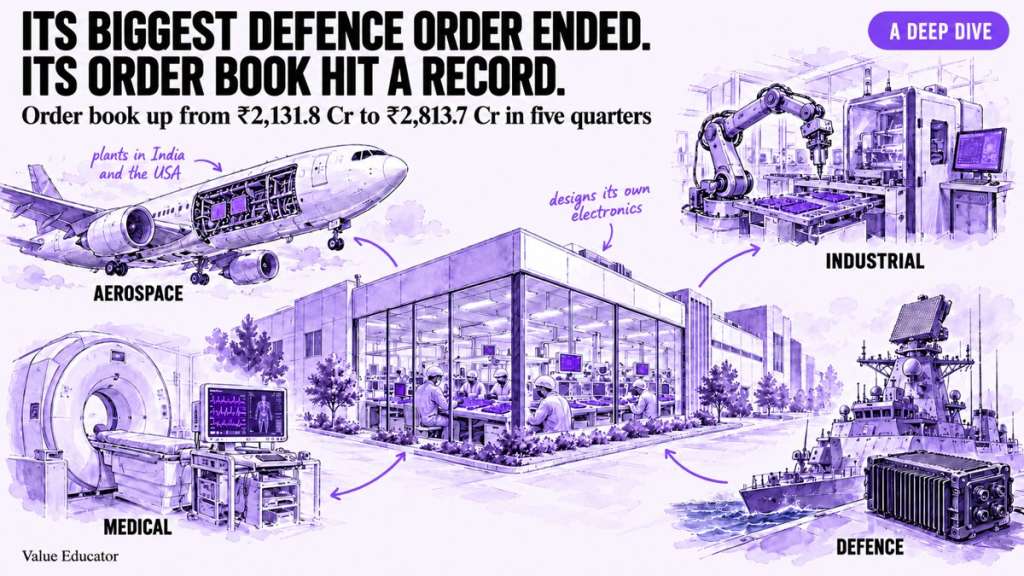
Every modern aircraft, factory robot and hospital scanner now carries far more electronics than it did ten years ago. The companies that design these products rarely build all of that electronics themselves. They hand the building to specialists, and that market is large. The global market for this outsourced work was about $649 Bn in 2025 and is expected to reach about $853 Bn by 2030 in a base case.
That outsourced work has a name. Electronics manufacturing services, or EMS, simply means building electronic boards, cables and complete units for a company that owns the product and its brand. Most of that market makes phones and laptops in huge volumes at thin margins. A smaller part, about $230 Bn by 2030 on one estimate, builds high-reliability electronics for aircraft, defence, medical and industrial use, where a failure is not an option.
That high-reliability part works very differently from phone assembly. Its volumes are small, but each board may carry hundreds of parts and must work for decades in heat, cold and vibration. A customer such as an aircraft maker tests every new supplier for years before it lets that supplier build a flight part. Once a supplier passes, the customer rarely changes it, because changing means repeating the whole test cycle.
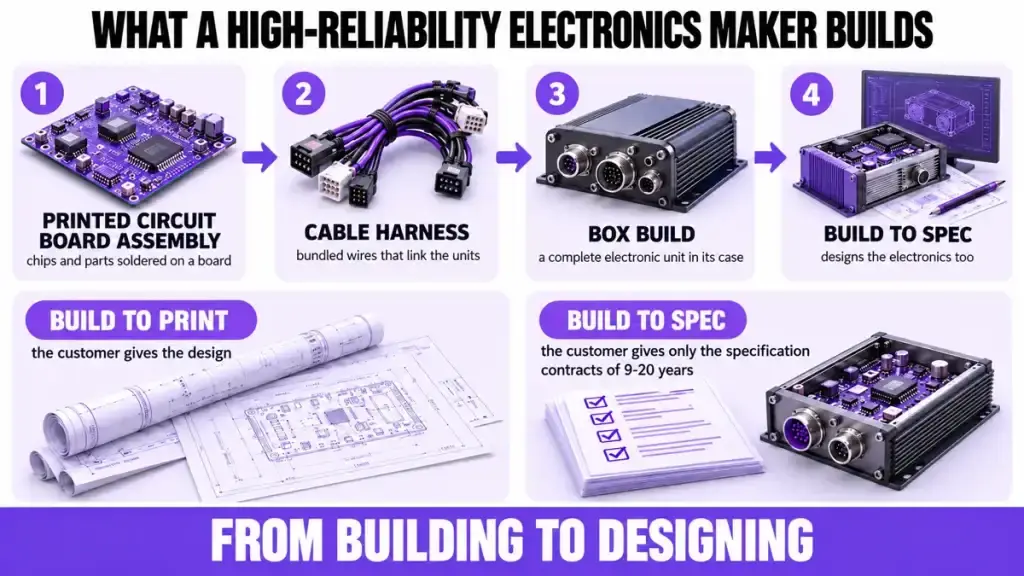
One Hyderabad company has spent 33 years earning that trust. Cyient DLM Ltd (NSE: CYIENTDLM), part of the Cyient group, builds printed circuit board assemblies, cable harnesses and complete electronic boxes for aerospace, industrial, medical and defence companies. It has five manufacturing units, four in India and one in Connecticut in the USA, with about 4,50,000 sq ft of production space. In Q2 FY27, 93% of its revenue came from customers outside India.
Most of that work is build to print, where the customer gives the design and Cyient DLM builds it. The company now wants more build to spec work, which means the customer gives only the specification and Cyient DLM designs the electronics as well. Build-to-spec contracts can run for 9-20 years and earn higher margins, because the designer controls the parts list for the whole life of the product.
Cyient DLM in five numbers
- Q2 FY27 revenue of ₹393.1 Cr, up 26.5% from a year ago
- An order book of ₹2,813.7 Cr on 30 September 2026, its highest ever
- A book-to-bill ratio of 1.6 in Q2 FY27, so orders came in faster than revenue
- Aerospace revenue up 62% in Q2 FY27, the largest of its four industries
- Build-to-spec work at 6% of FY26 revenue, with a double-digit share targeted for FY27
So how did a company whose biggest defence order ended a year ago get to a record order book? Let's first understand the company, and then look at the latest quarter.
Cyient DLM: Company Overview
Cyient DLM Ltd was founded in 1993 as Rangsons Electronics and is based in Hyderabad, in the GMR Aerospace and Industrial Park near the airport. Its promoter is Cyient Ltd, the engineering services company, which held 52.12% of its shares in March 2026. Krishna Bodanapu is the chairman and Rajendra Velagapudi the managing director and CEO. The company builds printed circuit board assemblies, cable harnesses and complete electronic boxes for aerospace, industrial, medical and defence customers, and it now designs more of that electronics itself. It runs five manufacturing units, four in India and one in Connecticut in the USA, and had 914 employees and 763 contract workers in FY26. It earned ₹1,261.5 Cr of revenue in FY26 and ended March 2026 with about ₹125.8 Cr of cash and bank balances against borrowings of about ₹106.1 Cr. Read this Defence Electronics Stocks to Watch (2026)
"The person that turns over the most rocks wins the game."
— Peter Lynch
With Cyient DLM, the rocks worth turning are the order book, the margin and the cash tied up in stock. Each tells a different part of the story below.
The Quarter That Set a New Order Record
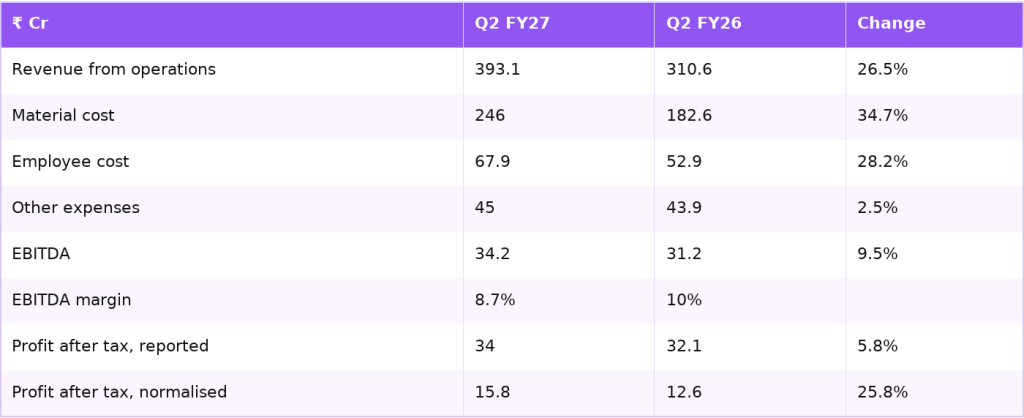
Let's look at Q2 FY27, the July to September quarter, which ended with a record order book. Its revenue was ₹393.1 Cr, up 26.5% from ₹310.6 Cr a year ago. For the first half of FY27, revenue was ₹766.9 Cr, up 30.2%.
That growth has now run for six quarters in a row. Revenue rose from ₹278.4 Cr in Q1 FY26 to ₹310.6 Cr, ₹303.3 Cr, ₹369.1 Cr, ₹373.8 Cr and now ₹393.1 Cr. In April, management had said FY27 would show growth over the year before in all four quarters. The first two quarters grew 34.3% and 26.5%.
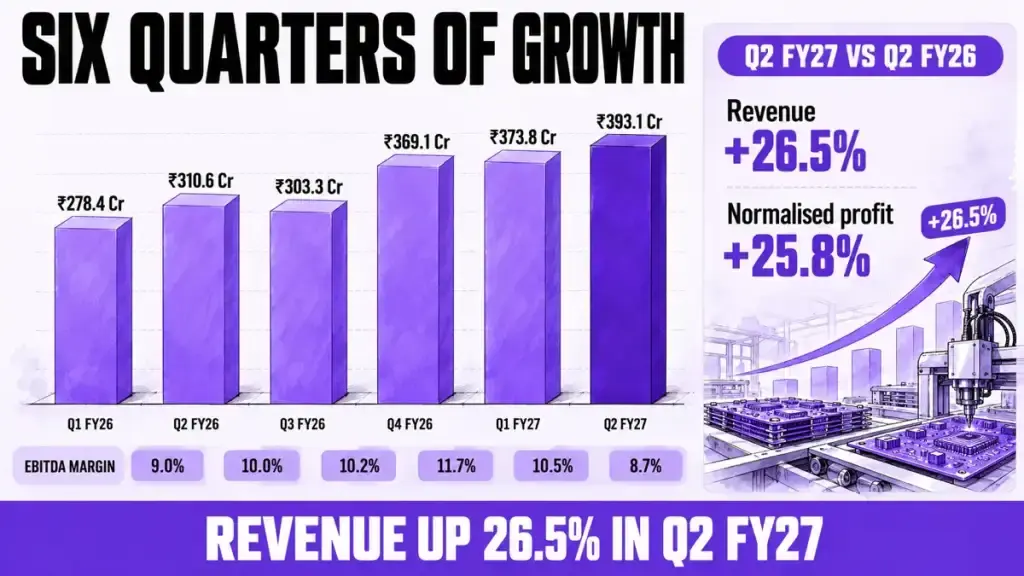
That quarter's profit needs one adjustment. Reported profit of ₹34 Cr included a one-off gain of ₹18.2 Cr. That gain came from reversing an earn-out, a payment the company had set aside for the sellers of its US plant if that plant hit certain targets. Without it, normalised profit was ₹15.8 Cr, up 25.8%, and for the half year it was ₹32.1 Cr, up 60.4%.
That adjustment does not touch the EBITDA margin, which was 8.7%, against 10% a year ago. Two costs explain that margin. Materials rose faster than revenue, because of the quarter's product mix and parts bought to develop build-to-spec products. Employee costs rose 28.2% as the company hired sales, strategy and design staff. Other expenses rose only 2.5%, so the fixed costs of the plants were spread over more revenue.
Those costs look smaller over the half year. EBITDA was ₹73.3 Cr, up 30.4%, and the margin was 9.6%, about the same as a year ago. Finance costs were 20.8% lower as working-capital loans came down. The company also generated ₹17.2 Cr of free cash flow in Q2 FY27. In the same quarter, it finished folding its US plant into the group and renamed it Cyient DLM Electronics Inc.
That steady half year is what the chairman had pointed to in July. He told shareholders that the problems of FY26 were behind the company and that it now had what it needed to grow.
"We have an order book, we have the people and we have the customers that will support this accelerated growth." - Krishna Bodanapu, Cyient DLM
That cash came as the business tied up less money in each rupee of revenue. Net working capital was 153 days at the end of September, down from 161 days in June. Inventory stayed at 162 days, receivables were 73 days and payables 68 days. Read this Inventory Turnover Ratio Explained Customer advances were 13 days of revenue.
The Orders Behind the Record Book
So where did the record order book come from? It was ₹2,598.9 Cr in June 2026 and ₹2,813.7 Cr in September, a rise of ₹214.8 Cr in one quarter. Adding back the quarter's revenue, new orders were about ₹608 Cr, up 11% from the quarter before and 15.4% from a year ago.
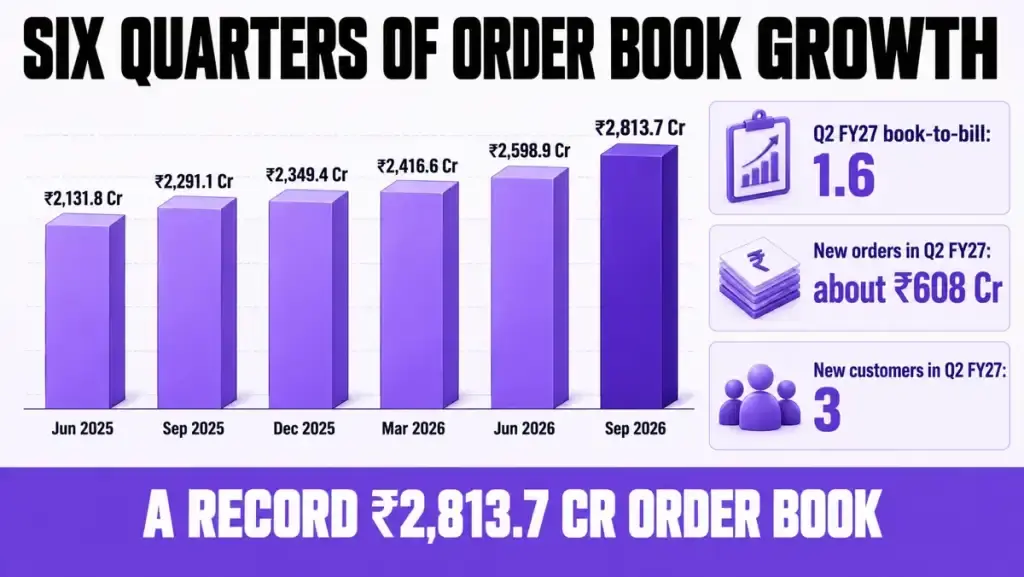
That book has grown every quarter for six quarters. It stood at ₹2,131.8 Cr in June 2025, then ₹2,291.1 Cr, ₹2,349.4 Cr, ₹2,416.6 Cr, ₹2,598.9 Cr and ₹2,813.7 Cr. The company counts only purchase orders against which it can buy materials. It leaves out the full value of long contracts, such as a five-year contract worth about $40 million.
These orders also come from a wider base than before. The company added three new customers in Q2 FY27, after two in Q1 FY27 in industrial and automotive. In Q1 FY27, about 70% of orders came from existing customers and 30% from customers added in the previous four to six quarters. Management said no single large order was behind the Q1 FY27 intake.
Those orders come out of a sales pipeline that has also grown. In April 2026, management put the pipeline at about $0.5 Bn of deals its teams were working on. By July, it called the pipeline substantially higher. About 48% of it was in aerospace and defence, just under 40% in industrial and semiconductor equipment, and most of the rest in medical. The company aims for a few large customers each year rather than many small ones, which it has described as four or five new logos a year.
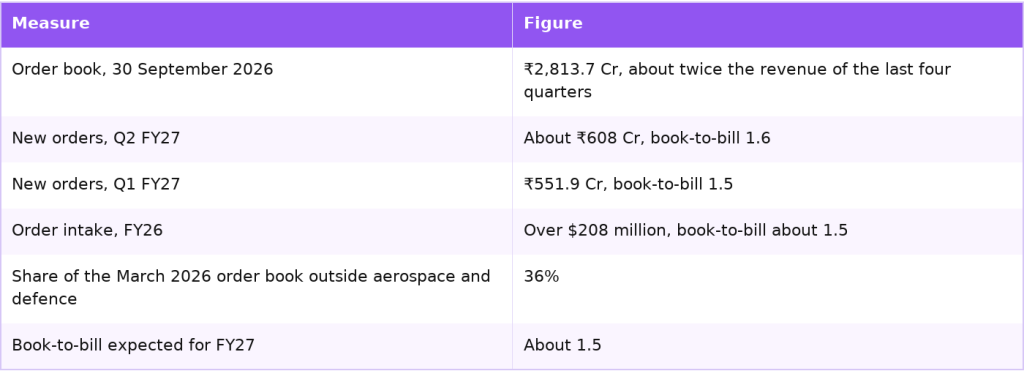
The jump in orders started a year earlier with a change inside the company. Order intake in FY25 was low, so the company rebuilt its sales team and hired sales leaders across regions. Intake then grew about 35-40% in FY26, and the book-to-bill ratio was above one in every quarter. Management expects orders from the newer sales leaders to show from the second half of FY27.
Why the book matters more than one quarter's margin: about ₹2,813.7 Cr of orders against quarterly revenue of ₹393.1 Cr gives the company work for roughly seven quarters at today's pace. Orders are usually delivered over 18-24 months, so most of this book turns into revenue in FY27 and FY28.
How One Large Order Shaped Three Years
To understand why the order book matters so much, let's go back three years. When Cyient DLM listed on 10 July 2023, a large part of its work came from one customer. That customer was Bharat Electronics, and the order was for electronics used in Navy systems.
That order drove two strong years. Revenue rose 43.2% to ₹1,191.9 Cr in FY24 and another 27.5% to ₹1,519.6 Cr in FY25. The company used its listing money to repay ₹160.9 Cr of borrowings and set aside ₹291.1 Cr for working capital, because a large defence order ties up a lot of stock.
Those years also gave the company money to build. In December 2023, it opened a precision machining plant in Bengaluru with 36,000 sq ft of space. The plant can run 60,000 machining hours a year and is designed to reach 1,80,000 hours with 20 more machines. That let the company make the metal parts and cases for its own boxes rather than buy them.
Then, in October 2024, it bought Altek Electronics, a Connecticut electronics maker with more than five decades of history. Altek served medical, industrial and defence customers, and its ITAR registration opened US defence work. The deal gave Cyient DLM a plant close to its North American customers.
The BEL order, however, was always going to end. When it did, FY26 revenue came in at ₹1,261.5 Cr. The company had also seen fewer new orders in FY25, so it changed its leadership and rebuilt its sales team. Rajendra Velagapudi took over as managing director and CEO, and R. M. Subramanian joined as CFO.
That rebuild is what the record order book now reflects. FY26 order intake grew about 35-40%, and most new orders now come from aerospace and industrial customers abroad rather than from one Indian defence buyer. So today, many customers drive the company's growth, not one.
"The essence of investment management is the management of risks, not the management of returns."
— Benjamin Graham
For Cyient DLM, the end of the BEL order showed what one large customer can do to a year. A wider customer base is the company's way of managing that risk.
Four Industries, Four Kinds of Customers
Now let's see who is placing these orders. Cyient DLM reports one business, but it splits revenue by the industry it serves and by the product it builds. Read this Segment-Wise Revenue Analysis Explained In Q2 FY27, aerospace and industrial together gave 78% of revenue.


These four industries differ in what they demand. Aerospace and defence parts are built to a customer's flight or military standard and are tested for years. Industrial work covers power electronics that control motors, drives and semiconductor machines. Medical work is for equipment such as scanners and monitors, where the device maker must prove every change to a regulator.
By product, the mix is also changing. Printed circuit board assemblies, the boards with chips and parts soldered on, gave 48% of Q2 FY27 revenue and grew 19%. Box builds, where the company delivers a complete electronic unit in its case, grew 86% from a year ago. A box carries more of the company's own work than a bare board, so it adds more value per order.
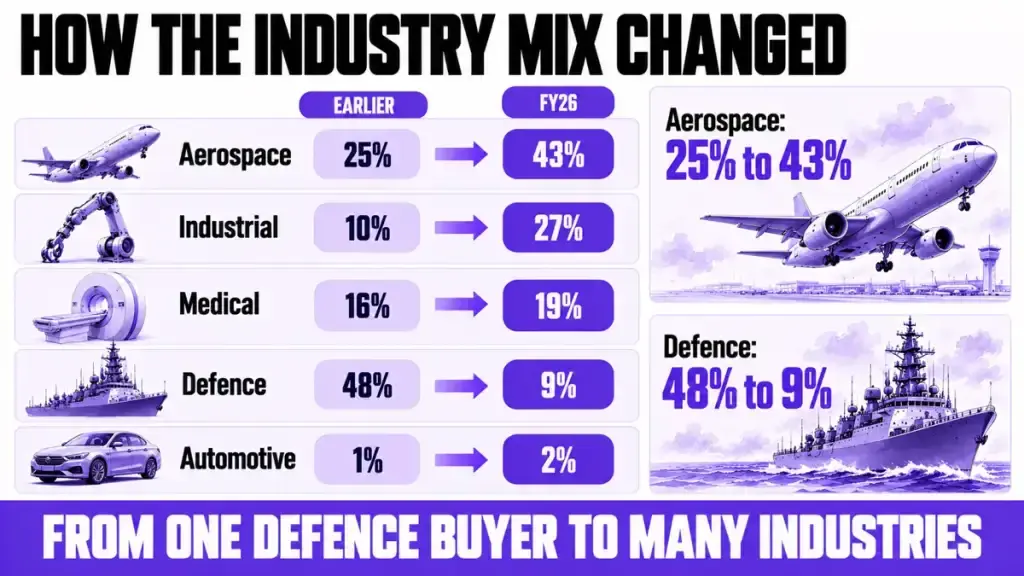
That mix looks very different from three years ago. Defence once gave 48% of revenue, largely from one large order for Bharat Electronics, and aerospace gave 25%. By FY26, aerospace was 43% and defence 9%. Industrial rose from 10% to 27% and medical from 16% to 19%.
Aerospace, the Largest Business
Let's start with aerospace, which gave 47% of Q2 FY27 revenue. The global market for aerospace and defence electronics outsourcing was about $81.8 Bn in 2025, and it is expected to grow about 5% a year through 2033. Aircraft makers are adding more electronics to each aircraft, and many of them now want suppliers outside China.
Cyient DLM entered aerospace more than a decade ago. In 2013, it won Honeywell's Best Emerging Supplier award, and in 2020 it earned a global quality award from Thales. It has since been recognised by Collins Aerospace and BAE Systems. Its Mysuru unit holds NADCAP approval, a demanding aerospace process approval, for cable harness assembly.
That long effort is now paying in orders. Honeywell Aerospace, the aircraft systems arm of the US group Honeywell, and Thales, the French aerospace and defence group, gave the company large programmes several years ago. The first builds are now under way, and management expects both accounts to ramp up over about 18 months. It expects what it called extraordinary growth from both in FY27.
The company also designs for aircraft, not only builds. It is designing and making the cabin management system for the D328eco, a regional turboprop from Deutsche Aircraft of Germany. A cabin management system controls the lights, temperature and passenger services inside the cabin. It is one of Deutsche Aircraft's first electronics programmes built entirely in India. The partnership covers design-led manufacturing support for the aircraft's avionics and electronic systems. So the company's role grows as Deutsche Aircraft builds more of these aircraft.
A newer customer adds an aircraft of a different kind. Cyient DLM is designing electronics for a Japanese eVTOL maker, an electric aircraft that takes off and lands vertically like a helicopter. The production life of that programme is about nine years. Management expects it to reach the production line in about a year to 18 months from July 2026, with mass production from FY29.
Industrial and Semiconductor Equipment
Next, let's look at industrial, the second-largest business at 31% of Q2 FY27 revenue. It grew 29% from a year ago, after 90% growth in Q1 FY27. Here the company builds power and control electronics for factory equipment, energy systems and, more and more, semiconductor machines.
That last area has a strong tailwind. Sales of semiconductor manufacturing equipment are expected to reach a record $165.9 Bn in 2026, up 23.2%, and about $229.5 Bn by 2028. Chipmakers are spending on AI chips, high-bandwidth memory and advanced packaging, and each new machine is full of power and control electronics.
That growth is also spreading to India. The government's semiconductor mission offers incentives that are seeding local equipment and subsystem makers. For a company that already builds power boxes for equipment makers abroad, those plants could become customers closer to home. It is one reason management treats semiconductor equipment as a growth lane of its own.
Cyient DLM builds power boxes, boards, harnesses and complete sub-assemblies for semiconductor equipment makers. In FY26, it started series production for one of them, a step beyond trial builds. Management expects revenue growth from this work over 6-12 months from July 2026, and says the work should also help margins.
That semiconductor work builds on an older industrial base. ABB, the Swiss power and automation group, recognised the company for performance in 2015 and again in 2016. Industrial EMS is growing as factories automate, and US industrial companies are coming to India for new suppliers as they spread production beyond China.
Medical Technology
Now let's turn to medical technology, which gave 14% of Q2 FY27 revenue and grew 14%. Medical device makers outsource more of their electronics each year, but they choose suppliers carefully. Every change in a medical product must be documented and approved, so device makers stay with a supplier that has passed their audits.
That care works in favour of an approved supplier. Once a device maker has validated a supplier's process, moving production means fresh validation and fresh paperwork. So medical customers, like aircraft makers, tend to stay for many years.
Cyient DLM builds boards and complete units for medical equipment makers in the US and Europe, and it serves some early-stage device companies as well. Medical was flat in Q1 FY27 because of seasonal buying by one customer. It returned to 14% growth in Q2 FY27. Medical makes up about 17-20% of the company's sales pipeline, close to its share of revenue.
Defence in India and Abroad
Next, let's look at defence, which gave 7% of Q2 FY27 revenue and grew 13%. Defence spending is rising in Europe, where the ReArm Europe plan aims to mobilise about €800 Bn, and in India, where the forces are buying more electronic warfare and autonomous systems.
That spending is already showing in the company's numbers. Defence revenue grew 35% in Q1 FY27 and 13% in Q2 FY27, from a small base after the BEL order ended.
In India, the company's largest defence customer is Bharat Electronics, the state-owned defence electronics maker. A large BEL order for Navy electronics was completed in FY25. BEL has since placed repeat orders, and management says they carry better margins than the earlier order. Abroad, the company works with European defence firms it does not name under confidentiality agreements, and with Israeli defence customers, where order intake picked up in Q1 FY27.
Defence is also where the company is winning its own designs. It added four defence customers for build-to-spec work, and management expects their production orders from the end of FY27 and in FY28. It is also in early talks with a European defence company on another build-to-spec product.
Those defence talks also reach the USA. The Connecticut plant, bought as Altek Electronics and renamed Cyient DLM Electronics Inc. in September 2026, is registered under ITAR, the US rule for handling defence items. It has one US defence project and is talking to a few more US defence customers.
The New Lanes in AI Data Centres and Robotics
Finally, let's look at AI data centres and robotics, two lanes the company has not entered yet but is preparing for. Management has been clear about the kind of work it wants.
"We are deliberately not chasing commodity high-volume, low-margin work." - Rajendra Velagapudi, Cyient DLM
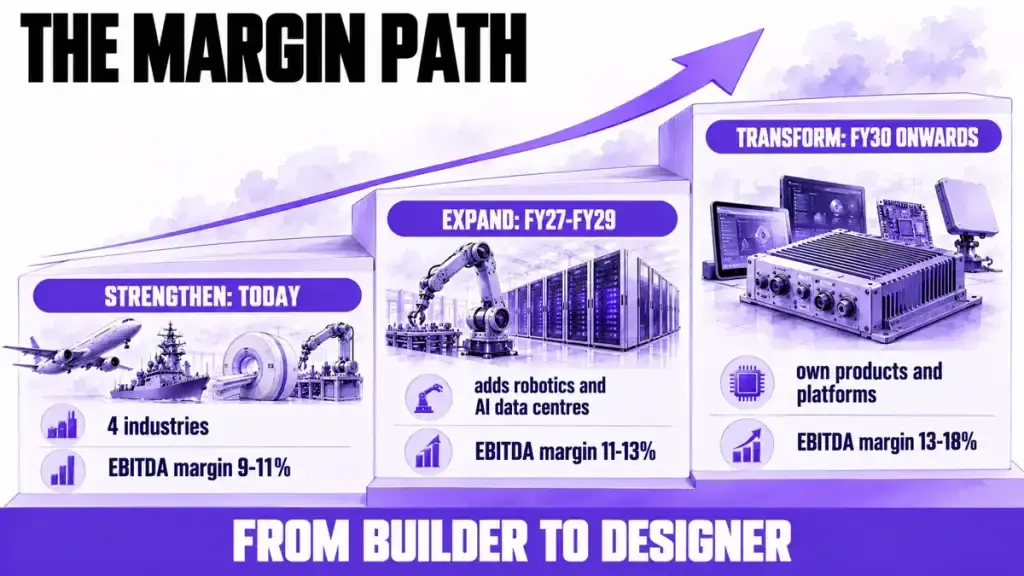
That choice shapes the next step. Management calls its plan Strengthen, Expand, Transform. In the expand phase, from FY27 to FY29, it wants to add robotics and AI data-centre hardware to its four industries, using the same factories and machines.
These two markets are large. On the company's numbers, data centres will need about $6.7 trillion of spending by 2030, and data-centre capacity is expected to rise from 82 GW in 2025 to 219 GW in 2030. The company puts its own addressable EMS opportunity in data centres at about $58 Bn. The global robotics market is expected to reach about $111 Bn by 2030, growing about 14% a year from about $50 Bn in 2025.
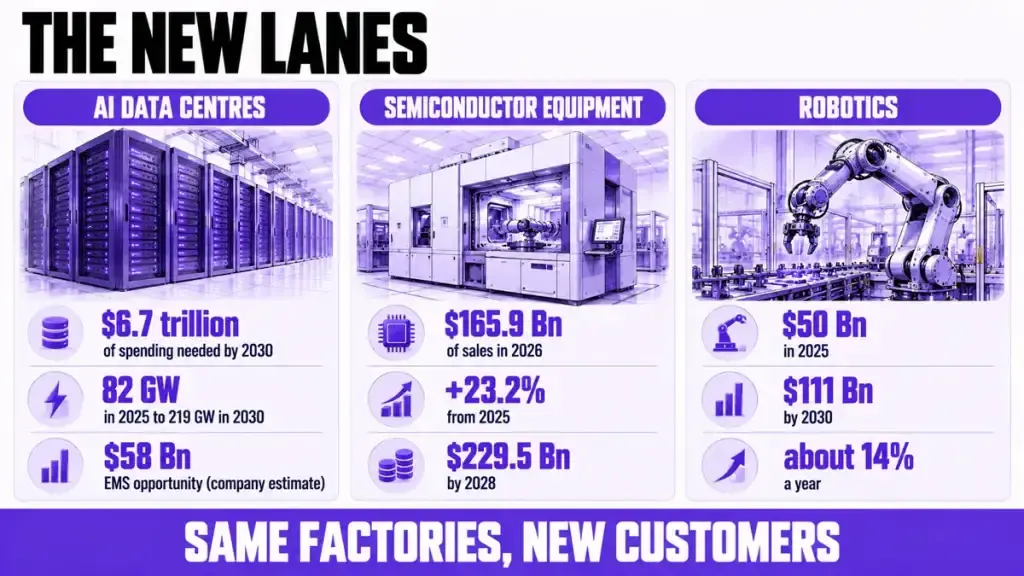
The company has hired sales directors for these areas and expects to name its target products within two to three quarters. It says these products carry better margins than plain assembly. It also says it needs no new factory for them, only application engineers who understand each customer's product. Revenue from these lanes will take time, but management expects the first orders within FY27.
Why Aircraft Makers Rarely Change a Qualified Supplier
Now that we have seen each business, let's understand what keeps customers with Cyient DLM. It starts with qualification. An aircraft maker tests a new supplier's processes, then its first articles, then its batches, before it allows that supplier to build a flight part. That cycle takes years, and it has to be repeated for every new supplier.
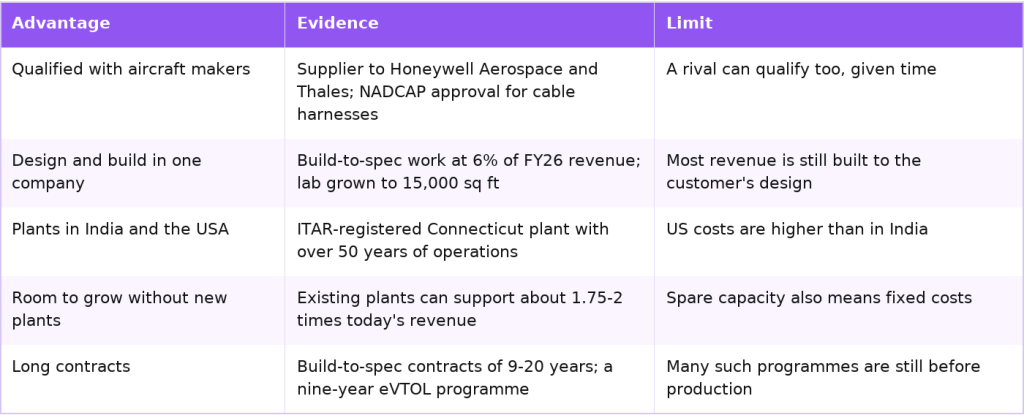
That qualification is why management calls aerospace hard to enter but lasting once you are in. Read this Economic Moat Explained The company says it now works with nearly every major aircraft maker or first-tier supplier that buys electronics. A supplier that is already approved can win the next programme with far less testing than a newcomer.
"It's very, very difficult to get into. But once you are in, you're in." - R. M. Subramanian, Cyient DLM
That hold grows deeper with build-to-spec work. When Cyient DLM designs a product's electronics, it picks the components and suppliers for the whole life of the product. Contracts like these run for 9-20 years. The customer would have to redesign the product to move it, so it rarely does.
"The single most important decision in evaluating a business is pricing power."
— Warren Buffett
A builder that only follows the customer's drawings has little pricing power. A designer that controls the parts list for 9-20 years has more, and that is the shift Cyient DLM is trying to make.
That design work changes the relationship in several ways. Under build to print, the customer directs the parts list and the contract can be short. Under build to spec, the company influences the parts list from the start, and the customer stays for the life of the product. The company describes customer stickiness under build to spec as extremely high, against low under build to print.
That design work needs space and people, and the company has been adding both. It expanded its build-to-spec lab from 6,000 sq ft to 15,000 sq ft in Q1 FY27. It also runs a power electronics lab of 6,000 sq ft. Management expects build-to-spec work to add about 250-300 basis points to the group's EBITDA margin once it reaches scale.
Its plants back up that claim with testing. Each main site runs in-circuit tests, flying probe tests, boundary scan tests, functional tests, environmental stress screening and X-ray inspection. These tests catch a faulty joint or part before a board leaves the plant, which is what aircraft and medical customers audit most closely. In FY26, the company had 914 employees and 763 contract workers across its sites.
Its two countries add another layer. The Connecticut plant, with 81,000 sq ft and over 50 years of operations, lets the company build in the USA for customers who want local production. About half of that plant's new orders are shipped within the same year. The company's first customer shared between the Indian and US plants placed its order in Q4 FY26.
Its plants also leave room to grow without large spending. Management says today's factories can support about 1.75-2 times current revenue, so it plans only routine capital spending. The Hyderabad unit, in a special economic zone near the airport, has room for 50,000 sq ft more.
Financials: Growth, Thin Margins and Cash Tied in Stock
Cyient DLM's last five years include one large order arriving and ending, so full years tell the story better than one quarter. The figures are consolidated.
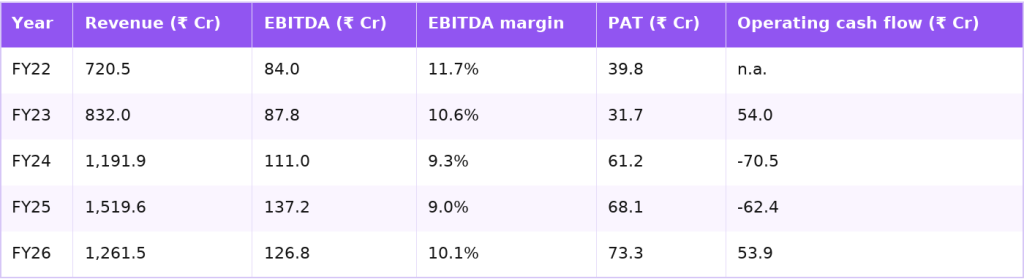
Revenue more than doubled from ₹720.5 Cr in FY22 to ₹1,519.6 Cr in FY25 as the large BEL order was delivered, and then fell 17% to ₹1,261.5 Cr in FY26 when it ended. The EBITDA margin stayed in a narrow band of about 9-12% in every year, which is typical of a company that mostly builds to its customers' designs. FY26 profit after tax of ₹73.3 Cr was the highest of the five years, but it included ₹19.6 Cr of earn-out reversals.
Cash flow is the weakest number in the table. From FY23 to FY26, profit after tax added up to about ₹234 Cr, while operating cash flow added up to less than zero. In FY24 and FY25, the large defence order tied up cash in stock and receivables. In FY26, operating cash flow turned positive at ₹53.9 Cr as receivables fell to ₹307.3 Cr from ₹347.4 Cr, even though inventory rose to ₹647.3 Cr from ₹571.3 Cr.
Debt is low. Borrowings fell to about ₹106.1 Cr in March 2026 from about ₹243.8 Cr a year earlier, against equity of about ₹1,012.1 Cr, a debt-to-equity ratio of about 0.1.
"Your margin is my opportunity."
— Jeff Bezos
In contract manufacturing, the customer usually holds the margin and the builder works on a thin one. Cyient DLM's plan to design its own products is an attempt to keep more of that margin for itself.
What the Next Two Years Look Like on Management's Numbers
So what could all of this add up to for you as a reader following Cyient DLM? Management does not give revenue guidance. It expects a book-to-bill ratio of about 1.5 for FY27, In January it agreed with an analyst's figure of 20-25% revenue growth, and in April it said growth would be within that range.
On FY26 revenue of ₹1,261.5 Cr, growth of 20-25% would mean about ₹1,514-1,577 Cr in FY27. The first half has already delivered ₹766.9 Cr. A book-to-bill of 1.5 on that revenue would add about ₹2,271-2,365 Cr of new orders in the year, so the order book would keep growing.
Beyond revenue, the larger plan is for margins. Management describes three steps. The core four industries run at about 9-11% EBITDA margin. From FY27 to FY29, robotics and AI data centres are expected to lift it to about 11-13%. From FY30, its own products and platforms are expected to take it to about 13-18%.
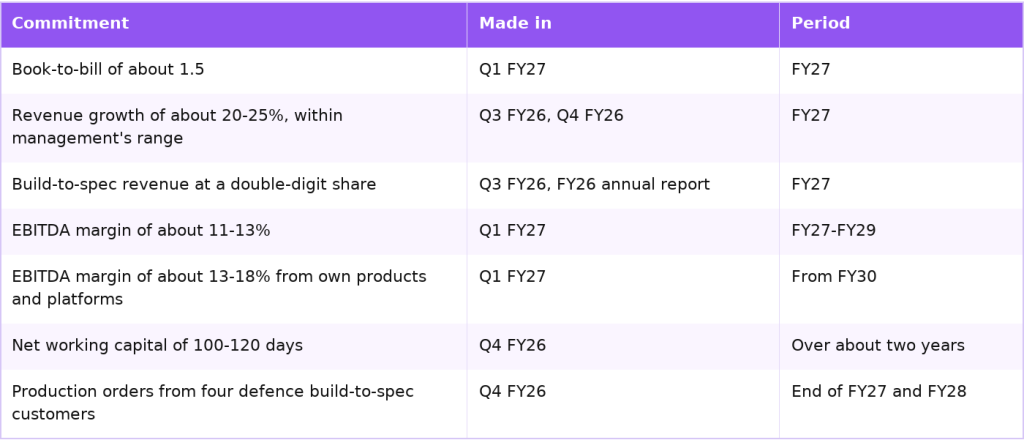
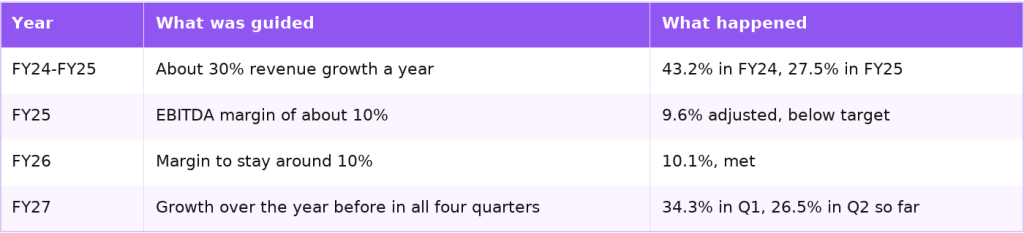
These commitments come with a record we can check. In FY24, the company aimed for about 30% growth a year over three years. Growth came in at 43.2% in FY24 and 27.5% in FY25.
In FY25, it targeted an EBITDA margin of about 10% and reached 9.6% on an adjusted basis. The margin of about 10% it set for FY26 was met at 10.1%.
Key Risks
No business grows in a straight line, so let's look at what could go wrong for Cyient DLM.
- One order can swing a year: when the large BEL order ended, consolidated revenue fell 17% to ₹1,261.5 Cr in FY26 and defence revenue fell 68%. A similar loss of a large programme would hit revenue again.
- Margins slipped in Q2: the EBITDA margin fell to 8.7% from 10.5% in Q1 FY27 and 11.7% in Q4 FY26, as material and staff costs rose. The 11-13% target needs new sectors that have not yet produced revenue.
- Few customers: customers above 10% of revenue gave about 70.5% of FY26 standalone revenue. Losing or delaying one large programme would show quickly in the numbers.
- Cash tied up in stock: materials make up most of the cost, and inventory was 162 days in September 2026. Inventory rose to about ₹701 Cr from about ₹647 Cr in March 2026, and the 100-120 day working capital target is still far off.
- Profit quality: reported profit included earn-out reversals of ₹19.6 Cr in FY26 and ₹18.2 Cr in Q2 FY27. These came because the US plant did not meet the performance targets set when it was bought.
- Supply routes and tariffs: many components fly in through Dubai and Doha, and the West Asia conflict delayed materials and cut Q4 FY26 revenue. US tariffs have also made some US customers wait before placing orders.
- A record of missed targets: the FY25 margin target was missed, and the 30% growth aim did not hold in FY26.
"Invert, always invert."
— Charlie Munger
Turning the Cyient DLM story around means asking what would stop margins from rising even as orders grow. The risks below are the answers.
Explore our Products
Research Framework

Emerging Titans
Combination of quantitative analysis, industry tailwinds, and management assessment - SPRINT investment philosophy

Tiny Titans
Heavy emphasis on scuttlebutt research, plant visits, and early on-ground signals
What to Track Next
If you follow Cyient DLM, these are the signals that will show whether the plan is on track.
- The book-to-bill ratio staying near 1.5 for FY27, and the order book above ₹2,813.7 Cr
- The EBITDA margin returning above 10%, then moving towards 11-13%
- Revenue from Honeywell Aerospace and Thales as their programmes ramp up
- Build-to-spec revenue reaching a double-digit share of revenue in FY27
- The first named products and orders in AI data centres and robotics
- Net working capital moving from 153 days towards 100-120 days
Conclusion
Let's step back and put it all together. Cyient DLM spent three decades getting qualified with some of the world's most demanding electronics buyers, from aircraft makers to medical device companies. When its biggest Indian defence order ended, aerospace and industrial customers abroad stepped in. The order book is now at a record ₹2,813.7 Cr and revenue is growing again. The cautious thread is cash and concentration: operating cash flow from FY23 to FY26 added up to less than zero against about ₹234 Cr of profit, and customers above 10% of revenue gave about 70.5% of FY26 standalone revenue.
So the next two years will show whether that growth can also lift margins. The company is spending on sales teams, design labs and new sectors ahead of the revenue. If build-to-spec products and the new lanes deliver, margins could move from about 10% towards the 11-13% management expects. If they take longer, the company will still have a large order book, but at the margins of a builder rather than a designer.
FAQs
What does Cyient DLM do?
+Cyient DLM builds printed circuit board assemblies, cable harnesses and complete electronic boxes for aerospace, industrial, medical and defence companies. It has five manufacturing units, four in India and one in Connecticut in the USA, and in Q2 FY27 93% of its revenue came from customers outside India.
What is the difference between build to print and build to spec?
+Under build to print, the customer gives the design and Cyient DLM builds it. Under build to spec, the customer gives only the specification and Cyient DLM designs the electronics as well. Build-to-spec contracts can run for 9-20 years and earn higher margins; this work was 6% of FY26 revenue.
How big is Cyient DLM's order book?
+The order book was a record ₹2,813.7 Cr on 30 September 2026, up from ₹2,598.9 Cr in June 2026. New orders in Q2 FY27 were about ₹608 Cr, a book-to-bill ratio of 1.6, and management expects a book-to-bill of about 1.5 for FY27.
Why did Cyient DLM's revenue fall in FY26?
+A large order from Bharat Electronics for Navy electronics ended, so FY26 revenue fell 17% to ₹1,261.5 Cr and defence revenue fell 68%. Revenue has grown since, and Q2 FY27 revenue was ₹393.1 Cr, up 26.5% from a year ago.
What is Cyient DLM's margin plan?
+Management says the four core industries run at about 9-11% EBITDA margin. It expects robotics and AI data-centre hardware to lift the margin to about 11-13% from FY27 to FY29, and its own products and platforms to take it to about 13-18% from FY30. The Q2 FY27 margin was 8.7%.
What are the main risks for Cyient DLM?
+The main risks are the loss of a large programme, margins that slipped to 8.7% in Q2 FY27, customers above 10% of revenue giving about 70.5% of FY26 standalone revenue, inventory of 162 days, profit that included earn-out reversals, and delays from supply routes and US tariffs.

High growth stock specialist, Value Educator
Shashank Mahajan is an equity research professional with over 12 years of experience in identifying high-potential SME and micro-cap stocks at an early stage. He follows a rigorous scuttlebutt research–driven approach, combining on-ground insights with deep financial analysis. Shashank specializes in uncovering under-researched and under-owned companies with strong management quality and long-term growth potential. Through disciplined research and early identification, he focuses on spotting tomorrow’s market leaders before they enter the mainstream investor radar.
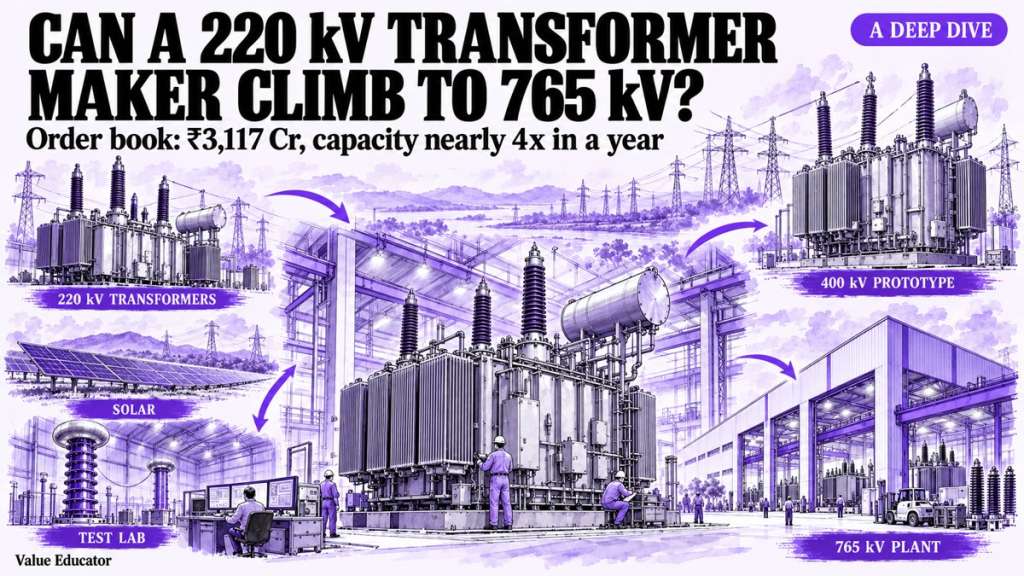
Atlanta Electricals: Capacity Nearly Quadrupled in a Year
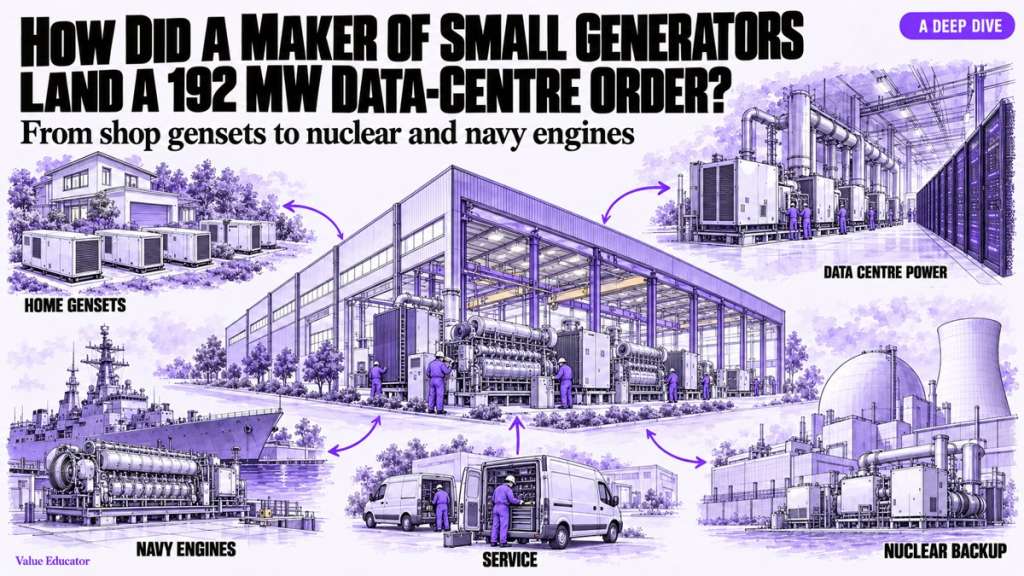
Kirloskar Oil Engines: Data Centres, Nuclear and the Navy
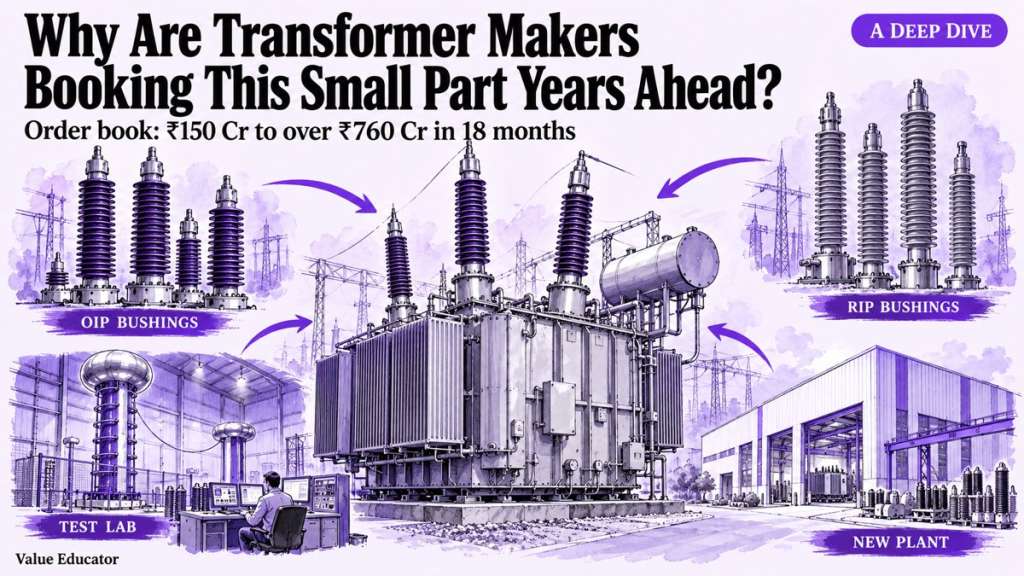
Yash Highvoltage: Bushing Maker With ₹760 Cr of Orders
Quality Power: Reactor Maker With a ₹1,945.5 Cr Order Book

Azad Engineering: Turbine Blades, Jet Engines and Orders

Zen Technologies: Revenue Fell After a Big Win
Explore our Products
Research Framework
Emerging Titans
Combination of quantitative analysis, industry tailwinds, and management assessment - SPRINT investment philosophy
Tiny Titans
Heavy emphasis on scuttlebutt research, plant visits, and early on-ground signals


 Orders
 Subscription
 Share with friends


Required Details
₹23999.00
(12 month subscription)
As per SEBI regulations, all users are mandated to complete the KYC that is validated for 1 year. Post payment, you will be redirected to the KYC screen


No comments yet. Be the first to comment!