
Netweb Technologies: AI Servers and ₹2,629 Cr of Orders
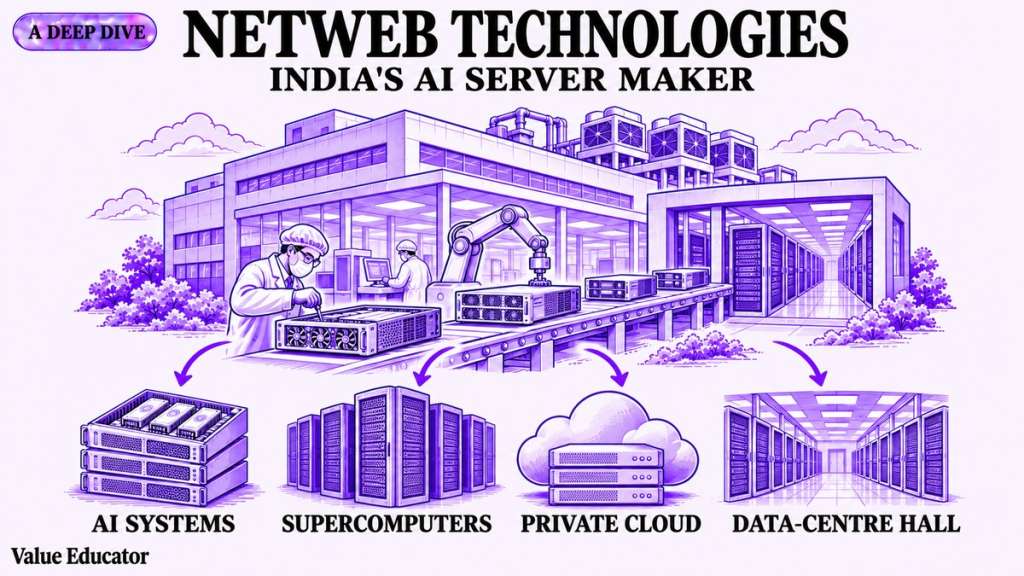
In FY23, AI systems made up about 7% of an Indian computer maker's revenue. By FY25 the share was about 15%. In FY26 it was 43.4%, and in the April to June quarter of 2026 it was 62.29%. Over the same years, the company's yearly revenue grew from about ₹445 Cr to ₹2,183.6 Cr. In the July to September quarter of 2026 alone, it sold ₹1,323.3 Cr of computers.
That shift tells us what kind of computers it makes. These are not laptops or office desktops. They are high-performance computing systems, or HPC, which means hundreds or thousands of powerful servers wired together so they can work on one large problem, such as a weather model or a space simulation. A supercomputer is the largest form of this.
The newest kind of these systems is the AI system. It is a server packed with graphics processing units, or GPUs, the chips that NVIDIA and AMD design for the heavy maths that AI models need. A large AI cluster can hold thousands of GPUs. Training a language model or running a chatbot for millions of users needs racks of such servers inside a data centre.
Then there is a third kind, called private cloud. Here a company or a government department builds its own cloud inside its own data centre, instead of renting space from a public cloud provider. Hyperconverged infrastructure, or HCI, is the hardware and software that puts computing, storage and networking into one box, so such a private cloud is quicker to set up.
That computer maker is Netweb Technologies India Ltd (NSE: NETWEB). It designs, builds and installs all three kinds of systems from Faridabad, near Delhi, mostly under its own Tyrone brand. It has installed more than 600 supercomputing systems, more than 60 private cloud and HCI systems and more than 10,000 GPU-based AI systems. Its systems have been listed 17 times in the world's top 500 supercomputers.
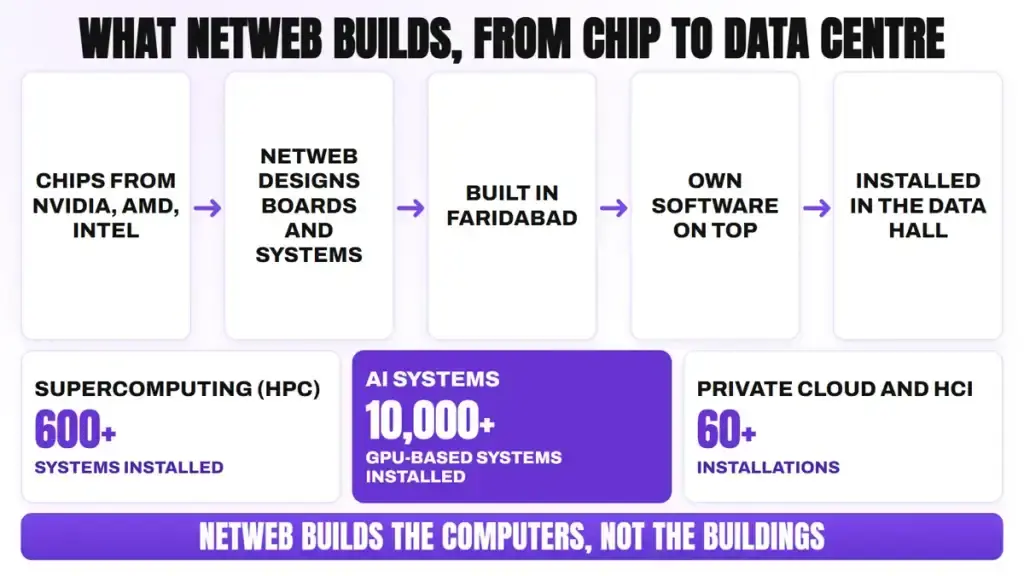
So Netweb sits at a clear point in the data-centre chain. It does not build the buildings, the power lines or the cooling. It builds the computers that go inside the halls, and it writes the software that runs them.
Netweb Technologies in five numbers
- Q2 FY27 revenue of ₹1,323.3 Cr, up 335.7%
- AI systems at 58.4% of Q2 FY27 revenue
- An order book of ₹2,629 Cr in September 2026, plus ₹652.5 Cr of L1 positions
- An active pipeline of about ₹11,152 Cr
- A target of ₹4,000 Cr of revenue for FY27
So a company that listed in July 2023 on a revenue base of about ₹400 Cr now earns more in one quarter than it did in all of FY24. How did that show up in the latest numbers? Let's first understand the company, and then look at the latest quarter.
Netweb Technologies: Company Overview
Netweb Technologies India Ltd was incorporated in 1999 and is based in Faridabad, Haryana, where it designs and builds its systems in three facilities; it also has 22 offices across India. Sanjay Lodha founded the business and is its Chairman and Managing Director, and Navin, Vivek and Niraj Lodha are whole-time directors; the promoter group held 64.16% in September 2026. Netweb makes supercomputers, GPU-based AI systems, private cloud and hyperconverged systems, storage and data-centre servers, mostly under its Tyrone brand, as an OEM partner of NVIDIA and AMD. It listed on the NSE and BSE in July 2023. It had 569 permanent employees in March 2026, and 380 engineers in September 2026. Revenue from operations was ₹2,183.6 Cr in FY26, and after raising ₹1,200 Cr in August 2026 it held a net cash position of about ₹13.6 Cr in September 2026. Read this Data Centre Stocks in India 2026: Suppliers and Operators
"Behind every stock is a company. Find out what it's doing."
— Peter Lynch
Netweb's numbers changed because what it sells changed: from supercomputers for research labs to GPU clusters for AI. Knowing which of its three pillars brings in the revenue is the first step to reading its results.
The Quarter Revenue Grew 335.7%
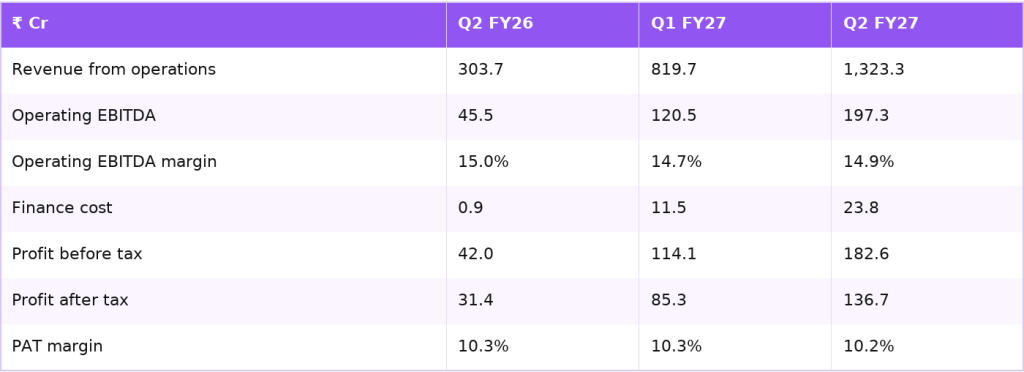
Let's look at Q2 FY27, the July to September quarter that the company reported on 24 October 2026. Revenue from operations was ₹1,323.3 Cr, up 335.7% from ₹303.7 Cr a year ago. It was also 61.4% higher than the ₹819.7 Cr of Q1 FY27. The company says it was its highest quarterly revenue and profit after tax so far.
As we can see, AI systems did most of the lifting. They brought in ₹773.1 Cr, or 58.4% of revenue, against about ₹66 Cr a year ago, a rise of 1,068.1%. Supercomputing brought in ₹248.2 Cr and private cloud ₹244.8 Cr. Both of these grew fast from the previous quarter too: supercomputing rose about 98% from ₹125.3 Cr in Q1 FY27, and private cloud rose about 81% from ₹135.3 Cr.
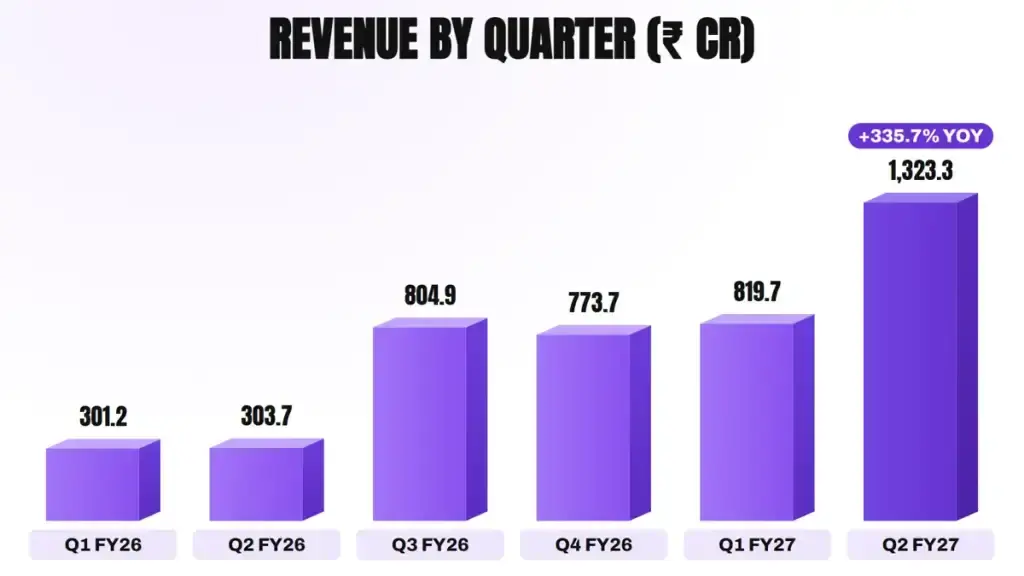
That chart also shows how uneven the path has been. Revenue was ₹301.2 Cr in Q1 FY26 and ₹303.7 Cr in Q2 FY26. It then jumped to ₹804.9 Cr in Q3 FY26, when the first large AI order was delivered, and slipped to ₹773.7 Cr in Q4 FY26, when part of that order moved into the next quarter. Since then it has risen to ₹819.7 Cr and ₹1,323.3 Cr. In a business where one order can be worth more than a quarter's revenue, the timing of a single delivery moves the quarterly numbers a lot.
That growth did not come at the cost of the margin. Read this EBITDA Explained: Uses and Limits Operating EBITDA was ₹197.3 Cr, up 334.0%, at a margin of 14.9%, against 15.0% a year ago. Profit after tax rose 334.8% to ₹136.7 Cr. Management guides an operating EBITDA margin of 13% to 14%, so the quarter was a little above its own range.
Beyond that line, one cost grew much faster than the business. Finance cost was ₹23.8 Cr, against ₹0.9 Cr a year ago. Borrowings rose as the company built up inventory for large orders: they were ₹321.3 Cr in September 2026, against ₹1.3 Cr in March 2025.
The gross margin, the share of revenue left after the cost of materials, also came down in the quarter. Management says large deals carry a different margin from small ones, and that overheads do not grow at the same pace on a large deal. So it asks investors to judge the EBITDA margin over a full year, not the gross margin in one quarter.
That same pattern shows in the first half, at a larger scale. H1 FY27 revenue was ₹2,143.0 Cr, up 254.2%. That is close to the ₹2,183.6 Cr the company made in all of FY26. Operating EBITDA for the half was ₹323.0 Cr at a margin of 15.1%, and profit after tax was ₹222.0 Cr. That is already more than the ₹205.8 Cr of profit after tax in all of FY26.
That growth also changed the shape of the balance sheet. In August 2026 Netweb raised ₹1,200 Cr through a qualified institutional placement, its first fund-raise since listing. Net worth rose to ₹2,104.1 Cr in September 2026, from ₹723.3 Cr in March. By September it had used about ₹766.7 Cr of the money for working capital, and about ₹425.6 Cr was still unused. Net debt was close to zero, at a net cash position of about ₹13.6 Cr.
Working capital tells us where that money went. The cash conversion cycle, the number of days between paying suppliers and collecting from customers, was 94 days in September 2026, against 84 days in March and 73 days in March 2025. Receivable days improved to 62 from 86. But inventory days rose to 117 from 86, because the company bought GPUs, memory and other parts in advance for orders it has to deliver. Management expects the cycle to stay between 90 and 110 days. Read this Days Sales Outstanding (DSO) Explained
Those growth needs also got more room from the banks. In June 2026 CRISIL reaffirmed Netweb's long-term rating at A+/Stable and rated bank facilities of ₹2,420 Cr, up from ₹700 Cr. Even after the new equity, return on equity was 31.4% and return on capital employed was 38.6% on an annualised basis in September 2026.
The Orders Behind the Next Two Quarters
Now let's look at the orders, because they show how much of the coming revenue is already booked. Netweb reports three numbers. The order book is confirmed purchase orders not yet delivered. L1 means tenders where Netweb was the lowest qualified bidder or the chosen vendor, but the formal order has not come yet. The pipeline is the value of active deals the company is chasing.
At the end of September 2026 the order book was ₹2,629 Cr, with ₹652.5 Cr more in L1 positions. In June 2026 the order book was ₹2,506.9 Cr. So even after shipping a record ₹1,323.3 Cr of systems in the quarter, the book grew.

That book was very different only two years ago. It was ₹411.2 Cr in March 2024 and ₹229.9 Cr in June 2025. Then, in September 2025, Netweb won two large AI orders worth about ₹2,184 Cr together: ₹1,734 Cr for servers on NVIDIA's Blackwell chips, and ₹450 Cr for Tyrone AI GPU systems. Both came from a large Indian technology distributor, and the ₹1,734 Cr order was for India's sovereign AI compute under the IndiaAI Mission. The order book jumped to about ₹2,677.9 Cr.
Those two orders have been delivered quarter by quarter since then. Netweb shipped ₹450.4 Cr of them in Q3 FY26 and about ₹558.8 Cr in all of FY26. In Q1 FY27 it shipped about ₹430 Cr more. From June 2026 the company stopped showing large orders separately, and its pipeline now counts every kind of deal together. That is why the pipeline rose from about ₹4,431.5 Cr in March 2026 to about ₹10,410 Cr in June and about ₹11,152 Cr in September.
What the order book says: ₹2,629 Cr is more than the ₹1,857 Cr Netweb needs in H2 FY27 to reach its ₹4,000 Cr target. Management puts its usual delivery time at 10 to 16 weeks, so most of this book can turn into revenue within the year.
Management also gives a rule of thumb for the pipeline. It says about 60% of the pipeline usually turns into orders, over 18 to 24 months. On the September pipeline, that would mean about ₹6,691 Cr of orders over that time. That is a rough guide, not a booked number, and the mix between government and private buyers changes every quarter. Management says private enterprises are now a larger part of the pipeline than the government.
How a Faridabad Server Maker Became an AI Supplier
Now that we have seen the quarter, let's go back and see how a Faridabad server maker became an AI supplier. Sanjay Lodha founded Netweb in 1996, the company was incorporated in 1999, and he is its Chairman and Managing Director. Three other Lodhas, Navin, Vivek and Niraj, are whole-time directors. For most of its life it was known for supercomputers built for research labs, universities and government bodies. In 2023 it deployed AIRAWAT, India's flagship AI supercomputer, which was ranked 75th in the world at the time of commissioning.
That supercomputer work gave it two skills that AI buyers now need. One is designing dense systems where thousands of chips work together. The other is the software that manages such clusters. Netweb listed on the NSE and BSE in July 2023, and its revenue has grown every year since.
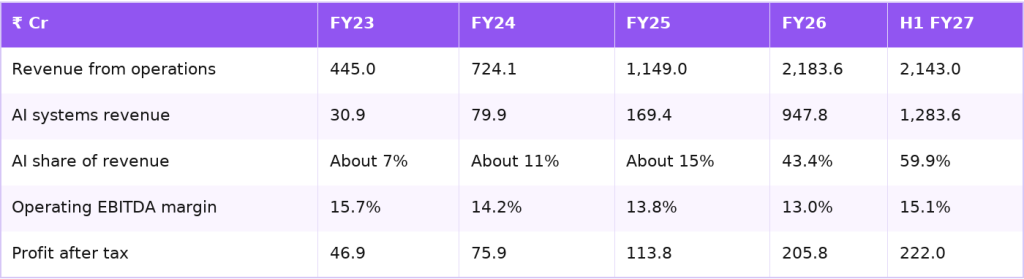
Before FY26, AI was a small part of the business. Management kept separate guidance for it and said in October 2024 that AI would be about 15% of FY25 revenue, which it was. Then the IndiaAI Mission and India's large cloud and data-centre buyers began to order GPU servers in bulk.
"Invert, always invert."
— Charlie Munger
For Netweb, inverting the question means asking what would stop the AI orders: a delayed tender, a chip shortage or a rival with a lower price. The rest of this article looks at each of these.
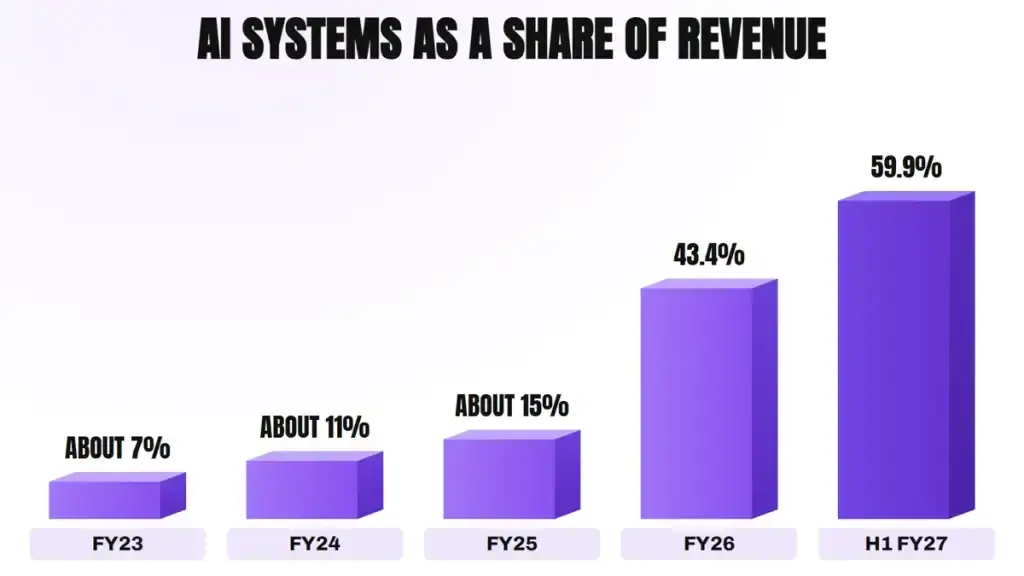
That change shows clearly in FY26. Revenue grew 90.0% to ₹2,183.6 Cr, and AI systems grew 459.6%. FY26 revenue included about ₹558.8 Cr from the two large orders. Supercomputing and private cloud kept growing too, at about 31% and about 28% in the year. But AI grew so much faster that the other two now make up a smaller part of the whole.
That shift had a cost in margin. The operating EBITDA margin went from 15.7% in FY23 to 13.0% in FY26. A GPU server carries expensive chips that Netweb buys from NVIDIA or AMD, so a large AI order brings in a lot of revenue but a smaller margin on each rupee. The first half of FY27 shows the margin back at 15.1%, but management still guides 13% to 14% for the year.
"We don't want to get into setting up data centers or providing cloud services directly because basically, all our customers try to do it. So our forte is primarily R&D." - Sanjay Lodha, Chairman and Managing Director, November 2025
Three Pillars and Three Smaller Lines
Now let's split the business into its parts, because each one sells to a different buyer. Netweb reports one business, high-end computing solutions, but it shows revenue for six product lines. Management calls the first three its three pillars, and says more than 95% of revenue comes from them.
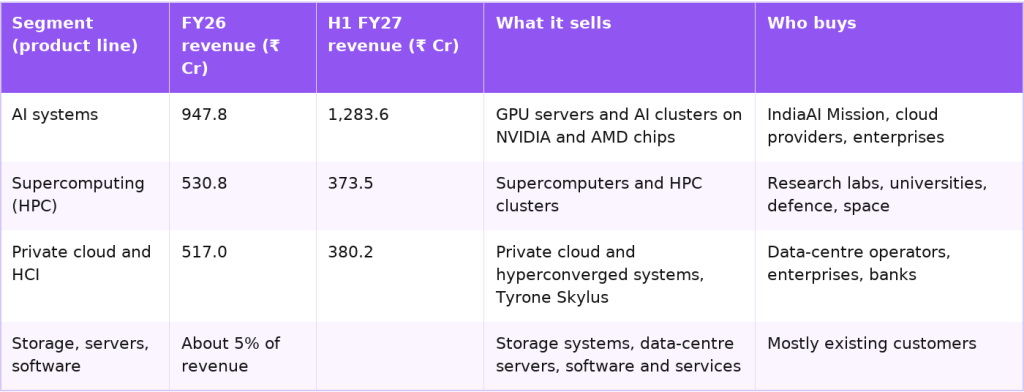
These lines sound alike, but as you will see, each one wins orders in a different way. Supercomputers come through government tenders. Private cloud is sold to companies that want their data in India and under their own control. AI systems are sold to both, and to cloud providers who rent GPUs to others.

AI Systems on NVIDIA and AMD Chips
Let's start with AI systems, now the largest line. Netweb designs and builds GPU servers under an OEM partnership with NVIDIA, and also works with AMD. An OEM, or original equipment manufacturer, designs and builds the finished system under its own brand, using chips bought from the chip maker. Netweb's Tyrone Camarero range includes systems on NVIDIA's GB200 and GB300 Blackwell chips.
That line has grown faster than any other. AI revenue was ₹79.9 Cr in FY24, ₹947.8 Cr in FY26 and ₹1,283.6 Cr in H1 FY27 alone. The company says the line grew at 212.9% a year from FY23 to FY26. Management says about 40% to 45% of the June 2026 order book was for AI systems.
Its next product is already in design. NVIDIA's next platform is called Vera Rubin, and Netweb has started the board designs for it. Management plans to offer Vera Rubin systems to customers from January. To speed up its hardware design work, the board approved a wholly owned research subsidiary in Taiwan in October 2026, where many chip and server design engineers work.
Supercomputing and the National Supercomputing Mission
Next, let's look at supercomputing, the oldest line. Netweb has built some of India's best-known systems, including AIRAWAT and PARAM machines for C-DAC and ISRO. Supercomputing revenue was ₹530.8 Cr in FY26, up from ₹172.8 Cr in FY23, a growth rate of 45.4% a year.
The next driver here is the National Supercomputing Mission 2.0, or NSM 2.0. The company's deck says it targets pre-exascale and exascale systems by 2028, and gives weight to systems designed and built in India. Management says it aims for more than half of the programme. NSM 2.0 runs over five years, and management expects the first orders from it around early 2027.
That line has a ceiling, though. In November 2025 management put India's total HPC market at about ₹4,000 Cr, of which the part Netweb addresses is about ₹1,000 Cr. So supercomputing alone cannot carry a ₹4,000 Cr company.
Private Cloud and HCI, the Data-Centre Business
Now let's move to private cloud, which management calls its data-centre business. Netweb sells these systems under the Tyrone Skylus brand, with its own software stack for virtual machines, containers and storage. The company's deck names private cloud customers such as Yotta Data, Akamai and Graviton.
The demand here comes from data rules and cost. Indian banks, government bodies and companies with sensitive data often want their data to stay in India and in their own control. Netweb's own Skylus.ai software then lets them run GPUs inside that private cloud.
That business brought in ₹517.0 Cr in FY26, against ₹146.1 Cr in FY23, a growth rate of 52.4% a year. Management says it used to be 30-35% of revenue and was 24% in FY26, as AI took a larger part.
Storage, Servers and Software
Finally, let's look at the three smaller lines. High-performance storage holds the large data sets that supercomputers and AI clusters read from. Data-centre servers are ordinary servers, which management says it does not chase because it does not want to be a box seller. Software and services cover cloud management and support. Together these made up about 5% of revenue, and management says it does not track the server line closely.
Where Netweb Sits in the Data-Centre Value Chain
Now let's place Netweb in the wider data-centre chain. A data centre needs land, power, cooling and racks before a single server goes in. Then come the computers, the network and the software. Netweb's place is the computers and the software: it buys chips from NVIDIA, AMD, Intel and Samsung, designs the boards and systems around them, builds them in Faridabad and installs them at the customer's site.
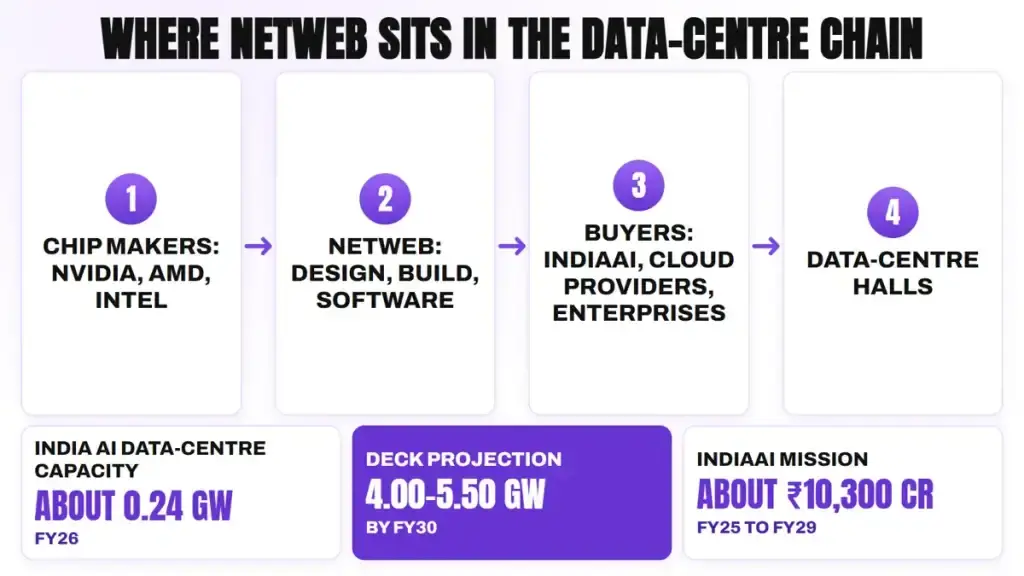
That chain is growing fast in India. The company's deck, using an industry report, puts India's AI data-centre capacity at about 0.24 GW in FY26 and projects 4.00-5.50 GW by FY30. The same deck says the IndiaAI Mission has an allocation of about ₹10,300 Cr over FY25 to FY29 for compute, models and data sets. Large cloud providers and data-centre operators are also building GPU capacity in India.
That demand reaches Netweb through three kinds of buyers. Government demand comes directly or through programmes such as IndiaAI, where cloud providers win GPU tenders and then buy servers. Cloud providers and data-centre operators buy too, including the newer neocloud companies that rent GPUs by the hour. Large enterprises, such as banks, IT companies and telecom firms, make up the rest.
Those buyers also need more than the server. Dense GPU racks give off so much heat that air cooling alone struggles, so newer AI data centres use liquid cooling. Netweb has a collaboration with Vertiv to design and deliver liquid-cooled AI systems for large deployments. So its systems are designed with the data hall's power and cooling in mind.
One more tailwind is Make in India. Netweb is one of the few Indian makers that qualify for the government's production-linked incentive (PLI) schemes for both IT hardware and telecom and networking products. In March 2025 it got approval for a PLI claim of about ₹5.94 Cr for July 2023 to March 2024. More government tenders now give weight to systems designed and made in India.
Why Netweb's Moat Is Hard to Copy
Now that we have seen the parts, let's understand the moat. A GPU is the same chip whoever puts it in a box. So the question is why a buyer should pay Netweb, and not a global server brand or a contract maker, to build its AI cluster. Read this Economic Moat Explained
One part of the moat is design. Netweb designs its own boards, firmware and cooling, and then tunes the whole cluster, from the chips to the storage and the software above them. Management says this lets customers get more AI output for the same money, which it calls better token economics. A token is a small piece of text that an AI model reads or writes, so a lower cost per token means cheaper AI for the buyer.
Another layer comes from building in India. Government and defence buyers increasingly want systems designed and made in India, and many large tenders now give weight to it. Netweb's plant in Faridabad has surface-mount lines that place parts onto boards, and a newer 15,000 sq ft facility for making and testing dense GPU systems. The company says it is one of the few OEMs in India that make IT hardware at scale.
That work needs people more than machines. Netweb had 569 permanent employees in March 2026, up from 441 a year earlier. In September 2026 it had 380 engineers, and 128 people in its research and development team. That is why management calls Netweb a capability-driven company, not a capacity-driven one.
Beyond design and the plant, customer ties add a third layer. In FY26, 75.6% of revenue came from repeat customers, and the company had 302 repeat customers. It added 131 new customers in FY26 and 49 more in H1 FY27. Once a lab or a bank runs its workloads on Netweb's cluster software, moving to another supplier means moving the software and retraining the staff too.
"The key to investing is not assessing how much an industry is going to affect society, or how much it will grow, but rather determining the competitive advantage of any given company and, above all, the durability of that advantage."
— Warren Buffett
AI will clearly grow. The question for Netweb is whether its design, software and customer ties keep buyers coming back when global server brands chase the same orders.

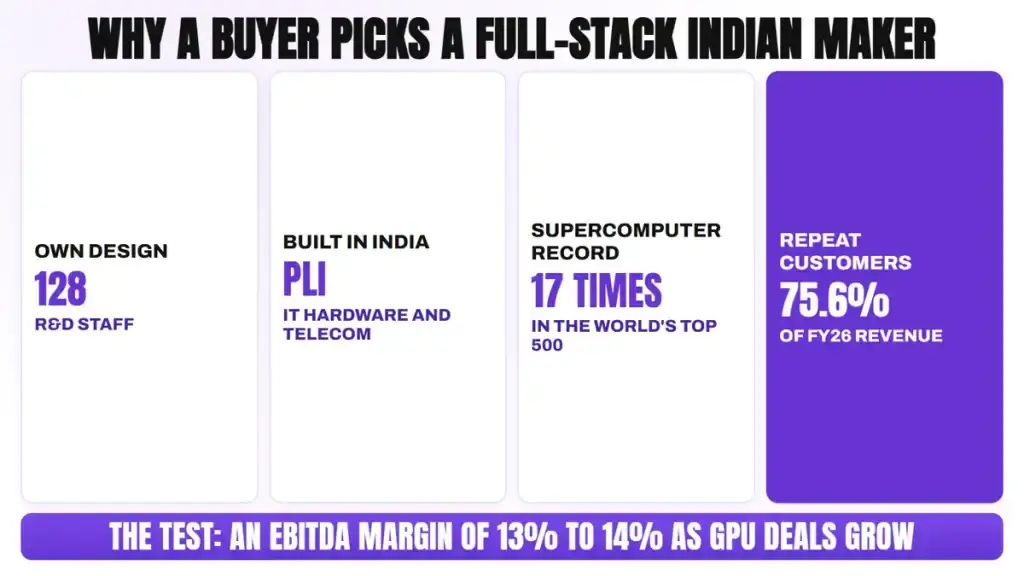
That table shows us why the margin is the real test of the moat. If buyers value the design and the software, Netweb should hold its EBITDA margin even as GPU-heavy orders grow. So far it has: the margin was 13.0% in FY26 and 15.1% in H1 FY27, close to management's 13% to 14% range.
Financials: Five Years of Revenue, Margins and Cash Flow
One quarter can mislead in a business where one order can be worth more than a quarter's revenue, so let's look at the full years together. Operating EBITDA here excludes other income, as the company reports it; the company's decks give it from FY23 onwards, and the first half of FY27 is shown for comparison.
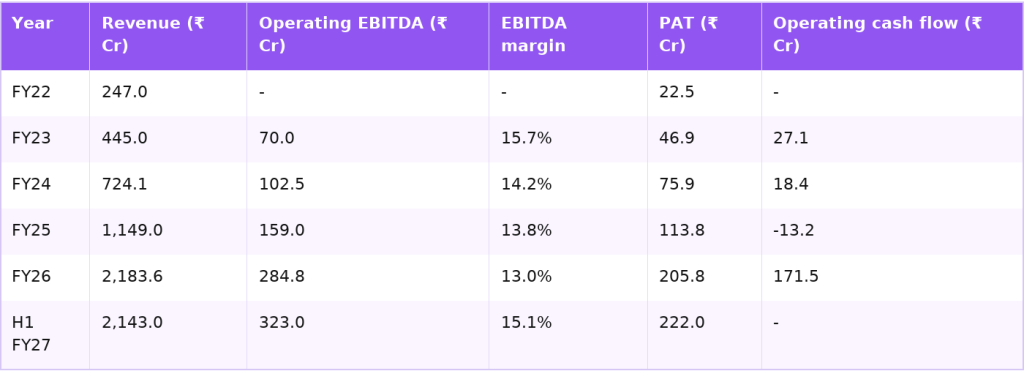
Revenue grew about 8.8 times in four years, from about ₹247.0 Cr in FY22 to ₹2,183.6 Cr in FY26, and profit after tax grew about 9.1 times, from about ₹22.5 Cr to ₹205.8 Cr. The operating EBITDA margin came down from 15.7% in FY23 to 13.0% in FY26 as GPU-heavy AI orders, which carry costly bought-in chips, became a larger part of revenue.
Cash flow has lagged profit. From FY23 to FY26, operating cash flow added up to about ₹203.8 Cr, against about ₹442.4 Cr of profit after tax, or about 46%. It was negative in FY25, at about ₹13.2 Cr, when receivables and inventory grew with the business, and it turned positive at about ₹171.5 Cr in FY26.
The balance sheet has carried that growth with equity more than debt. Borrowings were ₹321.3 Cr in September 2026, but after the ₹1,200 Cr share placement in August 2026 the company held net cash of about ₹13.6 Cr, and net worth stood at ₹2,104.1 Cr. The inventory built for large orders is the next test of how fast profit turns into cash.
"Accounting is the language of business."
— Warren Buffett
Netweb's income statement shows a business growing several times over. Its cash flow statement shows what that growth asks for in inventory and receivables, and both need to be read together.
What FY27 Could Look Like on Management's Numbers
So where does the business go from here? On 26 October 2026 management said it is targeting ₹4,000 Cr of revenue in FY27. That would be about 83% more than the ₹2,183.6 Cr of FY26. For the years after that, it plans to grow at 30% to 40% a year for at least the next two to three years.
That growth plan rests mostly on the three pillars, but management is also spending on two newer areas. One is physical AI, which means AI that controls machines in the real world, such as robots and autonomous systems. The other is quantum computing, where Netweb has started research on quantum simulators and emulators. Management has not given any revenue numbers for either, and says both are at an early stage of development.
Now let's put that revenue target against the first half. H1 FY27 revenue was ₹2,143.0 Cr. Reaching ₹4,000 Cr needs about ₹1,857 Cr in H2. That is about 17.6% more than H2 FY26, against 254.2% growth in the first half. It is also less than twice the Q2 FY27 revenue of ₹1,323.3 Cr. So the target looks covered by the order book, but it also implies a slower second half than the second quarter.
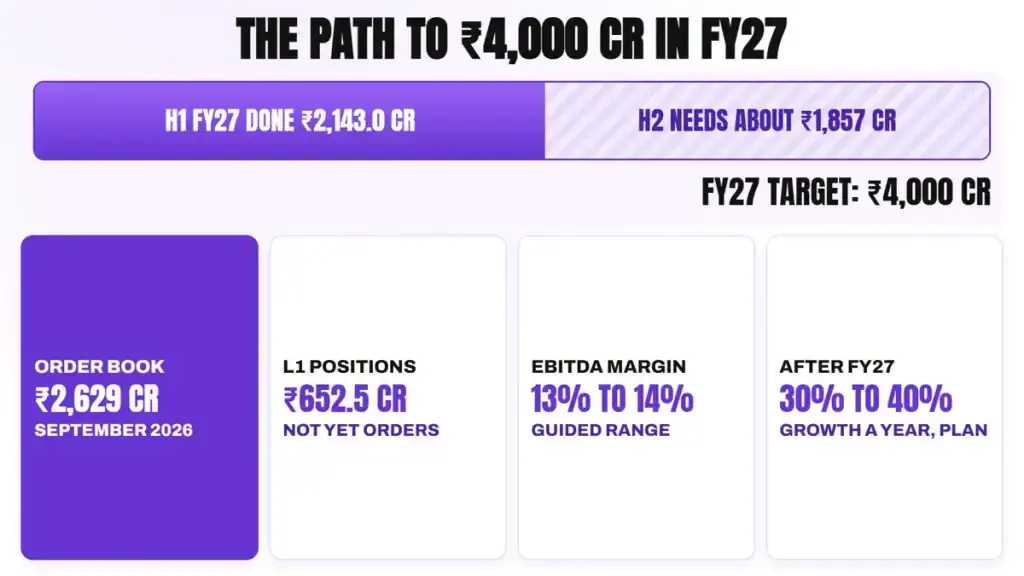
Beyond revenue, margins have their own guide. Management guides an operating EBITDA margin of 13% to 14% for the next couple of years. It says the business does not need a large new plant, since its facilities can support more than ₹3,000 Cr of revenue, and routine capex of about ₹20-25 Cr a year continues.
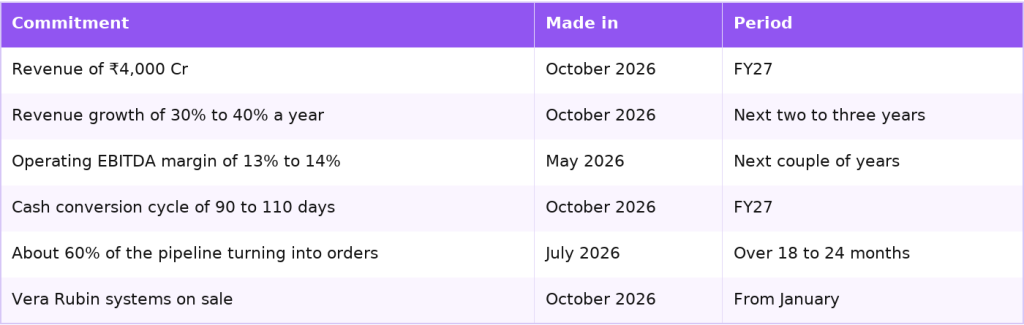
Those commitments are easier to judge against the past. So let's check what management said before against what it delivered.

That record shows us a clear pattern. Revenue targets have been met or beaten for three years, and the company raised its FY27 target within six months. The PAT margin has been the softer number, partly because finance cost rose as the business borrowed for inventory. That makes the margin and the working capital the numbers to watch from here.
Key Risks
Now let's look at what could go wrong for Netweb, because the latest half year has already shown some of these risks.
- Lumpy large orders: a few large AI orders now drive much of the revenue. If a large tender is delayed or goes to a rival, a quarter can look very different from the one before.
- Slower second half: the ₹4,000 Cr target implies about 17.6% growth in H2 FY27, against 254.2% in H1. The pipeline has to keep turning into orders for FY28 to grow on this base.
- Working capital and inventory: inventory days rose to 117 in September 2026, and the cash conversion cycle to 94 days. Operating cash flow was negative in FY25, at about ₹13.2 Cr, as the business grew. A delay in delivery would leave costly chips on the balance sheet.
- Rising finance cost: finance cost was ₹23.8 Cr in Q2 FY27, against ₹0.9 Cr a year ago, and bank guarantees came to about ₹136.3 Cr in March 2026.
- Chip supply and prices: Netweb depends on NVIDIA, AMD and others for the chips at the heart of each system. Management says memory prices have gone up by 200% or more, and it does not expect them to soften for about a year.
- Thinner margin on GPU deals: GPU servers carry costly bought-in chips, so the gross margin came down in Q2 FY27. If large deals get more competitive, the 13% to 14% EBITDA range could be harder to hold.
- Competition: global server brands and Taiwanese contract makers also sell GPU servers in India. Management did not name any rival when asked, but more competition is likely as AI orders grow.
- Customer and government concentration: government and defence buyers, and a few large cloud providers, make up a large part of demand. A change in government spending or in a cloud provider's plans would show in Netweb's numbers.
- Global AI spending: management says the rising cost of capital has not cut demand so far. A slowdown in global AI capex would still affect GPU prices and the pace of orders.
"Definitely, any sector which grows at such a fast rate, definitely, more eyebrows are there." - Sanjay Lodha, Chairman and Managing Director, October 2026
"You can't predict. You can prepare."
— Howard Marks
No one can say when the next large AI tender will close or where chip prices will go. What an investor can do is watch the order book, the margin and the inventory days each quarter, which is what the list below sets out.
Explore our Products
Research Framework

Emerging Titans
Combination of quantitative analysis, industry tailwinds, and management assessment - SPRINT investment philosophy

Tiny Titans
Heavy emphasis on scuttlebutt research, plant visits, and early on-ground signals
What to Track Next
If you follow Netweb, these are the signals that will show where it goes next.
- H2 FY27 revenue against the ₹4,000 Cr target, and the AI share of revenue
- The operating EBITDA margin against the 13% to 14% range, and finance cost after ₹23.8 Cr a quarter
- The order book after ₹2,629 Cr, the L1 after ₹652.5 Cr and the pipeline after about ₹11,152 Cr
- Inventory days after 117 and the cash conversion cycle against 90 to 110 days
- The first orders under NSM 2.0, expected around early 2027
- Vera Rubin system sales from January, and progress at the Taiwan research subsidiary
Conclusion
Let's put it all together. Netweb Technologies has grown from ₹445 Cr of revenue in FY23 to ₹2,183.6 Cr in FY26, and it made ₹2,143.0 Cr in the first half of FY27 alone. AI systems went from about 7% of revenue to 58.4% in the latest quarter, while the operating EBITDA margin stayed close to management's 13% to 14% range. The cautious thread is the second half, where the ₹4,000 Cr target implies much slower growth, and the working capital, where inventory days have risen to 117. The next two quarters will show which thread is stronger.
Still, the next step is bigger than one strong year. What happens next depends on whether the ₹11,152 Cr pipeline keeps turning into orders, whether the margin holds as GPU deals get larger, and whether the inventory built for those deals turns back into cash.
FAQs
What does Netweb Technologies do?
+Netweb designs, builds and installs high-end computers in India: supercomputers, GPU-based AI systems and private cloud and hyperconverged systems, mostly under its Tyrone brand. It also sells storage, data-centre servers and software. FY26 revenue from operations was ₹2,183.6 Cr.
How did Netweb Technologies do in Q2 FY27?
+Revenue from operations rose 335.7% to ₹1,323.3 Cr. AI systems brought in ₹773.1 Cr, or 58.4% of revenue. Operating EBITDA was ₹197.3 Cr at a 14.9% margin, and profit after tax rose 334.8% to ₹136.7 Cr.
What is Netweb's order book?
+The order book was ₹2,629 Cr in September 2026, with ₹652.5 Cr more in L1 positions, where Netweb was the lowest bidder but the order has not come yet. Its active pipeline was about ₹11,152 Cr, and management says about 60% of the pipeline usually turns into orders over 18 to 24 months.
Where does Netweb fit in the data-centre value chain?
+Netweb builds the computers that go inside data-centre halls and the software that runs them. It buys chips from NVIDIA, AMD and Intel, designs and builds the systems in Faridabad, and sells to government programmes such as the IndiaAI Mission, cloud providers and large enterprises. It does not build or run data centres itself.
What revenue does Netweb target for FY27?
+Management targets ₹4,000 Cr of revenue in FY27, against ₹2,183.6 Cr in FY26. H1 FY27 revenue was ₹2,143.0 Cr, so about ₹1,857 Cr is needed in the second half. It guides an operating EBITDA margin of 13% to 14%.
What are the main risks for Netweb Technologies?
+A few large AI orders drive much of the revenue, so quarters can be uneven. Inventory days rose to 117 in September 2026 and finance cost to ₹23.8 Cr in the quarter. Netweb also depends on NVIDIA, AMD and others for chips, and competition is likely to rise as AI orders grow.

High growth stock specialist, Value Educator
Shashank Mahajan is an equity research professional with over 12 years of experience in identifying high-potential SME and micro-cap stocks at an early stage. He follows a rigorous scuttlebutt research–driven approach, combining on-ground insights with deep financial analysis. Shashank specializes in uncovering under-researched and under-owned companies with strong management quality and long-term growth potential. Through disciplined research and early identification, he focuses on spotting tomorrow’s market leaders before they enter the mainstream investor radar.
More about Shashank Mahajan →
Azad Engineering vs MTAR vs Unimech: Aerospace Parts

Subros vs Lumax Auto vs Sona BLW: EV Auto Parts Compared
Jyoti CNC vs Macpower CNC: Machine Tool Makers Compared
Data Patterns vs Astra Microwave vs Apollo Micro

Himadri vs PCBL: Carbon Black and Battery Materials

Inox Wind vs Suzlon: Wind Turbine Makers Compared
Explore our Products
Research Framework
Emerging Titans
Combination of quantitative analysis, industry tailwinds, and management assessment - SPRINT investment philosophy
Tiny Titans
Heavy emphasis on scuttlebutt research, plant visits, and early on-ground signals



India's Aerospace Opportunity
Global Demand. Supply Bottlenecks. Opportunities Ahead.
Don't Miss This Exclusive Webinar!
Join Value Educator to decode the key trends shaping India's aerospace sector and learn how to identify tomorrow's potential leaders in the space.
- How the aircraft value chain works, layer by layer
- Indian companies supplying global aircraft makers
- A framework to judge any aerospace company

 Orders
 Subscription
 Share with friends


Required Details
₹23999.00
(12 month subscription)
As per SEBI regulations, all users are mandated to complete the KYC that is validated for 1 year. Post payment, you will be redirected to the KYC screen


No comments yet. Be the first to comment!