
Piramal Pharma: CDMO Revenue Up 36% After a Lost Year
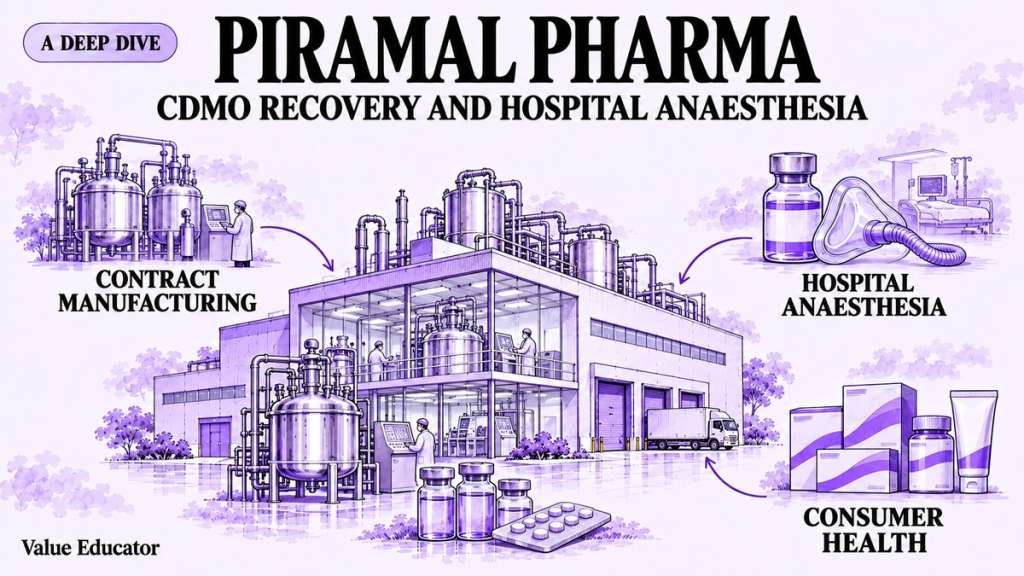
In the year to March 2026, an Indian drug company lost almost half of one of its best revenue lines. Its income from making patented medicines for global drug companies had grown from $52 million in FY23 to $179 million in FY25. In FY26 it came to $96 million. One large customer had built up too much stock of one patented product, and it stopped ordering while it used that stock up.
The company had not lost the customer, and no plant had failed an inspection. But the hit was large enough to pull the whole group down. Revenue came to ₹8,869 Cr, 3% lower than the year before, and after a one-time write-down, the year ended with a loss of ₹326 Cr.
So to see why one customer's stock could matter so much, we need to know how this kind of company earns. It is a contract development and manufacturing organisation, or CDMO, which means a company that makes medicines for other drug companies. A CDMO does not own the medicines it makes. It develops the manufacturing process for a drug company's molecule, makes small batches for clinical trials and, if the drug is approved, makes it at commercial scale. The drug company owns the patent and sells the medicine. The CDMO earns a fee for its science and its plants.
The most valuable part of that work is called on-patent commercial manufacturing, which means making a drug that is already approved and still under patent. Volumes are steady and prices are good, because the drug company cannot easily move a regulated process to another plant. But when a customer cuts its stock, the CDMO feels it right away.
"Know what you own, and know why you own it."
— Peter Lynch
For Piramal, knowing what you own means knowing that more than half of the revenue comes from other companies' medicines, and that their stock decisions can move this company's numbers.
That company is Piramal Pharma Ltd (NSE: PPLPHARMA). Besides its contract business, it is a world leader in gases that keep patients asleep during surgery, and it sells consumer brands such as Little's and Lacto Calamine in India. It has 17 development and manufacturing facilities and a commercial presence in more than 100 countries.
Since then, the picture looks very different. The destocking has passed, orders from biotech companies have come back, and all three businesses are growing again.
Piramal Pharma in five numbers
- Q2 FY27 revenue of ₹2,617 Cr, up 28%
- CDMO revenue of ₹1,424 Cr in the quarter, up 36%
- An EBITDA margin of 14.7%, against 11.0% a year ago
- A 48% value share of the US sevoflurane market
- An FY27 revenue growth outlook raised to 19% to 20%
So the revenue has come back. The harder question is why a company with nearly ₹9,000 Cr of revenue still earns so little profit. Let's first understand the company, and then look at the latest quarter.
Piramal Pharma: Company Overview
Piramal Pharma Ltd was incorporated in 2020 and has its registered office in Mumbai. It was demerged from Piramal Enterprises and listed on the BSE and NSE in FY23. It runs three businesses: a contract development and manufacturing business for global drug companies, a complex hospital generics business led by inhalation anaesthesia gases, and a consumer healthcare business with brands such as Little's, Lacto Calamine, CIR and i-range. It has 17 development and manufacturing facilities across India, the US, the UK and Canada, including one through its investment in Yapan Bio, and a commercial presence in more than 100 countries. It had 7,285 permanent employees in FY26. It also holds 49% of a joint venture with AbbVie that sells eye-care medicines in India. Nandini Piramal is the Chairperson, Peter DeYoung the CEO of Global Pharma and Vivek Valsaraj the Chief Financial Officer. Revenue from operations was ₹8,869 Cr in FY26, and net debt was ₹4,859 Cr in September 2026. Read this Debt to Equity Ratio Explained
"The stock market is a device for transferring money from the impatient to the patient."
— Warren Buffett
Piramal's plants were built for more work than they now do. Filling them takes years of trials, approvals and audits, and that kind of business rewards patience more than quick judgements.
The Quarter All Three Businesses Grew Again
Let's look at Q2 FY27, the July to September quarter in which all three businesses grew again, which the company reported on 27 October 2026. Revenue from operations was ₹2,617 Cr, up 28% from ₹2,044 Cr a year ago. It was also 15% higher than the ₹2,270 Cr of Q1 FY27.
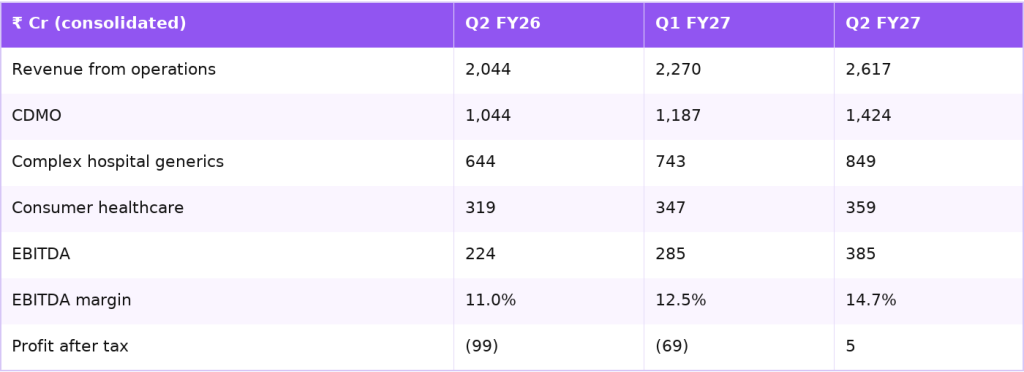
As we can see, all three businesses grew, but at different speeds. CDMO revenue rose 36% to ₹1,424 Cr. Complex hospital generics, the anaesthesia and injectables business, rose 32% to ₹849 Cr. Consumer healthcare grew 13% to ₹359 Cr.
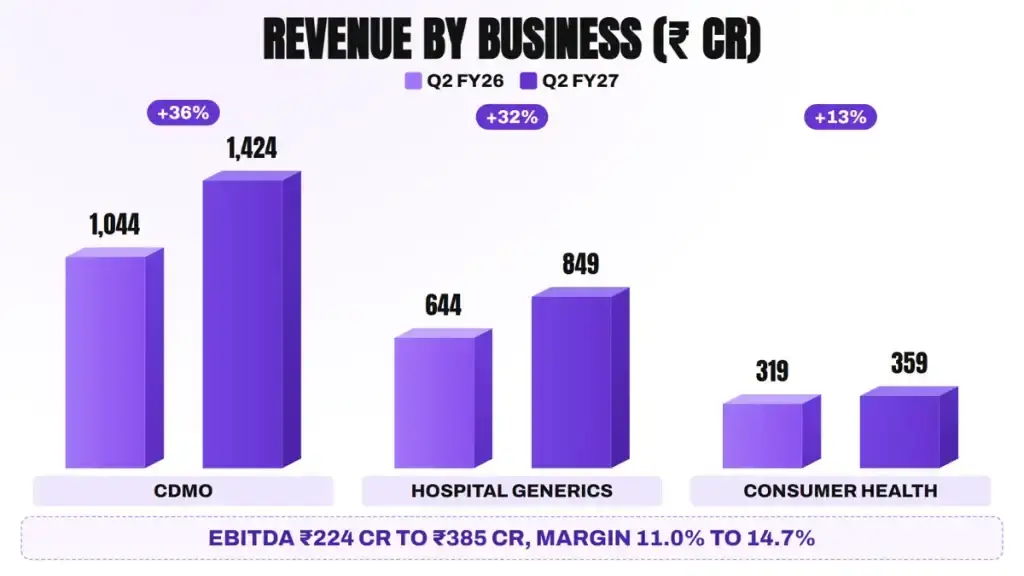
EBITDA grew much faster than revenue, and the reason is in the cost lines. Read this EBITDA Explained: Uses and Limits Material costs rose 29%, roughly in step with revenue. But employee costs rose only 17%, to ₹714 Cr, and other expenses rose 13%, to ₹648 Cr. These are largely fixed costs: the scientists, plants and quality teams are there whether a plant runs half full or nearly full. So when more batches went through the same plants, most of the extra gross profit reached EBITDA. That is operating leverage. EBITDA rose 72% to ₹385 Cr, and the margin rose to 14.7% from 11.0%.
The same pattern shows in the first half. H1 FY27 revenue was ₹4,887 Cr, up 23%. EBITDA was ₹669 Cr, up 72%, at a margin of 13.7% against 9.8% a year ago.
Why ₹385 Cr of EBITDA Left Only ₹5 Cr of Profit
Now let's follow that ₹385 Cr down to the bottom line, because this is where Piramal differs from most Indian drug makers. Depreciation took ₹233 Cr and interest took ₹88 Cr. The company's share of profit from associates added ₹18 Cr. That left a profit before tax of ₹82 Cr.
Then tax took ₹77 Cr of that ₹82 Cr. Almost all of it. So the profit after tax was ₹5 Cr, against a loss of ₹99 Cr a year ago. For the half year, the company still had a loss of ₹64 Cr.
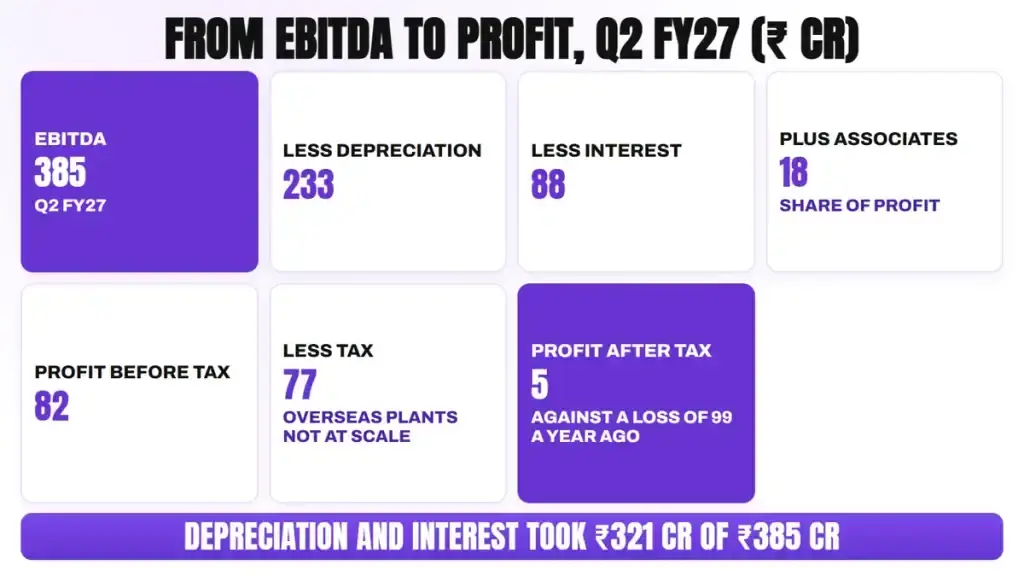
That tax line looks strange, but it has a simple cause. Piramal pays tax plant by plant, country by country. Its Indian plants and some overseas plants make good profits and pay tax on them. Other overseas plants are not yet at scale, so they run at a loss, which cannot be set off against profits elsewhere. The tax bill is then large compared with the group's small total profit.
That is how the CFO explained it in July 2026. The company does not pay more than the local rate anywhere: below 25% in India and below 21% in the US. Its tax rate should settle at a normal 24-25% as the overseas plants fill up. In Q1 FY27 there was also a one-off, because a past R&D tax credit at an overseas plant was disallowed, and the company plans to appeal.
Both depreciation and interest have the same root. Read this Interest Coverage Ratio Explained Over the years, Piramal built and bought plants in the US, the UK and Canada. Those plants carry heavy fixed costs and depreciation whether they are full or not. So the path to real profit runs through one thing: more batches in the plants it already owns.
"In the short run, the market is a voting machine but in the long run, it is a weighing machine."
— Benjamin Graham
A single quarter of profit says little on its own. What gets weighed over time is whether the plants fill up and the margin climbs year after year.
What the profit gap says: Depreciation and interest alone took ₹321 Cr of the ₹385 Cr of EBITDA in Q2 FY27. These costs barely move with volume, so each extra batch through the existing plants adds almost fully to profit before tax.
The Balance Sheet After Two Deals
Next, let's look at the balance sheet, where two deals show up. Net debt was ₹4,859 Cr at the end of September 2026, against ₹4,164 Cr in March. Intangible assets, including goodwill, rose to ₹4,254 Cr from ₹3,841 Cr.
That rise came mostly from two deals. In the CHG business, Piramal completed the purchase of Kenalog, an injectable steroid brand, for an upfront $35 million and up to $65 million more if targets are met. In the CDMO business, it bought a controlling stake in Yapan Bio, a biologics and vaccines company in which it already held a minority stake. Capital work in progress rose to ₹1,271 Cr from ₹1,100 Cr, as the US expansions continued.
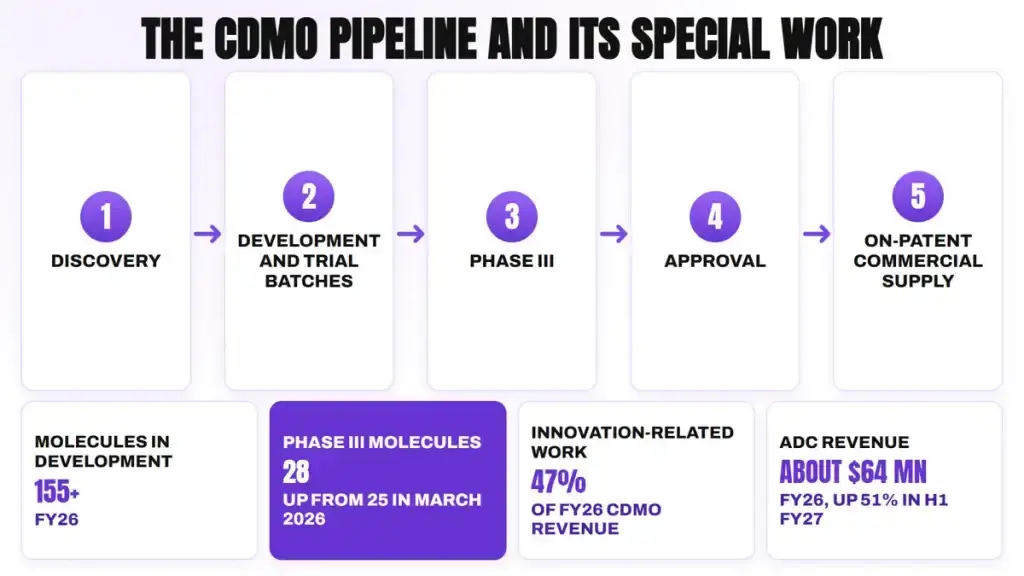
In the half, Piramal added 22 new CDMO customers and hosted 110 customer audits. Its plants cleared 12 regulatory inspections. Molecules in Phase III trials rose to 28 from 25 in March 2026. Phase III is the last and largest stage of clinical trials before a drug goes to the regulator for approval.
How Piramal Pharma Lost a Year and Got It Back
Now that we have seen the quarter, let's go back and see what went wrong in FY26. Piramal Pharma was demerged from Piramal Enterprises and listed on the BSE and NSE in FY23. Its first year as a listed company was difficult. Revenue grew 8%, but the EBITDA margin was 12%, and the company made a loss of ₹186 Cr. Part of that came from a one-time inventory charge of ₹68 Cr.

Then came two good years. In FY24 CDMO revenue grew 19%, and in FY25 it grew 15%. On-patent commercial manufacturing did most of the work, rising from $52 million in FY23 to $179 million in FY25. Group revenue crossed $1 billion in FY25, and the EBITDA margin reached 17%.
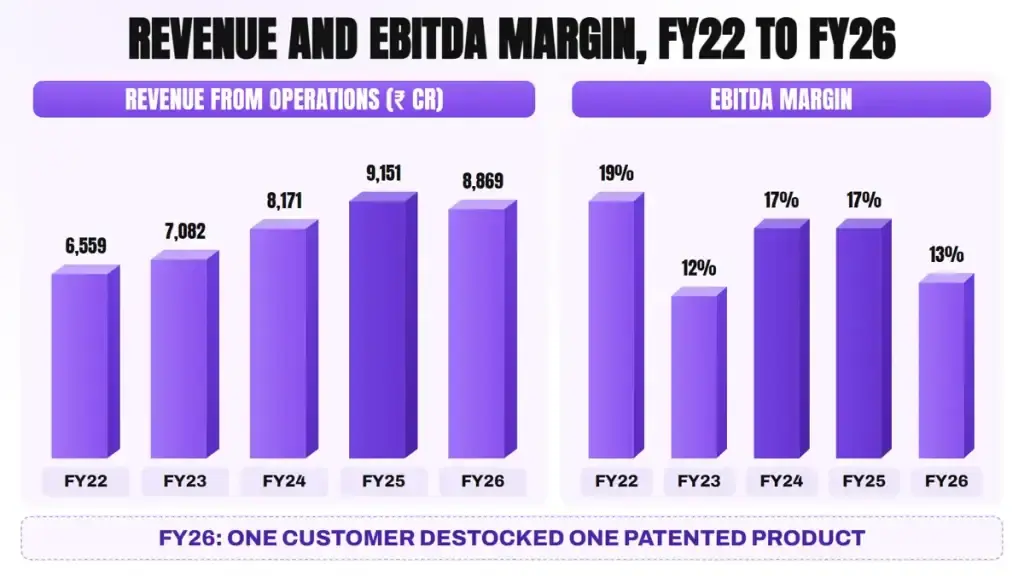
Then FY26 brought three problems together. First came the destocking we saw in the opening. Then came fewer new orders in the first half, because US biotech companies had found it hard to raise money, and with trade rules uncertain, many delayed decisions. On top of that, sales of anaesthesia gases outside the US softened, as competition there had increased.
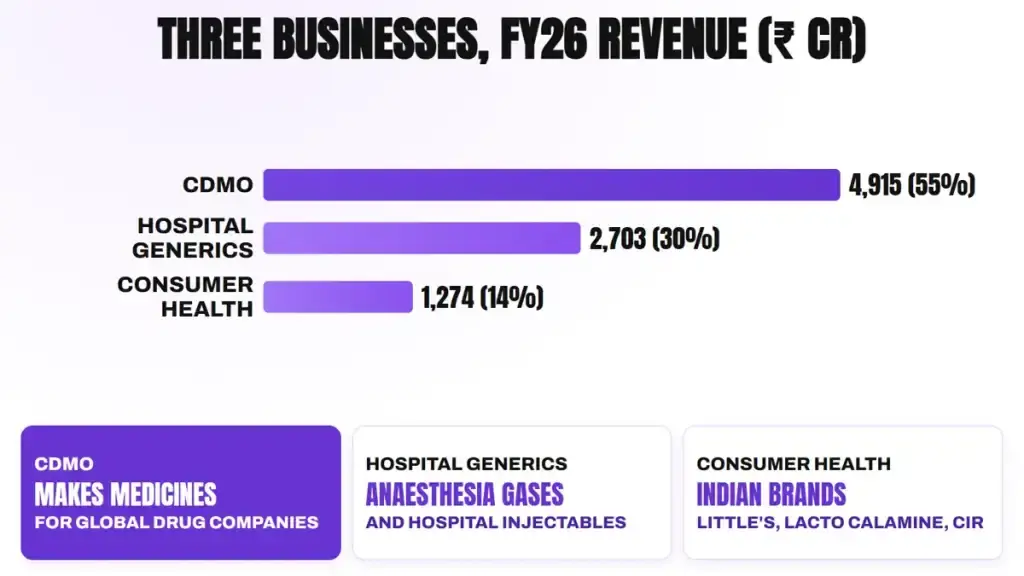
As a result, CDMO revenue came to ₹4,915 Cr, 10% lower than in FY25. EBITDA was 28% lower at ₹1,135 Cr, and the margin went to 13% from 17%. In Q4 FY26 the company also wrote off ₹176 Cr of an intangible asset under development, a product it no longer expected to earn enough from. The net loss for the year was ₹326 Cr.
Still, not everything went wrong in FY26. The company says that adjusted for the destocking, revenue grew both in Q4 and in the full year. Consumer healthcare grew 17%, and CHG grew 3%. Operating cash flow was strong too: ₹1,652.6 Cr in FY26, against ₹892.3 Cr in FY25. And from September 2025, US biotech funding began to recover. The company cites industry data showing that it rose 75% year on year in H2 FY26.
"FY26 was a transitional year, shaped by external disruptions and certain business-specific factors. Despite these challenges, we exited the year on a stronger note, with clear momentum across all our businesses." - Nandini Piramal, Chairperson, April 2026
Three Businesses With Three Different Engines
Now let's split the company into its three businesses, because each one makes money in a different way. Piramal reports one segment for accounts, but it shows revenue for each business every quarter. Read this Segment-Wise Revenue Analysis Explained
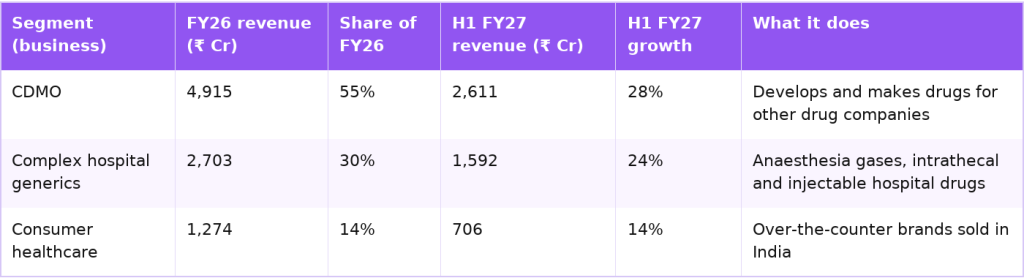
These three share a name but little else, as you will see. The CDMO business sells science and plant time to drug companies. CHG sells a few hard-to-make products to hospitals around the world. PCH sells brands to Indian shoppers.
Contract Manufacturing for Global Drug Companies
Let's start with the CDMO business, which earns more than half the revenue. It has 15 manufacturing and development sites across the US, Europe, Canada and India. It serves over 500 customers and has more than 155 molecules under development for them.
Here is how a molecule moves through such a network. A drug company brings a new molecule at an early stage. The CDMO works out how to make it and makes small batches for trials. If the drug passes Phase III and is approved, the CDMO that made the trial batches is often the natural choice to make it commercially. That is why the 28 Phase III molecules matter: each one is a possible future source of on-patent commercial revenue.
In FY26, 47% of CDMO revenue came from such innovation-related work. Big Pharma and emerging biotech companies brought 65% of revenue, and 79% came from the regulated markets of the US, Europe and Japan. Long relationships matter too: 13 of the top 20 customers have worked with Piramal for more than seven years.
That work also includes differentiated offerings, areas where few CDMOs can compete. These include high-potency drugs, sterile injectables, peptides and antibody drug conjugates, or ADCs. An ADC is an antibody that carries a strong cancer-killing drug straight to a tumour cell, so it needs very careful handling. Differentiated offerings made up 40% of CDMO revenue in FY26.
ADCs are Piramal's strongest niche. Its Grangemouth plant in Scotland was the world's first US FDA-approved commercial ADC CDMO site, and it has made more than 1,500 ADC batches. ADC services earned about $64 million in FY26, and that revenue grew 51% in H1 FY27.
Now the company is spending $90 million to add to this in the US. At Lexington, it is adding sterile injectable capacity to raise output from 104 to more than 240 batches a year. At Riverview, it has opened a commercial-scale suite for payload-linkers, the drug-and-chemical part of an ADC. Together, the two sites will offer every step of an ADC under one company.
Beyond the type of work, location also decides the margin. Overseas plants earn gross margins of 75-85%, against 55-65% at the Indian plants, because they handle more complex work and charge more for it. But overseas plants also cost more to run, so they reach good EBITDA margins only when they are full. About 48% of CDMO revenue comes from outside India. That is why the CFO says higher use of the overseas plants is the main path to better margins. Volume is the key.
Separately, the CDMO business also supplies eye-care products to a joint venture with AbbVie in India, in which Piramal holds 49%. That venture is a leader in Indian ophthalmology, with brands such as Lumigan and Combigan. It reported revenue of ₹526 Cr in FY26, with a profit margin of 23%. Piramal's share of its profit shows up in the associates line.
Anaesthesia Gases and Hospital Drugs
Next, let's look at complex hospital generics, or CHG, which brings in about 30% of revenue. Its biggest product line is inhalation anaesthesia: gases such as sevoflurane, desflurane and isoflurane. A patient breathes them in through a mask during surgery to stay unconscious. Hospitals buy them in bulk through group purchasing organisations, which pool buying for many hospitals.
That anaesthesia line made up 64% of CHG revenue in FY26. Piramal is the leader in the US sevoflurane market, with a 48% value share in Q2 FY27, up from 45% in March 2024. It makes these gases from the starting chemical onwards. The starting material is made at Dahej in Gujarat, and the gases at Bethlehem in the US and at Digwal in Telangana. This chain gives it control over cost and supply.
Beyond the US, this business is harder. Chinese makers have pushed prices down in several markets. Piramal's answer has been to supply sevoflurane from its lower-cost Digwal plant to price-sensitive markets. In Q1 FY27 those ex-US sales started to pick up.
Besides anaesthesia, the rest of CHG is a set of hard-to-make hospital drugs. Intrathecal therapy, 15% of CHG revenue, means drugs delivered straight into the fluid around the spinal cord. Piramal is number one in the US for intrathecal baclofen, a drug for severe muscle stiffness. Injectable pain management, 11%, includes Sublimaze, a leading pain brand in several countries. That line has suffered from a supplier's shortages, and the company expects steady supplies from FY28.
Alongside these, Kenalog is the newest product. It is an injectable steroid used against inflammation in conditions such as arthritis. Kenalog lost patent protection more than 30 years ago, yet it still faces little competition in most of its markets because it is hard to make. Its supplies began in Q2 FY27, and management expects it to be an important growth driver in FY27. About 51% of CHG revenue came from the US in FY26, and 73% from the regulated markets of the US, Europe and Japan.
Consumer Brands Sold in India
Finally, let's look at Piramal Consumer Healthcare, or PCH, the smallest business, with about 14% of revenue. It sells over-the-counter products, which people buy without a prescription. It has more than 25 brands across baby care, skin care, women's health, pain relief and digestion.
Six of these are power brands: Little's, Lacto Calamine, CIR, i-range, Tetmosol and Polycrol. They made up 52% of PCH sales in FY26, against 42% in FY23, and grew 24% in FY26. In H1 FY27 they grew 21% and made up 53% of sales.
Another driver is e-commerce. It made up 27% of PCH sales in FY26, against 16% in FY23, and grew 48% that year. In H1 FY27 it grew 32% and made up 28% of sales. The products also reach more than 1,80,000 chemists and cosmetic shops and more than 13,000 modern trade outlets.
This business has grown steadily, from ₹874 Cr of revenue in FY23 to ₹1,274 Cr in FY26. To keep that growth, it spends about 11-12% of its sales on media and trade promotion each year. One change is coming: a distribution agreement with Bayer ends in December 2026. The company says the handover is being managed jointly and should have no material impact on its FY27 guidance.
Why Drug Companies Rarely Leave a Qualified CDMO
Now that we have seen all three businesses, let's understand the moat. A drug company that has approved a manufacturing process at one plant cannot simply move the work. Every change of site needs new validation batches and, often, fresh approval from regulators in each country. So once a CDMO makes an approved drug, it usually keeps that work for years. Read this Economic Moat Explained
That stickiness depends on trust, and trust in this industry depends on inspections. Since FY2012, Piramal's sites have cleared 415 regulatory inspections, including 49 by the US FDA, and 2,120 customer audits. None of its US FDA inspections has ended in an Official Action Indicated status. That is the FDA's most serious outcome, which can stop a plant from shipping to the US. In FY26 alone it hosted 209 customer audits, its highest ever.
Breadth also helps Piramal keep a customer. It can take a molecule from discovery to commercial supply, and from an Indian plant to a US one. It has run more than 140 integrated projects since 2020. Of its top 20 customers, 13 work with two or more of its sites, and 10 use both an Indian and an overseas site. The company measures customer satisfaction too. Its Net Promoter Score was 60 in FY26, while a third-party benchmark the company cites puts the average CDMO below zero.
Unlike the CDMO business, the anaesthesia business has a moat built on its cost chain. Piramal makes its own starting material, has plants on two continents, and sells to more than 6,000 hospitals in over 100 countries. A new entrant would need years of approvals in each market and would still have to win group purchasing contracts. That takes years.
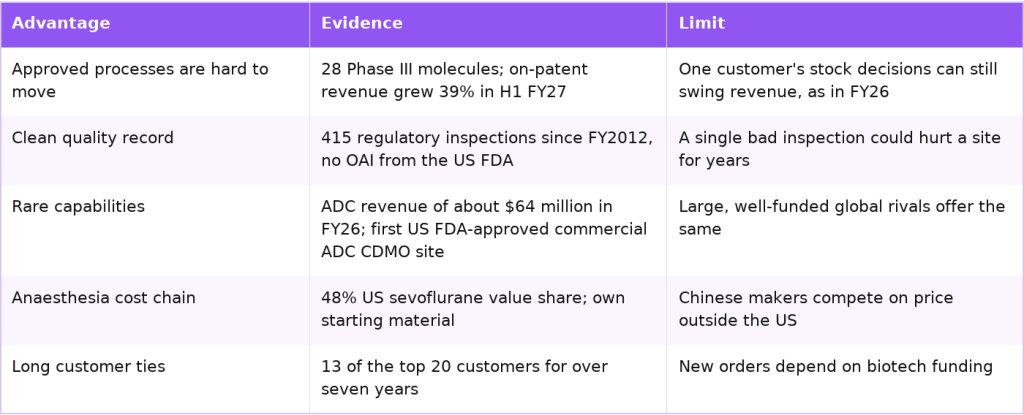
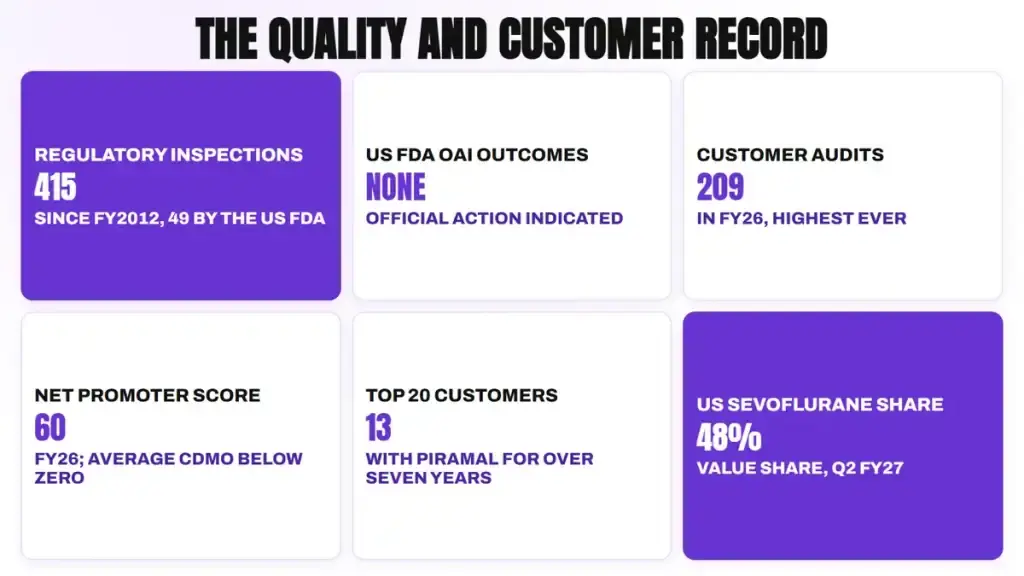
That table shows us why margins are the real test of this moat. If the moat holds, more batches should fill the existing plants and lift the margin without much new spending. The margin rose to 14.7% in Q2 FY27. The question is how far it can go.
Financials: Five Years of Revenue, Margins and Profit
One year can mislead in a business where a single customer's stock decisions move revenue, so let's look at five full years together. These are consolidated figures as the company reported them. EBITDA here is the company's own figure, which includes other income. FY22 is shown as the company first reported it, before the demerger, so it is not strictly comparable with later years.
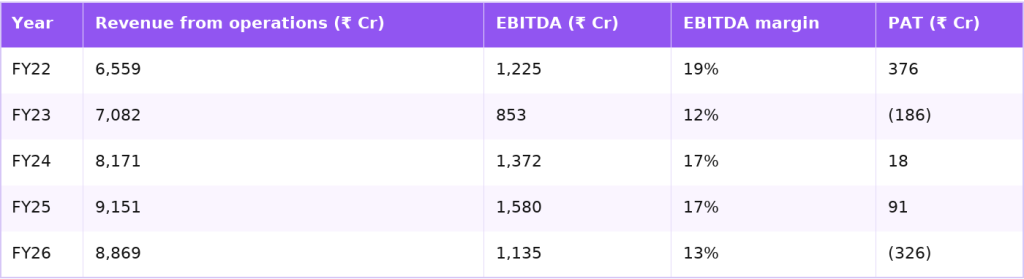
Revenue grew from about ₹6,559 Cr in FY22 to about ₹9,151 Cr in FY25 before the FY26 destocking. Profit did not follow. Over the five years, profit after tax added up to a small loss of about ₹27 Cr, because depreciation, interest and tax took almost all of the EBITDA each year.
Cash flow tells a better tale than profit. Operating cash flow was about ₹1,652.6 Cr in FY26, against about ₹892.3 Cr in FY25, helped by lower working capital. The company invested about $94 million in capex in FY26, across growth and maintenance projects.
The balance sheet still carries debt from the years of building and buying plants. Net debt was ₹4,859 Cr in September 2026, after the Kenalog purchase and the Yapan Bio stake. That debt, and the interest on it, is why margin gains matter so much for this company.
"Rule No. 1: Never lose money. Rule No. 2: Never forget rule No. 1."
— Warren Buffett
Piramal's five-year table shows how hard it is to turn revenue into profit when plants, debt and tax sit between the two. The margin is what decides how much reaches shareholders.
What FY27 and FY30 Could Look Like on Management's Numbers
So where does the company go from here? On 27 October 2026, management raised its FY27 outlook. It now expects revenue to grow 19% to 20%, with meaningfully higher profitability.
Now let's put that outlook against the first half. Growth of 19% to 20% on FY26 revenue of ₹8,869 Cr gives about ₹10,554-10,643 Cr for FY27. H1 FY27 revenue was ₹4,887 Cr, so H2 needs about ₹5,667-5,756 Cr. That is about 15.8-17.7% more than the ₹4,892 Cr of H2 FY26, against 23% growth in the first half. The company also notes that H2 is usually stronger than H1 for its CDMO business, as more batches are delivered at the end of the year.
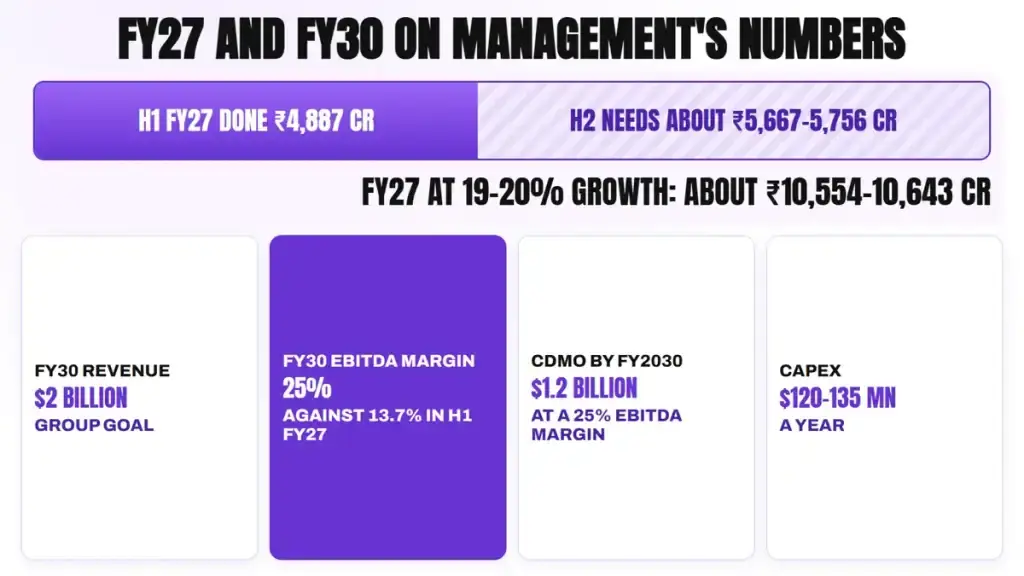
Beyond FY27, management has set long-term goals. By FY30 it aims to be a $2 billion revenue company with a 25% EBITDA margin and a high-teens return on capital employed. For the CDMO business alone, it targets $1.2 billion of revenue by FY2030, also at a 25% EBITDA margin.
Those goals need spending. The company has guided for capex of $120-135 million a year, and it had spent about $21 million of it in Q1 FY27. Most of the margin gain is meant to come from the overseas CDMO plants filling up, not from new plants.
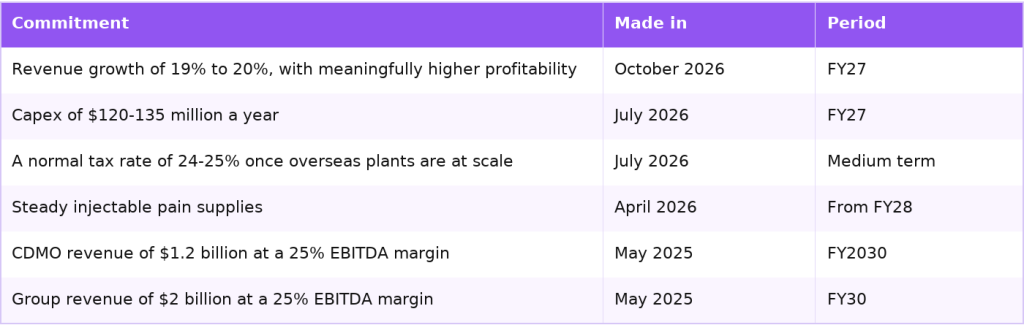
Those commitments are easier to judge against the past. So let's check what management said before against what it delivered.

That record shows a clear pattern. Revenue outlooks have been met or raised, but margins have fallen short, because the FY26 destocking hit the high-margin work hardest. That makes the second-half margin the number to watch from here.
Key Risks
Now let's look at what could go wrong for Piramal Pharma, because FY26 already showed some of these risks.
- Customer stocking cycles: one customer's destocking of one patented product took on-patent revenue from $179 million in FY25 to $96 million in FY26. The same could happen again with another product.
- Thin profit: depreciation, interest and tax took almost all of Q2 FY27's ₹385 Cr EBITDA, leaving ₹5 Cr. The H1 FY27 result was still a loss of ₹64 Cr.
- Debt: net debt rose to ₹4,859 Cr in September 2026 from ₹4,164 Cr in March, after two deals. Interest cost was ₹176 Cr in H1 FY27.
- Margin gap: the FY27 margin target of about 19-20%, set in May 2025, compares with 13.7% in H1 FY27.
- Biotech funding: early-stage orders depend on US biotech funding, which fell in early FY26 before it recovered. Customer decisions remain slow.
- Competition in anaesthesia: Chinese makers compete on price outside the US, which softened ex-US anaesthesia sales in FY26.
- Supply and write-downs: the injectable pain line depends on an outside supplier, with steady supply expected only from FY28. In Q4 FY26 the company wrote off ₹176 Cr on a product under development.
- Tax disputes: contingent liabilities include about ₹78.29 Cr of disputed excise, service tax, customs and GST demands at March 2026. A disallowed R&D tax credit at an overseas plant is under appeal.
- Consumer distribution: the Bayer distribution agreement ends in December 2026.
"The single largest driver for our EBITDA margins to improve will be operating leverage and related to getting more of our facilities at the target scale." - Peter DeYoung, CEO Global Pharma, July 2026
"All I want to know is where I'm going to die, so I'll never go there."
— Charlie Munger
For Piramal, the places to avoid are clear from the list above: one customer's stock cycle, a thin profit line and the debt behind it. The tracking list below shows how to see which way each one goes.
Explore our Products
Research Framework

Emerging Titans
Combination of quantitative analysis, industry tailwinds, and management assessment - SPRINT investment philosophy

Tiny Titans
Heavy emphasis on scuttlebutt research, plant visits, and early on-ground signals
What to Track Next
If you follow Piramal Pharma, these are the signals that will show where it goes next.
- H2 FY27 revenue against the 19-20% growth outlook, about ₹5,667-5,756 Cr for the half
- The EBITDA margin after 14.7%, and the gap to the 25% goal for FY30
- CDMO order inflows, the number of Phase III molecules after 28, and on-patent revenue
- The tax rate and whether profit after tax stays positive
- Net debt after ₹4,859 Cr, and capex against $120-135 million a year
- Kenalog sales, ex-US anaesthesia sales and the US sevoflurane share after 48%
Members can read our full Research Desk report on Piramal Pharma, with its detailed scorecard and section-by-section analysis.
Conclusion
Let's put it all together. Piramal Pharma's revenue grew from ₹7,082 Cr in FY23 to ₹9,151 Cr in FY25, came to ₹8,869 Cr in FY26 when one customer destocked, and grew 23% again in H1 FY27. Its CDMO revenue rose 36% in Q2 FY27, and the EBITDA margin rose to 14.7%. The cautious thread is the profit line, where tax and interest still take almost all of the EBITDA. The next two quarters will show which thread is stronger.
Still, the next step is about profit, not revenue. What happens next depends on whether new orders keep filling the overseas plants, whether the margin can climb from the low teens towards 25%, and whether that finally turns a large business into a profitable one.
FAQs
What does Piramal Pharma do?
+Piramal Pharma has three businesses. Its CDMO business develops and makes medicines for global drug companies, its complex hospital generics business sells inhalation anaesthesia gases and hospital injectables, and its consumer healthcare business sells brands such as Little's and Lacto Calamine in India. FY26 revenue from operations was ₹8,869 Cr.
How did Piramal Pharma do in Q2 FY27?
+Revenue from operations rose 28% to ₹2,617 Cr, with CDMO revenue up 36% to ₹1,424 Cr. EBITDA rose 72% to ₹385 Cr at a 14.7% margin, and profit after tax was ₹5 Cr, against a loss of ₹99 Cr a year ago.
Why did Piramal Pharma's revenue drop in FY26?
+One large customer destocked one patented product, so Piramal's on-patent commercial manufacturing revenue went from $179 million in FY25 to $96 million in FY26. New orders were also slower in the first half, and ex-US anaesthesia sales softened. Revenue came to ₹8,869 Cr, 3% lower than in FY25.
Why does Piramal Pharma make so little profit?
+Depreciation and interest took ₹321 Cr of its ₹385 Cr of EBITDA in Q2 FY27, and tax took ₹77 Cr of the ₹82 Cr profit before tax. Several overseas plants are not yet at scale, so their losses cannot offset tax paid on profitable plants elsewhere.
What is Piramal Pharma's outlook for FY27 and FY30?
+In October 2026 the company raised its FY27 revenue growth outlook to 19% to 20%. By FY30 it aims for $2 billion of revenue at a 25% EBITDA margin, and $1.2 billion of CDMO revenue at a 25% margin by FY2030.
What are the main risks for Piramal Pharma?
+A customer's stock decisions can swing CDMO revenue, as in FY26. Profit is thin, net debt was ₹4,859 Cr in September 2026, the FY27 margin target of about 19-20% compares with 13.7% in H1, and Chinese makers compete on anaesthesia prices outside the US.

High growth stock specialist, Value Educator
Shashank Mahajan is an equity research professional with over 12 years of experience in identifying high-potential SME and micro-cap stocks at an early stage. He follows a rigorous scuttlebutt research–driven approach, combining on-ground insights with deep financial analysis. Shashank specializes in uncovering under-researched and under-owned companies with strong management quality and long-term growth potential. Through disciplined research and early identification, he focuses on spotting tomorrow’s market leaders before they enter the mainstream investor radar.
Glenmark: The USD 700 Mn Cancer Deal and Its Brands
Pharma Stocks in India 2026: Generics, APIs and CDMOs
Granules India: From Paracetamol to a 65% Gross Margin
Natco Pharma: After Revlimid, 29 Patent Challenges

Shilpa Medicare: Cancer APIs, Films and Biosimilars
Alembic Pharma: US Plants Pay Back, Margin Hits 22.2%
Explore our Products
Research Framework
Emerging Titans
Combination of quantitative analysis, industry tailwinds, and management assessment - SPRINT investment philosophy
Tiny Titans
Heavy emphasis on scuttlebutt research, plant visits, and early on-ground signals



Modern Warfare to Multibaggers
Key Trends. Strategic Shifts. Opportunities Ahead.
Don't Miss This Exclusive Webinar!
Join Value Educator to decode the key trends shaping India's defence sector and learn how to identify tomorrow's potential leaders in the space.
- In-depth research on India's defence sector
- Live Q&A session
- Actionable takeaways for long-term investors

 Orders
 Subscription
 Share with friends


Required Details
₹23999.00
(12 month subscription)
As per SEBI regulations, all users are mandated to complete the KYC that is validated for 1 year. Post payment, you will be redirected to the KYC screen


No comments yet. Be the first to comment!