
PTC Industries: The Titanium Melt Shop Behind Aerolloy

The world's two big aircraft makers ended 2025 with a combined backlog of 15,461 aircraft. That is about eleven years of production at the current pace. Airlines want the planes, but Airbus and Boeing delivered only 1,393 aircraft in 2025, still below the 1,606 they delivered in 2018.
That hold-up is mostly in the engines. Engine availability now sets the pace of aircraft deliveries, and engines in turn wait for castings, forgings and titanium. Titanium supply is also highly concentrated. China's share of the world's titanium metal production rose from about 40% in 2019 to more than 75% in 2025, and Russia's VSMPO-AVISMA remains the main maker of aerospace titanium outside China.
That metal goes through a long chain before it flies. Titanium sponge is melted into ingots, the ingots are cast or forged into parts, and the parts are machined to their final shape. Vacuum arc remelting, or VAR, means melting the metal again inside a vacuum with an electric arc, so that gases and impurities are driven out. Aerospace buyers accept titanium only from melters they have approved.
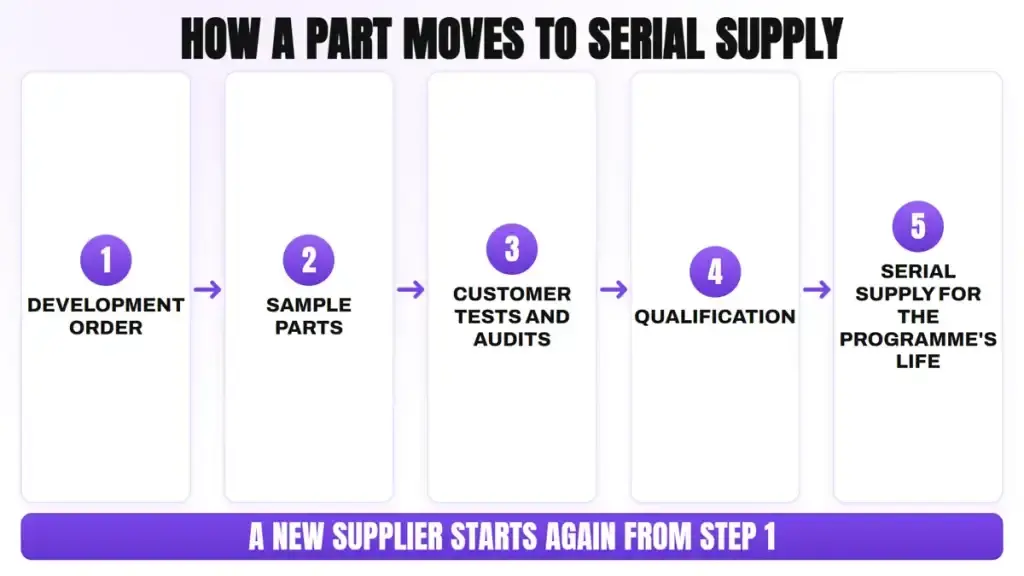
That approval is the second idea we need. Qualification is the process in which an engine or aircraft maker tests a supplier's part, its process and its paperwork before it buys the part in volume. It usually takes years, and it is done part by part.
One such buyer is Safran Aircraft Engines of France. With GE, it makes the LEAP engine, which powers the Airbus A320neo, the Boeing 737 MAX and China's COMAC C919. Safran sells the engines to aircraft makers and then earns for decades from spare parts and repairs. So it needs suppliers that can deliver the same part, to the same standard, for the whole life of the engine.
Our company is one of those suppliers. PTC Industries Ltd (NSE: PTCIL) was set up in Lucknow in 1963 as India's first investment casting foundry. Investment casting means pouring metal into a ceramic shell made around a wax or foam model, so that complex shapes come out close to their final size. Through its subsidiary Aerolloy Technologies, PTC now also melts its own titanium and superalloys, which are nickel-based metals that keep their strength in the heat of an engine. Its UK arm, Trac Precision Solutions, machines the parts.

PTC Industries in five numbers
- Q1 FY27 consolidated total income of ₹197.1 Cr, up 83.0% from a year ago
- Aerolloy's Q1 FY27 total income of ₹74.3 Cr, up 466.4%, at an EBITDA margin of 45.0%
- FY26 revenue from operations of ₹602.78 Cr, up 95.66%
- A ₹1,800 Cr share placement in October 2026, oversubscribed over 5 times
- A titanium recycling furnace planned at 5,000 tonnes a year
So how did a 1963 foundry end up melting titanium for Safran's LEAP engine? Let's first understand the company, and then look at the quarter in which Aerolloy carried the group.
PTC Industries: Company Overview
PTC Industries Ltd was set up in Lucknow in 1963 as a casting foundry and is listed on the NSE and BSE. It is led by its Chairman and Managing Director, Sachin Agarwal. The group makes precision castings for industry and defence, melts aerospace-grade titanium and superalloys, and machines finished parts for engine, aircraft, missile and turbine makers. It works from the Advanced Manufacturing and Technology Centre in Lucknow, a casting plant at Mehsana in Gujarat, Aerolloy Technologies' materials complex in Lucknow and Trac Precision Solutions' plant in Crewe, UK. The parent company had 720 permanent employees in March 2026, including 145 trainees. Consolidated revenue from operations was ₹602.78 Cr in FY26, and the promoter group held 59.72% of the shares at March 2026, before the October 2026 share placement. Read this Best Defence Stocks in India for 2026
"Know what you own, and know why you own it."
— Peter Lynch
For PTC, knowing what you own means knowing which parts are already in serial supply and which are still being qualified. The sections below separate the two.
The Quarter Aerolloy Carried
Let's look at Q1 FY27, the April to June 2026 quarter, which Aerolloy carried. Consolidated total income was ₹197.1 Cr, up 83.0% from ₹107.7 Cr a year ago. EBITDA, as the company reports it, rose 180.1% to ₹54.2 Cr, and profit after tax rose 466.2% to ₹29.2 Cr. Q2 FY27 results are due on 14 November 2026, so this is the latest filed quarter.
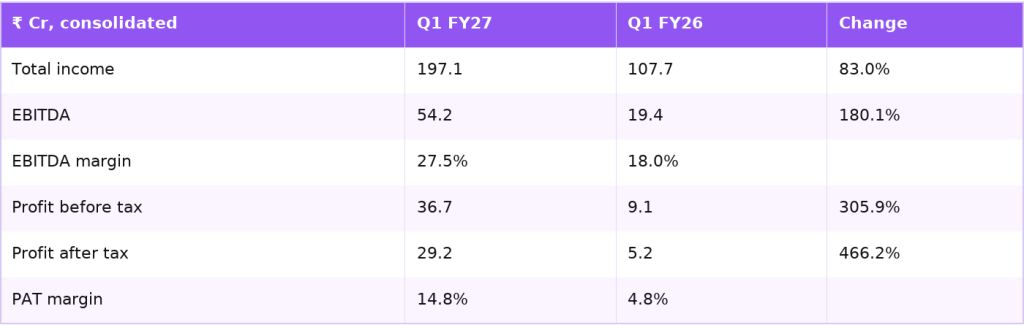
Most of that jump came from one company in the group. That company is Aerolloy, whose total income was ₹74.3 Cr, up 466.4% from about ₹13.1 Cr a year ago. Its EBITDA was ₹33.4 Cr, a margin of 45.0%, and its profit after tax was ₹22.1 Cr. Trac, the UK machining arm, added total income of ₹71.4 Cr and EBITDA of ₹6.1 Cr.
That mix explains why profit grew so much faster than income. Read this Operating vs Net Profit Margin Explained Group costs before depreciation and interest were about ₹142.9 Cr in Q1 FY27, against about ₹88.3 Cr a year ago. They rose about 62%, while income rose 83.0%. So about 39% of the extra income of about ₹89.4 Cr reached EBITDA, and Aerolloy's EBITDA alone was ₹33.4 Cr of the group's ₹54.2 Cr.
This is how the chairman explained the quarter in the results presentation.
"Aerolloy continued to emerge as a key growth driver, demonstrating the operating leverage beginning to come through from the capabilities and investments we have built over the past several years." - Sachin Agarwal, Chairman and Managing Director, PTC Industries, Q1 FY27 presentation
So the full year tells us more than one quarter. In FY26, consolidated revenue from operations rose 95.66% to ₹602.78 Cr from ₹308.07 Cr. Total income was ₹643.29 Cr, EBITDA was ₹172.28 Cr and profit after tax rose 66.44% to ₹101.56 Cr. Trac, in its first full year in the group, contributed about ₹247 Cr of revenue.
Those five quarters, set side by side, show how the business has scaled.
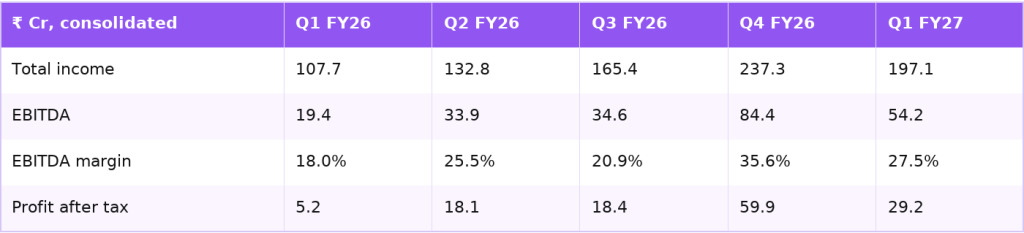
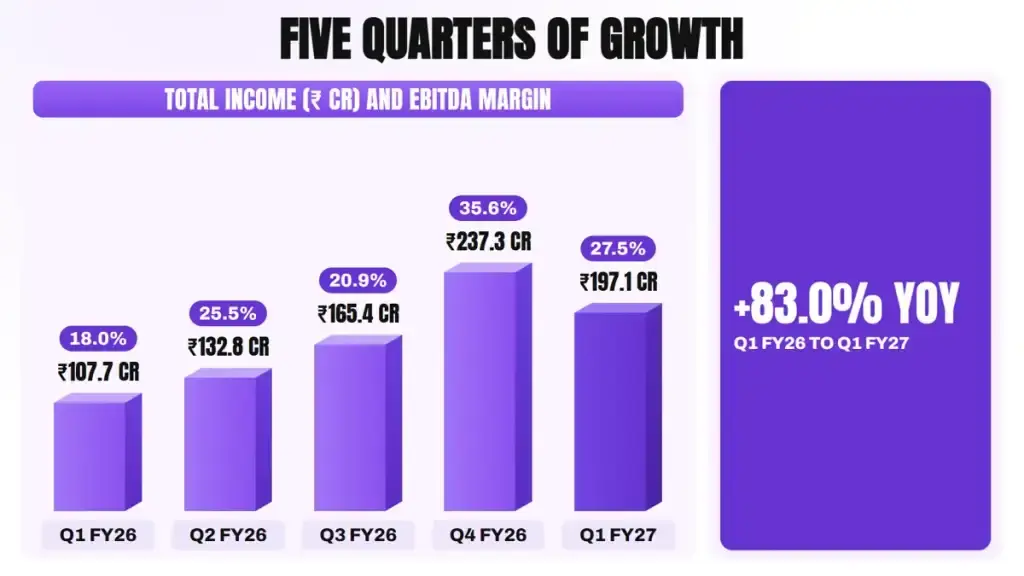
You can also see that rise in the balance sheet. Consolidated net worth was ₹1,507.11 Cr at March 2026, and borrowings were ₹261.34 Cr, a debt-equity ratio of 0.17. In March 2026, ICRA upgraded the company's long-term bank rating to A (Stable) and its short-term rating to A1.
The Orders and Agreements Behind the Growth
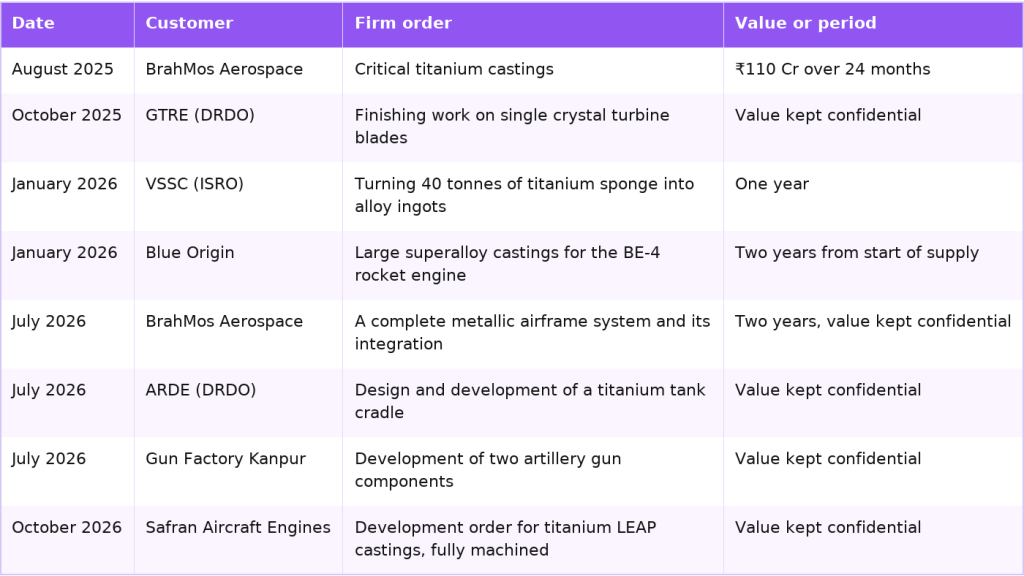
So who is buying from PTC, and how can we judge those orders? Unlike most defence suppliers, PTC does not report an order book. It reports orders and agreements one by one, and it keeps most values confidential. So we need to read them in two groups.
The first group is firm orders, where a customer has placed a purchase order for a defined job.
The second group is long-term agreements and memoranda, which set the terms for future supply once parts pass qualification.
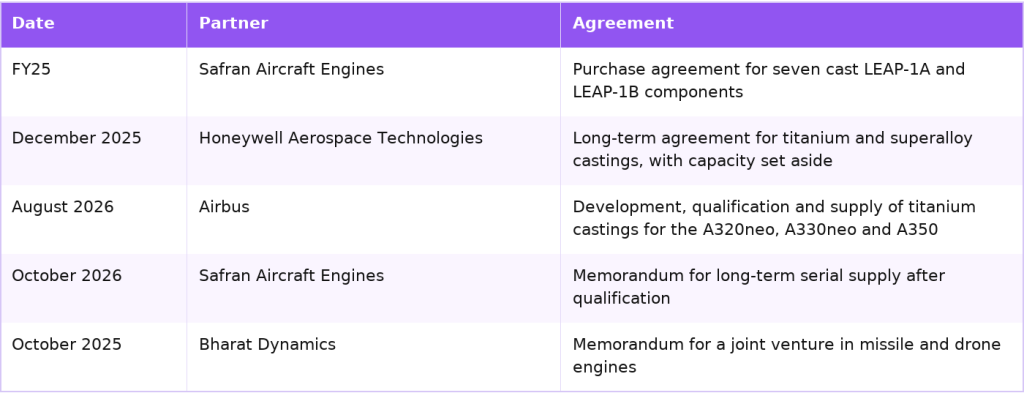
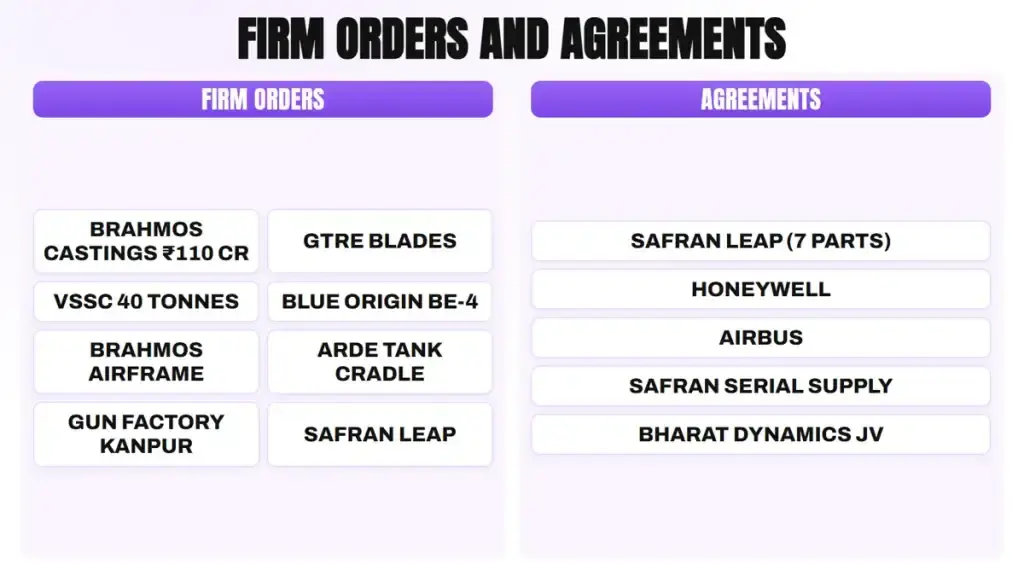
Why the order list matters more than one number: only one of these orders has a disclosed value, the ₹110 Cr BrahMos castings order. The rest are development orders and agreements. Each one becomes revenue only after the part passes qualification, and then it can run for the life of the aircraft or missile programme.
That conversion from development to serial supply is what we will keep coming back to. Before that, let's see how a casting company got into melting metal.
"The big money is not in the buying and the selling, but in the waiting."
— Charlie Munger
PTC has spent years building furnaces before the orders that need them. Much of what it has built is still waiting for customer approval.
From India's First Investment Casting Foundry to a Titanium Melt Shop
Let's go back to the start, because PTC was a foundry for most of its life. It made castings for oil and gas, marine and process industries, and it built its own casting methods, which it calls RepliCast, RapidCast, PrintCast and ForgeCAST. Those methods made complex parts close to their final shape, which cut the machining needed later.
That foundry base led to the aerospace plan. Aerolloy Technologies was set up on 17 February 2020 as a wholly owned subsidiary, to make aerospace castings and materials. In FY23, the state's industrial body allotted it 50 acres in the Lucknow node of the Uttar Pradesh Defence Industrial Corridor, next to the BrahMos site.
That land needed money, and PTC raised it in steps. In September 2024, it raised about ₹700 Cr through a share placement to institutions. In December 2024, it bought Trac Precision Solutions in the UK, together with its holding companies, for about ₹174.95 Cr. In October 2026, it raised ₹1,800 Cr more.
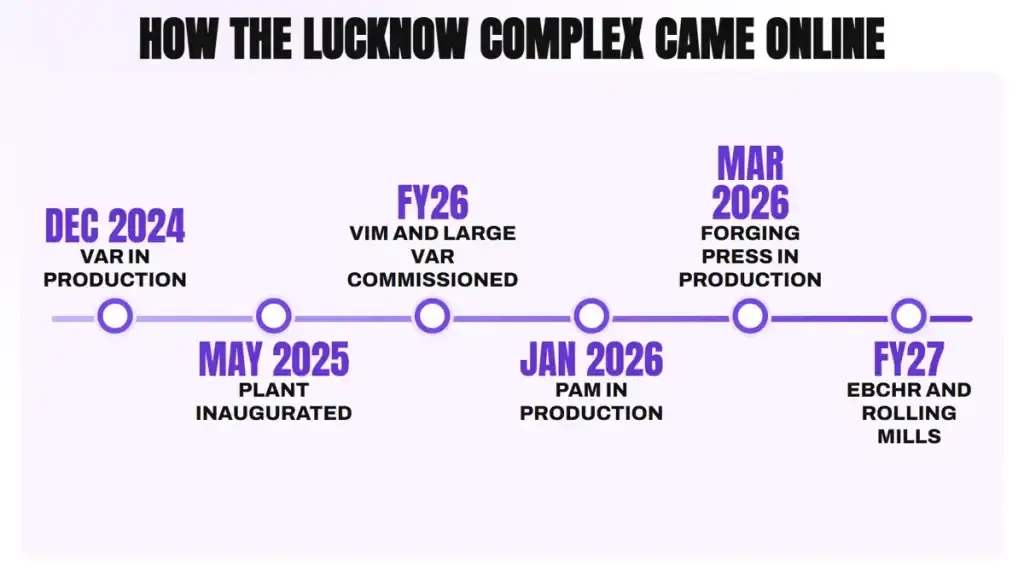
Then the furnaces came one after another. The VAR mill at Aerolloy has been in production since December 2024, and it produced India's first aerospace-grade titanium ingot without foreign supervision. The titanium and superalloy materials plant was inaugurated on 11 May 2025 and dedicated to the nation on 18 October 2025 by the Defence Minister and the Uttar Pradesh Chief Minister.
Then the rest followed during FY26. A vacuum induction melting furnace for large superalloy castings and a VAR furnace for large titanium castings were commissioned. The plasma arc melting furnace entered production in January 2026, and a 4,500/5,100-tonne open die forging press entered production in March 2026. The electron beam recycling furnace and the rolling mills were still being installed at the year end.
Those steps also changed the size of the group. In FY22, its revenue from operations was about ₹178.95 Cr, so the group we see today is more than three times that size. Its profit after tax rose from about ₹12.81 Cr to ₹101.56 Cr over the same years. The company calls the whole chain Melt to Mission, which means one group handling the metal from the melt to the finished, inspected part.
Three Companies, One Chain From Melt to Machined Part
Now let's see what each part of the group makes, because the three companies sell very different things. PTC reports one business segment, but it runs three operating groups: metals, castings and machining. The clearest split by revenue is by company.
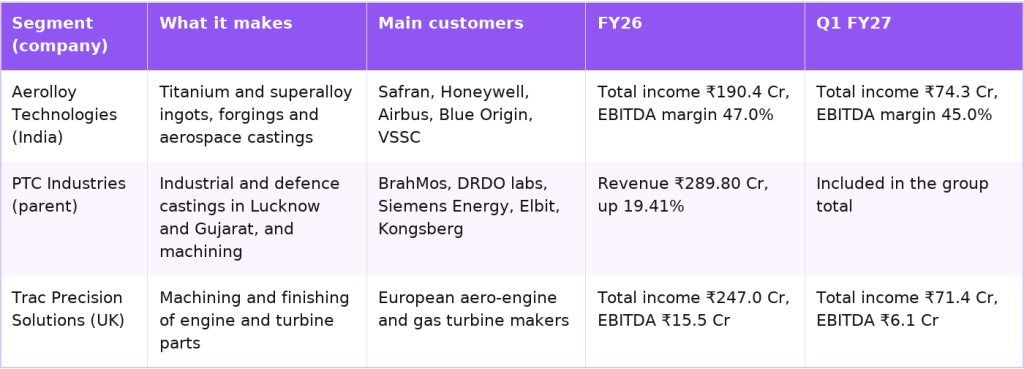
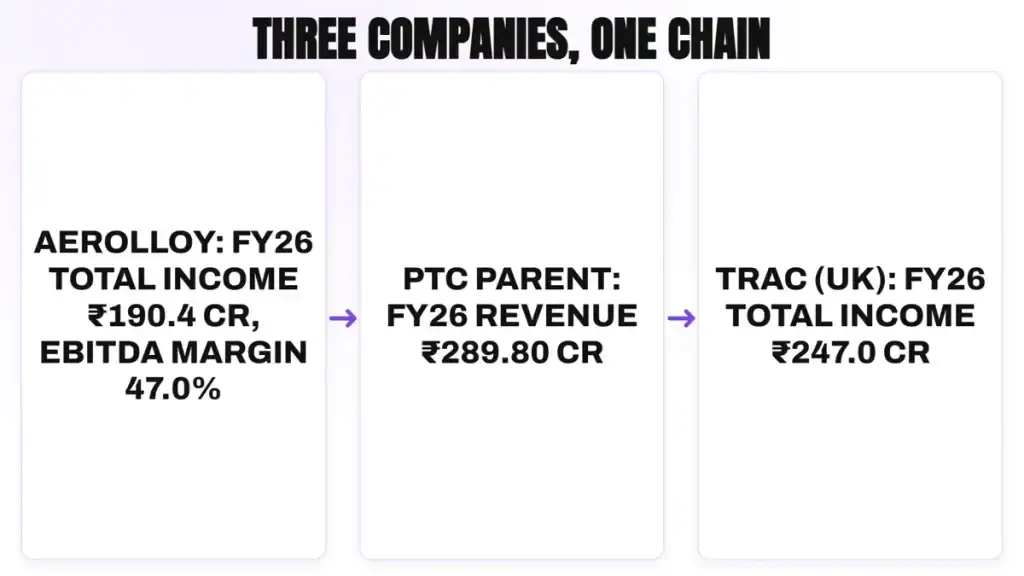
These three differ in where they sit in the chain. Read this Segment-Wise Revenue Analysis Explained Aerolloy starts with the metal itself and casts the hardest aerospace parts. The parent makes castings in steel and other alloys for industry and defence, which is the older business. Trac does none of the melting or casting; it machines parts that others have cast, so that they can be fitted straight into an engine.
Since Aerolloy does two different jobs, we will take them one at a time.
Aerolloy's Melt Shop for Titanium and Superalloys
Let's start with the metal, since this is where PTC differs from most Indian aerospace suppliers. Industry estimates put the global titanium industry at about USD 22 billion to USD 28 billion in 2025, growing 5% to 6% a year. Aerospace and defence are its largest uses. India had no aerospace-grade titanium melting capacity of its own until Aerolloy built it, so it imported all of it.
That gap is what the melt shop fills. Titanium sponge, the raw metal, is pressed into electrodes and melted in the VAR furnace into ingots. The plasma arc melting furnace, or PAM, uses a plasma torch to melt titanium in a shallow hearth, which helps to remove dense impurities. The electron beam cold hearth refining furnace, or EBCHR, will melt titanium scrap and turn it back into aerospace-grade ingots.
These units are large, and the company gave their sizes in its presentations. The VAR facility has a capacity of 1,500 tonnes a year, and the EBCHR furnace is planned at 5,000 tonnes a year. The forging press can forge about 12,000 tonnes a year, and the rolling mill for plates and sheets is sized at 5,000 tonnes a year. The large VIM furnace can pour 1,000 kg of superalloy at a time.
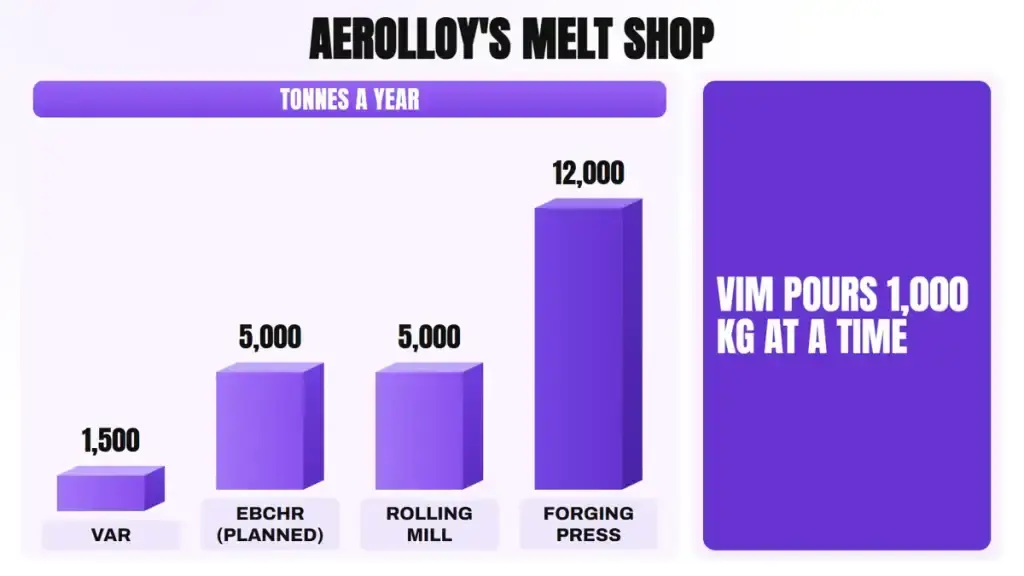
That recycling furnace is the part of the plan you should watch most closely. Every tonne of titanium made from scrap avoids an estimated 27 tonnes of carbon dioxide compared with making it from sponge. Aircraft makers also produce a lot of titanium scrap, because a large part of each block is machined away. So a melter that can take that scrap back can offer both a cleaner and a more secure supply.
So far, the orders for the metal itself have come from India. In January 2026, VSSC, a centre of ISRO, asked PTC to turn 40 tonnes of Grade 1 titanium sponge into Ti-6Al-4V alloy ingots by melting them twice in VAR. Ti-6Al-4V is the most widely used aerospace titanium alloy. The company has also signed memoranda with the Ministry of Steel under its production-linked incentive scheme, covering both titanium alloys and superalloys.
That metal starts as sponge, and sponge supply is the input the company is still securing. It has a memorandum with AMIC TOHO Titanium Metal Company in Saudi Arabia, and it has proposed a sponge plant in Odisha. Until those come through, the melt shop buys sponge and master alloys from the market.
Aerolloy's Castings for Engines, Airframes and Rockets
Next, let's look at what Aerolloy makes from that metal. Across all aircraft makers, the order backlog is about 17,000 aircraft, or ten to fourteen years of production. The fleet is estimated to be about 5,400 aircraft short of what airlines would fly if deliveries had kept up. Hot-section castings, titanium structural castings and forgings are among the parts that limit how many engines can be built.
That shortage is where Aerolloy's castings come in. A casting for an engine frame or casing must hold its shape and strength at high heat and under vibration for thousands of flights. Aerolloy pours titanium in vacuum furnaces and superalloys in its large VIM furnace, then presses out internal pores with hot isostatic pressing, a process that applies heat and gas pressure at the same time.
Those castings already drive Aerolloy's numbers. In FY26, its total income rose 219.8% to ₹190.4 Cr, its EBITDA was ₹89.5 Cr and its profit after tax was ₹68.0 Cr. Its quarterly path shows how fast it grew. Aerolloy's total income was about ₹13.1 Cr in Q1 FY26, about ₹29 Cr in Q2, about ₹49.2 Cr in Q3 and about ₹99.1 Cr in Q4, before ₹74.3 Cr in Q1 FY27.
Its customers are some of the largest names in aerospace. Safran signed a purchase agreement for seven cast components for the LEAP-1A and LEAP-1B, the first such contract for an Indian company. In October 2026, Safran placed a second set of orders for titanium LEAP castings, to be supplied fully machined and ready to fit, and signed a memorandum for serial supply once they qualify.
After Safran, Honeywell and Airbus followed. In December 2025, Aerolloy signed a long-term agreement with Honeywell Aerospace Technologies for titanium and superalloy castings, including castings for engine parts. Honeywell is a large American aerospace company, and it has set aside dedicated capacity at Aerolloy for its programmes. In August 2026, Airbus signed an agreement for ready-to-fit titanium castings for the A320neo, A330neo and A350, with serial supply after Airbus's qualification.
Space is the newest market for these castings. There were 330 orbital launch attempts in 2025, a 25% increase over 2024. Blue Origin's New Glenn rocket uses seven BE-4 engines on its first stage, each giving roughly 550,000 pounds of thrust. In January 2026, Blue Origin gave Aerolloy a development and supply order for large nickel superalloy housings and manifolds for the liquid oxygen side of the BE-4.
That order also shows how qualification works. It came after a long technical, qualification and regulatory review, including export control checks. The castings depend on Aerolloy's VIM furnace, which the company describes as among the largest in operation in the world. Very large superalloy castings of this kind are made by only a few companies worldwide.
PTC's Own Plants for Defence and Industrial Castings
Now let's turn to the parent company, where you will find most of the defence work. India's FY27 defence budget sets aside ₹2,19,306 Cr for capital outlay, the money spent on new weapons and equipment. That budget includes ₹63,734 Cr for aircraft and aero-engines. Three-quarters of the capital acquisition budget is reserved for Indian industry, and India's defence exports reached ₹38,424 Cr in FY26.
That spending reaches PTC through missiles, guns and tanks. In August 2025, BrahMos Aerospace placed an order worth ₹110 Cr for critical titanium castings, to be executed over 24 months. BrahMos Aerospace makes the supersonic cruise missile of the same name. In July 2026, it went further and gave PTC its first order for a complete system: a metallic airframe structure for the missile, with its integration.
Beyond missiles, the land forces are also adding work. ARDE, a DRDO laboratory, gave PTC a design and development order for a titanium cradle for the 105 mm Indian light tank. The cradle holds the gun barrel and breech and passes the firing and recoil loads to the turret. This is the first order in which PTC designs the part as well as makes it. Gun Factory Kanpur also placed a development order for two artillery gun components.
That move toward design builds on earlier defence work. GTRE, DRDO's engine laboratory, gave PTC a purchase order for the finishing work on single crystal turbine blades, including machining, coating and heat treatment. A single crystal blade is cast as one crystal of metal so that it can survive the hottest part of a jet engine. That makes PTC, in its own words, the first Indian company trusted with this work.
Besides defence, the parent also runs the industrial casting business. Its Mehsana plant in Gujarat makes investment castings for oil and gas, LNG, marine, petrochemical and power customers. In FY26, standalone revenue rose 19.41% to ₹289.80 Cr, and about 59% of it was earned outside India. The year also brought new qualifications and serial supply with Siemens Energy, Elbit Systems, Kongsberg, Westad, Safran and Honeywell.
Even at group level, as you can see below, most of the money still comes from abroad. That means exports were about 82% of FY26 consolidated revenue, at ₹493.73 Cr. The European Union gave 30.2% of revenue, the UK 16.7% and the US 11.2%, while India gave 18.2%. The company expects India's share to rise as this year's defence and space orders reach serial production.
Trac Precision Solutions in the UK
Finally, let's look at Trac, the UK arm, which works at the other end of the chain. Its main market, industrial gas turbines, is now in high demand, because data centres need power around the clock. The industrial gas turbine market was about USD 62.5 billion in 2025 and is projected at about USD 88 billion by 2030. GE Vernova's gas turbine backlog and reservations reached 116 GW in Q2 2026.
Those turbines need hot-section parts, and Trac machines them. Its blades, vanes and other parts sit in the hot gas path of aero-engines and power turbines. It uses five-axis machining, grinding, spark erosion and deep-hole drilling, the fine holes that let cooling air through a blade. In Q4 FY26 it installed a second Makino G7 machine, which mills, drills and grinds a part in one setup.
That work brings revenue, though at thinner margins than Aerolloy. Its FY26 total income was ₹247.0 Cr and its EBITDA was ₹15.5 Cr. In Q1 FY27, its total income was ₹71.4 Cr with EBITDA of ₹6.1 Cr, a margin of about 8.5%. In March 2026, it signed a five-year memorandum with Coolbrook, which intends to make Trac its preferred partner for aerofoil machining in its electric industrial heater.
Trac also gives the group a base close to European engine makers. Machining is the last step that the new Safran and Airbus parts need, since both are to be supplied fully machined and ready to fit. So the three companies together cover the whole route from sponge to a finished part.
Why Qualified Capacity Is Hard to Copy
Now that we have seen all three companies, let's understand what protects them. What protects them, in short, is qualification. An aerospace buyer approves a supplier's material, process, paperwork and people before it buys a part, and it does this for each part. A new supplier would have to repeat that cycle, which can take years. Read this Economic Moat Explained
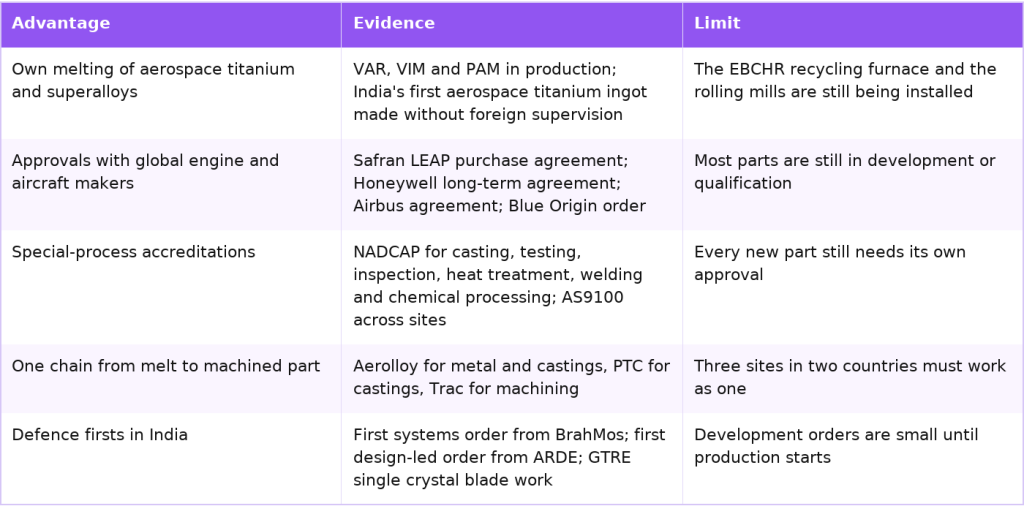
That is also how the chairman put it in the latest annual report.
"In aerospace, defence and energy, capacity by itself is not a competitive advantage. Qualified capacity is." - Sachin Agarwal, Chairman and Managing Director, PTC Industries, FY26 annual report
That idea explains why we think the furnaces matter so much. Owning the melt lets PTC control the chemistry and cleanliness of the metal from the start. It also gives the buyer one chain of records, from the sponge to the final inspection, which is what aerospace audits ask for. A buyer that qualifies PTC for a part is approving that whole chain.
Those approvals take time, and the Blue Origin order shows how much. It came after a prolonged technical, qualification and regulatory review. Safran's LEAP work also moved in steps: a purchase agreement for seven castings first, then a second set of development orders in October 2026, and a memorandum for serial supply only after those parts qualify. Each step adds parts that a rival would have to qualify from scratch.
"In business, I look for economic castles protected by unbreachable moats."
— Warren Buffett
For PTC, the moat is the stack of part-by-part approvals with engine and aircraft makers. Every approval is a wall a new supplier would have to rebuild.
That record is also hard to copy because few companies anywhere can do all the steps. The company describes the market for its castings in superalloys and titanium as one with long learning curves, high scrap and multi-year qualification, served by a small number of foundries worldwide. It places its own equiaxed airfoils in series production, with directionally solidified and single crystal castings still in development.
Beyond approvals, supply concentration adds to the barrier. With China and Russia holding most aerospace titanium, Western engine and aircraft makers have spent four years qualifying other sources. So the approvals PTC already holds would take a new entrant both a melt shop and years of testing to match.
Financials: Five Years of Growth and a Cash Squeeze
One strong quarter says little about a business that is still building its plants, so let's look at five full years together. These are consolidated figures from the company's annual reports, in ₹ Cr. EBITDA is the company's own figure, which includes other income.

Revenue grew about 3.4 times in four years, from about ₹179 Cr in FY22 to about ₹603 Cr in FY26, and profit after tax grew about eight times. The margin rose every year to FY25 and then dipped in FY26, when Trac's UK cost base came in for a full year and the new furnaces at Aerolloy began running before their parts were qualified.
Cash is the weak spot. Over the five years, operating cash flow added up to about -₹80 Cr, against about ₹243 Cr of profit after tax. Most of the gap is stock: work in progress rose to about ₹222 Cr in March 2026, as ingots, forgings and castings waited for customer approval.
That gap has been funded mostly with equity. Net worth rose from about ₹169 Cr in FY22 to about ₹1,507 Cr in FY26 through two share placements, and borrowings were about ₹261 Cr in March 2026, a debt-equity ratio of 0.17. The ₹1,800 Cr placement in October 2026 adds to that cushion.
"You can't predict. You can prepare."
— Howard Marks
PTC cannot know when each part will qualify, so it has raised money and built capacity ahead of time. The cash flow column shows the cost of preparing.
What the Next Two Years Look Like on Management's Numbers
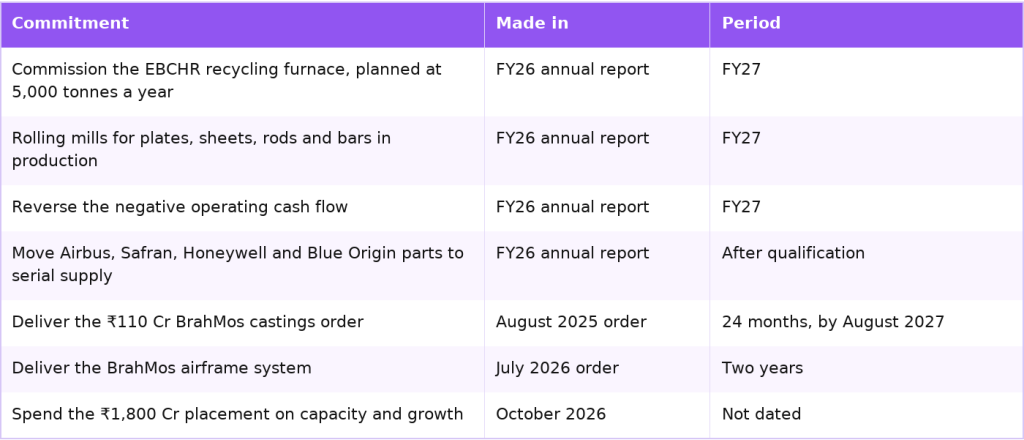
So what does the plan look like from here, and what can you check? PTC gives no revenue or margin guidance. Instead, it gives a list of plants to finish, programmes to move into serial supply and money to fund them. So let's read the plan through those items.
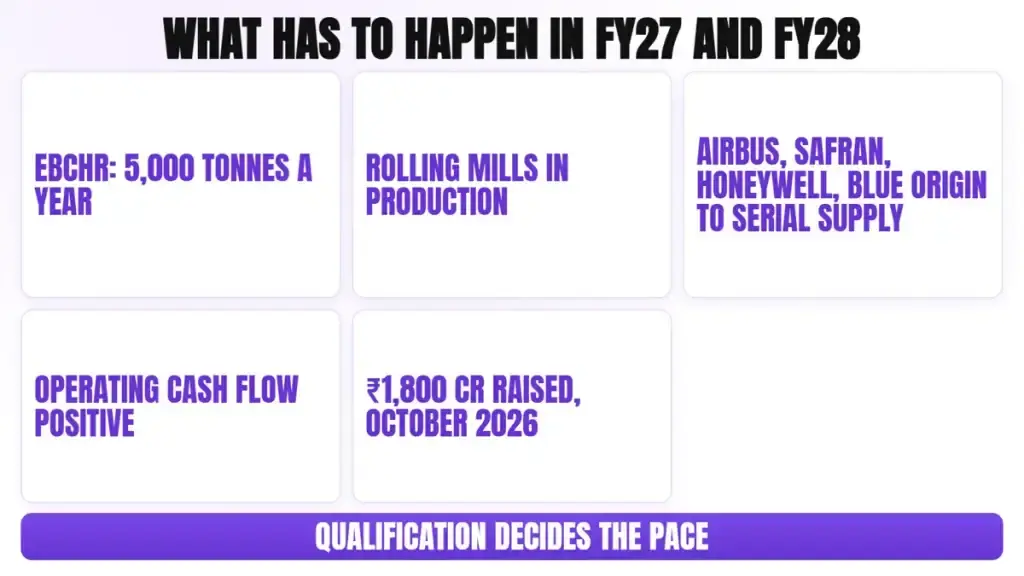
The first item is the plants. For FY27, the company plans to commission the EBCHR furnace, with its projected 5,000 tonnes a year of titanium recycling, and to run the VIM, PAM and VAR units as one integrated chain into castings, forgings and rolled products. It also plans to commission ceramic-core making, with technology from the UK, for turbine castings.
Next come the customers. Here management wants the Airbus, Honeywell, Safran, Blue Origin, ISRO, GTRE and BrahMos work to move from qualification and small batches into serial production. It also says that reversing the negative operating cash flow of FY26 is a priority for FY27, as those programmes move to serial production and billing.
Then there is the money. The October 2026 placement raised ₹1,800 Cr by issuing 8,54,700 new shares, and it was oversubscribed over 5 times. The company says the money will go to organic expansion, more capacity, new projects and acquisitions across the group. In June 2026, the board also approved raising the company's borrowing limit from ₹350 Cr to ₹600 Cr.
Next, let's do some simple arithmetic to see the scale these plans work on. If Aerolloy repeated its Q1 FY27 total income of ₹74.3 Cr for four quarters, it would earn about ₹297 Cr in FY27, against ₹190.4 Cr in FY26. That is a run-rate, not a forecast, and it does not include any new Airbus or Safran parts.
These plans come with a record we can check, because the company gave dates for each plant. The table compares the dates in its FY25 presentations with what happened.
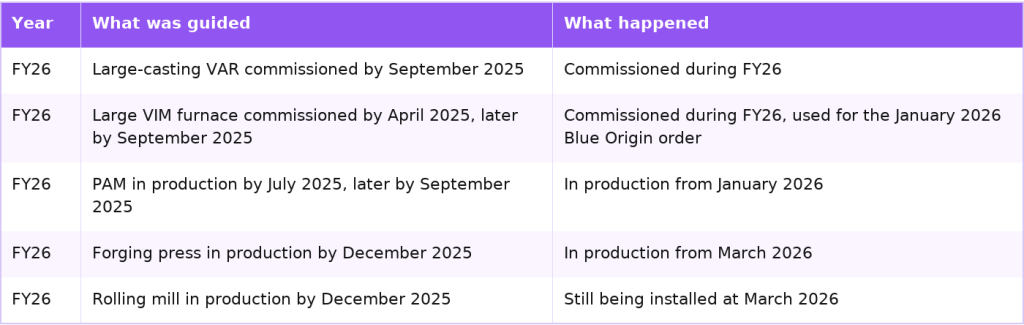
So the melting furnaces arrived, but most of them a few months after the first date given. The press came about three months late, and the rolling mill is later still. That pattern matters for FY27, because the EBCHR furnace and the rolling mills are the next two dates to watch.
Key Risks
PTC is building a large plant ahead of its orders, so let's look at what could go wrong.
- Qualification can take longer: most of the Safran, Airbus, Honeywell and Blue Origin work is still at the development or qualification stage. Revenue from each part starts only after the customer approves it, and delays at the customer end can push that revenue out by quarters or years.
- Plant dates have slipped before: PAM came about six months after its first date, the forging press about three months late, and the rolling mill was still being installed at March 2026 against a December 2025 date. If the EBCHR furnace slips too, the recycling plan and its margins move out with it.
- Cash is tied up in work in progress: operating cash flow was -₹68.66 Cr in FY26, against +₹13.59 Cr in FY25. Work in progress rose to ₹222.24 Cr from ₹125.37 Cr, because ingots, forgings and castings for programmes in qualification take a long time to bill. Capital spending was ₹317.32 Cr in the same year.
- Margins fell during the ramp-up: the FY26 EBITDA margin on total income was 26.8%, down from 32.0%. Standalone EBITDA fell 6.89% to ₹67.62 Cr even as revenue grew 19.41%, because material and employee costs rose faster. Group employee cost was 25.0% of revenue, against 18.4% a year earlier.
- Other income props up EBITDA: the company counts other income inside EBITDA. Other income was ₹40.51 Cr in FY26, including a foreign exchange gain of ₹18.96 Cr. Without it, FY26 EBITDA would have been about ₹131.77 Cr, a margin of about 21.9% of revenue.
- Quarters move unevenly: Q1 FY27 total income of ₹197.1 Cr was below Q4 FY26's ₹237.3 Cr, and Aerolloy's ₹74.3 Cr was below its estimated ₹99.1 Cr in Q4. Long casting cycles make single quarters a weak guide.
- More shares and more debt: the October 2026 placement raised the share count from 1,49,92,549 to 1,58,47,249 shares, about 5.7% more. The promoter group held 59.72% before it, so its share falls to about 56.5%. Borrowings rose to ₹261.34 Cr from ₹60.83 Cr in FY26.
- Thin margins at Trac: Trac's EBITDA was ₹15.5 Cr on ₹247.0 Cr of FY26 total income, and it had an EBITDA loss of about ₹1.4 Cr in H1 FY26 because castings and outside processes arrived late. Its Q1 FY27 margin was about 8.5%.
- Raw materials and currency: titanium sponge, nickel and cobalt are exposed to export controls and supply shocks, and the sponge memoranda are not yet producing. About 82% of revenue is earned abroad, so currency moves change both sales and other income.
"Risk comes from not knowing what you're doing."
— Warren Buffett
For PTC, the risks are known ones: slow approvals, late plants and cash tied up in stock. The signals below show early whether they are easing.
Explore our Products
Research Framework

Emerging Titans
Combination of quantitative analysis, industry tailwinds, and management assessment - SPRINT investment philosophy

Tiny Titans
Heavy emphasis on scuttlebutt research, plant visits, and early on-ground signals
What to Track Next
If you follow PTC Industries, these are the signals that will show whether the plan is on track.
- Q2 FY27 results on 14 November 2026, and whether Aerolloy keeps its margin near 45.0%
- Commissioning of the EBCHR recycling furnace and the rolling mills in FY27
- The first Airbus and second-round Safran LEAP parts passing qualification and moving to serial orders
- Operating cash flow turning positive in FY27, as the company has set out
- How the ₹1,800 Cr from the placement is spent, and on which plants or acquisitions
- Trac's EBITDA margin, which was about 8.5% in Q1 FY27
Conclusion
Let's step back and put it together. PTC started as a foundry in 1963 and spent the last six years building India's first aerospace titanium and superalloy melt shop, with castings, forging and UK machining around it. In FY26 that plant began to show in the numbers, and in Q1 FY27 Aerolloy earned ₹74.3 Cr at a 45.0% margin.
So the next two years will be about conversion. Safran, Honeywell, Airbus and Blue Origin have each placed development orders or agreements, and BrahMos has moved PTC up to a complete system. If those parts qualify on time, the furnaces built ahead of demand turn into serial supply; if they slip, the plant keeps tying up cash and the ₹1,800 Cr raise carries the wait.
FAQs
What does PTC Industries do?
+PTC Industries is a Lucknow company, set up in 1963 as a casting foundry, that makes precision castings for industry and defence. Through its subsidiary Aerolloy Technologies it melts aerospace-grade titanium and superalloys and casts engine and airframe parts, and through Trac Precision Solutions in the UK it machines finished parts.
How did PTC Industries do in Q1 FY27?
+Consolidated total income was ₹197.1 Cr, up 83.0% from a year ago, with EBITDA of ₹54.2 Cr and profit after tax of ₹29.2 Cr. Aerolloy's total income rose 466.4% to ₹74.3 Cr at an EBITDA margin of 45.0%.
What is Aerolloy Technologies?
+Aerolloy is PTC's wholly owned subsidiary in Lucknow. It runs VAR, VIM and plasma arc melting furnaces and a 4,500/5,100-tonne forging press, with an electron beam recycling furnace and rolling mills being installed. Its FY26 total income was ₹190.4 Cr at an EBITDA margin of 47.0%.
Who are PTC Industries' main customers?
+Its aerospace customers include Safran Aircraft Engines for LEAP engine castings, Honeywell Aerospace Technologies, Airbus and Blue Origin. In India it supplies BrahMos Aerospace, DRDO laboratories such as GTRE and ARDE, Gun Factory Kanpur and ISRO's VSSC. About 82% of FY26 revenue came from outside India.
Does PTC Industries report an order book?
+No. It discloses orders and agreements one by one, and most values are kept confidential. The only disclosed value is a ₹110 Cr BrahMos order for titanium castings over 24 months; the Safran, Airbus and Honeywell agreements turn into serial orders only after the parts pass qualification.
What are the main risks for PTC Industries?
+The main risks are slow customer qualification, plant dates slipping as they did for the PAM furnace, forging press and rolling mill, negative operating cash flow of -₹68.66 Cr in FY26, lower margins during the ramp-up, thin margins at Trac and more shares from the ₹1,800 Cr placement.

High growth stock specialist, Value Educator
Shashank Mahajan is an equity research professional with over 12 years of experience in identifying high-potential SME and micro-cap stocks at an early stage. He follows a rigorous scuttlebutt research–driven approach, combining on-ground insights with deep financial analysis. Shashank specializes in uncovering under-researched and under-owned companies with strong management quality and long-term growth potential. Through disciplined research and early identification, he focuses on spotting tomorrow’s market leaders before they enter the mainstream investor radar.

Jyoti CNC: The 5-Axis Machines Behind India's Aircraft Parts

INOX India: The Rocket Order Behind a ₹2,268 Cr Book

APAR Industries: Google, Amazon and ₹12,025 Cr of Orders

Techno Electric: ₹11,000 Cr of Grid Orders and Data Centres

Sansera Engineering: Aircraft and Chip Parts Hit 14.9%

HBL Engineering: Defence Batteries, Fuzes and Kavach Orders
Explore our Products
Research Framework
Emerging Titans
Combination of quantitative analysis, industry tailwinds, and management assessment - SPRINT investment philosophy
Tiny Titans
Heavy emphasis on scuttlebutt research, plant visits, and early on-ground signals



Modern Warfare to Multibaggers
Key Trends. Strategic Shifts. Opportunities Ahead.
Don't Miss This Exclusive Webinar!
Join Value Educator to decode the key trends shaping India's defence sector and learn how to identify tomorrow's potential leaders in the space.
- In-depth research on India's defence sector
- Live Q&A session
- Actionable takeaways for long-term investors

 Orders
 Subscription
 Share with friends


Required Details
₹23999.00
(12 month subscription)
As per SEBI regulations, all users are mandated to complete the KYC that is validated for 1 year. Post payment, you will be redirected to the KYC screen


No comments yet. Be the first to comment!