
Sansera Engineering: Aircraft and Chip Parts Hit 14.9%

Two of the world's busiest factories are aircraft lines and chip-equipment lines, and both are running behind. Airbus and Boeing had 15,255 aircraft waiting to be built in August 2025, up from 13,107 in 2019. The Boeing 737 alone had 4,747 planes on order in February 2025. At the same time, the companies that build chip-making machines are racing to keep up with AI data centres.
Both industries face the same limit. Every aircraft door and every chip machine needs many metal parts machined to exact shapes, and each supplier has to be approved before it can make them. So the makers keep adding approved suppliers, and they place long orders with the ones they trust.
Those long orders show up as an unexecuted order backlog, which means the total value of confirmed orders that a supplier still has to deliver. In this business the backlog usually runs over several years. A part is first made as a sample, tested by the customer, approved, and then supplied for the life of the aircraft or machine programme.
That buying model is why the big makers rarely switch, and why a special process matters so much. A special process means a step such as heat treatment, plating or coating, which an aircraft maker approves separately from machining. Airbus, Boeing and the chip-equipment makers give a supplier the drawing and buy the finished part, so the supplier does not own the design. What the supplier owns is the approval. Once a part passes, moving it to someone else means repeating every test.
One Bengaluru company has spent four decades building the skills these buyers want, mostly by making engine parts for cars and motorcycles. Sansera Engineering Ltd (NSE: SANSERA) began in 1981 and won its first order from Maruti Udyog in 1986. Its biggest product is the connecting rod, the steel rod that links an engine's piston to its crankshaft and turns the piston's up-and-down push into rotation. It forges and machines such parts in 18 plants for 109 customers in 28 countries.
So, over the last few years, that skill has moved into a second business called ADS, short for aerospace, defence and semiconductor equipment. ADS gave 3.8% of sales in FY21. In Q2 FY27 it gave 14.9%.

Sansera Engineering in five numbers
- Q2 FY27 revenue of ₹1,091.5 Cr, up 32%, its highest ever, with an EBITDA margin of 19.4%
- ADS revenue of ₹164.3 Cr in the quarter, against ₹54.5 Cr a year ago
- An ADS backlog of ₹5,869.7 Cr at 30 September 2026, up from ₹2,871.3 Cr at March 2025
- One chip-equipment order of about ₹1,250 Cr over five years, won in August 2026
- ADS at 14.9% of Q2 FY27 sales, up from 3.8% in FY21
So how did a connecting-rod maker end up with a multi-year backlog from aircraft and chip-machine makers? Let's first understand the company, and then look at the quarter where the shift showed most clearly.
Sansera Engineering: Company Overview
Sansera Engineering Ltd was founded in Bengaluru in 1981 by S Sekhar Vasan, who is still its Chairman and Managing Director, and it listed on the NSE and BSE in 2021. B R Preetham is Joint Managing Director and Group CEO, and the promoter group held 29.04% of the company in September 2026. Sansera forges and machines precision parts such as connecting rods, crankshafts and rocker arms for motorcycles, scooters, cars and trucks, and parts for aircraft, defence and chip-making equipment. It runs 18 integrated plants, 17 in India and one in Sweden, and employs 12,443 people, including 529 engineers. It serves 109 customers in 28 countries, and 34.8% of FY26 revenue came from outside India. Revenue was ₹3,497.9 Cr in FY26, with profit after tax of ₹326.1 Cr. In September 2026, borrowings were ₹636.3 Cr, against cash and bank balances of ₹375.2 Cr. Read this Best Defence Stocks in India for 2026
"Does the company have products or services with sufficient market potential to make possible a sizable increase in sales for at least several years?"
— Philip Fisher
For Sansera, the answer now sits in the ADS backlog: ₹5,869.7 Cr of aircraft, defence and chip-equipment orders to be delivered over about five years, on top of a growing auto business.
The Quarter When Non-Auto Passed ₹200 Cr
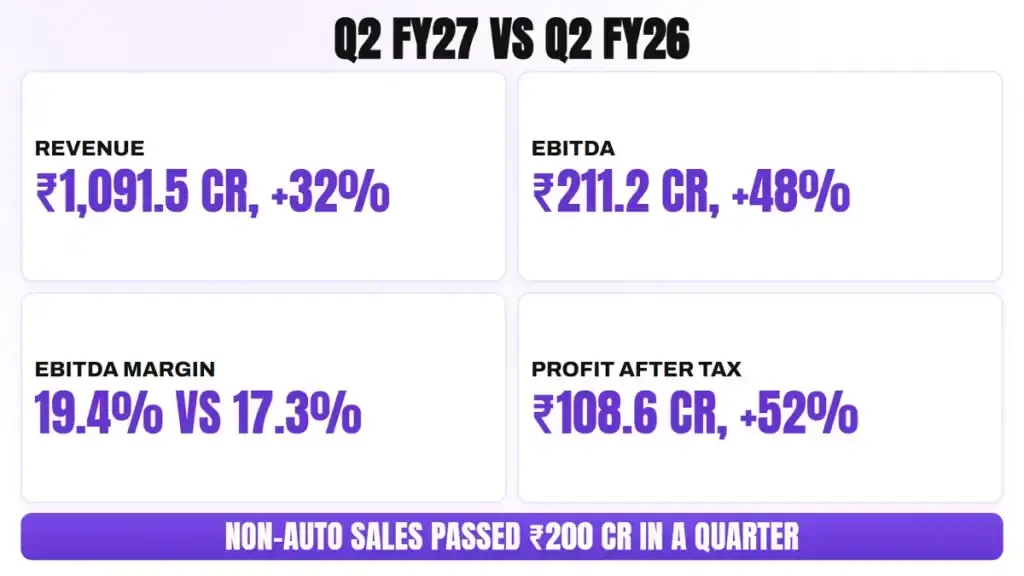
Let's look at Q2 FY27, the July to September quarter, when non-auto sales passed ₹200 Cr for the first time. Sansera's revenue was ₹1,091.5 Cr, up 32% from ₹825.2 Cr a year ago. Its EBITDA was ₹211.2 Cr, up 48%, and the EBITDA margin rose to 19.4% from 17.3%. Its profit after tax was ₹108.6 Cr, up 52%.

That profit grew faster than revenue, and we can see why in the cost lines. Read this How to Read a Profit & Loss Statement Cost of goods sold, which includes power and fuel, rose about 28%, slower than revenue. So the company's gross margin went up to 43.0% from 41.2%. Employee cost rose about 24%, also slower than revenue. Other expenses rose about 41%, but they are the smallest of the three lines.
That gross margin gain, as we read it, came from the mix. ADS parts and exports earn more per rupee of sales than domestic engine parts. In this quarter, international sales grew 56.2%, while India grew 20.6%. Within that, sales to the US rose 77.8% on aerospace and car parts. Sales to other foreign countries rose 128.9%, mainly on semiconductor parts.
All three businesses had their best quarter ever. Engine and chassis parts for petrol and diesel vehicles, called Auto ICE, grew 18.2%. Parts that fit any powertrain, together with parts for electric vehicles, grew 27.0%. Non-auto sales grew 107.7% and passed ₹200 Cr in a quarter for the first time, mainly because ADS sales grew 206.5%.

If you look back, that ADS climb has been steady for six quarters. ADS revenue was ₹39.4 Cr in Q1 FY26, then ₹54.5 Cr, ₹125.1 Cr, ₹116.9 Cr, ₹145.4 Cr and now ₹164.3 Cr. These figures include scrap and tooling income. The full year FY26 gave ₹335.9 Cr, and the first half of FY27 has already given ₹309.7 Cr.
The first half shows the same trend. Revenue was ₹2,112.7 Cr, up 33%, and EBITDA was ₹407.3 Cr, up 48%. The EBITDA margin for the half was 19.3%, against 17.3% a year earlier and 18.1% for all of FY26.
The Orders Behind the ₹5,869.7 Cr Backlog
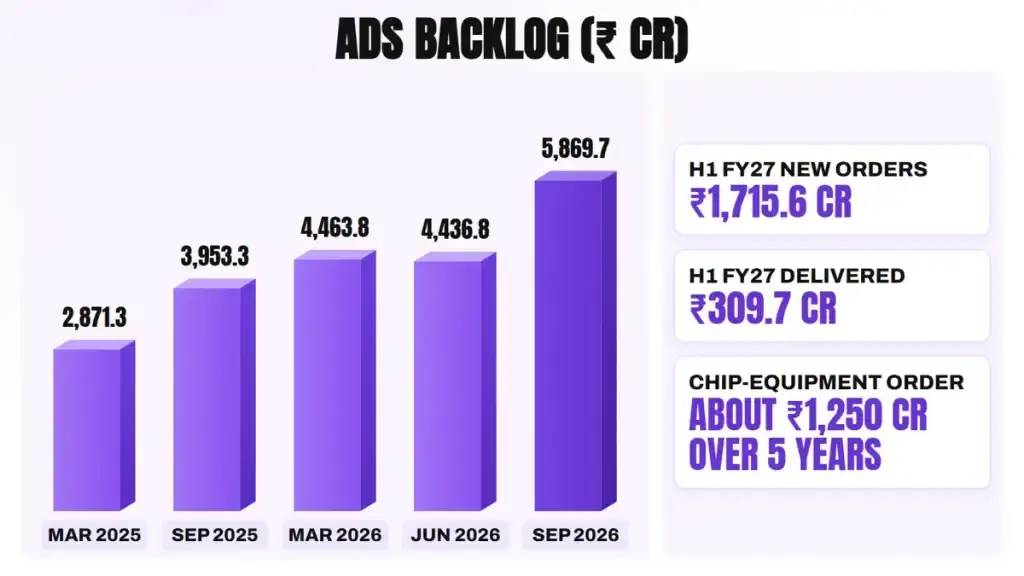
So where will the next ADS quarters come from? The ADS backlog was ₹2,871.3 Cr at March 2025. It rose to ₹3,953.3 Cr by September 2025, ₹4,463.8 Cr by March 2026 and ₹5,869.7 Cr by September 2026. The company says it can be delivered over about five years.
That last jump, as you can see, came from new orders far larger than what was shipped. In the first half of FY27, Sansera booked ₹1,715.6 Cr of new ADS orders and delivered ₹309.7 Cr. So the backlog grew by about ₹1,406 Cr in six months.
One order drove most of that jump.
"Know what you own, and know why you own it."
— Peter Lynch
In Sansera's case, knowing what you own means knowing that one chip-equipment customer gave most of the new ADS orders in the first half of FY27. In August 2026, an existing semiconductor-equipment customer gave Sansera an order worth about ₹1,250 Cr over five years. It would take Sansera's yearly business with that one customer to about $75 million, management said. Its revenue should start in calendar 2027, once the new machines arrive, and peak in 2029.
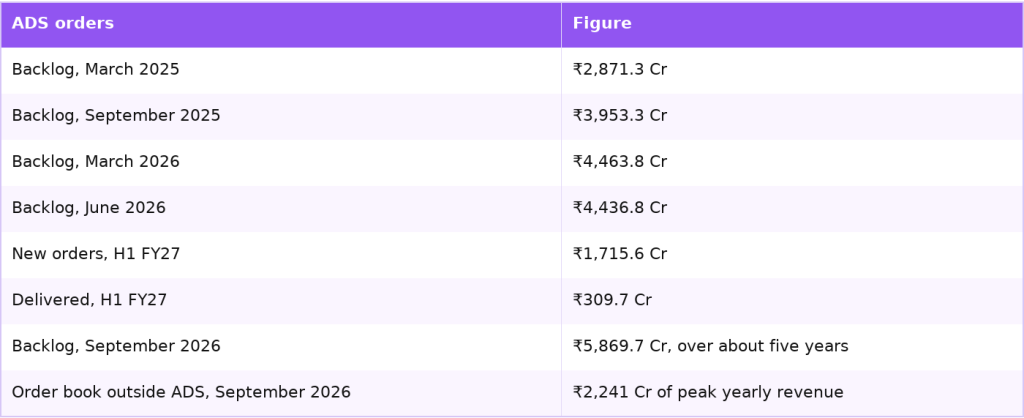
That table also shows us a second, different order book. For the rest of the business, Sansera reports the peak annual revenue of new programmes, meaning the yearly sales a new part will bring once it reaches full volume. That figure stood at ₹2,241 Cr in September 2026, up from ₹1,849.3 Cr in June. Domestic customers gave 49% of it.
These two measures cannot be added. The ADS figure is the total value of five years of orders, while the auto figure is the yearly revenue at peak. That is why the company keeps ADS out of the auto order book, so the same order is not counted twice.
Why the backlog matters: spread evenly over five years, ₹5,869.7 Cr is about ₹1,174 Cr of ADS work a year. That is roughly twice the ₹550-600 Cr of ADS revenue that management has guided for FY27, so the backlog already asks for much more capacity than the company runs today.
From Maruti's Connecting Rods to Aircraft Door Beams
So let's go back to see how an engine-parts maker got approved by aircraft and chip-machine makers. Sansera was founded in Bengaluru in 1981 by S Sekhar Vasan. Its first purchase order came from Maruti Udyog in 1986, and connecting rods were its first big product.
We can see that base grew plant by plant. New plants in Haryana, Maharashtra and Uttarakhand followed between 2004 and 2008. In 2017, Sansera bought Mape, a Swedish maker of large connecting rods for heavy trucks. Today the group runs 18 plants, 17 in India and one in Sweden, and employs 12,443 people, including 529 engineers.
That base also gave Sansera its first aerospace work, early but small. In 2013, the company set up a dedicated aerospace facility with AS9100 certification, the quality standard aircraft makers require. Its operations began in 2015. Management says it started in aerospace in 2010 with cargo and lighting parts, and moved on to landing-gear parts, engine casings and structural parts.
After that, the next aerospace steps came faster. In 2021, Sansera won a project to machine aircraft engine casings and listed on the NSE and BSE. In 2023, it finished a new aerospace and defence plant that quadrupled its capacity, and invested in MMRFIC Technology, a Bengaluru radar company. In 2025, it started supplying parts for semiconductor equipment.
That push needed money, and part of it came from a share sale. In FY25, Sansera raised ₹1,200 Cr through a qualified institutional placement, a share issue to large investors. That money paid down debt and funded the new capacity.
Those plants soon earned awards from aircraft customers. Boeing gave Sansera an Excellent Supplier Performance award in 2022. Airbus gave it a zero-defect award in 2023 for supplies with no rejected parts, and RTX, the owner of Collins Aerospace and Pratt & Whitney, gave it a premier award.
Those years of work show up in the sales mix. Revenue grew from ₹1,559.3 Cr in FY21 to ₹3,497.9 Cr in FY26, about 2.2 times. Auto ICE product sales grew 1.9 times in those five years, from ₹1,209.2 Cr to ₹2,304.1 Cr. ADS product sales grew 5.7 times, from ₹54.8 Cr to ₹315.5 Cr. In the first half of FY27 alone, they reached ₹288.7 Cr.
Three Businesses Built on One Forging Skill
Now let's see how the three businesses differ. Read this Segment-Wise Revenue Analysis Explained All of them use the same core skill: forging hot metal into a rough shape and then machining it to the final size. What changes is the buyer, the volume and the number of years an order runs.
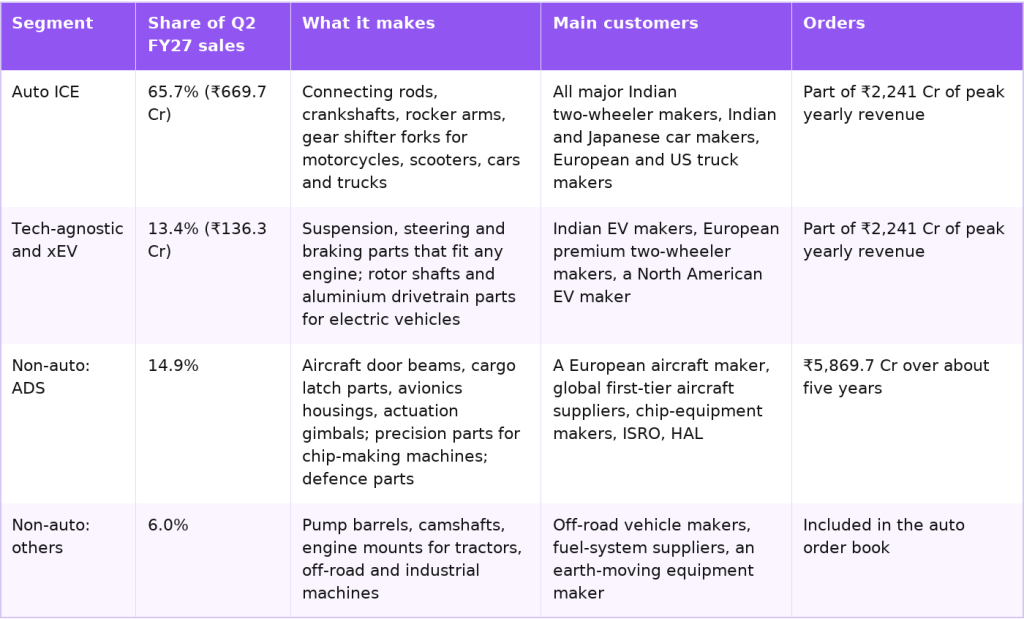
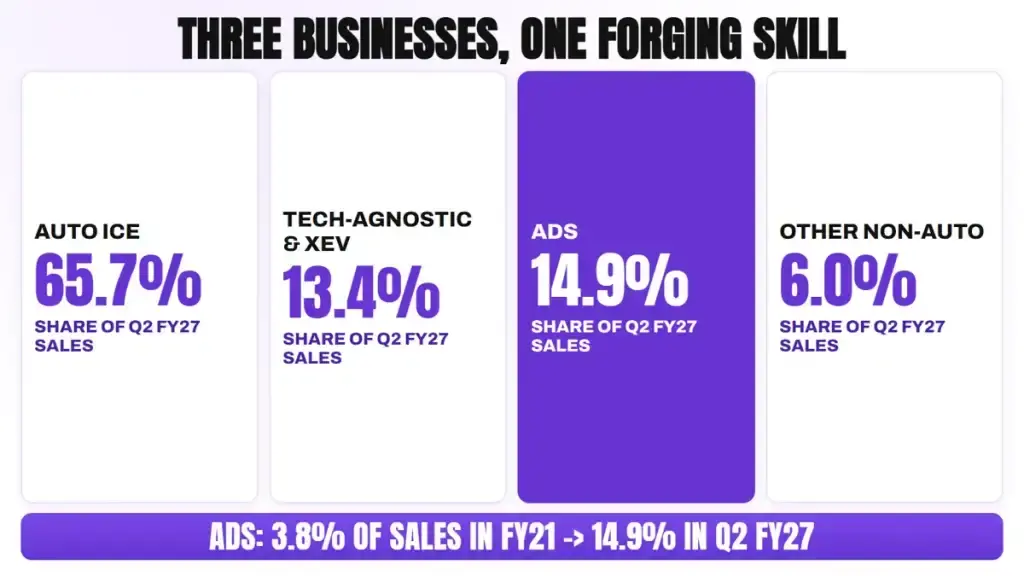
You will notice that these businesses also run at different speeds. An auto part reaches full volume within about three years, and the customer orders in large, steady batches. An aircraft or chip-machine part needs a longer approval, is made in smaller numbers, and comes with a five-year order. Management says ADS and export parts earn EBITDA margins of 25% to 30%, against a company margin of 19.4% in Q2.
Aircraft Parts, the Oldest Part of ADS
Let's start with aircraft, the part of ADS Sansera has been in the longest. The two big makers were booking more orders than they delivered, and their backlogs kept rising. The Boeing 737 and the Airbus A350, two of their largest programmes, are where Sansera says it is adding parts.
For us, that backlog matters because it decides how many parts suppliers must deliver each month. Airbus and Boeing had 15,255 aircraft on order in August 2025, against 13,107 in 2019. Raising build rates on those lines means buying more door, wing and engine parts from approved suppliers around the world.
Sansera's aircraft parts sit inside those sections. It machines cargo latch pawls, cargo housings, door beams, avionics housings, tail-cone parts, aero-structure beams and actuation gimbals, which hold moving parts in place as they turn. The deck names a global European aircraft maker and global first-tier suppliers as its customers. Management says the end customers are Boeing and Airbus.
"The ultimate two customers are Boeing and Airbus. We are getting into increasing number of programs." - Hari Krishnan, Sansera Engineering
That list of programmes keeps getting longer. In FY25, Sansera signed a deal with Dynamatic Technologies to machine critical parts for door assemblies on the Airbus A220. In June 2025, Airbus Defence and Space gave it a long-term contract worth about ₹160 Cr, or USD 18.80 million. Under it, Sansera machines and assembles the intensive-care transport module, a medical evacuation kit that fits inside military transport aircraft. Airbus said it was the first time it had picked an Indian supplier for that kit.
After doors, Sansera's next aircraft step is the engine. A large aircraft engine maker has given Sansera work on a blisk, a single piece that combines an engine disc and its blades. Management says such parts are probably not made by anyone else in India today. After a first trial portion went well, it was given the full blisk to machine, and first samples were due by about mid-September 2026. It is also machining a single-crystal part, a turbine part grown as one crystal of metal, for the first time.
Those parts are now bigger too. Sansera says it can machine aircraft parts up to 4 metres long, on about ten types of five-axis machines, which cut a part from five directions without moving it. Management said aerospace revenue grew 63.3% in FY26, before the semiconductor and defence parts are counted.
Chip-Machine Parts, the Fastest Grower
Next, let's look at semiconductors, which grew from almost zero in about a year. Sansera does not make chips. It machines very precise parts for the companies that build chip-making equipment, and those machines go into the plants that make AI chips.
For our purposes, that demand is what changed the backlog. Management says its chip-equipment customers see themselves unable to meet demand until FY29 or FY30. The customers are booking machining capacity with suppliers ahead of time, and they have large targets for sourcing from India.
Sansera started supplying chip-equipment parts in 2025 and moved into mass production around the middle of FY26. It now calls itself a first-tier supplier to global equipment makers, and it has added sales teams in the US, Japan and Korea. In Q2 FY27, sales to other foreign countries made up 8.2% of revenue, against 4.7% a year ago, mainly because of this business.
As we saw earlier, the August 2026 order is the largest so far. About ₹1,250 Cr over five years, from a customer Sansera already supplied, will take that customer to about $75 million of business a year. Management also says the value of each part keeps rising as it gets more complex work, and it called the margins in this business "super exciting".
So the pace here, as you can see, depends on machines more than on orders. The ultra-precise machines this work needs take seven to nine months to arrive after they are ordered. That is why revenue from the August order starts only in 2027.
Defence, the Smallest and Newest
Now let's turn to defence, the smallest part of ADS today. Sansera makes precision machined parts for defence in small batches for ISRO and HAL. It also exports some parts to companies in Israel.
As we will see, that small base is about to get its own building. Sansera is moving defence into a separate plant of its own, so it can take on larger packages. It is in talks for large defence orders from customers outside India, mainly in Europe. It also plans to add sheet-metal work, first for defence and then for aircraft, so it can quote for more parts in each package.
India's own defence industry is growing fast. Defence exports reached a record ₹38,424 Cr in FY26, up 62.66% from the year before. Management expects the new plant to support about ₹500 Cr of defence revenue over the next five years.
Sansera also holds a stake in that sector through MMRFIC Technology, a Bengaluru company that designs radar chips and radar systems for defence and space. MMRFIC works on orders from DRDO labs and ISRO, and has iDEX funding of ₹20 Cr for next-generation systems. Sansera has the right to raise its stake to 51% at a pre-set formula.
The Auto Core That Pays for It
So who pays for all this new capacity? Mostly the auto business. Auto ICE made up 65.7% of Q2 FY27 sales and grew 18.2%, on a large base. Within it, car parts grew 42.4% and two-wheeler parts 14.2%.
We think that growth comes from customers handing over more work. Two-wheeler makers are outsourcing crankshafts that they used to make themselves, and car makers are consolidating suppliers. For the parts it already makes for Maruti Suzuki, Sansera supplies about 75% of the volume. It is adding forging and crankshaft lines at Pantnagar in Uttarakhand and more space at Manesar in Haryana.
The middle business is growing faster than the engine parts. Tech-agnostic and xEV sales grew 27.0% in Q2 and have grown 5.6 times since FY21, from ₹79.4 Cr to ₹444.9 Cr in FY26. Sansera supplies hybrid programmes of a leading Japanese car maker. It also started an energy-storage supply to a North American customer. A 60:40 joint venture with Nichidai Corporation of Japan, where Sansera will invest ₹50 Cr, should start production in the second half of FY27.
The Plants Being Built for the Backlog
Now that we have seen all four parts of the business, let's look at the space the backlog needs. Sansera's existing ADS plant in Bengaluru covers 140,000 sq ft. Two-thirds of it is used for aerospace and semiconductors, and one-third for defence.
That plant is being extended step by step, with every new building close to the existing plant. An 80,000 sq ft hangar for aircraft and chip-machine lines was due to be commissioned in September or October 2026. A surface-treatment line next to it is awaiting NADCAP approval. A build-to-suit plant of about 100,000 sq ft should be ready about ten months after its lease talks close, which management hoped to do in August 2026.
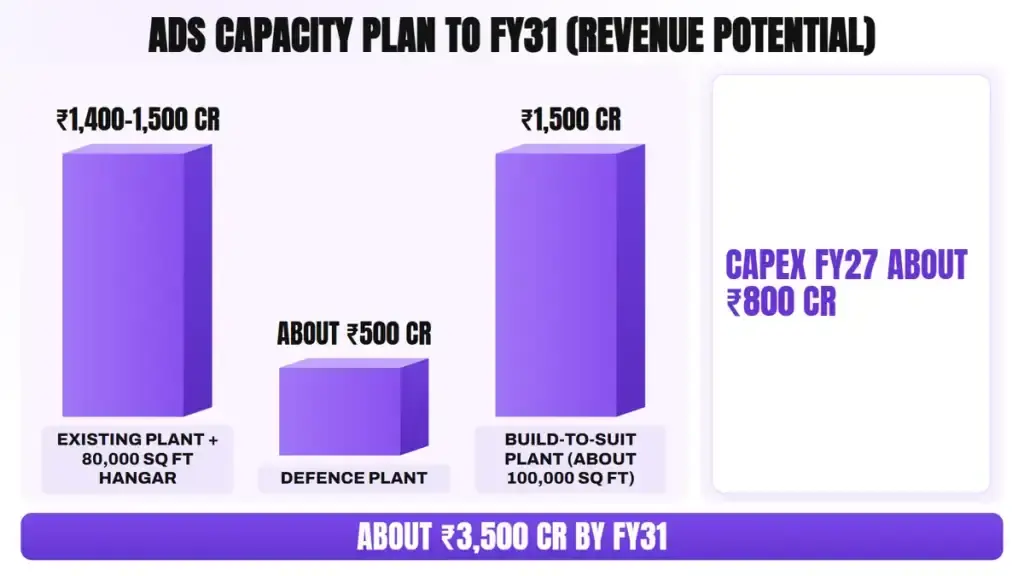
Management has put revenue figures on each of these sites. The existing plant with the hangar can support ₹1,400-1,500 Cr of revenue. The defence plant can support about ₹500 Cr over five years, and the new build-to-suit plant another ₹1,500 Cr. That makes about ₹3,500 Cr of ADS capacity by FY31.
As you would expect, spending on these plants has risen sharply. Capex was ₹591.1 Cr in FY25 and ₹509.7 Cr in FY26, and the company plans about ₹800 Cr in FY27, with ₹326 Cr spent in the first half. A third of the planned machinery spend goes to non-auto. Each rupee spent on ADS machines brings 2.0 to 2.2 rupees of yearly revenue, against 1.25 to 1.3 rupees in auto.
Why an Approved Part Is Hard to Copy
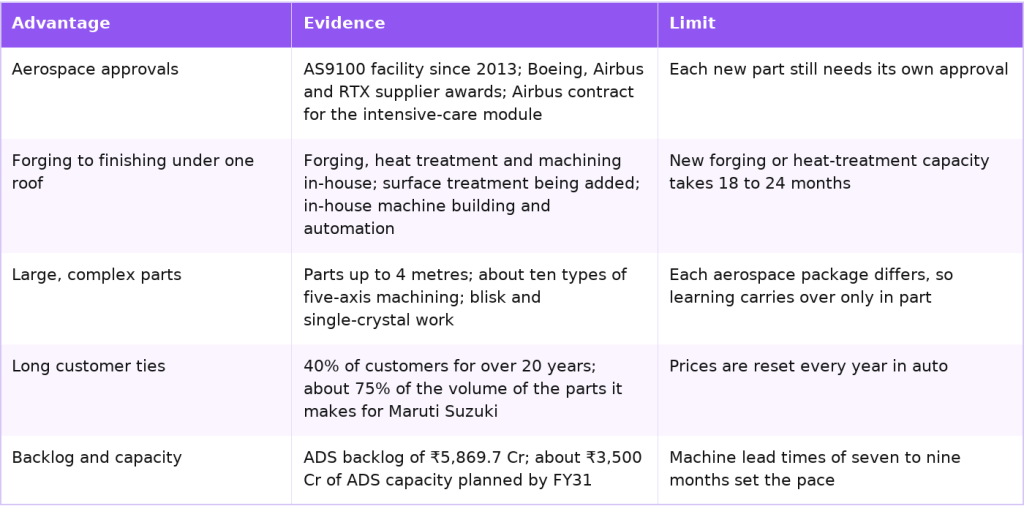
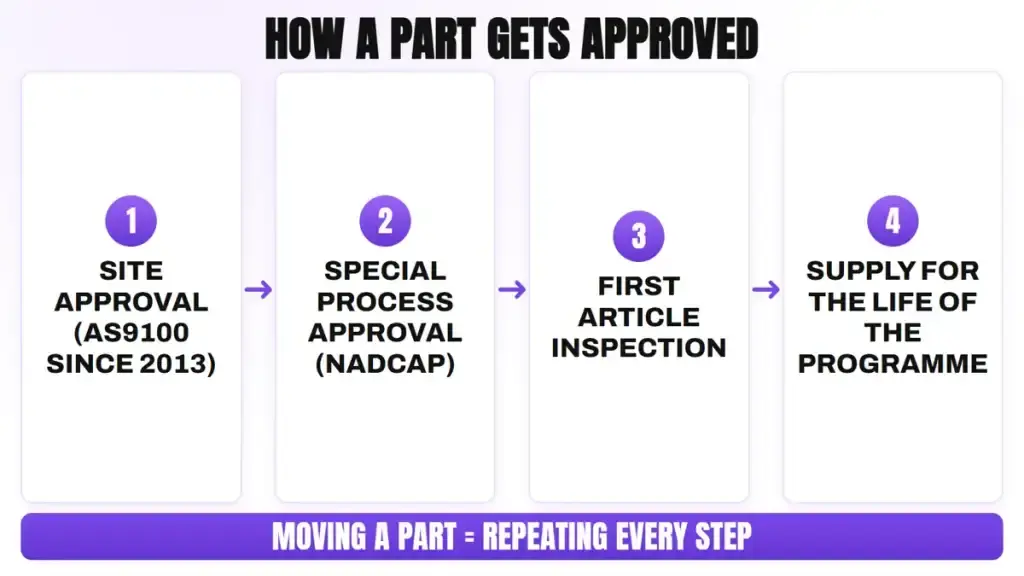
Now that we have seen the plants, let's understand what keeps customers with Sansera once a part is approved. In aerospace and chip equipment, a buyer approves the supplier, the process and each part separately. Each step takes months, and each one has to be passed again if the part moves.
The first layer is the approval of the site.
"The key to investing is not assessing how much an industry is going to affect society, or how much it will grow, but rather determining the competitive advantage of any given company and, above all, the durability of that advantage."
— Warren Buffett
Sansera's advantage in ADS is the stack of approvals on each part. It lasts as long as the programmes it supplies keep running. Aircraft makers buy only from plants certified to AS9100, and Sansera's aerospace plant has held it since 2013. Each special process then needs its own approval, such as NADCAP, an industry audit of processes like heat treatment and coating. That is why the new surface-treatment line matters: it brings a step in-house that earlier went to outside shops.
Next comes the part itself. A new part goes through a first article inspection, which means the first piece is measured against every line of the drawing before production can start. Management says its first trial on the blisk came out right the first time, and that very complex parts from Boeing were approved in record time. Each approval like that makes the next package easier to win.
Then comes the integrated process. Read this Economic Moat Explained Sansera forges, heat-treats and machines its parts in its own plants, and it builds many of its own machines and automation cells. That cuts development time and keeps more of the value with the company. A rival would need to build the same chain and earn the same approvals before a buyer would move a part.
"See, the blisk, you're right, probably is not done by anybody in India at this point of time." - Hari Krishnan, Sansera Engineering
You can see how long those ties last in customer tenure. About 40% of Sansera's customers have bought from it for more than 20 years, and another 20% for more than ten. The top five customers gave 44.5% of FY26 sales, down from 59.2% in FY21, because new customers keep being added. In aerospace, that same pull towards an approved supplier works for Sansera once a part is in production.
Financials: Five Years of Steady Growth
Before we look at management's numbers for FY27, let's see how Sansera's revenue, margins and cash have moved over the last five years.
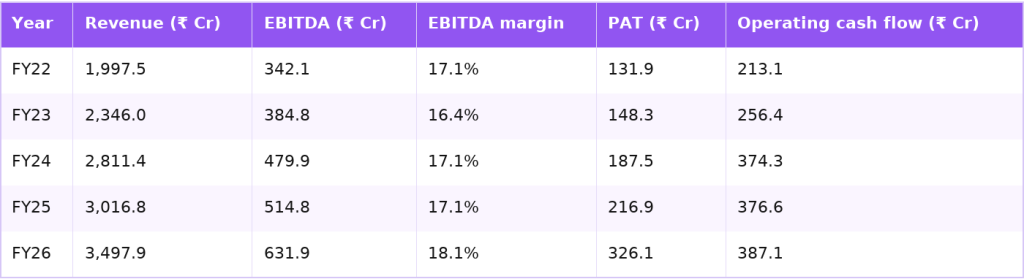
Revenue grew from ₹1,997.5 Cr in FY22 to ₹3,497.9 Cr in FY26, and profit after tax rose from ₹131.9 Cr to ₹326.1 Cr. The EBITDA margin stayed between 16.4% and 17.1% for four years and moved up to 18.1% in FY26, as ADS and export parts grew.
Operating cash flow has been higher than profit in every year, about ₹1,607.5 Cr against about ₹1,010.7 Cr of profit over the five years. But capex has run even higher. It was ₹591.1 Cr in FY25 and ₹509.7 Cr in FY26, above operating cash flow of ₹376.6 Cr and ₹387.1 Cr, so free cash flow was negative in both years.
The ₹1,200 Cr share sale of FY25 paid for much of that gap. With capex of about ₹800 Cr planned for FY27, borrowings have started to rise again, to ₹636.3 Cr in September 2026.
"The worst sort of business is one that grows rapidly, requires significant capital to engender the growth, and then earns little or no money."
— Warren Buffett
Sansera is not that business: it earns well on its sales. But its growth does need heavy capital, so the test is whether the new ADS plants earn the higher returns that management expects from them.
What FY27 Could Look Like on Management's Numbers
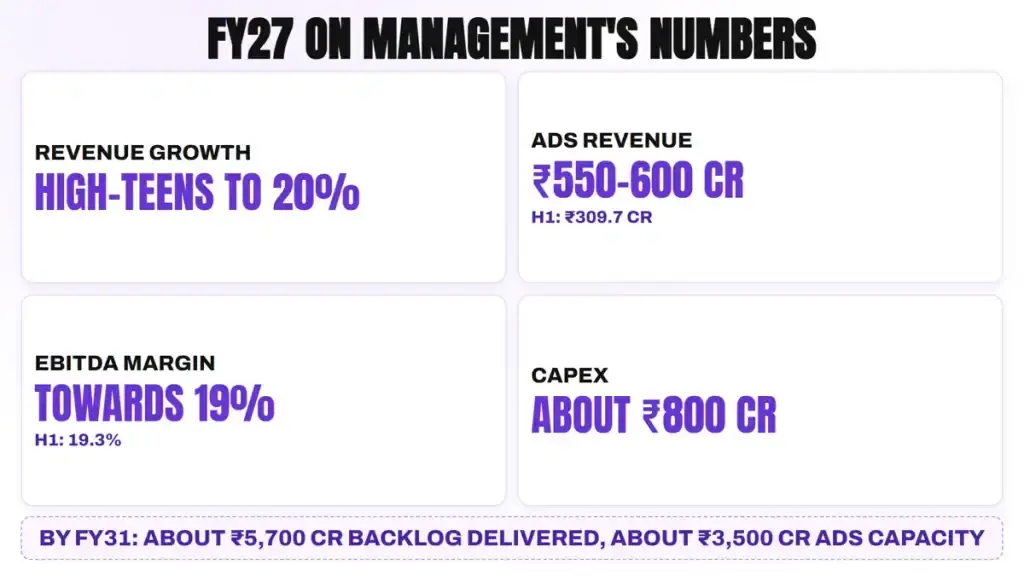
So what could all of this add up to? In August 2026, management said it expected FY27 revenue growth of high-teens to 20%. It expected ADS to grow 75% to 80%, and the rest of the business to grow in the mid-teens. It also guided ADS revenue of ₹550-600 Cr for the year.
So let's put that into numbers. Growth of 20% on FY26 revenue of ₹3,497.9 Cr would mean about ₹4,197 Cr in FY27. The first half has already delivered ₹2,112.7 Cr, so the second half would need about ₹2,085 Cr. That is less than the first half, so the guidance looks easy to meet if the current pace holds.
The same is true for ADS. The first half gave ₹309.7 Cr, so the second half needs only about ₹240-290 Cr to reach ₹550-600 Cr. Q2 alone delivered ₹164.3 Cr. The new hangar and special-process line should add to that pace from the second half.
Next, we come to margins, which have a target too. FY26 ended at 18.1%, and management said it would be happy to move towards 19% in FY27. The first half came in at 19.3%. Over the long term, management keeps a 20-20-20 aim: a 20% EBITDA margin, 20% growth and a 20% return on capital.
Beyond FY27, management talks about two large numbers. It expects the ADS backlog of about ₹5,700 Cr that it held in August 2026 to be delivered by FY31. It also says the company is building facilities for overall revenue of about ₹8,000-9,000 Cr by the end of the decade, led by ADS and by auto export outsourcing, on its own growth alone.
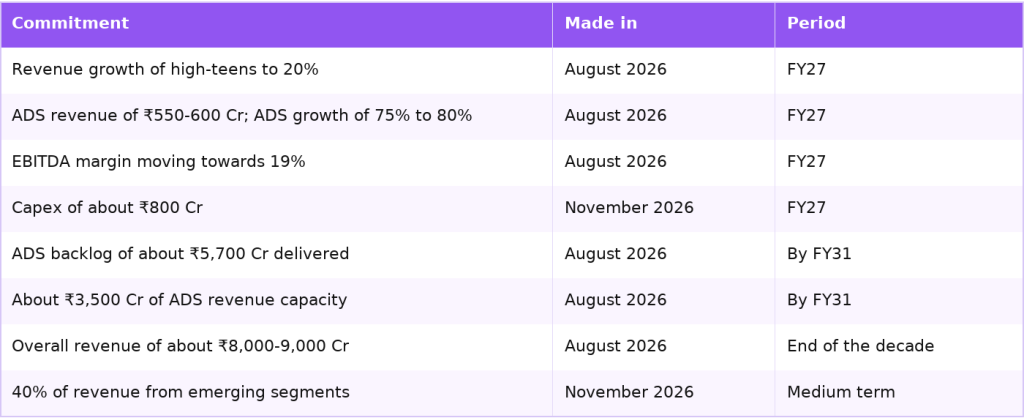
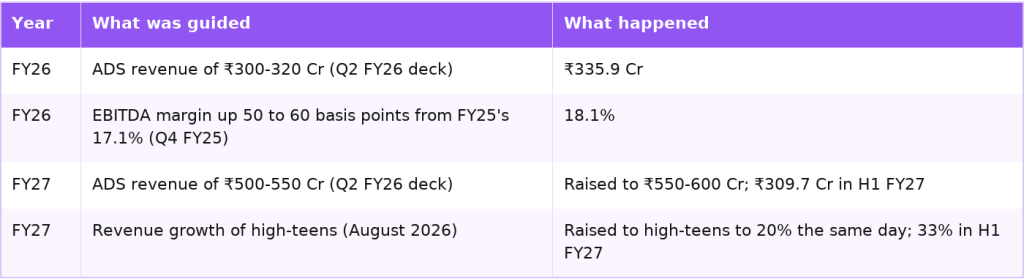
These promises come with a record we can check. In the Q2 FY26 deck, management guided FY26 ADS revenue of ₹300-320 Cr. The year delivered ₹335.9 Cr. The FY27 ADS guidance has also been raised twice, from ₹500-550 Cr in the Q2 FY26 deck to ₹500-600 Cr in the Q3 FY26 deck and ₹550-600 Cr from the Q1 FY27 deck.
Key Risks
A plan this large carries real risks, so let's look at what could go wrong for Sansera.
- Cash and debt: capex is running ahead of operating cash. In the first half of FY27, operations generated ₹222.3 Cr, while investing used ₹370.4 Cr. Borrowings rose from ₹457.5 Cr in March 2026 to ₹636.3 Cr in September, and net debt was about ₹261 Cr. Finance cost rose to ₹14.6 Cr in Q2 from ₹8.1 Cr a year ago.
- Working capital in ADS: ADS ties up about 170 to 180 days of working capital, against about 80 days in auto. Inventory rose from ₹671.2 Cr in March 2026 to ₹897.4 Cr in September. As ADS grows, more cash gets locked in stock for each rupee of sales.
- One customer, one cycle: the August chip-equipment order of about ₹1,250 Cr was about 73% of the ₹1,715.6 Cr of new ADS orders in the first half. That demand follows AI chip spending. If chip-equipment makers cut orders, the backlog could shrink or slip.
- Aircraft programme shocks: management itself names a Boeing-type crisis, like the one about six years ago, as the main aerospace risk. Aircraft parts depend on Airbus and Boeing build rates and on a few programmes.
- Execution of new plants: revenue from the backlog needs the hangar, NADCAP approval and new machines that take seven to nine months to arrive. Any delay pushes revenue into later years, while the cost of the buildings starts earlier.
- The engine-parts base: Auto ICE is still 65.7% of sales, and motorcycles alone were 32.0% in Q2. Battery electric vehicles need no connecting rods or crankshafts, so a faster shift to them would shrink this business.
- Costs and tariffs: steel and aluminium costs pass to auto customers with a lag, and labour-cost compensation in the northern plants was still being negotiated in Q1. The company provided ₹12.6 Cr for US import duty for the previous year in Q1 FY27, and it paid ₹16.9 Cr to settle a US court case, without admitting liability.
- Tax claims and promoter stake: at March 2026, excise, entry and service tax claims of about ₹11.3 Cr were contested and shown as contingent liabilities. Promoters held 29.04% of the company in September 2026, with no shares pledged.
"Risk means more things can happen than will happen."
— Howard Marks
For Sansera, the backlog shows what can happen. Machine deliveries, approvals, chip-equipment demand and aircraft build rates will decide what does.
Explore our Products
Research Framework

Emerging Titans
Combination of quantitative analysis, industry tailwinds, and management assessment - SPRINT investment philosophy

Tiny Titans
Heavy emphasis on scuttlebutt research, plant visits, and early on-ground signals
What to Track Next
If you follow Sansera, these are the signals that will show whether the plan is on track.
- Management's comments from the 6 November 2026 results discussion, once published, for any update to the ₹550-600 Cr ADS guidance and the FY28 view
- Q3 FY27 results, due around February 2027: ADS revenue against the roughly ₹240-290 Cr the second half needs
- The 80,000 sq ft hangar in production and NADCAP approval for the surface-treatment line
- New ADS orders from aircraft makers, so the backlog does not rest on chip equipment alone
- Operating cash flow against capex of about ₹800 Cr, and net debt from about ₹261 Cr
- Auto ICE growth staying in double digits as the crankshaft lines at Pantnagar and Manesar start
Conclusion
Let's step back and put it all together. Sansera spent four decades learning to forge and machine engine parts for India's car and motorcycle makers. It used that skill, and the cash from that business, to get approved by aircraft makers and then by chip-equipment makers. In Q2 FY27, ADS gave 14.9% of sales, and the ADS backlog reached ₹5,869.7 Cr.
So the next few years are about delivery. The backlog asks for roughly twice the ADS revenue the company makes today, and the plants for it are being built now. If the hangar, the special-process line and the new plants come on time, ADS can carry Sansera's growth for years. If they slip, or if chip spending turns, the company will have spent heavily on capacity that fills more slowly than the backlog suggests. The next two quarterly results, starting with Q3 FY27, will show whether the new hangar adds to ADS revenue and whether operating cash flow keeps pace with the ₹800 Cr capex plan.
FAQs
What does Sansera Engineering do?
+Sansera Engineering forges and machines precision parts in 18 plants. Its largest products are connecting rods, crankshafts and rocker arms for motorcycles, scooters, cars and trucks. Its ADS business makes parts for aircraft, defence and chip-making equipment, and it served 109 customers in 28 countries.
How did Sansera Engineering do in Q2 FY27?
+Revenue was ₹1,091.5 Cr, up 32%, its highest ever. EBITDA rose 48% to ₹211.2 Cr, a margin of 19.4% against 17.3% a year ago, and profit after tax rose 52% to ₹108.6 Cr. All three businesses had their best quarter ever.
What is Sansera's ADS business?
+ADS stands for aerospace, defence and semiconductor equipment. It machines aircraft door beams, cargo latch parts, avionics housings and actuation gimbals, precision parts for chip-making machines, and defence parts for ISRO and HAL. ADS gave 14.9% of sales in Q2 FY27, against 3.8% in FY21.
How big is Sansera's ADS order backlog?
+The ADS backlog was ₹5,869.7 Cr on 30 September 2026, to be delivered over about five years, up from ₹2,871.3 Cr in March 2025. In the first half of FY27, Sansera booked ₹1,715.6 Cr of new ADS orders, including a chip-equipment order of about ₹1,250 Cr, and delivered ₹309.7 Cr.
What has Sansera guided for FY27?
+Management expects revenue growth of high-teens to 20%, ADS revenue of ₹550-600 Cr and an EBITDA margin moving towards 19%. It plans capex of about ₹800 Cr. By FY31 it plans about ₹3,500 Cr of ADS revenue capacity.
What are the main risks for Sansera Engineering?
+Capex is running ahead of operating cash, and net debt was about ₹261 Cr in September 2026. ADS ties up about 170 to 180 days of working capital, much of the new ADS orders came from one chip-equipment customer, and Auto ICE engine parts are still 65.7% of sales.

High growth stock specialist, Value Educator
Shashank Mahajan is an equity research professional with over 12 years of experience in identifying high-potential SME and micro-cap stocks at an early stage. He follows a rigorous scuttlebutt research–driven approach, combining on-ground insights with deep financial analysis. Shashank specializes in uncovering under-researched and under-owned companies with strong management quality and long-term growth potential. Through disciplined research and early identification, he focuses on spotting tomorrow’s market leaders before they enter the mainstream investor radar.

Jyoti CNC: The 5-Axis Machines Behind India's Aircraft Parts

INOX India: The Rocket Order Behind a ₹2,268 Cr Book

APAR Industries: Google, Amazon and ₹12,025 Cr of Orders

Techno Electric: ₹11,000 Cr of Grid Orders and Data Centres

PTC Industries: The Titanium Melt Shop Behind Aerolloy

HBL Engineering: Defence Batteries, Fuzes and Kavach Orders
Explore our Products
Research Framework
Emerging Titans
Combination of quantitative analysis, industry tailwinds, and management assessment - SPRINT investment philosophy
Tiny Titans
Heavy emphasis on scuttlebutt research, plant visits, and early on-ground signals



Modern Warfare to Multibaggers
Key Trends. Strategic Shifts. Opportunities Ahead.
Don't Miss This Exclusive Webinar!
Join Value Educator to decode the key trends shaping India's defence sector and learn how to identify tomorrow's potential leaders in the space.
- In-depth research on India's defence sector
- Live Q&A session
- Actionable takeaways for long-term investors

 Orders
 Subscription
 Share with friends


Required Details
₹23999.00
(12 month subscription)
As per SEBI regulations, all users are mandated to complete the KYC that is validated for 1 year. Post payment, you will be redirected to the KYC screen


No comments yet. Be the first to comment!