
SG Mart: The Engine of India's Steel Supply

Somewhere in India, a steel mill just produced another 10,000 tonnes of raw material today.
It has no idea where that steel is going.
That's not a flaw in the mill's planning it's the reality of how Indian steel actually reaches the market. A mill can manufacture at massive scale. But the businesses that need that steel fabricators, contractors, factories, project sites are scattered across thousands of locations, each needing different quantities, in different forms, on different timelines. Somebody has to stand in the middle and make that connection work. SG Mart wants to be that somebody.
Right now, almost nobody does it well. Even the largest organised player in India's steel distribution market moves only 25,000 to 30,000 tonnes a month. For context: India is pouring over ₹11 lakh crore into infrastructure this year alone, building highways, metros, and cities at a pace the world has rarely seen. A $2 trillion construction industry by 2030 needs a distribution engine that can keep up. Right now, it doesn't have one.
One company thinks it's found the answer and the early numbers are hard to ignore.
Meet SG Mart.
"The essential economic test is whether a business has a durable competitive advantage—a moat." — Warren Buffett
SG Mart Is Organising India's Fragmented Steel Distribution Market
That gap didn't go unnoticed. It was staring at the very people who understood the steel business best its manufacturers.
"The number one idea is to view a stock as ownership of a business, and to judge the staying quality of the business in terms of its competitive advantage." — Charlie Munger
The idea for SG Mart didn't come from outsiders studying the steel trade from a distance. It came from the promoters of the APL Apollo Group people who had already spent years inside manufacturing, building businesses like APL Apollo Steel Tubes and Apollo Pipes. They'd lived the problem from the other side: even when you make a strong product, getting it to market efficiently through old-style, fragmented distributor networks is its own uphill battle.
So SG Mart wasn't conceived as just another trading company. It was conceived as distribution infrastructure a platform designed to organise how material moves from mills to a fragmented base of end users, making procurement faster, availability more predictable, and the entire chain easier to plan around.
And the numbers back the ambition. As of 2024, even the leading player in India's largely unorganised steel distribution market was moving only around 25,000 to 30,000 tonnes a month a ceiling the fragmented, informal structure of the industry seemed unable to break through. Within its first eight months of operations, SG Mart moved close to 322,000 tonnes of steel through its trading business averaging roughly 40,000 tonnes a month, already ahead of what the unorganised market's best player had managed to build over years. By the end of June 2024, the company had already scaled to 800+ customers and 90+ registered vendors a sign that the volume wasn't concentrated in a handful of relationships, but spread across a expanding network on both sides of the trade.
And the timing isn't incidental. As global supply chains shift away from China and India steps into that vacuum, manufacturing capacity alone won't be enough to capture the opportunity. Material still has to reach the right customer, in the right form, at the right time at a scale no unorganised player has managed yet.
That's the bet at the heart of SG Mart and, judging by its early numbers, one showing that the model can scale quickly.
The Business Model: Four Ways SG Mart Moves Steel
The idea behind SG Mart is simple to say and harder to execute: organise how steel moves from producers to the people who actually need it. In practice, that ambition has taken shape across four distinct businesses, each sitting at a different point in the steel value chain from simply moving material, to processing it, to converting it into a finished application, to selling it without ever owning it.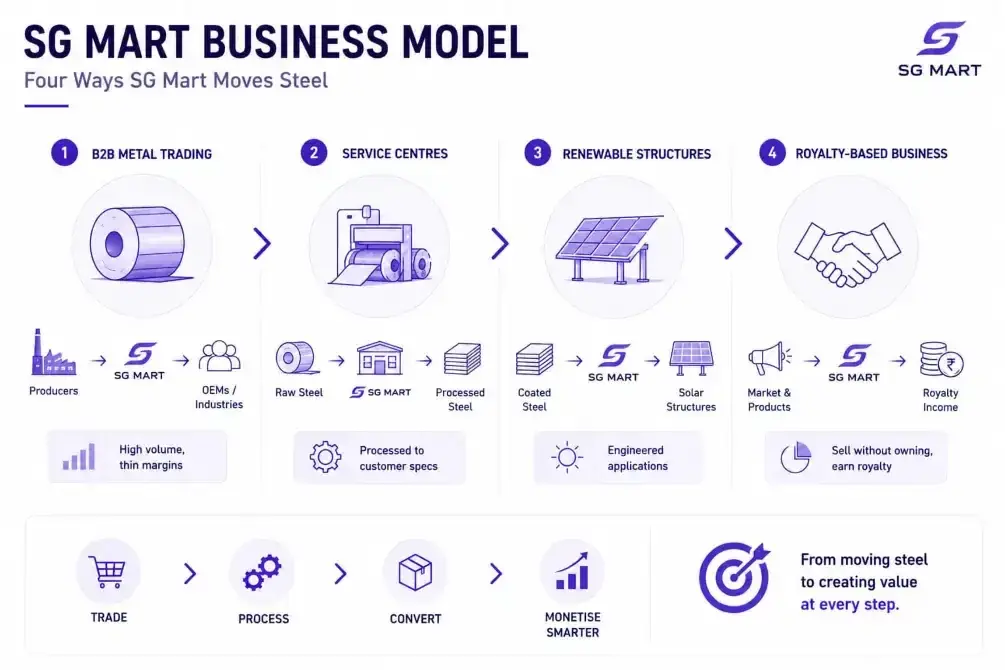
1. B2B Metal Trading The Foundation
This is where SG Mart began, and it remains the largest part of the business. The company buys long and flat steel products directly from producers and supplies them to OEMs, fabricators, construction companies, pre-engineered building (PEB) players, and packaging businesses. For a buyer, the appeal is straightforward one platform instead of a dozen scattered suppliers. For a steel producer, SG Mart becomes another reliable channel to reach the market.On its own, this is classic trading: high volume, thin margins. But it plays a bigger role than the numbers alone suggest. Every transaction gives SG Mart a closer look at what different industries actually need knowledge that becomes increasingly valuable as the company moves up the value chain into processing and specialised products.
2. Service Centres Making Steel Ready to Use
The second business takes SG Mart a step beyond pure trading. Through a growing network of service centres, the company processes raw steel into semi-finished inputs cut-to-length sheets, slitted sheets, and other forms tailored to a customer's exact specification.Here's why that matters: most manufacturers don't want to buy a raw coil and handle the cutting and shaping themselves. An appliance maker, a packaging company, a fabricator they need steel that's already close to production-ready. By processing material before it reaches the customer, SG Mart becomes more than a supplier; it becomes part of the customer's own production line.
This is a more demanding business than trading. It calls for tighter operations, consistent quality, and reliable turnaround. But it also opens the door to a part of the market where price is no longer the only thing that matters service and precision start to count too.
3. Renewable Structures — Steel Meets Solar
The third business applies the same logic to a newer market: renewable energy. SG Mart takes coated steel and turns it into solar mounting and racking structures the physical framework that holds solar panels in place across utility-scale solar parks and residential rooftops alike. Its customers here are EPC contractors and independent power producers.These structures don't generate electricity, but without them, nothing else works. A solar module is only as reliable as the frame holding it steady through years of sun, wind, and rain. This puts SG Mart much closer to the final product than trading ever could success here depends on engineering and design, not just material availability.
4. Royalty-Based Business — Selling Without Owning
The fourth business is the leanest of them all. Here, SG Mart's sales team identifies products and market opportunities, sells them under a brand arrangement, and earns a royalty on volume without ever holding the inventory.
That one distinction changes everything about the economics. No inventory means no working capital tied up in stock. The real investment is in sales effort finding the market and building relationships not in capital. It's a way for SG Mart to widen what it offers and monetise the customer network it has already built, without repeating the capital intensity of trading for every new product line.
One Platform, Four Layers of Value
Put together, these four businesses tell a clear story: SG Mart was never meant to stay a steel trader. Trading builds reach and volume. Service centres turn raw steel into something customers can use immediately. Renewable structures push further still, into a finished application. And the royalty model lets the company grow its footprint without growing its balance sheet at the same pace.
The thread connecting all four is the same SG Mart sits between supply and demand, but with a steadily increasing ability to do more than simply move material from one side to the other. The question that follows naturally: can this shift from volume to value actually change the quality of the business itself?
From Volume to Value: SG Mart's Shift in Mix
Steel trading rewards scale. Buy more, and purchasing terms improve. Turn inventory faster, and capital works harder. But the trade-off is just as real: margins stay thin, and when steel prices move sharply, a volume-only model shows its limits fast.
"A great business at a fair price is superior to a fair business at a great price." — Charlie Munger
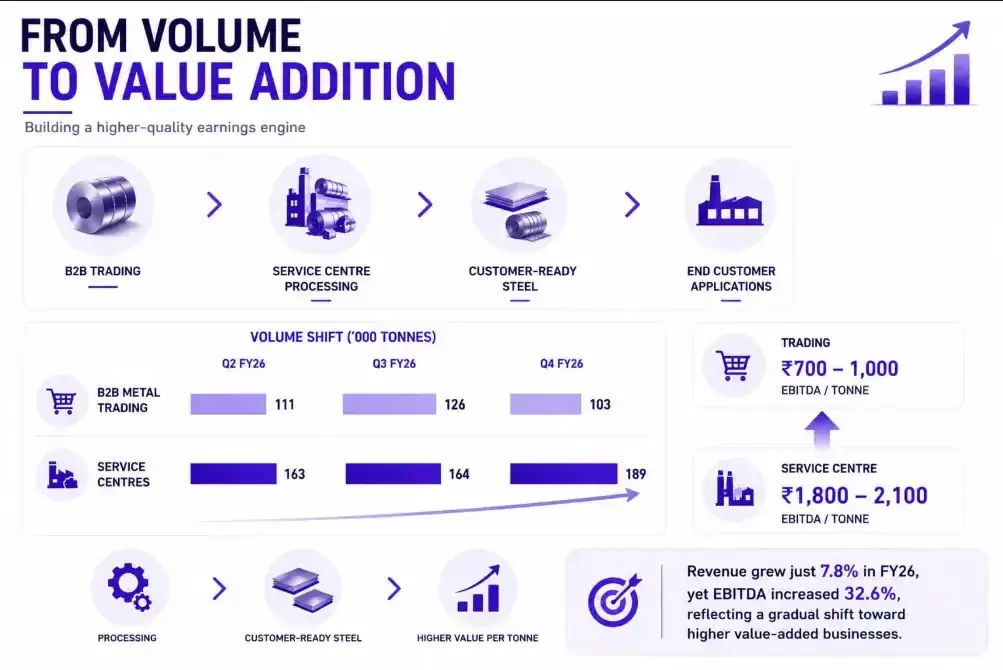
SG Mart didn't have to imagine that scenario it lived through one. In the second quarter of FY26, steel prices fell by roughly ₹3,000 per tonne. The correction continued over the following quarter, taking the cumulative decline across the two-quarter period to around 15%. For a B2B trading business that typically earns just 1.5%–2% per order, a move that size is a sharp reminder that scale alone can't carry the whole business.
The company's response wasn't to step back from trading. Trading still gives SG Mart reach, purchasing power, customer access, and a steady flow of material that hasn't changed. What has changed is how that foundation is being used: increasingly, to push more steel into businesses where SG Mart does more than simply buy and resell it.
The numbers tell their own story. B2B trading volume climbed through Q3, then eased back to 103,000 tonnes in Q4. Service-centre volume moved the other way rising steadily from 163,000 tonnes in Q2 to 189,000 tonnes in Q4.
That's not just steel finding a different route to market. It's steel becoming a different product. Once it passes through a service centre, raw material turns into cut-to-length sheets, slitted sheets, and other inputs processed to a customer's exact specification closer to ready-to-use than raw-to-process.
For an appliance maker, a packaging company, or a fabricator, that difference is real. Rather than receiving a large coil and doing the cutting and shaping in-house, the customer gets steel that's already closer to what they actually need. SG Mart stops being just a supplier of material and starts being a supplier of usable input.
At the time of this shift, the company had seven operational service centres, each built to handle roughly 10,000–12,000 tonnes. The plan isn't only to process more steel through this network it's also to grow the share of coated-steel products, where management sees room for stronger margins than plain trading offers.
The financial outcome is consistent with a better product mix. Revenue grew at a single-digit pace over the period, while EBITDA rose by nearly 30%. That doesn't prove service centres alone drove the improvement, and it doesn't make trading any less important. But it does show why the *quality* of each tonne sold is starting to matter as much as the *quantity*.
Revenue alone rarely tells the full story of a business. To understand why investors closely watch profitability metrics like EBITDA, read EBITDA Explained: Why Investors Use It and When It Misleads.
This shift isn't free, and it's worth being honest about the cost. Management had originally guided for a lean working-capital cycle of just 0–10 days. As service centres and processing take up a bigger share of the business, that cycle has stretched to roughly 10–25 days. Processing adds value but it also means holding and converting material for longer before it's sold.
Working capital isn't just about inventory—it also reflects how efficiently a business converts sales into cash. Learn more in Days Sales Outstanding (DSO) Explained: A Hidden Cash Flow Warning Signal.
SG Mart appears to be making that trade-off with its eyes open. Management has guided toward adding five to six new service centres every year, steadily expanding the infrastructure that turns standard steel into something customer-ready.
Renewable structures follow the same playbook. SG Mart can lean on the land, buildings, and service-centre network it's already building, adding the required machinery to convert coated steel into solar mounting and racking structures. The incremental working-capital need here is modest around 10–15 days while management expects margins near 8%, a clear step up from pure trading.
The shift is still playing out, but the strategic direction is clear. SG Mart built its foundation on volume and reach. It's now using that foundation to push a growing share of its steel through processing and application-led products where every tonne handled can earn more than it once did.
The question that follows: do the economics of these higher-value businesses justify the extra capital and complexity they demand?
Unit Economics of a Service Centre: Why Value Addition Matters
A service centre is more capital-intensive than pure steel trading, but it can also earn materially more from every tonne it handles.
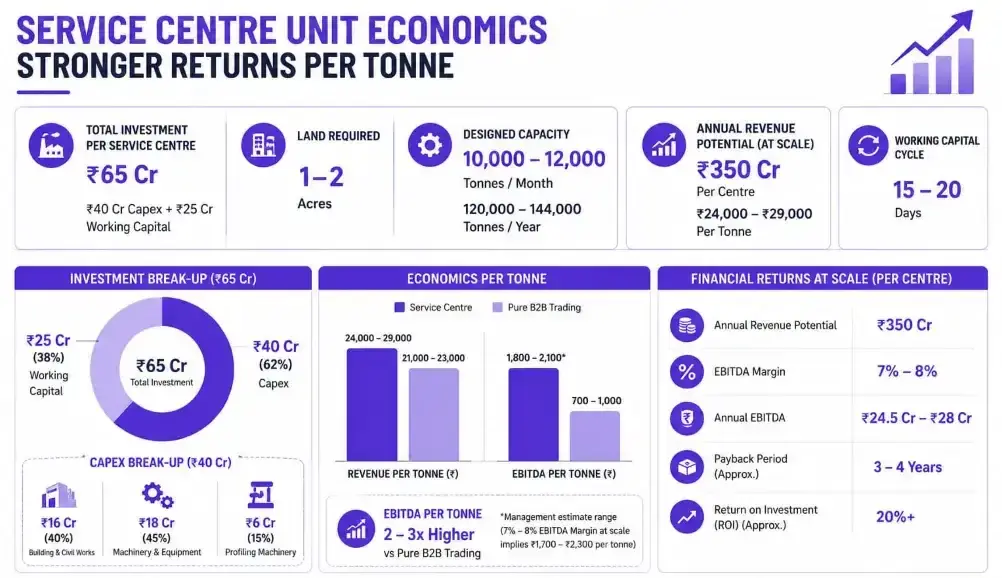
Under SG Mart's current model, a new service centre requires around ₹65 crore of total investment: ₹40 crore of capex and ₹25 crore of working capital. The capex is split broadly between the building, machinery and equipment, and profiling machinery. Each centre requires roughly 1–2 acres of land and is designed to handle 10,000–12,000 tonnes a month, or 120,000–144,000 tonnes annually. At full scale, management estimates annual revenue potential of around ₹350 crore per centre translating to roughly ₹24,000–29,000 per tonne. At a 7–8% EBITDA margin, that implies roughly ₹1,700–2,300 per tonne. Management's latest guidance of ₹1,800–2,100 per tonne sits comfortably within that range. The expected working-capital cycle is 15–20 days.
That compares with around ₹700–1,000 per tonne in pure B2B trading. In simple terms, processing steel through a service centre can potentially generate around two to three times the EBITDA per tonne of simply moving the same material from a producer to a buyer.
The higher earning potential comes with a clear trade-off. Unlike trading, a service centre needs land, machinery, processing capability, and more working capital. But once the infrastructure is in place, it can convert standard steel into cut-to-length sheets, slitted sheets, and other customer-ready inputs products where quality, turnaround, and precision matter alongside price.
Businesses that require significant investment in plants and equipment follow a very different economic model. Our guide Capital-Intensive Businesses Explained: Risks, Economics, and Investor Insights explores why this matters for investors.
SG Mart already has seven operational service centres, with plans to add five to six more each year spread across all four directions of the country. Positioning centres regionally means each one can serve nearby customers faster.
That is the economic logic behind SG Mart's move from volume to value: accept a higher upfront investment and a slightly longer working-capital cycle in exchange for meaningfully higher earnings from every tonne processed.
Managing Steel Price Volatility: A Real-World Stress Test
Steel is not a product whose price stays still. For a company that buys, holds, and distributes large volumes of material, even a short period of sharp price movement can affect margins meaningfully.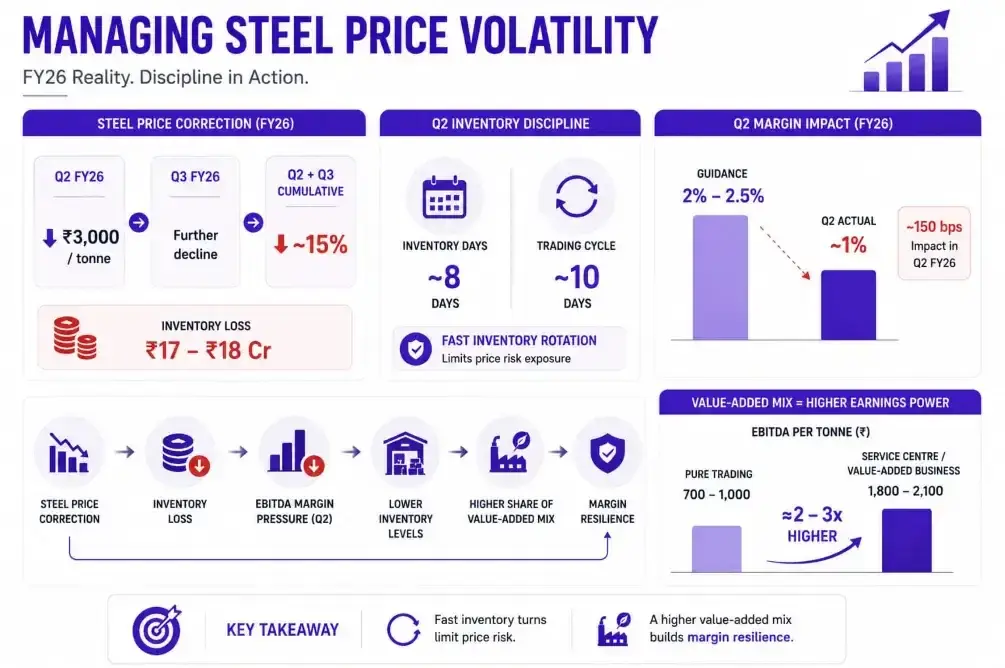
SG Mart saw that firsthand in FY26. Steel prices fell by roughly ₹3,000 per tonne in the second quarter, and the correction continued into the third taking the cumulative decline across the two-quarter period to around 15%. Management indicated that the decline led to an inventory loss of roughly ₹17–18 crore, pulling EBITDA margin down to around 1%, against its earlier guidance of 2%–2.5%.
What made the episode notable was that SG Mart was not carrying unusually long inventory. The company typically completes its trading cycle in about 10 days, with inventory days of around eight days. Steel prices are also generally revised at the beginning of each month, which helps reduce the time for which the company is exposed to an old purchase price.
"Time is the friend of the wonderful business, the enemy of the mediocre." — Warren Buffett
But the correction showed the limit of that protection. Fast inventory turns can reduce price risk; they cannot eliminate it when the underlying commodity keeps moving in the same direction over consecutive quarters.
The response has been to stay disciplined on inventory, particularly when steel prices are volatile or global trade conditions are uncertain. Management intends to keep stock levels low enough to preserve liquidity and reduce the risk of carrying material bought at prices that the market no longer supports.
At the same time, SG Mart is trying to improve the overall mix of the business. Service centres, renewable structures, and royalty-led distribution are not a hedge against falling steel prices. They can still be affected by commodity movements. But because these businesses earn more per tonne than pure trading, they can help cushion the impact of volatility on the company's overall margins.
The lesson from FY26 was straightforward: in steel distribution, managing price risk matters as much as moving volume. SG Mart's ability to combine quick inventory turns with a growing share of value-added business will be central to the resilience of its earnings.
Financial Performance: A Smaller Top Line, Better Economics
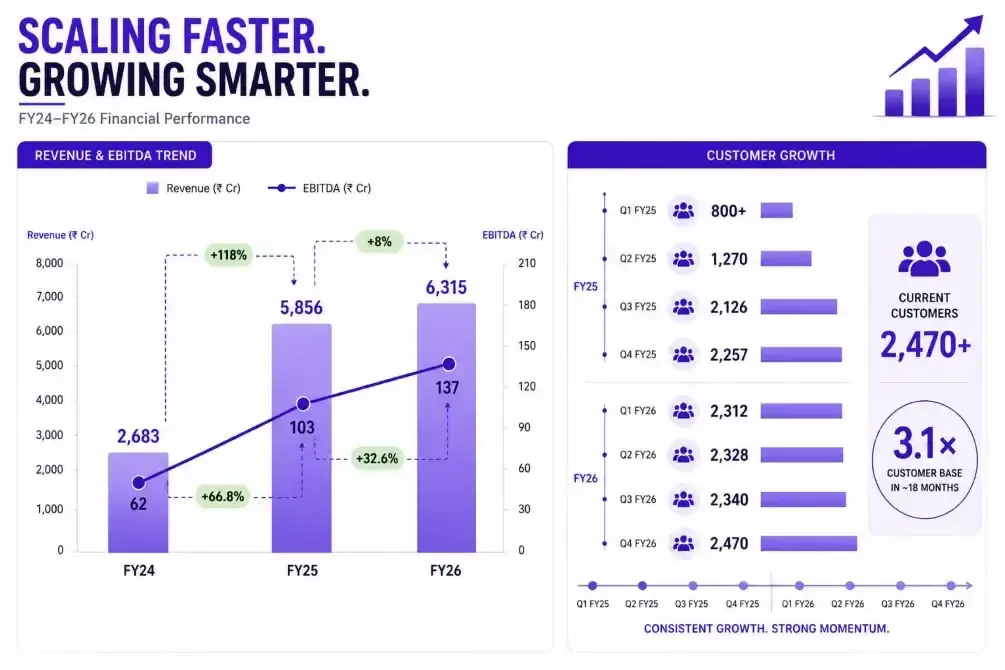
SG Mart's financials tell two different stories across the last two years.
FY25 was about scale. Revenue more than doubled, from ₹2,683 crore in FY24 to ₹5,856 crore in FY25, driven largely by the rapid expansion of the trading business.FY26 was about something else entirely improving the quality of that revenue. Growth slowed sharply on the surface: revenue rose just 7.8% to ₹6,315 crore. But EBITDA told a different story, growing 32.6% over the same period. The result was a meaningful step-up in EBITDA margin, from 1.76% in FY25 to 2.16% in FY26.
That gap between revenue growth and EBITDA growth isn't a footnote it's the headline. It's consistent with SG Mart moving away from relying purely on plain steel trading, and toward service centres, renewable structures, and royalty-led distribution businesses that earn more from every tonne they touch, rather than simply moving more tonnes.
There's a second reason reported revenue needs a closer read, and it has nothing to do with demand. In Q4 FY25, the TMT business shifted from a full pass-through model to a royalty-based one. Under the earlier model, both the sale of material and its cost ran through SG Mart's books. Under the new model, only the royalty income does.
That single accounting shift can make revenue look smaller even as the underlying business grows. TMT volume, for instance, rose from 33,000 tonnes in Q4 FY25 to 39,000 tonnes in Q1 FY26 genuine growth but because of how revenue is now recognised, that growth barely shows up on the top line. Reported revenue and underlying business momentum have started to tell different stories, and a reader comparing this year's numbers to last year's needs to know why.
The customer base, meanwhile, kept widening throughout this transition. From just over 800 customers in June 2024, SG Mart had grown to 2,470 by Q4 FY26. That's not just a vanity metric a wider customer base means more opportunities to cross-sell processed steel, renewable structures, and royalty-led products, rather than leaning on standard trading transactions alone.
All of this is being backed by real capital commitment. FY26 capex came in at around ₹525 crore, including capital work-in-progress and advances to suppliers and contractors, with the bulk of it directed toward building out the service-centre network. The Board has since approved a further ₹600 crore of capex over the next two years. Management has said this expansion will be funded through operating cash flow rather than fresh debt or equity a claim worth tracking as the company scales up its spending.
Whenever a company funds expansion internally, investors should closely evaluate its cash generation. Read Cash Flow Statement Explained: The Most Honest Financial Report to understand what to look for.
Put together, the financial picture isn't one of a business slowing down. It's a business changing what it's optimising for moving from a model where growth was measured mainly by turnover, to one where mix, per-tonne profitability, working-capital discipline, and disciplined execution of capex will increasingly decide the outcome.
Management's FY27 EBITDA target of more than ₹350 crore captures the scale of that ambition. But it remains guidance, not an outcome. For now, FY26 offers the first real evidence in the numbers, not just in the narrative that SG Mart's push toward value addition is starting to show up where it matters most.
What to Watch Going Forward
Everything covered so far explains how SG Mart got here. This section is about what would confirm or complicate where it's headed.
The new geography is a different test than the old one
The next batch of service centres Mandi, Jaipur, Patna, Siliguri, Kolkata, Bhubaneswar, Hyderabad, Chennai pushes SG Mart into markets it hasn't operated at scale before, particularly the East. The earlier centres were built where the company already had trading relationships and demand visibility. These new locations are more of a bet that the model travels that the same unit economics (₹65 crore capital employed, ₹1,800–2,100 per tonne EBITDA) hold up in markets with different customer bases, different competitive intensity, and different logistics. If utilisation ramps at a similar pace to the first seven centres, that's a strong signal the model is repeatable rather than dependent on where the company started. If it's slower, that's worth understanding why.
Capex is about to become far more granular a story
Up to now, capex has largely been a single number moving up each year. With ₹600 crore approved and a stated split a third to buildings, half to machinery and equipment, a sixth to profiling machinery there's now a template to check actual spending against. A meaningful deviation from that split (say, machinery costs running well ahead of building costs) would be an early signal of either cost inflation or a change in the kind of processing capability the company is prioritising worth watching not as a headline number, but as a ratio.
"An economic moat protects a company from being encroached on by competitors." — Warren Buffett
Solar has the widest range of outcomes of any segment
Every other part of the business has a fairly narrow, established EBITDA-per-tonne band. Solar doesn't management has guided anywhere from ₹3,000 to ₹5,000 per tonne, a much wider spread than B2B trading or service centres. Combined with a supply-side bottleneck (coated steel availability, tied to gas supply at suppliers) that's outside SG Mart's direct control, renewables is structurally the least predictable segment in the portfolio right now. It's also the one where the company is chasing the most ambitious share of market over 50% of a 150,000-tonne TAM. That combination wide margin range, external supply dependency, aggressive share target makes this the segment most worth tracking on a quarter-by-quarter basis, more so than its current small size in the overall mix would suggest.
Whether "value addition" becomes self-reinforcing
Management has indicated a preference for selling more coated steel specifically through the service-centre network, because it carries better margins than standard processed steel. That's a subtle but important shift it suggests the service-centre network isn't just a fixed set of processing hubs, but a channel management is actively trying to route toward higher-margin product within its own walls. Whether that internal shift in product mix continues, and whether it shows up as margin improvement within the service-centre segment specifically (rather than just at the company level), is a more granular signal than the headline EBITDA-per-tonne guidance provides.
A structural question the next few years will answer
SG Mart now runs five distinct economic engines B2B trading, service centres, renewables, TMT royalty, and non-TMT distribution each with a different capital intensity, margin profile, and growth ceiling. As the company scales, the more interesting question isn't whether any single segment grows, but how the blend between them evolves whether trading shrinks as a share of the whole even as it stays flat or grows in absolute terms, and whether that blend shift is what ultimately defines the business five years from now, more than any single quarter's revenue or EBITDA number will.
If you want a structured framework for evaluating companies like SG Mart before investing, check out A Fundamental Checklist: How to Research a Stock in 1 Hour.
Explore our Products
Research Framework

Emerging Titans
Combination of quantitative analysis, industry tailwinds, and management assessment - SPRINT investment philosophy

Tiny Titans
Heavy emphasis on scuttlebutt research, plant visits, and early on-ground signals
FAQs
Why is SG Mart more than just a steel trading company?
+While steel trading is SG Mart's foundation, the company is gradually transforming into a value-added steel distribution platform. Beyond buying and selling steel, it processes steel through service centres, manufactures solar mounting structures, and operates royalty-based distribution businesses. This diversification aims to improve profitability per tonne while leveraging the same customer network.
Why is SG Mart investing heavily in service centres?
+Service centres allow SG Mart to convert raw steel into customer-ready products such as cut-to-length and slitted sheets. Although each centre requires around ₹65 crore of investment, management expects EBITDA of roughly ₹1,800–2,100 per tonne—around two to three times higher than traditional trading. These centres also strengthen customer relationships by becoming part of the manufacturing supply chain rather than just a supplier.
How does SG Mart deal with steel price volatility?
+The company manages price risk primarily through fast inventory turnover, typically completing its trading cycle in around 10 days with inventory held for about eight days. However, FY26 demonstrated that prolonged price declines can still impact profitability. To reduce this risk, SG Mart is maintaining disciplined inventory levels while increasing the contribution of higher-margin businesses like service centres, renewable structures, and royalty-based distribution.
Why did SG Mart's revenue growth slow while profitability improved?
+The slowdown in reported revenue was partly due to an accounting change, where the TMT business shifted from a trading model to a royalty-based model, reducing reported sales despite rising volumes. At the same time, a larger share of revenue came from higher-margin businesses such as service centres, resulting in EBITDA growing much faster than revenue. This reflects a shift from pursuing volume alone to improving the quality of earnings.
What should investors monitor over the next few years?
+The biggest indicators will be the successful ramp-up of new service centres, execution of the ₹600 crore expansion plan, growth of the renewable structures business, and continued improvement in EBITDA per tonne. Investors should also watch whether value-added businesses become a larger share of revenue while the company maintains disciplined working capital and healthy returns on capital.

High growth stock specialist, Value Educator
Shashank Mahajan is an equity research professional with over 12 years of experience in identifying high-potential SME and micro-cap stocks at an early stage. He follows a rigorous scuttlebutt research–driven approach, combining on-ground insights with deep financial analysis. Shashank specializes in uncovering under-researched and under-owned companies with strong management quality and long-term growth potential. Through disciplined research and early identification, he focuses on spotting tomorrow’s market leaders before they enter the mainstream investor radar.

Zen Technologies: Why Revenue Fell After Its Biggest Win

Data Patterns: India's Radar Designer and Its Waiting Orders
KSH International: The Wire Inside India's Transformers

Krishna Defence: The Steel Behind India's Warship Hulls

PNG Jewellers: A 194-Year-Old Name Goes National
Axiscades: From Services to Missile and Radar Electronics
Explore our Products
Research Framework
Emerging Titans
Combination of quantitative analysis, industry tailwinds, and management assessment - SPRINT investment philosophy
Tiny Titans
Heavy emphasis on scuttlebutt research, plant visits, and early on-ground signals


 Orders
 Subscription
 Share with friends
 Logout


Required Details
₹23999.00
(12 month subscription)
As per SEBI regulations, all users are mandated to complete the KYC that is validated for 1 year. Post payment, you will be redirected to the KYC screen


No comments yet. Be the first to comment!