
DII Buying: How Mutual Funds Move Prices

“Follow the money, and you’ll understand the market.”
By the end of every trading day, almost every broking firm releases a simple dataset called FII and DII activity. It shows where big institutional money is going, whether large investors are buying or selling.
For beginners, this data works like a market compass. It doesn’t predict prices, but it helps investors see where big institutions are putting their money. Since these institutions invest in very large amounts, their actions can create or reduce demand, and we all know that in the stock market, prices are ultimately driven by demand and supply.

This naturally leads to the next question: who are these big investors?
They are mainly divided into two groups :
FIIs and DIIs. FIIs (Foreign Institutional Investors) invest money coming from outside India, while DIIs (Domestic Institutional Investors) invest money sourced within India.
If you are new to the market. You can read our article What is Nifty, Sensex & Market Indices? Beginners Guide
In this article, we focus on DII activity, especially what DIIs are buying and how mutual fund investments influence share prices over time.
Mutual funds became the first and most important part of DIIs in India because they were the earliest organized institutions created to channel household savings into the stock market. Now, let us try to understand the types of DIIs in India.
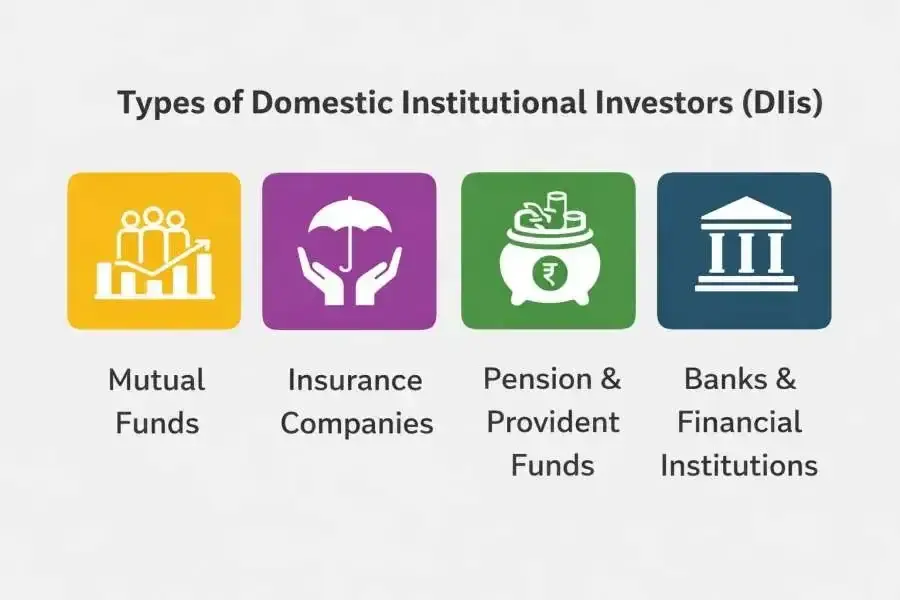
- Mutual Funds
Mutual funds are the most visible and active part of DIIs. They invest pooled household savings across equities and other assets. Because money comes in regularly through SIPs, mutual funds end up being steady and continuous buyers, which is why most daily DII activity is largely driven by them.
- Insurance Companies
Insurance companies invest money, which is collected through premiums, for a long period of time. They usually invest in large, stable companies and prefer patience over frequent trading.
- Pension and Provident Funds
These institutions manage retirement savings. Their priority is mostly capital safety and gradual growth. So they invest in more stable stocks.
- Banks and Financial Institutions :
Banks and financial institutions invest surplus funds and manage large balance sheets. Their market participation may not be daily, but they still contribute meaningfully to domestic institutional capital.
With this context, let us now move to the data, where we try to figure out where the money in the Indian stock market or NSE-listed companies comes from. After that, we also try to understand the composition of DIIs.
Here we have the pattern of NSE-listed companies,
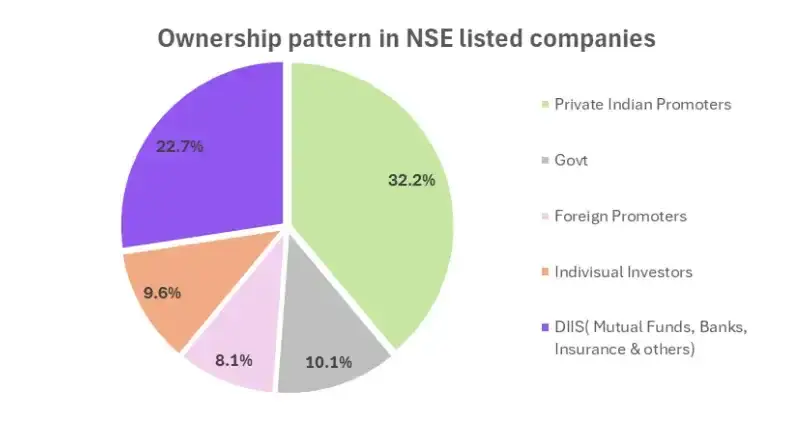
This ownership pattern shows that while promoters continue to hold the largest stake in NSE-listed companies, Domestic Institutional Investors now also hold a good percentage of shares in the market. These hold almost one-fourth of the investment. Currently, Indian markets have higher domestic money savings than foreign money, giving DIIs a stronger role in shaping demand, stability, and share price movements.
“Markets reflect participation before they reflect performance.”
While this gives us a broad ownership picture, it is important to break down what makes up the DII category. To understand the influence of DIIs more clearly, let us break them down further and look at how this domestic institutional ownership is actually composed.
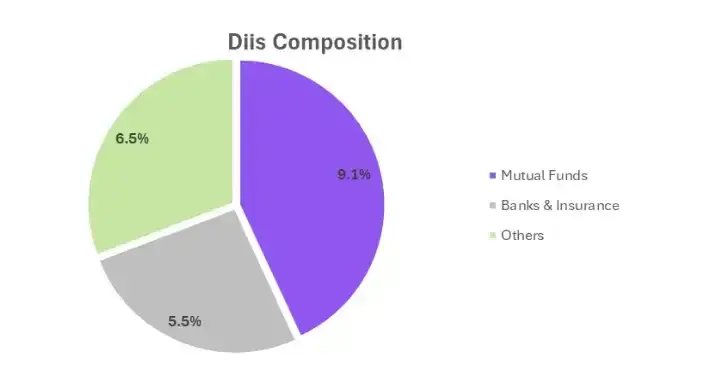
The DII composition clearly shows that mutual funds form the largest share of domestic institutional ownership, followed by banks, insurance companies, and other institutions. This highlights how household savings, when pooled through mutual funds, have become the most dominant source of domestic capital in the Indian stock market.
Since mutual funds contribute the largest share to DIIs, it becomes important to understand how they evolved in India and how they grew into such a powerful force in the market.
A Brief History of Mutual Funds in India
The mutual fund industry in India has evolved through five key phases. It began in the 1960s with the creation of UTI, a government-backed institution that introduced mutual funds to Indian households and built early trust. In the late 1980s, public sector banks entered the space, giving investors more choices.The real transformation came after 1993, when private players were allowed and Systematic Investment Plans (SIPs) were introduced. The period between 2003 and 2014 was challenging due to regulatory changes and the global financial crisis, which slowed the mutual industry growth. But, due strong regulatory support, and an increased number of SIPs since 2014 people started investing in mutual funds, turning mutual funds into a major force in Indian markets.
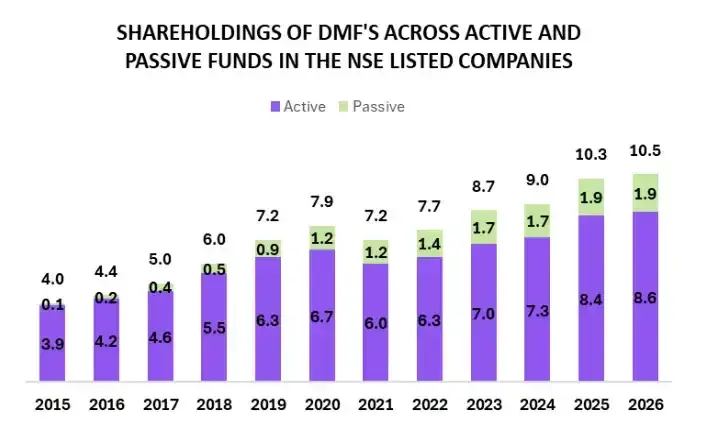
This chart clearly shows the numerical growth in mutual fund ownership across NSE-listed companies. Total Domestic Mutual funds shareholding rose from 4.0% in 2015 to 10.5% by 2026. To understand more clearly, active funds, which are actively managed by fund managers, increased from 3.9% to 8.6% and passive funds which follow index funds, grew from 0.1% to 1.9%. This rise highlights how mutual funds have evolved into the largest and most consistent contributors to DIIs over a period of time.
Want to know more about Mutual funds read our article: Direct Plan vs Regular Plan in Mutual Funds: The Cost Difference Explained
Now, to understand how DIIs impact the stock market, we need one simple concept of correlation, which shows how closely two things move together.
Data shows a clear shift in market leadership. From 2000 to 2014, the correlation between FII flows and the Sensex was +0.37, which means foreign investors had a positive influence on market movements. But from 2014 to 2025, the scenario had changed; this correlation fell to -0.03, indicating that FIIs no longer drive the market the way it used to.
For DIIs, the trend is the opposite. Before 2014, their correlation with the Sensex was weak at -0.20. After 2014, it changed and increased to +0.59, showing that domestic institutional money is now closely linked to market direction. In short, Indian markets have shifted from being FII-driven to DII-driven.
“Experience is the best teacher in markets.”
To see how the market moves with the inflow of DIIs, specifically mutual funds, as they are the largest contributors among domestic institutional investors.
Coronavirus Crash 2020: How DIIs Influenced Market Movement
March 2020 marked one of the biggest market crashes in Indian history as the COVID-19 outbreak triggered global panic. Foreign Institutional Investors (FIIs) exited Indian equities aggressively, which led to putting heavy pressure on benchmark indices.During Covid-19 pandemic, due to global uncertainty, foreign investors lost confidence in other markets, and the same followed with the Indian market too. They prefer to invest in US bonds or commodities. During this phase.
FIIs sold shares worth ₹54,232 crore, leading to steep market declines. On March 23, 2020, FIIs sold ₹3,515 crore in a single session, pushing the Sensex down 3,934 points and the Nifty down 1,135 points. This fall had already started earlier, on March 9, with a sharp fall across indices.
While foreign investors were selling, Domestic Institutional Investors (DIIs) stepped in. In the same month, DIIs invested ₹45,243 crore, absorbing a large part of the selling pressure. This somehow helps the market to stay stable.
To understand more about the DII's impact came on March 13, 2020. After Nifty hit a 10% lower circuit and trading was halted, DIIs invested ₹5,867 crore. This buying led to a sharp intraday reversal, which helped the market to stabilize and save India’s economic status in front of other countries.
This Case study shows that while FII was selling, it led to an increase in the fall, but DII buying helped the market to limit losses and stabilize prices. The 2020 crash marked a turning point where domestic institutional money emerged as a key force in shaping market direction.
“The time of maximum pessimism is the best time to buy.” - John Templeton
This episode clearly shows how domestic institutional money can influence markets during extreme stress.
Read More : What is Value Investing? Complete Guide for Beginners
Let’s take one more example to understand the impact of DIIs better:
When the Russia & Ukraine war took place, foreign investors felt that India’s heavy dependence on Russia for crude oil imports and other trade deals could directly impact the profits of Indian companies. This uncertainty made FIIs cautious, and they started selling aggressively, leading to nearly ₹50,000 crores of outflow from Indian equities between February and March 2022. Putting high pressure on the Sensex and Nifty, especially as commodity prices increased. In contrast, DIIs remained steady buyers throughout the period, helping absorb selling pressure, reduce volatility, and showing strong domestic confidence despite the global conflict.
This strong domestic support helped markets understand and adjust to the risks faster, instead of staying in panic for a long time. As the uncertainty gradually reduced and stability came back, FIIs slowly started returning to the market by July 2022. This clearly showed how consistent participation from DIIs played a key role in holding the market steady and acting as an anchor during a major global shock.
Market crashes often test behaviour more than knowledge. You can read our article “How to Stay Calm During Market Crashes.”
These case studies show how DII activity has influenced markets across different phases. To go one level deeper, it is now important to look specifically at what mutual funds have been buying over the last five years, and how their preferences have evolved.
DMF sector allocation of the NSE-listed universe over the last five years :
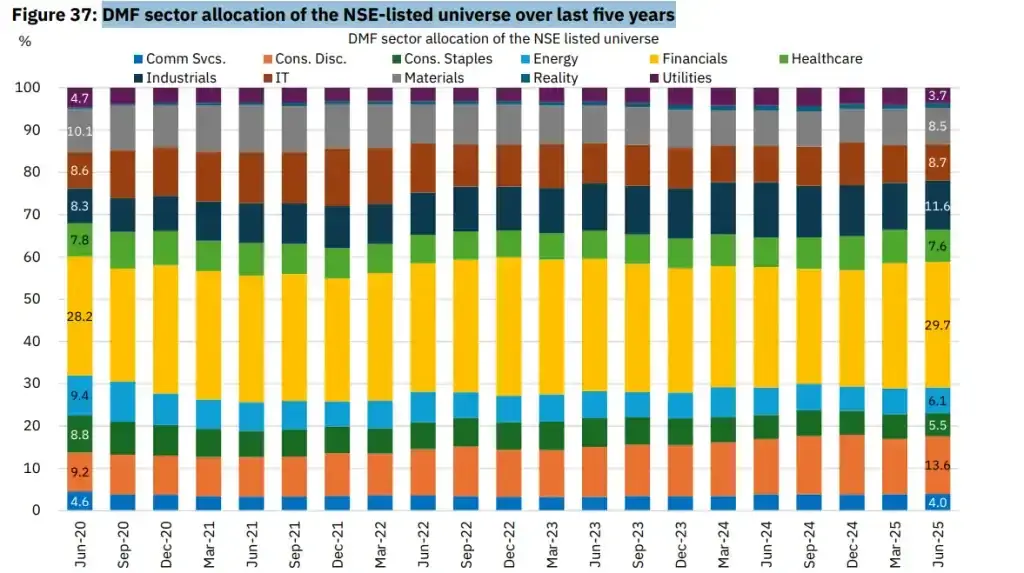
If we look at mutual fund investment data over the last five years, we notice that their sector allocation in NSE-listed companies has stayed largely stable. Investments in the financial sector remain almost unchanged and continue to form the biggest portion of mutual fund holdings. At the same time, exposure to sectors such as industrials, IT, and consumer discretionary has gradually increased, showing a clear shift toward economic growth and consumption-driven themes. This steady and well-spread allocation clearly shows how mutual funds focus on diversification to reduce risk and maintain long-term stability.
You can also diversify your portfolio. I want to know how. Read our article: Portfolio Diversification – How Many Stocks Should You Hold?
While mutual funds invest with a long-term and balanced approach, the real question is:
How retail investors should use (and not follow) DII flows:
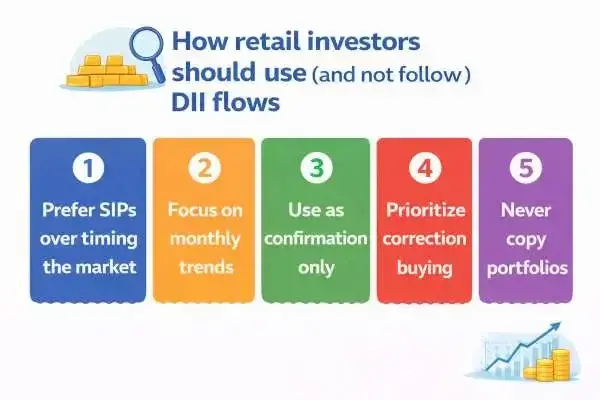
1. Prefer SIPs instead of trying to time the market
Daily DII data may look useful, but it is not reliable for deciding when to buy or sell. Even mutual funds do not try to predict short-term market moves. They use SIPs because timing the market consistently is very hard.
For retail investors, the smarter approach is to invest regularly through SIPs instead of reacting to daily DII movements.
2. Look at monthly trends, not daily numbers
One day of DII buying or selling does not mean much. It can happen due to short-term adjustments or internal reasons. What really matters is what DIIs are doing over a few weeks or months.
Tracking DII trends over 4–6 weeks gives a better idea of whether institutions are actually buying with conviction or just making temporary changes.
3. Use DII data only as support, not as a decision-maker
DII buying should support your own analysis, not replace it. If you do not understand a company or the reason for investing, institutional buying alone is not enough.
Think of DII data as a second opinion, not the final answer.
4. Pay attention during market corrections
DII buying becomes more meaningful when markets are falling and fear is high. During such periods, institutional buying often shows long-term confidence.
Buying during strong rallies usually means prices are already high. DII activity during corrections is far more useful than during market highs.
5. Don’t copy institutional portfolios
DIIs invest very large amounts and have different goals, time horizons, and risk levels. What works for a ₹1,000-crore fund may not work for a ₹1-lakh retail portfolio.
Final Thoughts:
Instead of copying what institutions buy, focus on learning how they invest patiently and with discipline.DIIs now play a very important role in the Indian stock market. Their growing participation has helped investors move beyond traditional options like fixed deposits and savings accounts and take part in long-term wealth creation through equities. Events such as the COVID-19 crash and the Russia–Ukraine war clearly showed how domestic institutional support can help absorb shocks and bring stability to the market, especially as the role of DIIs has strengthened after 2014.
That said, markets keep changing. DII data can shift over time, and making investment decisions based only on buying or selling numbers of DIIs can force you to make decisions which might be wrong . But they cannot replace personal understanding. The real value lies in doing your own research and using insights like the ones discussed in this article to become a better and more confident investor over a period of time.
Explore our Products
Research Framework

Emerging Titans
Combination of quantitative analysis, industry tailwinds, and management assessment - SPRINT investment philosophy

Tiny Titans
Heavy emphasis on scuttlebutt research, plant visits, and early on-ground signals
FAQs
What exactly does DII buying mean?
+Is DII buying always good for the stock market?
+Should retail investors buy stocks just because DIIs are buying?
+No. DII activity should be used only as additional context. Making decisions based solely on DII buying without understanding the business or valuation can lead to poor outcomes.
Why are mutual funds the biggest part of DIIs?
+Mutual funds pool money from millions of investors through SIPs and invest regularly. This makes them consistent and visible participants in the market, unlike other institutions that invest less frequently.
How can a beginner use DII data correctly?
+
High growth stock specialist, Value Educator
Shashank Mahajan is an equity research professional with over 12 years of experience in identifying high-potential SME and micro-cap stocks at an early stage. He follows a rigorous scuttlebutt research–driven approach, combining on-ground insights with deep financial analysis. Shashank specializes in uncovering under-researched and under-owned companies with strong management quality and long-term growth potential. Through disciplined research and early identification, he focuses on spotting tomorrow’s market leaders before they enter the mainstream investor radar.

Atlanta Electricals: Capacity Nearly Quadrupled in a Year

Kirloskar Oil Engines: Data Centres, Nuclear and the Navy

Yash Highvoltage: Bushing Maker With ₹760 Cr of Orders

Quality Power: Reactor Maker With a ₹1,945.5 Cr Order Book

Azad Engineering: Turbine Blades, Jet Engines and Orders

Cyient DLM: Aircraft Electronics and a Record Order Book
Explore our Products
Research Framework
Emerging Titans
Combination of quantitative analysis, industry tailwinds, and management assessment - SPRINT investment philosophy
Tiny Titans
Heavy emphasis on scuttlebutt research, plant visits, and early on-ground signals



Modern Warfare to Multibaggers
Key Trends. Strategic Shifts. Opportunities Ahead.
Don't Miss This Exclusive Webinar!
Join Value Educator to decode the key trends shaping India's defence sector and learn how to identify tomorrow's potential leaders in the space.
- In-depth research on India's defence sector
- Live Q&A session
- Actionable takeaways for long-term investors

 Orders
 Subscription
 Share with friends


Required Details
₹23999.00
(12 month subscription)
As per SEBI regulations, all users are mandated to complete the KYC that is validated for 1 year. Post payment, you will be redirected to the KYC screen


No comments yet. Be the first to comment!