
Direct vs Regular Mutual Fund Plans

Meet Sameer and Rahul. Twenty years ago, they both started investing ₹10,000 a month into the same mutual fund on the same day. They never missed a payment, never panicked during market crashes, and held on tight for two decades. They assumed that since they owned the same stocks and the same fund manager was making the calls, they’d cross the finish line with identical bank balances.

But when they sat down to compare their portfolios, Rahul was in for a shock. Sameer’s account was nearly ₹25 lakh ahead of his. Rahul hadn't picked a "bad" fund or timed the market poorly; everything was identical except for one tiny, boring checkbox they clicked at the very start: Direct Plan vs. Regular Plan.
The difference came down to a "silent partner" in Rahul's account. Because he used a Regular Plan, a tiny slice of his money, about 1%, was being leaked every single year to pay commissions to a distributor. It felt like pocket change at the time, but over 20 years, that 1% didn't just disappear; it took all its future compounding power with it. While Sameer’s money was working entirely for his retirement, a massive chunk of Rahul’s potential wealth was working for someone else.
It’s a wake-up call for any investor: real wealth isn't always built by chasing the "hottest" stock. More often, it’s about the quiet, technical choices you make before you even invest your first rupee. More often, it’s about the quiet, technical choices you make before you even invest your first rupee.
Read More on: How to start Investing in the Stock Market with just ₹1,000
Mutual Funds: Direct vs Regular Plans Explained
Think of a mutual fund as a group road trip. You and thousands of others pool your money together to fuel the car, and a professional manager takes the driver’s seat. Instead of you stressing over every turn in the market, they handle the steering, buying a mix of stocks and bonds to keep things moving.Because your money is spread out across so many different companies, the ride is usually a lot smoother than trying to navigate the wild turns of individual stocks on your own. Every day, the value of your specific "seat" in that car is tracked by the NAV (Net Asset Value), basically just a daily price tag for your slice of the pie.
But here’s where most investors get tripped up. Even though the fund manager and the stocks are the same, you have to choose how you want to buy in: through a Direct Plan or a Regular Plan.
Direct Plans
When you go Direct, you’re dealing straight with the mutual fund company (the AMC). There are no middlemen, no agents, and no banks taking a cut. Because the fund doesn't have to pay a commission to anyone for "selling" you the fund, the Expense Ratio (the fee to run the fund) is much lower
It might only save you 0.5% or 1% a year, but don't let that small number fool you. Over a decade or two, that "tiny" savings stays in your account, compounding over and over. It’s the difference between keeping the whole harvest and giving a few baskets away every year.
Regular Plans
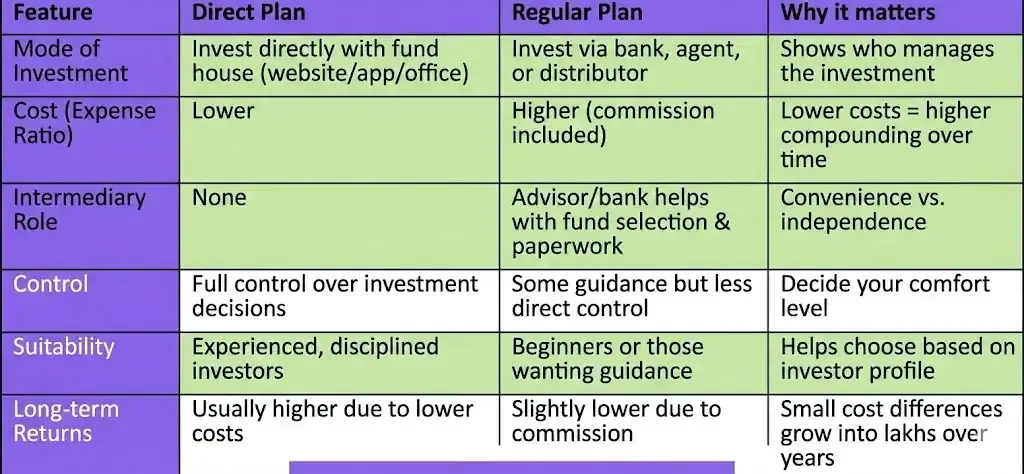
A Regular plan is for those who don’t want to go it alone. You invest through a bank, a broker, or a financial advisor. In exchange for a slightly higher fee, these intermediaries handle the paperwork, help you pick which funds fit your goals, and give you a shoulder to lean on when the market gets shaky. For beginners or busy professionals who don't have the time to research, that extra 1% fee is essentially the convenience tax paid for expert hand-holding. Let’s separate hype from structure by comparing their core characteristics.
Key Differences Between Direct and Regular Plans

1. Mode of Investment
In a Direct Plan, an investor invests directly with the mutual fund company through its website or app, such as SBI Mutual Fund, HDFC MF, or ICICI Prudential MF. For example, Ramesh from Pune invests using the AMC’s mobile app without visiting any office.In a Regular Plan, the investment is routed through a bank or advisor, such as a relationship manager at an SBI branch or a local mutual fund agent in the neighborhood. This difference exists because Regular Plans include an intermediary who completes the process on behalf of the investor, while Direct Plans allow investors to do it themselves.
2. Role of an Intermediary
Direct Plans do not involve any middleman, whereas Regular Plans depend on a financial advisor, bank, or mutual fund distributor. For instance, Sunita in Jaipur relies on her bank advisor to suggest funds and explain market ups and downs, while Arjun in Bengaluru selects and tracks his own funds using online platforms.In a Regular Plan, the intermediary guides fund selection and provides ongoing support. In a Direct Plan, the investor is fully responsible for choosing the fund and monitoring performance.
3. Expense Ratio (Cost)
Think of the Expense Ratio as the "management fee" for your money.- Direct Plans are leaner and cheaper because you’re dealing directly with the fund house.
- Regular Plans come with a higher price tag. Why? Because the fund house has to pay a commission to the broker or advisor who sold you the plan. That commission isn't a separate bill; it’s baked right into the fund’s expenses.
For instance, if a Direct Plan charges you 1%, the Regular version of that same fund might sit at 2%. It might not seem like much daily, but that extra 1% is essentially coming out of your pocket and eating into your wealth every single day. Let’s separate hype from structure by comparing their core characteristics.
4. Impact on Long-Term Returns
Over a decade or two, that tiny difference in fees creates a massive divide in your final corpus. It’s all about the power of compounding. When you pay less in fees, more of your money stays invested, earning its own interest year after year.Take two investors in Mumbai, both putting away ₹5,000 every month for 20 years. The one in the Direct Plan could easily end up with several lakhs more than the one in the Regular Plan. A mere 0.5% to 1% difference in annual costs might feel small now, but over 20 years, it’s the difference between a good retirement and a great one.
5. Suitability for Investors
Choosing between the two really comes down to how much "homework" you want to do:- Direct Plans: These are perfect for the "DIY" investor. If you’re a tech-savvy professional who enjoys tracking NAVs, researching funds online, and managing your own portfolio, the cost savings make this a no-brainer.
- Regular Plans: These are better if you value peace of mind over raw returns. If you’re a first-time investor, a senior citizen, or simply too busy to watch the markets, paying that extra fee for a professional advisor’s guidance and hand-holding can be worth it.
To see these differences in action, here’s a real-life example showing how just one decision at the start can create a huge wealth gap over time.
Read more: What is DII Buying? How Mutual Funds Impact Share Prices
Case Study: Neha, Pooja and the ₹24 Lakh Difference
When Neha and Pooja began their careers at 25 in Bengaluru, investing was not a priority. Like most young professionals, their salaries went into rent, food, and weekend plans. Mutual funds sounded complicated until one coffee break changed their thinking. Neha excitedly shared that her HDFC bank manager had started an SIP for her, while Pooja said she had invested in the same fund using the SBI Mutual Fund app through the Direct Plan.Both friends decided to invest ₹10,000 per month in the same equity mutual fund for 20 years with the same goal of wealth creation. Neha chose the Regular Plan for convenience and guidance, while Pooja chose the Direct Plan and managed everything online herself. In the initial years, the difference in returns seemed small, just about 1% per year, so Neha felt her decision was fine.
After 20 years, they compared results. Neha’s Regular Plan investment had grown to around ₹76 lakh, while Pooja’s Direct Plan investment had reached nearly ₹1 crore. Shocked, Neha asked how this was possible when both had invested in the same fund for the same period.
Pooja explained that the only difference was cost. The Regular Plan included distributor commission, which reduced returns every year, while the Direct Plan had lower expenses, allowing more money to compound. The lesson was clear: in mutual funds, even a small cost difference can create a huge wealth gap over time. What you save today quietly becomes your wealth tomorrow..
Curious how you can apply this to your own investments? Here’s a practical view of how these two routes work in India.
Seeing the massive gap in Neha and Pooja's wealth highlights a critical reality: your choice of "how" to invest is just as important as "where" you invest.
Read More: The Power of Compound Interest: How to Create Wealth in the Stock Market.
One Mutual Fund, Two Investment Routes: Direct vs. Regular
In India, almost every major mutual fund scheme comes in two flavors: the Direct Plan and the Regular Plan. This setup is actually great because it gives you the freedom to decide not just what you invest in, but how you want to manage the whole process. not change at all; the only things that differ are the route you take and the price you pay to get there.Think of it like this: an investor in Pune might be totally comfortable using the SBI Mutual Fund app or an AMC website to go "Direct." By doing the work themselves, they cut out the middleman and keep their costs to a minimum. On the flip side, someone in a smaller town might prefer the face-to-face trust they get at their local bank branch or with a neighborhood agent. By picking a "Regular" plan, they get someone to handle the messy paperwork and provide that personal guidance we often need. The most important thing to keep in mind is that the fund itself is exactly the same. Whether you go Direct or Regular, the stocks, the fund manager, and the investment strategy don't change one bit—only the route you took to get there and the fee you pay change. Expense ratio: Regular Plans include a commission for the distributor, while Direct Plans remove that extra layer of cost.

Every big name in the Indian market, from SBI and HDFC to ICICI Prudential, Axis, and Kotak, offers both options for their popular schemes like the SBI Bluechip or HDFC Flexi Cap Fund. The real "behind-the-scenes" difference is the expense ratio. Regular plans have a built-in commission for the distributor, while Direct plans strip that away.
While a difference of 0.5% to 1% a year might sound like pocket change, the power of compounding turns that tiny gap into a difference of lakhs of rupees over 10 or 20 years. This dual system exists because every investor is different. You might be a first-timer in a Tier-2 city who wants the reassurance of an expert, or a tech-savvy pro in Mumbai looking to squeeze every bit of profit out of your portfolio. Ultimately, you’re choosing between paying a little more for professional support or doing the "homework" yourself to save money. Both paths lead to the same market opportunities, but the choice you make today will quietly shape how much wealth you actually end up with years down the line. Would you like me to help you identify whether a fund you currently own is a Direct or Regular plan based on its recent statement?
Read More: Best Stock Market Apps in India for Beginners (2026 Review)
Choosing Between Direct and Regular Mutual Fund Plans
When it comes down to it, choosing between a Direct Plan and a Regular Plan is less about the "math" and more about how much of the heavy lifting you want to do yourself. Think of it as the difference between being your own pilot versus hiring a navigator.
Who should go with Direct Plans?
If you have a handle on how mutual funds work and you’re comfortable keeping an eye on your own performance, a Direct Plan is likely your best fit. This is for the investor who doesn't mind logging into an app or a website to pick their own funds and do their own rebalancing.The biggest perk here is the lower Expense Ratio. Because you aren't paying a commission to a bank or an agent, more of your money stays in your account. While a $0.5\%$ to $1\%$ difference doesn’t look like much today, over 20 years, that "saved" money compounds into a massive sum. It’s essentially a reward for the time and effort you spend managing your own money. However, the responsibility is entirely on you to be disciplined enough to stay the course when the market gets bumpy.
Who should go with Regular Plans?
On the other hand, if the world of finance feels like a foreign language, a Regular Plan offers a valuable safety net. This is often the better route for beginners or busy professionals who just want someone they can call when things get confusing.When you go "Regular," you’re paying for a service. You get a financial advisor or a distributor who helps with the paperwork, sets up your SIPs, and most importantly, helps you pick the right funds for your specific goals. Yes, the fees are slightly higher because of the built-in commissions, but many investors find this a fair price for the peace of mind and the "hand-holding" they receive.
In the end, choosing between a Direct and a Regular plan isn't just a math problem; it's about how much "heavy lifting" you’re willing to do.
If you’re the type of person who enjoys doing your own homework, digging into fund performance, and staying disciplined when the market gets bumpy, then a Direct Plan is basically a reward for your effort. You cut out the middlemen and keep those extra lakhs for your own future.
On the flip side, if the thought of managing your own portfolio feels overwhelming or you're just too busy to keep tabs on every market dip, a Regular Plan acts like a safety net. You're paying a "convenience tax" for professional hand-holding and help with the paperwork. There’s no right or wrong answer here; the best plan is simply the one that keeps you investing consistently without losing sleep. It’s about matching your choice to your lifestyle and your long-term goals.
Explore our Products
Research Framework

Emerging Titans
Combination of quantitative analysis, industry tailwinds, and management assessment - SPRINT investment philosophy

Tiny Titans
Heavy emphasis on scuttlebutt research, plant visits, and early on-ground signals
Conclusion:
Choosing between a Direct and a Regular mutual fund plan might seem like a minor detail when you're first starting, but it’s actually a decision that can completely reshape your financial future. Imagine two friends starting the same SIP in the same fund on the very same day. Fast forward twenty years, and one of them could be sitting on significantly more wealth than the other. This isn't down to luck; it's because Regular plans have built-in commissions for advisors, while Direct plans cut out those extra costs, allowing more of your money to stay invested and grow through the magic of compounding. own experiences or questions. Making a conscious choice and staying consistent is what eventually turns a modest investment into meaningful wealth.At the end of the day, there’s no "wrong" choice, but it depends on what you need. If you’re the type who stays disciplined and enjoys tracking your own portfolio, a Direct plan is a great way to maximize your returns. On the other hand, if you're busy or want that extra peace of mind, the professional guidance and convenience of a Regular plan are totally valid. The most important thing is simply knowing what you’re paying for and how it impacts your long-term goals. If this cleared things up for you, hit the like button and subscribe for more honest investing tips, and definitely drop the word “DISCIPLINE” in the comments to share your story or ask a question. Staying consistent and respecting the power of compounding is how you turn a modest start into real, life-changing wealth.
FAQs
What’s the big difference between a Direct and a Regular Plan?
+Why do Direct Plans tend to make more money over time?
+Is a Direct Plan riskier?
+Who should go for a direct plan?
+Who is better off with a Regular Plan?
+
High growth stock specialist, Value Educator
Shashank Mahajan is an equity research professional with over 12 years of experience in identifying high-potential SME and micro-cap stocks at an early stage. He follows a rigorous scuttlebutt research–driven approach, combining on-ground insights with deep financial analysis. Shashank specializes in uncovering under-researched and under-owned companies with strong management quality and long-term growth potential. Through disciplined research and early identification, he focuses on spotting tomorrow’s market leaders before they enter the mainstream investor radar.

Zen Technologies: Revenue Fell After a Big Win




PNG Jewellers: A 194-Year-Old Name Goes National

Explore our Products
Research Framework
Emerging Titans
Combination of quantitative analysis, industry tailwinds, and management assessment - SPRINT investment philosophy
Tiny Titans
Heavy emphasis on scuttlebutt research, plant visits, and early on-ground signals


 Orders
 Subscription
 Share with friends


Required Details
₹23999.00
(12 month subscription)
As per SEBI regulations, all users are mandated to complete the KYC that is validated for 1 year. Post payment, you will be redirected to the KYC screen


No comments yet. Be the first to comment!