
7 Checks Before Buying Penny Stocks
The hidden checklist every penny stock ‘tip’ hopes you never see
In early 2023, thousands of Indian college students and young professionals woke up to a YouTube notification from a channel called “The Advisor”. The thumbnail screamed, “Next Adani Group Takeover! Buy Fast!” The stock being promoted was Sadhna Broadcast Limited, trading at roughly ₹5. The video claimed a major foreign entity was acquiring the company and that the price would soon touch ₹500. For beginners chasing quick wins, it sounded like the perfect opportunity.
Driven by FOMO, retail money rushed in aggressively. Within weeks, the stock jumped to ₹33, and social media was flooded with profit screenshots. Early buyers felt confident and smart, believing they had spotted the next big breakout. Very few questioned the sudden rise or verified the claims being made in the videos. The excitement drowned out basic checks that could have raised red flags. Then the rise abruptly ended.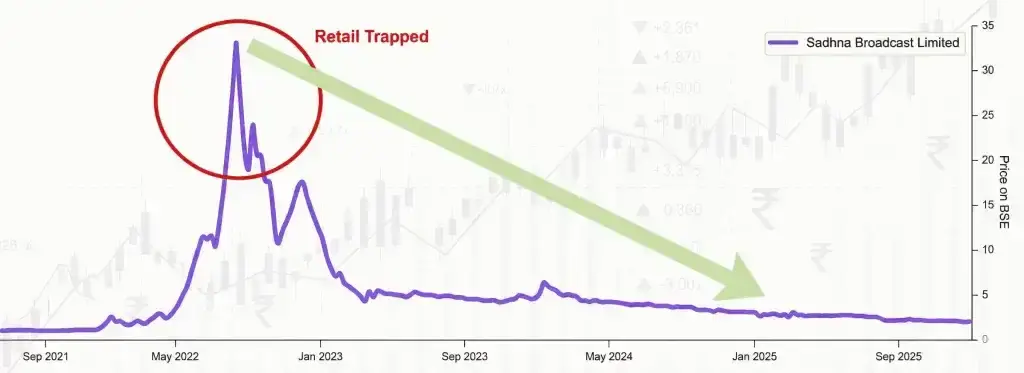
The individuals pushing the stock quietly sold their shares at the top, and the stock began hitting continuous lower circuits with no buyers. Investors were trapped as prices fell back to single digits, wiping out savings. This later became a confirmed case investigated by SEBI, which found it to be a classic pump-and-dump scheme. Importantly, the Adani Group was not involved and their name was falsely used to create hype. In 2025, SEBI banned and penalized the manipulators for illegally profiting from the stock surge.
This was not a rare accident or bad luck. It was a textbook penny-stock playbook repeating itself: low float, loud stories, fake urgency, and silent exits by insiders. Every major penny stock disaster in India follows this exact sequence. The only difference is the company name. If you want to survive this segment of the market, you don’t need better tips, you need better filters.
“Popular opinion is rarely right in the market.”— Benjamin Graham
If you’re wondering why stories like this repeat every year, here’s the uncomfortable truth behind: Why 95% Penny Stock Investors Lose Money (And How to Avoid It)
This story wasn’t an accident; it followed a pattern. To avoid repeating it, you first need to understand why penny stocks rise so suddenly in the first place.
Why Penny Stocks Rise Suddenly – The "Dark Side"
Before learning how to avoid bad penny stocks, it’s important to understand why they rise so fast in the first place. Most beginners assume a rising price means a growing business, but in penny stocks, the reason is often very different. This section breaks down the real forces: manipulation, misleading numbers, and psychology that push prices up without real value.
“Most people get interested in stocks when everyone else is.” — Warren Buffett
The Manipulation Machine
Sudden penny stock rallies are rarely driven by real business growth. They usually start with a low number of shares available for trading, which makes the price easy to push up. Early players create fake activity through repeated buying and selling and then spread exciting stories through YouTube, Telegram, or SMS. As seen in cases like Sadhna Broadcast, this creates urgency to buy, but once enough people enter, those who started the hype quietly exit.The Financial Illusion
Many of these companies don’t improve their business at all. Instead, they show attractive numbers on paper: fake growth, sudden profits, or flashy announcements like bonus issues to look healthier than they really are. The reality comes out when auditors resign or lenders sell pledged shares, triggering sharp crashes like those seen in Brightcom, Manpasand Beverages, or Reliance Capital. When numbers don’t match cash, price collapses sooner or later.The Psychological Trap
Rising prices and daily upper circuits make these stocks look “strong,” but they often hide a dangerous problem: no buyers when things turn. Investors in stocks like PC Jeweller learned this the hard way when prices started falling and exits disappeared. Add trendy name changes or stock splits, and the illusion becomes even stronger. When the story matters more than the business, it’s not an investment, it’s a setup.
Before going deeper, let us understand: What Are Penny Stocks? The Complete Beginner’s Guide (Pros & Cons)
Once you understand how hype, manipulation, and psychology drive these rallies, the next step is to understand the logic behind the penny stock price.Cheap Price vs Broken Business: Know the Difference
A ₹10 share price is not always a bargain. Sometimes, it’s the final stage of a business that has already failed. One of the most important things to understand in penny stocks is how a company became cheap: whether it is a small business still trying to grow or a once-strong company that collapsed due to serious problems. When a large company falls into penny-stock territory, the low price usually reflects lasting damage, not a temporary opportunity.Many well-known Indian companies became penny stocks after years of bad decisions. Reliance Communications (RCom) and DHFL were once trusted, high-priced stocks. They didn’t start small; they fell after heavy debt, poor management, and loss of trust destroyed their businesses. Investors who bought them just because the price looked “cheap” ended up stuck in companies that had no real path to recovery.
On the other hand, many penny stocks were never strong businesses to begin with. They have no track record of steady profits, trusted brands, or stable operations. Instead, they stay alive through hype, frequent name changes, and announcements that don’t lead to real results. Even a company like Suzlon Energy, which struggled for years under heavy debt, survived because there was a real business underneath. Most penny stocks don’t even have that foundation.
Once you understand the difference between low prices and broken businesses, one thing becomes clear: the real danger isn’t missing out, it’s stepping in without a survival checklist.
The Survival Checklist: How to Separate Real Wealth Builders from Traps
Not all cheap stocks are bad, but most bad investments start cheap. After seeing how hype, operators, and fake stories push penny stocks up, the real question isn’t “Can this stock rise?” but “Should I trust it with my money?”
“The stock market is filled with individuals who know the price of everything, but the value of nothing.” — Philip Fisher
This checklist is not about finding the next jackpot; it’s about avoiding the mistakes that wipe beginners out. Think of it as a basic safety filter, if a stock fails even one of these tests, excitement is no longer your friend.
1. The "Real Business" Test
Many penny stocks are "shell companies" that exist only on paper with fancy names like "Global Tech" or "Future Infra," but have no real operations. Before you invest a single rupee, do a simple "Google Test": search for their office address on Maps and look for their actual products in shops. If a company claims to be a market leader but operates out of a residential flat or you can’t explain what they sell in one simple sentence, it is likely a trap. If you can't see the business in the real world, you likely won't see any returns in your bank account.
Buying a share of a company is buying a piece of a business.” — John Templeton
A classic example is Morepen Laboratories. In the mid-2000s and 2010s, Morepen Labs was a classic "dead" penny stock, trading between ₹5 and ₹15 due to massive debt and legal issues. Many wrote it off. However, unlike a fake shell company, Morepen owned household brand names like "Burnol" and "Lemolate". You could walk into any pharmacy in India and physically hold their product. Investors who recognized that "a company with a product in every Indian home cannot be zero" stuck with it. The tangible business survival allowed them to eventually restructure, pay off lenders, and ride the stock to ₹70+, proving that a real product is the ultimate safety net.
2. The Promoter Integrity Check
In small Indian companies, the Promoter (owner) is the captain of the ship. If they are unethical, the ship will sink regardless of the wind. You must check "Promoter Pledging", this shows if the owners have mortgaged their own shares to take personal loans. If a promoter is pledging more than 20-30% of their holding, they are financially stressed. Even worse, if they are selling their own shares in the market while appearing on TV interviews telling you to buy, treat it as an immediate exit signal.A classic example is CG Power. In 2020, CG Power was the ultimate penny stock disaster. Due to a massive fraud scandal by its previous owners, the stock crashed to ₹5. It was bankrupt and untouchable. Then, the Murugappa Group, a conglomerate known for absolute integrity, stepped in to acquire the company. They didn't just pledge shares; they injected capital and cleaned up the governance. Smart investors bought the stock at ₹20-30 solely betting on the integrity of the new owners. Today, that same ₹5 penny stock trades above ₹800, driven entirely by the credibility of the new "Captain."
3. The Debt Trap
Debt is the silent killer of small businesses. While large giants like Reliance can handle big loans, a penny stock with high debt is like a small boat with a heavy cargo; one storm will sink it. Always compare the company's debt to its annual profit. If the company owes ₹500 Crore but only makes ₹5 Crore in profit, it is working just to pay the bank, not you. Avoid companies where debt is rising every year while profits remain zero; they are likely heading toward bankruptcy, not a breakout.
A classic example is Marksans Pharma. Around 2013-14, Marksans Pharma was a struggling penny stock trading at ₹5-10. It had a history of foreign currency debt defaults and looked risky. However, the management started a rigorous "financial detox." Year after year, they used their operating cash flow to repay loans rather than announcing flashy expansions. As the company approached "debt-free" status, the market realized the risk was gone. The stock re-rated from single digits to over ₹150+, creating massive wealth for those who tracked the reducing loan book, not just the share price.
Read more about debt without jargon: What Is Debt-to-Equity Ratio? Why It Matters for Small-Cap Investing
Consider Suzlon Energy during its difficult years (2019-2022). It was trading like a penny stock between ₹2 and ₹8, but unlike dangerous "trap" stocks, it never suffered from low volume. Because it was a well-known power company, crores of shares were traded daily. This massive liquidity meant that even though the stock was risky, investors were never "locked inside." You could always sell your shares in seconds, a safety luxury you rarely get with obscure micro-cap stocks.
5. The 10-Year Track Record
Beginners often get excited by a stock that has jumped 200% in the last six months, but professionals zoom out to look at the last ten years. A real company should have a history of survival. Check if the company has been profitable in at least 7 out of the last 10 years. If a company has posted losses since 2015 and suddenly shows a massive profit in 2025 just as the stock price is rising, be very suspicious. Consistency is boring, but in investing, boring is what makes you rich.A classic example is Elecon Engineering. For nearly a decade (2010–2020), Elecon Engineering was a frustrating stock, often languishing in the ₹20-40 range. It was ignored as a "dead" industrial stock. But a 10-year check revealed it wasn't a fake company; it was a market leader in industrial gears with a 50-year history of surviving business cycles. It just faced a slow economy. When the capital expenditure cycle turned in 2021, this "boring" survivor didn't just double; it went to ₹1,000+. The 10-year survival record was the clue that the company wouldn't go bust; it was just waiting for its turn.
6. The "Operator" Game
Real growth happens in steps (like a staircase), while manipulated growth looks like a vertical line (like a rocket). "Operators" rig penny stocks by pumping the price up daily without any pauses, creating a chart that looks too perfect. If you see a stock hitting the "Upper Circuit" for 15 days straight with no news, do not buy it. That vertical climb is a trap designed to trigger your greed. When the operators pull the plug, the stock will fall just as vertically as it rose.
A perfect example is Titagarh Rail Systems. Between 2018 and 2020, Titagarh (then Titagarh Wagons) crashed to ₹20-30. When it started its recovery, it didn't look like a vertical operator-driven line. It moved in a "Staircase Pattern." It would rise when they won a Metro order, then stay flat (consolidate) for months, then rise again when they showed profitable earnings. This "stop-and-go" movement confirmed that the buying was backed by genuine business progress like Vande Bharat/Metro orders and not manipulation. Investors who trusted the staircase rode it to ₹1,000+, while those chasing "Upper Circuit" rockets in other stocks lost everything.
7. The Dividend Truth
Companies can fake their profit numbers using creative accounting, but they cannot fake the cash needed to pay a dividend. The "Dividend Check" is the ultimate lie detector for penny stocks. If a tiny company pays a regular dividend to its shareholders, even if it is just a few paise per share, it proves two things: the company is actually generating real cash, and the management is willing to share that cash with you. It separates the real businesses from the paper tigers.
A classic example is Trident Limited In 2013-14, Trident Limited was a written-off penny stock trading at ₹3-7, crushed by heavy debt from massive expansions. While the market feared bankruptcy, the "Dividend Truth" revealed a different reality:
Trident consistently paid dividends even during its darkest days. This was the ultimate "Lie Detector", companies going bust hoard cash; they don't share it. Smart investors realized that a firm paying dividends while servicing debt was financially solvent. This single signal gave them the conviction to hold, eventually reaping 50x returns as Trident transformed into a global textile giant.
If this checklist helped you filter stocks, this: A Fundamental Checklist: How to Research a Stock in 1 Hour will help you go one level deeper.
“Investing should be more like watching paint dry or watching grass grow.” — Paul Samuelson
Most investors struggle with penny stocks not due to bad luck, but due to the absence of a repeatable decision framework. Reading stories helps, but applying structured rules consistently and unemotionally is what protects capital over time.
If this checklist changed how you think about penny stocks, comment “DISCIPLINE” below to show your support.
Like the post to encourage more research-driven investing content, share it with investors who value process over tips, and comment with one rule you personally follow before buying any stock. The strongest investing lessons are built through calm analysis and thoughtful discussion, not urgency.
Explore our Products
Research Framework

Emerging Titans
Combination of quantitative analysis, industry tailwinds, and management assessment - SPRINT investment philosophy

Tiny Titans
Heavy emphasis on scuttlebutt research, plant visits, and early on-ground signals
Investor FAQs & Screening Tips
Are all penny stocks bad investments?
+No, but most bad investments start as penny stocks. A few genuine businesses begin small and grow slowly over years. The problem is that beginners can’t easily tell the difference between a real business and a manipulated stock. That’s why filters and discipline matter more than excitement.
Is promoter pledging always a red flag?
+Small amounts of pledging aren’t automatically bad, but high or rising pledging is dangerous, especially in small companies. It signals financial stress and increases crash risk if lenders force sell shares. Always see promoter behaviour as a signal, not noise.
Why is liquidity so important in penny stocks?
+Liquidity is your exit door. In low-volume stocks, you may buy easily but find no buyers when bad news hits. High daily trading volume ensures you can exit without panic or heavy losses. Being able to sell matters more than being able to buy.
Should beginners hold penny stocks long term?
+Usually no. Penny stocks are best treated as trades with clear exits, not lifelong investments. Long-term wealth is built with stable businesses that survive cycles. Holding penny stocks forever often turns hope into permanent loss.
How can beginners avoid falling for fake tips and hype?
+Ignore urgency and verify everything. Real companies communicate through annual reports, not WhatsApp messages or YouTube thumbnails. If a stock is being aggressively pushed with guaranteed targets, assume manipulation. When in doubt, do nothing, capital protection is also a decision.

High growth stock specialist, Value Educator
Shashank Mahajan is an equity research professional with over 12 years of experience in identifying high-potential SME and micro-cap stocks at an early stage. He follows a rigorous scuttlebutt research–driven approach, combining on-ground insights with deep financial analysis. Shashank specializes in uncovering under-researched and under-owned companies with strong management quality and long-term growth potential. Through disciplined research and early identification, he focuses on spotting tomorrow’s market leaders before they enter the mainstream investor radar.

Atlanta Electricals: Capacity Nearly Quadrupled in a Year

Kirloskar Oil Engines: Data Centres, Nuclear and the Navy

Yash Highvoltage: Bushing Maker With ₹760 Cr of Orders

Quality Power: Reactor Maker With a ₹1,945.5 Cr Order Book

Azad Engineering: Turbine Blades, Jet Engines and Orders

Cyient DLM: Aircraft Electronics and a Record Order Book
Explore our Products
Research Framework
Emerging Titans
Combination of quantitative analysis, industry tailwinds, and management assessment - SPRINT investment philosophy
Tiny Titans
Heavy emphasis on scuttlebutt research, plant visits, and early on-ground signals



Modern Warfare to Multibaggers
Key Trends. Strategic Shifts. Opportunities Ahead.
Don't Miss This Exclusive Webinar!
Join Value Educator to decode the key trends shaping India's defence sector and learn how to identify tomorrow's potential leaders in the space.
- In-depth research on India's defence sector
- Live Q&A session
- Actionable takeaways for long-term investors

 Orders
 Subscription
 Share with friends


Required Details
₹23999.00
(12 month subscription)
As per SEBI regulations, all users are mandated to complete the KYC that is validated for 1 year. Post payment, you will be redirected to the KYC screen


No comments yet. Be the first to comment!