
Build a Diversified Portfolio With ₹50,000
Most people don’t lose money because they picked the wrong stock. They lose money because all their money is tied to the same risk. When markets are good, this isn’t obvious. Everything goes up, confidence builds, and mistakes don’t hurt.
When things turn, it all shows up at once. Prices fall together, panic kicks in, and portfolios that looked fine not long ago suddenly feel shaky.
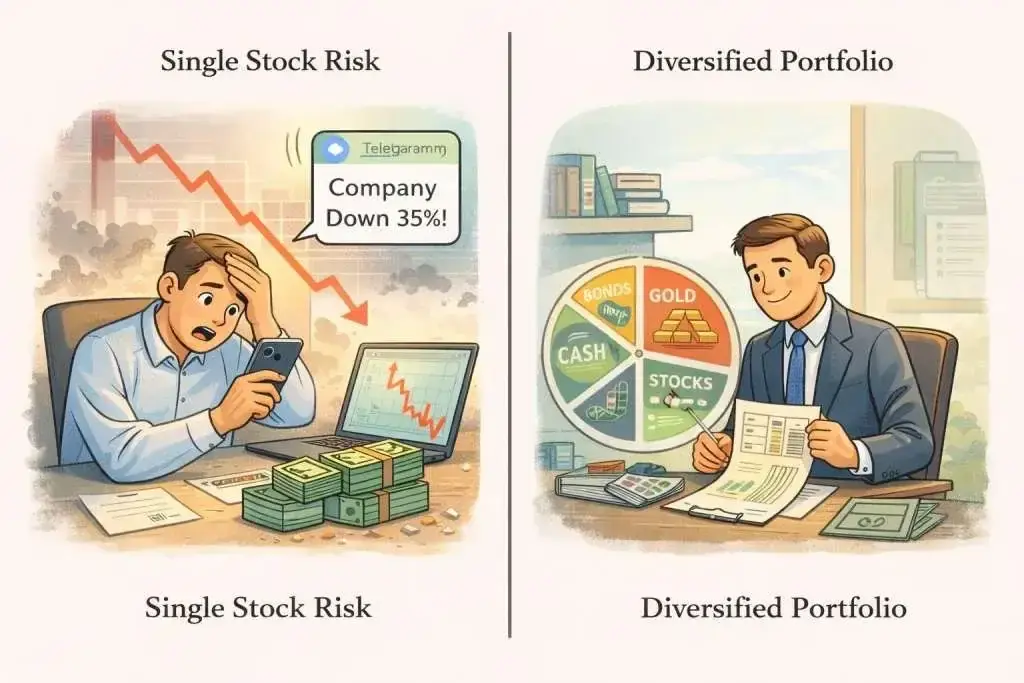
This is why diversification matters far more than most beginners realise. It is not about owning many stocks. It is about not letting a single shock decide your financial future. Markets don’t punish ignorance immediately. They wait for stress. And when stress arrives, portfolios without structure tend to break.
“Risk comes from not knowing what you’re doing.”- Warren Buffett
₹50,000 may not look like a large sum on the screen, but in reality, it is your first capital base. It is the foundation on which every future investment decision will sit. The way you deploy this money decides more than just returns. It decides whether you build confidence and consistency, or whether one bad phase pushes you out of the market altogether.
Right now, the priority isn’t big returns. It’s staying invested and moving ahead. A portfolio that can take hits and still let you continue is worth more than one that looks great for a moment and then falls apart. That’s why setup comes before stock picks, and risk control comes before return chasing.
Once you understand this, building a diversified portfolio stops feeling complicated. It becomes a simple exercise in allocating money across different types of risk, so that no single event can undo all your effort at once.
Step 1: First Understand Risk (Before Returns)
Diversification means not putting all your money in situations that fail together. New investors usually think about making money first and risk later, but survival comes first. You only earn returns if you’re still invested when time does the work.Every investor, regardless of experience, faces three core risks. If your portfolio ignores even one of these, it becomes fragile. It may look fine in good times, but it will break when conditions change.
- Market risk – This is the risk most people recognise. When markets fall, stocks tend to fall together. Even good companies can drop sharply in a panic. If all your money is in equities, a single market downturn can damage both your capital and your confidence.
- Inflation risk works quietly. Even when markets are calm, prices rise, and cash loses value over time. Money that just sits feels safe, but slowly buys less.
- Liquidity risk shows up when you need cash fast. If your money is tied up and hard to sell, you’re forced into bad decisions right when timing matters most.
A good portfolio doesn’t try to remove risk. That can’t be done. What it does instead is spread risk so that one bad event doesn’t wreck everything. When you see it this way, diversification stops sounding fancy and starts looking practical; it’s about staying in the game.
If you want to understand how as a student,you can actually build portfolios around this idea, How to start Investing in Stock Market with just ₹1,000 breaks down how different assets are used to get through market cycles.
“The biggest risk is not taking any risk… In a fast-changing world, the only strategy guaranteed to fail is avoiding risk altogether.” - Mark Zuckerberg
Step 2: The One Rule That Matters With ₹50,000
With ₹50,000, the priority isn’t high returns. It’s not getting hit early. People don’t stop investing because returns were a bit lower. They stop after one bad year destroys their money and their confidence.
This is why simplicity matters more than intelligence at this stage.
With small capital, every extra decision increases the chance of a mistake. More stocks mean more monitoring. More instruments mean more rules. More activity means higher costs and emotional fatigue. None of this improves outcomes for a beginner portfolio.
You don’t need:
- 10 stocks, because you won’t have enough allocation in any one idea to matter, and you won’t track all of them properly
- Exotic instruments like complex derivatives or thematic products that behave unpredictably in stress
- High-frequency trading, which turns investing into a reaction game and slowly leaks money through costs and poor timing
What you actually need is structure + discipline.
Structure answers one question clearly: Why is this money here?
Discipline answers the harder one: Will I stick to this when markets test me?
This is where most portfolios fail. People buy things without roles. When markets fall, they don’t know what to sell, what to hold, or what to add to. Panic fills the gap where structure should have been.
That’s why you should think in buckets, not stocks.
A bucket is a job description for your money. One bucket exists to grow. Another exists to stabilise. Another exists to protect purchasing power. When markets move, you don’t react emotionally; you simply rebalance between buckets.
With ₹50,000, buckets keep things clean:
- You always know what each part of your portfolio is supposed to do
- You avoid overexposure to one single type of risk
- You make fewer, better decisions over time
This approach may not feel exciting on day one. But it is the exact structure that allows you to keep adding money year after year without blowing up when conditions turn difficult.
And surviving the early years is what actually creates long-term wealth.
Many investors fail early, not because markets are unfair, but because of avoidable structural errors. Common Mistakes Every Small-Cap Investor Makes (And How to Avoid Them) breaks down where beginners usually go wrong.
“The most important investment you can make is in yourself.” - Warren Buffett
Step 3: The 4-Bucket Portfolio (Core Framework)
This is where everything comes together. Once you understand risk and commit to simplicity, the next step is to assign clear roles to your money. The 4-bucket framework does exactly that. Each bucket exists for a reason, and together they create a portfolio that can grow, absorb shocks, and keep you invested through bad phases.We start with the most important bucket.
Bucket 1: Growth Engine (Equities)
Typical Range: ~50–70% of portfolio
Purpose
This bucket exists for one dominant reason: to outpace inflation and compound wealth over time.If your capital grows slower than inflation, purchasing power erodes quietly — even when account balances rise. Equities are the only mainstream asset class that has consistently solved this problem over long periods.
Volatility here is unavoidable. That is not a flaw. It is the admission ticket for growth.
How to Structure It
With smaller portfolios, simplicity beats diversification theatre.Rather than spreading capital across many ideas, a cleaner structure often works better:

Core Layer → Broad Market Exposure
A Nifty 50 or Sensex index fund provides low-cost ownership of India’s strongest businesses across sectors. This is your foundation. The goal is not to outperform. The goal is to participate in economic growth with minimal decision stress.
Satellite Layer → Controlled Upside
A smaller allocation to a high-quality mid-cap stock or mid-cap fund introduces growth asymmetry. Mid-caps can grow faster than the index but carry higher volatility. Keeping this portion limited allows upside without destabilising the portfolio.
Together, these components balance predictability and opportunity.
Mental Model Required
Equity markets will periodically test conviction.Temporary drawdowns of 10–20% are normal features, not system failures.
The most damaging beginner behaviours are predictable:
- Selling during declines
- Constantly changing strategies
- Abandoning equities after volatility
At smaller capital levels, time is the primary advantage, not precision.
Non-Negotiable Rule
Do not expand equity complexity simply because markets are rising.Do not exit equities purely because markets are falling.
Compounding is driven more by endurance than timing.
Bucket 2: Stability Anchor (Debt / Low-Volatility Assets)
Typical Range: ~10–30% of portfolio
Purpose
Debt rarely creates wealth acceleration. Its role is psychological and structural: to prevent panic during equity stress.
Boring assets are often portfolio stabilisers.
How to Use It
At modest portfolio sizes, prioritise safety, liquidity, and simplicity:- Liquid funds
- Short-duration debt funds
- High-interest savings instruments
Choosing one clean vehicle is usually sufficient. Complexity adds little benefit at this stage.
Why It Matters
Market declines do not just reduce portfolio values.They disproportionately damage investor confidence.
A stability bucket:
- Dampens total portfolio swings
- Preserves emotional composure
- Provides liquidity without forced equity sales
Diversification is not purely mathematical; it is emotional insulation.
Success Metric
This bucket is successful if it prevents poor decisions during volatility. Return maximisation is secondary.Bucket 3: Insurance Asset (Gold / Defensive Hedge)
Typical Range: ~5–15% of portfolio
Gold earns its place in a portfolio for a very different reason than stocks or debt. It is not there to excite you. It is there to protect you when things stop behaving normally.Every portfolio needs something that holds up when confidence cracks. Gold has done that for years. When stocks fall hard, currencies weaken, or inflation quietly eats away at value, gold usually stays steady or moves higher.
That’s why it matters. Gold doesn’t have to beat equities. It just has to be there when equities aren’t.
For a ₹50,000 portfolio, gold acts like insurance. You hope you never need insurance, but the day things go wrong, you are glad it exists. A 10% allocation is enough to reduce drawdowns without dragging long-term returns.
The cleanest way to add gold today is through a Gold ETF or Sovereign Gold Bonds (SGBs). Gold ETFs are liquid and simple, ideal if flexibility matters. SGBs work well if your time horizon is long and you don’t need liquidity, since they also pay interest on top of gold price appreciation. Physical gold is best avoided at this stage due to making charges, storage risk, and poor liquidity.

If you’re considering gold as a long-term hedge rather than a trading asset, What are Sovereign Gold Bonds (SGBs)? A Smarter Way to Own Gold explains why many investors prefer SGBs over physical gold.
The most important mindset shift here is this:
Gold is not a return-generating asset. It is a shock absorber. It protects purchasing power during inflationary periods, offsets equity stress during crises, and gives psychological stability when markets feel hostile.
In simple terms, equities help you grow. Debt helps you stay calm.
Gold helps you survive.
That’s why even a small ₹5,000 allocation matters more than it looks on paper.
Bucket 4: Optionality / Opportunity Cash
Typical Range: ~5–20% of portfolio
This bucket is the most underrated part of a portfolio, especially for beginners. It doesn’t look productive on the surface, but it quietly gives you something extremely valuable: flexibility. Most investors don’t fail because they lack intelligence or information. They fail because when opportunity appears, they have no dry powder left.
Opportunity cash exists for moments when markets misbehave. Corrections don’t send calendar invites. Panic selling creates bargains suddenly, and only investors with available cash can act calmly when others are forced to watch from the sidelines. This bucket lets you buy when prices fall, instead of wishing you could.
It also helps you learn. Early on, you’re going to make mistakes. Keeping a small amount of money aside lets you try ideas and learn from them without hurting your main portfolio.
Cash also reduces pressure. When everything is invested, every market move feels personal. A little cash gives you room to wait, think, and act only when you’re ready; not because you feel forced.
Most importantly, opportunity cash gives you optionality. It lets you respond to events rather than predict them. In investing, that’s a powerful edge. You don’t need to be right all the time; you just need to be ready when the odds finally tilt in your favour.
Think of this bucket as patience with a balance sheet.
Final Perspective
Portfolio construction is not about precision. It is about survival, stability, and participation across cycles. Asset buckets serve different psychological and economic roles:- Growth assets drive compounding.
- Stable assets protect behaviour.
- Hedges protect purchasing power.
- Cash protects flexibility.
The exact mix is personal.
What matters most is building a structure you can hold through discomfort without destructive decisions.
That, far more than allocation perfection, determines long-term outcomes.
Step 4: What About Real Estate?
With ₹50,000, real estate just isn’t realistic. Property needs big upfront money, long lock-ins, and the ability to sit through illiquid phases and cycles. Trying to get into it too early usually means stretching yourself, taking leverage, or making decisions based on aspiration instead of logic.That said, ignoring real estate completely is also unnecessary. The right approach at this stage is indirect exposure, not ownership. Real estate is a powerful wealth creator, but it works best once your capital base is large and stable.
Indirect exposure allows you to participate in the real estate cycle without the usual downsides. Instruments like REITs (Real Estate Investment Trusts) make sense later, when your portfolio grows, and income stability becomes important. They provide rental-like cash flows, professional management, and liquidity, without locking your money for years.
At the early stage, exposure can also come through real-estate-linked businesses such as cement companies, infrastructure players, and housing finance firms. These businesses benefit when construction activity and housing demand rise, yet they remain liquid and scalable with small capital.
The key idea is timing. Real estate is capital-intensive, illiquid, and cyclical. It rewards patience and scale, not small starting capital. For now, your priority is to build liquidity, compounding engines, and optionality. Real estate belongs in a later chapter of your investing life, not the opening page.
Think of it this way: first, build the money that buys assets freely. Don’t lock the money before it learns how to grow.
Step 5: Rebalancing – The Silent Superpower
Rebalancing is the most boring part of investing, and also the most powerful. It’s what quietly separates long-term winners from people who keep reacting to markets.Once a year, pause and look at your portfolio, not the news. If equities have run up sharply and now occupy much more than their intended share, trim a little and move that excess into debt or gold. You’re not predicting a crash. You’re restoring balance and locking in discipline.
When the opposite happens, and markets fall, your equity bucket will shrink. This is where rebalancing works in your favour. Instead of freezing or panicking, you move money from cash or debt into equities, buying when fear is high and prices are lower. The decision is already made in advance. No emotions required.
This is how professionals “buy low and sell high” without trying to time tops or bottoms. They don’t rely on forecasts. They rely on structure.

“Successful investing is about managing risk, not avoiding it.”- Benjamin Graham
Rebalancing turns volatility from a threat into a tool. It forces you to do the uncomfortable but correct thing, year after year. Over time, this single habit contributes more to long-term returns than chasing hot stocks ever will.
Step 6: What Most People Get Wrong (Brutally Honest)
Most investors don’t fail because markets are cruel. They fail because their structure is fragile.Putting all ₹50,000 into one or two stocks feels bold, but it’s usually just concentrated risk. One bad quarter, one regulatory issue, or one cycle turning, and your entire capital is hostage to a single outcome. That’s not conviction. That’s exposure without a safety net.
Ignoring debt and gold because “returns are low” is another classic mistake. These assets are not meant to excite you. They exist to keep you invested when equities are falling. Without them, most people sell at the worst possible time. Low returns are the cost of emotional stability.
Over-diversifying is the opposite error. Spreading small amounts across too many stocks or funds creates noise, not safety. You end up tracking everything, understanding nothing, and benefiting from none of it. Diversification works when each piece is meaningful, not symbolic.
The biggest misunderstanding is confusing diversification with comfort. A diversified portfolio will still fluctuate. It will still have drawdowns. The goal is not to eliminate volatility; it’s to reduce the risk of permanent loss and give you the ability to stay invested long enough for compounding to do its job.
Temporary pain is unavoidable. Permanent damage is optional.
Read more on: Portfolio Diversification – How Many Stocks Should You Hold?
Explore our Products
Research Framework

Emerging Titans
Combination of quantitative analysis, industry tailwinds, and management assessment - SPRINT investment philosophy

Tiny Titans
Heavy emphasis on scuttlebutt research, plant visits, and early on-ground signals
Conclusion: Structure First, Returns Later
Building a portfolio isn’t about predicting the next winner or chasing the highest return. It’s about structure. When your money is spread across different types of risk, you give yourself the ability to stay invested through good times and bad. That’s what actually compounds wealth.With ₹50,000, the goal is not perfection. It’s survival + discipline. If your portfolio can handle fear, volatility, and uncertainty without forcing you into bad decisions, you’ve already won half the game. Returns come later. Staying power comes first.
Most investors fail not because they lack information, but because their portfolios break under pressure. A well-structured portfolio doesn’t need constant action. It quietly works in the background while you focus on earning, learning, and adding more capital over time.
Start simple. Stay consistent. Rebalance occasionally. Let time do the heavy lifting.
“The first rule of compounding: never interrupt it unnecessarily.”- Charlie Munger
Comment “PORTFOLIO” if you want a step-by-step guide on upgrading this ₹50,000 framework as your capital grows.
FAQs
What is the best investment if I have ₹50,000?
+There is no single “best” investment for ₹50,000 in isolation.
The best decision is how you structure the money, not which product you choose.
For a first-time investor, the most sensible approach is a diversified portfolio, not an all-in bet. That means:
A growth engine (equities) to beat inflation
A stability anchor (debt) to control volatility
A protection layer (gold) for crises
A cash buffer for flexibility and opportunity
This structure ensures that:
One bad market phase doesn’t wipe you out
You stay invested long enough to actually benefit from compounding.
The “best investment” at ₹50,000 is the one that keeps you investing, not the one that promises the highest short-term return.
What is the 60/20/20 rule for portfolios?
+The 60/20/20 rule is a classic asset allocation framework:
60% in equities for growth
20% in debt for stability
20% in defensive or alternative assets (often gold or cash)
This rule works because it balances return potential with survivability.
It accepts one important truth: markets will be volatile, and portfolios must be built to endure that volatility.
Your ₹50,000 framework is a refined version of this idea:
60% equities → growth
20% debt → emotional stability
10% gold + 10% cash → protection + flexibility
The exact percentages matter less than the logic behind them:
No single risk should be allowed to dominate your financial future.
How do I double my ₹50,000?
+Trying to “double” ₹50,000 quickly is how most beginners lose it.
The realistic way to grow ₹50,000 is:
Invest it in a repeatable, disciplined structure
Add more capital over time
Let compounding work over years, not months
If you chase:
One hot stock
One aggressive trade
One “sure-shot” idea
You may double it once;but you’re far more likely to lose it permanently.
Doubling money safely happens through:
Consistent equity exposure
Periodic rebalancing
Time + discipline
The real goal is not doubling ₹50,000 once.
It’s building a system that can turn ₹50,000 → ₹5,00,000 → ₹50,00,000 over decades.
Where should I invest ₹50,000 right now?
+“Right now” is the wrong question.
Markets change. Cycles turn. Headlines fade.
Instead, ask:
Where should ₹50,000 live so that no single event can destroy it?
A sensible allocation today is:
Equities for long-term growth (not trading)
Debt for stability and peace of mind
Gold for crisis protection
Cash for flexibility
This approach works in:
Bull markets
Bear markets
High inflation
Uncertain economic phases
Good investing is not about timing the market.
It’s about being positioned correctly before the market tests you.

High growth stock specialist, Value Educator
Shashank Mahajan is an equity research professional with over 12 years of experience in identifying high-potential SME and micro-cap stocks at an early stage. He follows a rigorous scuttlebutt research–driven approach, combining on-ground insights with deep financial analysis. Shashank specializes in uncovering under-researched and under-owned companies with strong management quality and long-term growth potential. Through disciplined research and early identification, he focuses on spotting tomorrow’s market leaders before they enter the mainstream investor radar.

Glenmark: The USD 700 Mn Cancer Deal and Its Brands

Pharma Stocks in India 2026: Generics, APIs and CDMOs

Granules India: From Paracetamol to a 65% Gross Margin

Natco Pharma: After Revlimid, 29 Patent Challenges

Shilpa Medicare: Cancer APIs, Films and Biosimilars

Alembic Pharma: US Plants Pay Back, Margin Hits 22.2%
Explore our Products
Research Framework
Emerging Titans
Combination of quantitative analysis, industry tailwinds, and management assessment - SPRINT investment philosophy
Tiny Titans
Heavy emphasis on scuttlebutt research, plant visits, and early on-ground signals



Modern Warfare to Multibaggers
Key Trends. Strategic Shifts. Opportunities Ahead.
Don't Miss This Exclusive Webinar!
Join Value Educator to decode the key trends shaping India's defence sector and learn how to identify tomorrow's potential leaders in the space.
- In-depth research on India's defence sector
- Live Q&A session
- Actionable takeaways for long-term investors

 Orders
 Subscription
 Share with friends


Required Details
₹23999.00
(12 month subscription)
As per SEBI regulations, all users are mandated to complete the KYC that is validated for 1 year. Post payment, you will be redirected to the KYC screen


No comments yet. Be the first to comment!