
Why 95% of Penny Stock Investors Lose

“This ₹2 stock is the next multibagger FMCG success — don’t miss it.” That flashed across WhatsApp and Telegram groups in 2017, shared with urgency and confidence. The stock being talked about was Sanwaria Consumer. Earlier known as Sanwaria Agro Oils, the company changed its name to sound like a modern FMCG brand. That small shift was enough to change perception. Social media groups were filled with messages about rapid expansion, big brand tie-ups, and massive growth potential. As excitement grew, the stock price surged from around ₹2 to ₹35, making it look like the kind of opportunity young investors dream of catching early.
“Behind every stock is a comany. Find out what it is doing.” — Peter Lynch
What most people didn’t see was what was happening behind the scenes. The business wasn’t improving at the same pace as the stock price. Debt was mounting, cash flows were weak, and the much-talked-about partnerships never turned into reality. While retail investors were buying into the story, promoters were slowly reducing their stake. Once reality became impossible to hide, confidence collapsed. The stock didn’t correct gradually, it fell sharply, eventually trading around 50 paise.
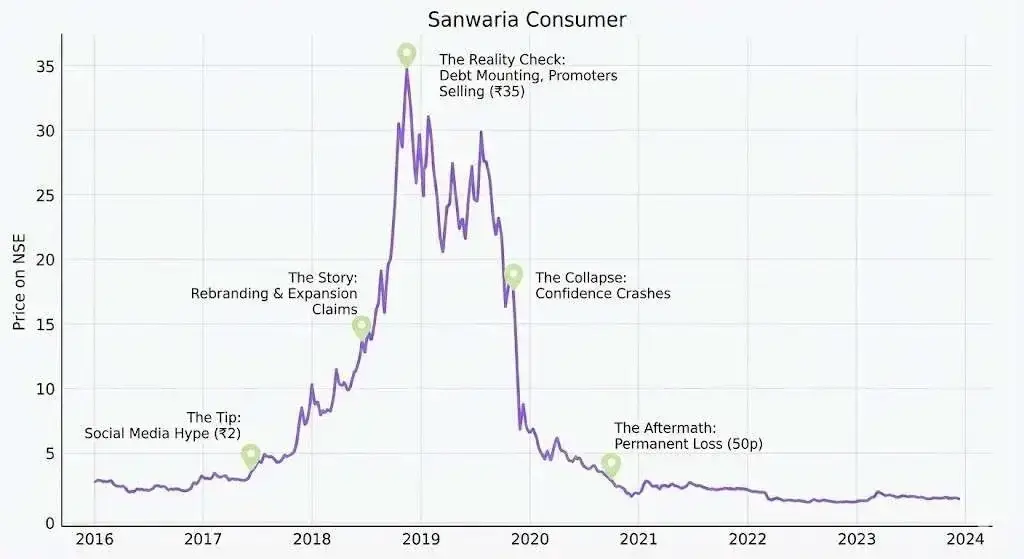
For thousands of beginners, the damage was permanent. Students and early professionals who had invested their savings saw their capital shrink to pennies, with no clear exit. This wasn’t a result of bad luck or market manipulation alone. It happened because a catchy story and a rising price felt safer than boring fundamentals. Penny stocks don’t usually destroy wealth in a single day; they do it quietly, while investors are still convinced they are holding the future.
Stories like this aren’t rare accidents. They are part of a much bigger pattern hiding in plain sight. So, how often do penny stocks actually survive long enough to reward investors? Read ahead to find out.
The Survival Rate Reality Check: Why Penny Stocks Rarely Make It
While everyone talks about the one penny stock that became a giant, nobody talks about the thousands that quietly disappeared.
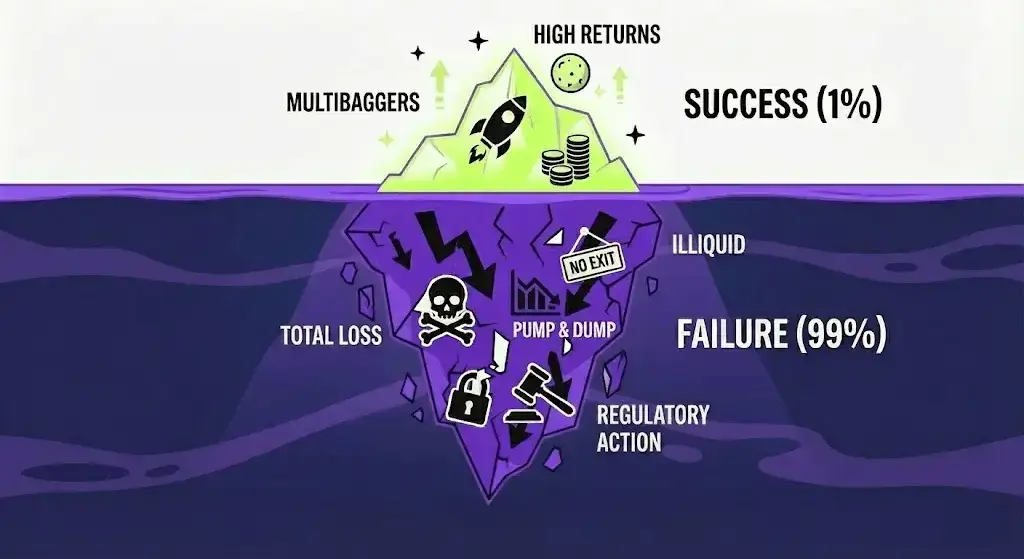
Long-term studies of BSE and NSE-listed companies show that most penny stocks don’t just fall in price; they slowly disappear. Over the last 10–15 years, thousands of small and micro-cap companies have been suspended or delisted, meaning they stopped trading altogether. For investors, this is not a paper loss; it’s a permanent capital loss.
When researchers track the long-term “survival rate” of penny stocks, the numbers are uncomfortable. Out of more than 5,000 companies that have been listed across exchanges, over 2,000 have vanished from trading screens due to bankruptcies, governance failures, or regulatory action. Studies suggest that for every one penny stock that successfully grows into a stable small-cap or mid-cap company, 300 to 400 others either stagnate for years or shut down completely. In simple terms, the odds of picking a long-term winner are well below 1%.
Risk data makes the picture even clearer. Historical volatility measures show that penny stocks are three to five times more volatile than large, stable companies. This means deep drawdowns till 40%, 50%, even 70% losses are not rare events but normal outcomes.
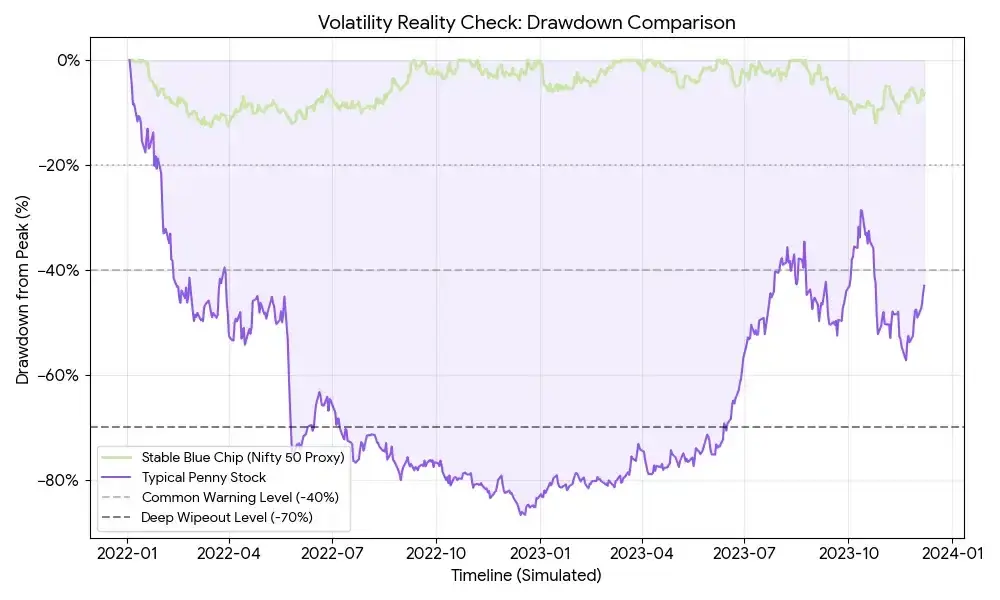
When you buy a penny stock, you’re not just betting on growth; you’re fighting basic probability. The famous multibagger is the exception that survives against the odds, while wealth destruction is what usually happens quietly in the background.
Now that you know the math is dangerous, you need to know how the game is rigged. Why do smart people keep falling for these stocks despite the risks? The answer lies in five invisible traps explained ahead.
Why Penny Stock Investors Lose Money: 5 Hard Truths
By the time most beginners lose money in penny stocks, the damage is already done. The loss doesn’t come from one bad decision, but from repeating the same patterns again and again. Below are five hard truths that explain why penny stock investing is stacked against retail investors from the very start.
1. The “Influencer” Trap
"People who invest make money for themselves; people who speculate make money for their brokers." — Benjamin Graham
In the age of Instagram and YouTube, the most dangerous investment advice comes from "Fin-fluencers" who claim to have found a hidden gem. The reality is often a coordinated scam. Operators buy a stock at ₹2, pay influencers to scream "Multi-bagger" to their million followers, and wait for the price to hit ₹20. When you and thousands of others buy in due to FOMO, the operators sell their shares to you and vanish.
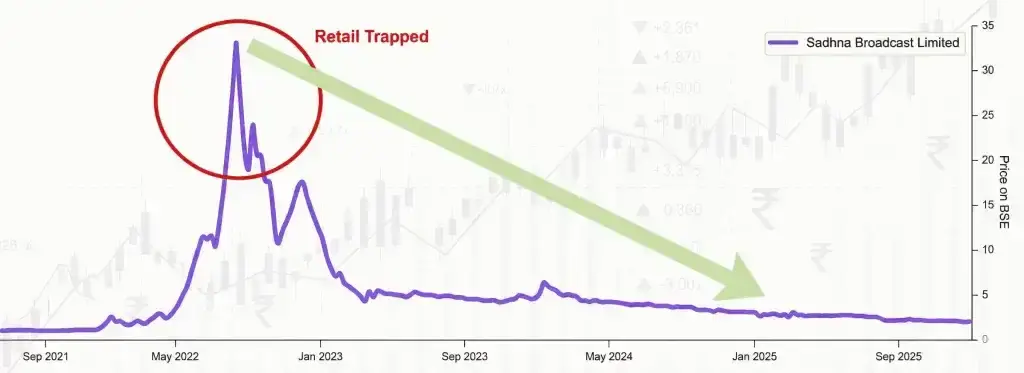
A classic example is Sadhna Broadcast. In 2023, a viral YouTube video claimed that this company is being acquired by the Adani Group. The videos looked professional and convincing. The stock jumped from around ₹5 to ₹33 in weeks. Retail investors piled in. The news was fake. Once insiders sold, the stock crashed back to single digits, trapping thousands who trusted videos over official exchange filings.
2. The Brand Names & Sector Hype Illusion
Beginners often buy a "Story" rather than a business. This happens in two ways: relying on a Brand Name or chasing a Hot Sector. Investors assume a famous brand is safe, or they blindly buy any cheap stock in a booming sector (like Green Energy or Defense).
In both cases, they ignore the debt and weak fundamentals because the "Story" feels convincing. A familiar logo or a trendy sector name does not protect your capital if the underlying business is a shell.
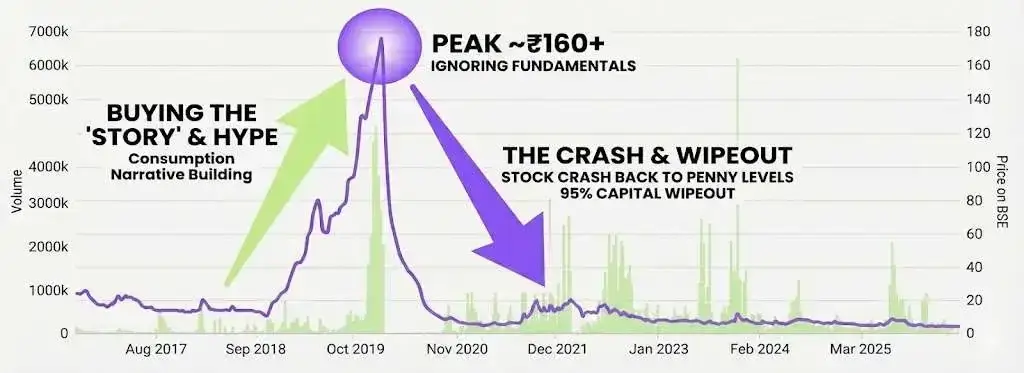
A perfect example is 7NR Retail. In 2019, amidst a buzz for consumption stocks, investors were attracted by the "Retail" tag, associating it with giants like Trent and DMart.
The stock was pumped from around ₹10 in early 2019 to a peak of over ₹150 by October 2019. Investors ignored the weak financials, blinded by the sector hype and aggressive price-volume action. However, the rally was hollow; as the manipulation ended, the stock crashed relentlessly. It now trades in the ₹4–₹5 range, leaving those who chased the "Retail" label with a 95% capital wipeout.
3. The “Cooking the Books” Trap
Some penny stocks look cheap only because the numbers are manipulated. Sales and profits are inflated to show attractive valuations. The biggest warning signs are negative cash flows and sudden auditor resignations. When auditors walk away, it usually means the truth is uglier than the reports.
A perfect example is Brightcom Group. In 2021, Brightcom Group became a retail obsession because it reported massive profits while trading at a suspiciously cheap valuation. Beginners thought they had found a hidden gem, believing the market was wrong to ignore such "growth." But the numbers were a lie. SEBI eventually exposed that the profits were manipulated and the cash didn't exist. The stock crashed to single digits (under ₹10), and investors who trusted the "fake spreadsheet" saw their real capital evaporate into thin air.
Read more: How to Read a Balance Sheet Like a Professional Investor
4. The “Averaging Down” Suicide
This is the single biggest destroyer of wealth in penny stocks. When a strong company falls 20%, buying more can make sense. But when a penny stock falls 20%, it is usually a warning. Beginners try to “lower their average” by buying again at ₹20, then ₹10, then ₹5, refusing to admit they were wrong. What starts as a small, manageable loss quickly turns into a total wipeout because ego replaces logic.
A classic example is Sintex Industries.Almost every Indian home had a Sintex water tank, investors felt safe buying the stock when it drifted to ₹20–₹25 in 2018, believing a household name couldn't fail. They ignored the company’s massive debt pile and governance issues, aggressively averaging down. Instead of recovering, the company defaulted and entered insolvency; the stock crashed relentlessly to ₹1–₹2 and was eventually delisted, wiping out 100% of the capital of those who refused to exit.
5. The Circuit Trap
In blue-chip stocks like Reliance or TCS, you can convert your shares to cash in seconds. In penny stocks, the exit door often disappears exactly when you need it most. It happens when the stock hits a Lower Circuit (millions of sellers, zero buyers) or gets moved to Stage 4 Surveillance (GSM) where trading is allowed only once a week. In both cases, you watch your portfolio value crash day after day, physically blocked from selling. You can check in any time you like, but you can never leave.
A classic example is RRP Semiconductor. Riding the "Chip Shortage" narrative, this stock surged over 50,000% from penny levels to thousands of rupees. Retail investors chased the momentum, ignoring that the company had negligible revenue.
When regulators stepped in and placed it under GSM (Graded Surveillance Measure), trading was restricted to once a week. Investors who bought at the top are now trapped; they can only watch the price fall week by week, with no buyers available to provide an exit.
Knowing these traps is only half the battle; surviving them requires a new set of rules. Read ahead to find out how to walk through it without blowing up your capital?"
The Ground Rules Before Touching Penny Stocks
Before penny stocks test your skill, they test your psychology. Most losses don’t happen because people don’t know what to buy, but because they don’t know how to behave once money is involved. This section is about survival rules, the kind that protect you when: excitement, fear, and ego start making decisions for you.
“It’s good to learn from your mistakes. It’s better to learn from other people’s mistakes.” — Warren Buffett
1. The "No Marriage" Rule – Exit Over Emotion
Treat penny stocks like a casual date, not a life partner. The biggest mistake beginners make is falling in love with a stock because it gave them a 20% profit once. You must enter with a clear exit plan: “I will sell if it hits ₹50 (Target) or if it drops to ₹30 (Stop Loss).”
Penny stocks usually have much higher volatility than the broader market, which means they can move sharply in both directions. Committing large amounts of capital to such stocks magnifies mistakes as quickly as gains. Once the goal is met, leave. Do not hold on “forever” hoping for a miracle; in penny stocks, “forever” often results in zero.
A classic example is retail investors in Yes Bank (2018-2020). Many bought it at ₹300 and refused to sell when it dropped to ₹200, then ₹100, and finally ₹10. They were "married" to the idea that "a big bank cannot fail."
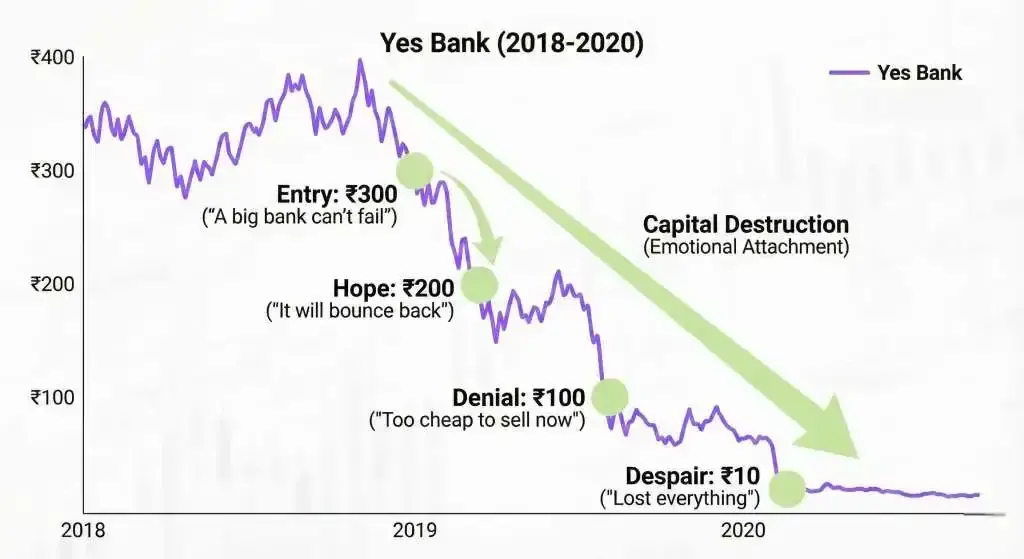
If they had treated it like a trade and exited when their stop-loss was hit, they would have saved 90% of their capital. Emotional attachment destroys wealth; discipline saves it.
2. The "Casino Token" Rule – Position Sizing
How much money should you put in penny stocks? The answer is simple: Your allocation should be small enough that if it goes to zero, your lifestyle doesn't change, but large enough that if it grows, it makes a difference. The amount depends entirely on your personal risk appetite, but it must never be money you need for rent, fees, or emergencies. Treat your penny stock capital like "Casino Tokens"; if you lose it, it should hurt no more than the cost of a bad movie or a weekend trip.
Imagine you have ₹1 Lakh in savings. You should put ₹90,000 into safe stocks (like Nifty 50 or Gold) and only ₹10,000 into penny stocks. If that ₹10,000 becomes zero, your life doesn't change; you can still pay your bills. But if you put the full ₹1 Lakh into a risky stock like Vakrangee just before it crashed, you would have lost your entire financial footing. Survive first, get rich second.
3. The "Iron Fence" – Capital Protection Rule
Before you focus on how much you can make, decide exactly how much you are willing to lose. This is called setting a "Stop Loss." If you buy a stock at ₹20, swear to yourself that you will sell it instantly if it touches ₹15. No hoping, no praying. The market does not care about your feelings. By setting this boundary, you ensure that a small mistake doesn't turn into a financial disaster.
“The goal of a successful trader is to make the best trades. Money is secondary.” — Alexander Elder
A perfect example is of traders who lost everything in RCom (Reliance Communications) because they kept waiting for a "rebound." They bought it at ₹50, watched it go to ₹30, then ₹10, always thinking "It's too cheap to sell now." A smart trader with an "Iron Fence" would have sold at ₹45 (a 10% loss) and moved on. Taking a small loss is not failure; it is the fee you pay to protect your capital for the next opportunity.
4. The "Free Ride" Strategy – Greed Control
Greed is what kills you at the top. When a penny stock doubles in price, you will feel like a genius and want to put more money in. Do the opposite. Use the "Free Ride" tactic: Sell 50% of your shares immediately. This removes your original investment (principal) back to your bank account. The remaining shares are now "free", that is if they go to the moon, you win; if they go to zero, you lose nothing.
“The most important quality for an investor is temperament, not intellect.” — Warren Buffett
Let’s say you bought ₹10,000 worth of a small IT stock. In two months, it will become ₹20,000. The amateur waits for ₹50,000. The pro sells ₹10,000 worth immediately. Now, the pro has their cash back and still holds ₹10,000 worth of shares for free. If the stock crashes the next day (like many "pump and dump" stocks do), the amateur loses profit and principal. The pro loses nothing.
5. The "Sleep Test" – Risk Tolerance
The ultimate psychological check is your sleep. If you find yourself waking up at 3 AM to check your portfolio, or if you are constantly refreshing your phone during office hours, you have too much money invested. Trading should be boring. If your heart races when the market opens, it means your position size is too big for your emotional capacity. Cut it down until you can sleep peacefully.

During the crash of 2020, investors who had borrowed money or used 100% of their savings were in panic mode, selling at the bottom because they couldn't handle the stress. In contrast, investors who followed the "Sleep Test" and only invested what they could ignore were able to stay calm. They didn't panic-sell, and eventually, their portfolios recovered. Your peace of mind is more valuable than any "multibagger" return.
Explore our Products
Research Framework

Emerging Titans
Combination of quantitative analysis, industry tailwinds, and management assessment - SPRINT investment philosophy

Tiny Titans
Heavy emphasis on scuttlebutt research, plant visits, and early on-ground signals
Conclusion: The Boring Path to Wealth
Real wealth isn't built on "lottery tickets" or overnight spikes; it is built on patience, discipline, and owning high-quality businesses. If you treat the market like a casino, the house always wins, but if you treat it like a business, you build a legacy. Remember, the ultimate goal isn't just to make money, but to keep it, so choose boring consistency over exciting gambles every time.
For clearer, no-hype market insights focused on protecting capital first, consider subscribing. And if this article made you pause before your next trade, drop an “AGREED” in the comments as a reminder to yourself to never enter a stock without a clear exit plan. Let’s focus on building wealth the patient, disciplined way.
FAQs ( Frequently Asked Questions )
Are penny stocks risky only because they are cheap?
+Why do penny stocks look attractive to beginners?
+Can researching fundamentals make penny stocks safe?
+Why is it easy to buy penny stocks but hard to sell them?
+
High growth stock specialist, Value Educator
Shashank Mahajan is an equity research professional with over 12 years of experience in identifying high-potential SME and micro-cap stocks at an early stage. He follows a rigorous scuttlebutt research–driven approach, combining on-ground insights with deep financial analysis. Shashank specializes in uncovering under-researched and under-owned companies with strong management quality and long-term growth potential. Through disciplined research and early identification, he focuses on spotting tomorrow’s market leaders before they enter the mainstream investor radar.

Zen Technologies: Revenue Fell After a Big Win




PNG Jewellers: A 194-Year-Old Name Goes National

Explore our Products
Research Framework
Emerging Titans
Combination of quantitative analysis, industry tailwinds, and management assessment - SPRINT investment philosophy
Tiny Titans
Heavy emphasis on scuttlebutt research, plant visits, and early on-ground signals


 Orders
 Subscription
 Share with friends
 Logout


Required Details
₹23999.00
(12 month subscription)
As per SEBI regulations, all users are mandated to complete the KYC that is validated for 1 year. Post payment, you will be redirected to the KYC screen


Another great write-up. Superb