
Penny Stocks vs Small Caps

Penny Stocks vs Small Caps: The Mirage of the "Cheap" Stock
In the early 2010s, Unitech Ltd became the classic "value trap" that burned thousands of retail investors. Once a market giant trading above ₹500, the stock crashed to single digits, and while many rushed in believing it was "too big to fail" or simply too cheap to ignore.
They focused entirely on the past price rather than the current reality of mounting debt, stalled projects, and legal troubles. Instead of the expected turnaround, the company spiraled into a zombie stock, proving that a 90% drop doesn't make a stock a bargain, it just means the business is broken.
“The four most dangerous words in investing are: ‘This time it’s different.’” – John Templeton
During the same period, Aarti Industries was a quiet small-cap stock, trading in the ₹200–₹250 range. It wasn’t the kind of name you’d hear in stock-tips in WhatsApp groups or see hyped on social media.
The company simply kept its head down and focused on the basics: adding capacity, improving margins, and nurturing long-term customer relationships. Slowly but consistently, revenues increased, profits followed, and the market began to take notice. Over time, the valuation moved up in line with the business.
Today, Aarti Industries has firmly moved into mid-cap territory, largely held by investors who believed in patience and fundamentals. No overnight success. Just steady execution and business growth playing out over time.
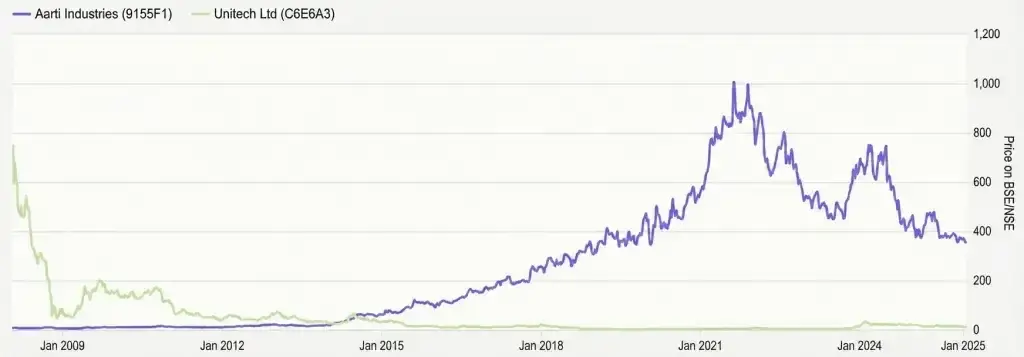
Both stocks were available to the same investors, in the same market, at the same time. One was chosen because it was cheap. The other because it was growing. And that single difference, between buying a penny stock and backing a small-cap business, often decides whether money quietly disappears or compounds over the long run.
That story explains the damage, now let’s understand the real difference between penny stocks and small caps becomes much clearer.
Read More : Portfolio Diversification – How Many Stocks Should You Hold?
Penny Stocks vs Small Caps: The Simple
Difference
Small-cap stocks, on the other hand, belong to companies with a market value of roughly ₹500 crore to ₹5,000 crore. These are real businesses that already have products, customers, and revenues, but are still in their growth phase. They carry risk, but that risk comes from expansion and competition not survival. Small caps can be volatile, but their price movement is usually linked to business growth, profits, and long-term potential rather than speculation.
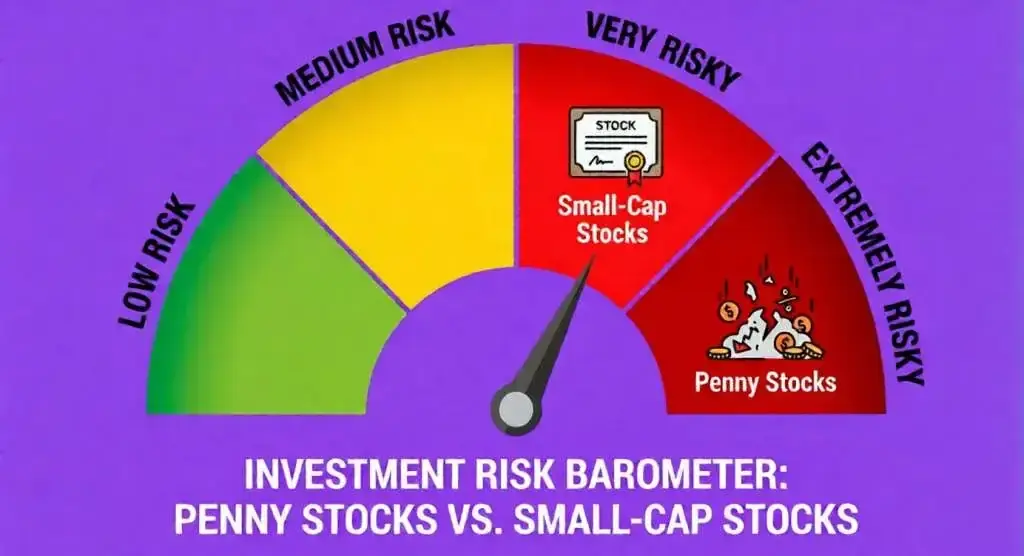
In the Indian market, stock prices ultimately follow business reality. One company can move from the penny zone into small-cap territory as its operations and finances improve, while another can slide from small-cap status into penny levels when debt and execution start to break the business.
Suzlon Energy is an example of a company that spent years in the penny-stock zone after debt and losses pushed its price into single digits, but later moved out of it as restructuring and debt reduction slowly improved confidence.
On the other hand, Reliance Communications shows the opposite journey. Once a small-cap with big ambitions, it slipped into penny-stock levels as debt mounted and the business weakened, before trading was eventually suspended.
These examples make one thing clear: stocks don’t move because they are cheap or expensive, they move because the business either improves or breaks down over time. But clarity alone isn’t enough, because some penny stocks do succeed, and that’s where confusion deepens.
Penny Stocks vs Small Caps: The Illusion of “Cheapness”

For most beginners, a ₹10 stock feels safer than a ₹200 stock, even when both belong to risky companies. The lower price creates a false sense of safety and upside, while buying more shares feels comforting, almost like control. This is where confusion begins: price starts feeling more important than the business behind it. Social media tips, familiar brand names, and multibagger stories reinforce this bias, making cheap stocks look like opportunities rather than warnings. When investors focus on price instead of company quality, judgment quietly slips.
The reality is that penny stocks and small caps are not separated by price, but by business strength. A penny stock is cheap because its fundamentals are fragile, while a small cap is risky because it is still growing. Humans are wired to compare prices, not businesses, and markets exploit this tendency. What looks like “value” is often just damage on the balance sheet.
It’s far better to buy a wonderful company at a fair price than a fair company at a wonderful price. – Warren Buffett
To break this illusion, investors must shift their focus from how cheap a stock looks to how strong the business truly is. Let’s understand this with a real Indian market case study.
Read More : A Fundamental Checklist: How to Research a Stock in 1 Hour
Case Study: Eicher Motors vs Hindustan Construction Company (HCC)
In the early 2000s, Eicher Motors was trading at penny-stock prices, despite being classified as a small-cap company. The low price reflected serious internal problems. Eicher was a scattered conglomerate running over a dozen unrelated businesses, from tractors to garments, with no clear focus. Its motorcycle division, Royal Enfield, was loss-making and close to being shut down. To the market, the stock looked “cheap,” but that cheapness was simply a signal of confusion, weak execution, and poor fundamentals.
The real change began when management made a tough but transformative decision to exit most businesses and focus entirely on motorcycles and commercial vehicles. This was not a short-term turnaround, but a complete reset of strategy, execution, and product quality.
As Royal Enfield improved its bikes and built a strong brand, volumes rose, margins expanded, and cash flows strengthened. The stock price followed the business improvement, gradually moving out of penny levels into the small-cap range and beyond. Today, Eicher Motors is a fundamentally strong company, and its past “cheapness” has disappeared because the business itself became valuable.
Hindustan Construction Company started from a position that looked far stronger, but its outcome was far worse. In the mid-2000s, Hindustan Construction Company was a respected small-cap infrastructure player, executing large projects such as dams, highways, metros, and bridges.
During the 2007–08 cycle, the stock traded in the ₹70–₹80 range, and the company’s market capitalisation ran into several thousand crores, backed by a strong order book and visible revenues. On the surface, the business looked solid and scalable. The problem lay beneath: growth was increasingly funded by heavy borrowing rather than internally generated cash.
The real damage began around 2010, when HCC doubled down on the Lavasa township project. Regulatory approvals got stuck, legal issues dragged on, and cash flows from the project dried up. While execution slowed, interest costs kept compounding. Debt ballooned, receivables were delayed, and working capital stress intensified. Over the next decade, repeated equity dilution, slow claim recoveries, and mounting borrowings eroded shareholder value.
The stock slid steadily into the penny-stock range, not because the market missed an opportunity, but because the balance sheet never healed. Even today, HCC continues operations, but equity holders remain stuck with a broken capital structure and no meaningful recovery. What looks “cheap” now is simply the long shadow of unresolved debt and weakened fundamentals and no value waiting to be discovered.
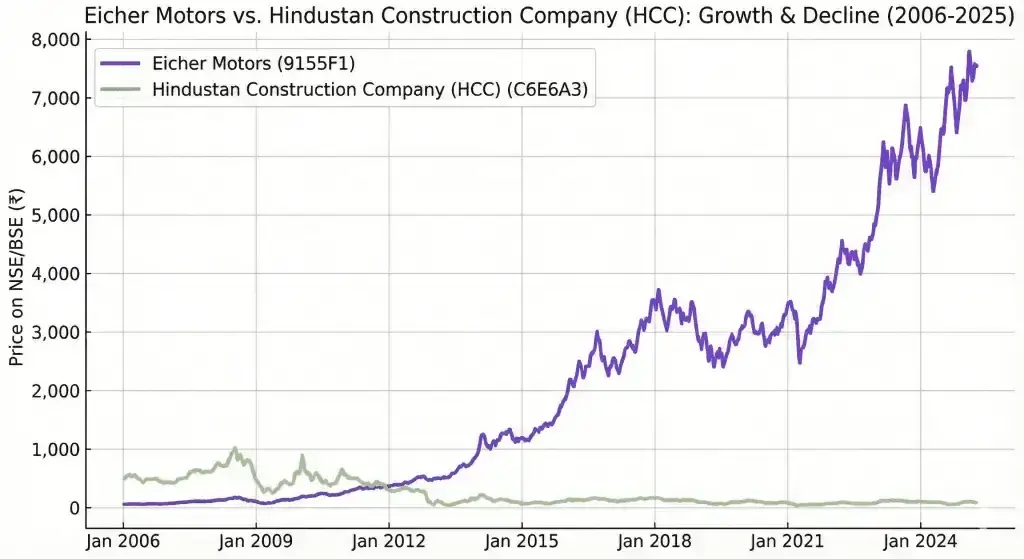
The key takeaway here is: Eicher moved from penny stock to small-cap to large-cap because its business improved. HCC moved from small-cap to penny stock because its business weakened under debt.
Price was never the reason in either case. The real story and real returns, always lie in fundamentals, not in how cheap a stock appears on the screen.
Since these rare successes are so easy to misread, discipline matters more than optimism, which brings us to hidden risks that cheap stocks hide inside them.
Read More : Best Stock Market Apps in India for Beginners (2026 Review)
Understanding Risk-Reward Differences
To an untrained eye, a 20% fall in a penny stock looks identical to a 20% fall in a small-cap stock. In reality, the forces behind that fall and the rewards on the other side are very different.In the stock market, risk and reward are always connected, but they don’t come from the same source. Small caps carry business and execution risk, where outcomes depend on growth, competition, and management decisions. Penny stocks carry structural and survival risk, where outcomes often depend on whether the business can stay alive at all.
“Markets are never wrong. Opinions often are.” – Rakesh Jhunjhunwala
To see how risk and reward truly differ, let’s break down the five key factors that separate a penny stock from a small-cap company.
1. The Liquidity Trap (Risk of Exit vs Reward of Flexibility)
In penny stocks, the biggest risk is not losing money on paper, but being unable to exit at all. Low trading volumes mean that when bad news hits, buyers disappear and stocks hit lower circuits day after day. Even if the price looks attractive, you may be completely stuck.
A perfect example is GTL Infrastructure and Ruchi Soya.. Investors enjoyed quick paper gains during upper circuits, but when the trend reversed, weeks of lower circuits erased capital with no exit. The reward was short-lived excitement and the risk was permanent illiquidity.
In contrast, a small-cap company like Greenpanel Industries can be volatile and may fall sharply, but liquidity usually remains. The risk is price volatility, not being trapped indefinitely.
2. Information Asymmetry (The "WhatsApp" Risk)
Penny stocks thrive where information is limited. With little analyst or institutional coverage, prices are driven by rumours and tips rather than facts. The risk is buying into stories that later collapse under scrutiny.
Brightcom Group is a classic example. For years, investors believed they were buying a profitable, undervalued tech stock. SEBI’s 2023–25 findings revealed profits overstated by over ₹1,200 crore, turning perceived reward into an illusion.
In contrast, small caps like Mold-Tek Packaging are not risk-free, but they offer verifiable risk. Regular disclosures, earnings calls, and institutional scrutiny allow investors to judge reality, even when performance disappoints.
3. Survival Risk vs. Growth Risk
When you invest in a penny stock, you are often betting on survival. The reward, if it comes, is a rare turnaround. The risk is total capital loss. In contrast, small caps may be highly volatile at times but most of them survive and the main risk with them is how well they grow.
Kingfisher Airlines and Jet Airways attracted buyers even as they slipped into penny territory because they looked “too cheap.” Their business models collapsed, and equity holders were wiped out. The risk materialised fully.
In contrast, small caps usually survive but may disappoint. La Opala RG Ltd. faced slow growth and competition, leading to weak returns for a period. The risk was underperformance, not extinction. Small-cap investors risk time and opportunity cost, not total capital loss by default.
Read More : A Beginner's Guide to Investing in the Indian Stock Market (2026 Edition)
4. Promoter Integrity and Pledging
In penny stocks, high promoter pledging creates a dangerous risk. If prices fall, lenders dump pledged shares, causing sharp crashes unrelated to business fundamentals. Any upside depends on promoters’ financial health, not company performance.
Kwality Ltd. illustrates this risk. High debt and pledging led to insolvency, wiping out shareholder value. The reward never arrived.
Small caps are not immune to governance issues, but higher-quality ones often face monitoring risk, not blind trust. Institutional presence and cleaner balance sheets reduce it, but do not eliminate governance shocks.
5. The "Operator" Manipulation
Penny stocks are vulnerable to operator-driven pump-and-dump schemes. The risk is buying into hype created by a few players who exit silently, leaving retail investors holding illiquid shares.
RRP Semiconductor’s 2024 surge is a textbook case. A name change during semiconductor hype drove prices up despite zero profits and negligible promoter ownership. The reward was temporary price movement; the risk was buying a hollow shell.
In contrast, manipulating a ₹3,000–₹4,000 crore small-cap stock is difficult. Prices may still be wrong, but they are more often corrected by earnings, institutions, and competition rather than pure manipulation.
Explore our Products
Research Framework

Emerging Titans
Combination of quantitative analysis, industry tailwinds, and management assessment - SPRINT investment philosophy

Tiny Titans
Heavy emphasis on scuttlebutt research, plant visits, and early on-ground signals
Conclusion
“Know what you own, and know why you own it.”– Peter Lynch
Most investing mistakes don’t come from bad picks, they come from inconsistent thinking. Spotting the difference between risk and growth once is helpful, but applying that lens again and again is what actually protects capital and builds wealth over time.
If this article helped you understand penny stocks and small caps more clearly, subscribe for structured stock-analysis frameworks, safety-first checklists, and real Indian market case studies: no tips, no noise, just a repeatable way to invest. Share this with investors who prefer discipline over excitement, and drop a comment with one rule you personally follow or comment “FUNDAMENTAL”. Strong investing habits grow when clear frameworks meet thoughtful discussion.
FAQs ( Frequently Asked Questions )
Can a penny stock really become a multibagger?
Yes, but it’s extremely rare. Penny stocks succeed only when the business fundamentally fixes itself: debt reduces, profits turn sustainable, and governance improves. Most penny stocks don’t recover; they dilute, stagnate, or disappear quietly. Betting on turnarounds is speculation, not investing.
Are all low-priced stocks bad investments?
+No. A low price alone doesn’t make a stock bad. The problem is that most penny stocks are cheap because the business is weak, not undervalued. Some small-cap stocks may trade at low prices and still grow, the difference is business quality, not price.
Why do penny stocks move so fast compared to small caps?
+Because they are usually illiquid and operator-driven. Even small buying or selling can push prices sharply. Small caps move slower because their prices are influenced more by earnings, growth, and fundamentals rather than price manipulation.
Is it safer to buy more shares of a cheap stock?
No. Safety does not come from owning more shares; it comes from owning a strong business. Holding 1,000 shares of a bad company is far riskier than holding 2 shares of a good one. Quantity feels comforting, but it doesn’t reduce risk.
Should beginners completely avoid small-cap stocks?
Beginners should avoid picking individual small-cap stocks directly. A Small Cap Mutual Fund is a better starting point, as professionals handle stock selection while you learn how businesses, balance sheets, and market cycles work.

High growth stock specialist, Value Educator
Shashank Mahajan is an equity research professional with over 12 years of experience in identifying high-potential SME and micro-cap stocks at an early stage. He follows a rigorous scuttlebutt research–driven approach, combining on-ground insights with deep financial analysis. Shashank specializes in uncovering under-researched and under-owned companies with strong management quality and long-term growth potential. Through disciplined research and early identification, he focuses on spotting tomorrow’s market leaders before they enter the mainstream investor radar.

Zen Technologies: Why Revenue Fell After Its Biggest Win

Data Patterns: India's Radar Designer and Its Waiting Orders

KSH International: The Wire Inside India's Transformers

Krishna Defence: The Steel Behind India's Warship Hulls

PNG Jewellers: A 194-Year-Old Name Goes National

Axiscades: From Services to Missile and Radar Electronics
Explore our Products
Research Framework
Emerging Titans
Combination of quantitative analysis, industry tailwinds, and management assessment - SPRINT investment philosophy
Tiny Titans
Heavy emphasis on scuttlebutt research, plant visits, and early on-ground signals


 Orders
 Subscription
 Share with friends
 Logout


Required Details
₹23999.00
(12 month subscription)
As per SEBI regulations, all users are mandated to complete the KYC that is validated for 1 year. Post payment, you will be redirected to the KYC screen


No comments yet. Be the first to comment!