
Rashi Peripherals: IT Distribution on a 3% Margin
On 6 November 2026, a Mumbai company told its shareholders that it had just earned more profit in six months than in any half year of its 37-year life. Revenue for the July to September quarter was ₹6,185.1 Cr, up 48.8% from a year earlier. Profit after tax more than doubled to ₹130.7 Cr. In the same breath, its management asked investors to look at two other numbers: operating cash flow for the half year was negative, and net debt had risen to 0.76 times equity.
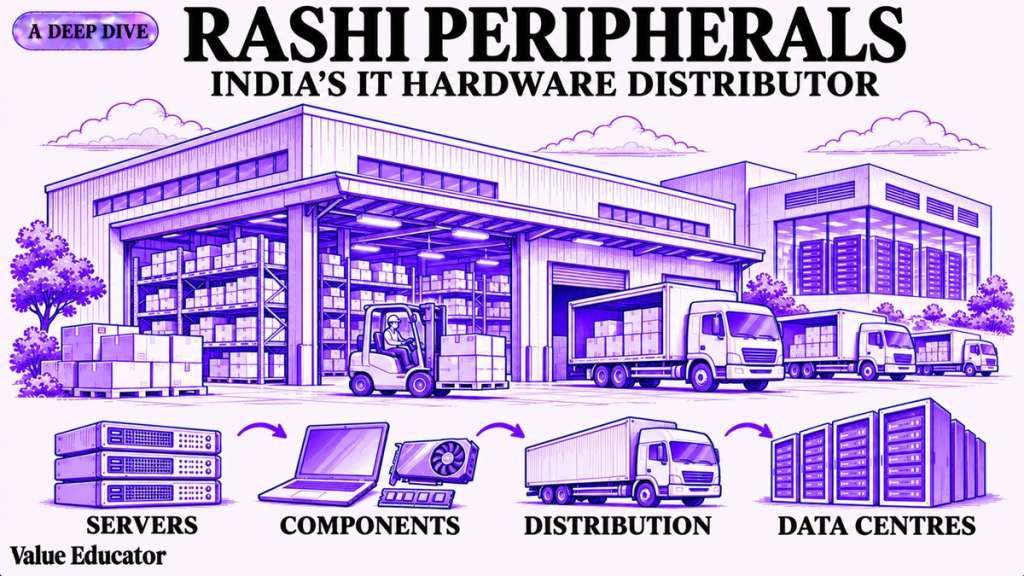
That mix of a record profit and a cash outflow tells us what kind of business this is. The company does not make the laptops, chips and servers it sells. It is a distributor, which means it buys products from global brands, holds them in its warehouses, and sells them on credit to thousands of shops, system integrators and companies across India. Its job is to move boxes fast, pay the brands on time, and collect from customers before the cash runs out.
That is why the margin is so thin. In FY26, the company sold ₹15,827.3 Cr of products and kept 2.90% of that as EBITDA, which is the profit before interest, tax, depreciation and amortisation. After interest and tax, profit was 1.78% of revenue. So on every ₹100 of sales, the company kept about ₹1.78.
That thin margin has a partner, called working capital. Working capital means the money tied up in stock and in customer dues, minus what the company owes its own suppliers, and a distributor needs a lot of it. In September 2026 this company held ₹4,498.7 Cr of inventory and ₹3,130.4 Cr of receivables, against net worth of ₹2,412.7 Cr.
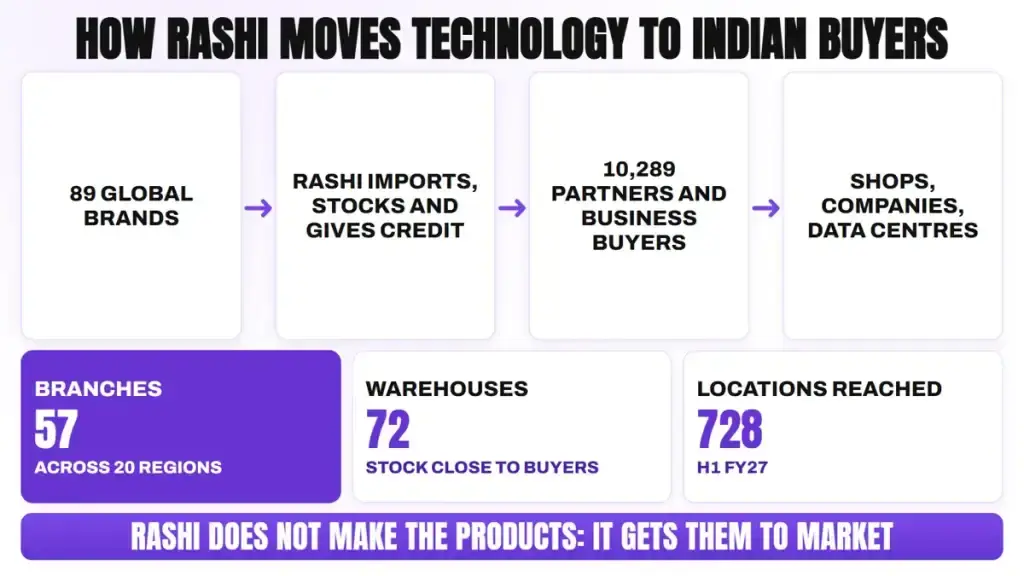
That company is Rashi Peripherals Ltd (NSE: RPTECH), known in the trade as RP Tech. It was incorporated in 1989 and listed on the NSE and BSE on 14 February 2024. It distributes products from 89 global technology brands through 57 branches, 72 warehouses and a reach of 728 locations, to 10,289 channel partners and business customers.
It also has a link to data centres. In FY25 it supplied the servers for an AI data centre at Yotta, a project management later described as worth about ₹2,000 Cr, with 512 servers and 4,000 GPUs. A GPU is a graphics processing unit, the chip that runs AI models. That was one large deal, not a steady line, and the article looks at both sides of it.
Rashi Peripherals in five numbers
- Q2 FY27 revenue of ₹6,185.1 Cr, up 48.8%
- An EBITDA margin of 3.56% in Q2 FY27, against 2.50% a year ago
- H1 FY27 profit after tax of ₹235.3 Cr, up 94.6%
- Inventory of ₹4,498.7 Cr in September 2026, against ₹2,553.7 Cr in March
- Operating cash flow of a negative ₹516.5 Cr in H1 FY27
So a distributor that grew revenue at 18.7% a year from FY23 to FY26 is now growing much faster, with better margins and a heavier balance sheet. Let's first understand the company, and then look at the latest quarter.
Rashi Peripherals: Company Overview
Rashi Peripherals Ltd, known as RP Tech, was incorporated in 1989 and is based in Andheri (East), Mumbai. Krishna Kumar Choudhary is Chairman, Sureshkumar Pansari is Vice-Chairman and Kapal Pansari is Managing Director, with Rajesh Goenka as Director and Chief Executive Officer. The company distributes laptops, PCs, components, peripherals, servers, storage and data-centre hardware for 89 global technology brands, and it is adding system integration through VDA Infosolutions and semiconductor solutions through a joint venture with Restar Corporation. It works through 57 branches and 72 warehouses, reaching 728 locations and 10,289 partners and business customers, and had 2,602 employees in September 2026. It listed on the NSE and BSE on 14 February 2024. Revenue from operations was ₹15,827.3 Cr in FY26, and total borrowings stood at ₹1,967.9 Cr in September 2026 against equity of ₹2,412.7 Cr. Read this Data Centre Stocks in India 2026: Suppliers and Operators
"Know what you own, and know why you own it."
— Peter Lynch
Rashi does not make what it sells. It earns a thin margin for moving products from global brands to Indian buyers, so the margin, the stock and the credit it carries are what an owner needs to understand.
The Quarter Revenue Grew 48.8%
Let's look at Q2 FY27, the July to September 2026 quarter that the board approved on 5 November 2026. On a consolidated basis, revenue from operations was ₹6,185.1 Cr, up 48.8% from ₹4,155.4 Cr a year ago and 21.2% higher than the ₹5,101.9 Cr of Q1 FY27. The company says it was its highest quarterly profit so far.

As we can see, profit grew much faster than revenue. EBITDA rose 112.2% and profit after tax rose 120.8%, while revenue grew 48.8%. Management says the gross margin, the share of revenue left after the cost of the products, improved by close to 100 basis points in the quarter.

That chart also shows where the growth came from. Revenue was ₹3,152.1 Cr in Q1 FY26 and has risen almost every quarter since, to ₹6,185.1 Cr. Management splits the latest growth of about 50% into three parts. About 30% came from higher prices, 10% to 11% from more units sold, and about 10% from new businesses.
Those higher prices are linked to data centres. Memory chips, flash storage and GPUs have been in short supply because AI data centres around the world are buying so much of them. In February 2026 management said the majority of supplies were going to hyperscalers and data centres. When a laptop or a memory module costs more, a distributor's revenue rises with it, and margins usually widen too when supply is tight and buyers are not fighting over price.
Beyond the core business, the quarter also brought a new company into the numbers. In the quarter Rashi bought 67% of VDA Infosolutions, a system integration and managed IT services company, for ₹368.5 Cr. VDA was in the numbers for only part of the quarter, and management says it made up less than 2% of revenue. That is why depreciation and amortisation rose to ₹11.9 Cr from ₹5.1 Cr a year ago.
A One-Time Gain in the Standalone Numbers
Now let's look at the standalone numbers, the parent company alone, because they look even stronger. Standalone profit after tax rose 171.6% to ₹152.9 Cr. That figure includes a one-time gain of ₹41.4 Cr from moving the embedded business into a new semiconductor subsidiary. Inside the group, that gain cancels out, so the consolidated profit of ₹130.7 Cr is the cleaner number, and it is the one this article uses.
The Half Year and the Cash It Needed
So the first half shows the same pattern at a larger scale. H1 FY27 revenue was ₹11,287.0 Cr, up 54.5%. EBITDA was ₹375.4 Cr at a margin of 3.33%, and profit after tax was ₹235.3 Cr. That is already about 83% of the ₹282.3 Cr of profit after tax in all of FY26.
That profit did not turn into cash in the half. Operating cash flow was a negative ₹516.5 Cr. Inventory rose to ₹4,498.7 Cr in September from ₹2,553.7 Cr in March, an increase of ₹1,945.0 Cr in six months. Receivables rose to ₹3,130.4 Cr from ₹2,184.2 Cr. Trade payables, the money Rashi owes its own suppliers, also rose, to ₹4,484.8 Cr from ₹2,171.0 Cr, so suppliers carried a large part of that stock.
Management gave two reasons for the stock. Diwali came on 8 November in 2026, against about 20 October in 2025, so the festive buying cycle moved about a month later and stock was built through September and October. It also says it bought ahead to secure supply in a tight market and for committed enterprise and AI projects. The managing director said that turning this inventory into cash in the second half is a priority.
So borrowings carried the rest of that stock. Total borrowings were ₹1,967.9 Cr in September 2026, against ₹958.6 Cr in March, and they include a term loan of about ₹353.1 Cr raised for the VDA purchase. Net debt to equity rose to 0.76 times from 0.43 times. Finance cost for the quarter was ₹48.0 Cr, almost double the ₹24.4 Cr of a year ago.
How a Mumbai Distributor Grew for 37 Years
Now that we have seen the quarter, let's go back and see how this distributor was built. Rashi Peripherals was incorporated in 1989 in Mumbai, where its registered office still is. Krishna Kumar Choudhary is its Chairman, Sureshkumar Pansari is Vice-Chairman, and Kapal Pansari is Managing Director. Rajesh Goenka is Director and Chief Executive Officer.
For most of its life, Rashi was a private company that brought computer parts and branded PCs into India for global brands. About 40% of its distribution revenue came from dollar-based business in FY24, where it imports from the brand's factory, clears customs and sells in India, because the brand has no logistics set-up of its own here. That is still the core of the business: the brand makes the product, and Rashi gets it to the market.
Then, in February 2024, the company listed on the stock exchanges through an IPO with a fresh issue of ₹600 Cr, which added equity to carry a larger stock and credit book. Since then revenue has grown every year.

That table shows a pattern. Revenue grew at 18.7% a year from FY23 to FY26, and profit after tax at 31.8% a year. The margin dipped to 2.18% in FY25, the year of the large Yotta deal, which carried a lower margin, and then rose to 2.90% in FY26 and 3.33% in H1 FY27.

So where does ₹100 of sales go? Read this Operating vs Net Profit Margin Explained In FY26, about ₹97.10 went to the products bought from brands, staff, rent, freight and other running costs. That left ₹2.90 of EBITDA. Interest took about ₹0.67, and depreciation and tax took most of the rest, leaving ₹1.78 of profit. A distributor earns its return by turning that thin margin over many times a year on the same capital.
"This industry is of very matured margins and EBITDA level is more relevant for our industry." - Himanshu Shah, Chief Financial Officer, February 2024
Two Segments and Three New Engines
Now let's split the business into its parts, because each one sells to a different buyer. Rashi reports one operating segment for accounting, but it shows revenue for two business verticals. Its deck also describes three engines: distribution, system integration through VDA, and embedded and semiconductor solutions.
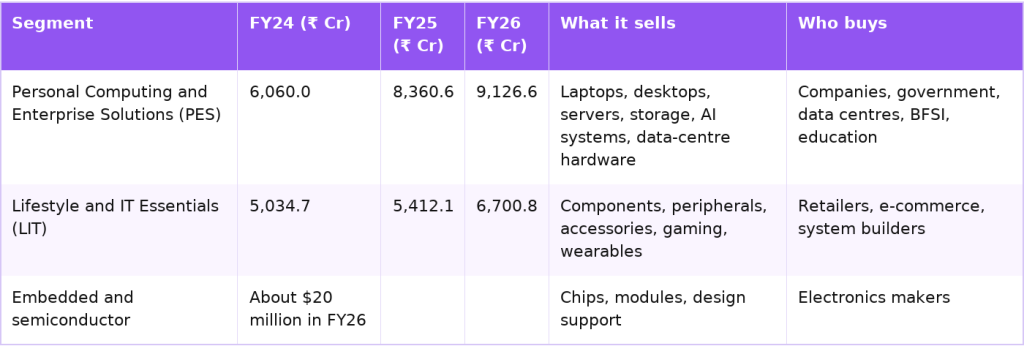
These lines look alike on paper, but they behave very differently. PES deals are larger and include project orders. LIT is a fast-moving business with quicker inventory turns. Management says it earns extra margin on non-PC items such as CPUs, motherboards and hard drives.

Personal Computing and Enterprise Solutions
Let's start with PES, which stands for personal computing and enterprise solutions, the larger vertical. It made up about 58% of FY26 revenue. It sells branded laptops and desktops, plus servers, storage and networking for companies, with pre-sales and post-sales support. PES revenue grew from ₹5,292.2 Cr in FY23 to ₹9,126.6 Cr in FY26.
That vertical also holds the data-centre business. The enterprise unit distributes high-performance computing, AI systems, data-centre hardware and storage from brands such as Dell, NVIDIA, Intel, AMD, Lenovo and Supermicro. In FY25, PES jumped to ₹8,360.6 Cr from ₹6,060.0 Cr, largely because of the Yotta servers.
That project also shows why PES needs more capital than the rest of the business. A server order is far larger than a carton of keyboards, it takes longer to deliver and install, and the buyer pays over a longer period. In FY25, the year of the Yotta deal, management said the collection cycle stretched by about five days. So when PES grows through projects, receivables tend to grow with it.
Lifestyle and IT Essentials
Next, let's look at LIT, lifestyle and IT essentials, which sells the smaller items. These are components such as memory and processors, plus keyboards, monitors, gaming gear and other accessories. LIT revenue grew from ₹4,162.1 Cr in FY23 to ₹6,700.8 Cr in FY26, and it rose 23.8% in FY26 alone. Management says more than 35% to 37% of the business is now non-PC products.
VDA, Restar and the Semiconductor Push
Finally, let's look at the newer engines: VDA, the Restar venture and the semiconductor push. VDA Infosolutions brings system integration, cybersecurity, cloud and managed IT services. Rashi bought 67% in the second quarter and will buy the remaining 33% in three tranches of 11% each by August 2029.
The semiconductor engine is smaller than VDA, but it is growing faster. Rashi did about $20 million of semiconductor business in FY26, and management says H1 FY27 was already twice that. It aims for three to four times last year's figure in FY27. In 2026 it set up Rashi Semiconductor Solutions and formed a joint venture with Restar Corporation, a Japanese semiconductor distributor, which will hold 26%. Management says the JV brings two Japanese brands, design help from about 200 engineers in Tokyo, and access to Japanese manufacturers in India. It targets more than $100 million of JV revenue within three years, and says semiconductor margins are about twice the company level.
Where Rashi Sits in the Data-Centre Value Chain
Now let's place Rashi in the data-centre chain, and size its part honestly. A data centre needs land, power, cooling and racks before the computers go in. Then come the servers, storage and network gear, made by brands such as Dell, Lenovo, Supermicro and Asus around chips from NVIDIA, Intel and AMD. Rashi's place is between those brands and the buyer: it sources the hardware, finances it, delivers it and helps install it.

That role showed up once at large scale. In FY24 Rashi won an order of ₹1,510 Cr from NMDC Data Center, known as Yotta, for an AI cloud data centre. It was its largest single order. The servers were made by Asus, with more than 70% of the content from NVIDIA GPUs, and Rashi delivered them in FY25. A follow-on order of about ₹200 Cr to ₹300 Cr came in August 2024. In May 2026 management described the whole project as a ₹2,000 Cr, 512-server, 4,000-GPU AI data centre, including installation.
That one deal shaped FY25. The company says revenue grew 8.9% in FY25 without the AI deal, against 24.1% with it. That puts the deal at about ₹1,690 Cr, or about 12% of FY25 revenue. In FY26 there was no large data-centre deal, only smaller orders of about ₹5 Cr to ₹15 Cr, and growth without the Yotta base effect was about 31%.
How big is data centres for Rashi? About 12% of FY25 revenue came from one AI data-centre deal. In FY26 and in H1 FY27 the company took no large data-centre project, so the direct share has been small since then. The indirect link, through higher memory and GPU prices, has been larger.
So why has Rashi not taken more of these deals? Management says there were funnels of ₹20,000 Cr to ₹25,000 Cr of data-centre projects under consideration in May 2026, and that it is part of almost every discussion. But it says these projects need a lot of capital, carry lower margins and expose the company to large single customers. With the core business already growing at about 50%, it chose to stay away in the last year.
"Rashi will pick up proportionate to our capacity amongst these opportunities and obviously not run after everything." - Rajesh Goenka, Director and CEO, May 2026
That choice tells us how management thinks about capital. A ₹1,510 Cr order ties up money in servers and receivables for months, for a margin below the company's usual level. Management says it can return to such projects when it wants to, because it has the record.
"The difference between successful people and really successful people is that really successful people say no to almost everything."
— Warren Buffett
Rashi has said no to large AI data-centre projects for a year, even with a proven record. Whether that discipline holds when the next large order comes will say a lot about how it uses its capital. For an investor, that means the data-centre part of the business is an option, not a steady stream of revenue.
The Working Capital Behind a Thin Margin
Now that we have seen the parts, let's look at the working capital behind them, because for a distributor the balance sheet matters as much as the thin margin. Every rupee of revenue needs stock in a warehouse and credit to a customer before the cash comes back.
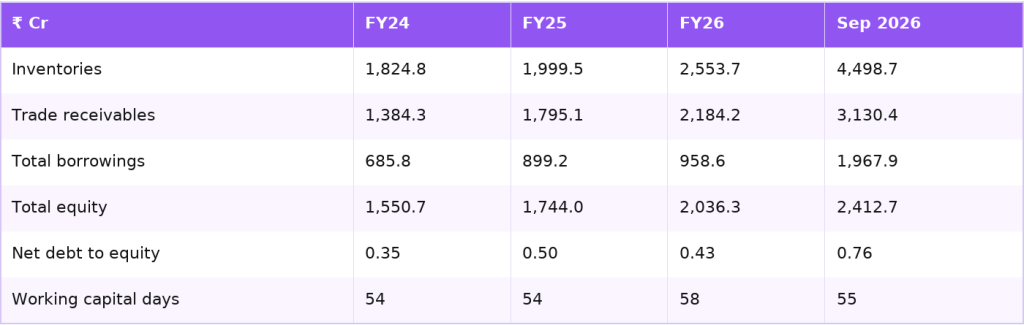
So inventory and receivables together were ₹4,737.9 Cr in March 2026, more than twice the company's equity. After netting off what it owes suppliers, the trade working capital was about ₹2,566.9 Cr in March and about ₹3,144.3 Cr in September.

That money has to come from somewhere, and for most of the last four years it came from borrowing. As we can see below, cash from operations stayed below zero in FY23, FY24 and FY25 and turned positive at ₹113.7 Cr in FY26, before the H1 FY27 outflow.

From FY23 to FY26, the company earned ₹759.2 Cr of profit after tax, but its operating cash flow added up to a negative ₹402.1 Cr. In a growing distributor that is normal to a degree, because every year of growth needs more stock and more credit. Read this Cash Flow Statement Explained But it means that growth has been paid for with debt and the IPO money, not with the profits themselves.
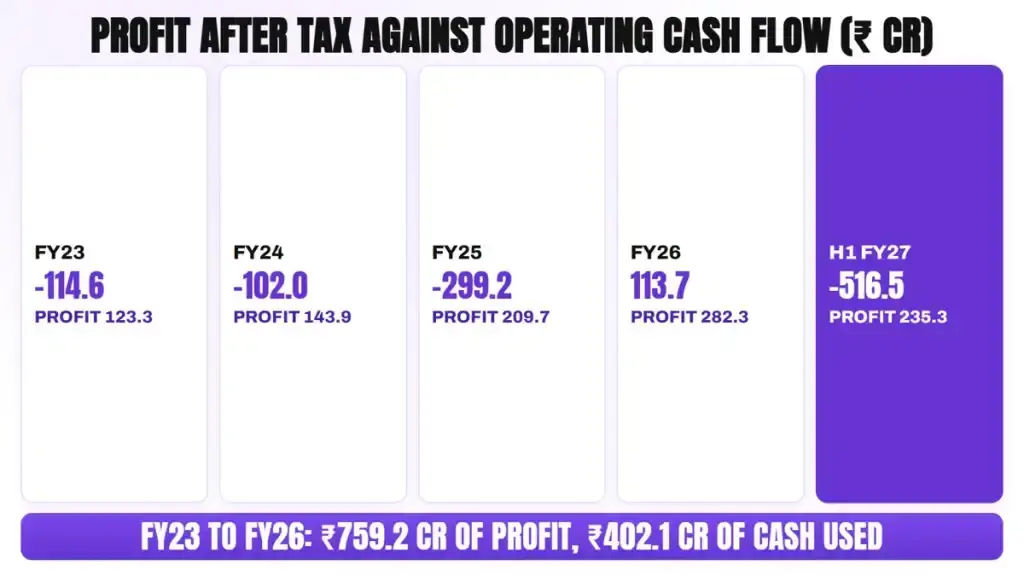
Even so, the days tell a steadier tale than the rupees. The company's own measure of working capital days was 55 in H1 FY27, against 61 a year earlier. Debtor days were 43 against 46, and creditor days 48 against 44. Inventory days were 60 against 59. Read this Inventory Turnover Ratio Explained So the jump in rupees came mostly from the business getting bigger and from the September build-up, not from customers paying later.
Suppliers also carry part of this load. Trade payables of ₹4,484.8 Cr in September were close to the inventory figure of ₹4,498.7 Cr, so the brands were funding much of the stock through their credit terms. That support lasts only as long as Rashi pays them on time, which is one reason the company's credit rating matters so much to the model.
That brings us to interest, where the thin margin and the working capital meet. In FY26 finance cost was ₹106.5 Cr, about 23.2% of EBITDA. Management puts its cost of borrowing at 7.5% to 8%. Some borrowing also earns its keep: the company says it sometimes borrows to pay brands early and earn early-payment incentives.
"Show me the incentive and I will show you the outcome."
— Charlie Munger
In distribution, brand incentives, credit terms and stock targets shape much of the margin. Following those incentives explains why debt and stock move the way they do.
Why Rashi's Moat Is Hard to Copy
Now let's understand the moat. A laptop or a GPU server is the same product whoever ships it, and the brands set most of the prices. Then what makes a brand use Rashi, and a shop buy from it?
One part of the moat is reach. Rashi reaches 728 locations through 57 branches, 72 warehouses and 50 service centres, and it bills in about 700 towns. Its mission is to make IT products available in each of India's 800+ districts. A global brand that wants to sell in Tier-2 and Tier-3 towns would need years to build that network. In H1 FY27 it served 10,289 partners and business customers and carried 19,302 products.
Another layer is the brands themselves. Rashi works with 89 global technology brands and has had relationships of more than five years with more than 20 of them. It has handled imports, customs, warranty and after-sales support for many of them. NVIDIA and Lenovo have each named it a distributor of the year in their programmes.
Beyond reach and brands, credit is a third layer. A distributor that cannot borrow cheaply cannot carry stock. CRISIL rated Rashi's long-term debt A+/Positive in FY24, and the rating is now AA-/Stable. That lets it fund a working capital book of several thousand crore at 7.5% to 8%.
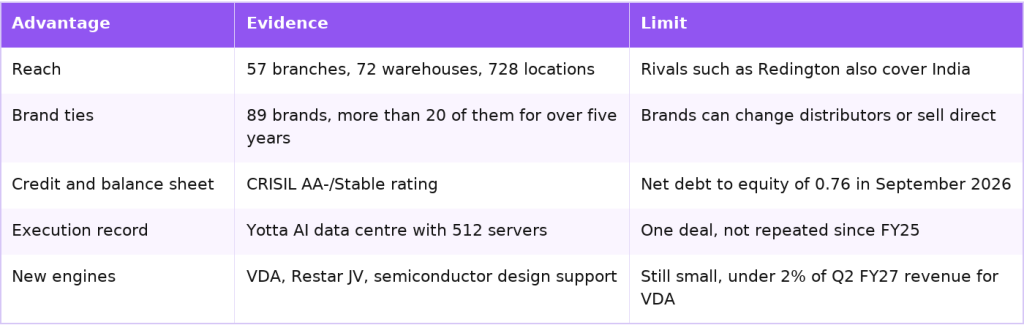
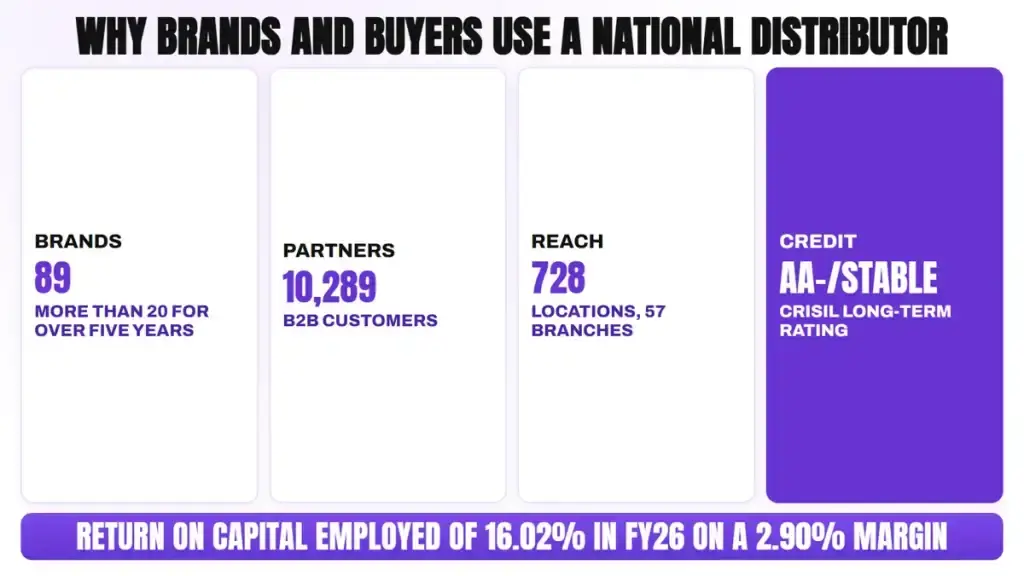
That table shows us why the return on capital is the real test of the moat. A distributor with a strong position should earn a good return on the money it ties up, even at a 3% margin. Return on capital employed was 12.93% in FY24, 13.02% in FY25 and 16.02% in FY26, and management says it was close to 23% on an annualised basis in Q2 FY27, the highest since listing.
Financials: Four Years of Thin Margins and Heavy Working Capital
A single quarter can mislead in a seasonal distribution business, so let's look at the full years together. EBITDA here excludes other income, as the company now reports it; FY23 is worked out the same way from the annual report, and the first half of FY27 is shown for comparison. FY22 consolidated figures are not available in the company documents used here.

Revenue grew at 18.7% a year from FY23 to FY26, from ₹9,454.3 Cr to ₹15,827.3 Cr, and profit after tax grew at 31.8% a year, from ₹123.3 Cr to ₹282.3 Cr. The EBITDA margin stayed between 2.18% and 2.90% in those years, and reached 3.33% in H1 FY27 as rising prices helped.
Cash flow has lagged profit throughout. From FY23 to FY26, the company earned ₹759.2 Cr of profit after tax, while operating cash flow added up to a negative ₹402.1 Cr, because inventory and receivables grew with sales. Cash flow was positive only in FY26, and it was a negative ₹516.5 Cr in H1 FY27 as stock was built for the festive season and for projects.
Borrowings have filled the gap. They rose to ₹1,967.9 Cr in September 2026 from ₹958.6 Cr in March, partly for the VDA purchase, and net debt to equity rose to 0.76 from 0.43. Finance cost was ₹106.5 Cr in FY26, about 23.2% of EBITDA, so interest takes a large bite out of a thin margin.
"Only when the tide goes out do you discover who's been swimming naked."
— Warren Buffett
A distributor's stock and credit look fine while prices rise and sales grow. The test comes when prices ease, which is why Rashi's cash flow and debt matter as much as its profit.
What FY27 and FY28 Could Look Like on Management's Numbers
So where does the business go from here? Management has not given a revenue target for FY27. It has given a set of smaller markers, and together they sketch the next two years.
Let's take prices first. Management expects price rises to add about 10% to 15% to growth in H2 FY27, against about 30% in H1. It expects unit volumes to be flattish in H2, with consumer units lower and commercial units flat or higher in the January to March quarter. New lines, VDA and the semiconductor business should add the rest. Management plans for the new businesses to bring in more than 10% of revenue in H2, and for enterprise to be about 20% of the business next year.
Next, on margins, the chief financial officer says an EBITDA margin of about 2.75% is a safe assumption for FY29 and FY30. That is below the 3.33% of H1 FY27, which was helped by tight supply and rising prices.
That guide also has a mix effect inside it. Management says semiconductor margins are about twice the company level, and VDA brings services work, which usually earns more than moving boxes. If the new businesses reach more than 10% of revenue, they could lift the blended margin. They also bring intangible assets, acquisition debt and a new kind of business for the team to run.
Then there is capital. The board approved on 5 November 2026 a plan to raise up to ₹900 Cr through a qualified institutional placement or similar route, subject to shareholder approval. Management says it is a preparation and it may not raise the money if it does not need it. It explains the maths this way: each round of equity, kept at a debt to equity ratio of up to 1:1, gives about ₹1,800 Cr to ₹2,000 Cr of deployable capital. At six to seven working capital turns a year, that could carry about ₹12,000 Cr to ₹15,000 Cr of extra revenue.

That plan also has a cash test. Management says borrowings peak in the September quarter with sales, and should come down as the festive stock is sold. It guides interest cost to stay in the same range as H1, which included the acquisition debt.

Those commitments are easier to judge against the past. So let's check what management said before against what it delivered.
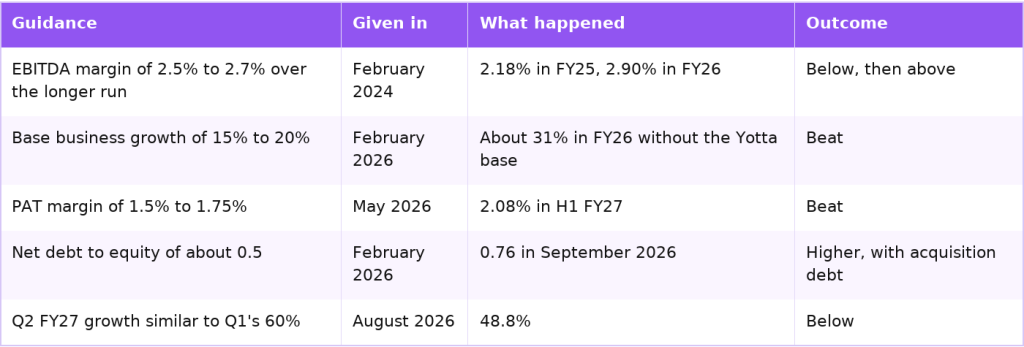
That record shows us a clear pattern. Growth and margins have come in above management's own ranges over the last year, helped by rising prices. The balance sheet has moved the other way, with more debt than management planned in February. That makes cash flow and debt the numbers to watch from here.
Key Risks
Now let's look at what could go wrong for Rashi Peripherals, because some of these risks already showed up in the latest half year.
- Working capital and cash flow: operating cash flow was a negative ₹516.5 Cr in H1 FY27, and it was negative in three of the last four full years. If the festive stock does not turn into cash in H2, borrowings could stay near ₹1,967.9 Cr.
- Rising debt and interest: net debt to equity rose to 0.76 from 0.43 in six months, and quarterly finance cost almost doubled to ₹48.0 Cr. On a 3% margin, interest takes a large share of profit.
- Prices turning down: about 30% of H1 growth came from higher prices. When memory and GPU prices fall, revenue falls with them. Management says prices dropped about 10% to 15% after COVID, and holding stock bought at high prices into a price cut could hurt margins.
- Thin margin: management's own long-term guide of about 2.75% is below the 3.56% of Q2 FY27. A return to that level would slow profit growth even if revenue keeps rising.
- Weaker consumer demand: management expects consumer unit sales to decline in H2 FY27 as higher prices hit affordability.
- Customer credit: expected credit loss on receivables was ₹9.8 Cr in H1 FY27, against ₹0.7 Cr a year ago, on a much larger receivable book.
- Brand dependence: the business depends on a small number of large brands. A brand that moves to another distributor or sells direct would take that revenue with it.
- Disputed tax demands: the parent company showed ₹343.6 Cr of disputed indirect tax demands as contingent liabilities in March 2026, mostly GST show-cause notices. Management says past notices have closed at less than 1% of the amounts shown, but they remain unresolved.
- Acquisitions and dilution: VDA added ₹304.8 Cr of intangible assets and ₹74.9 Cr of goodwill, and the proposed ₹900 Cr fund-raise would dilute existing shareholders if it goes ahead.
- Lumpy data-centre deals: large AI data-centre orders need heavy capital and carry low margins. Taking one on would stretch the balance sheet further; staying out means the data-centre link stays small.
"Converting the cash inventory into cash in the second half is a priority, and we will report on our progress next quarter." - Kapal Pansari, Managing Director, November 2026
"The essence of investment management is the management of risks, not the management of returns."
— Benjamin Graham
For a business that keeps about ₹1.78 of every ₹100 of sales, small changes in prices, credit or interest can move profit a lot. The list below sets out where those changes could come from.
Explore our Products
Research Framework

Emerging Titans
Combination of quantitative analysis, industry tailwinds, and management assessment - SPRINT investment philosophy

Tiny Titans
Heavy emphasis on scuttlebutt research, plant visits, and early on-ground signals
What to Track Next
If you follow Rashi Peripherals, these are the signals that will show where it goes next.
- Operating cash flow and inventory in H2 FY27, after ₹4,498.7 Cr of inventory in September
- Borrowings after ₹1,967.9 Cr and net debt to equity after 0.76
- The EBITDA margin against management's long-term guide of about 2.75%
- The share of growth from prices, after about 30% in H1 and 10% to 15% expected in H2
- VDA and semiconductor revenue against the plan of more than 10% of revenue
- Any new large AI data-centre order, and the margin and credit terms on it
- Whether the ₹900 Cr fund-raise goes ahead
Conclusion
Let's put it all together. Rashi Peripherals grew revenue from ₹9,454.3 Cr in FY23 to ₹15,827.3 Cr in FY26, and made ₹11,287.0 Cr in the first half of FY27 alone. Its EBITDA margin rose from 2.18% in FY25 to 3.33% in H1 FY27, and profit after tax nearly doubled in the half. The cautious thread is the balance sheet: inventory, borrowings and the cash outflow all rose in the same half. The next two quarters will show whether the festive stock turns into cash as management expects.
Still, this is a distributor, and its profits only become real when the stock is sold and the customers pay. What happens next depends on whether the ₹4,498.7 Cr of inventory turns back into cash, whether margins hold as price rises ease, and whether the new engines and any data-centre deals add returns without stretching the balance sheet further.
FAQs
What does Rashi Peripherals do?
+Rashi Peripherals, or RP Tech, is a Mumbai-based distributor of IT hardware. It buys laptops, PCs, components, peripherals, servers and storage from 89 global technology brands and sells them across India through 57 branches and 10,289 partners and business customers. FY26 revenue from operations was ₹15,827.3 Cr.
How did Rashi Peripherals do in Q2 FY27?
+Consolidated revenue rose 48.8% to ₹6,185.1 Cr. EBITDA was ₹220.1 Cr at a 3.56% margin, against 2.50% a year ago, and profit after tax rose 120.8% to ₹130.7 Cr. About 30% of the growth came from higher prices.
Why is Rashi Peripherals' margin so thin?
+A distributor earns a small cut for moving products from brands to buyers. In FY26 Rashi kept 2.90% of revenue as EBITDA and 1.78% as profit after tax. It earns its return by turning that margin over many times a year on the same capital.
Why was Rashi Peripherals' operating cash flow negative?
+Inventory rose to ₹4,498.7 Cr in September 2026 from ₹2,553.7 Cr in March, and receivables to ₹3,130.4 Cr, as the company built stock for a later Diwali and for projects. Operating cash flow was a negative ₹516.5 Cr in H1 FY27, and borrowings rose to ₹1,967.9 Cr.
How much of Rashi Peripherals' business comes from data centres?
+One AI data-centre deal at Yotta, with 512 servers and 4,000 GPUs, made up about 12% of FY25 revenue. The company took no large data-centre project in FY26 or H1 FY27, as these need heavy capital and carry lower margins.
What are the main risks for Rashi Peripherals?
+The main risks are working capital and debt, a fall in memory and GPU prices after about 30% of H1 growth came from price rises, a thin margin that management guides to about 2.75% in the long run, and ₹343.6 Cr of disputed indirect tax demands.

High growth stock specialist, Value Educator
Shashank Mahajan is an equity research professional with over 12 years of experience in identifying high-potential SME and micro-cap stocks at an early stage. He follows a rigorous scuttlebutt research–driven approach, combining on-ground insights with deep financial analysis. Shashank specializes in uncovering under-researched and under-owned companies with strong management quality and long-term growth potential. Through disciplined research and early identification, he focuses on spotting tomorrow’s market leaders before they enter the mainstream investor radar.
More about Shashank Mahajan →
Azad Engineering vs MTAR vs Unimech: Aerospace Parts

Subros vs Lumax Auto vs Sona BLW: EV Auto Parts Compared
Jyoti CNC vs Macpower CNC: Machine Tool Makers Compared
Data Patterns vs Astra Microwave vs Apollo Micro

Himadri vs PCBL: Carbon Black and Battery Materials

Inox Wind vs Suzlon: Wind Turbine Makers Compared
Explore our Products
Research Framework
Emerging Titans
Combination of quantitative analysis, industry tailwinds, and management assessment - SPRINT investment philosophy
Tiny Titans
Heavy emphasis on scuttlebutt research, plant visits, and early on-ground signals



India's Aerospace Opportunity
Global Demand. Supply Bottlenecks. Opportunities Ahead.
Don't Miss This Exclusive Webinar!
Join Value Educator to decode the key trends shaping India's aerospace sector and learn how to identify tomorrow's potential leaders in the space.
- How the aircraft value chain works, layer by layer
- Indian companies supplying global aircraft makers
- A framework to judge any aerospace company

 Orders
 Subscription
 Share with friends


Required Details
₹23999.00
(12 month subscription)
As per SEBI regulations, all users are mandated to complete the KYC that is validated for 1 year. Post payment, you will be redirected to the KYC screen


No comments yet. Be the first to comment!