
Premier Energies vs Waaree Energies: Solar Makers Compared

India is building solar plants faster than ever, and two listed companies sit near the centre of that build-out: Premier Energies and Waaree Energies. Both make solar cells and solar modules in India. Both have grown many times over in five years. And both reported their July to September 2026 quarter (Q2 FY27) in late October and early November 2026. That is why investors so often type "Premier Energies vs Waaree Energies" into a search box.
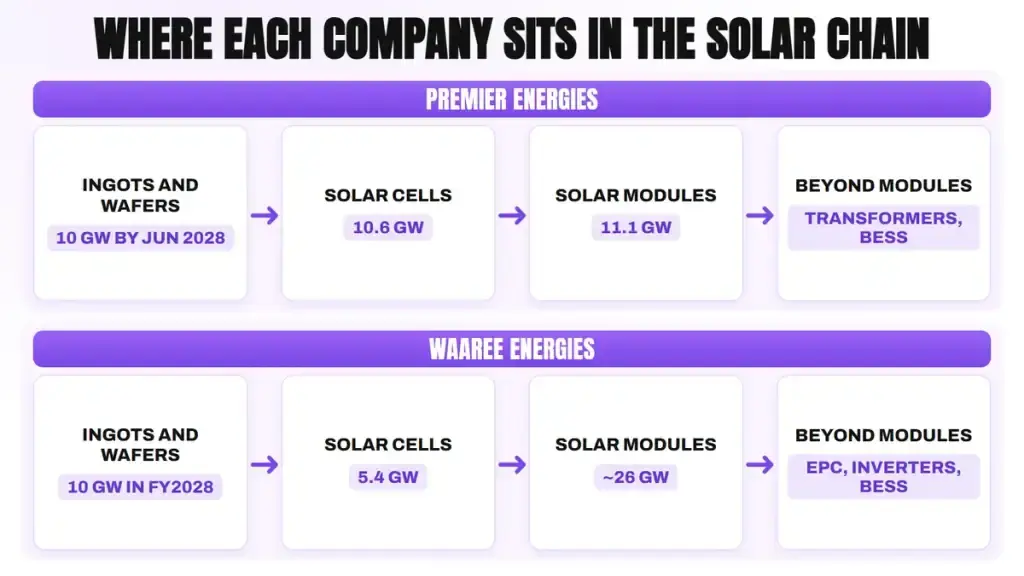
Yet the two companies are built very differently. Waaree is the bigger module maker, with about 26 GW of module capacity, a business that also builds solar plants, and factories in the US. Premier is smaller, but it now has almost as much cell capacity as module capacity, after a new 7 GW cell plant started in September 2026. This page compares them measure by measure, using each company's own reported figures, so you can see where each one is stronger.
Figures as of 20 November 2026. This page is research, not a recommendation to buy or sell any stock.
Premier Energies vs Waaree Energies at a Glance
| Measure | Premier Energies | Waaree Energies |
|---|---|---|
| What it does | Makes solar cells and modules; also transformers, through Transcon | Makes solar modules and cells; also builds solar plants, and makes inverters, transformers and battery systems |
| Plants and capacity | 10.6 GW of cells and 11.1 GW of modules (October 2026), in Telangana and Andhra Pradesh | About 26 GW of modules in India and the US, and 5.4 GW of cells (September 2026) |
| FY26 revenue from operations | ₹7,824.4 Cr, up 20.03% | ₹26,536.77 Cr, up 83.72% |
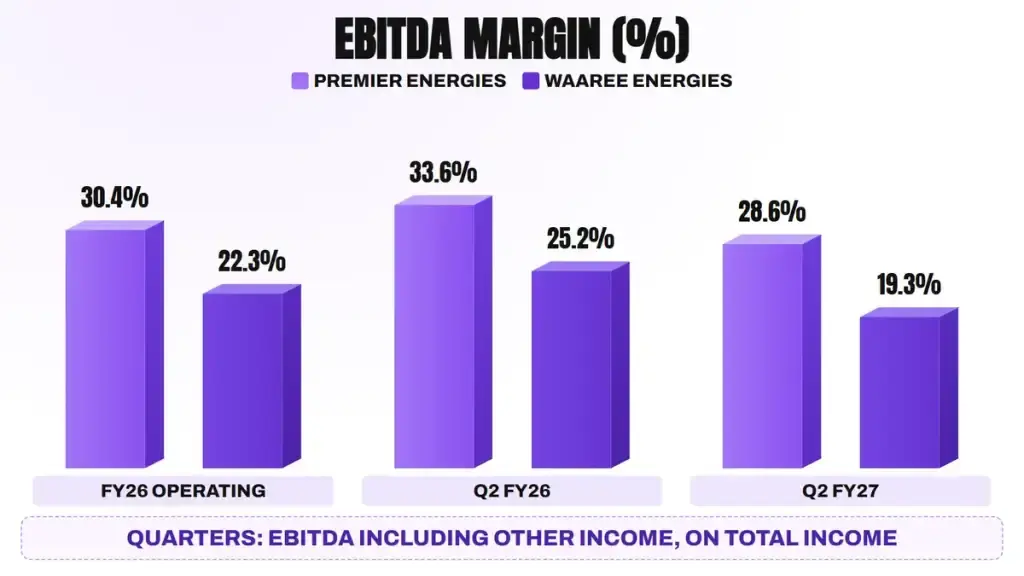
| FY26 operating EBITDA margin | 30.4% | 22.3% |
| FY26 profit after tax | ₹1,509.7 Cr, up 61.1% | ₹3,884.15 Cr, up 101.45% |
| FY26 return on equity | 42.4% | 31.6% |
| Debt, March 2026 | Net debt of ₹1,046.4 Cr | Net cash of about ₹4,236.84 Cr (cash and bank balances minus borrowings) |
| Order book (date) | ₹16,260 Cr (30 September 2026) | About ₹59,200 Cr (26 October 2026, all group businesses) |
| Q2 FY27 total income growth | 38.2% | 23.1% |
| Customers | Power producers and builders such as NTPC and IRCON, pump maker Shakti Pumps, and retail buyers (about 35% to 40% of sales) | Retail buyers (46.1% of Q2 FY27 revenue), power producers, companies and plant builders, and US buyers (18.5%) |
| Key risk | Falling prices for modules sold outside the local-content rule; starting up the new cell plant | US trade action against its exports; a falling margin |
In one line: Waaree is about 3.4 times Premier's size by FY26 revenue, but Premier earns a higher margin and a higher return on its equity, and grew faster in Q2 FY27.
Business Models: Cell-Heavy vs Module-Heavy
A solar cell is the thin square of treated silicon that turns sunlight into electricity. A solar module, or panel, is many cells wired together under glass. Cells are the harder, costlier step. Government rules now push buyers towards Indian-made cells as well as Indian-made modules. Projects that use them are called DCR (domestic content requirement) projects, and they pay higher prices.
Premier Energies: Cells First
Premier Energies was set up in 1995 and began with module assembly. Today it is a cell company as much as a module company. On 21 September 2026 it started its Naidupeta cell plant in Andhra Pradesh, built at a cost of ₹3,293 Cr, about ₹470 Cr per GW. That lifted its cell capacity from 3.6 GW to 10.6 GW, against 11.1 GW of module capacity. So Premier can now make about 95% of the cells its own module lines need. In FY26, modules gave 77.19% of its turnover and cells 20.15%. It calls itself India's largest cell maker. It also bought Transcon, a transformer maker, in December 2025, and is building an ingot and wafer plant and a 12 GWh battery container plant.
Waaree Energies: Scale and Range
Waaree Energies was founded in 1990 and is the larger module maker. At the end of September 2026 it had about 26 GW of module capacity, mostly the 24.2 GW in India plus 1.6 GW in Texas, US. The Texas plant doubled to 3.2 GW on 29 October 2026. It describes itself as the largest solar module maker outside China. Its cell capacity is 5.4 GW, at Chikhli in Gujarat, which is only about a fifth of its module capacity. A new 10 GW cell plant at Unn, Gujarat, is due in FY2027, and a 10 GW ingot and wafer plant at Nagpur in FY2028.
Waaree is also wider. Its group builds solar plants for others through its listed subsidiary Waaree Renewable Technologies (a separate company, whose figures are counted inside Waaree Energies' consolidated numbers). It also makes inverters (4.15 GW of capacity), transformers and battery systems. In June 2026 its subsidiary bought 55% of APSPL, a power transmission company, for ₹1,225 Cr.
Both companies sell more and more to retail buyers: homes, farmers and small businesses under government schemes such as rooftop solar and solar pumps. These buyers must use DCR modules, which pay better. At Waaree, retail revenue rose 252.9% to ₹3,464 Cr in Q2 FY27 and made up 46.1% of revenue. At Premier, retail is about 35% to 40% of the mix.
A third listed company does the same job. Emmvee also makes solar cells and modules in India, so "Premier Energies vs Emmvee" is the other comparison investors often make in this group.
Latest Quarter: Q2 FY27 Side by Side
Premier reported its July to September 2026 quarter on 5 November 2026, and Waaree on 27 and 28 October 2026. Premier reports its quarterly revenue as total income (which includes other income), and its EBITDA includes other income. To compare like with like, the table uses the same measures for Waaree.
| ₹ Cr | Premier Q2 FY27 | Premier Q2 FY26 | Waaree Q2 FY27 | Waaree Q2 FY26 |
|---|---|---|---|---|
| Total income | 2,656 | 1,921.4 | 7,664.81 | 6,226.54 |
| Growth, year on year | 38.2% | 23.1% | ||
| EBITDA, including other income | 760 | 645.4 | 1,482.27 | 1,567.30 |
| EBITDA margin | 28.6% | 33.6% | 19.3% | 25.2% |
| Profit after tax | 462 | 353.4 | 753.64 | 878.21 |
| Profit growth, year on year | 30.8% | down 14.18% | ||
| Profit margin | 17.4% | 18.4% | 9.83% | 14.10% |
Two things stand out. First, Premier grew faster and kept more of its sales as profit. Its total income rose 38.2% and its profit 30.8%. Its margin did slip, from 33.6% to 28.6%, as module prices outside the DCR market fell and costs of aluminium, copper and polymer films rose. Its solar business alone earned a 29.3% EBITDA margin. Transcon, the transformer business, added ₹122 Cr of revenue and ₹18 Cr of profit. Premier said its profit margin was also hit by higher depreciation and lower other income.
Second, Waaree's sales grew but its profit fell. Revenue from operations rose 23.94% to ₹7,517.74 Cr, yet operating EBITDA fell 5.06% to ₹1,335.20 Cr, and the operating margin dropped from 23.19% to 17.76%. Profit after tax fell 14.18% to ₹753.64 Cr. Depreciation rose to ₹347.26 Cr from ₹239.76 Cr as new plants came on. The mix also changed: overseas revenue fell about 52%, from ₹2,875 Cr to ₹1,389 Cr, while retail grew. In the six months to September 2026, Waaree also booked ₹360.40 Cr of refunds of US tariffs as other operating revenue.
Five-Year Financials
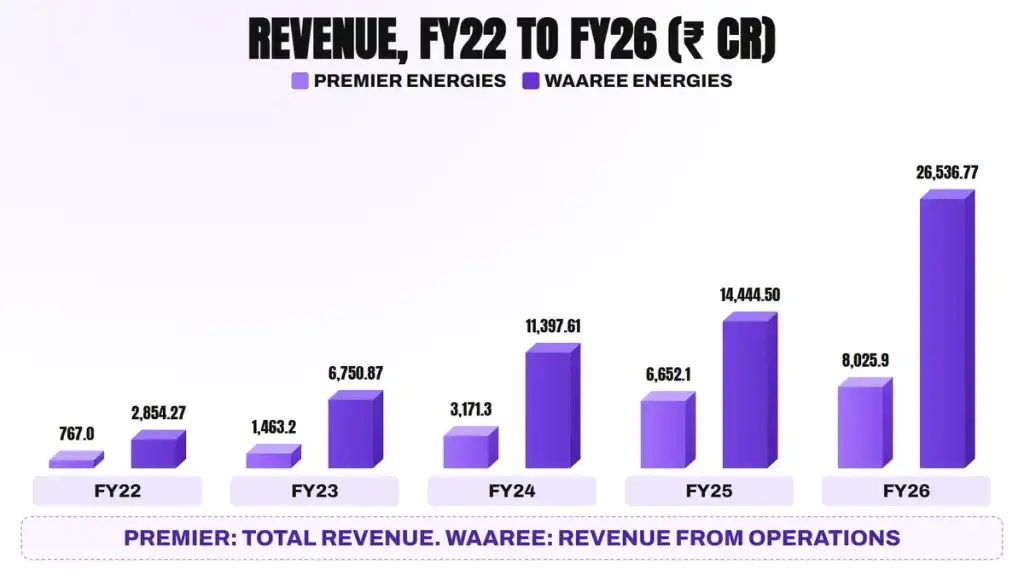
Both companies grew very fast over five years. Waaree's revenue grew 9.3 times from FY22 to FY26, and Premier's total revenue grew 10.5 times. Premier was loss-making in FY22 and FY23, while Waaree was already profitable.
| Year | Premier total revenue (₹ Cr) | Premier profit after tax (₹ Cr) | Waaree revenue from operations (₹ Cr) | Waaree profit after tax (₹ Cr) |
|---|---|---|---|---|
| FY22 | 767.0 | Loss of 14.4 | 2,854.27 | 79.65 |
| FY23 | 1,463.2 | Loss of 13.3 | 6,750.87 | 500.28 |
| FY24 | 3,171.3 | 231.4 | 11,397.61 | 1,274.38 |
| FY25 | 6,652.1 | 937.1 | 14,444.50 | 1,928.13 |
| FY26 | 8,025.9 | 1,509.7 | 26,536.77 | 3,884.15 |
Note: Premier's five-year figures are total revenue, which includes other income; Waaree's are revenue from operations. Other income is small for both (₹708.15 Cr for Waaree in FY26, against total income of ₹27,244.92 Cr).
The margin story is where they part. Waaree's operating EBITDA margin climbed every year: 3.9% in FY22, 12.4% in FY23, 13.8% in FY24, 18.8% in FY25 and 22.3% in FY26. Premier's operating margin jumped from 15.2% in FY24 to 30.4% in FY26, helped by its cells, which were scarce in India and sold at high prices. In FY26, Premier kept 19.3% of its revenue from operations as profit, against 14.6% at Waaree. Waaree's FY26 profit also absorbed a one-time provision of ₹294.78 Cr linked to a US customs probe (see risks below).
To read these numbers well, it helps to know what EBITDA shows and what it leaves out.
Order Book and Growth Plans
An order book is the value of orders a company has won but not yet delivered.
| Order book | Premier Energies | Waaree Energies |
|---|---|---|
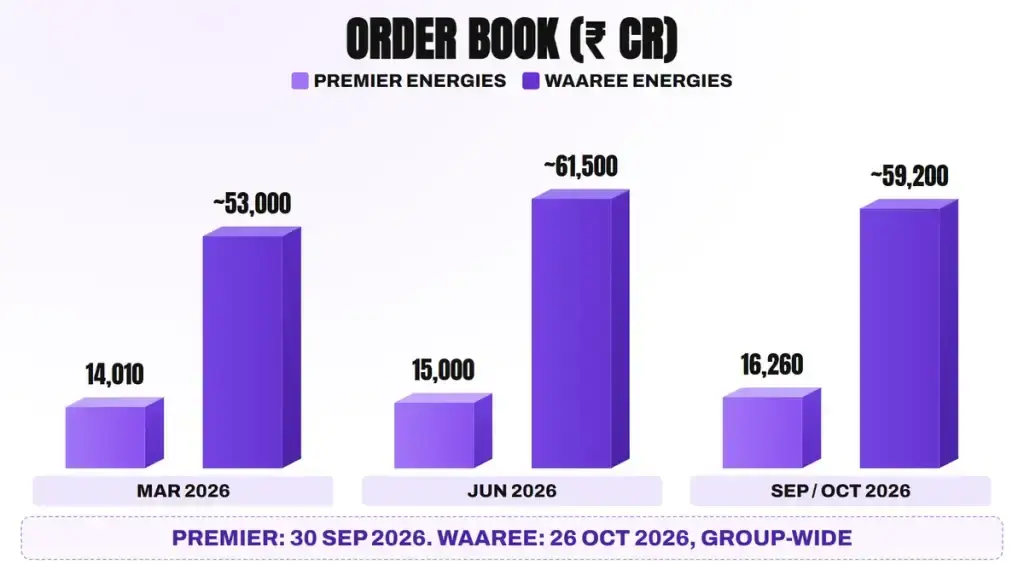
| March 2026 | ₹14,010 Cr | About ₹53,000 Cr |
| June 2026 | ₹15,000 Cr (including transformers) | About ₹61,500 Cr |
| Latest | ₹16,260 Cr (30 September 2026) | About ₹59,200 Cr (26 October 2026) |
| Latest order book against FY26 revenue from operations | About 2.1 times | About 2.2 times |
Waaree's book is about 3.6 times Premier's in rupees, which matches its larger size. Against their FY26 revenue, both books are about the same, a little over two years of sales. But the direction differs. Premier's book has grown every quarter this year; it won ₹4,001 Cr of new orders (2,308 MW) in July to September 2026, and expects to deliver its book in about 12 to 14 months. Waaree's book fell from about ₹61,500 Cr to about ₹59,200 Cr, partly because, due to US trade uncertainty, a large part of its export orders has been treated as cancelled. Waaree's figure also covers its whole group, including plant building and other products. Its solar module order book alone was 25.6 GW.
What is in the book also matters. About 68% to 70% of Premier's book is DCR products, and cells and modules are about 48% each. The 25% to 30% that is non-DCR earns only single-digit EBITDA margins. In March 2026, about 65% to 70% of Waaree's book came from overseas.
Growth plans. Premier plans to spend about ₹12,500 Cr over three years. It expects about ₹2,400 Cr of capex in FY27. The new Naidupeta plant should run at 25% to 30% of capacity in December 2026 and about 70% by March 2027. Its ingot and wafer plant should reach phase 1 by December 2027 and about 10 GW by June 2028, and its battery plant should start in Q2 2027. Management also expects transformer revenue to more than treble in three years.
Waaree's plan is about three times bigger. It has announced ₹31,852 Cr of projects, of which ₹11,525 Cr was spent by 30 September 2026, leaving ₹20,327 Cr. That includes ₹10,000 Cr for battery cells and systems, the 10 GW cell plant, the 10 GW ingot and wafer plant and a solar glass plant. Its group targets about 29 GW of modules and 15.4 GW of cells. For FY27, Waaree has guided for operating EBITDA of ₹7,000 Cr to ₹7,700 Cr. After ₹2,775.12 Cr in the first half, it needs between ₹4,224.88 Cr and ₹4,924.88 Cr in the second half, well above its first-half pace.
Balance Sheet and Cash Flow
| Measure | Premier Energies | Waaree Energies |
|---|---|---|
| Net worth (total equity), March 2026 | ₹4,307.7 Cr | ₹15,010.89 Cr |
| Debt position, March 2026 | Net debt of ₹1,046.4 Cr (0.41 times EBITDA) | Borrowings of ₹2,491.53 Cr against cash and bank balances of ₹6,728.37 Cr |
| Latest debt position | Net debt of ₹1,641.7 Cr (June 2026) | Net cash of ₹3,224 Cr (September 2026) |
| Operating cash flow, FY24 | ₹90.2 Cr | ₹2,305.04 Cr |
| Operating cash flow, FY25 | ₹1,348.0 Cr | ₹3,158.21 Cr |
| Operating cash flow, FY26 | ₹1,261.1 Cr | ₹1,626.95 Cr |
| FY26 operating cash flow as a share of profit | About 84% | About 42% |
Waaree has the stronger balance sheet. It raised money in its October 2024 listing and still holds more cash than debt. Its FY26 cash flow was weak, at about 42% of profit, as inventories grew to ₹5,855.64 Cr. But it recovered strongly in the first half of FY27: ₹3,477.06 Cr of operating cash flow, about 2.1 times profit for the period. It spent ₹4,327.30 Cr on plants in those six months alone, and ₹4,963.41 Cr in FY26.
Premier carries some debt, but it is low and its cash conversion is better. Its net debt rose to ₹1,641.7 Cr by June 2026 as it paid for Naidupeta. In FY26 it turned about 84% of its profit into operating cash. Premier says it has no plan to raise equity, and that cash from operations will fund its capex. Its credit rating was raised to CRISIL A+/Positive in August 2026. Its inventory build-up in Q2 FY27 was mostly raw material, which management expects to come back to normal by the March quarter.
If you want a refresher on why the cash flow line matters as much as profit, see cash flow statements explained.
Risks for Each Company
Premier Energies
- Prices outside DCR. Prices for non-DCR modules fell from about ₹14 to ₹15 per watt last year to about ₹12.5 now, and that part of the book earns single-digit margins.
- Starting the new plant. Naidupeta was due to begin commercial output only in late November 2026. Cell quality, yield and the speed of the ramp to about 70% by March 2027 will decide how much it adds.
- Cell competition. Waaree, Emmvee and others are adding cell lines. As more Indian cells reach the market, the high cell prices of FY26 may not last.
- More businesses at once. Wafers, battery containers and transformers are new fields for Premier, and each needs money and skill.
Waaree Energies
- US trade action. US customs opened a probe into the origin of parts in modules Waaree shipped to the US since January 2021. Waaree made a provision of ₹294.78 Cr in FY26, has since received a notice of determination, and has asked for a review. Separately, US trade uncertainty led to a large part of its export orders being treated as cancelled.
- Falling margins. The operating margin dropped from 23.19% to 17.76% in a year. Meeting its FY27 guidance needs a much stronger second half.
- Cell gap. With only 5.4 GW of cells against about 26 GW of modules, Waaree still buys many cells. Its own cell lines ran at about 81% in Q2 FY27, while module lines in India ran at about 45%. The new 10 GW cell plant is key.
- Big capex. ₹20,327 Cr of projects are still to be spent, across fields such as battery cells and solar glass that are new to it.
- A legal dispute. Enel Green Power has started arbitration against Waaree over a purchase deal that did not go through. Waaree disputes the claims.
Which Is Stronger on Each Measure?
This is not a stock pick. It shows which company is ahead on each measure, using the latest figures for both.
| Measure | Stronger | Why |
|---|---|---|
| Size and scale | Waaree | FY26 revenue from operations about 3.4 times Premier's, and profit about 2.6 times |
| Module capacity | Waaree | About 26 GW against 11.1 GW, with plants in the US |
| Cell integration | Premier | Cells about 95% of module capacity, against about a fifth at Waaree |
| Margin | Premier | FY26 operating EBITDA margin 30.4% against 22.3%; Q2 FY27 28.6% against 19.3% |
| Return on equity, FY26 | Premier | 42.4% against 31.6% |
| Latest growth | Premier | Q2 FY27 total income up 38.2% against 23.1%; profit up 30.8% against down 14.18% |
| Order book size | Waaree | About ₹59,200 Cr against ₹16,260 Cr |
| Order book trend | Premier | Rising each quarter, while Waaree's slipped after export cancellations |
| Balance sheet | Waaree | Net cash, against Premier's net debt |
| Cash conversion, FY26 | Premier | About 84% of profit against about 42% |
| Range of products | Waaree | Also builds plants, makes inverters, transformers and battery systems, and has US plants |
| Exposure to US trade rules | Premier | Small overseas sales; Waaree faces a US customs probe |
Explore our Products
Research Framework

Emerging Titans
Combination of quantitative analysis, industry tailwinds, and management assessment - SPRINT investment philosophy

Tiny Titans
Heavy emphasis on scuttlebutt research, plant visits, and early on-ground signals
Conclusion
Premier Energies and Waaree Energies are both betting that India will keep demanding Indian-made cells and modules. They differ in shape. Waaree is the scale player: the biggest module capacity, a group that also builds plants and makes other power equipment, a US presence and a cash-rich balance sheet. Premier is the focused, more integrated player: nearly as many cells as modules, higher margins and returns, and a growing order book.
The comparison depends on what a reader values. A reader who looks first at size, range and balance-sheet strength will find Waaree ahead on those. A reader who looks first at margins, return on equity and recent growth will find Premier ahead on those. For both, the next year turns on the same few things: how fast the new cell plants run, how long DCR prices hold, and, for Waaree, how the US issues end.
For our full research on each company, read our Premier Energies analysis and our Waaree Energies analysis. For the wider sector, from solar glass to wind turbines, see renewable energy stocks in India for 2026.
FAQs
Premier Energies vs Waaree Energies: which is better?
+Neither is better on every measure. Waaree is bigger, with FY26 revenue from operations of ₹26,536.77 Cr against ₹7,824.4 Cr, about 26 GW of module capacity and net cash. Premier earns more on each rupee, with a FY26 operating EBITDA margin of 30.4% against 22.3%, a FY26 return on equity of 42.4% against 31.6%, and faster Q2 FY27 growth. Which matters more depends on the reader. This is research, not a recommendation.
Which company is bigger, Premier Energies or Waaree Energies?
+Waaree Energies. In FY26 its revenue from operations was ₹26,536.77 Cr and its profit after tax ₹3,884.15 Cr, against ₹7,824.4 Cr and ₹1,509.7 Cr for Premier Energies. Its order book of about ₹59,200 Cr (26 October 2026) is also about 3.6 times Premier's ₹16,260 Cr (30 September 2026).
Which company has higher margins?
+Premier Energies. Its FY26 operating EBITDA margin was 30.4%, against 22.3% for Waaree Energies. In Q2 FY27, on EBITDA including other income, Premier earned 28.6% of total income and Waaree 19.3%. Both margins fell from a year earlier.
Which company makes more solar cells?
+Premier Energies now has 10.6 GW of cell capacity, after its Naidupeta plant started in September 2026. Waaree Energies has 5.4 GW, with a 10 GW cell plant due in FY2027. Waaree has much more module capacity: about 26 GW against Premier's 11.1 GW.
Premier Energies vs Emmvee: how are they different?
+Both make solar cells and modules in India. Emmvee is another listed maker of solar cells and modules, while Premier Energies also makes transformers through Transcon and is building ingot, wafer and battery plants.
What are the main risks for Premier Energies and Waaree Energies?
+For Premier: falling prices for non-DCR modules, the ramp-up of its new cell plant, and more cell supply from rivals. For Waaree: a US customs probe for which it set aside ₹294.78 Cr, export orders treated as cancelled due to US trade uncertainty, a falling margin and ₹20,327 Cr of projects still to be spent.

High growth stock specialist, Value Educator
Shashank Mahajan is an equity research professional with over 12 years of experience in identifying high-potential SME and micro-cap stocks at an early stage. He follows a rigorous scuttlebutt research–driven approach, combining on-ground insights with deep financial analysis. Shashank specializes in uncovering under-researched and under-owned companies with strong management quality and long-term growth potential. Through disciplined research and early identification, he focuses on spotting tomorrow’s market leaders before they enter the mainstream investor radar.
More about Shashank Mahajan →
PCBL Chemical: Carbon Black Margins and Battery Materials

KEC International: Record Orders, Weak Margin, High Debt

Sona BLW: EV Revenue Now Tops Half of Its Auto Sales

HPL Electric & Power: Smart Meters, Wires and Two Engines

Kaynes Technology: EMS, Chip Plants and ₹10,563.5 Cr Orders

Sterlite Technologies: Glass Rods to Hyperscaler Deals
Explore our Products
Research Framework
Emerging Titans
Combination of quantitative analysis, industry tailwinds, and management assessment - SPRINT investment philosophy
Tiny Titans
Heavy emphasis on scuttlebutt research, plant visits, and early on-ground signals



India's Aerospace Opportunity
Global Demand. Supply Bottlenecks. Opportunities Ahead.
Don't Miss This Exclusive Webinar!
Join Value Educator to decode the key trends shaping India's aerospace sector and learn how to identify tomorrow's potential leaders in the space.
- How the aircraft value chain works, layer by layer
- Indian companies supplying global aircraft makers
- A framework to judge any aerospace company

 Orders
 Subscription
 Share with friends


Required Details
₹23999.00
(12 month subscription)
As per SEBI regulations, all users are mandated to complete the KYC that is validated for 1 year. Post payment, you will be redirected to the KYC screen


No comments yet. Be the first to comment!