
Emmvee: The Quiet Power Behind India's Solar

Picture a rooftop in Karnataka on a clear afternoon. Sunlight hits a panel, and somewhere under that glass, silicon does something we mostly take for granted — it turns light into electricity. Most of us never think about what's happening beneath the surface. We just notice the panel, maybe the brand sticker, and get on with our day.
Here's a question worth sitting with, though. Who actually makes that panel? In many cases, a Bengaluru company called Emmvee. Not the installer who put it on your roof. Not the developer who built the 500-acre solar park out in Rajasthan. Somebody took raw silicon wafers, turned them into electricity-generating cells, and then turned those cells into the finished module sitting on that rooftop.
That's a completely different business. It's manufacturing — heavy, capital-intensive, not particularly glamorous manufacturing. No ribbon-cuttings, no rooftop selfies. Just factories, furnaces, silver paste, and a lot of very exacting engineering.
Now scale that up. India wants tens of gigawatts of new solar capacity every year for the rest of this decade, pushed along by rising electricity demand, energy-security concerns, and a government that has decided, fairly deliberately, that it doesn't want its clean-energy future built entirely on imported equipment. Someone has to make the cells and modules that go into all of it.
That's the business we're unpacking today. It isn't a household name the way a consumer brand would be — you won't see it advertised anywhere. Its products have been supplied across a range of domestic and international markets, though the company itself remains far less visible to consumers than the developers and installers whose projects actually carry its equipment.
What makes the story worth telling is this: it isn't a company that jumped into solar because it's trendy right now. It's been building quietly since 1992, starting with solar water heaters of all things, and only became a public company in November 2025. That's a long operating history compressed into a very recent listing — which usually means the market hasn't quite settled on how to think about it yet.
So let's work through it properly. What does the business actually do, how does it make money, what's pushing growth, and just as important, what could go wrong along the way.
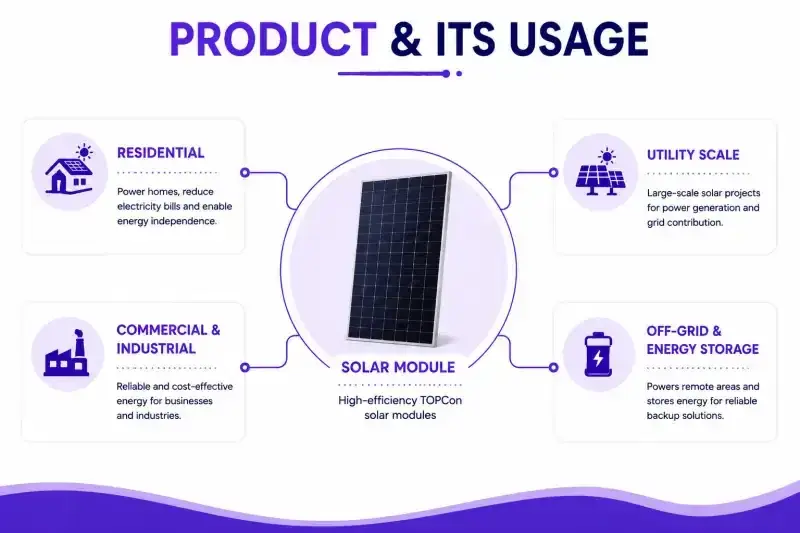
Meet Emmvee Photovoltaic Power Limited
Emmvee Photovoltaic Power Limited (NSE: EMMVEE, BSE: 544608), based out of Bengaluru, is one of India's larger integrated manufacturers of solar photovoltaic modules and solar cells. Commercial module production started in 2007, though the group's manufacturing roots go back further still, to 1992. According to the company's own disclosures, it is the second-largest pure-play integrated module-and-cell manufacturer in India by capacity, accounting for roughly 5.1% of India's ALMM-listed module manufacturing capacity as of its most recent public disclosure — worth reading as a capacity share rather than a revenue or sales-volume share, since the two aren't the same thing.
The company listed on Indian exchanges in November 2025, raising about ₹2,900 crore through its IPO, of which roughly ₹2,144 crore was a fresh issue, according to management. A sizeable chunk of that around ₹1,621 crore, per management's own confirmation on the concall — went toward repaying debt, and that decision shows up clearly in how the balance sheet looks today. We'll get to that. It's worth being precise about what kind of business this is.
“Know what you own, and know why you own it.”-Peter Lynch
Emmvee doesn't own solar farms or sell electricity to anyone. It manufactures the equipment cells and modules that other companies then use to build solar power plants, rooftop systems, and commercial installations. Think less utility, more specialised industrial manufacturer sitting inside the clean-energy supply chain.
The Business Model: Selling Efficiency, Not Just Silicon
Here's a useful lens for what Emmvee is really selling. Not silicon exactly — more like efficiency and output density. Two panels can occupy the same amount of roof space; if one has higher efficiency and power density, it can generate more electricity from that same footprint over its life. That gap is where a manufacturer like Emmvee actually competes.Efficiency isn't the whole picture, though, and it's worth being upfront about that. Customers evaluating a module or cell supplier are also weighing price per watt, degradation over time, warranty terms, reliability, bankability with lenders, delivery schedules, and whether the product is eligible under DCR and ALMM rules.
“The key to investing is not assessing how much an industry will affect society, or how much it will grow, but rather determining the competitive advantage of any given company.”-Warren Buffett
Efficiency is one differentiator among several — a real one, but not the only one that decides who wins an order.
Its manufacturing is built around TOPCon technology — Tunnel Oxide Passivated Contact, if you want the full name, though the acronym is more useful than the physics. It's a newer solar-cell architecture than the older polycrystalline or even Mono PERC lines. Without wading too far into engineering detail: a conventional cell loses some of the electricity it generates because electrons get lost inside it. TOPCon uses a very thin "tunnel oxide" layer plus a heavily doped polysilicon layer to create a cleaner electrical contact, cutting that loss down. Less loss, more efficiency, and efficiency is what customers pay up for — among other things.
The shift toward TOPCon has been fast. According to management, TOPCon modules made up roughly 69% of module revenue in FY25; by Q1 FY26, that had climbed to about 79%, with Mono PERC filling most of the remainder and polycrystalline essentially phased out. Emmvee actually shut its Unit I polycrystalline line in May 2025, taking a plant-and-machinery impairment of about ₹20 crore. That's the flip side of chasing the technology curve — yesterday's leading-edge line can become tomorrow's write-off fairly quickly.
“If you keep learning all the time you have a huge advantage.”-Charlie Munger
Revenue is overwhelmingly business-to-business. Per management, B2B sales made up 98.65% of revenue in Q1 FY26, with a small remainder split between government-linked and retail channels — the retail slice being close to nothing. This is a company selling in bulk to developers, EPC contractors, and large commercial customers, not to homeowners buying one or two panels.
Value Chain: Where Emmvee Sits, and Why It Matters
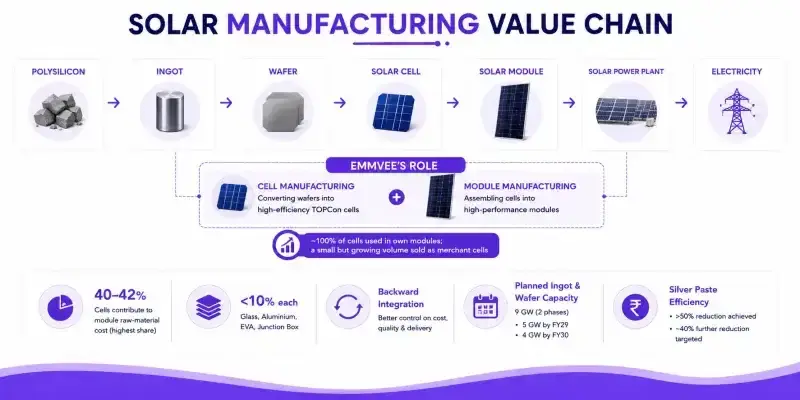
Lay out the full solar manufacturing chain and it looks something like this:Polysilicon → Ingot → Wafer → Solar Cell → Solar Module → Solar Power Plant → Electricity
Emmvee sits in the middle stretch of that chain today — buying wafers, converting them into TOPCon cells, and turning those cells into finished modules. By management's account, nearly all the cells it makes go into its own modules, though a modest and growing volume has recently been sold separately as merchant cells — described on one of the calls as "a meaningful, though not dominant" part of the mix.
Making your own cells and then your own modules is what's usually called backward integration. Cells are typically one of the largest cost components of a finished module, which is why owning cell manufacturing internally is economically important — it gives a company more control over cost, coordination, and how well the cell is tuned to the module it'll end up in, rather than being at the mercy of an external supplier's pricing and timing.
That said, calling Emmvee fully integrated would be overstating it. It still depends on external — largely imported — upstream materials: wafers, polysilicon-linked inputs, and silver paste among them. India simply doesn't have enough domestic capacity yet at the ingot-and-wafer stage. Management has been fairly open about this and has outlined a proposed 9 gigawatt ingot-and-wafer roadmap, in two phases (5 GW targeted for FY2029, another 4 GW for FY2030). It's worth being clear that this is a proposed plan rather than a project already under execution the way the current 6 GW cell-and-module expansion is — timing is subject to clarity on the proposed ALMM List III framework covering ingot and wafer manufacturing, and to prevailing market conditions, and management has said the capex would be funded largely through internal accruals rather than fresh borrowing.
One raw-material detail worth flagging: silver paste, used in cell manufacturing, has seen sharp price swings recently. According to management, process R&D and design tweaks have let Emmvee cut its silver paste consumption per cell by more than half over a period of a few months, with a further reduction of roughly 40% being targeted from current levels. That's a genuine operating lever — and also a reminder of just how sensitive cell economics are to one input moving around. Solar manufacturing is also a classic example of a capital-intensive business, where capacity utilisation, depreciation and returns on invested capital can materially shape the investment case. Our guide on Capital-Intensive Businesses Explained: Risks, Economics, and Investor Insights explains what investors should look for in businesses like these.
Emmvee Product Overview
Emmvee's product line centres on solar PV modules and cells, both mostly built on TOPCon, spanning bifacial modules (capturing light on both faces, including light reflected off the ground) and monofacial modules (front-side only), across a power range of roughly 395 Wp to 605 Wp — and, more recently, higher-power-density G12R format modules. A small legacy solar water-heater business is still around, a nod to where the group actually started more than three decades back, though it barely matters to the current investment case. As of Q1 FY27 (June 2026), installed capacity stood at roughly 10.3 GW for modules and 2.94 GW for TOPCon cells.Growth Drivers
A handful of tailwinds are converging on this business around the same time, and it's worth pulling them apart individually rather than lumping them into a single "solar is growing" narrative.Domestic content policy. The two policy frameworks doing much of the heavy lifting here are DCR (Domestic Content Requirement) and ALMM (Approved List of Models and Manufacturers) — related but distinct mechanisms, not interchangeable names for the same rule. Emmvee is included in the relevant ALMM framework for both modules and cells, which strengthens its position on projects where domestically compliant equipment is required.
Applicability has been phased across project categories and bid or commissioning timelines, with grandfathering provisions and subsequent government clarifications affecting exactly how and when it bites — this has continued to evolve through 2026, and it would be a stretch to describe it as a single clean cut-off. According to management, DCR modules accounted for more than 50% of the sales mix in Q1 FY27, though management itself has cautioned that this ratio can move around in coming quarters given the gap between module and cell capacity and the DCR inventory currently on hand. Investors should treat this as a live figure worth re-checking each quarter, not a settled structural level.
Government demand schemes. PM Surya Ghar Yojana supports rooftop solar adoption across households, and PM-KUSUM supports decentralised renewable-energy plants and the solarisation of agricultural pumps and feeders — both feeding structural demand for domestically compliant equipment. As of management's January 2026 disclosure, roughly 5-6 GW of Surya Ghar's broader ~30 GW ambition had been completed, a figure that has likely moved since and is worth checking against the scheme's more current official data rather than treated as current. Management has also pointed to C&I demand — factories and commercial customers procuring solar directly — as the fastest-growing segment industry-wide, at roughly 15-16 GW installed nationally over the year to that point.
Capacity expansion on a fairly defined timeline. Emmvee is midway through a 6 GW integrated TOPCon cell-and-module expansion, with an estimated total project cost of about ₹5,500 crore (hard costs around ₹4,600 crore, according to management). It has an IREDA-sanctioned term loan of approximately ₹3,306 crore at a management-stated rate of 7.95%. Management has guided to the module line being commissioned around December 2026, with the cell line following by March 2027. Once done, total capacity should reach approximately 16.3 GW of modules and 8.9 GW of cells. Capacity expansion can create enormous growth, but only if the company can earn attractive returns on the capital being deployed. That is why understanding the economics of manufacturing capex matters when evaluating companies like Emmvee.A SME Company Riding the Make in India Manufacturing Wave
About 60% of the hard-cost equipment orders were already placed as of the last update — a reasonable, though not foolproof, sign the project is on track.
A slow-burn export option. Exports are currently not a material part of Emmvee's business, despite the company's historical international customer relationships and its sales offices in Germany and the US. It's a thread worth watching regardless: several Western markets are moving toward requiring non-Chinese-linked components in their solar supply chains, and management says Emmvee already has a resilient, non-China-linked alternate supply chain for key materials. Whether that turns into meaningful revenue is a multi-year question, not a near-term one.
Better unit economics as scale and efficiency improve. Cell capacity utilisation moved from roughly 68% a year ago to 83% in the most recent quarter, according to management, with further improvement expected as the transition to the higher-throughput G12R cell format continues. Higher utilisation can improve operating leverage because fixed manufacturing costs get spread across a larger production base — a fairly standard dynamic in capital-intensive manufacturing, and one worth watching as the new 6 GW capacity comes online and needs its own utilisation ramp.
Put together, this isn't a single-driver story. Policy, government schemes, capacity, and operating efficiency are all pointing roughly the same direction at once — though a strong tailwind, on its own, says nothing about how well any particular company sails in it.
Order Book: The Forward Pipeline
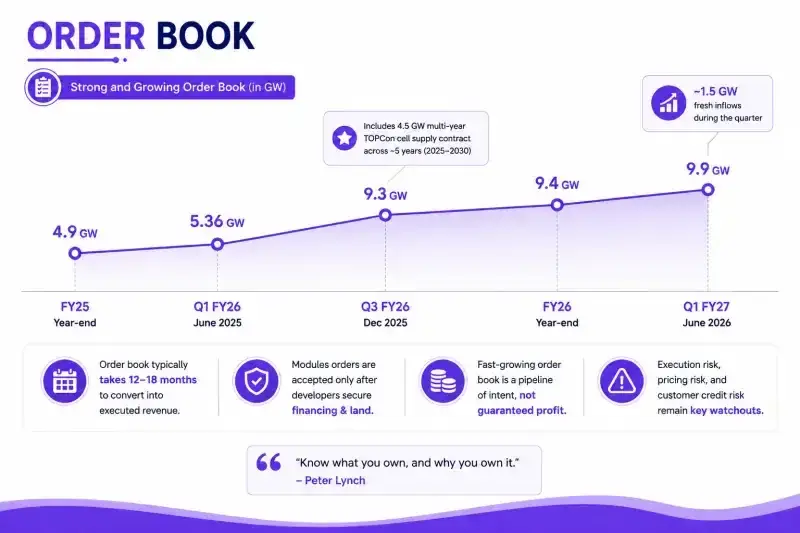
For a manufacturer, the order book is one of the clearer indicators of near-term revenue visibility — though far from a guarantee. According to management commentary across recent quarters, Emmvee's order book has moved like this:FY25 year-end: 4.9 GW
Q1 FY26 (June 2025): 5.36 GW
Q3 FY26 (December 2025): 9.3 GW, notably including a 4.5 GW multi-year TOPCon cell supply contract spread across roughly five years, 2025 to 2030
FY26 year-end (March 2026): 9.4 GW
Q1 FY27 (June 2026): 9.9 GW, with fresh inflows of roughly 1.484 GW during the quarter alone.
Management has indicated that the order book generally carries a 12-18 month execution cycle. That shouldn't be read as a mechanical revenue-recognition schedule, though — actual revenue recognition depends on delivery and the specific contractual terms of each order, not simply a fixed clock starting the day an order is booked. Management has also been fairly explicit that it deliberately avoids over-booking modules beyond what near-term capacity can realistically deliver — module orders in particular are only accepted once a developer customer has secured financing and land, which is management's way of filtering out speculative bookings. Sensible enough, though it also means a fast-growing order book shouldn't be mistaken for guaranteed future profit. Execution risk, pricing risk, and customer credit risk all sit somewhere between an order booked today and revenue eventually recognised.
Financials: The Numbers Behind the Story
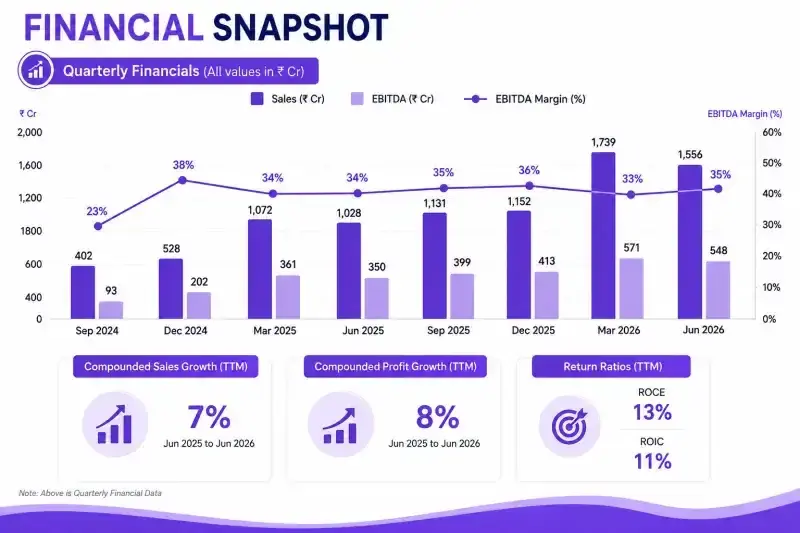
According to the company's financial disclosures, consolidated revenue rose from ₹618 crore in FY23 to ₹5,050 crore in FY26. EBITDA increased from ₹56 crore to ₹1,734 crore over the same period, while net profit rose from ₹9 crore to ₹1,082 crore. Based on these reported figures, EBITDA margin expanded from single digits in FY23 into the low-to-mid-30s by FY26 (Screener's own ratio calculations, used here as a cross-check, are broadly consistent with this range).That's not a typo, and it's not a one-quarter blip either. Quarterly figures show the same pattern holding — revenue climbed from ₹402 crore in the September 2024 quarter to ₹1,556 crore in the June 2026 quarter, with EBITDA margin sitting fairly consistently in the 33-38% band across the last seven quarters on a reported basis. The June 2026 quarter (Q1 FY27) alone brought in ₹1,555 crore of revenue, ₹548 crore of EBITDA — management reported an EBITDA margin of 35.2% for the quarter — and ₹380 crore of net profit.
What's actually driving the margin, and does it hold up?
This is where looking beyond headline revenue growth becomes important. Margins, cash flow, leverage and returns on capital can tell a very different story from revenue alone. For a structured approach, see A Fundamental Checklist: How to Research a Stock in 1 Hour.
“The biggest investment errors come from looking at things in isolation.”-Howard Marks
Management's own framing is useful here — rather than leaning on percentage margins, which move around with raw-material costs and DCR mix, they've pointed to absolute EBITDA-per-watt figures instead: roughly ₹2.0-2.5 per watt for non-DCR modules, ₹6.0-6.5 per watt for cells, and ₹8.5-9 per watt for DCR modules (which effectively bundle cell and module economics together), according to management. These spreads have reportedly held broadly stable across the last several quarters. But it's worth laying out plainly what's been pushing margin up, and what could just as easily push it back down.
On the way up: a richer DCR mix, rising cell utilisation and more internal cell consumption, falling silver-paste usage per cell, and general operating leverage as volumes have scaled — all landing in a period where the broader raw-material environment has also been fairly benign. On the other side of that ledger: the DCR mix could normalise rather than keep climbing, silver and other input prices could turn against the company again, the new 6 GW capacity will bring meaningfully higher depreciation once commissioned, module utilisation remains low relative to management's own target range, and competitive intensity or the next technology shift could compress spreads that have looked comfortable for a few quarters now. None of this means the current margin profile is fragile — but it does mean the recent run shouldn't be extrapolated forward without asking which of these tailwinds are structural and which are cyclical.
The balance sheet tells a genuinely encouraging story on leverage. Total borrowings fell from ₹2,065 crore (March 2025) to ₹360 crore (March 2026), largely on the back of the roughly ₹1,621 crore of IPO proceeds used to prepay term loans, according to management. Net debt-to-equity came in effectively net-cash, and the current ratio stood at 2.1x, based on reported balance-sheet figures. Return ratios need a little more care: management reported ROCE of 38% and ROE of 51% for FY26 on the concall, while Screener's own calculated ratios show ROCE closer to 45% for the same year. The gap likely comes down to differing calculation methodologies — average versus year-end capital employed, for instance — rather than any inconsistency in the underlying numbers, but it's worth treating both figures as approximate rather than fully reconciled, and noting that both benefit from the recent debt paydown and a still relatively small equity base against the scale of profits now coming through.
One aspect that should be closely monitored is working capital. Reported inventory increased from ₹758 crore (March 2025) to ₹1,711 crore (March 2026), while the corresponding inventory days moved from around 197 to roughly 225 over the same period, which were among the highest in the company's history. Management said the slowdown in the ramp-up in production, along with the conscious decision to maintain a slightly higher buffer of raw material stocks due to recent silver-supply and geopolitical disruptions, are the primary reasons for the slowdown and management believes the robust order book will help to absorb the production buildup over the upcoming quarters. The cash conversion cycle has also extended to approximately 159 days and free cash flow has been in negative for three consecutive years, at approximately -₹440 crore for FY24, -₹375 crore for FY25 and -₹440 crore for FY26. While it's comprehensible that in a period of substantial growth the company might be burning cash, it doesn't matter, because the company still needs to generate cash out of the accounting profits, and that cash burn is a quarter-by-quarter concern that still needs to be watched.
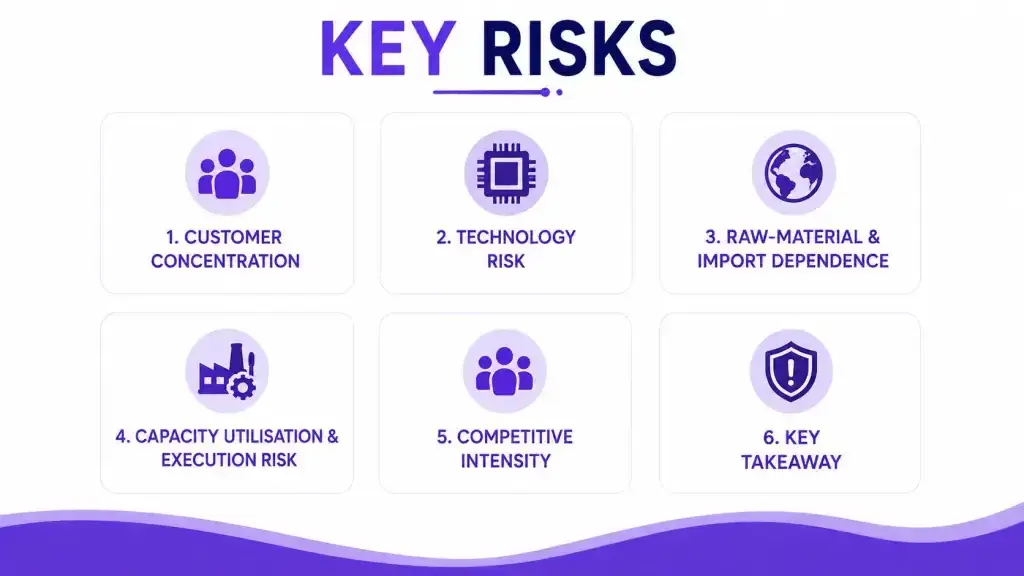
Key Risks for Emmvee
No growth story is risk-free, and this one has a fairly concentrated handful worth watching closely.Customer concentration is one of the most significant risks here. In Q1 FY26, the top 10 customers accounted for 93.96% of revenue, up from 80.53% in FY23 and 85.82% in FY24 (84.98% in FY25) — an elevated level that has generally trended higher, not lower, even as the company has scaled up. The largest single customer alone contributed 36.57% of revenue in that same Q1 FY26 period. Newer disclosures should be checked to see whether this concentration has since moderated, but on the most recent verified reading, it sits close to the top of the risk list rather than somewhere in the middle of it. If even one or two large customers were to shift suppliers, renegotiate terms, or push out projects, the revenue impact could show up quickly.
Supplier concentration sits on the other side of the same coin. Per available disclosures, the top 10 suppliers accounted for roughly 68.9% of purchases in Q1 FY26. The company's dependence on imported inputs — wafers and silver paste chief among them — is a material risk in its own right, since disruptions to these upstream materials, whether from pricing, logistics, or geopolitical restrictions, can affect both availability and margins. Combined with concentrated sourcing, that dependence is worth tracking as closely as the customer side.
Module capacity and cell capacity aren't running at the same utilisation, and that gap matters. As of Q1 FY27, module utilisation sat around 45% while cell utilisation was already at roughly 83%, according to management. Emmvee is simultaneously adding 6 GW of further integrated capacity on top of that. The real question isn't simply whether capacity will increase — it clearly will — but whether demand grows fast enough to absorb the new capacity at utilisation levels that actually make it profitable, particularly on the module side where there's considerably more headroom left to fill.
Technology risk is real, and it's already shown up once. The polycrystalline write-down in FY25 is a live example of what happens when a solar technology falls behind. TOPCon is currently among the leading mainstream high-efficiency cell technologies, but HJT (heterojunction), back-contact designs, tandem cells, and other emerging architectures are all being developed across the industry, and there's no guarantee TOPCon holds its relative position indefinitely.
Raw-material and import dependence. Raw materials reportedly make up 80-85% of operating costs for Indian solar-cell manufacturers, with wafers and silver paste as major imported components, per management commentary. Management has indicated that many contracts include pass-through mechanisms, meaning cost increases can generally be passed to customers, although the timing gap between a cost spike and a customer price adjustment can still create temporary margin pressure.
Competitive intensity. The list of Indian competitors is long and reasonably well-funded — Waaree Energies, Premier Energies, Vikram Solar, Tata Power, Adani Solar, among others — alongside competition from large-scale Chinese manufacturers, whose cost advantages can place pressure on global module pricing. Industry estimates cited in a sector report suggest the top five players account for roughly 54% of domestic module capacity and around 85% of cell capacity — figures that reflect broader industry data rather than Emmvee's own disclosures, but that give a useful sense of how concentrated this business is at the top end. In a market where several well-funded manufacturers are competing for the same growth opportunity, the bigger question is what prevents margins from being competed away over time. That brings us to the idea of an economic moat. Economic Moat Explained: Why Some Companies Stay Dominant for Decades
Explore our Products
Research Framework

Emerging Titans
Combination of quantitative analysis, industry tailwinds, and management assessment - SPRINT investment philosophy

Tiny Titans
Heavy emphasis on scuttlebutt research, plant visits, and early on-ground signals
Conclusion
“Price is what you pay. Value is what you get.”-Warren Buffett
Pulling the threads together: Emmvee is a scaled, technologically current, and increasingly integrated solar manufacturer riding a genuine, multi-year domestic policy tailwind, with a recently deleveraged balance sheet and margins that have expanded meaningfully as scale and cell utilisation have improved. The order book has nearly doubled over the past year, and capacity is expanding on a fairly defined timeline, with debt largely tied up and equipment substantially ordered. Management has also been reasonably forthcoming about both the opportunities and the risks in its public disclosures.
Set against that: customer and supplier concentration are both unusually high, working capital and inventory have stretched alongside the growth, free cash flow has stayed negative through the expansion phase, and the business operates in an industry where today's leading technology and today's favourable margin environment have both, historically, proven temporary. The recent run of strong absolute EBITDA-per-watt numbers is encouraging, but it has also coincided with a particularly favourable moment — improving DCR mix, falling silver costs, and rising cell utilisation all moving the same way at once, even as module utilisation still has considerable room left to climb. The current order book and planned capacity expansion provide visibility for potential growth, but that visibility is subject to execution and demand actually showing up as expected — it isn't a guarantee in itself.
The key investment question is whether Emmvee can convert its current order visibility and capacity expansion into sustainable returns on capital and free cash flow once DCR-related pricing benefits, technology advantages, and utilisation gains normalise. That distinction between a good business and a good investment is ultimately where fundamental research meets valuation. Before making an investment decision, it helps to have a systematic process for assessing the business, its risks and the price being paid. To learn more watch our Top-Down vs Bottom-Up Investing: Understanding Two Core Investment Strategies
That's the thread worth following in the quarters ahead, more than any single number in this article.
As with any single-company research note, none of this should be read as a recommendation to buy or sell. The point here has simply been to lay out what the business does, how it earns its money, and what an honest look at both sides of the ledger looks like.
FAQs
What does Emmvee Photovoltaic Power do?
+Emmvee Photovoltaic Power is an integrated solar manufacturer that produces solar cells and photovoltaic modules. The company primarily uses TOPCon technology and supplies products to developers, EPC contractors and other large B2B customers.
What is Emmvee's business model?
+Emmvee operates across the solar manufacturing value chain, primarily converting wafers into solar cells and then cells into finished modules. Its backward integration gives it greater control over manufacturing, costs, product quality and supply compared with a pure module assembler.
Why is TOPCon technology important for Emmvee?
+TOPCon is a high-efficiency solar-cell technology that can generate more power from a similar panel footprint. Emmvee has been shifting its product mix toward TOPCon, making the technology an important part of its strategy as the solar industry moves away from older technologies such as polycrystalline and Mono PERC.
What are the key growth drivers for Emmvee?
+Emmvee's growth is supported by India's expanding solar capacity, domestic-content policies such as DCR and ALMM, government schemes including PM Surya Ghar and PM-KUSUM, rising demand for domestically manufactured solar equipment, and the company's planned capacity expansion. Its growing order book also provides greater visibility for future production.
What are the major risks for Emmvee investors?
+The key risks include high customer concentration, supplier and imported raw-material dependence, elevated working capital, negative free cash flow during the expansion phase, technology changes, competitive pressure and the risk that new manufacturing capacity is not utilised quickly enough. Solar-sector margins can also change significantly with policy, input costs and industry supply-demand conditions.

High growth stock specialist, Value Educator
Shashank Mahajan is an equity research professional with over 12 years of experience in identifying high-potential SME and micro-cap stocks at an early stage. He follows a rigorous scuttlebutt research–driven approach, combining on-ground insights with deep financial analysis. Shashank specializes in uncovering under-researched and under-owned companies with strong management quality and long-term growth potential. Through disciplined research and early identification, he focuses on spotting tomorrow’s market leaders before they enter the mainstream investor radar.

Glenmark: The USD 700 Mn Cancer Deal and Its Brands

Pharma Stocks in India 2026: Generics, APIs and CDMOs

Granules India: From Paracetamol to a 65% Gross Margin

Natco Pharma: After Revlimid, 29 Patent Challenges

Shilpa Medicare: Cancer APIs, Films and Biosimilars

Alembic Pharma: US Plants Pay Back, Margin Hits 22.2%
Explore our Products
Research Framework
Emerging Titans
Combination of quantitative analysis, industry tailwinds, and management assessment - SPRINT investment philosophy
Tiny Titans
Heavy emphasis on scuttlebutt research, plant visits, and early on-ground signals



Modern Warfare to Multibaggers
Key Trends. Strategic Shifts. Opportunities Ahead.
Today at 7:00 PM IST. Room opens 30 minutes before.
Don't Miss This Exclusive Webinar!
Join Value Educator to decode the key trends shaping India's defence sector and learn how to identify tomorrow's potential leaders in the space.
- In-depth research on India's defence sector
- Live Q&A session
- Actionable takeaways for long-term investors

 Orders
 Subscription
 Share with friends


Required Details
₹23999.00
(12 month subscription)
As per SEBI regulations, all users are mandated to complete the KYC that is validated for 1 year. Post payment, you will be redirected to the KYC screen


No comments yet. Be the first to comment!