
Premier Energies: Solar Cells and a ₹16,260 Cr Order Book
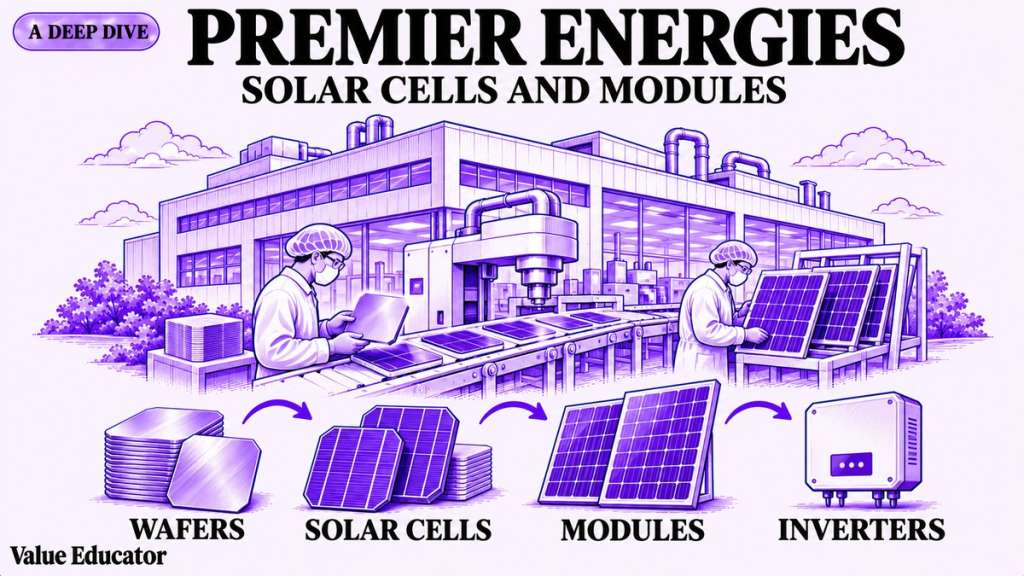
On 21 September 2026, a Hyderabad company switched on a solar cell plant at Naidupeta in Andhra Pradesh. The plant covers 101 acres, cost ₹3,293 Cr and can make about 88,000 solar cells an hour. With it, the company's cell capacity went from 3.6 GW to 10.6 GW in one step, and the company says it is now India's largest solar cell maker.
That plant tells us where the money in Indian solar is moving. A solar cell is the thin square of treated silicon that turns sunlight into electricity. A solar module is the panel we see on rooftops and in solar parks. It is made by wiring many cells together and sealing them under glass in an aluminium frame.
That is changing because of two government rules. ALMM, the Approved List of Models and Manufacturers, is the list of plants whose products may be used in government-backed projects. List I covers modules, and List II, which covers cells, has applied to more kinds of projects since 2024. DCR, or domestic content requirement, means a project must use modules made from Indian cells to get a subsidy. Subsidised home rooftops and farm solar projects both use them.
The new plant makes TOPCon cells. TOPCon stands for tunnel oxide passivated contact, a newer cell design that adds a very thin oxide layer to turn more sunlight into power than the older mono PERC cells. The company is targeting an average cell efficiency of about 25.8% at the new plant once it settles.
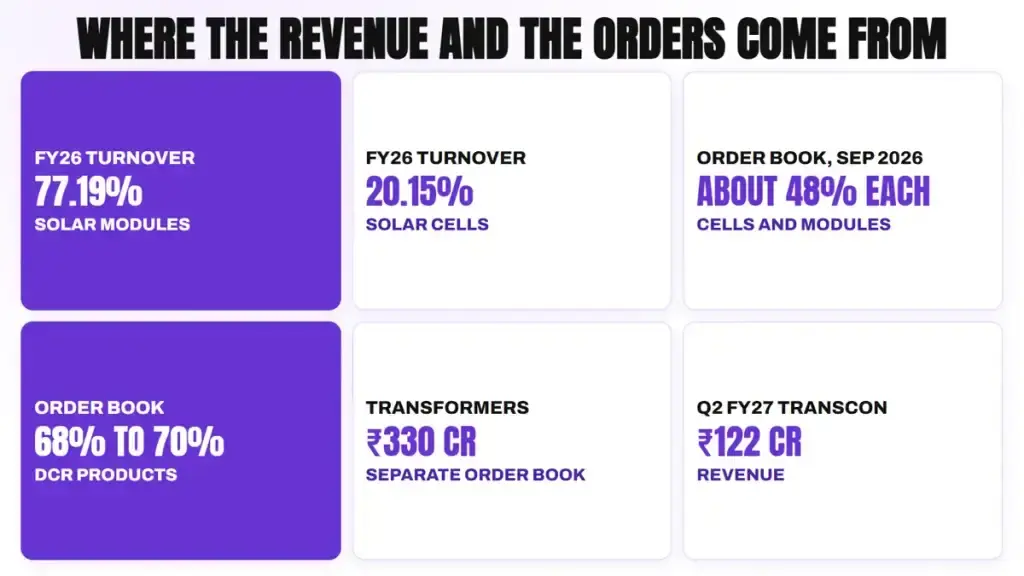
That company is Premier Energies Ltd (NSE: PREMIERENE). It started in 1995 by assembling modules and now makes both cells and modules in Telangana and Andhra Pradesh, with 11.1 GW of module capacity. In FY26, modules brought in 77.19% of its turnover and cells 20.15%.
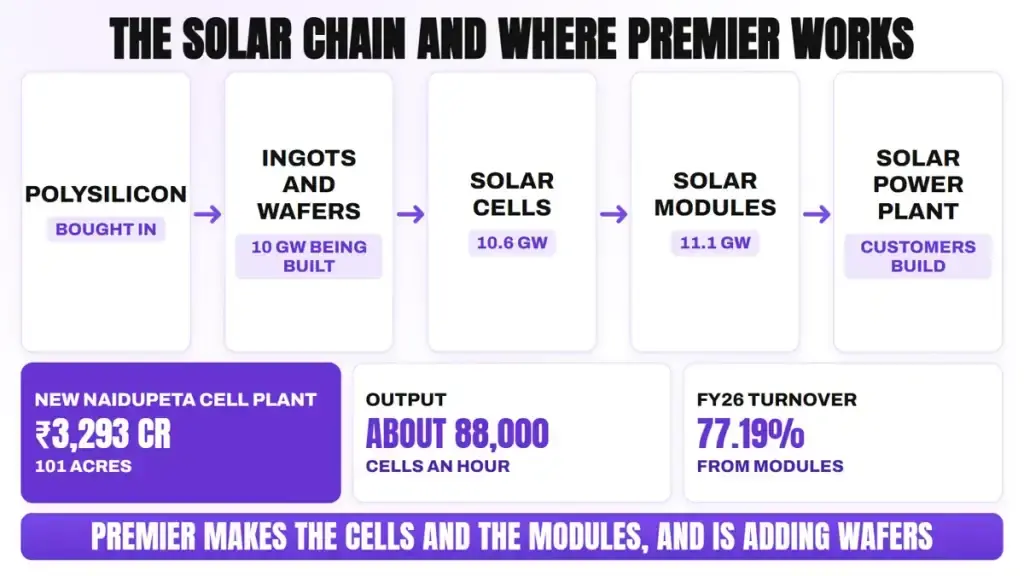
That puts Premier in the centre of the solar chain. It does not make polysilicon or build solar parks. It makes the cells and modules that go into them, and it is now building the ingot and wafer steps that come before the cell.
Premier Energies in five numbers
- Q2 FY27 total revenue of ₹2,656 Cr, up 38.2%
- Solar cell capacity of 10.6 GW, up from 3.6 GW
- An order book of ₹16,260 Cr in September 2026
- FY26 profit after tax of ₹1,509.7 Cr, up 61.1%
- A capex plan of about ₹12,500 Cr over three years
So a company that made 110 MW of cells in FY22 now has plants for nearly a hundred times that. How did that show up in the latest numbers? Let's first understand the company, and then look at the latest quarter.
Premier Energies: Company Overview
Premier Energies Ltd was established in 1995 and is based in Hyderabad, Telangana. Surender Pal Singh Saluja is its Chairman and has been with the company since it was incorporated, and Chiranjeev Singh Saluja is its Managing Director; the promoter group held 63.94% in March 2026. The company makes solar cells and solar modules, and through its 51%-owned subsidiary Transcon it also makes power and distribution transformers. Its plants are in Telangana and at Naidupeta in Andhra Pradesh, where it is now building ingot and wafer lines, a battery container plant and an aluminium frame plant. It listed on the NSE and BSE on 3 September 2024, and had a workforce of 9,080 people in March 2026. Revenue from operations was ₹7,824.4 Cr in FY26, and net debt stood at ₹1,046.4 Cr in March 2026, or 0.41 times EBITDA. Read this Waaree Energies: Riding India's Solar Push
"Know what you own, and know why you own it."
— Peter Lynch
Premier's profit changed when Indian rules turned its cells into a scarce product. Knowing how much of the business rests on cells, DCR modules and the new lines is the first step to reading its results.
The Quarter Total Revenue Grew 38.2%
Let's look at Q2 FY27, the July to September quarter, which the company discussed with investors on 5 November 2026. Total revenue, which includes other income, was ₹2,656 Cr, up 38.2% from ₹1,921.4 Cr a year ago. It was also 5.9% higher than the ₹2,507.6 Cr of Q1 FY27.

As we can see, profit grew more slowly than revenue. Read this EBITDA Explained: Uses and Limits EBITDA rose 17.8% to ₹760 Cr, and profit after tax rose 30.8% to ₹462 Cr. The EBITDA margin of 28.6% was lower than the 33.6% of Q2 FY26. Management says prices of non-DCR modules have come down, while costs of aluminium, copper and polymer films have gone up.

That chart also shows a steady climb. Total revenue was ₹1,869.5 Cr in Q1 FY26 and has risen every quarter since, to ₹2,656 Cr. The largest step came in Q4 FY26, when it reached ₹2,268.9 Cr.
Within those totals, the solar business and the new transformer business moved differently. The solar manufacturing business earned an EBITDA margin of 29.3% and a PAT margin of 17.9% in the quarter. Management says the PAT margin eased because depreciation rose and other income was lower. Transcon, the transformer subsidiary, reported revenue of ₹122 Cr and profit after tax of ₹18 Cr, at margins of 15% and 8%.
That transformer margin moves from quarter to quarter. In Q1 FY27 Transcon earned ₹110 Cr of revenue and ₹18 Cr of profit after tax, at margins of 27% and 17%. Management says that quarter gained because steel and copper costs went up, so prices on some orders rose while Transcon had already bought its stock. It calls about 15% a normal EBITDA margin for this business.
Put the two quarters together and the first half is close to a full year of the recent past. H1 FY27 total revenue was about ₹5,163.6 Cr, and profit after tax was about ₹933.9 Cr. That is almost the ₹937.1 Cr of profit after tax the company made in all of FY25.
That growth needs cash, and the balance sheet shows it. Capex was about ₹1,500 Cr in Q1 FY27 alone, mostly for the Seetharampur module plant and the Naidupeta cell plant. Net debt was ₹1,641.7 Cr in June 2026, against a net cash position of about ₹567.3 Cr in September 2025. Inventory also rose in Q2 FY27. Management says the build-up is mostly raw material bought ahead of the new plants, plus extra stock kept because of shipping delays, and it expects inventory to return to normal by the March quarter.
The ₹16,260 Cr Order Book
Now let's look at the orders, because they show how much of the coming revenue is already booked. Premier reports an order book, the value of signed supply contracts not yet delivered, and each quarter it reports new bookings, the orders signed in that quarter.
In the July to September quarter, Premier won new orders worth ₹4,001 Cr for 2,308 MW of cells and modules and some EPC work. That does not count orders from the retail market. The order book reached ₹16,260 Cr at the end of September 2026.
That book was much smaller two years ago. It was ₹6,946.1 Cr in December 2024 and ₹8,445.6 Cr in March 2025. It then jumped to ₹13,249.6 Cr in September 2025, after the company signed ₹6,483.8 Cr of new orders in a single quarter.
Those orders come from a mix of buyers. In the April to June quarter of 2026, Premier won ₹3,011 Cr of orders for 1,846 MW of cells and modules, with deliveries spread across FY27 and FY28. The buyers were power producers, module makers, EPC companies and others, and the ₹4,001 Cr of the next quarter came from a similar mix.

Since then the book has kept growing even as deliveries rose. It was ₹14,010 Cr in March 2026 and about ₹15,000 Cr in June 2026, including transformers. Over the year to September 2026 it grew by about 22.7%, and it now equals about two years of FY26 total revenue.
What the order book says: ₹16,260 Cr is about 2.0 times the ₹8,025.9 Cr of total revenue in FY26. Management expects the current book to be delivered over about 12 to 14 months, so most of it should turn into revenue by early FY28.
Beyond the size, the mix of the book matters. Management says cells and modules are about 48% each of the book. About 68% to 70% of the book is for DCR products, the part that pays better, and about 25% to 30% is for non-DCR modules, which management says earn single-digit EBITDA margins. The transformer subsidiary had a separate order book of ₹330 Cr, up from about ₹250 Cr in June 2026.
How a Hyderabad Module Assembler Became a Cell Maker
Now that we have seen the quarter, let's go back and see how a small Hyderabad module assembler became India's largest cell maker. Premier Energies was set up in 1995. Surender Pal Singh Saluja is its Chairman and has been with the company since it was incorporated. Chiranjeev Singh Saluja has been with the company since 1997 and is its Managing Director. He is also President of the Indian Solar Manufacturers Association.
That family business stayed small for most of its life. It began with module assembly and added cell lines later. Along the way, the private equity firm GEF Capital put in ₹1.8 Bn of equity. The shares listed on the NSE and BSE on 3 September 2024, and the IPO raised fresh capital of ₹12.9 Bn, or about ₹1,290 Cr, for new plants.

Before FY24, the business did not make a profit. Then the government's rules turned Indian cells into a scarce product. In October 2025, management put India's cell capacity at about 27 GW, with output running at about 16 to 17 GW a year, against much larger module demand.
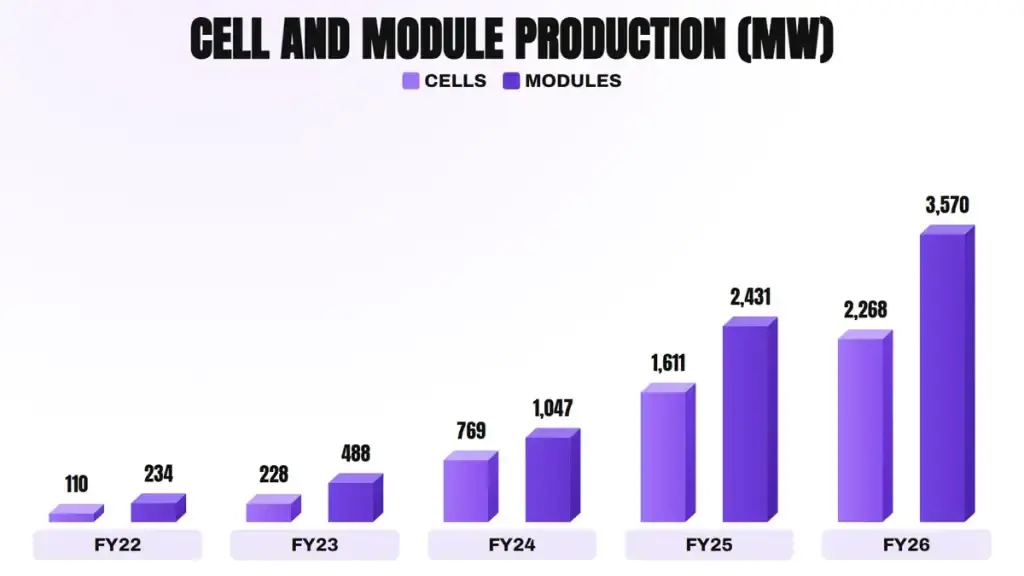
That shift shows clearly in the margins. EBITDA, including other income, was 15.9% of total revenue in FY24, 28.8% in FY25 and 32.1% in FY26. Profit after tax went from ₹231.4 Cr in FY24 to ₹1,509.7 Cr in FY26, about 6.5 times. Total revenue grew about 10.5 times from FY22 to FY26, and cell output grew about 20.6 times.
That jump came from the core business, not from interest on cash. Leaving out other income, operating EBITDA was ₹2,377.2 Cr in FY26, a margin of 30.4%, against 15.2% in FY24. Revenue from operations, which also leaves out other income, grew 20.03% to ₹7,824.4 Cr in FY26.
That record also came with cash. Over FY24 to FY26, cash from operations added up to about ₹2,699.3 Cr, against profit after tax of about ₹2,678.2 Cr. Read this Cash Flow Statement Explained Return on equity was 42.4% in FY26 and return on capital employed was 33.5%. That cash also built equity: shareholders' funds were ₹4,307.7 Cr in March 2026, against ₹2,822.1 Cr a year earlier, even as the company paid for new plants.
"We feel that players which are going to be at scale, who have the financial bandwidth and execution skill to set up ingot-wafer, that is backward integration, will be the ones which will be the difference between men and boys." - Chiranjeev Saluja, Managing Director, November 2026
Cells, Modules and the New Businesses
Now let's split the business into its parts, because each one sells to a different buyer. The company reports solar as a single segment, but it shows the cell and module mix, and from FY27 it reports transformers separately.
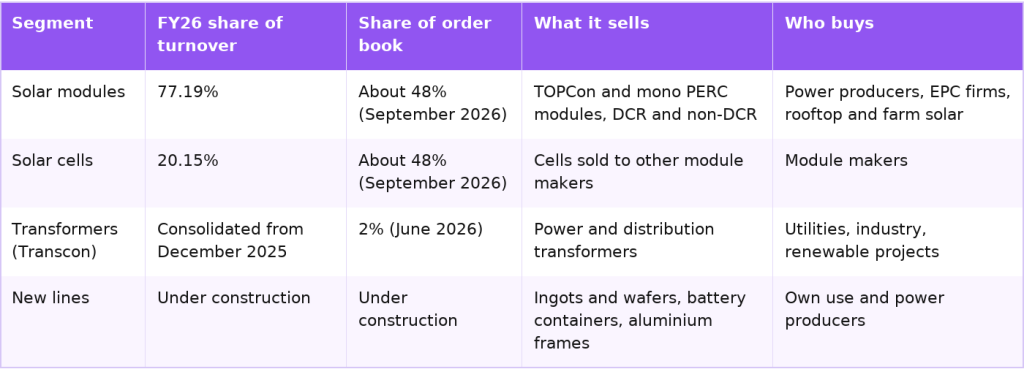
These lines are linked, and as you will see, each one feeds the next. Cells go into Premier's own modules or are sold to other module makers. Transformers and batteries are sold to the same power producers that buy modules.
Solar Modules and the DCR Market
Let's start with modules, the largest line. Premier's module capacity went from 5.1 GW to 11.1 GW after the fully automated Seetharampur plant started, which can make four modules every 16 seconds. Module output was 3,570 MW in FY26.
That module business has two very different price levels. In November 2026 management said DCR modules sell for about ₹23 to ₹24 a watt in the retail market, about ₹21.5 for KUSUM C and C&I projects, and about ₹20 to ₹20.5 for large power producers. That gives an average of about ₹21.5 to ₹22 a watt. Non-DCR modules, which can use imported cells, sell for about ₹12.75 to ₹13 a watt at Premier.
That gap is why the DCR share matters so much. Retail buyers make up about 35% to 40% of the order mix. Management expects new versions of PM Surya Ghar and PM-KUSUM to keep the mix tilted towards DCR modules.
Solar Cells for Itself and Others
Next, let's look at cells, the line that changed the business. Premier made 2,268 MW of cells in FY26, and its Telangana cell plants ran at a record 92% in Q1 FY27. It says it made India's first zero busbar TOPCon cell, a design that uses thinner metal lines on the cell face so more light gets in.
That cell business is now shifting towards its own modules. With 11.1 GW of module lines, management says it would rather use more cells in-house and sell fewer outside. In November 2026 it said mono PERC cells sell for about $0.12 to $0.125 a watt and TOPCon cells for about $0.14 to $0.145.
That shift also shows in the order book. In the April to June quarter of 2026 the company took no new cell orders, only module orders, so the cell part of the book has come down as deliveries went out. Management says no orders were cancelled.
Transformers Through Transcon
Now let's move to transformers, the first business outside solar. In October 2025 Premier agreed to buy 51% of Transcon Ind Limited for up to ₹5,003 Mn, or about ₹500.3 Cr. The deal closed in December 2025. Transcon took over a Hyderabad transformer business that has made transformers since 2003.
That business is small but growing. It has 6.75 GVA of working capacity and is building 10 GVA more for high and extra-high voltage transformers. Management expects its revenue to more than treble over three years, and puts its normal EBITDA margin at about 15%.
That market is also growing. India's demand for power transformers on the generation and transmission side is estimated at 170 GVA in FY26, rising to 280 GVA by FY30, a growth rate of about 13% a year. Transformers go into the same solar parks, battery projects and grid links that buy Premier's modules, so the two businesses can sell to many of the same customers.
Ingots, Wafers, Batteries and Frames
Finally, let's look at the lines still being built. An ingot is a large cylinder of pure silicon, and a wafer is a thin slice cut from it that becomes a cell. Premier is building 10 GW of ingot and wafer capacity at Naidupeta on 169 acres, next to the new cell plant, with Taiwan's SAS as technology partner.
Beyond wafers, the company is building a 12 GWh plant for battery energy storage containers with Germany's RCT. It plans to buy battery cells, pack them, and fit the packs into containers. An 18,000 tonne aluminium frame plant will supply its own module lines. Management expects these allied products to make up about 25% of group revenue over time.
That wafer step matters because of a timing rule. ALMM List III for ingots and wafers is expected to apply from 2028, and the two phases are planned to match it. Premier had earlier signed a deal with a wafer equipment vendor and paid a small deposit, and it is registering those agreements with the Chinese authorities so that they count as existing contracts.
Where Premier Sits in the Renewables Value Chain
Now let's place Premier in the wider renewables chain. A solar plant starts with polysilicon, which is melted into ingots, cut into wafers, turned into cells and assembled into modules. Developers then build the plant and connect it to the grid with transformers, and more and more often add batteries.
That chain is still led by China, which holds about 85% of the world's solar manufacturing capacity and 95% of wafer output. World module capacity is above 1,500 GW a year, against 605 GW of solar installed in 2025.
India's demand, though, is large and growing. India added 44.61 GW of solar in FY26, part of 55.29 GW of non-fossil capacity, nearly double the previous record. Management expects about 50 GW AC of solar to be added this year, and estimates yearly module demand at about 60 GW.
That demand reaches Premier through a few kinds of buyers. Large power producers and EPC firms buy modules for solar parks. Other module makers buy cells. Rooftop installers buy DCR modules for PM Surya Ghar, and farm solar projects buy them for PM-KUSUM. Its customers have included NTPC, IRCON International and Shakti Pumps.
Policy decides much of where this demand goes. From January 2027, C&I projects must use DCR modules, which management expects to add to demand. From 2028, ALMM List III is set to extend the same rule to ingots and wafers, which is why Premier is building that step now.
"Show me the incentive and I will show you the outcome."
— Charlie Munger
India's DCR and ALMM rules reward makers who build cells, and soon wafers, at home. Premier's plants follow those incentives, so any change in the rules would change its outcome too.
That demand also follows a calendar. In August 2026 management said India had added nearly 12 GW of solar in the April to June quarter alone. The government has set March 2027 as the deadline for ongoing PM-KUSUM projects, and management expected 6 to 8 GW AC of KUSUM installations over the following nine months.
Exports are a small part of the business. Sales outside India were ₹63.7 Cr in FY26, against ₹270.5 Cr in FY25, so almost all of the business is now in India. Management says it is close to choosing a site to make cells in the US with a partner, and in September 2026 it set up a subsidiary in Singapore.
Why Premier's Moat Is Hard to Copy
Now that we have seen the parts, let's understand the moat. A module from one Indian maker looks much like a module from another. So the question is why buyers should keep paying Premier more than a new maker with fresh lines. Read this Economic Moat Explained
One part of the moat is scale. With 10.6 GW of cells, Premier can supply large orders without buying cells from others. A maker that only assembles modules has to buy DCR cells at whatever price cell makers ask. Management says a 1 or 2 GW cell maker competing with one five times its size is in a different game.
That scale is visible outside India too. In 2026 Premier was ranked 13th in Terawatt PV's list of the top 100 module makers in the world. Its new module lines also use AI-based checks that spot defects in real time as panels come off the line.
Another layer is cost of building. The full Naidupeta cell plant cost ₹3,293 Cr, or about ₹470 Cr per GW. Expanding it from 4.8 GW to 7 GW added only about ₹502 Cr, because the land and utilities were already in place. Lower capex per GW means lower depreciation per watt sold.
Cell efficiency, the share of sunlight a cell turns into power, is the next test of that cost edge. In January 2026 management aimed to lift efficiency at its existing lines from 25.2% to 25.8% by the end of the year, and the new Naidupeta plant targets about 25.8% too. Its Telangana cell lines ran at 92% of capacity in Q1 FY27, and it is the only Indian solar maker with a LEED Gold-certified plant.
Beyond scale, technology and quality add a third layer. Premier was among the first Indian makers to produce TOPCon cells, and works with RENA Technology of Germany on cell efficiency. Its modules have been rated Top Performer on the Kiwa reliability scorecard for three years in a row, which matters to buyers who expect a module to work for decades.
The last layer is the balance sheet. In August 2026 CRISIL upgraded the company's bank facilities to A+/Positive. Net debt was 0.41 times EBITDA in March 2026. That lets Premier borrow for the next plant at a lower cost than smaller rivals.

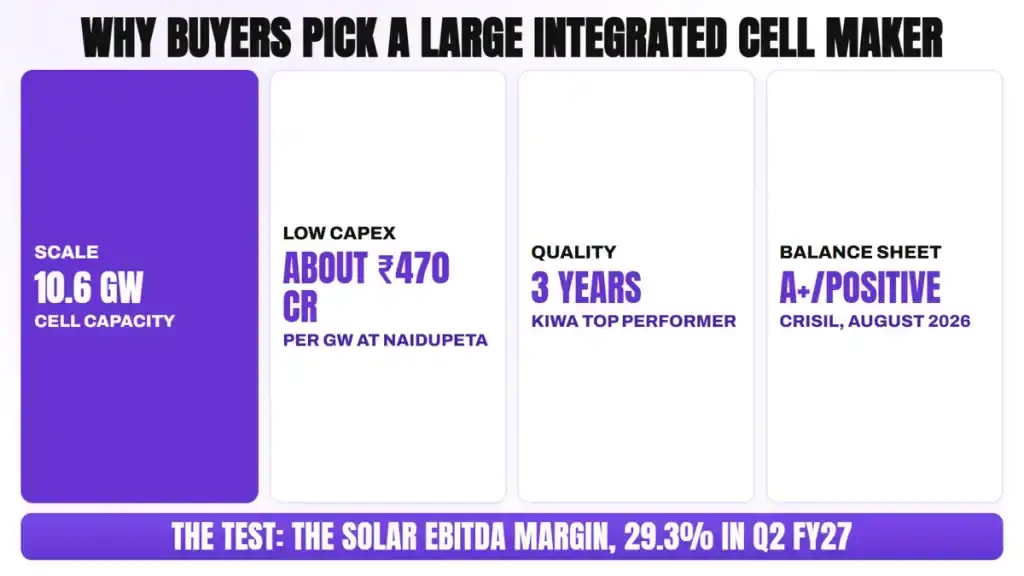
That table shows us why the margin is the real test of the moat. If the advantages hold, Premier should keep a higher margin than pure module assemblers even as cell supply grows. So far the margin has held near 30%, even after the price cuts in non-DCR modules.
"In business, I look for economic castles protected by unbreachable moats."
— Warren Buffett
Premier's castle is its 10.6 GW of cells. The test of the moat is whether that scale keeps its margin above that of the many new cell makers coming up across India.
Financials: Five Years of Revenue, Margins and Cash Flow
A single quarter can hide the shape of a business that has grown this fast, so let's look at the full years together. Total revenue here includes other income, as the company reports it in its five-year summary, and EBITDA includes other income too.

Total revenue grew about 10.5 times in four years, from ₹767.0 Cr in FY22 to ₹8,025.9 Cr in FY26. The EBITDA margin went from 7.0% to 32.1% over the same years, as Indian rules on domestic cells made Premier's cell lines far more valuable, and profit after tax went from a small deficit of ₹14.4 Cr to ₹1,509.7 Cr.
Cash flow has kept pace with profit. From FY24 to FY26, operating cash flow added up to about ₹2,699.3 Cr, against about ₹2,678.2 Cr of profit after tax, so nearly every rupee of profit came in as cash. FY24 was the weak year, with ₹90.2 Cr of operating cash flow against ₹231.4 Cr of profit.
The balance sheet is now carrying a large build-out. Net debt was ₹1,046.4 Cr in March 2026, or 0.41 times EBITDA, and it rose to ₹1,641.7 Cr in June 2026 as the Naidupeta cell plant was completed. How fast that plant ramps up will decide how quickly the debt comes back down.
"An investment in knowledge pays the best interest."
— Benjamin Franklin
Premier's five-year table shows how much of its profit depends on one change in policy. Knowing that history helps an investor judge whether today's margins can last.
What FY27 and FY28 Could Look Like on Management's Numbers
So where does the business go from here? The company does not give revenue or margin guidance. It does give plant dates and capex numbers, and those tell us when new output should arrive.
The biggest step is the Naidupeta cell plant. Management expects the plant to run at about 25% to 30% of capacity in December 2026, once it gets its ALMM listing, and to reach about 70% by the end of March 2027.
That ramp-up comes with a lighter capex bill. Management expects about ₹2,400 Cr of capex in FY27, of which about ₹700 Cr is left for the next two quarters. It says it has enough cash from operations to fund its announced plans, and that no share sale is planned in the near future. Depreciation should be about ₹600 Cr for FY27, up as the new plants start.

After cells, the next steps come in 2027 and 2028. The battery container plant is expected to start in Q2 2027. The first phase of the ingot and wafer plant is planned for December 2027, and the second, which takes it to about 10 GW, for June 2028. The transformer business expects its revenue to more than treble over three years.
The battery plan needs less new money than it sounds. Premier will assemble packs and containers from bought-in battery cells, and management says this meets the government's 40% local content rule without extra capex. It has not yet signed a firm supply deal for those cells, which it plans to buy from large Chinese makers. Beyond India, management is looking at a cell plant in the US with a partner, and expects to settle it within about 12 to 18 months.
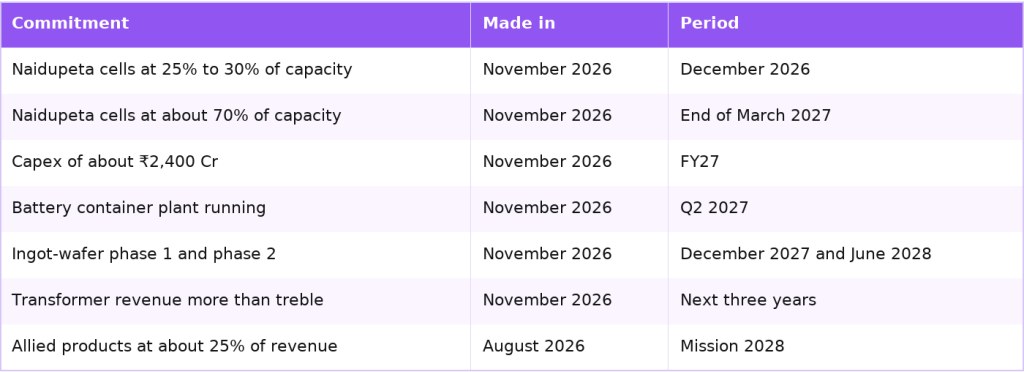

Those commitments are easier to judge against the past. So let's check what management said before against what it delivered.
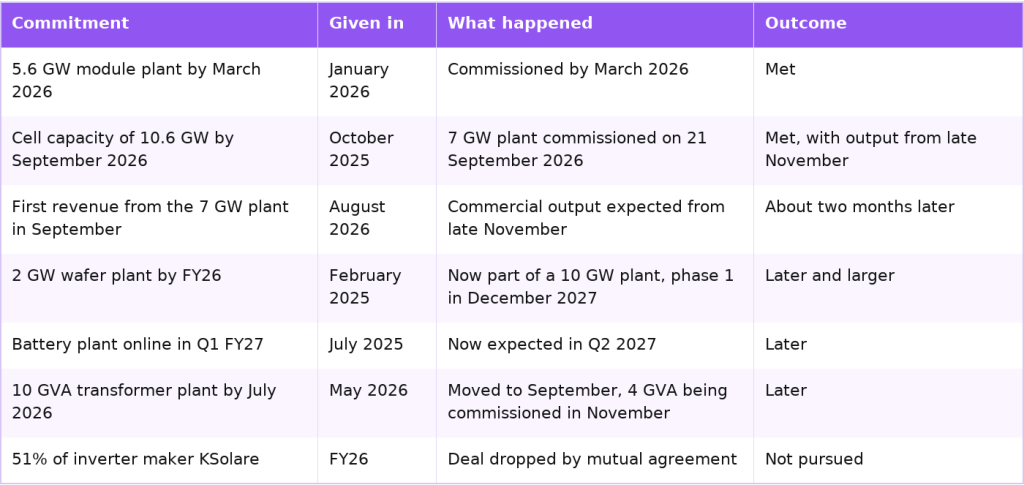
That record shows us a clear pattern. The core solar plants, which make the money today, have come close to their dates. The newer projects, such as wafers, batteries and the large transformer plant, have taken longer than first said. That makes the Naidupeta ramp-up the number to watch first.
Key Risks
Now let's look at what could go wrong for Premier, because some of these risks are already visible in the latest half year.
- Cell oversupply: many Indian companies are adding cell lines, and India's cell capacity could reach about 100 GW by 2027 or 2028. Management puts current demand at about 50 to 60 GW. DCR prices could fall as these lines start.
- Price cuts by new entrants: one new cell maker won a government tender at about ₹17 to ₹18 a watt for DCR modules, against the ₹20 Premier expects for such buyers. Management says that was an introductory price, but more such bids would press margins.
- Lower module margins: non-DCR module prices fell from about ₹14 to ₹15 a watt a year ago to about ₹12.5, and costs of aluminium, copper and films rose. The EBITDA margin fell to 28.6% in Q2 FY27, from 33.6% a year earlier.
- Ramp-up delays: first revenue from the 7 GW plant has already moved from September to late November. The battery, wafer and large transformer plants are also later than first planned.
- Debt and inventory: net debt rose to ₹1,641.7 Cr in June 2026 from net cash a year earlier, and inventory rose in Q2 FY27. If the new plants ramp up slowly, both could stay high for longer.
- Chinese equipment rules: China has proposed export controls on some solar equipment. Premier says its cell machines are already installed, but it has not yet ordered the ingot equipment.
- Policy dependence: much of the margin comes from ALMM and DCR rules. Any delay or relaxation, such as the temporary ALMM List II exemption for some projects until December 2026, changes demand.
- New businesses: transformers, batteries and wafers are new to Premier. Transcon's EBITDA margin moved from 27% in Q1 FY27 to 15% in Q2, and the battery cells still have no firm supplier. Mistakes in these lines would use cash that the core business earns.
- Few exports: sales outside India were only ₹63.7 Cr in FY26, so the business depends almost fully on Indian demand and Indian policy.
- Commodity prices: management says the Middle East war raised prices of key raw materials and delayed deliveries.
- Tax disputes and duty bonds: in March 2026 the group had indirect tax claims of ₹24.3 Cr and direct tax claims of ₹4.6 Cr under dispute, and a contingent customs and GST liability of ₹490.3 Cr on imported plant equipment, which management does not expect to arise.
"I would say this is temporary in nature. As these new plants stabilize, revenue starts coming into the numbers, you will see the numbers fall back to the normal scenario." - Vinay Rustagi, Chief Business Officer, November 2026
"Your margin is my opportunity."
— Jeff Bezos
Premier's 30% margin is exactly what draws the new cell makers now building plants across India. Watching DCR prices and the order book each quarter will show how much of that margin they take.
Explore our Products
Research Framework

Emerging Titans
Combination of quantitative analysis, industry tailwinds, and management assessment - SPRINT investment philosophy

Tiny Titans
Heavy emphasis on scuttlebutt research, plant visits, and early on-ground signals
What to Track Next
If you follow Premier, these are the signals that will show where it goes next.
- ALMM listing of the Naidupeta plant, and its output against the 25% to 30% target for December and about 70% by March 2027
- The order book after ₹16,260 Cr, and the DCR share after about 68% to 70%
- The EBITDA margin after 28.6% in Q2 FY27
- Net debt after ₹1,641.7 Cr and inventory by the March 2027 quarter
- Chinese export rules for ingot and wafer equipment, and the December 2027 date for phase 1
- Transcon's revenue as the new 10 GVA plant starts, and the battery plant in Q2 2027
For the other listed solar and wind companies, from glass and cells to turbines and power producers, see Renewable Energy Stocks in India 2026: Solar and Wind.
Compare: see how it measures up against its peers in Premier Energies vs Waaree Energies: Solar Makers Compared, a side-by-side look at order books, margins and balance sheets.
Conclusion
Let's put it all together. Premier Energies has grown from ₹767.0 Cr of total revenue in FY22 to ₹8,025.9 Cr in FY26, and from a small module assembler to India's largest solar cell maker with 10.6 GW of capacity. Its order book of ₹16,260 Cr covers about two years of FY26 revenue, and its EBITDA margin stayed close to 30% through the expansion. The cautious thread is price: new cell plants across India could push DCR prices down just as Premier's own 7 GW plant ramps up, and net debt has risen to pay for the build-out. The next two quarters, with Naidupeta's first full output, will show which way the margin goes.
That growth has also changed what Premier is. It now uses more of its own cells in its own modules, owns a transformer maker, and is building wafers and battery containers. Each of these steps sells to the same customers and draws on the same balance sheet, so the order book and net debt need to be read together.
Still, the next step is bigger than one strong year. What happens next depends on how fast the Naidupeta plant reaches full output, whether DCR prices hold as new cell plants start across India, and whether the wafer and battery plants arrive on their new dates.
FAQs
What does Premier Energies do?
+Premier Energies makes solar cells and solar modules in Telangana and Andhra Pradesh. Through its 51%-owned subsidiary Transcon it also makes transformers, and it is building ingot and wafer lines and a battery container plant. In FY26, modules brought in 77.19% of turnover and cells 20.15%.
How did Premier Energies do in Q2 FY27?
+Total revenue rose 38.2% to ₹2,656 Cr. EBITDA rose 17.8% to ₹760 Cr, and profit after tax rose 30.8% to ₹462 Cr. The EBITDA margin was 28.6%, against 33.6% a year earlier.
What is Premier Energies' order book?
+The order book was ₹16,260 Cr at the end of September 2026, after new orders of ₹4,001 Cr in the July to September quarter. About 68% to 70% of the book is for DCR products, and management expects it to be delivered over about 12 to 14 months.
How large is Premier Energies' solar cell capacity?
+Cell capacity rose from 3.6 GW to 10.6 GW when the 7 GW Naidupeta plant was commissioned on 21 September 2026. Module capacity is 11.1 GW. Management expects the new plant to run at about 25% to 30% of capacity in December 2026 and about 70% by the end of March 2027.
Where does Premier Energies fit in the solar value chain?
+Premier makes the cells and modules that go into solar plants. It buys wafers today, and it is building 10 GW of ingot and wafer capacity, with phase 1 planned for December 2027 and phase 2 for June 2028. It does not build or own solar parks.
What are the main risks for Premier Energies?
+Many Indian companies are adding cell lines, which could push DCR prices down. Non-DCR module prices have already moved from about ₹14 to ₹15 a watt to about ₹12.5. Net debt rose to ₹1,641.7 Cr in June 2026, and the wafer, battery and large transformer plants are later than first planned.

High growth stock specialist, Value Educator
Shashank Mahajan is an equity research professional with over 12 years of experience in identifying high-potential SME and micro-cap stocks at an early stage. He follows a rigorous scuttlebutt research–driven approach, combining on-ground insights with deep financial analysis. Shashank specializes in uncovering under-researched and under-owned companies with strong management quality and long-term growth potential. Through disciplined research and early identification, he focuses on spotting tomorrow’s market leaders before they enter the mainstream investor radar.
More about Shashank Mahajan →
Azad Engineering vs MTAR vs Unimech: Aerospace Parts

Subros vs Lumax Auto vs Sona BLW: EV Auto Parts Compared
Jyoti CNC vs Macpower CNC: Machine Tool Makers Compared
Data Patterns vs Astra Microwave vs Apollo Micro

Himadri vs PCBL: Carbon Black and Battery Materials

Inox Wind vs Suzlon: Wind Turbine Makers Compared
Explore our Products
Research Framework
Emerging Titans
Combination of quantitative analysis, industry tailwinds, and management assessment - SPRINT investment philosophy
Tiny Titans
Heavy emphasis on scuttlebutt research, plant visits, and early on-ground signals



India's Aerospace Opportunity
Global Demand. Supply Bottlenecks. Opportunities Ahead.
Don't Miss This Exclusive Webinar!
Join Value Educator to decode the key trends shaping India's aerospace sector and learn how to identify tomorrow's potential leaders in the space.
- How the aircraft value chain works, layer by layer
- Indian companies supplying global aircraft makers
- A framework to judge any aerospace company

 Orders
 Subscription
 Share with friends


Required Details
₹23999.00
(12 month subscription)
As per SEBI regulations, all users are mandated to complete the KYC that is validated for 1 year. Post payment, you will be redirected to the KYC screen


No comments yet. Be the first to comment!