Why Companies Spending ₹3.5 Lakh Crore Will Create More Wealth Than Those Saving Cash
The ₹200 Trillion Roadmap Nobody’s Talking About Enough

March 20, 2026. The Ministry of Power dropped a document that should have made every investor in India stop and pay attention. A ₹200 trillion investment roadmap for India’s power sector over the next two decades. Not ₹2 lakh crore. Not ₹20 lakh crore. ₹200 lakh crore — $2.2 trillion. The plan outlined 243 GW of new generation capacity additions, ₹7.9 trillion for transmission expansion, and ₹1.53 trillion for distribution reforms. The scale is staggering. For context, India’s entire GDP in 2026 is roughly ₹350 lakh crore. This single sector is getting investment worth 57% of the current GDP spread over 20 years.
For a complete deep dive into this ₹200 trillion roadmap, read: What is an Economic Moat? Why It's the Key to a Company's Long-Term Success.
The market’s response? Power stocks jumped 2-5% that day. BHEL rallied 5%. Tata Power hit a 52-week high of ₹418. Adani Power, JSW Energy, Torrent Power, and Power Grid all surged. But here’s what most investors missed in the excitement of that one-day pop. The real story isn’t the ₹200 trillion headline number. Rather, the real story is which specific companies have already started deploying massive capital expenditure today, in 2026, to position themselves for this multi-decade expansion. Because in infrastructure and capital-intensive sectors like power, the companies spending aggressively now — building capacity ahead of demand, investing in transmission networks before they’re fully utilized, expanding renewable portfolios before subsidies materialize — are the ones that compound wealth over the next decade. The companies hoarding cash and waiting for “perfect visibility” get left behind as first-movers capture market share, lock in long-term PPAs, and build competitive moats through scale.
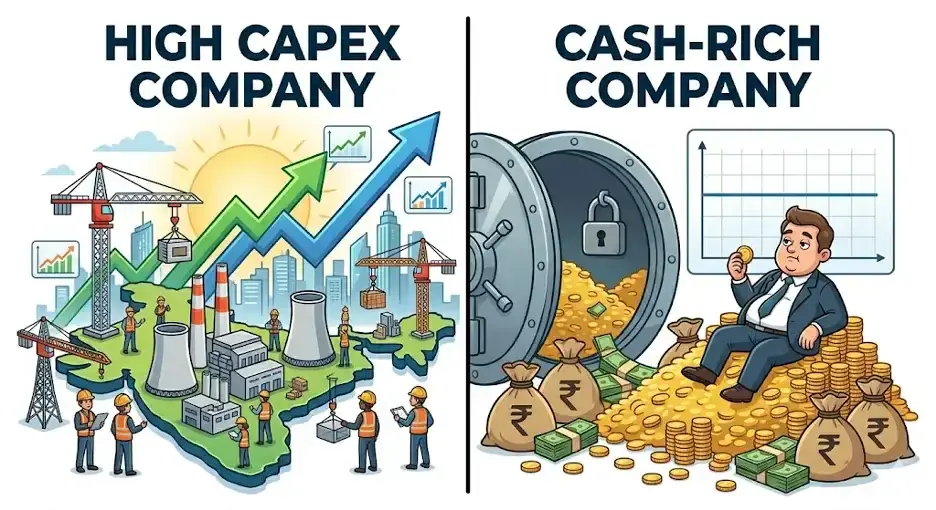
This is where most retail investors get capital allocation completely backwards. They see a company announcing ₹30,000 crore capex and worry about debt increasing and near-term profit dilution. They prefer companies with “strong balance sheets” sitting on ₹10,000 crore cash, earning 7% in FDs. What they miss is that in the power sector today, aggressive capex is a signal of management confidence in long-term demand visibility, regulatory support, and return profiles. Hoarding cash is a signal of either a lack of growth opportunities or a lack of conviction to deploy capital.
If you’ve ever wondered why some power stocks deliver 80% returns over three years while others in the “same sector” deliver 15%, this article will show you exactly why. If you’re trying to figure out which power stock to buy in 2026 and feel confused by conflicting broker reports, understanding capex intensity and capacity expansion plans will give you the clearest signal. And if you thought “debt is bad” and “cash is king” apply universally across all sectors and situations, the data on power stocks with high capex versus those playing it safe will completely change how you evaluate capital allocation. This isn’t about picking stocks based on P/E ratios or dividend yields. It’s about understanding that in capital-intensive sectors during an expansion supercycle, the winners are those who deploy capital aggressively today to capture tomorrow’s cash flows.
Companies deploying ₹3.5 lakh crore in capex over three years aren’t taking reckless risks. They’re positioning for a decade of returns while conservative players watch from the sidelines.
1. NTPC: The ₹3.5 Lakh Crore Expansion Machine
Scale That Dwarfs Private Players
NTPC has raised its capex outlook on FY26-28 by 15 percent to an outrageous ₹3.5 lakh crore. In perspective, that is over the sum of the market capitalization of JSW Energy and Adani Power. This is not maintenance capital expenditure or sustaining capital, but aggressive growth capital to see it increase 11.8 GW in FY26 and 9.9 GW in FY27 alone. NTPC has an existing capacity of 71594 MW. An increase of 21.7 GW in two years can be translated as a 30 percent capacity growth. In the case of a company of the size of NTPC, 15% annual capacity expansion is phenomenal and is an indication of strong belief in the visibility of the demand and the ability to execute projects. The capex will be divided between the addition of thermal capacity to satisfy the baseload demand and renewable capacity to reach the company's target of 60 GW of renewable energy by the year 2032.
What makes NTPC’s capex story compelling for investors isn’t just the size but the return profile. As a regulated entity, NTPC earns a fixed 15.5% return on equity for thermal plants and 14% for hydro. This means every rupee of capex deployed gets a regulated return, eliminating execution risk from the return equation. The only question is whether projects get commissioned on time and whether capacity utilization stays high. NTPC’s track record on both fronts is exceptional — the company has a multi-decade history of on-time project commissioning and currently operates thermal plants at 95% capacity utilization during peak hours. This combination of massive scale capex with regulated returns creates a unique risk-reward profile. You’re not betting on merchant pricing volatility or hoping renewable subsidies come through. You’re betting on NTPC’s ability to deploy ₹1 lakh crore+ annually and start earning regulated returns on that capital within 3-4 years.
The market currently values NTPC at 18x P/E, which looks full versus the Nifty 50 average of 22x. But here’s the framework investors miss — NTPC is deploying capital at 15.5% regulated returns while trading at a 5.5% earnings yield (inverse of 18x P/E). As the ₹3.5 lakh crore capex gets commissioned over FY26-28, the earnings base expands by 30-35%.
Even if the P/E multiple stays flat at 18x, the stock delivers 30-35% total returns over three years purely from earnings growth. If the multiple re-rates to 20-22x as growth becomes visible, you get another 10-20% on top. This is why NTPC is Mirae Asset’s top pick with a ₹430 target price, implying 25% upside from current levels. The capex story is the entire investment thesis — it’s not a risk, it’s the opportunity.
For investors, NTPC represents the safest way to play India’s power expansion supercycle. The regulatory framework caps upside during extraordinary merchant pricing spikes, but it also provides downside protection during demand slowdowns. The capex is being deployed in both thermal (to meet baseload) and renewables (to meet long-term decarbonization goals), creating optionality regardless of which energy source dominates. And the company’s government ownership ensures access to capital at attractive rates and support during any execution challenges.
If you want exposure to ₹200 trillion power sector opportunity without taking merchant pricing risk or renewable subsidy risk, NTPC’s ₹3.5 lakh crore capex story is the core holding.
If you’re comparing different types of power companies in detail,
Private Power Companies vs PSU Power Stocks – 2026 Comparison gives a clearer breakdown.
“The big money is not in the buying or selling, but in the waiting. And in power, it’s in the companies building capacity today for tomorrow’s demand.”— Charlie Munger (adapted)
Like this analysis? Get powerful insights like this every week. No spam.
2. Adani Green & Adani Power: The ₹31,000 Crore Renewable Bet
Private Sector Aggression at Scale
Adani Green Energy has invested in FY 26 alone ₹31,000 crore before the capital expenditure, one of the highest capexs per year in the Indian renewable industry. This is a target of adding 5 GW to the solar and wind capacity of Adani Green to the broader target of 50 GW by the year 2030. This isn’t diversified capex across multiple businesses — it’s laser-focused on utility-scale renewable parks, hybrid projects combining solar and wind, and energy storage integration.
The scale of deployment matters because in renewables, achieving cost leadership requires massive scale to negotiate equipment pricing, optimize logistics, and spread fixed costs. Adani Green, at 14.2 GW operational capacity, has already achieved scale advantages that smaller players can’t replicate. The ₹31,000 crore capex in FY26 further widens this moat.
The thermal arm, Adani Power, is doing things differently yet in an equally aggressive way. As Adani Green is developing renewable capacity, Adani Power is updating its standing thermal fleet to take advantage of merchant pricing spikes. The company has significant uncontracted capacity that benefits directly from evening peak demand surges. In March 2026, when evening peak demand hit 225 GW and merchant prices breached the ₹10/kWh ceiling 13 times, Adani Power’s uncontracted capacity monetized this scarcity at multiples of long-term PPA rates.
Bernstein initiated coverage with an “outperform” rating and ₹177 target price, representing 18% upside, specifically citing Adani Power’s merchant exposure and capacity to add incremental thermal capacity if demand warrants. The dual strategy — Adani Green deploying ₹31,000 crore in renewables while Adani Power optimizes thermal for merchant pricing — positions the Adani Group to benefit regardless of which way energy transition plays out.
The risk with Adani’s aggressive capex is execution and leverage. Adani Green’s debt-to-equity ratio has increased as it funds rapid expansion, and any slowdown in renewable project commissioning or delays in subsidy payments from government offtakers could strain cash flows. But the counterargument is scale and first-mover advantage. Smaller players will have 2-3 GW of renewable portfolio by then, whereas Adani Green will be 25-30 GW of operational capacity with locked-in PPAs and economies of scale that will result in it being the cheapest producer.
Being the largest player in a renewable industry generates pricing power with equipment vendors, You Xian's accessibility to SECI bids and capacity to execute corporate PPAs that small players cannot attain. The ₹31,000 crore capex is the price of maintaining market leadership.
For investors, Adani Green and Adani Power offer a leveraged bet on India’s power expansion with higher risk and higher return potential than NTPC. If you believe renewable energy will dominate long-term and that merchant pricing volatility creates opportunities, Adani’s aggressive capex positions it to capture outsized gains. The stock has already delivered significant returns — Adani Power up 55% in 2024, Adani Green up 40% — but the capex story suggests more room to run.
Bernstein’s outperform rating signals that even after the run-up, the capacity being added supports further upside. Position size based on risk tolerance, but don’t ignore the company deploying ₹31,000 crore in a single year to build renewable capacity at scale.
“Compound interest is the eighth wonder of the world. He who understands it, earns it. In power, compound capacity growth earns it.”
— Albert Einstein (adapted)
Be part of the
Value Educator
community
Get exclusive insights tailored to
sharpen your investment decisions.
3. Power Grid: The ₹82,000 Crore Transmission Backbone
The Enabler Everyone Underestimates
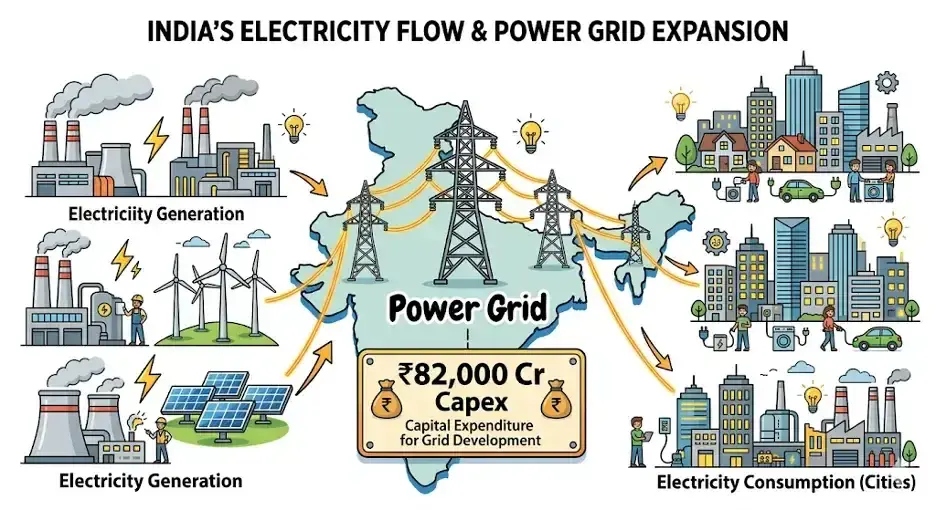
Power Grid Corporation has revised its FY26 capex guidance upward three times — from ₹28,000 crore to ₹32,000 crore to ₹35,000 crore. And it’s not just guidance inflation — as of March 22, 2026, Power Grid has already achieved ₹35,540 crore in capex, representing 102% of the latest guidance with a week left in the fiscal year. For FY27-28, the company has outlined ₹82,000 crore in capex focused on transmission infrastructure, HVDC projects like Khavda-Nagpur and Pang-Leh, and transformer upgrades. This ₹1.08 lakh crore three-year capex plan makes Power Grid one of India’s largest infrastructure capex stories regardless of sector, not just within power.
Why does transmission capex matter for investors when generation (NTPC, Adani, JSW) gets all the attention? Because without transmission capacity expansion, the 243 GW generation capacity additions planned over the next decade can’t be monetized. Renewable energy parks in Gujarat, Rajasthan, and Karnataka generating power need HVDC transmission lines to move that power to consumption centers in Delhi, Mumbai, and Chennai.
The ₹7.9 trillion transmission expansion outlined in the Ministry of Power roadmap isn’t optional — it’s the bottleneck that determines whether generation capacity additions translate to actual power supply. Power Grid is the monopoly player building this national grid backbone. Every megawatt of new generation capacity requires corresponding transmission capacity, and Power Grid captures regulated returns on every rupee deployed in transmission infrastructure.
The investment case for Power Grid is different from that of generation companies. You’re not betting on merchant pricing spikes or capacity utilization rates. You’re betting on infrastructure build-out at regulated returns of 14-15.5% on equity. As long as Power Grid deploys the ₹82,000 crore capex over FY27-28 and commissions those assets, earnings grow mechanically. The company’s current dividend yield of 3.3% adds to total returns.
The stock trades at 14x P/E, a discount to NTPC’s 18x despite having a similarly regulated business model and arguably lower execution risk since transmission projects face fewer environmental clearances than generation projects. If the market re-rates Power Grid to 16-17x as the capex story becomes visible, you get 15-20% multiple expansion on top of 8-10% earnings growth from capex deployment. That’s 25-30% total return potential over 3 years with lower volatility than generation companies.
For conservative investors who want power sector exposure without merchant pricing risk, Power Grid’s transmission capex story is ideal. The regulatory framework provides downside protection. The monopoly position in interstate transmission ensures no competitive risk. And the ₹82,000 crore capex over FY27-28 provides earnings growth visibility. Companies benefiting from Power Grid’s capex include KEC International and L&T, which recently won “major” orders (₹5,000-10,000 crore) for GIS substations and transmission line construction. These picks-and-shovels plays on Power Grid’s expansion offer additional ways to capture the transmission capex theme.
“The best investment you can make is in yourself. The second best is in infrastructure during an expansion cycle.”
— Warren Buffett (adapted)
4. JSW Energy & Tata Power: Hybrid Capex Strategies
Balanced Bets on Thermal + Renewables
JSW Energy has exceeded its capacity by almost fifty percent in the five years since it increased its capacity by over 10,000 MW, against a growing capacity of up to 4,559 MW in FY20, and thus JSW Energy has enhanced its capacity by a hundred and fifty percent in its capacity in five years through massive growth in thermal, hydro, and renewables. The company is currently implementing capex in hybrid projects, which consist of a combination of solar, wind, and pump storage and offer 24/7 renewable energy. This is a hybrid model that meets the greatest obstacle of renewables, which is intermittency. Pure solar provides power between 6 and 8 hours a day.
Pure wind supplies power for 4-6 hours. By storing surplus production and releasing it during times of peak demand, hybrid solar-wind with pump storage can produce 16-18 hours. The strategic emphasis of hybrid projects by JSW Energy places it in a position to enter into premium PPAs with corporate offtakers who would be ready to pay a higher rate in order to be assured of reliable renewable power.
Similar is a balanced strategy of Tata Power with ₹20-22,000 crore capex in FY25, with more than 50% of it devoted to renewables and grid modernization, including pump hydro storage. However, in contrast to pure-play renewable firms, Tata Power is also developing coal-based capacity in Prayagraj with 1,600 MW capacity addition, as it is aware that baseload thermal demand cannot be gone in a day. This dual strategy — renewables for long-term growth and ESG positioning, thermal for near-term cash flow and merchant pricing upside — creates a portfolio approach to energy transition. When renewable subsidies accelerate, Tata’s solar/wind portfolio benefits. When thermal merchant prices spike during summer peaks, Tata’s coal capacity benefits. The company isn’t making a binary bet on one energy source dominating.
Bernstein’s “outperform” rating on both JSW Energy (₹575 target) and Tata Power reflects confidence in this balanced capex strategy. The risk is spreading capital across too many segments without achieving scale in any single area. But the counterargument is optionality — in a sector undergoing technological and regulatory transformation, having exposure to thermal, hydro, solar, wind, and storage provides multiple paths to value creation.
JSW Energy’s capacity growth from 4.5 GW to 10 GW in five years proves the strategy is working. The company delivered 90% stock returns in 2024, significantly outperforming pure thermal players like NTPC and pure renewable players who faced subsidy delays.
For investors, JSW Energy and Tata Power offer middle-ground plays between NTPC’s regulated stability and Adani’s aggressive renewable bet. If you want exposure to capacity expansion without taking extreme views on thermal versus renewable or regulated versus merchant, the hybrid capex strategies of JSW and Tata fit the bill. Both companies trade at 12-15x P/E with 15-20% capacity growth rates, making them more attractive on PEG ratio basis than NTPC despite lower absolute scale. Position sizing should reflect your conviction about energy transition speed — if you believe transition happens fast, tilt toward Adani Green; if you believe it takes 15-20 years, JSW and Tata’s balanced approach captures value either way.
“In investing, what is comfortable is rarely profitable. But diversification across energy sources during transition can be both.”
— Robert Arnott (adapted)
Join 1,45,000+ investors discovering under-researched small caps before they rerate.
5. Why Capex Intensity Matters More Than Current Earnings
The Framework Most Investors Miss
When you screen power stocks by P/E ratio, ROE, or dividend yield, you’re looking backward at what the company earned on past capital. What actually drives stock returns over the next 3-5 years is what the company deploys in new capital and the returns earned on that incremental capex. A company earning 15% ROE on ₹10,000 crore equity but deploying no new capex will compound earnings at 0% as existing plants age and capacity utilization plateaus.
A company earning 12% ROE today but deploying ₹30,000 crore new capex at 15% returns will compound earnings at 20%+ annually as new capacity comes online. The stock market eventually recognizes this difference, which is why companies like JSW Energy with aggressive capex delivered 90% returns while cash-rich players underperformed.
In 2026, the Indian power sector will be at a structural inflexion point with increasing demand facing additions to supply at a faster rate than itself in a decade. The highest ever peak demand recorded was 225 GW in March 2026, and the thermal power plants were operating at 95 percent utilization during the evening hours.
This tightness on supply-demand implies all the megawatts of new capacity produced in the next 3-5 years will be taken up instantly and will be priced at a premium, especially in the peak hours and summer seasons. Companies that invest today are investing in capital that will yield cash flow for 25-30 years in a supply-constrained world. Companies waiting for “perfect clarity” before deploying capital will enter the market late, pay higher equipment costs as demand for turbines and panels spikes, and face more competition for land and environmental clearances.
The risk assessment framework for high-capex power stocks should focus on three variables. First, does the company have access to capital at reasonable costs? NTPC with government backing, Adani with bankers’ confidence in its operational scale, and Power Grid with AAA ratings all pass this test. Second, does management have proven execution capability? NTPC’s multi-decade track record, Power Grid’s 102% capex achievement versus guidance, and Adani Green’s commissioning of 5 GW in recent years all demonstrate execution competency. Third, is demand visibility sufficient to absorb the new capacity? The Ministry of Power’s ₹200 trillion roadmap, India’s electricity demand growing at 6-7% annually, and the structural shift toward electrification of transport and manufacturing all support demand visibility. If all three variables check positive, high capex is a signal of opportunity, not risk.
For investors evaluating power stocks in 2026, shift the framework from “is debt increasing?” to “is incremental capital earning attractive returns?” Debt financing at 8-9% to deploy capacity earning 15%+ returns, creates value. Cash sitting idle, earning 7% FD rates, destroys value through opportunity cost. The power stocks delivering outsized returns over the next 5 years will be those deploying ₹30,000-50,000 crore annually, while others watch. The stocks underperforming will be those with “clean balance sheets” and no growth because they chose safety over opportunity during an expansion supercycle.
“The stock market is a device for transferring money from the patient to the impatient. Wait, that’s backwards.”
— Warren Buffett
Market Cap focus
No. of ideas in a year
Holding period
Pricing

Emerging Titans
Combination of quantitative analysis, industry tailwinds, and management assessment - SPRINT investment philosophy
Multi Cap
20-25
3+ Years
Rs. 23,999/year

Tiny Titans
Heavy emphasis on scuttlebutt research, plant visits, and early on-ground signals
Exclusively for SME's
15-20
3+ years
Rs. 31,999/year
Conclusion
Most investors look at power stocks and see companies with 12–18x P/E ratios, 2–3% dividend yields, and exposure to India’s electricity demand growth. They compare valuations, read analyst reports, and pick stocks based on whoever looks “cheapest” or has the highest yield. What this approach completely misses is that within the power sector, the companies deploying ₹30,000–50,000 crore annually in capacity expansion are playing a completely different game than those sitting on cash. The aggressive capex deployers are positioning to capture a decade of cash flows by building capacity ahead of demand, while conservative players are optimizing for near-term safety and potentially missing the expansion cycle.
Understanding this difference is critical because your returns over the next 5 years will depend far more on which strategy you align with than on which individual stock you pick. NTPC deploying ₹3.5 lakh crore over three years is locking in regulated returns at scale. Adani Green’s ₹31,000 crore renewable push is about building long-term market dominance. Power Grid’s ₹82,000 crore transmission expansion secures its role as the backbone of India’s power infrastructure. Meanwhile, companies like JSW Energy and Tata Power are creating flexibility by balancing thermal and renewable investments.
The power sector in 2026 offers a rare setup where policy support (₹200 trillion roadmap), demand growth (6–7% annually), and supply tightness all align to drive a capex supercycle. The last time this happened between 2008–2012, investors who stayed through the cycle saw 3–5x returns. The companies deploying capital today are positioned for a similar outcome—if execution holds.
The real decision isn’t whether to invest in power stocks. It’s choosing between companies compounding capacity at 15–20% versus those growing at 6–8%. Over a decade, that difference turns ₹10 lakh into ₹55 lakh instead of ₹26 lakh. Same sector, same story—very different outcomes.
If this breakdown helped, follow for more data-backed insights on sectors where capital allocation—not headlines—drives real wealth creation. Also, share this with someone who’s still picking stocks based only on P/E ratios—they’re missing the bigger picture.
FAQs
Should I worry about debt increasing as these companies deploy massive capex?
+
Not if the debt is funding productive assets earning 15%+ returns. NTPC’s regulated return structure means every rupee of capex earns fixed returns, making debt servicing predictable. Adani and JSW have higher leverage but also higher return potential from merchant pricing and renewables. Evaluate the debt-to-equity ratio in the context of return on invested capital, not in isolation. If ROIC is 18% and debt costs 9%, leverage creates value.
Which has better risk-reward — NTPC with regulated returns or Adani with merchant exposure?
+
Depends on your risk appetite and time horizon. NTPC offers 10-12% annual returns with minimal volatility, suitable for conservative portfolios. Adani offers 18-25% potential returns but with 30-40% drawdown risk during corrections. Both are deploying massive capex; the difference is return distribution. Stable investors should own NTPC. Growth-oriented investors can handle Adani’s volatility for higher long-term returns.
How do I evaluate if the capex will actually generate expected returns?
+
Track project commissioning timelines quarterly. Monitor capacity utilization rates post-commissioning. Check if merchant pricing or PPA rates support the return assumptions. For NTPC and Power Grid, regulatory filings disclose returns explicitly. For private players, compare guided capacity additions versus actual commissioning and look for management commentary on project IRRs in investor presentations.
Is Power Grid’s transmission capex less exciting than generation capacity additions?
+
Transmission is less volatile but equally important. Without Power Grid’s ₹82,000 crore transmission expansion, renewable generation from Gujarat can’t reach Delhi. Every megawatt of generation needs corresponding transmission, and Power Grid has regulated returns on that capex. It’s not “exciting,” but it’s essential and profitable. For conservative investors, Power Grid’s 3.3% dividend yield plus capex-driven earnings growth is attractive.
Should I buy power stocks now or wait for a correction?
+
If you believe India’s electricity demand continues growing 6-7% annually and that supply-demand remains tight, the capex being deployed by NTPC, Adani, JSW, Power Grid, and Tata positions them for 5-10 years of growth. Trying to time 10-15% corrections in stocks with 25-30% upside over three years often means missing the entire move. Better approach: buy partial positions now, keep cash for averaging down during corrections.
Can power equipment companies like BHEL benefit from this capex cycle?
+
Yes, but selectively. BHEL supplies turbines and equipment to power companies deploying capex, so its order book should grow. But BHEL faces execution challenges and competition from private players. L&T and KEC International are better-positioned to capture transmission and EPC orders from Power Grid and NTPC. Equipment suppliers offer leveraged plays on the capex cycle, but with higher execution risk than the power companies themselves.
About the author

Shashank Mahajan
High growth stock specialist, Value Educator
Shashank Mahajan is an equity research professional with over 12 years of experience in identifying high-potential SME and micro-cap stocks at an early stage. He follows a rigorous scuttlebutt research–driven approach, combining on-ground insights with deep financial analysis. Shashank specializes in uncovering under-researched and under-owned companies with strong management quality and long-term growth potential. Through disciplined research and early identification, he focuses on spotting tomorrow’s market leaders before they enter the mainstream investor radar.
Join 1,45,000+ investors discovering under-researched small caps before they rerate.











 Orders
 Subscription
 Share with friends
 Logout


No comments yet. Be the first to comment!