
Private vs PSU Power Stocks for 2026

Private Power Companies vs PSU Power Stocks – 2026 Comparison
The Divergence Nobody Saw Coming

February 2026. India’s power stocks were supposed to move together. Rising electricity demand. Record heatwave forecasts. Government push for renewable energy. Every analyst report said the same thing — “buy power sector for summer demand surge.”
To understand the bigger picture behind this surge, you can also read Why Power Sector Stocks are Booming – Data & Trend Analysis.
Both private players like Adani Power and Tata Power, and PSU giants like NTPC and Power Grid, looked positioned to benefit equally. After all, they’re all selling the same product — electricity — into the same grid, to the same customers, under the same regulatory framework.
Then the numbers came in. In the first two months of 2026, while private power companies like Adani Power surged 16%, Torrent Power jumped 14%, and JSW Energy climbed 11%, the PSU stocks told a completely different story. NTPC managed 8%. Power Grid crawled up 6%. The gap wasn’t 1-2%. It was doubling the returns or more. Investors who assumed “power sector” meant one homogeneous opportunity watched in confusion as their NTPC holdings barely moved while friends who owned Adani Power celebrated double-digit gains in weeks.
This is the conversation that reveals everything wrong with how investors think about sectoral investing. Private power companies and PSU power stocks are NOT the same investment. They have different business models, different risk profiles, different growth trajectories, and completely different ways of creating — or destroying — shareholder value. Lumping them together because they both generate electricity is like saying Maruti and Tata Motors are the same because they both make cars. The sector might be electricity, but the investment thesis couldn’t be more different.
What makes this divergence so important in 2026 specifically is the structural shift happening in India’s power sector. The push in the renewable energy by the government, the volatility in the price of merchant power, and the peaks of demand are making winners and losers in the same sector. Agile private companies that are able to shift to merchant sales, renewable projects, and premium pricing are taking undue value.
PSU companies with regulated return structures, government oversight, and a focus on stable bulk power sales are trading stability for explosive growth. Understanding which model fits your portfolio needs, your risk appetite, and your return expectations is the difference between making 15% annually for the next five years versus making 6% and wondering why you even bothered with power stocks.
If you’ve ever owned both types and couldn’t figure out why one outperformed the other despite “same sector” logic, this article will show you exactly why. If you’re trying to decide which power stock to buy in 2026 and feel overwhelmed by conflicting analyst reports, you’re about to get clarity on what actually drives returns in each category. And if you thought government ownership automatically means safety while private means risk, the data from the past 12 months will shatter that assumption completely.
This isn’t about picking stocks. It’s about understanding that within the power sector, you’re actually choosing between two fundamentally different businesses that happen to both generate electricity.
Private power companies bet on growth and volatility. PSU power stocks bet on stability and dividends. Which bet you take depends on who you are as an investor — not which one is “better.”
1. Business Model: How Private and PSU Companies Make Money Differently
The Core Structural Difference Nobody Explains
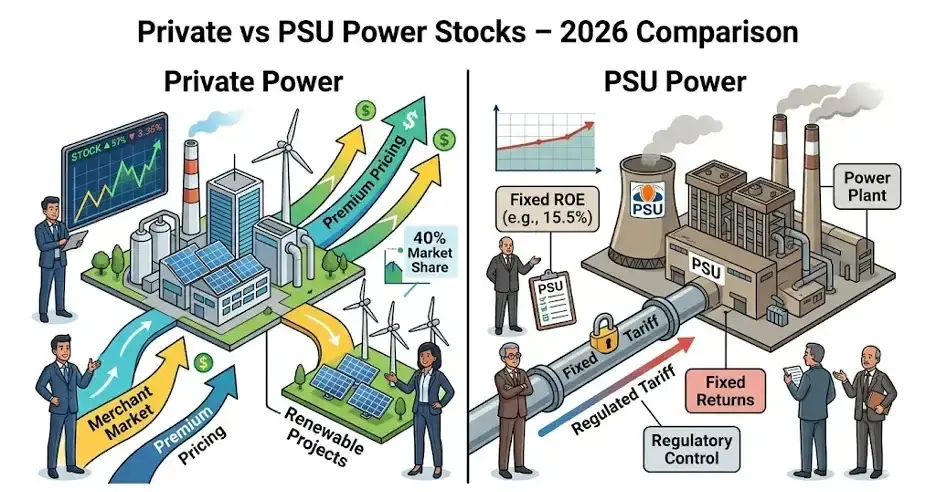
Private power companies like Adani Power, Tata Power, and JSW Energy operate with one primary objective — maximize shareholder returns. They can sign long-term Power Purchase Agreements (PPAs) at negotiated tariffs with state utilities, or sell power in the merchant market at whatever price demand-supply dynamics dictate on that day. When peak demand hits during summer heatwaves and merchant prices spike to ₹12-15 per unit versus ₹4-5 base rate, private companies with uncontracted capacity make windfall profits. They have flexibility to shut down uneconomical plants, sell non-core assets, pivot toward renewables if that’s where returns are higher, or even exit certain geographies if regulations become unfavorable.
Compensation in management of a privately based company is usually pegged on stock performance and profit growth, which provides incentives to shareholders. The entire structure optimizes for profit maximization within regulatory constraints.
PSU power companies like NTPC and Power Grid operate under a completely different framework. The main business of NTPC is not the returns to shareholders but the supply of credible and affordable bulk power to the state electricity boards and secure energy supply to the country. The Central Electricity Regulatory Commission (CERC) regulates tariffs which permits a fixed return on equity of 15.5 percent in thermal plants and 14 percent in hydro plants.
This means regardless of how efficiently NTPC operates or how much merchant prices spike, its profit margin is capped at regulated levels.
Power Grid similarly operates under regulated tariff mechanisms with fixed returns. The upside is that during market downturns or low demand periods, their revenues stay stable because PPAs are locked in and tariffs don’t crash. The downside is that during boom periods like 2026’s summer demand surge, PSUs can’t capitalize on merchant pricing spikes the way private players can.
Management in PSUs faces government oversight, bureaucratic decision-making, and political considerations that private companies don’t. Project approvals take longer. Strategic pivots require inter-ministerial committees. Shareholder value creation is important but secondary to national energy goals.
This fundamental difference in business model explains why in February 2026, when evening peak demand hit record 224.6 GW and merchant power prices spiked, Adani Power stock jumped 16% while NTPC managed only 8%. Adani has significant merchant exposure and uncontracted capacity that benefits directly from price spikes. NTPC’s 95% capacity utilization during peak hours generated maximum output but at regulated tariffs, not market rates.
Both companies operated at full capacity, but one could monetize the scarcity while the other operated under price controls. For investors, this means you need to match the business model to your investment goal. If you want exposure to India’s electricity demand growth with stable, predictable returns and minimal volatility, PSU structure makes sense. If you want to capture upside from merchant pricing volatility, renewable energy transition, and management agility, private companies are the play. Neither is better in absolute terms — they’re designed for different investor needs.
2. Growth Profile: Why Private Companies Grow Faster (And What It Costs)
The Numbers That Tell the Real Story
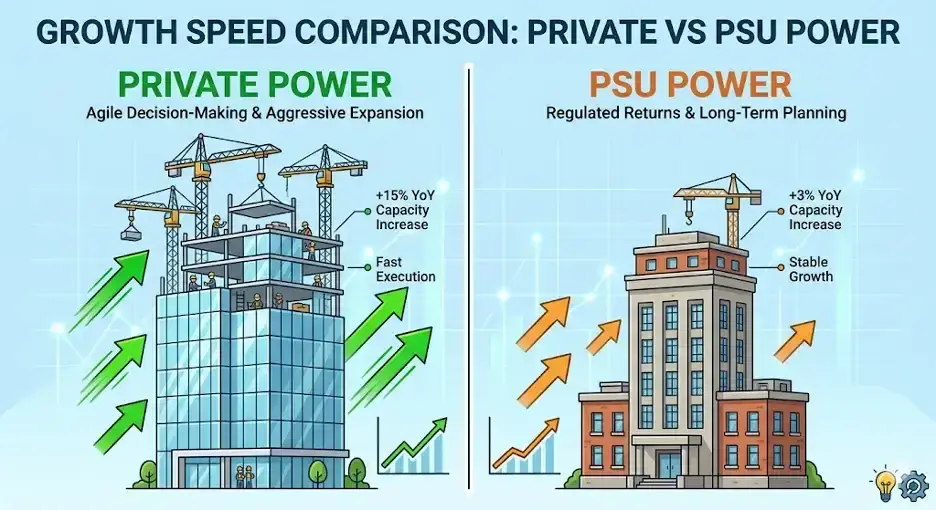
When you compare growth trajectories between private and PSU power companies over the past five years, the divergence is stark. Adani Power’s installed capacity grew from 12,410 MW in FY20 to 15,250 MW in FY25, a 23% increase driven by acquisitions and new plant commissioning. JSW Energy’s capacity jumped from 4,559 MW to over 10,000 MW in the same period, more than doubling through aggressive expansion in both thermal and renewable energy.
Tata Power’s renewable energy portfolio alone grew from 2,900 MW to 4,975 MW, a 71% increase as the company pivoted toward clean energy. These aren’t incremental gains — they’re transformation-level growth achieved by companies willing to take leverage, make bold acquisitions, and pivot business models rapidly based on where returns are highest. The result shows in stock performance — JSW Energy delivered 90% returns in calendar year 2024, Adani Power was up 55%, and Tata Power climbed 40%.
Now compare this to PSU growth. NTPC’s installed capacity grew from 66,000 MW in FY20 to 71,594 MW in FY25, a 8.5% increase over five years. That’s stable, predictable expansion but nowhere close to the doubling or tripling private companies achieved.
Power Grid’s transmission capacity additions followed similar steady-but-slow patterns dictated by government infrastructure plans and regulatory approvals. NTPC’s stock returned 17% in calendar year 2024 and is up about 15% in the past 12 months — decent returns, but half of what private players delivered. The reason isn’t that PSU management is incompetent or lazy. It’s structural.
PSUs require government approvals for major capex, face land acquisition challenges that private companies can sometimes navigate faster through local negotiations, and prioritize different metrics. NTPC’s mandate includes ensuring coal security, supporting domestic equipment manufacturers, and maintaining employment in coal-dependent regions — all of which slow down pure growth optimization.
The growth difference compounds over time. A private company growing capacity at 15-20% annually while improving margins through merchant sales and renewables can deliver 18-22% annual stock returns over a decade. A PSU growing at 6-8% with regulated margins delivers 10-12% returns — still good, but half the wealth creation. For a ₹10 lakh investment, this difference means ₹60 lakh versus ₹30 lakh after 10 years.
The catch — and it’s a big one — is that private companies achieve this growth by taking more debt, more execution risk, and more regulatory risk. Adani Power’s debt-to-equity ratio runs above 2x. JSW Energy took on significant leverage to fund its renewable expansion. If demand disappoints, fuel costs spike unexpectedly, or regulations change adversely, highly levered private companies face severe profit compression. PSUs with lower leverage and government backing weather such storms far better. In 2020 when COVID crashed demand, NTPC’s stock fell 25% but recovered within months. Several private power companies fell 40-50% and took over a year to recover.
The investment decision here isn’t about which grows faster — that’s obviously private companies. It’s about whether you can handle the volatility and risk that comes with that growth.
3. Dividend Yield vs Capital Appreciation: Choosing Your Poison
What You’re Actually Buying
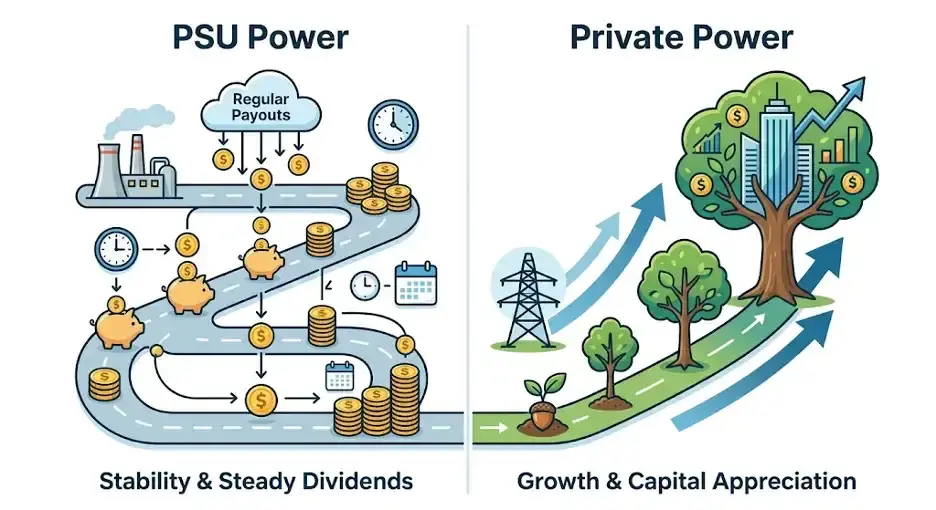
PSU power stocks are dividend machines. NTPC paid ₹8.40 per share in FY25, translating to 2.2% dividend yield at current prices. Power Grid paid ₹9 per share with a 3.3% yield. Coal India, though not pure power, paid ₹15.75 per share for a 3.5% yield. These aren’t one-time payouts — PSUs have consistent dividend track records spanning decades because government policy mandates dividend payouts from profitable PSUs and because these companies generate stable cash flows under regulated structures.
For investors seeking passive income, these yields are attractive, especially when FD rates are 7% and you add the yield to modest 6-8% capital appreciation. But understand what you’re getting — you’re trading explosive growth potential for steady income. NTPC’s stock might deliver 10-12% annualized total returns (dividend + price appreciation) over the next five years, with very low probability of doubling but also very low probability of losing 30%.
Private power companies follow a different playbook. Adani Power’s dividend yield is under 1%. JSW Energy pays token dividends or none in recent years because they’re plowing back every rupee into growth — renewable expansion, capacity additions, debt reduction.
Tata Power yields around 1.2% — better than pure-growth private companies but nowhere close to PSU levels. What private companies offer instead is capital appreciation potential. If JSW Energy’s capacity doubles again over the next five years and renewable contribution reaches 70%, the stock could easily deliver 3x-4x returns. That’s 25-30% annualized compounding. But it’s not guaranteed. If execution stumbles, leverage becomes a problem, or renewable subsidies get cut, the stock could stagnate or fall. Private power investing is a bet on management’s ability to deploy capital at high returns and execute complex projects on time. PSU power investing is a bet on India’s electricity demand growing steadily and regulatory frameworks staying favorable.
For retirees or conservative portfolios, PSU dividend yields make more sense. For wealth accumulation during working years when dividends get reinvested anyway, private power’s growth profile is superior.
The mistake investors make is owning PSU power stocks and expecting 20% annual returns, or owning private power companies and being disappointed when dividends are 0.5%. Match the investment to your life stage and income needs. If you need current income, PSUs are better despite lower total returns. If you’re reinvesting everything for 15 years, private companies’ capital appreciation beats PSU dividends + modest price gains.
4. Valuation and Risk: Why Cheaper Isn’t Always Better
Reading the Numbers Right
As of March 2026, NTPC trades at 18x trailing twelve month earnings. Power Grid is at 14x. These look reasonable compared to Nifty 50’s 22x average. Adani Power trades at 12x, which looks even cheaper. But here’s where investors get trapped by simplistic valuation analysis. NTPC at 18x with regulated 15.5% ROE and 6-8% growth is arguably fully valued or even slightly expensive. You’re paying 18x for a business that will grow earnings at single digits. Adani Power at 12x with ability to grow capacity at 15%+ and benefit from merchant pricing spikes is potentially undervalued despite the “cheaper” multiple. The P/E ratio means nothing without understanding growth and return profiles. A 15x P/E on a 15% grower (PEG ratio of 1x) is far more attractive than 18x on a 7% grower (PEG ratio of 2.5x).
For investors, the framework should be: PSUs for the core stable portion of the portfolio (30-40% of equity allocation), where you want exposure to power sector without wild swings. Private companies for satellite high-growth allocation (10-20% of equity), where you can afford volatility and want to capture upside from merchant pricing and renewable transition.
This approach is part of a broader strategy discussed in Asset Allocation 101: The Key to Reducing Risk and Smoothing Returns.
Trying to make PSU power your growth engine or treating private power as your stability anchor leads to disappointment. The valuations reflect the business models — PSUs trade at premium multiples for stability, private trade at discount multiples because growth comes with execution risk.

5. 2026 Outlook: Which Looks Better Right Now and Why
The Tailwinds and Headwinds
Summer 2026 is proving to be the hottest in recent past. IMD predicts high temperatures above normal to May, and El Nino is likely to be 50-60% probability of H2 2026. The highest peak power demand was already reported at 224.6 GW in early March, and this is the highest recorded during the month of March.
PSU power companies will also benefit but in more muted ways. NTPC will run at maximum capacity, but 95% of its output is sold under long-term PPAs at regulated tariffs. The remaining 5% merchant exposure helps, but it’s not enough to drive major profit beats. Power Grid benefits indirectly from higher transmission volumes but within regulated return frameworks. The upside is capped but so is the downside — if summer disappoints, PSUs won’t crash the way merchant-exposed private companies might.
For investors deciding what to buy in March 2026, the framework is: if you believe the summer demand thesis and want exposure to merchant pricing upside, tilt toward private companies. If you want power sector exposure without timing summer demand perfectly, PSUs offer steady appreciation without gambling on the weather.
Medium-term (12-24 months) the renewable energy transition is biased towards agile companies. The huge array of solar EV chargers installed by Tata Power, the 20,000 MW and above renewable portfolio of Adani Green Energy, and the hybrid efforts of JSW Energy all make them likely to win the government subsidies and corporate PPAs of clean energy.
NTPC is also increasing renewables to 60 GW by 2032, however, the implementation will be slower and returns will be controlled. Investors with the 2-3 year horizon, the 12-15x (with 15-20 growth) private companies will be more attractive compared to the 18x (with 7-8 growth) PSUs.
Explore our Products
Research Framework

Emerging Titans
Combination of quantitative analysis, industry tailwinds, and management assessment - SPRINT investment philosophy

Tiny Titans
Heavy emphasis on scuttlebutt research, plant visits, and early on-ground signals
Conclusion
Young investors with a 10–15-year horizon and the ability to withstand 40% drawdowns should lean toward private power companies. The mix of capacity expansion, merchant pricing upside, renewable shift, and management flexibility creates a strong case for 18–22% long-term compounding. Yes, there will be sharp corrections. Yes, you’ll need patience during tough phases. But if you hold through them, the wealth creation potential from players like JSW Energy, Adani Power, and Tata Power can significantly outperform PSU alternatives.
For conservative investors, retirees, or anyone with near-term goals, PSU power stocks make more sense. Their regulated returns, government backing, consistent dividends, and lower volatility create stability. You may miss out on occasional 20% return years, but you also avoid the kind of drawdowns that force emotional decisions. Over time, consistent 10–12% returns often beat higher returns that investors fail to hold onto.
The biggest mistake is treating the power sector as one single opportunity and choosing stocks purely based on low P/E or high dividends. Understand the business model, align it with your risk appetite and time horizon, build conviction, and stay consistent — even when one category underperforms the other.
Now over to you — which side are you on? Private power for growth or PSU power for stability? Drop your answer in the comments and tell us why.

FAQs
Should I own both private and PSU power stocks or pick one?
+For most investors, owning both makes sense for diversification within power sector exposure. Allocate 60-70% to one category based on your risk appetite (PSU if conservative, private if aggressive) and 30-40% to the other. This captures steady PSU dividends while participating in private sector growth. Avoid 50-50 split unless you truly have no view — bet sizing should reflect conviction.
Which is better for SIP — NTPC or Adani Power?
+For long-term SIPs over 10+ years, private companies like Adani Power or JSW Energy offer higher return potential (15-18% annually) versus NTPC’s 10-12%. But only if you can handle seeing 30-40% drawdowns without stopping the SIP. If market crashes make you anxious and you’ll pause SIPs during corrections, NTPC’s lower volatility is better because you’ll actually stick to the plan. Consistency matters more than picking the highest potential return stock.
Do PSU power stocks benefit from renewable energy growth?
+Yes, but less than private companies. NTPC has aggressive renewable targets but execution is slower and returns are regulated. Private companies can sign merchant PPAs for solar at premium rates, build projects faster, and pivot to wherever returns are highest. For pure renewable play, Adani Green Energy, Tata Power’s renewable division, or JSW Energy are better bets than NTPC.
Why did private power outperform PSU power in 2024-2025?
+Merchant power prices were volatile with several spikes during peak demand periods. Private companies with 20-40% merchant exposure captured these spikes. PSUs with 95%+ long-term PPA exposure missed the upside. Additionally, private companies grew capacity faster and pivoted toward renewables more aggressively. When market rewards growth and merchant pricing, private companies win. When market values stability and dividends, PSUs win.
Should I avoid PSU power since returns are lower?
+No. Lower returns aren’t bad if they match your risk capacity and income needs. 10-12 percent annual returns of 2-3 percent dividend yield and little volatility fits the retiree and the conservative investor and all people who cannot afford 30 percent corrections. You should not pursue 18% returns in the private power business when you will panic-sell when a 40% crash will come.Match risk to your situation, not to maximum theoretical returns.
Which category is safer during recessions or demand slowdowns?
+PSUs hands down. Regulated tariffs and government backing mean revenues and profits stay relatively stable even when demand falls. Private companies with merchant exposure see severe profit compression when prices collapse. In 2020 COVID crash, PSU power stocks fell less and recovered faster than private power companies. Safety comes at the cost of upside, but for risk-averse investors, that’s the right trade-off.

High growth stock specialist, Value Educator
Shashank Mahajan is an equity research professional with over 12 years of experience in identifying high-potential SME and micro-cap stocks at an early stage. He follows a rigorous scuttlebutt research–driven approach, combining on-ground insights with deep financial analysis. Shashank specializes in uncovering under-researched and under-owned companies with strong management quality and long-term growth potential. Through disciplined research and early identification, he focuses on spotting tomorrow’s market leaders before they enter the mainstream investor radar.

Zen Technologies: Revenue Fell After a Big Win




PNG Jewellers: A 194-Year-Old Name Goes National

Explore our Products
Research Framework
Emerging Titans
Combination of quantitative analysis, industry tailwinds, and management assessment - SPRINT investment philosophy
Tiny Titans
Heavy emphasis on scuttlebutt research, plant visits, and early on-ground signals


 Orders
 Subscription
 Share with friends


Required Details
₹23999.00
(12 month subscription)
As per SEBI regulations, all users are mandated to complete the KYC that is validated for 1 year. Post payment, you will be redirected to the KYC screen


No comments yet. Be the first to comment!