
Astra Microwave: The Radar Order That Doubled Its Book
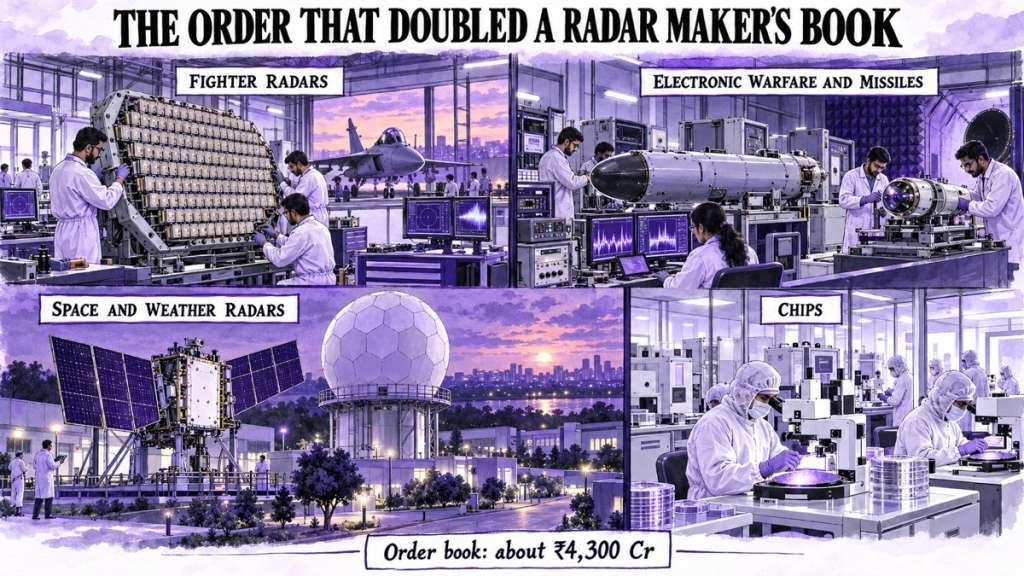
Every modern fighter jet now flies with a new kind of radar. India's own Tejas Mk1A will carry the Uttam radar, and in September 2025 the Ministry of Defence signed a ₹62,370 Cr contract with HAL for 97 more of these jets. Defence production in India reached a record ₹1.78 lakh Cr in FY26, and private companies made 24% of it.
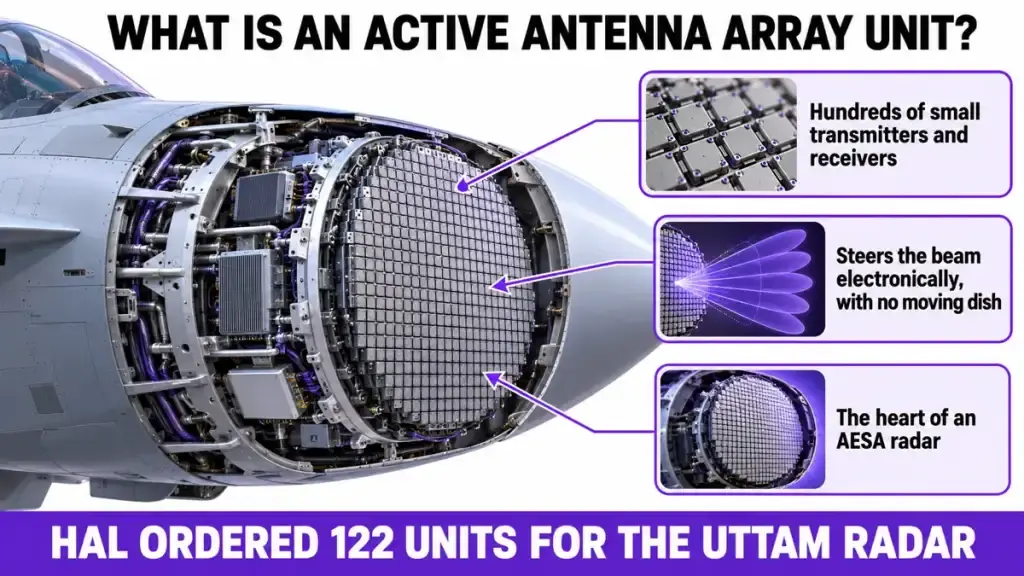
That new radar is an AESA radar, which means a radar that steers its beam electronically through hundreds of small transmitters instead of turning a dish. The heart of it is the active antenna array unit, the flat panel in the nose of the jet that holds those transmitters and receivers. Whoever builds that panel supplies the most valuable part of the radar.
One Hyderabad company was chosen to build it. Astra Microwave Products Ltd (NSE: ASTRAMICRO), founded in 1991 by a team of scientists, designs and makes radio-frequency and microwave electronics for radars, electronic warfare, missiles, satellites and weather radars. It earns in two steps. Labs like DRDO first pay it to develop a part, and when that part qualifies, production orders follow for years, often through HAL or BEL.
In July 2026, that model paid off on a large scale. HAL ordered 122 antenna array units for the Uttam radar, worth ₹2,205.23 Cr with taxes, the largest order in the company's history. It roughly doubled the order book to about ₹4,300 Cr. Astra is also a development-cum-production partner on newer programmes, which means a company that designs a part during development and is first in line to make it in production.
So you are looking at a company that spent three decades building radar parts, and now has orders that stretch over five years. Let's see how it got here and what the next few years could look like.
Astra Microwave in five numbers
- ₹2,205.23 Cr order from HAL for 122 Uttam radar antenna units, the largest in its history
- Order book of about ₹4,300 Cr, against FY26 revenue of ₹1,156 Cr
- EBITDA margin of 28% in FY26, up from 18.5% in FY23
- Operating cash flow of ₹376 Cr in FY26
- FY27 revenue target of ₹1,350 Cr, and about ₹1,600 Cr in FY28
That is a large book for a company of this size. So how fast can it turn those orders into revenue? Let's first understand the company, and then look at the latest quarter and the order that changed the scale.
Astra Microwave Products: Company Overview
Astra Microwave Products was set up in Hyderabad in 1991 by a team of scientists, and it has designed radio-frequency and microwave electronics for India's defence and space programmes ever since. It reports two businesses: defence and aerospace, and space, meteorology and hydrology. It runs four manufacturing units in Hyderabad, R&D centres in Hyderabad and Bengaluru, a 50:50 joint venture with Rafael of Israel for military radios, and a Singapore chip design subsidiary, Aelius Semiconductors. It had a workforce of 1,878 at the end of June 2026, and it earned ₹1,156 Cr of standalone revenue in FY26. Read this Astra Microwave: Defence Electronics Play
"Behind every stock is a company. Find out what it's doing."
— Peter Lynch
With Astra, what the company does is changing in scale. A maker of radar parts for development projects now holds a five-year production order for the most valuable part of a fighter radar, so the numbers need to be read with that shift in mind.
The Quarter the Order Book Doubled
Let's look first at Q1 FY27, the April to June quarter, just before the order book doubled. In that quarter, revenue was ₹176 Cr on a standalone basis, against ₹197 Cr a year ago, as some deliveries waited for customer inspection and final technical clearances. EBITDA was ₹33 Cr, at a margin of 18.8%, and profit after tax was ₹10 Cr.
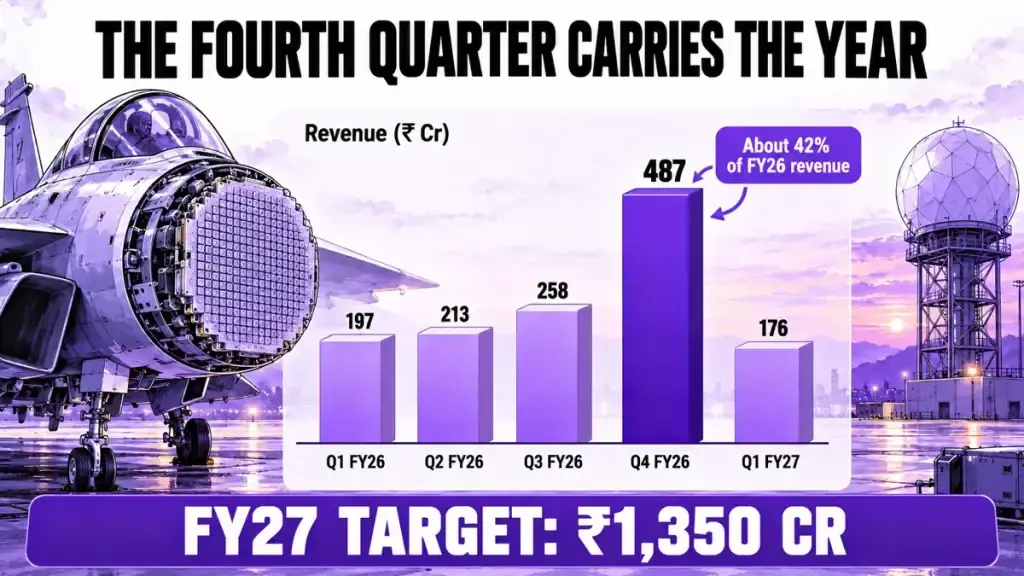
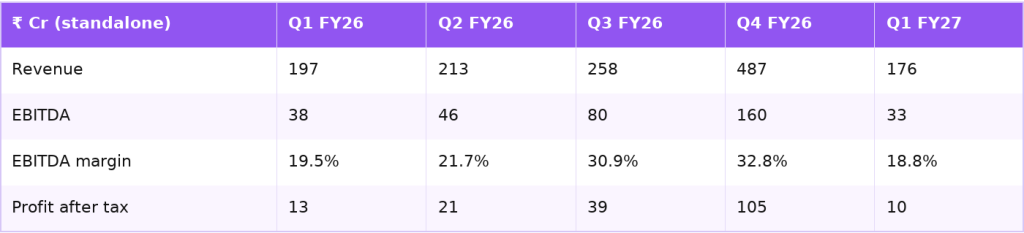
That table shows the rhythm of this business. Astra's customers inspect and accept most deliveries late in the year, so the fourth quarter carries the year. In FY26, Q4 alone brought ₹487 Cr, about 42% of the year's revenue. Its margin was 32.8%, because fixed costs were spread over far more revenue.
That pattern is why management talks only about yearly numbers. It says it has already received the materials for the third and fourth quarters, and that the development projects are in their final stage of clearance. The gross margin in Q1 FY27 was 45.3%, against 44.6% a year earlier, so the mix of work held up even in a small quarter. Interest costs came down to ₹11 Cr from ₹14 Cr, because cash from the year end cut the use of overdrafts.
That cash came from a strong FY26. Standalone revenue grew 10.7% to ₹1,156 Cr, EBITDA rose to ₹324 Cr at a 28% margin, and profit after tax grew 24% to ₹178 Cr. On a consolidated basis, with the joint ventures, profit after tax was ₹193 Cr.
The Order Behind the Order Book
Now let's look at the order itself, because it changes the size of the company. On 30 July 2026, HAL ordered 122 active antenna array units and 121 interface frames for the Uttam radar, for ₹2,205.23 Cr including taxes. Without GST, it is about ₹1,870 Cr. Read this Defence Stocks With Order Books to 2035
That order comes with a clear delivery schedule. The first 12 units are due by September 2027, about 14 months after the order. After that, Astra expects to deliver about 25 units a year on average, and it must complete the order within five years. Management aims to finish it by FY31 as production ramps up.
"As on date, this is the single largest order in the history of Astra, and it is a direct result of a decade of continuous efforts." - Dr. M.V. Reddy, Joint Managing Director, Astra Microwave
Why Uttam matters for Astra: the antenna array unit is the most valuable part of an AESA radar, and Astra designed it during development. So when HAL moved Uttam into production, it ordered the units from the company that already knew the design. The same path now runs for the Su-30 and AMCA radars.
That decade of work began with development. Astra built and delivered antenna units for an airborne AESA radar in 2023, during development. When the radar moved into production, the same supplier was in line for the order. The order also adds weight to HAL as a customer, next to DRDO and BEL.
That order took the standalone book to about ₹4,300 Cr, from ₹2,156 Cr at the end of June. You can compare that with FY26 revenue of ₹1,156 Cr: the book is now close to four years of revenue. Most of the Uttam order will be billed over about five years, so its ₹1,870 Cr before GST works out to about ₹374 Cr a year on average.

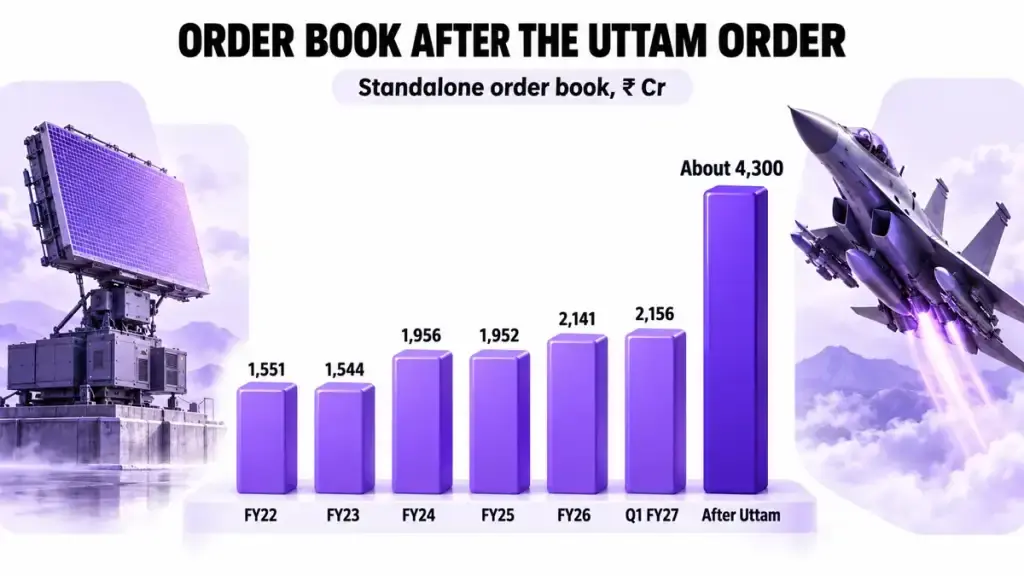
That jump came after years in a narrow range. The book stayed between ₹1,544 Cr and ₹1,551 Cr over FY22-FY23 and near ₹2,000 Cr for three more years, covering about two years of revenue. On a consolidated basis, including the Rafael joint venture, the book was ₹2,849 Cr in June 2026, of which ₹244 Cr were service orders, which management says earn better margins.
How the Margin Rose
So how did the margin climb from 18.5% in FY23 to 28% in FY26? Most of the rise came from a change in what Astra chose to sell.
For years, Astra did offset work for foreign defence companies. These were build-to-print jobs, where Astra made parts to someone else's design and was paid only for the conversion, at single-digit margins. Revenue billed to customers outside India shrank to almost nothing by FY26, as the company stopped taking that work.

That space went to its own designs and to the joint venture with Rafael, where Astra co-develops the radio parts at a gross margin of about 40-45%. Exports, which now mean mostly deemed exports to that joint venture in India, were 11.9% of FY26 revenue. The gross margin rose to 49.1% in FY26.
That shift also shows in the kind of orders Astra wins. Production orders are the ones you want to see, because they repeat a design that is already paid for. In FY26, 51% of revenue came from production orders, 27.6% from development, 9.4% from maintenance and services and 11.9% from exports. By June 2026, production made up 65.7% of the order book, or ₹1,417 Cr, even before the Uttam order. Development orders were ₹308 Cr, maintenance and services ₹173 Cr and exports ₹258 Cr. With Uttam added, production now makes up most of the book, which is the kind of work that should keep margins near FY26 levels.
Where the Cash Came From
Next, let's see whether that margin turned into cash for you as a shareholder, because in this business it often does not. In FY26 it finally did. Operating cash flow was ₹376 Cr in FY26, after three years in which the business used more cash than it made: ₹22 Cr in FY23, ₹187 Cr in FY24 and ₹99 Cr in FY25. Over FY26, receivables came down from ₹783 Cr to ₹687 Cr as customers paid for earlier deliveries.
That cash went into paying down debt. Borrowings came down from ₹418 Cr to ₹287 Cr over FY26, and cash and bank balances rose to ₹243 Cr, so net debt went from ₹325 Cr to ₹44 Cr. Customers had also paid ₹168 Cr in advance of delivery by March 2026, against ₹155 Cr a year earlier.
That improvement also shows in how long money stays tied up. By the company's own measure, receivable days came down to 216 in FY26 from 273 in FY25, and inventory days to 193 from 213. The cash conversion cycle, the days between paying for materials and collecting from customers, came to 374 days, against 459 a year earlier. Read this Cash Flow Statement Explained
That stronger balance sheet now lets Astra take on the Uttam work without new equity. The board has also proposed a dividend of ₹2.40 a share for FY26, against ₹2.20 for FY25.
Why the cash matters here: a five-year order needs materials bought years ahead of payment. Astra entered the Uttam order with net debt of only ₹44 Cr and an A+ rating, so it can fund that build-up from its own cash and bank lines.
Two Businesses, One Being Spun Off
Now let's look at what Astra sells. It reports two businesses, and the board has decided to move the smaller one into a separate listed company.
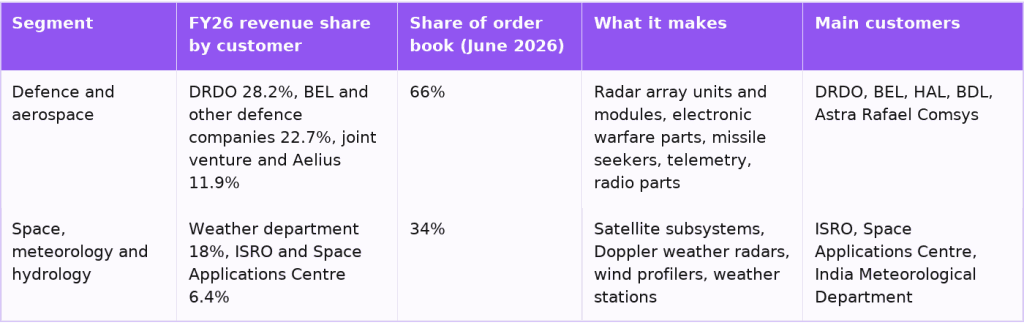
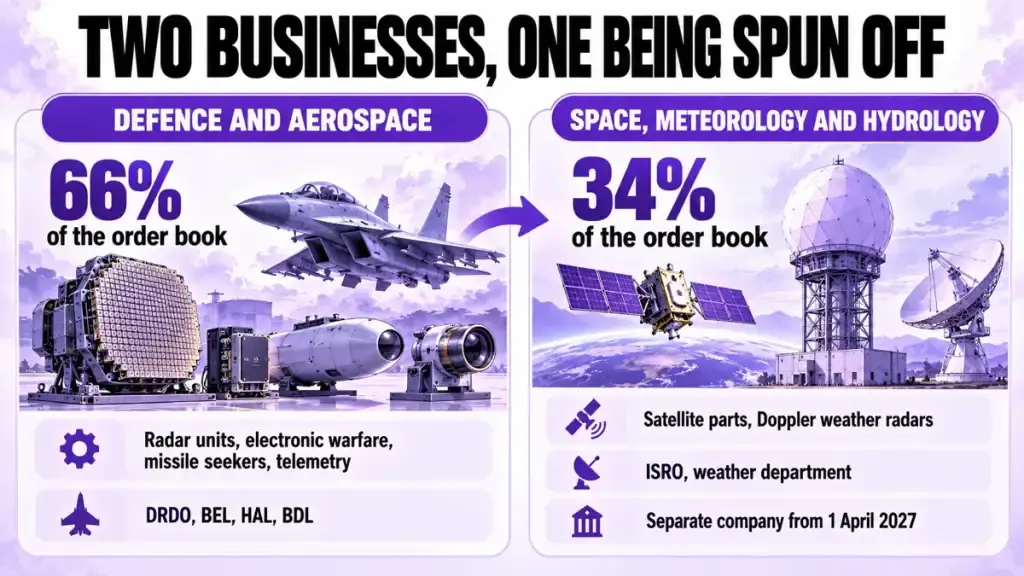
These two can sound alike, since both build radars and RF electronics. The difference is the customer and the end use. Defence sells parts and systems that go into fighters, missiles and air defence through DRDO, BEL and HAL. Space and weather sells to ISRO and the weather department, for satellites and for forecasting storms and rain.
Those customers are concentrated. The four largest groups, DRDO, BEL with other defence companies, the weather department and ISRO, gave about three-quarters of FY26 revenue between them, so a few buyers account for most of the year's revenue. Space electronics alone brought ₹110.6 Cr of revenue in FY26.
Defence Radars, From Fighters to Air Defence
Let's begin with defence, the larger business. India's defence electronics market, which includes telemetry, is expected to reach ₹65,000-70,000 Cr by FY27, growing about 14% a year. The Indian radar market is projected at about ₹12,200 Cr by 2033, growing about 20.6% a year.
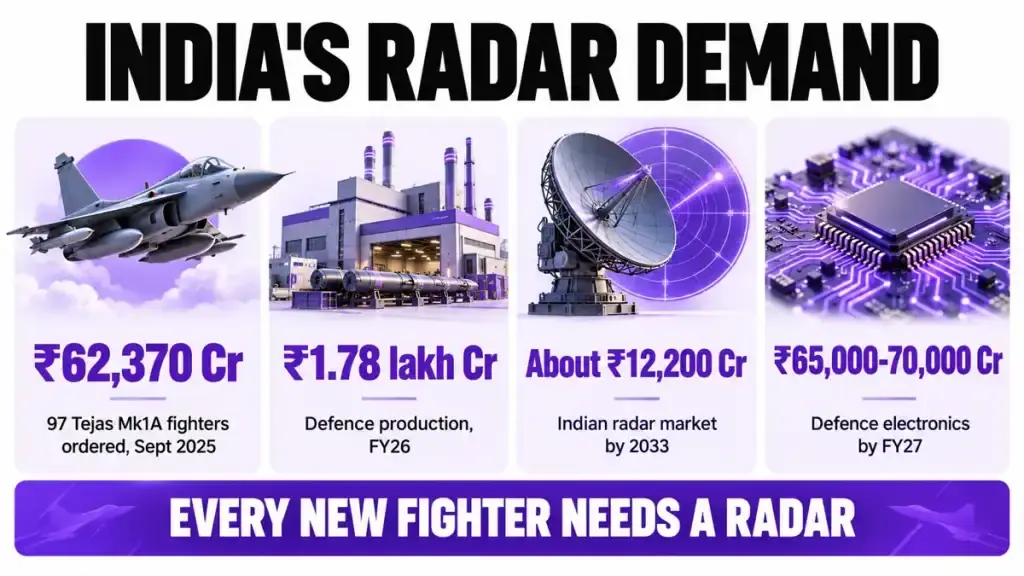
That radar demand reaches Astra through programmes, and fighters come first. Beyond Uttam, it is developing the antenna unit for the Virupaksha radar of the upgraded Su-30MKI. In August 2026, it emerged as the lowest bidder, with BEL second, for the antenna array unit of the AMCA, India's planned fifth-generation fighter. Management expects that development contract soon, with four units to be built as prototypes.
Those fighters also need electronic warfare, which means jamming and fooling an enemy's radar. Astra makes a receiver-transmitter unit for the Tejas Mk1A self-protection jammer pod, and that unit is already qualified. Once the full jammer suite clears its final tests, production orders could add about ₹500-600 Cr. For the Su-30, Astra is one of two development-cum-production partners in the Angad electronic warfare pod.
That jamming work has its own market. The Indian electronic warfare market is projected at about ₹9,500 Cr by 2033, growing about 4.5% a year, slower than radars but steady, because every new fighter, ship and ground system needs protection from enemy radars. For Astra, the larger prize is the Su-30 programme as a whole. Management expects at least ₹3,000 Cr of business from the Su-30 radar and the Angad pod together, once both qualify and move into production.
That fighter work also has a long tail. A fighter flies for decades, and its radar and jammer get upgrades and repairs along the way. Astra's service orders, ₹244 Cr in the consolidated book, cover this kind of maintenance work, and you can expect that share to grow as more of its designs enter service.
That work on fighters sits next to air defence. QRSAM is a quick reaction surface-to-air missile system that BEL will produce for the Army. Astra makes radar and missile subsystems for it, and it expects ₹700-800 Cr of orders for the first three regiments, part of it before March 2027. For two BEL naval electronic warfare programmes, Shatrughat and Samaghat, it expects about ₹100-120 Cr.
That position took three decades to build. Astra started with telecom parts in 1991, moved into radar subsystems in 1993, added electronic warfare parts in 2000, space electronics in 2003 and its own chips in 2005. It entered complete radar systems in 2015, and delivered its first full system to the forces in 2018.
That move from parts to systems also changed its orders. In Q1 FY27, the largest new orders were ₹93.6 Cr of radar production work from BEL in Bengaluru, ₹49.3 Cr of space work from the Space Applications Centre, ₹14.1 Cr of missile work from BDL and ₹12.7 Cr of radar work from BEL in Ghaziabad. In FY26, its ten largest orders added up to ₹657 Cr, led by ₹145.2 Cr from the weather department and ₹112.1 Cr of radar production for DRDO.
Those orders also reach beyond fighters. In August 2025, DRDO ordered a ₹135 Cr upgrade of a ground-based radar system from Astra, to be done over 18 months. Astra also supplies telemetry subsystems for the Tejas and the Intermediate Jet Trainer, and it signed a memorandum of understanding with BEL to develop critical technologies together. You can think of BEL as Astra's largest door into the forces: it wins the big system contracts and buys subsystems from suppliers like Astra.
That depth comes from design. Astra has developed 35 radars and worked on 25 satellites and 15 large defence programmes. It also designs its own chips, called MMICs, which are tiny circuits made of gallium nitride or gallium arsenide that amplify radio signals. Few private companies in India design such chips up to 40 GHz. Owning the chip means Astra can tune the whole module, from the chip to the antenna, for each radar it builds. In Q1 FY27, BEL ordered about ₹45 Cr of these chipsets from Astra.
That design base also feeds missiles. Astra supplies a critical RF part of the seeker in today's BrahMos missiles, the part that helps the missile find its target, and telemetry products that send data back during tests. It is developing a seeker for the next-generation BrahMos on its own initiative, and that work will go for testing after a few more months.
The Rafael Joint Venture
Next, let's look at the joint venture, which links Astra to one of the world's best-known missile and radio makers. Astra Rafael Comsys, owned 50:50 with Rafael Advanced Defense Systems of Israel, makes software-defined radios for the Indian Air Force, Army and Navy. A software-defined radio changes its frequencies and codes through software, so units can talk securely in one network.
That joint venture runs a 48,000 sq ft plant in Hyderabad, which the company calls India's first private military-grade radio facility. Its order book was ₹836 Cr in mid-2026, and it plans about ₹360 Cr of sales in FY27. Astra supplies modules, cables and antennas to it, and it expects ₹500-750 Cr of new orders for itself from the joint venture over the next few years.
Space and Weather, the Business Being Spun Off
Now let's turn to space and weather, the business that will become a separate company. India's space economy is about ₹70,000 Cr today, and the country aims to take 8% of the global space market by 2033. The Department of Space had a budget of ₹13,416 Cr for 2025-26. On the weather side, Mission Mausam is the government's plan to improve forecasts with more radars and sensors.
That weather plan already uses Astra's radars. A Doppler weather radar measures how rain and wind move inside a storm, which helps forecast floods and cyclones. Astra was the first Indian company to develop one for the weather department, and it has supplied more than 45 of them. In December 2025, it won an order of about ₹171 Cr for six S-band Doppler weather radars with seven years of maintenance.
That business also has its own numbers inside Astra. Space electronics had an order book of about ₹187 Cr in March 2026. Space revenue came mostly in Q4 FY26, when Astra delivered subsystems for a defence satellite programme, and it made up 19.5% of that quarter's revenue.
That business will soon stand on its own. In June 2026, the board approved moving space, meteorology and hydrology into Astra Space Technologies, which will be listed with one new share for each Astra share held. Management expects it to run as an independent company from 1 April 2027, with first-year revenue of ₹300 Cr or more at a profit-before-tax margin of 18-20%. It plans to launch its own satellite, part of a constellation, within six months of listing.
The Parts That Take a Decade to Qualify
Now that we have seen both businesses, let's understand why Astra's position is hard to copy. It starts with how India buys radar parts. A lab gives a development order, the supplier builds and tests prototypes, and only after the full radar qualifies does a production order follow, often years later.

That process took about a decade for Uttam, by management's own account. The same path is now running for the Su-30 radar, which management expects to qualify in FY28, with production orders two to three years after that. A rival would have to start that cycle from the beginning, while the qualified supplier is already building. Read this Economic Moat Explained
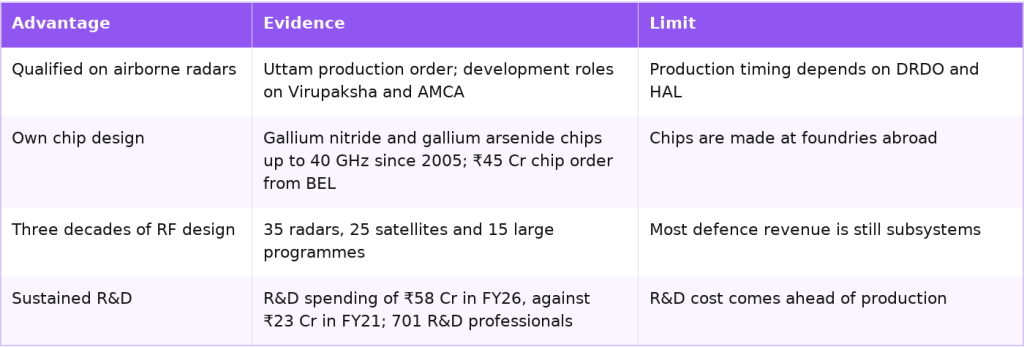
That cycle also builds switching costs over time. A radar designed around Astra's antenna units, receivers and chips has to be re-qualified if the customer changes any of them. So each programme Astra enters during development tends to stay with it through production, upgrades and maintenance, which management says can run for years after the first order.
"In business, I look for economic castles protected by unbreachable moats."
— Warren Buffett
Astra's moat is not a brand. It is the decade of qualification on each radar, which a rival would have to repeat before it could win the production order.
That chip design is a quieter part of the advantage. Most of the active devices in Astra's subsystems come from its own chip division, so it controls a part that many rivals must import. Its Singapore subsidiary, Aelius Semiconductors, designs chips that are made at foundries abroad, and Astra now sells them to other companies too.
That same R&D also produces new products outside the order book. In July 2026, Astra showed a vehicle-mounted anti-drone system and an electromagnetic wall at Jalandhar. It plans two radars of its own design and a drone-mounted electronic intelligence product around Diwali 2026. Management has not included any of these in its guidance.
That R&D runs on people more than plants. Astra had a workforce of 1,878 at the end of June 2026, and 701 of them work in R&D, including 96 with master's degrees and 9 with doctorates. In FY26, R&D spending was about 5% of revenue. Management says it has also added a new chief technology officer, a new quality head and new heads for purchasing, sales and HR over the last 18 months.
Its plants are ready for the volume. Astra runs four manufacturing units in Hyderabad and R&D centres in Hyderabad and Bengaluru, with clean rooms and RF test equipment up to 40 GHz. Management says its lines are ready for large-scale execution, and it plans capital spending of only ₹40-50 Cr a year.
Financials: Five Years of Growth, Margins and Cash
One large order can flatter any company, so let's look at five full years together. These are standalone figures as restated in the company's latest annual results presentation.

Revenue grew about 1.6 times in four years, from ₹735 Cr in FY22 to ₹1,156 Cr in FY26, a growth rate of about 12% a year. Profit grew much faster. EBITDA rose about 3.7 times, from ₹87 Cr to ₹324 Cr, and profit after tax rose from ₹40 Cr to ₹178 Cr, because the gross margin climbed every single year, from 28.7% to 49.1%, as low-margin build-to-print work was replaced by Astra's own designs.
ROE rose from 7.0% in FY22 to 15.0% in FY26, calculated on average equity. It rose more slowly than profit because equity also grew, from ₹590 Cr in March 2022 to ₹1,291 Cr in March 2026, as profits were retained and new shares were issued in FY24.
Cash flow is the weak spot. Over the five years, operating cash flow added up to about ₹169 Cr, against ₹551 Cr of profit after tax, or about 31%. Three of the five years used cash, as receivables rose from ₹202 Cr in March 2022 to ₹783 Cr in March 2025. FY26 was the first strong year, with ₹376 Cr of operating cash flow, and the Uttam order will test whether that can last as Astra buys materials years ahead of payment.
"The big money is not in the buying and the selling, but in the waiting."
— Charlie Munger
For Astra, the waiting is built into the business: development orders take years to turn into production, and production orders take years to turn into cash.
What the Next Five Years Could Look Like on Management's Numbers
So what could all of this add up to? Management has given yearly revenue targets, an order intake range and the programmes behind it, so we can put them side by side.
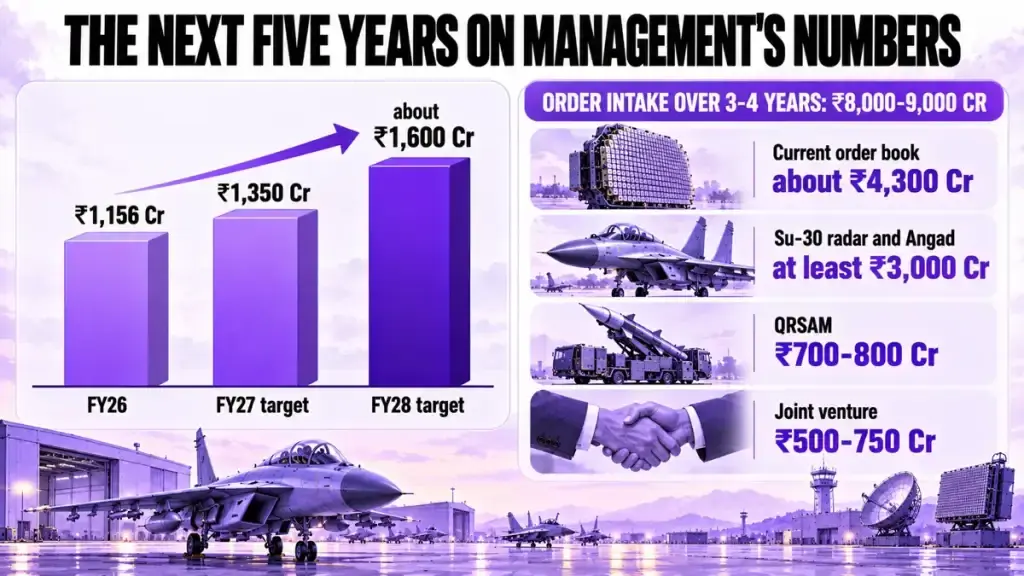
That plan starts with FY27. Management targets revenue of ₹1,350 Cr, plus or minus ₹25 Cr, which is growth of more than 15%, and about ₹1,600 Cr, plus or minus ₹50 Cr, in FY28. It expects margins similar to FY26 or slightly higher. Out of the FY27 revenue, about ₹120-150 Cr should come from space.
Beyond FY28, the plan leans on order intake. Management expects ₹8,000-9,000 Cr of orders over the next three to four years, to be executed over five to six years. That includes the current book of about ₹4,300 Cr, ₹700-800 Cr from QRSAM, ₹500-750 Cr from the joint venture and at least ₹3,000 Cr from the Su-30 radar and Angad programmes. It excludes chips, anti-drone systems and exports.
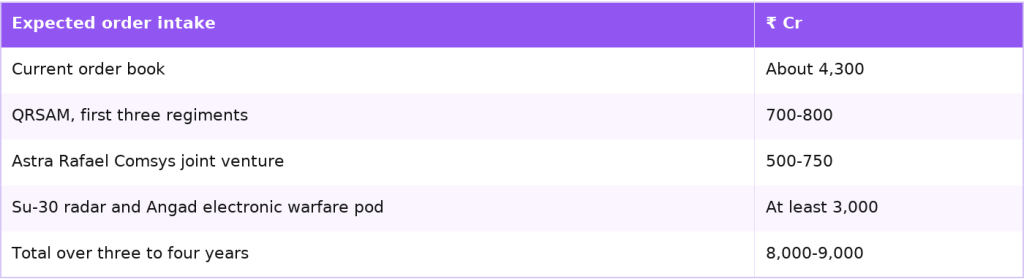
That intake would be several times the company's past scale. Management has said it expects to execute at least six to seven times its FY26 turnover over the next five years or so. You can see the scale with simple numbers: FY26 revenue of ₹1,156 Cr, repeated five times, is about ₹5,780 Cr, so six to seven times FY26 means about ₹6,936-8,092 Cr in five years.
"Every single year, we will do more than what Astra achieved in the last 33-odd years, and that's no mean order by any means." - Atim Kabra, Director, Strategy and Business Development, Astra Microwave
That growth is to be funded without new shares for working capital. Management said the company will not issue shares to fund working capital, and CRISIL upgraded its bank rating to A+ with a stable outlook in August 2026. In June 2025, Astra allotted convertible warrants worth about ₹174 Cr, and ₹130.5 Cr is due when they are converted.
"Till we have accretive nonorganic opportunities, we will not dilute for working capital." - Atim Kabra, Director, Strategy and Business Development, Astra Microwave
The Plan for FY27 and FY28
Those targets come with dates, so let's list the plan for FY27 and FY28 that management has committed to.
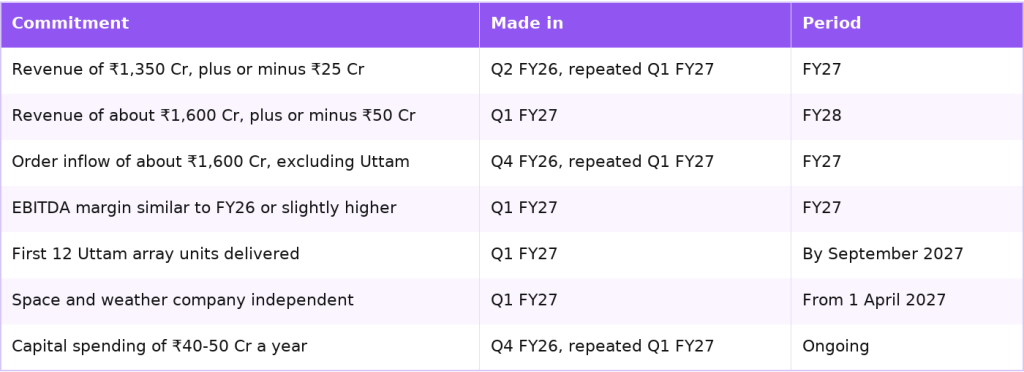
That plan comes with a record we can check. For FY24, management guided revenue of ₹900-950 Cr, and Astra delivered ₹904 Cr. For FY25, it guided ₹1,000-1,100 Cr and delivered ₹1,044 Cr. For FY26, it first guided about 20% growth, later lowered the target to about ₹1,150 Cr, and delivered ₹1,156 Cr.

We can also check the plan against the shape of a normal year. In FY26, the first quarter brought about 17% of the year's revenue and the last quarter about 42%. If FY27 follows the same pattern, a ₹176 Cr first quarter points to about ₹1,035 Cr for the year, so Astra needs a stronger second half than last year to reach its target.
That record matters for the FY27 target. After a ₹176 Cr first quarter, Astra needs about ₹1,174 Cr in the next three quarters to reach ₹1,350 Cr, against ₹958 Cr in the same three quarters of FY26.
"Know what you own, and know why you own it."
— Peter Lynch
For Astra, knowing why means tracking quarterly revenue against the yearly target, the receivable days and the dated commitments in the table above.
Key Risks
No plan of this size is free of hurdles, so let's look at what could go wrong for Astra.
- Execution: revenue has to grow sharply to deliver the order book. Missed inspections or technical clearances push revenue into later quarters, as Q1 FY27 showed.
- Slow payments: government customers pay slowly. Receivables were 216 days of revenue in FY26, and money was tied up for 374 days in all, by the company's own measure. The auditor named the credit-loss provision on receivables a key audit matter.
- The joint venture: sales to Astra Rafael Comsys more than doubled to about ₹160 Cr in FY26, and it owed Astra about ₹196 Cr at the year end. Astra also guarantees ₹80 Cr of its borrowings.
- Supply chain: many specialised parts are imported, and management named stretched global supply chains as its main execution risk.
- Few programmes: three customers gave over half of revenue, and the Uttam order is over half of the order book.
- Development delays: the Su-30 radar is expected to qualify only in FY28, and production follows two to three years later.
- The demerger: it needs approvals from the tribunal, SEBI and the exchanges, and a third of the order book will leave the company.
- Leadership change: S.G. Reddy stepped down as managing director on 30 September 2026, and Dr. M.V. Reddy took over from 1 October.
"You can't predict. You can prepare."
— Howard Marks
None of these risks can be timed in advance. What an investor can do is watch the few numbers below that will show early whether the plan is slipping.
Explore our Products
Research Framework

Emerging Titans
Combination of quantitative analysis, industry tailwinds, and management assessment - SPRINT investment philosophy

Tiny Titans
Heavy emphasis on scuttlebutt research, plant visits, and early on-ground signals
What to Track Next
If you follow Astra, these are the signals that will show whether the plan is on track. Read this Research a Stock in 1 Hour: A Checklist
- Q2 FY27 results, due by mid-November 2026, and revenue against the ₹1,350 Cr target
- The AMCA antenna array development contract, where Astra is the lowest bidder
- QRSAM production orders through BEL, part of them expected before March 2027
- Progress on the first 12 Uttam antenna units, due by September 2027
- Receivable days and operating cash flow, after ₹376 Cr in FY26
- Approvals for the space and weather demerger, and the first numbers of Astra Space Technologies
Conclusion
Let's step back and put it all together. Astra spent three decades building radar and microwave parts for India's labs, and that work has now turned into the largest order in its history. The Uttam order doubled its book to about ₹4,300 Cr, and new roles on the Su-30, AMCA and QRSAM could add several thousand crore more.
So the next five years are about execution, not orders. Astra has to deliver far more each year than it has ever done, while collecting its money from slow-paying government customers. If it does, it becomes a much larger radar maker with a separate space company alongside. If deliveries lag, the large book will simply take longer to turn into revenue. The cautious thread is cash: receivables were still 216 days of revenue in FY26, and the Uttam order alone is over half of the book. The next few quarters, starting with the Q2 FY27 results and the first 12 Uttam units due by September 2027, will show which thread wins.
FAQs
What does Astra Microwave Products do?
+Astra Microwave is a Hyderabad company founded in 1991 that designs and makes radio-frequency and microwave electronics for radars, electronic warfare, missiles, satellites and weather radars. It sells mainly to DRDO, BEL, HAL, ISRO and the India Meteorological Department, and earned ₹1,156 Cr of standalone revenue in FY26.
What is the Uttam radar order Astra Microwave won?
+On 30 July 2026, HAL ordered 122 active antenna array units and 121 interface frames for the Uttam AESA radar of the Tejas Mk1A, worth ₹2,205.23 Cr including taxes, or about ₹1,870 Cr without GST. It is the largest order in Astra's history, and the first 12 units are due by September 2027.
How big is Astra Microwave's order book?
+The standalone order book was ₹2,156 Cr at the end of June 2026 and about ₹4,300 Cr after the Uttam order, close to four years of FY26 revenue. Management expects ₹8,000-9,000 Cr of orders over the next three to four years, including the current book.
What revenue has Astra Microwave guided for FY27 and FY28?
+Management targets revenue of ₹1,350 Cr, plus or minus ₹25 Cr, in FY27 and about ₹1,600 Cr, plus or minus ₹50 Cr, in FY28, with margins similar to FY26 or slightly higher. Revenue was ₹176 Cr in Q1 FY27, so most of the year has to come in the later quarters.
Why is Astra Microwave splitting off its space business?
+In June 2026 the board approved moving space, meteorology and hydrology into Astra Space Technologies, to be listed with one new share for each Astra share held. Management expects it to run independently from 1 April 2027, with first-year revenue of ₹300 Cr or more. The demerger still needs tribunal, SEBI and exchange approvals.
What are the main risks for Astra Microwave?
+The main risks are execution of a much larger order book, slow payments from government customers (receivables were 216 days of revenue in FY26), dependence on a few programmes, imported parts, delays in development programmes such as the Su-30 radar, and the leadership change at managing director level from 1 October 2026.

High growth stock specialist, Value Educator
Shashank Mahajan is an equity research professional with over 12 years of experience in identifying high-potential SME and micro-cap stocks at an early stage. He follows a rigorous scuttlebutt research–driven approach, combining on-ground insights with deep financial analysis. Shashank specializes in uncovering under-researched and under-owned companies with strong management quality and long-term growth potential. Through disciplined research and early identification, he focuses on spotting tomorrow’s market leaders before they enter the mainstream investor radar.

Zen Technologies: Why Revenue Fell After Its Biggest Win

Data Patterns: India's Radar Designer and Its Waiting Orders

KSH International: The Wire Inside India's Transformers

Krishna Defence: The Steel Behind India's Warship Hulls

PNG Jewellers: A 194-Year-Old Name Goes National
Axiscades: From Services to Missile and Radar Electronics
Explore our Products
Research Framework
Emerging Titans
Combination of quantitative analysis, industry tailwinds, and management assessment - SPRINT investment philosophy
Tiny Titans
Heavy emphasis on scuttlebutt research, plant visits, and early on-ground signals


 Orders
 Subscription
 Share with friends
 Logout


Required Details
₹23999.00
(12 month subscription)
As per SEBI regulations, all users are mandated to complete the KYC that is validated for 1 year. Post payment, you will be redirected to the KYC screen


No comments yet. Be the first to comment!