
Astra Microwave: Defence Electronics Play
Modern warfare is no longer decided only by missiles, tanks, fighter jets or warships. Today, the real battlefield advantage is increasingly being determined by precision targeting, radar superiority, electronic warfare, secure communication and real-time intelligence systems. Behind every successful missile strike, every radar lock, every anti-drone interception and every encrypted battlefield communication network lies a hidden layer of strategic electronics that powers the entire defence ecosystem.
This hidden electronics layer rarely becomes the centre of public attention. Most investors and even most defence discussions usually focus on visible platforms like aircraft, missiles, submarines or artillery systems. But modern defence is no longer only about platforms. It is increasingly about the technology inside those platforms. A fighter aircraft may look impressive externally, but the actual combat effectiveness depends heavily on the radar system, electronic warfare capability, missile guidance systems, secure communication networks and signal processing architecture operating internally.
And this is exactly where Astra Microwave Products Limited becomes strategically important.
Astra Microwave operates in one of the most complex and high-entry-barrier areas of defence technology - RF and microwave electronics. The company works across radar sub-systems, electronic warfare hardware, missile electronics, microwave modules, tactical communication systems, semiconductor design, anti-drone systems and space-grade RF solutions.
What makes the company particularly interesting is that Astra is no longer trying to remain just a component supplier. The company is gradually moving higher in the defence value chain. Earlier, it primarily supplied specialized modules and sub-systems to larger defence programs. But now Astra is increasingly trying to transition toward complete systems, radar solutions, electronic warfare systems, tactical communication architecture and strategic electronics integration.
This transition is extremely important because in defence electronics, the higher a company moves in the value chain, the stronger the margins, technological ownership and strategic relevance become.
The Global Shift Toward Electronics-Driven Warfare
Globally, military expenditure has crossed roughly $2.7 trillion, and defence spending has continued rising for almost ten consecutive years. This is not looking like a temporary spike anymore. Instead, the global geopolitical environment appears to be moving from peace-time deterrence toward long-term strategic preparedness.
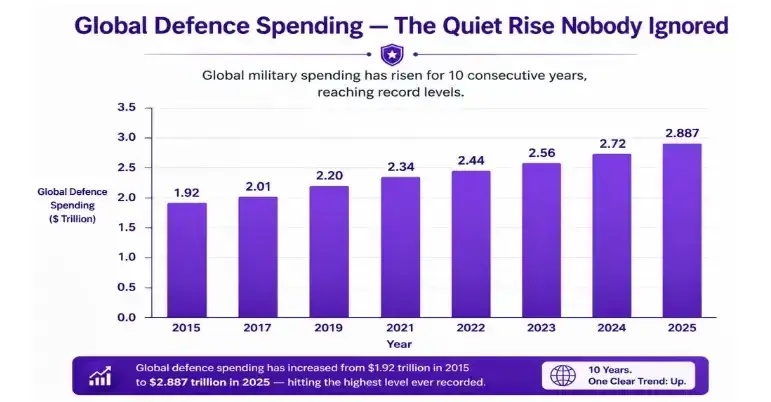
Earlier, defence spending was heavily platform-centric. Countries mainly focused on increasing the number of tanks, aircraft, ships or missiles. But modern warfare has evolved significantly. The demand is now shifting toward electronics-intensive systems like AESA radars, electronic warfare suites, secure communication systems, anti-drone solutions, cyber defence systems, space electronics and network-centric warfare architecture.
Modern battlefields are no longer isolated systems. Today’s military environment is highly interconnected. Fighter aircraft communicate with satellites, drones exchange data with ground radars, missile systems rely on secure navigation and communication networks, while electronic warfare systems constantly attempt to jam or confuse enemy radar and communication signals.
As a result, modern warfare is becoming increasingly electronics-driven.
This shift becomes even more relevant in India’s context.
India faces a unique strategic environment. It has a long border with China, ongoing security tensions with Pakistan, a coastline exceeding 7,500 kilometres and heavy dependence on maritime trade routes for crude oil imports. Defence spending for India is not optional. It is structural national-security insurance.
India’s defence budget has also been moving steadily toward domestic manufacturing and indigenous capability building. The Ministry of Defence allocation is around ₹7.85 lakh crore, and a growing share of capital procurement is being reserved for domestic industry.
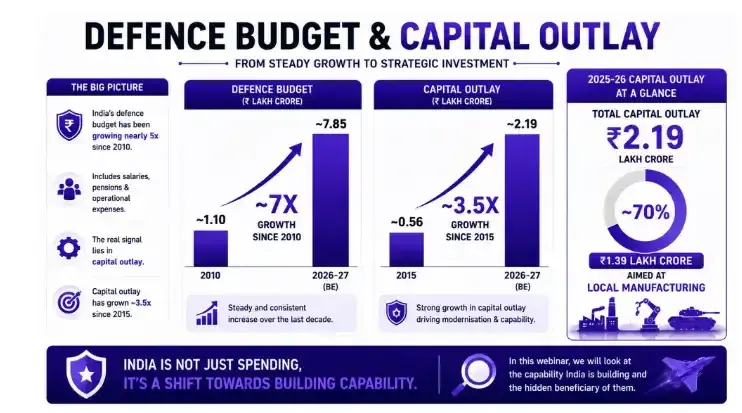
This creates a massive long-term opportunity for companies operating in India’s strategic electronics ecosystem.
Because once India starts indigenizing defence platforms, the next critical question becomes:
- Who will build the radar modules?
- Who will design the RF front-end?
- Who will manufacture the seekers?
- Who will develop electronic warfare hardware?
- Who will build secure battlefield communication networks?
That is exactly where Astra Microwave’s strategic importance emerges.
Know about Inflation here,
Inflation Explained: The Silent Destroyer of Wealth.
Understanding Build-to-Print vs Build-to-Specification
One of the most important concepts in defence manufacturing is understanding the difference between Build-to-Print (BTP) and Build-to-Specification (BTS).
In the Build-to-Print model, a company manufactures products according to a foreign OEM’s design blueprint. The company receives manufacturing orders, production visibility improves and factory utilization remains stable. However, value addition generally remains limited because the intellectual property and core design ownership remain with the foreign OEM. Margins in such work are usually moderate.
Build-to-Specification is very different.
In BTS, the company develops systems according to the customer’s performance requirements. It may co-develop intellectual property, own critical design capabilities and take system-level responsibility. This creates significantly higher value addition and stronger margins.
Astra Microwave is currently undergoing exactly this transition.
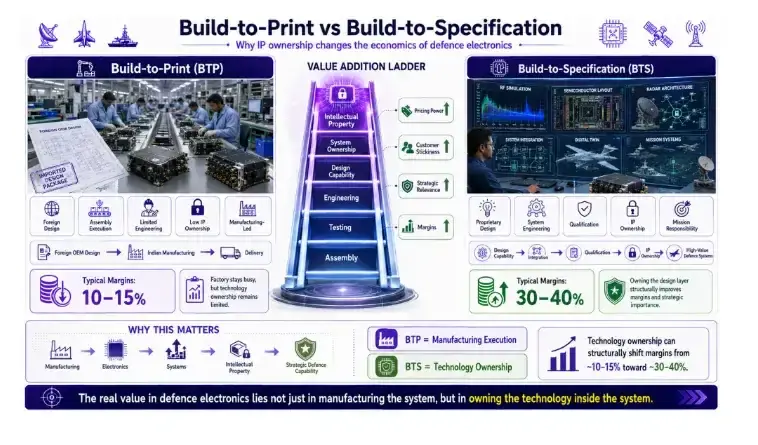
Historically, a meaningful portion of Astra’s export business involved Build-to-Print work. Foreign OEMs provided designs, while Astra manufactured according to those specifications. This gave the company manufacturing scale and exposure to global quality standards, but margins remained relatively lower.
Now, the company is increasingly shifting toward domestic defence programs where it can participate more deeply in design, testing, qualification and system integration.
This is important because domestic Build-to-Specification and system-level orders can generate structurally higher margins than traditional export manufacturing work.
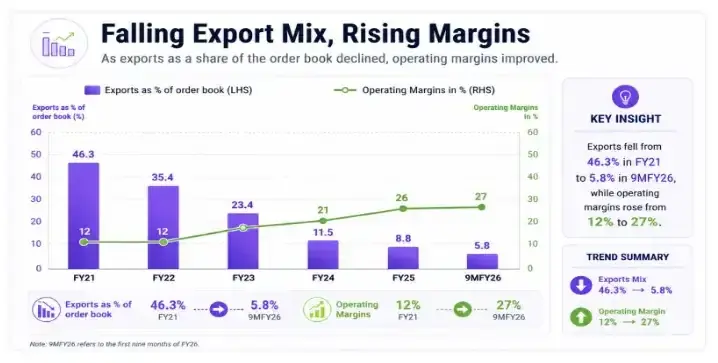
So the decline in export mix should not automatically be interpreted as weakness.
In Astra’s case, it may actually represent a strategic shift away from lower-margin BTP work toward higher-margin domestic system-led opportunities.
Read an interesting article on Union Budget Analysis: What Actually Matters for Investors, to expand your knowledge.
Astra’s Strategic Role in India’s Defence Ecosystem
Astra Microwave’s products are linked to several important Indian defence and space programs. These include:
- Tejas LCA’s Uttam AESA radar
- Su-30MKI Virupaksha upgrade
- BrahMos missile system
- Akash missile system
- Missile telemetry systems
- Tactical communication systems
- Radar electronics
- Counter-drone solutions
- Space-grade RF hardware
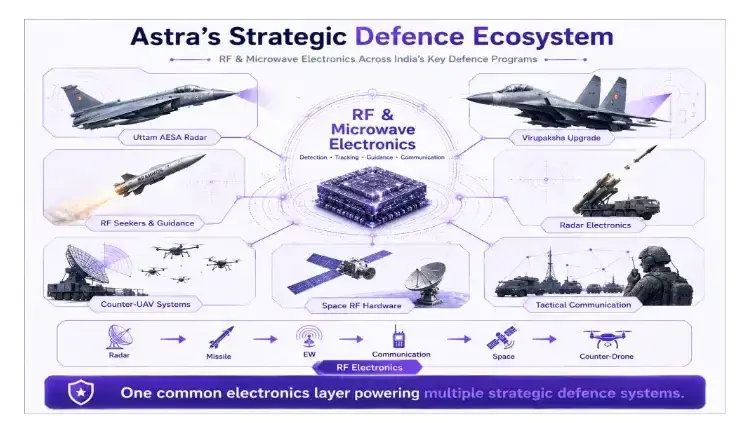
This positioning becomes strategically important because India is trying to reduce dependence on imported defence electronics architecture.
Historically, India relied heavily on foreign radar ecosystems.
The Su-30MKI historically used the Russian N011M Bars radar. Mirage 2000 upgrades used the French Thales RDY-2 radar. Rafale uses the French Thales RBE2 AESA radar. Earlier Tejas variants used Israeli ELTA radar architecture. MiG-29UPG used the Russian Zhuk-ME radar family.
Now India is increasingly trying to transition toward indigenous AESA radar systems such as Uttam AESA and the Virupaksha upgrade architecture.
Astra’s role is not that it independently manufactures the entire aircraft radar system. Instead, its strategic relevance lies in the RF and antenna-array layer — particularly Active Antenna Array Units, transmit-receive modules and microwave electronics that sit inside indigenous radar systems.
As India increasingly shifts from imported radar ecosystems toward indigenous radar architecture, Astra can become an important beneficiary of this transition.
Understanding AESA Radar and Why It Matters
To understand Astra properly, it is important to understand AESA radar technology.
Traditional radar systems mechanically rotate antennas to scan targets. AESA, or Active Electronically Scanned Array radar, works differently.
Instead of physically rotating the antenna, the radar electronically steers the beam.
This enables:
- Faster target acquisition
- Simultaneous multi-target tracking
- Better resistance against enemy jamming
- Improved battlefield responsiveness
At the heart of an AESA radar lies the Active Antenna Array Unit.
This system consists of hundreds or thousands of transmit-receive modules that enable electronic beam steering. These TR modules play a critical role in determining radar performance.
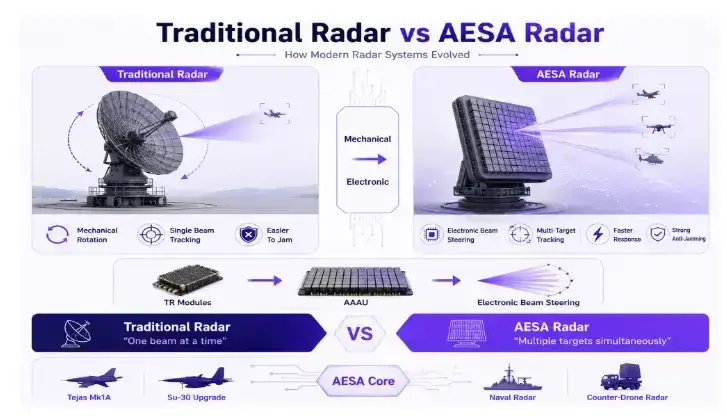
As India moves ahead with Tejas Mk1A, Tejas Mk2, Su-30 upgrades, naval radar systems, ground-based radar modernization and counter-drone radars, this deep-electronics capability becomes increasingly valuable.
Astra Microwave’s Journey
Astra Microwave began its journey in 1991.
At that time, private-sector participation in India’s strategic electronics ecosystem was extremely limited. Astra entered the highly specialized and high-entry-barrier segment of RF and microwave modules.
By 1993, the company had established itself as a supplier for radar and strategic electronics sub-systems. In 1994, it became publicly listed.
The company gradually expanded its technological capabilities over time:
- By 2000, Astra entered the electronic warfare segment.
- In 2003, it started supplying sub-systems for ISRO satellite programs.
- In 2005, Astra entered MMIC and semiconductor design.
- Post-2015, the company moved into radar systems and system-level integration.
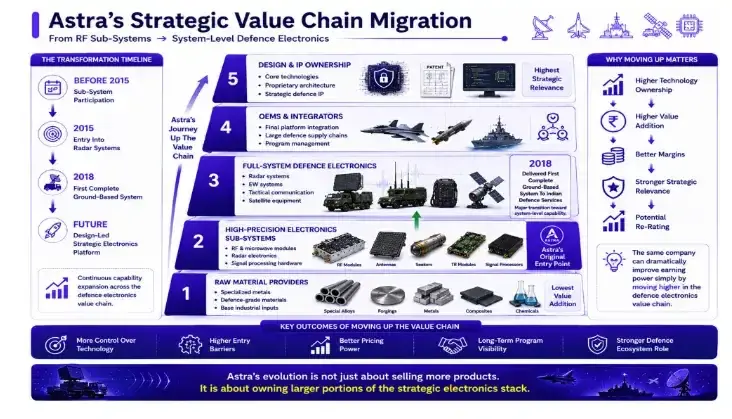
One of the most important milestones came in 2018, when Astra delivered its first complete ground-based system to Indian defence services. This marked a major strategic transition from being primarily a sub-system supplier toward becoming a systems-level strategic electronics player.
Astra’s Position in the Defence Value Chain
To properly understand Astra’s business model, it is important to understand the defence electronics value chain.
At the bottom are raw material suppliers providing specialized metals and base materials.
Above them are sub-system manufacturers producing RF modules, antennas, seekers, telemetry systems and signal processors.
Then come system providers capable of building complete radar systems, communication systems or electronic warfare systems.
Above them are OEMs and platform integrators managing large defence programs.
Finally, at the highest layer sit the IP owners and technology architects.
Astra originally operated closer to the sub-system layer. But today, it is trying to move upward toward systems-level and design-led positioning.
This matters because the higher a company moves in the value chain:
- The stronger the value addition
- The better the margins
- The stronger the technological moat
- The greater the strategic relevance
read about an interesting power sector investment idea here, The Power Engineering SME Riding India’s Transmission Expansion Cycle.
Margin Expansion Opportunity
Astra’s business transformation is deeply connected to its evolving margin structure.
Its current core business in radar and RF sub-systems can operate at margins around 25%. These include Active Antenna Array Units, RF seekers, telemetry systems, TR modules, EW receivers and signal processors.
However, as the company increasingly moves toward complete systems such as:
- Full radar units
- Tactical communication systems
- Electronic warfare systems
- Satellite integration systems
the margin profile can potentially move toward the 30–35% range.
The highest-value segment remains Build-to-Specification work, where the company owns or co-develops intellectual property. In such segments, gross margins can potentially move toward 40–45%.
Astra’s target is to move toward a revenue mix of roughly 50% sub-systems and 50% systems by 2028. If successful, the company may gradually transition from being viewed as a component supplier toward being valued as a strategic electronics platform company.
The margins have also been increasing consequently since the last 5 years as the share of exports in the order book has been declining. Exports mostly consisted of BTP work which gave factory utilization and topline but margins are low. As Astra increases its focus towards domestic high value orders - its margins will increase further.
Comparing Astra with BEL and Data Patterns
Astra Microwave occupies a unique niche within India’s defence electronics ecosystem. Bharat Electronics Limited is India’s large-scale defence electronics giant with deep government relationships, strong manufacturing capability and large-scale system integration expertise.
Data Patterns (India) Limited is more of an IP-led embedded electronics player focused on mission computers, processors, seekers and embedded defence systems.Astra, however, is fundamentally an RF and microwave engineering specialist.Its expertise lies specifically in high-frequency electronics used inside:
- Radars
- Missile systems
- Tactical communication systems
- Electronic warfare architecture
- Space-grade RF systems
This niche positioning matters because RF front-end systems, transmit-receive modules, antenna arrays and microwave electronics are among the most technologically complex parts of modern defence systems.
R&D as Astra’s Core Moat
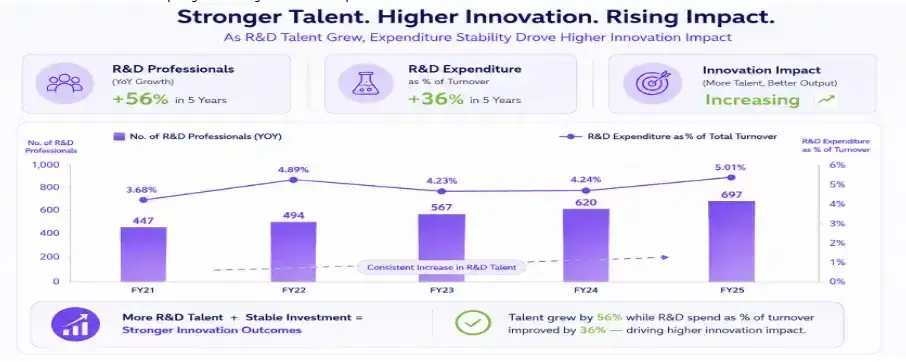
Astra’s R&D capability forms the foundation of its long-term strategic positioning. The company spends around ₹53 crore on R&D, which is roughly 5% of FY25 revenue, and employs nearly 700 R&D professionals.
In defence electronics, R&D is not just an operational expense.
It is the source of:
- Future margin expansion
- Technological ownership
- Qualification capability
- Long-term customer stickiness
- Strategic differentiation
The real moat in defence electronics does not come from simple assembly operations. It comes from reusable technology blocks, qualification experience, testing capability and platform approvals.
The more technology Astra owns internally, the more it can shift toward high-margin BTS and systems-level work.
Strategic Joint Ventures and Subsidiaries
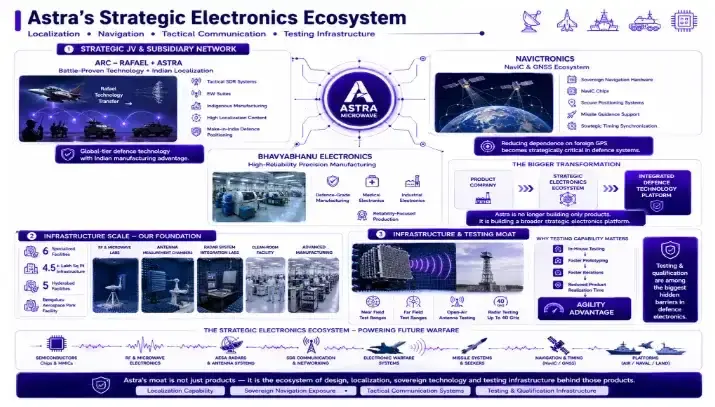
Astra’s subsidiaries and joint ventures significantly expand its strategic optionality.
Aelius Semiconductors
This subsidiary acts as Astra’s fabless MMIC design house. Gallium Nitride and Gallium Arsenide MMICs are critical for AESA radars, electronic warfare systems, high-power amplifiers and phase shifters.
This gives Astra deeper semiconductor-level capability inside defence electronics systems.
Astra Rafael Comsys (ARC)
ARC is a 51:49 JV with Rafael Advanced Defense Systems.
Through ARC, Astra gains access to:
- Tactical communication systems
- Software Defined Radios
- Electronic warfare systems
- Battlefield networking solutions
ARC’s BNET SDR systems enable encrypted, jam-resistant battlefield communication.
Its electronic warfare portfolio includes:
- Sky Shield
- Lite Shield
- X-Guard
These systems are important for aircraft survivability and electronic warfare operations.
Navictronics
This JV focuses on NavIC chips and GNSS products.
Since NavIC represents India’s sovereign navigation architecture, domestic navigation hardware becomes strategically important for missile guidance, secure synchronization and battlefield positioning systems.
Order Book and Financial Position
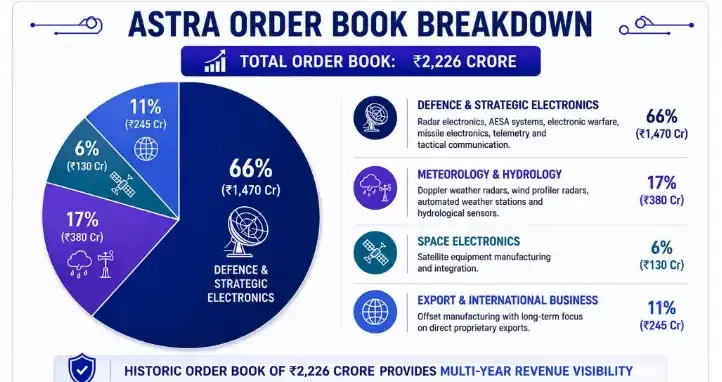
Astra’s order book has reached approximately ₹2,226 crore, providing multi-year revenue visibility.
Similarly read about an interesting Healthcare service SME here, The Healthcare Services SME Riding India’s Medical Tourism Boom
The Defence and Strategic Electronics segment forms around 66% of the order book, approximately ₹1,470 crore.
Other segments include:
- Meteorology and Hydrology: ~17%
- Space Electronics: ~6%
- Export and International Business: ~11%
FY25 consolidated revenue crossed the ₹1,000 crore milestone.
EBITDA margins are around 26.5%, while the debt-to-equity ratio remains below 0.4x. ROCE is trending around 18–20%.
Risks and Key Monitorables
Despite Astra’s strategic positioning, risks remain important.
The company remains dependent on defence procurement cycles, which can involve:
- Long working-capital cycles
- Delayed execution timelines
- Slower government procurement conversion
Promoter holding also remains relatively low at around 6.54%, although there is zero promoter pledge.
Key monitorables going forward include:
- Working-capital management
- Order execution speed
- Margin expansion
- Promoter alignment
Transition toward high-margin BTS and systems business
Explore our Products
Research Framework

Emerging Titans
Combination of quantitative analysis, industry tailwinds, and management assessment - SPRINT investment philosophy

Tiny Titans
Heavy emphasis on scuttlebutt research, plant visits, and early on-ground signals
Conclusion
Astra Microwave Products stands at a very interesting strategic inflection point.
The company started its journey in 1991 as a niche RF and microwave module player. Over time, it gradually expanded into electronic warfare, radar systems, semiconductor design, tactical communication, anti-drone systems, space electronics and strategic integration capability.
read our detailed article on a Solar Manufacturing Company Benefiting From India's Renewable Push.
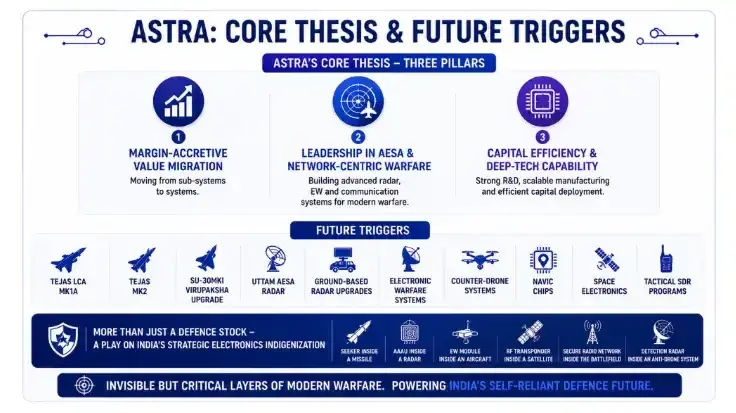
Today, Astra’s core investment thesis rests on three major pillars:
Margin-accretive migration from sub-systems toward systems
Leadership in AESA and network-centric warfare electronics
Deep-tech capability supported by R&D intensity
Future growth triggers include:
- Tejas Mk1A
- Tejas Mk2
- Virupaksha upgrades
- Uttam AESA radar
- Tactical SDR systems
- Anti-drone systems
- NavIC adoption
- Space electronics expansion
But perhaps the most important point is this:
Astra Microwave is not merely a defence stock.
It represents a play on India’s strategic electronics indigenization journey.
The radar module inside a fighter aircraft, the RF seeker inside a missile, the electronic warfare system protecting an aircraft, the tactical communication network connecting soldiers on the battlefield and the detection radar inside an anti-drone system - these are invisible systems, but they increasingly determine the outcome of modern warfare.
And Astra Microwave operates exactly inside this hidden but highly strategic layer of India’s future defence architecture. Comment below “DEFENSE” if you liked the detailed research driven article and share it with your Family & Friends who are keen about the defense sector.
FAQs
1. Why is the decline in Astra’s export mix not necessarily negative?
+Normally, lower exports may look like a weakness. But in Astra’s case, exports were historically more linked to Build-to-Print work, where foreign OEMs gave the design and Astra manufactured as per that design. This work gives revenue visibility, but margins are lower. Now Astra is shifting more toward domestic Build-to-Specification and system-level defence orders, which can have better margins.
2. What is the role of Astra Rafael Comsys?
+Astra Rafael Comsys is a 51:49 JV with Rafael. It gives Astra access to tactical communication, Software Defined Radios and electronic warfare technologies. Products like BNET radios, Sky Shield, Lite Shield and X-Guard are linked to secure battlefield communication and aircraft self-protection systems.
3. Why is Aelius Semiconductors important?
+Aelius Semiconductors gives Astra capability in fabless MMIC design. This is important because GaN and GaAs-based MMICs are used in AESA radars, electronic warfare systems, power amplifiers, low-noise amplifiers and phase shifters. In simple terms, Astra is trying to build capability not only at the system level, but also at the chip-design layer.
4. What role can Astra play in India’s radar indigenisation?
+India has historically used foreign radar systems from Russia, Israel and France across aircraft like Su-30MKI, Mirage 2000, Rafale, Tejas and MiG-29UPG. Now India is moving toward indigenous AESA radar systems like Uttam and Virupaksha. Astra’s role is mainly in the RF, antenna-array, transmit-receive module and microwave electronics layer inside these radar systems.
5. What are the biggest risks in Astra Microwave?
+The main risks are long defence procurement cycles, working capital pressure, slow order execution and government procurement delays. Promoter holding is also low at around 6.54%, though the positive point is that promoter pledge is zero. The key things to track are order conversion, working capital, promoter alignment and success in scaling high-margin system-level business.

High growth stock specialist, Value Educator
Shashank Mahajan is an equity research professional with over 12 years of experience in identifying high-potential SME and micro-cap stocks at an early stage. He follows a rigorous scuttlebutt research–driven approach, combining on-ground insights with deep financial analysis. Shashank specializes in uncovering under-researched and under-owned companies with strong management quality and long-term growth potential. Through disciplined research and early identification, he focuses on spotting tomorrow’s market leaders before they enter the mainstream investor radar.

Zen Technologies: Revenue Fell After a Big Win




PNG Jewellers: A 194-Year-Old Name Goes National

Explore our Products
Research Framework
Emerging Titans
Combination of quantitative analysis, industry tailwinds, and management assessment - SPRINT investment philosophy
Tiny Titans
Heavy emphasis on scuttlebutt research, plant visits, and early on-ground signals


 Orders
 Subscription
 Share with friends


Required Details
₹23999.00
(12 month subscription)
As per SEBI regulations, all users are mandated to complete the KYC that is validated for 1 year. Post payment, you will be redirected to the KYC screen


No comments yet. Be the first to comment!