
Praj Industries: Bioenergy for Clean Fuels
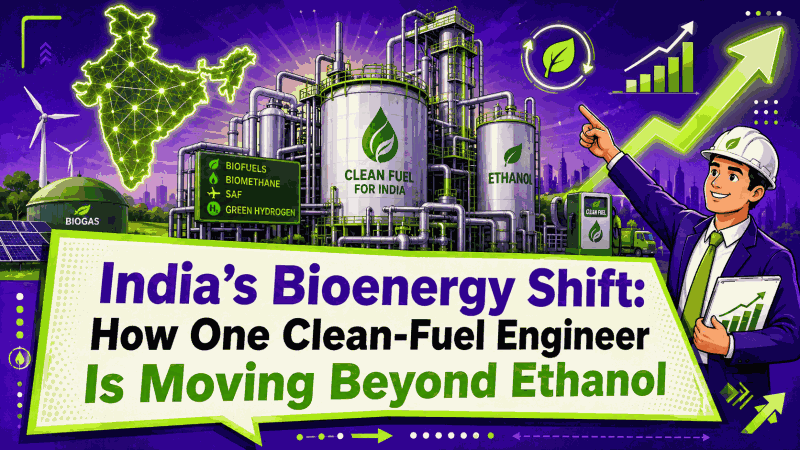
India’s fuel demand is rising with more vehicles, factories, logistics, and infrastructure, but a large part of this demand still depends on imported crude oil. This creates pressure from global oil prices, currency movements, and rising emissions.

Ethanol blending helps address this by mixing domestically produced biofuel with petrol. It can reduce crude oil dependence, support farmers through demand for sugarcane, maize, and other feedstocks, and lower emissions compared with pure petrol. This is why ethanol is not just a fuel policy; it is linked to India’s energy security, pollution reduction, rural economy, and cleaner mobility goals.
People generally envision more EVs, more solar, more airports, more factories and more infrastructure when they consider India's futures. But then a question that is not often asked is, what will fuel this growth and who will develop the technology that will drive the change?
“Energy is the only universal currency” — Vaclav Smil
Energy imports cannot be the sole means for India. The country requires cleaner fuels, maximizing utilization of agricultural resources, improving domestic energy solutions and converting waste and biomass into useful products as the economy grows.
However, policy is not sufficient to produce bioenergy. Complex engineering is required for ethanol blending, compressed biogas, sustainable aviation fuel and bio-based materials. They require plants, fermenters, distillation systems, process equipment, modular systems, water treatment solutions and execution expertise. Simply put, there is a complete industrial base supporting every clean-fuel story.
That backbone has been established over the years by one Indian company. It is a household name for ethanol now and is now attempting to expand its position in a much broader clean-fuel and industrial sustainability ecosystem in India. The opportunity is big, but so are the execution challenges, margins pressure and the proof of the future opportunities becoming profitable.
The Company is Praj Industries.
The energy problem in India is a big and complex issue. The country is in need of more fuel, power, mobility, industrial output and more infrastructure. The absolute demand for energy grows as incomes grow and the economy expands. There's more energy needed to power vehicles, factories, logistics, etc.
To understand how rising economic activity eventually flows into corporate revenues and sector demand, you can also read: How GDP Growth Impacts Corporate Earnings and Stock Markets
India is also dependent on large scale imports of energy. This poses a strategic issue. An oil and gas reliant country faces the risk of international oil and gas price fluctuations, currency pressures, geopolitical risks and supply disruptions. When crude prices rise or global energy markets become unstable, countries get affected.
This is where biofuels come in. Biofuels are not just about climate change. They are also related to energy security, farmer's income, value addition in agriculture, waste management and import substitution. Ethanol blending decreases crude oil utilization. CNG can help mitigate the dependency on natural gas import. SAF can provide a decarbonizing route for aviation. Bio-based chemicals and bioplastics help to decrease reliance on fossil based raw materials.
Bioenergy has a special relevance for India with its huge agricultural production and huge biomass resources. With the appropriate technology, economics and policies, sugarcane, molasses, maize, rice straw, press mud, agricultural residues and other feedstocks can be integrated into the energy and industrial value chain.
Praj is part of this opportunity since it brings the engineering and technology required to transform these resources into useful products. The company isn't just producing regular equipment. It is based on a proven process knowledge, plant design, execution ability, and domain expertise that has been gained over time.
“The future depends on what we do in the present” — Mahatma Gandhi
This line fits well because Praj’s story is linked to India’s long-term energy security and sustainability.
To understand why Praj’s current phase looks different from its past growth cycle, we first need to look at what changed in India’s ethanol market.
Why Greenfield Ethanol Slowed Down
The slowdown in greenfield ethanol projects is not difficult to understand. When India was short of ethanol capacity, new plants were required. Companies invested in setting up fresh capacity because demand visibility was strong. But once installed capacity caught up with E20 requirements, the urgency for new plants reduced.
This led to a temporary slowdown in new large ethanol project orders. Customers also faced liquidity challenges, which delayed project execution and extended site timelines. For an engineering company, this matters because delays can increase costs. If a project site remains open for longer than planned, expenses rise. Manpower, project supervision, logistics, site-related work, and execution overheads continue, even if revenue recognition slows.
This affected Praj’s profitability in FY26. Revenue did not collapse, but margins came under pressure because execution became more difficult and some fixed costs were not fully absorbed.
This is why investors should not look only at revenue. In this business revenue, order book, execution cycle, working capital, site readiness, cost escalation, and margin quality all are equally important. A company can have a good order book but still face margin pressure if execution is delayed or if new facilities are not fully utilized.
This is why engineering and project-driven businesses need to be studied differently from asset-light companies. For a deeper understanding, Read: Capital-Intensive Businesses Explained: Risks, Economics, and Investor Insights
But a slowdown in new ethanol plants does not mean the opportunity has disappeared. It simply means the opportunity is shifting from building new capacity to improving existing capacity.
Brownfield Ethanol: The Next Layer of Opportunity
As the greenfield ethanol slowdown kicks in, Praj is turning more towards brownfield projects. Brownfield is defined as upgrading, expanding, optimizing, or improving existing plants rather than construction of entirely new plants.
This is a significant move. Currently, there are ethanol producers with existing capacity. Their next question is how to make their plants more efficient, more profitable and more flexible. They might desire greater yields, reduced operating expenses, other co-products, enhanced fermentation capabilities, more efficient distillation, or better extraction from the by-products.
Praj is addressing this need with their plant and enhancement solutions, performance enhancers and co-product technologies. Distillers Corn Oil, rice protein, and biogenic CO2 capture are examples of products that can generate extra revenue opportunities for ethanol plants.
This is because ethanol producers will only be profitable if they are able to sell ethanol, and it is the ethanol pricing and feedstock cost that determines this. However, when they can also get value from co-products, then plant economics improve. Praj is benefiting since it can sell the Technology & Engineering Solutions to the same customer base.
The smaller ticket sizes of this type of business can be offset by the ability to generate more of a service business and recurring opportunity over time. It's at this point that the installed base becomes relevant. After a company has served hundreds or thousands of customers for decades, the customer base can serve as the basis for future plant improvement orders, performance solutions, maintenance and upgrades.
While brownfield upgrades can support the existing ethanol ecosystem, the next big demand trigger may come from India’s move toward higher ethanol blending.
Higher Ethanol Blends: A Possible Future Trigger
The next major trigger for ethanol could come from higher blending levels. India has moved to E20, but discussions are going around higher blends as well such as E25, E30, E85, and E100 indicate that the ethanol story may not end at E20.
Higher ethanol blends can create new demand, but they also require ecosystem. Petrol pumps need infrastructure. Oil marketing companies need blending and distribution systems. Automakers need compatible engines. Consumers need confidence. Policy needs to be clear. Pricing needs to work for producers and users.
This is why investors should remain balanced. Higher blends are a positive possibility, but they are not automatic earnings. The opportunity becomes meaningful only when mandates, infrastructure, vehicle availability, and commercial adoption move together.
Flex-fuel vehicles are also relevant. If India begins to scale vehicles that can run on higher ethanol blends, ethanol demand can increase beyond the E20 base. E85 and E100 retail outlets can become important if the rollout expands meaningfully. But again, the key word is “if.” The opportunity is visible, but the pace of execution will determine how quickly companies like Praj benefit.
Higher blends can create fresh demand, but India’s biofuel journey may also need better use of agricultural waste and non-food biomass.
Second-Generation Ethanol: Strong Logic, Long Gestation
Second-generation ethanol, also called 2G ethanol, is another important part of Praj’s technology. Unlike first-generation ethanol, which uses sugarcane-based or grain-based feedstocks, 2G ethanol uses agricultural residues and non-food biomass.
This is attractive for India because the country produces large quantities of agricultural waste. If these residues can be converted into ethanol, it can help farmers, reduce waste burning, improve rural income, and support energy security. It also reduces the concern of using food-related feedstocks for fuel.
However, 2G ethanol is technologically more difficult than 1G ethanol. Agricultural residues are complex. The process requires advanced pretreatment, enzymes, fermentation, and integration. Commercializing 2G at scale takes time, capital, and patience.
For Praj, 2G ethanol is strategically important because it demonstrates deeper technology capability. It also gives the company a possible long-term advantage if the market matures. But from an investor’s point of view, 2G should be treated as a long-gestation opportunity. It is valuable, but it may not contribute meaningfully to earnings in the near term unless commercial adoption accelerates.
“The entrepreneur always searches for change, responds to it, and exploits it as an opportunity” — Peter Drucker
New Energy Opportunities: CBG, SAF and Bio-Based Materials
Praj is expanding its capabilities in sectors of the industry that are not ethanol, like compressed biogas, sustainable aviation fuel, and bio-based materials. Press mud, Napier grass, agricultural waste, food waste, and mixed biomass can be used to produce compressed biogas (CBG). The opportunity is appealing because India has biomass potential and is looking to cut its energy imports. Praj has experience with CBG technologies with various feedstocks and has investigated add-ons like bio-bitumen to enhance economics of the projects. But CBG remains a nascent market and its growth is hinged on improved feedstock collection, gas offtake, grid connectivity, financing and viability of projects.
Another long-term opportunity is sustainable aviation fuel (SAF). Aviation is hard to decarbonize and SAF can help to decrease emissions but not alter the aircraft infrastructure. Praj has worked on ethanol-to-jet and has set up an ethanol-to-jet demo plant at R & D. In addition, the company has been awarded engineering projects for overseas SAF projects, which could help it establish credibility in this new territory. SAF is still in its infancy though, and if it is to be used at large scale, it will require a mix of blending mandates, cost competitiveness, feedstock availability, airline demand and policy support.
Praj is also working on bio based materials like lactic acid, PLA, Bio plastics etc. This is part of the broader bioeconomy which sees businesses seeking alternatives to fossil base plastics and chemicals. The company's fermentation expertise along with its ability to convert feedstocks and process engineering can enable the company to break into these fields. These opportunities for diversification should be viewed as long-term sources of income, for now, not as revenue streams.
“Innovation distinguishes between a leader and a follower” — Steve Jobs
Engineering and High-Purity Systems: Diversification beyond Bioenergy
Praj's diversification is also driven by its engineering and high purity systems business. Praj Mangalore is operating in the energy transition, oil and gas, carbon capture and process systems modular engineering business as well as in industrial markets. The business has the potential as modular systems can help minimize site work, bring quality and shorten the execution timeline of the project. But FY26 was difficult for GenX as energy transition projects were delayed or suspended resulting in low utilization and margin pressure. The company is now expanding its focus on a broader customer base, which now includes oil and gas, CCUS, data centers and traditional industrial markets. If they can improve utilization, GenX can fuel growth and margins, but otherwise they can keep it as a drag.
In addition to GenX, Praj's engineering business encompasses brewery solutions, water systems, zero liquid discharge solutions and industrial process solutions. These companies offer diversified businesses other than ethanol and bioenergy. Water and ZLD solutions are particularly important, particularly as industries increasingly prioritize recycling, compliance and responsible water use.
PHS (Praj HiPurity Systems) is a product of Praj that caters to industries where purity and reliability of processes is of utmost importance. It is a major supplier to the biopharma, injectables, blood plasma, high purity water and modular process systems sectors. PHS is also investigating opportunities in batteries, solar cells, semiconductors and precision fermentation. PHS can be an important diversification engine over time, and can help to decrease reliance on ethanol-related cycles, though smaller than Bioenergy.
These opportunities make the long-term story interesting, but investors also need to check how the business is performing in actual numbers.
FY26 Financial Performance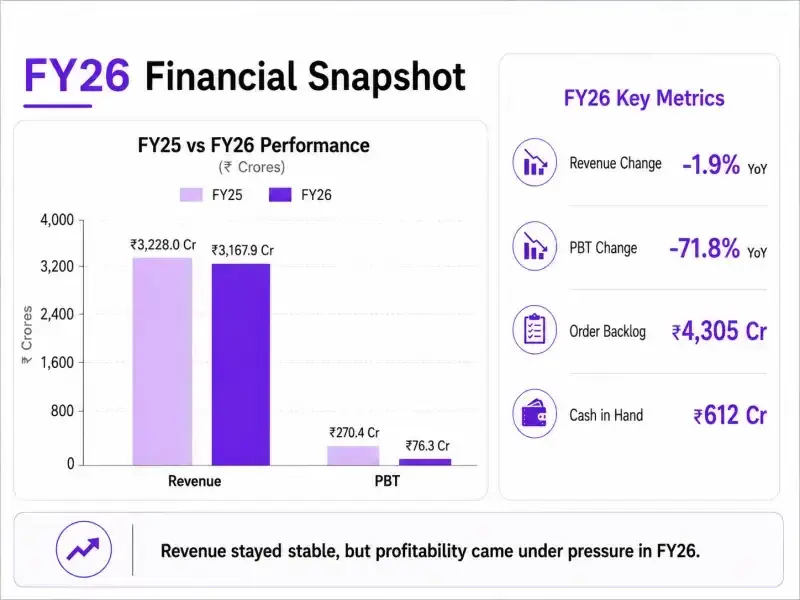
Praj’s FY26 financial performance reflects the transition phase clearly. The company’s income from operations was at 3,167.9 CR in FY26 and it was 3,228 CR in FY25. This indicates that the revenue was stable, but there was no meaningful growth.
The bigger issue was profitability. PBT declined to 76.3 CR in FY26 compared with 270.4 CR in FY25. PAT also came under pressure. This shows that the challenge was not just top-line growth. The real stress was in margins and execution.
Several factors contributed to this. Greenfield ethanol orders slowed. Some projects faced extended execution cycles due to customer funding and site readiness issues. Site-related costs increased. GenX had fixed costs with limited revenue contribution. Some cost escalations also affected margins. Together, these factors reduced profitability sharply.
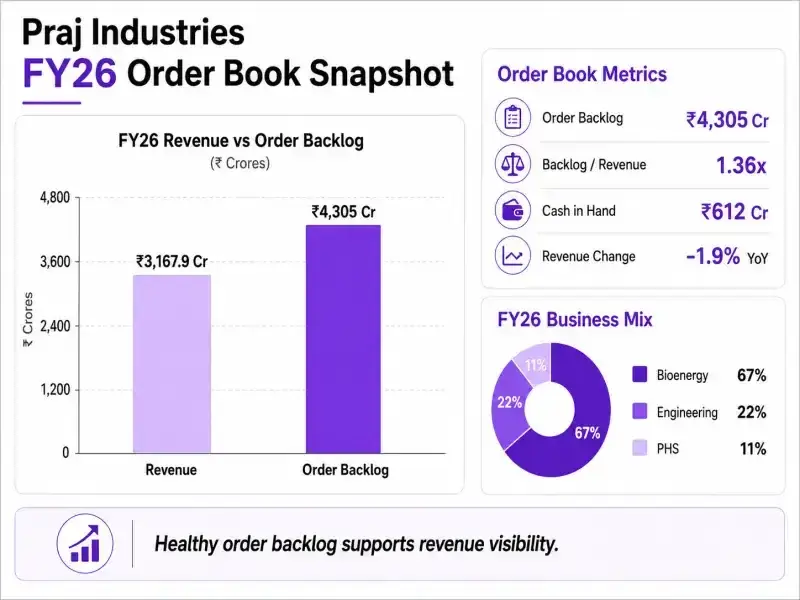
On the positive side, the company’s order backlog remained healthy at 4,305 CR as of March 2026. This provides revenue visibility. Cash in hand stood at ₹612 CR, giving the company balance-sheet comfort.
The revenue mix also shows that Bioenergy remains the core business. In FY26, Bioenergy contributed 67% of revenue, Engineering contributed 22%, and PHS contributed 11%. This mix is important because it shows that despite diversification efforts, Praj is still heavily linked to the bioenergy cycle.
This is a good example of why investors should not look only at total revenue, but also study which segment is actually driving the business. You can read more here: Segment-Wise Revenue Analysis: How to Find a Company's True Growth Engine
So, the financial picture is neither fully weak nor fully strong. The order book is healthy. The cash position is comfortable. The company has multiple future opportunities. But profitability has weakened, and investors need to see recovery.
Why Margin Recovery Matters
For Praj, margin recovery is one of the most important things to track. A technology-led engineering company should ideally convert its knowledge, brand, customer relationships, and execution capability into healthy margins. If margins remain weak for too long, the market may begin questioning whether the company’s technology leadership is translating into shareholder value.
The margin pressure in FY26 had multiple reasons. Some were external, such as project delays, customer liquidity issues, and tariff-related uncertainty. Some were internal or business-cycle related, such as underutilization at GenX and execution cost escalation.
The good part is that management has acknowledged these issues and indicated focus on operational excellence. The company also believes that as the business moves from large greenfield projects to shorter-cycle brownfield opportunities, execution challenges may reduce.
But investors should wait for evidence. Management commentary is useful, but numbers matter more. The key signs to watch are EBITDA margin improvement, better operating leverage, GenX utilization, lower execution cost overruns, and stronger profit conversion from the order book.
Since EBITDA margin is one of the key indicators in this story, investors should also understand what EBITDA really shows and where it can mislead. Read: EBITDA Explained: Why Investors Use It — And When It Misleads
Order Book Quality
A large order book is positive, but order book quality is more important than order book size. For an engineering company, not all orders are equal. Some orders are high-margin. Some are low-margin. Some are easy to execute. Some are complex. Some customers pay on time. Some stretch working capital. Some projects finish quickly. Some get delayed.
Praj’s order backlog gives visibility, but investors should also understand its mix. A backlog dominated by Bioenergy may provide revenue stability, but if greenfield ethanol is slowing and brownfield orders are smaller, revenue growth may depend on faster conversion across other businesses.
Similarly, Engineering orders can be attractive if GenX utilization improves, but they must be profitable. PHS orders may offer diversification, but the segment needs scale.
This is why the next phase of Praj’s journey depends on profitable execution, not just order announcements.
What Can Go Right for Praj
There are several things that can go right for Praj over the next few years. The first is higher ethanol blending. If India moves beyond E20 in a structured way, new demand can open for ethanol-related solutions. This can support both greenfield and brownfield opportunities.
The second is flex-fuel adoption. If E85 and E100 infrastructure scales and automakers launch compatible vehicles, ethanol demand can get a fresh growth path. This would be especially important because it can create demand beyond the current E20 requirement.
The third is SAF. If India announces clear blending mandates and commercial investments begin, Praj’s ethanol-to-jet technology can become valuable. International SAF opportunities can also help the company build credibility and revenue.
The fourth is CBG. If the CBG ecosystem matures through better feedstock supply, gas grid connectivity, and offtake models, Praj can benefit from its technology position.
The fifth is GenX recovery. If the Mangalore facility receives enough orders and improves utilization, it can shift from a drag to a contributor. This could meaningfully improve the margin profile.
The sixth is PHS growth. If biopharma, precision fermentation, semiconductors, batteries, and solar manufacturing grow in India, Praj’s high-purity systems business can benefit.
The seventh is services and co-products. If Praj can build a larger service-led business from its installed base, it can reduce dependence on large project cycles and improve revenue quality.
But every opportunity comes with risks, and Praj’s future will depend on how well it manages the challenges around policy, execution, margins, and valuation.
What Can Go Wrong
The risks are equally important. The biggest risk is policy delay. Many of Praj’s future opportunities depend on government policy, mandates, incentives, and infrastructure development. If higher ethanol blending, SAF mandates, or CBG policies are delayed, order conversion can slow.
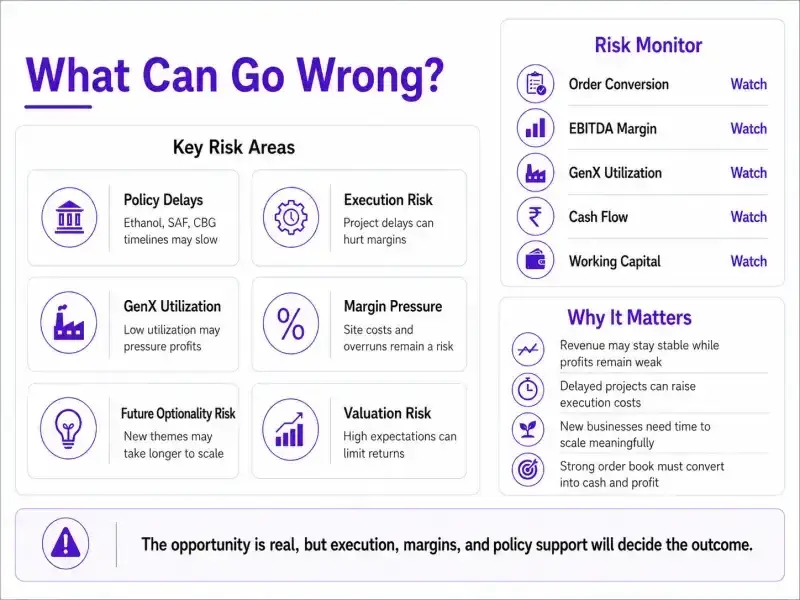
The second risk is execution. Praj operates in project-based businesses where delays can hurt margins. If customers face funding issues or sites are not ready, costs can rise.
The third risk is GenX underutilization. If the facility does not receive enough profitable orders, fixed costs can continue to pressure earnings.
The fourth risk is overdependence on future optionality. SAF, bioplastics, CBG, and 2G ethanol are attractive, but they are still developing. If investors price the company as if all these opportunities are already mature, returns may disappoint.
The fifth risk is margin inconsistency. Even if revenue remains stable, weak margins can reduce shareholder value.
The sixth risk is competition. As the clean energy and bioeconomy sectors grow, more engineering companies, technology providers, and global players may enter the market.
The seventh risk is valuation. A good company can still be a poor investment if bought at an expensive valuation without enough earnings visibility.
“The essence of investment management is the management of risks, not the management of returns” — Benjamin Graham
How Investors Should Track Praj
Investors tracking Praj should focus on whether the company can convert its long-term opportunities into actual financial performance. Segment-wise order intake across Bioenergy, Engineering, and PHS will show where growth is coming from and whether the business is becoming more diversified.
Order backlog conversion and EBITDA margin will also be important, because a strong order book matters only if it converts into revenue without major delays or cost overruns. GenX utilization is another key factor, as better use of the Mangalore facility can support margins, while weak utilization may continue to remain a drag.
Investors should also watch brownfield projects, services, SAF, CBG, and PHS growth. These areas can reduce dependence on large ethanol projects, but they need visible execution and commercial scale. Along with this, cash flow, working capital, and valuation comfort should be monitored closely before forming a final view on the stock.
The Bigger Picture
Praj’s story can be understood as a company moving from one growth cycle to another. The first major cycle was India’s ethanol capacity creation. This helped Praj build scale, reputation, and a strong installed base. That cycle is now maturing.
The next cycle may be broader but more complex. It includes ethanol upgrades, higher blends, flex fuels, SAF, CBG, 2G ethanol, bioplastics, carbon capture, water systems, PHS, and modular engineering. This new cycle could be larger than the old one, but it may also take longer to convert into earnings.
This creates a classic transition-phase investment situation. The company has long-term potential, but near-term numbers are under pressure. The market may become excited about optionality, but investors must check whether optionality becomes revenue and whether revenue becomes profit.
Praj’s technology depth is a strength. Its experience in bioenergy is a strength. Its installed base is a strength. Its diversification efforts are a strength. But execution, margins, and policy dependence remain key risks.
Explore our Products
Research Framework

Emerging Titans
Combination of quantitative analysis, industry tailwinds, and management assessment - SPRINT investment philosophy

Tiny Titans
Heavy emphasis on scuttlebutt research, plant visits, and early on-ground signals
Conclusion
Praj Industries is a strong technology-led engineering company operating in sectors that can remain important for India’s energy transition, energy security, and industrial sustainability. Its exposure to ethanol, CBG, SAF, bioplastics, CO2 capture, PHS, and modular engineering gives it multiple long-term growth options.
But the company is currently in a transition phase. FY26 showed that revenue stability alone is not enough. Profitability came under pressure due to slower greenfield ethanol demand, extended execution cycles, higher site-related costs, and underutilization at GenX. These issues need to improve before the investment case becomes stronger.
A neutral view would be this: Praj is a company with meaningful long-term potential, but investors should not judge it only by the excitement around clean energy. They should judge it by order conversion, margin recovery, GenX utilization, cash flows, and the pace at which emerging opportunities like SAF and CBG become commercially meaningful.
For patient long-term investors, Praj is worth tracking closely. But it is not a stock to blindly chase only because it is linked to bioenergy. The opportunity is real, but execution will decide the outcome.
Before making any investment decision, investors should study the latest quarterly results, order book quality, margin trend, GenX performance, segment-wise growth, cash flows, and valuation comfort.
This is where investor discipline matters, because a strong theme alone is not enough if risks are ignored. For more on this mindset, Read: Risk vs Reward: Why Investor Psychology Matters More Than Returns
Want to discover more such companies sitting inside India’s clean-energy and infrastructure shift? Comment Discover.
FAQs
Why is ethanol important for India?
+Ethanol is important because it helps reduce dependence on imported crude oil, supports domestic agriculture, and can lower emissions when blended with petrol. For India, ethanol is not only a clean-fuel theme but also an energy-security and rural-economy opportunity.
Why did greenfield ethanol projects slow down?
+Greenfield ethanol projects slowed because India has already achieved the E20 blending target, and the current installed ethanol capacity is broadly sufficient for that requirement. Unless higher blending mandates or new ethanol-use cases scale up, the urgency for new large ethanol plants may remain lower than before.
What are brownfield ethanol opportunities?
+Brownfield opportunities involve upgrading or improving existing ethanol plants rather than building new ones. These may include better yields, lower operating costs, co-product additions, improved fermentation, and better recovery from by-products. This can help existing producers improve profitability.
What is the role of compressed biogas in this story?
+Compressed biogas, or CBG, can be produced from agricultural waste, press mud, Napier grass, food waste, and mixed biomass. It can support India’s gas economy, reduce import dependence, and improve waste management. However, the sector still needs better feedstock collection, gas offtake, grid connectivity, and project viability.
What is the main risk investors should keep in mind?
+The main risk is execution. Many future opportunities such as higher ethanol blends, CBG, SAF, bioplastics, and modular engineering are attractive, but they need policy support, commercial adoption, and profitable execution. Investors should avoid looking only at the long-term story and should also track margins, cash flows, and valuation comfort.

High growth stock specialist, Value Educator
Shashank Mahajan is an equity research professional with over 12 years of experience in identifying high-potential SME and micro-cap stocks at an early stage. He follows a rigorous scuttlebutt research–driven approach, combining on-ground insights with deep financial analysis. Shashank specializes in uncovering under-researched and under-owned companies with strong management quality and long-term growth potential. Through disciplined research and early identification, he focuses on spotting tomorrow’s market leaders before they enter the mainstream investor radar.

Glenmark: The USD 700 Mn Cancer Deal and Its Brands

Pharma Stocks in India 2026: Generics, APIs and CDMOs

Granules India: From Paracetamol to a 65% Gross Margin

Natco Pharma: After Revlimid, 29 Patent Challenges

Shilpa Medicare: Cancer APIs, Films and Biosimilars

Alembic Pharma: US Plants Pay Back, Margin Hits 22.2%
Explore our Products
Research Framework
Emerging Titans
Combination of quantitative analysis, industry tailwinds, and management assessment - SPRINT investment philosophy
Tiny Titans
Heavy emphasis on scuttlebutt research, plant visits, and early on-ground signals



Modern Warfare to Multibaggers
Key Trends. Strategic Shifts. Opportunities Ahead.
Don't Miss This Exclusive Webinar!
Join Value Educator to decode the key trends shaping India's defence sector and learn how to identify tomorrow's potential leaders in the space.
- In-depth research on India's defence sector
- Live Q&A session
- Actionable takeaways for long-term investors

 Orders
 Subscription
 Share with friends


Required Details
₹23999.00
(12 month subscription)
As per SEBI regulations, all users are mandated to complete the KYC that is validated for 1 year. Post payment, you will be redirected to the KYC screen


No comments yet. Be the first to comment!