
Borosil Renewables: India's First Solar Glass Maker
In FY24, an Indian glass maker sold its glass at about ₹109.1 per square metre for each millimetre of thickness. In FY26 the same glass sold at ₹146.7, and in the April to June quarter of 2026 at ₹160.3. Over the same two years, the company's EBITDA margin in India went from 12.0% to 32.0%. Its furnaces did not change in that time. The biggest change was an anti-dumping duty, which is an extra import duty that a government puts on goods sold into its market below a fair price.
That glass is solar glass. Solar glass is the sheet of special glass that covers the front of every solar panel. It has to let almost all sunlight through, so it is made with very little iron, and it has to survive hail, heat and rain for 25 years or more. This company makes it in thicknesses from 2 mm to 4 mm, and it is sold by the square metre for each millimetre of thickness.
Solar glass is made in a furnace that runs day and night for years. So its capacity is counted in tonnes per day, or TPD, which is the weight of molten glass a furnace can turn out each day. A furnace cannot simply be switched off and on, and even a power cut can disturb it, so a glass maker plans its furnaces years ahead.
That glass maker is Borosil Renewables Ltd (NSE: BORORENEW). It calls itself India's first and largest solar glass maker. It runs three furnaces with a total capacity of 1,000 TPD at Bharuch in Gujarat, which is enough glass for about 6.5 GW of solar modules a year. It supplies more than 100 module makers in India, and it is building two more furnaces of 300 TPD each.

So Borosil sits at one clear point in the solar chain. It does not make solar cells, panels or power plants. It makes the glass that every module maker in India needs, whether that module goes on a rooftop or into a solar park.
Borosil Renewables in five numbers
- Q2 FY27 revenue of ₹396.2 Cr, and H1 FY27 revenue of ₹801.8 Cr, up 12.8%
- An EBITDA margin of 32.0% in FY26, against 16.3% in FY25
- Capacity of 1,000 TPD, rising to 1,600 TPD by the end of March 2027
- A project cost of about ₹1,100 Cr for the two new furnaces
- India's solar glass demand of 10,400 TPD, against domestic capacity of 2,900 TPD
So a company whose group lost money in FY24 and FY25 now earns a margin above 30%, and is spending more than ₹1,000 Cr to grow by 60%. How did the latest quarter look on that path? Let's first understand the company, and then look at the latest quarter.
Borosil Renewables: Company Overview
Borosil Renewables Ltd was incorporated in 1962 as Borosil Glass Works and was renamed under a merger scheme that the tribunal approved in January 2020, which merged the solar glass company Gujarat Borosil into it and moved the consumer and scientific glass businesses to Borosil Limited. Its registered office is in Mumbai, and its solar glass plant is at Govali near Jhagadia in Bharuch district, Gujarat, where it runs three furnaces with a capacity of 1,000 TPD. P. K. Kheruka is the Executive Chairman, Shreevar Kheruka is the Vice Chairman, Melwyn Moses is the Chief Executive Officer and Sunil Roongta is the Whole-Time Director and CFO; the promoter group held 56.02% in September 2026. The company makes textured, tempered and coated solar glass from 2 mm to 4 mm thick for more than 100 module makers in India and some customers abroad, and in 2026 it began to sell rooftop solar kits. It had 681 permanent employees in March 2026. Group revenue from operations was ₹1,555.8 Cr in FY26, and in September 2026 it held cash, bank balances and liquid investments of about ₹763.4 Cr against borrowings of about ₹128.0 Cr. Read this Power Sector Stocks in India 2026: List by Value Chain
"Know what you own, and know why you own it."
— Peter Lynch
Borosil makes one product for one industry, and its margin moves with the price of imported glass. Knowing that link between the duty, the selling price and the margin is the first step to reading its results.
The Quarter the Furnaces Went for Repair
Let's look at Q2 FY27, the July to September quarter when the furnaces went for repair, which the board approved on 30 October 2026. Revenue from operations of the company on its own, which is now the whole business, was ₹396.2 Cr, up 4.7% from ₹378.4 Cr a year ago. It was 2.3% lower than the ₹405.7 Cr of Q1 FY27.

As we can see, profit after tax rose 53.1% from a year ago, but that is because Q2 FY26 carried a one-time charge of ₹33.9 Cr for the German subsidiaries. EBITDA, which leaves out that charge, came down 7.3% to ₹116.3 Cr. The margin, which here is EBITDA divided by revenue from operations, came down to about 29.4%, from about 33.2% a year ago and 35.0% in Q1 FY27.
That dip had two causes, and both came from the furnaces and the fuel. Read this EBITDA Explained: Uses and Limits First, the company took its furnaces through routine maintenance in July and August, and fine-tuned them while doing so. Production went down by close to 4.5%, and management puts the lost revenue at about ₹15 Cr.
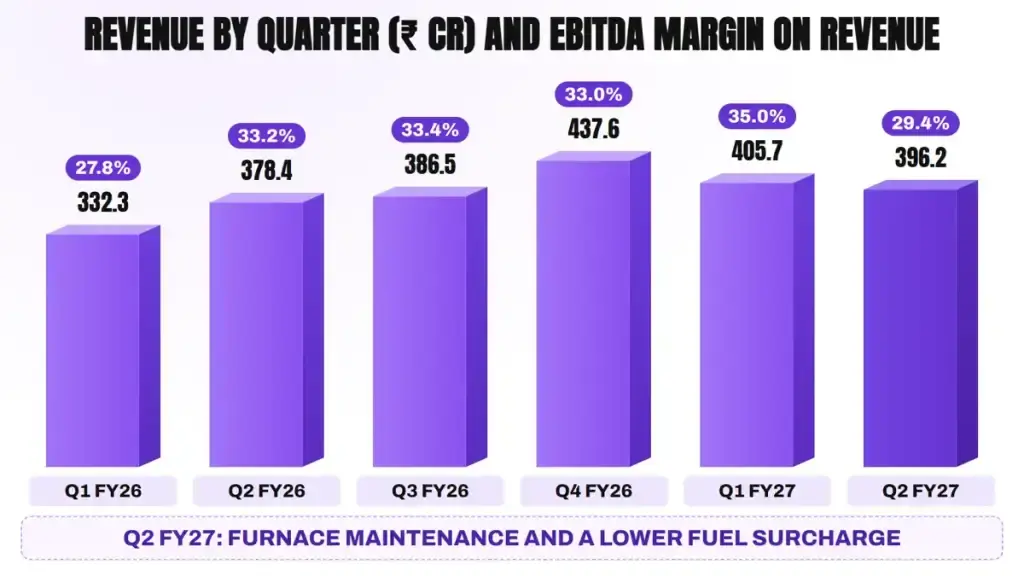
Second, the selling price slipped. Borosil's furnaces run on gas, and gas prices jumped after the war in West Asia began. In March 2026 the company asked its customers to pay a fuel surcharge, which is an extra charge on each square metre that covers part of the higher fuel cost. When gas prices eased in July, it cut part of that surcharge. The gas price soon went back up, but the surcharge had already been cut.
So the average selling price slipped to ₹155.9 per square metre per mm, from ₹160.3 in Q1 FY27, a dip of about ₹4.4. It was still higher than the ₹147.5 of Q2 FY26. Power and fuel cost was about ₹96.6 Cr in the quarter, or about 24.3% of revenue, against about 21.7% a year ago.
That fuel cost is not the only cost rising. Soda ash, which makes up about 30% to 32% of the raw material bill, rose about 10% in price. Dolomite and limestone of the grade the company needs are partly imported, and freight from China went up. Management says that apart from the fuel surcharge, there is no pass-through clause for these costs, so it has to offset them with efficiency.
You should also know that not all of the quarter's revenue was glass. Revenue included ₹14.1 Cr from a new business that sells rooftop solar kits, which brought almost no EBITDA. On solar glass sales of ₹382.1 Cr alone, the EBITDA margin was about 30.4%.
Then came the recovery. Management says production rose from the middle of September to its highest level so far, and October was an exceptionally good month. It is about 15% above the dip and 8% to 10% above the earlier level. In October the company also went back to its customers to restore the fuel surcharge.
If we look at the half year, the picture is steadier. H1 FY27 revenue was ₹801.8 Cr, up 12.8%, and EBITDA was ₹258.3 Cr, up 18.5%, at a margin of about 32.2%. Profit after tax for the half was ₹157.8 Cr, against a loss of ₹226.5 Cr in H1 FY26, when the company wrote off its German exposure.
The Balance Sheet Before the New Furnaces
Now let's look at the balance sheet, because the new furnaces will draw on it over the next two quarters. Read this How to Read a Balance Sheet In the quarter, holders of warrants paid the remaining 75% of their price and got 69,00,526 shares. That brought in about ₹274.3 Cr. Warrants are rights to buy shares later at a fixed price, and Borosil had issued them at ₹530 each in February 2025.
We should see that money as the last part of an equity raise that began in 2025. Borosil raised about ₹513.2 Cr through promoter shares and warrants at ₹530, and about ₹371.5 Cr through shares issued at ₹535 to other investors. Out of the first amount, ₹185 Cr went to settle a standby letter of credit that Borosil had given as security to the lenders of its German subsidiary.
So, in September 2026, the group had cash, bank balances and liquid investments of about ₹763.4 Cr. Borrowings were about ₹128.0 Cr, down from about ₹162.1 Cr in March. Net worth was about ₹1,944.8 Cr. Capital work in progress, the money spent on plant not yet in use, rose to about ₹348.5 Cr from about ₹107.6 Cr in March, almost all of it for the new furnaces.
How a Glassware Group Built India's First Solar Glass Line
Now that we have seen the quarter, let's go back to where the first solar glass line came from. The Borosil group has made glass for more than 60 years. It is best known for kitchen and laboratory glassware, which today sit in two other listed companies, Borosil Limited and Borosil Scientific Limited.
That group entered solar glass in 2008, when, as Executive Chairman P. K. Kheruka puts it, few people had heard of the product. In 2010 it set up India's first solar glass line, with a furnace of 180 TPD at Bharuch. A second furnace of 240 TPD and a rebuild of the first to 210 TPD took capacity to 450 TPD. In January 2020, the solar glass company, Gujarat Borosil, was merged into Borosil Glass Works, which was renamed Borosil Renewables, while the consumer and scientific glass businesses moved to Borosil Limited.
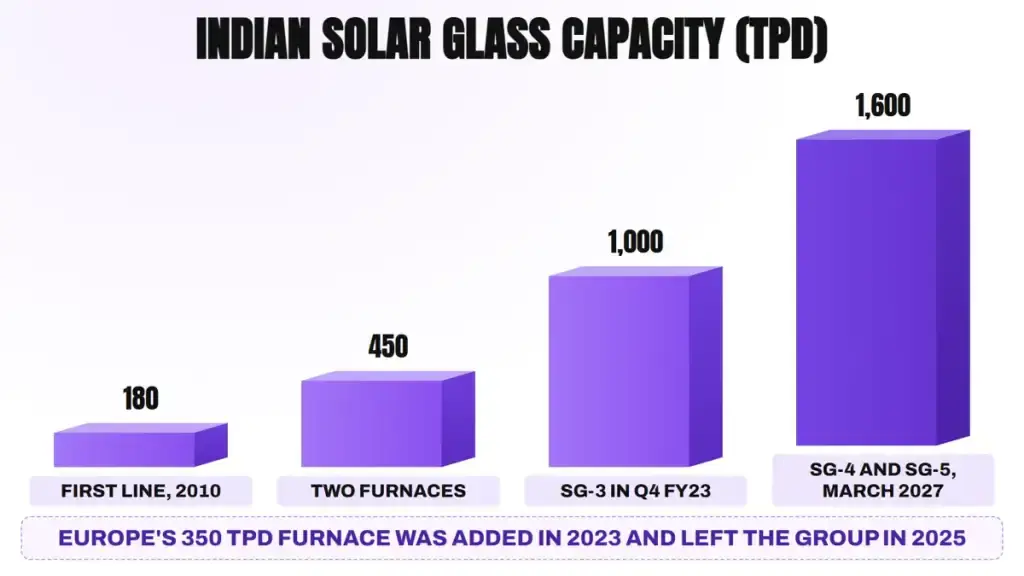
As you can see, that merged company then grew fast. A third furnace of 550 TPD began in Q4 FY23, taking Indian capacity to 1,000 TPD. Revenue of the Indian business grew from ₹644.2 Cr in FY22 to ₹1,534.8 Cr in FY26.

Those are the numbers of the Indian business on its own, and they show two very different years in the middle. Revenue grew in FY24 as the third furnace ran for a full year, but the margin came down to 12.0%. The reason was price. India's earlier anti-dumping duty on Chinese solar glass ended in August 2022, and Chinese glass flooded in at lower and lower prices.

That price slide shows clearly in the numbers. The average selling price went from ₹136.5 per square metre per mm in FY23 to about ₹109.1 in FY24. In Q3 FY25 it was down to about ₹105, which management says was about ₹42,000 a tonne. Without an anti-dumping duty, Borosil had to sell at whatever price Chinese glass landed at.
"When a management with a reputation for brilliance tackles a business with a reputation for bad economics, it is the reputation of the business that remains intact."
— Warren Buffett
In FY24 Borosil ran the same furnaces for the same customers, yet its margin came down to 12.0%. In a commodity like solar glass, the price that imports set decides much of the result.
Then the duty came back. On 4 December 2024 the government imposed a provisional anti-dumping duty on solar glass from China and Vietnam, in the form of a reference price below which imports pay extra duty. On 9 May 2025 it made the duty final, valid till 3 December 2029. Management called the first step a breath of oxygen for the company.
That duty shows up in every number after it. The selling price rose to ₹113.4 for FY25 and to ₹146.7 for FY26. The FY26 EBITDA margin of 32.0% was the highest in the table after FY22, and revenue grew 38.3%. Sales volume also rose 8% in FY26.
"When we entered the field of solar glass in 2008, it was a brand new field and few people only had heard about it." - P. K. Kheruka, Executive Chairman, October 2026
The German Detour
Now let's look at the costly detour that ran alongside that Indian growth. In October 2022 Borosil, through two wholly owned subsidiaries, bought 86% of Interfloat and GMB Glasmanufaktur Brandenburg, which the company described as Europe's largest solar glass maker, with a furnace of 300 TPD in Germany. It rebuilt that furnace to 350 TPD in 2023, taking group capacity to 1,350 TPD.
That timing did not work. European module makers lost out to cheap Chinese modules, demand for their glass shrank, and the German plant lost money. In Q4 FY25 the overseas companies had negative EBITDA of about ₹49.7 Cr. For FY25 as a whole, group EBITDA was ₹92.8 Cr, about ₹87.7 Cr less than the ₹180.5 Cr of the Indian business alone.

So in July 2025 GMB filed for insolvency in a German court, and Geosphere Glassworks, the German holding company, followed in December 2025. Borosil wrote off its whole exposure of about ₹325.9 Cr in FY26 and set aside about ₹33.9 Cr more against its Liechtenstein subsidiary, Laxman AG.
"All I want to know is where I'm going to die, so I'll never go there."
— Charlie Munger
The German plant showed where a solar glass maker can lose money: a high-cost market flooded with cheap imports. That lesson matters as Borosil decides its next step after the new furnaces. Management said the step would stop it from paying standing charges of about ₹9 Cr a month. Since then the overseas companies have earned almost nothing and lost very little: negative EBITDA of ₹0.11 Cr in Q2 FY27.
Glass, Coatings and a New Rooftop Line
Now let's split what Borosil sells, because even a single-product company has more than one kind of buyer. The company reports one segment, flat glass. Almost all revenue is solar glass, and a small new line sells rooftop solar kits.

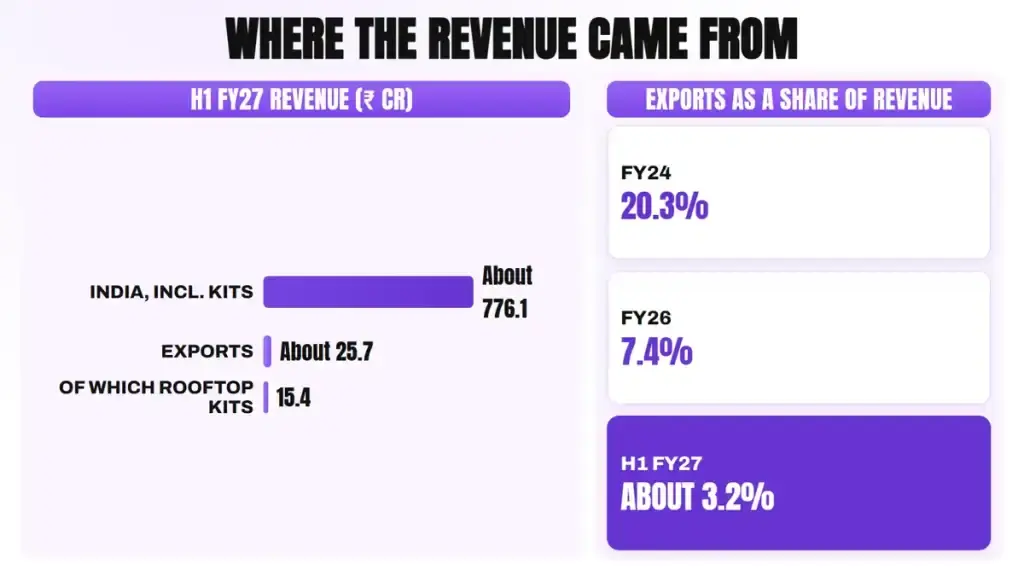
That table shows us how Indian the business has become. Exports were 20.3% of revenue in FY24, 7.4% in FY26 and about 3.2% in H1 FY27, as European demand shrank and Indian demand rose. Revenue from India is counted after kits, so the India figure above includes the ₹15.4 Cr of kits.
Solar Glass for Module Makers
Let's start with the main line. Borosil melts sand, soda ash, dolomite and limestone in its furnaces, rolls the glass into sheets with a light texture, and then toughens it with heat, which is called tempering. It can also add coatings that cut reflection or keep dust off the surface. Customers ask for different sizes, thicknesses and finishes, so the plant runs many product types.
That mix is moving to thinner glass. Many new panels have glass on both the front and the back, so each sheet has to be lighter. Borosil says it made the world's first fully tempered 2 mm textured solar glass, and that 2 mm glass rose to 75% of its production in FY26, with a target of 100% by Q4 FY27.
Its main buyers are Indian module makers, from small firms to the largest ones. Management says the company is already talking to new customers it could not supply so far because of limited capacity, so that the glass from the new furnaces has buyers on day one.
Exports to Europe and Turkey
Next, let's look at exports, once a fifth of the business. Borosil sells to customers mainly in Western Europe and Turkey, and has been reaching out to the Americas and the Middle East. Export sales were ₹199.78 Cr in FY24 and ₹113.29 Cr in FY26. In Q2 FY27 they were about ₹11.4 Cr, against about ₹45.6 Cr a year ago. Management says its main export markets still face low demand.
Rooftop Solar Kits, the New Line
Finally, let's look at the newest line. In 2026 Borosil began to sell complete rooftop solar kits under its own brand: panels above 600 W, inverters from 3 kW to 150 kW and lithium batteries, with installation and service. It buys the panels from its own glass customers, so each kit also uses Borosil glass.
That line is small and its margin is thin. It brought in ₹15.4 Cr in H1 FY27, and management says it is more like trading, with many competitors, so margins will stay low. It started in four states and plans to decide by the end of FY27 how far to take it.
Where Borosil Sits in the Solar Value Chain
Now let's place that glass in the wider solar chain. A solar panel starts as polysilicon, which is made into ingots and thin wafers. Wafers become solar cells. Module makers then join the cells and seal them between a sheet of solar glass on the front and a back sheet or a second glass, inside an aluminium frame. Developers install the modules on rooftops and in solar parks.
That chain is being built in India one step at a time, and the government sets the pace through ALMM, the Approved List of Models and Manufacturers. Projects covered by the rule have to use modules, and now cells, from makers on that list. ALMM for modules made India build module plants. ALMM-II, from 1 June 2026, does the same for cells, and ALMM-III from June 2028 is meant to cover ingots and wafers.

So India now has far more module capacity than it installs. Management says module capacity has reached 233 GW, against annual installations of about 62 GW on a DC basis, which is the panel capacity before conversion to grid power. India installed 44.6 GW of solar in FY26, its highest so far, and had about 171 GW in September 2026, against a target of 280 GW by 2030.
As we can see, glass is one of the gaps in that chain. The company's deck puts India's solar glass demand at 10,400 TPD, the glass for about 62 GW of modules, against domestic capacity of 2,900 TPD, or about 17.4 GW. That leaves a gap of 7,500 TPD, which is filled with imports. Management said in May 2026 that imports made up about 70% of glass use.
What the gap says: India uses glass for about 62 GW of modules a year but makes glass for only about 17.4 GW. Borosil's 600 TPD of new capacity is about 8% of today's 7,500 TPD gap.
Those new glass plants are coming. Domestic capacity is expected to rise to 7,900 TPD, or about 47.4 GW, by March 2027, much of it built by module makers for their own use. Even then, there would be a gap against today's demand. Customs duties keep the imports in check: the anti-dumping duty on China and Vietnam runs till December 2029, and in June 2026 the government extended a 9.71% countervailing duty on glass from Malaysia for five more years.
Why Borosil's Moat Is Hard to Copy
Now that we have seen the chain, let's understand the moat. Any module maker can buy imported glass. So why should it buy from Borosil, and why can a new rival not simply build a furnace and take the business? Read this Economic Moat Explained
One part is the furnace itself. A solar glass furnace is a large, slow project. It takes years to plan and build, a few months of trial runs before the glass is good enough, and then it has to run without a stop for about seven years before it needs a rebuild. Borosil has run solar glass furnaces in India since 2010, longer than anyone else, and management says it melts glass more efficiently than anywhere else in the world.
Another layer comes from product work. Borosil holds a patent for NoSbEra, which it calls the world's first textured solar glass made without antimony, a toxic element often used in glass. Its tempered glass withstands 180 MPa of stress, against the 90 MPa that the European standard EN 12150-1 asks for. A formal life-cycle study found a carbon footprint about 22% below the default benchmark for glass making.
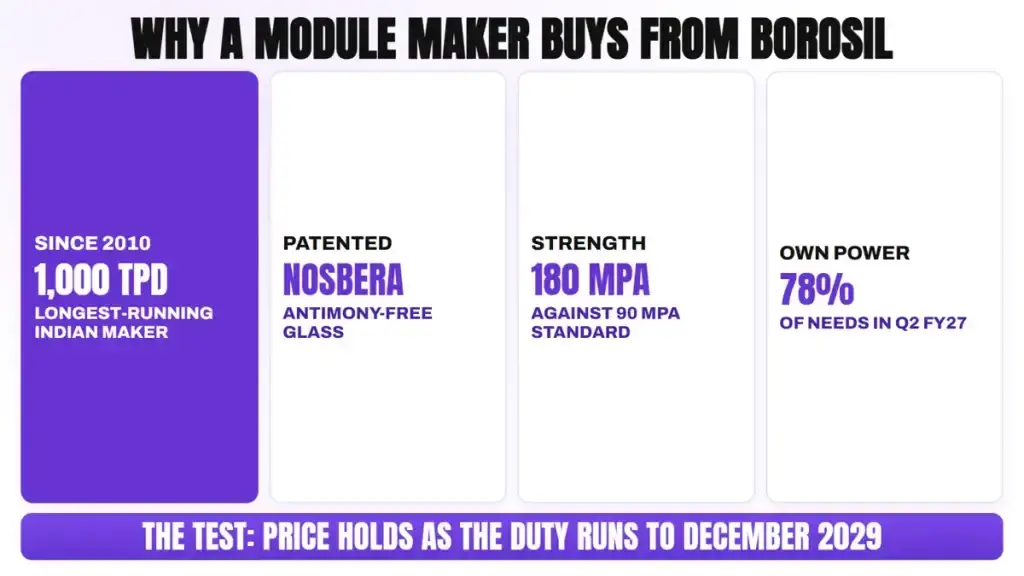
Beyond the product, cost matters. The new furnaces are being built at the existing site, which the company says saves about 20% on capital cost against a new site. Its own solar-wind hybrid power plant supplied about 78% of its power needs in Q2 FY27, and management says it saved close to ₹10 Cr in six months.
For you as an investor, customer ties are the last layer to check. Borosil is the largest merchant seller of solar glass in India, which means it sells to many module makers instead of making glass only for its own panels. A nearby supplier offers shorter lead times and more flexible order sizes than an importer.
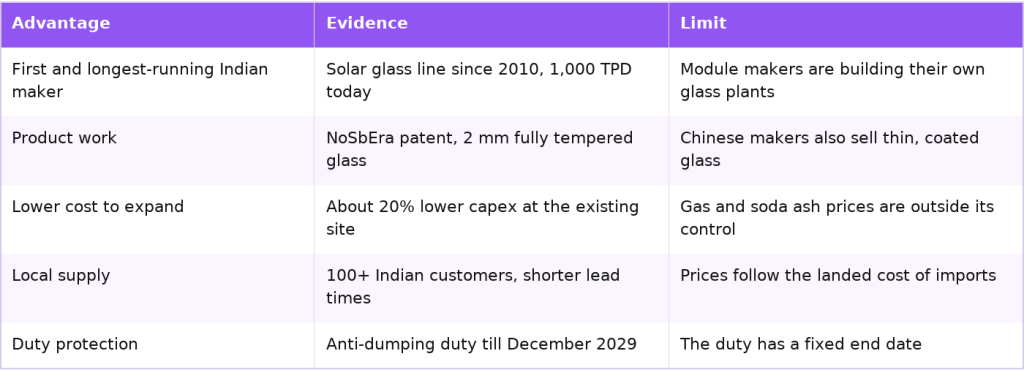
That table shows us why the margin is the real test of the moat. Before the duty came back, Borosil's margin went down to 12.0% even with the same furnaces and customers. With the duty, it rose to 32.0%. So the moat protects volume and quality, but the price still depends on what imported glass costs.
Financials: Five Years of Revenue, Margins and Cash Flow
One year can mislead in a business where an import duty moves the selling price, so let's look at the full years together. These are group (consolidated) figures; FY22 had no subsidiaries, so it shows the company alone. EBITDA here includes other income, as the company reports it, and the first half of FY27 is shown for comparison.

Revenue grew about 2.4 times in four years, from ₹644.2 Cr in FY22 to ₹1,555.8 Cr in FY26, as the third furnace came on and the German plant was part of the group for about three years. Profit did not follow the same path. The EBITDA margin went from 41.1% in FY22 to 5.4% in FY24, when Chinese glass pulled prices down and the German plant lost money, and then back to 29.9% in FY26 after the anti-dumping duty.
Cash flow has been steadier than profit. From FY22 to FY26, operating cash flow added up to about ₹758.7 Cr, against about ₹226.7 Cr of profit after tax, because depreciation and the German write-offs, which were largely non-cash, cut profit more than cash. In FY26 alone, operating cash flow was about ₹423.1 Cr against profit after tax of ₹127.4 Cr.
The balance sheet now carries little debt. Borrowings were about ₹128.0 Cr in September 2026, against cash, bank balances and liquid investments of about ₹763.4 Cr, after the equity raised in 2025 and 2026. Much of that cash is set aside for the new furnaces, so the next test is whether the company stays net cash after paying for them.
"Only when the tide goes out do you discover who's been swimming naked."
— Warren Buffett
FY24 and FY25 were Borosil's low tide: Chinese glass cut prices and the German plant lost money. The years since show how much of the recovery came from the duty and how much from the business itself.
What FY28 Could Look Like on Management's Numbers
So where does the business go from here? The plan is two new furnaces, SG-4 and SG-5, of 300 TPD each, at the Bharuch site. Management says it is on track to fire SG-4 in February 2027 and SG-5 in March 2027, and expects commissioning towards the end of Q4 FY27. That would lift capacity by 60%, from 1,000 TPD to 1,600 TPD, or about 10.5 GW of modules.
You should note that the project has grown in cost. In September 2026 the board raised the estimated cost by ₹150 Cr to about ₹1,100 Cr. Management says about 20% of the rise came from the rupee's slide against the dollar. Most of the rest went to fuel-saving equipment, which it says will pay for itself, and to extra backup against power failures. The money is in place: about ₹800 Cr from equity and internal funds, and a ₹300 Cr loan signed earlier but not yet drawn.

Now let's put the new capacity against the revenue. The company's deck puts revenue at about ₹2,500 Cr at a full-year run rate after the expansion, about 60% more than the ₹1,535 Cr of FY26. Management expects about 2% to 3% of extra EBITDA margin from spreading fixed costs over more glass. It also says the company should remain net cash positive in March 2027, even after paying for the whole project.
That plan has one known gap in FY28. The two older furnaces, SG-1 and SG-2, have run for seven years and may need rebuilds. Management expects to take them down one at a time for about 75 days each, most likely in the first half of FY28. It says the rebuilt furnaces should give more glass than before, and the new furnaces will be running by then. But the Chairman calls any promise to make up the lost volume speculative.
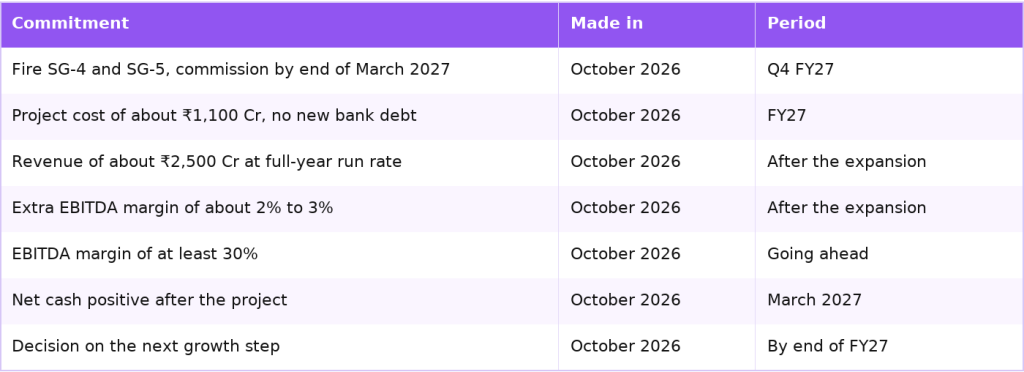
Those commitments are easier to judge against the past. So let's check what management said before against what happened.

That record shows us a clear pattern. Management has read the market well, and the demand it expected has arrived. Its own project dates have slipped, by about six months from the first target, and the cost has risen. The margin depended more on the duty than on anything the company guided. So the furnace dates and the margin after the rebuilds are the numbers to watch from here.
Key Risks
Now let's look at what could go wrong for Borosil, because the last four years have already shown several of these risks.
- Duty and import prices: the margin fell to 12.0% in FY24 when there was no duty. The anti-dumping duty on China and Vietnam ends in December 2029, and a change in the duty, or imports from other countries, would hit prices.
- Captive glass capacity: module makers are building glass plants for their own use, and domestic capacity is expected to rise to 7,900 TPD by March 2027. If they buy less glass from Borosil, the extra 600 TPD would need new buyers.
- Fuel and raw material costs: power and fuel took about 24.3% of revenue in Q2 FY27, and soda ash rose about 10% in price. The fuel surcharge depends on customers agreeing to it, and there is no pass-through for other costs.
- Project delay and cost: the commissioning date has moved from September 2026 to the end of March 2027, and the cost has risen to about ₹1,100 Cr. A new furnace also needs a few months of trial runs before it makes saleable glass.
- Furnace rebuilds in FY28: SG-1 and SG-2 may be shut for about 75 days each in H1 FY28, so FY28 may not get the full benefit of the new capacity.
- One product: almost all revenue comes from solar glass for one industry. A slowdown in solar installations would hit volume and price together.
- Low-margin new line: the rooftop kit business is more like trading and carries a thin margin, so growth there would pull down the overall margin.
- Germany and tax: the German insolvency proceedings are not concluded yet. Separately, an income tax demand of about ₹19.5 Cr for assessment year 2016-17 was quashed by the Bombay High Court, but the matter has not been finally closed.
"This is a speculative answer. We cannot guarantee that we make up the volume loss." - P. K. Kheruka, Executive Chairman, October 2026
"Risk comes from not knowing what you're doing."
— Warren Buffett
For Borosil, the main risks are known: the duty, the price of gas, the module makers' own glass plants and the furnace dates. The list below sets out each one.
Explore our Products
Research Framework

Emerging Titans
Combination of quantitative analysis, industry tailwinds, and management assessment - SPRINT investment philosophy

Tiny Titans
Heavy emphasis on scuttlebutt research, plant visits, and early on-ground signals
What to Track Next
If you follow Borosil Renewables, these are the signals that will show where it goes next.
- The EBITDA margin in Q3 FY27, against about 29.4% in Q2 and management's aim of at least 30%
- The average selling price after ₹155.9, and whether the fuel surcharge holds
- Firing of SG-4 in February 2027 and SG-5 in March 2027, and the final cost against about ₹1,100 Cr
- The timing of the SG-1 and SG-2 rebuilds in FY28
- New solar glass plants of module makers, against the 7,900 TPD expected by March 2027
- Any change to the anti-dumping duty that runs till December 2029
For the other listed solar and wind companies, from glass and cells to turbines and power producers, see Renewable Energy Stocks in India 2026: Solar and Wind.
Conclusion
Let's put it all together. Borosil Renewables built India's first solar glass line in 2010 and now runs 1,000 TPD at Bharuch. After two lean years, when Chinese glass pushed its margin down to 12.0%, the anti-dumping duty lifted its selling price and its EBITDA margin to 32.0% in FY26. It has also closed the costly German chapter and raised the money for a 60% expansion. The cautious thread is that the margin depends on a duty with an end date and on gas prices the company cannot control. The next two quarters, and the first glass from SG-4, will show which way it leans.
Still, the next step is bigger than one good year. What happens next depends on whether the two new furnaces start on time in early 2027, whether the margin holds once module makers' own glass plants come up, and whether the duty that lifted prices stays in place.
FAQs
What does Borosil Renewables make?
+Borosil Renewables makes solar glass, the special glass sheet that covers the front of solar panels. It runs three furnaces with 1,000 TPD of capacity at Bharuch in Gujarat, enough for about 6.5 GW of modules a year, and supplies more than 100 module makers in India. In 2026 it also began to sell rooftop solar kits.
How did Borosil Renewables do in Q2 FY27?
+Revenue from operations rose 4.7% to ₹396.2 Cr, and EBITDA came down 7.3% to ₹116.3 Cr, as furnace maintenance cut production by close to 4.5% and a lower fuel surcharge reduced the selling price to ₹155.9 per square metre per mm. Profit after tax rose 53.1% to ₹70.1 Cr. For H1 FY27, revenue was ₹801.8 Cr, up 12.8%.
Why did Borosil's margin rise after FY25?
+In December 2024 India put an anti-dumping duty on solar glass from China and Vietnam, valid till 3 December 2029. Borosil's selling price rose from ₹113.4 per square metre per mm in FY25 to ₹146.7 in FY26, and its EBITDA margin rose from 16.3% to 32.0%.
What is Borosil's expansion plan?
+Borosil is adding two furnaces, SG-4 and SG-5, of 300 TPD each at Bharuch, lifting capacity from 1,000 TPD to 1,600 TPD. Management plans to fire them in February and March 2027, at a cost of about ₹1,100 Cr. It expects revenue of about ₹2,500 Cr at a full-year run rate after the expansion.
What happened to Borosil's German subsidiary?
+In October 2022 Borosil bought 86% of Interfloat and GMB, a solar glass maker in Germany. The German plant lost money as European demand shrank, and GMB filed for insolvency in July 2025. Borosil wrote off its exposure of about ₹325.9 Cr in FY26.
What are the main risks for Borosil Renewables?
+The margin depends on the anti-dumping duty, which ends in December 2029, and on gas and soda ash prices. Module makers are building their own glass plants, and domestic capacity is expected to rise to 7,900 TPD by March 2027. The new furnaces have been delayed to March 2027, and the two older furnaces may need rebuilds of about 75 days each in FY28.

High growth stock specialist, Value Educator
Shashank Mahajan is an equity research professional with over 12 years of experience in identifying high-potential SME and micro-cap stocks at an early stage. He follows a rigorous scuttlebutt research–driven approach, combining on-ground insights with deep financial analysis. Shashank specializes in uncovering under-researched and under-owned companies with strong management quality and long-term growth potential. Through disciplined research and early identification, he focuses on spotting tomorrow’s market leaders before they enter the mainstream investor radar.
More about Shashank Mahajan →
Azad Engineering vs MTAR vs Unimech: Aerospace Parts

Subros vs Lumax Auto vs Sona BLW: EV Auto Parts Compared
Jyoti CNC vs Macpower CNC: Machine Tool Makers Compared

Data Patterns vs Astra Microwave vs Apollo Micro

Himadri vs PCBL: Carbon Black and Battery Materials

Inox Wind vs Suzlon: Wind Turbine Makers Compared
Explore our Products
Research Framework
Emerging Titans
Combination of quantitative analysis, industry tailwinds, and management assessment - SPRINT investment philosophy
Tiny Titans
Heavy emphasis on scuttlebutt research, plant visits, and early on-ground signals



India's Aerospace Opportunity
Global Demand. Supply Bottlenecks. Opportunities Ahead.
Don't Miss This Exclusive Webinar!
Join Value Educator to decode the key trends shaping India's aerospace sector and learn how to identify tomorrow's potential leaders in the space.
- How the aircraft value chain works, layer by layer
- Indian companies supplying global aircraft makers
- A framework to judge any aerospace company

 Orders
 Subscription
 Share with friends


Required Details
₹23999.00
(12 month subscription)
As per SEBI regulations, all users are mandated to complete the KYC that is validated for 1 year. Post payment, you will be redirected to the KYC screen


No comments yet. Be the first to comment!