
Centum Electronics: Radar, Space Electronics and EMS
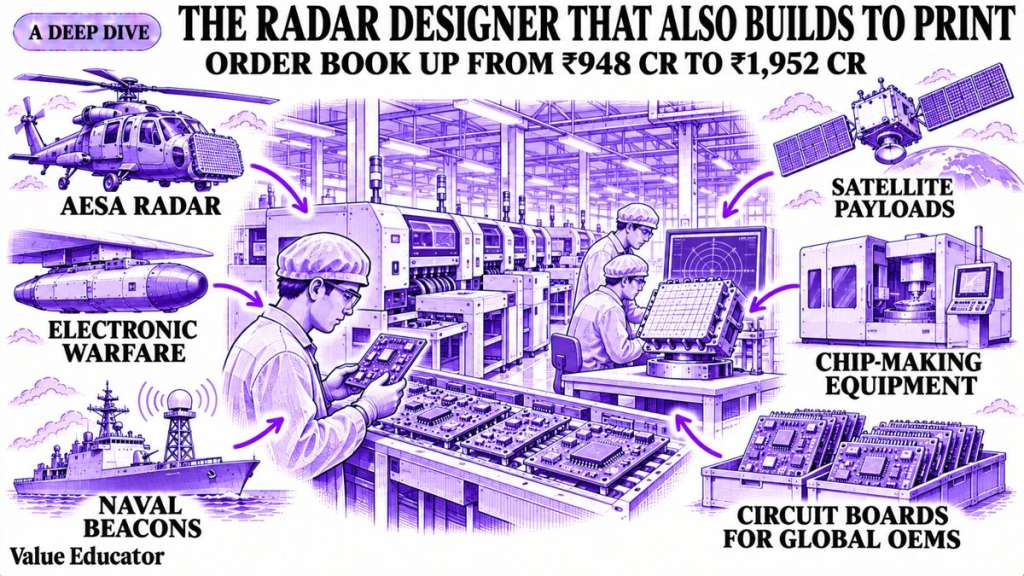
When ISRO's GSLV-F17 rocket put the GISAT-1A satellite, also called EOS-05, into orbit, more than 200 of the subsystems and modules on board came from one Bengaluru company. ISRO's leadership publicly recognised that work. In late 2025, the same company had delivered close to 400 critical modules for the CMS-03 satellite, which an LVM3 rocket carried up.
So how does a Bengaluru electronics maker end up with hundreds of parts on a satellite? It comes down to two very different ways of making electronics. The first way is build to specification. Build to specification means the customer only says what the product must do, such as what a radar must detect, how much it may weigh and what heat it must survive. The maker then designs the electronics itself, proves them in tests and keeps the design. So when the product goes into production, the orders come back to the company that designed it.
Then comes the second way, build to print. Build to print means the customer hands over a finished design, and the maker builds it exactly as drawn, at the agreed cost. This is the work of electronics manufacturing services, or EMS. Here the design belongs to the customer, so the maker earns a smaller margin on each board, but the orders repeat for years.
That electronics maker is Centum Electronics Ltd (NSE: CENTUM). Mallavarapu Venkata Apparao founded it in Bengaluru in 1993, and it runs both businesses side by side. Its build-to-specification arm, which it calls BTS, designs radar parts, electronic warfare systems and satellite payloads for India's defence and space programmes. Electronic warfare means using radio signals to find, track or jam an enemy's radars and communications. Its EMS arm builds circuit boards and complete boxes for global equipment makers in defence, aerospace, rail, industry, healthcare and semiconductor equipment.
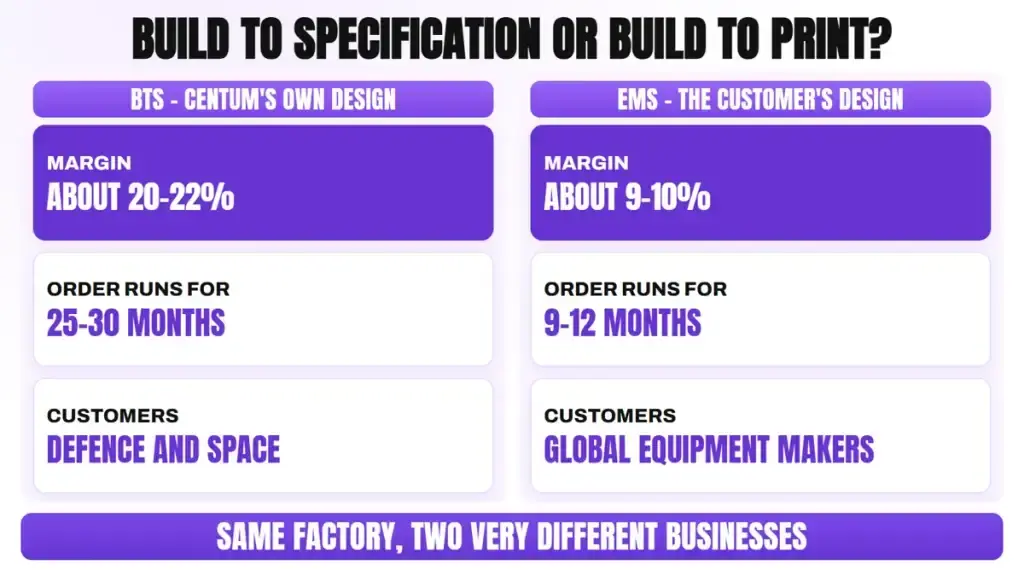
Those two businesses earn very different margins. Management puts the BTS margin at about 20-22%, and the EMS margin at about 9-10%. So the mix between the two decides how much of each rupee of revenue Centum keeps.
Centum Electronics in five numbers
- Q2 FY27 revenue of ₹312.1 Cr, up 51.9%, with BTS revenue up 84%
- An order book of about ₹1,952 Cr in September 2026, up about 37.8% in a year
- A BTS order book of about ₹959 Cr, about 3.5 times FY26 BTS revenue
- FY26 revenue of ₹973.1 Cr, up 25.4%, at an EBITDA margin of 12.42%
- Semiconductor equipment revenue of over ₹100 Cr in FY26, up from almost nothing in FY25
So a company with parts on India's satellites also runs a contract electronics business, and in 2026 it sold its French engineering arm in a court process. Let's first understand the company, and then look at the latest quarter, where the higher-margin business finally picked up.
Centum Electronics: Company Overview
Centum Electronics Ltd was founded in 1993 by Mallavarapu Venkata Apparao, who is its Chairman and Managing Director, and it is based in the KHB Industrial Area at Yelahanka in Bengaluru. Nikhil Mallavarapu is the Joint Managing Director and Sundararajan Parthasarathy the Chief Financial Officer. The company designs and makes high-reliability electronics in two businesses: build to specification, its own designs for defence and space, and electronics manufacturing services for global equipment makers. It has about 3,50,000 sq ft of manufacturing space, about 1,800 employees and 17 granted patents, and exports make up about 54% of revenue. The promoters held 46.81% of the shares in September 2026. Since June 2026, when its French and Canadian subsidiaries left the group, the business is run from India alone, with FY26 revenue of ₹973.1 Cr and an order book of about ₹1,952 Cr in September 2026. Read this Data Patterns: India's Radar Designer
"The stock market is filled with individuals who know the price of everything, but the value of nothing."
— Philip Fisher
Centum's value lies in designs that pass years of defence and space qualification. Those designs do not show up in one quarter's numbers, which is why this post looks at the order book and the mix as closely as the profit.
The Quarter Build-to-Spec Came Back
Let's look at Q2 FY27, the July to September quarter, which Centum reported on 4 November 2026. It was the quarter in which its build-to-spec business came back. Revenue was ₹3,121 Mn, up 51.9% from ₹2,055 Mn a year ago and up 52.4% from the June quarter. Since the overseas companies left the group in June 2026, the standalone numbers are now the whole company.
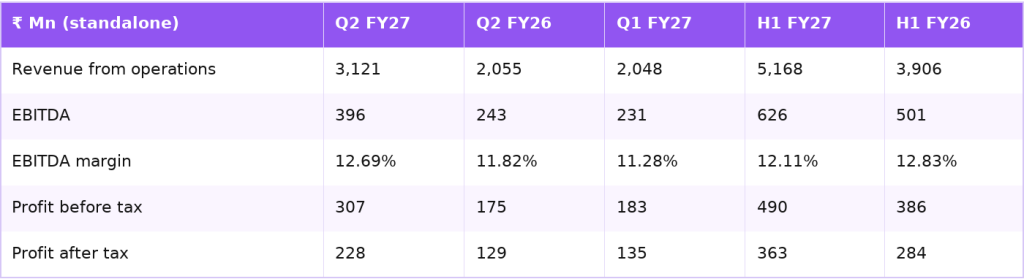
That jump came mostly from BTS. BTS revenue rose 84% from a year ago, as Centum delivered on its radar electronics and space programmes. We can work out the BTS share from the company's half-year split. BTS brought in about ₹1,002 Mn in Q2, or about 32.1% of revenue, against about 27.6% in the June quarter.
Alongside BTS, EMS grew by 41% from a year ago, to about ₹2,118 Mn. Deliveries rose to the semiconductor equipment customer and to the new customers added over the past year. So both businesses grew in the same quarter, which is why revenue rose so sharply.
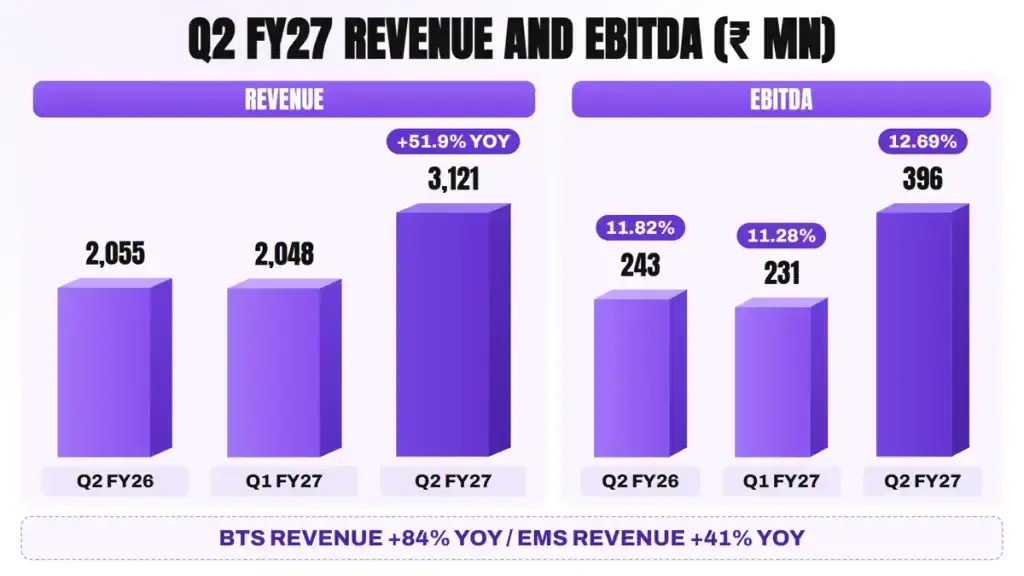
Profit grew even faster than revenue. Read this EBITDA Explained: Uses and Limits EBITDA rose 63% to ₹396 Mn, and profit after tax rose 76.7% to ₹228 Mn. The EBITDA margin came in at 12.69%, against 11.82% a year ago.
That margin still looks low for a quarter led by BTS. Management gave a simple reason. The BTS programmes delivered this quarter used more bought-in material than last year's, so their margins were lower than the usual range. The CFO said the BTS margin swings from programme to programme, but stays about 20-22% over time.
So for the half year, revenue was ₹5,168 Mn, up 32.3%. The EBITDA margin was 12.11%, a little below 12.83% in H1 FY26, because the June quarter was slower. In Q1 FY27 the BTS share was about 27.6%, as programmes moved into later months.
The Orders Behind the ₹1,952 Cr Book
Now let's look at the orders, because in a business like this they decide the next two years. The order book stood at ₹19,522 Mn in September 2026, about ₹1,952 Cr, against ₹14,171 Mn a year earlier. That is a rise of about 37.8%.

So the order book has roughly doubled since March 2023, about 2.1 times in three and a half years. Most of that growth came from BTS, which rose from ₹3,765 Mn to ₹9,587 Mn. The BTS book grew about 46.6% in the last year, and the EMS book about 30.2%.
"Know what you own, and know why you own it."
— Peter Lynch
Centum owns two businesses with very different margins and clocks. Knowing which half of the order book is growing tells you more about its future than the total does.
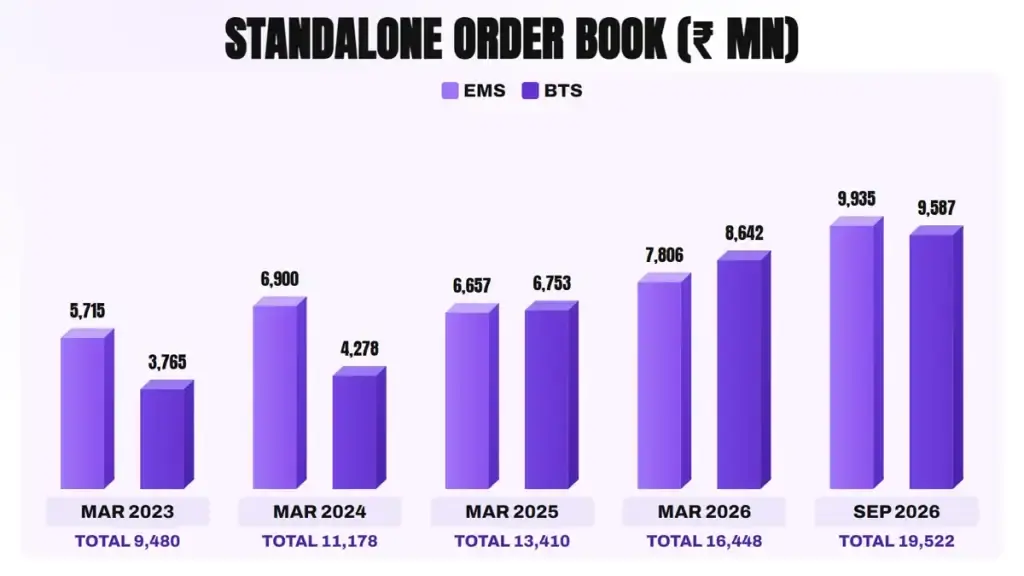
Those two halves of the book also run on different clocks. A BTS order is usually executed over 25 to 30 months, while an EMS order runs for 9 to 12 months. The EMS figure also counts only firm purchase orders, not the longer forecasts that customers share. So a BTS book of about ₹959 Cr is about 3.5 times FY26 BTS revenue, while the EMS book covers a little over a year.
We can also work out the new orders from the book and the revenue. In Q2 FY27, Centum booked about ₹4,671 Mn of new orders, of which about ₹1,335 Mn were BTS. That quarter's wins included:
- An export order of USD 3.22 million, about ₹305 Mn, for a core electronic warfare subsystem for a global equipment maker. It is Centum's first large BTS order from abroad, and it has to be delivered over seven months.
- A follow-on order of about ₹515 Mn from GRSE for TACAN beacon systems for warships, after a first order of ₹29.40 Cr in January 2026.
- Satellite payload electronics, as orders under the space-based surveillance programme began to come in during the half year.
That TACAN system is a radio beacon on a ship that tells an approaching aircraft its bearing and distance. Centum makes it under a technology partnership and adds its own design work to localise it. Management says it sees a healthy pipeline of further orders for these systems.
What the order book says: BTS was about 28.5% of FY26 revenue but about 49.1% of the September 2026 order book. Because BTS orders take two years or more to deliver, that gap shows up in revenue only slowly, which is why management talks about growth over several years rather than one quarter.
That order book comes with a heavier balance sheet. Inventory rose from ₹4,568 Mn in March 2026 to ₹5,381 Mn in September, as Centum bought parts early to beat long lead times. Customer advances paid for about half of the net inventory, the company says. Borrowings were ₹1,335 Mn, against cash of about ₹1,270 Mn, of which about ₹490 Mn was restricted. Receivable days improved by nine days to 106, after a collection drive in September. Read this Days Sales Outstanding (DSO) Explained
Why the French Exit Changed the Numbers
Now that we have seen the quarter, let's go back and see why the reported numbers looked so different a year ago. For years Centum ran two kinds of business abroad. It owned an engineering services group in France, Centum T&S Group, held through a UK company, and it had subsidiaries in Canada. The French group did outsourced design and engineering work for European customers, which the industry calls engineering research and development services.
Those overseas companies cost the group money. In FY25 and FY26 the consolidated accounts carried a hit of ₹523 Mn and ₹1,525 Mn from these discontinued operations. Consolidated profit after tax was negative in FY24, FY25 and FY26, even as the Indian business earned a profit before exceptional items every year.
"That allows us to really capitalize and focus on the opportunities that we have with our India platform for the ESDM business." - Nikhil Mallavarapu, Joint Managing Director, May 2026
So in December 2025 the board shut the Canadian subsidiaries. In March 2026 the French subsidiary entered a court-supervised restructuring in Lyon, called a redressement judiciaire. Management said that Europe's slow economy, low demand for engineering services, price pressure and a stretched balance sheet had blocked a turnaround.
That exit was costly on paper. In FY26 the standalone accounts took an exceptional charge of ₹2,033.07 Mn, about ₹203 Cr. It wrote off the full ₹1,537.83 Mn investment in the French group and ₹396.00 Mn of money owed by the Canadian companies. That charge is why FY26 standalone profit after tax shows a loss of ₹1,171 Mn, although profit before exceptional items was ₹1,004 Mn.
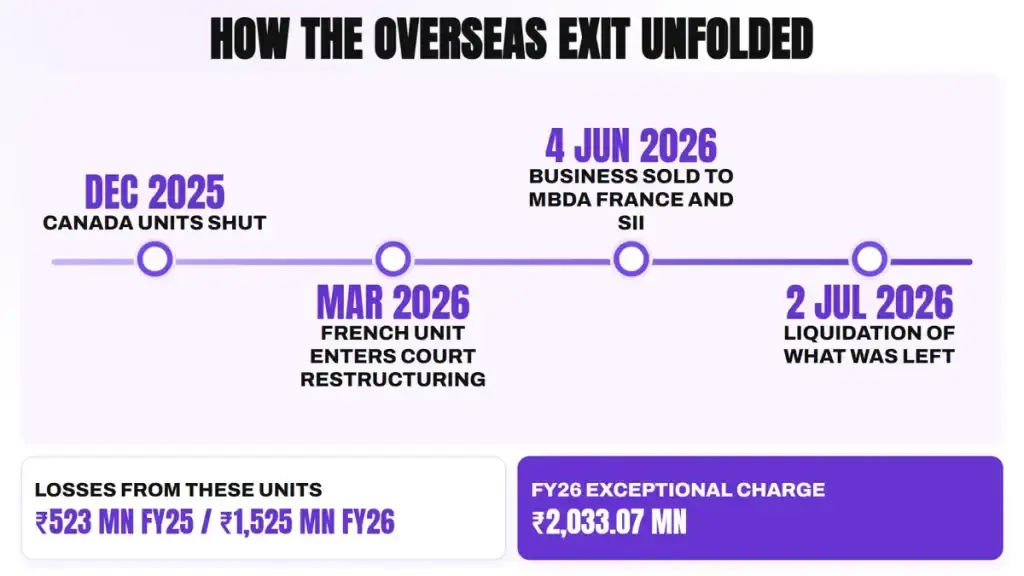
Then the court process ran its course. On 4 June 2026, the court in Lyon approved the transfer of the French operating business and its employees to two bidders, MBDA France and SII. The French companies left the group's accounts that day, and the court turned the case into a liquidation on 2 July 2026. Centum booked a one-time gain of about ₹94 Cr on leaving those companies, whose liabilities had been larger than their assets. Management says it expects no further liabilities from them.
"Should you find yourself in a chronically leaking boat, energy devoted to changing vessels is likely to be more productive than energy devoted to patching leaks."
— Warren Buffett
Centum tried for years to turn around its French business before letting a court sell it. The exit was costly on paper, but it stopped the losses that had hidden the Indian business.
So from Q2 FY27 the consolidated and standalone numbers are almost the same. That is why this post uses the standalone figures throughout. Centum's own engineering services team, first set up to work for the French business, now designs products for its EMS customers.
Two Businesses With Very Different Margins
Now let's split Centum into its two businesses, which management runs as two engines. Centum reports one segment, electronics system design and manufacturing, but its presentations show revenue and orders for BTS and EMS separately. Read this Segment-Wise Revenue Analysis Explained
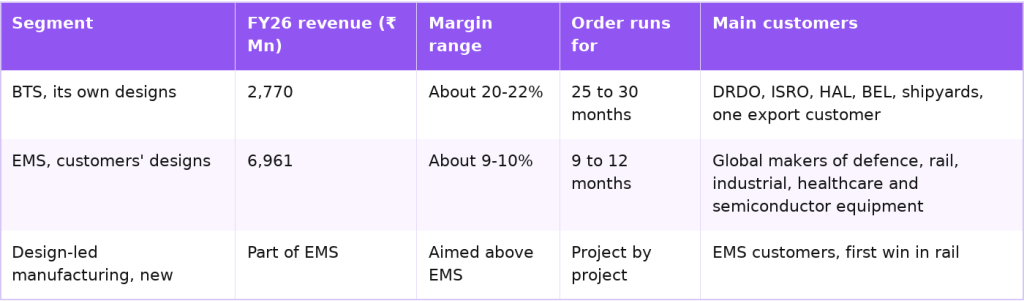
As you can see, these two lines share one factory floor but run on different economics. BTS grew 37.3% in FY26 and EMS grew 21.2%. Over FY23 to FY26, BTS revenue grew from ₹1,467 Mn to ₹2,770 Mn, while EMS grew from ₹3,538 Mn to ₹6,961 Mn.
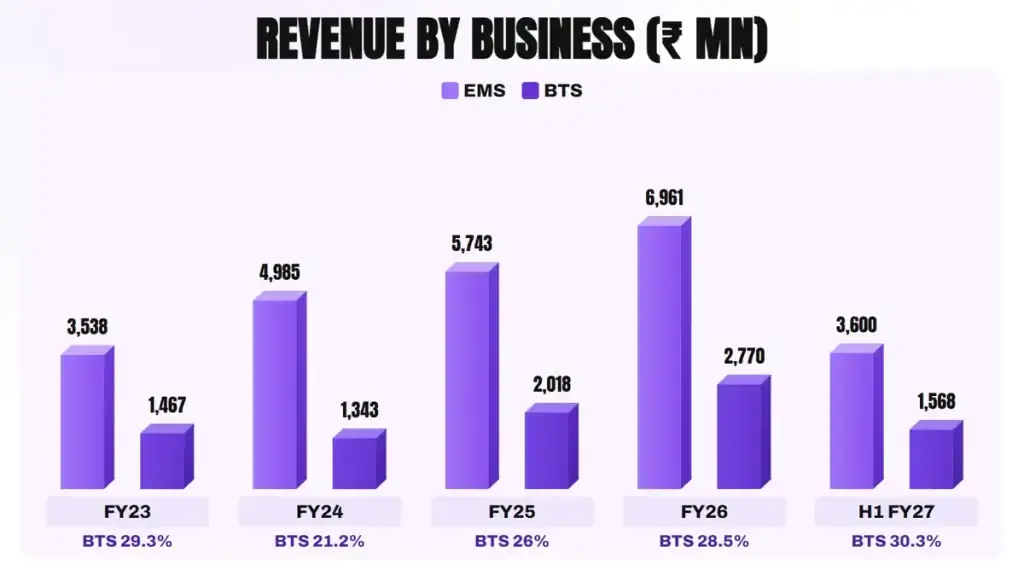
That mix has barely moved, though. BTS was about 29.3% of revenue in FY23, dipped in FY24, and was about 28.5% in FY26 and about 30.3% in H1 FY27. Management expects the share to tilt only a little towards BTS in the next year or two, because EMS is growing fast too.
Build to Specification for Radars and Payloads
Let's start with build to specification, or BTS, the smaller but higher-margin engine. Almost all of its revenue comes from defence and space. Centum moves up a ladder in this business, from components to modules, then subsystems, and now complete systems.
Space is the oldest rung. Centum has worked on India's space programme for close to 25 years, and today it builds complete payloads, the instrument part of a satellite. In 2024 it won its largest space order so far, about ₹300 Cr of electronic warfare payloads for a constellation of three military satellites. Management says the customer has signalled a need for more such constellations. It is now booking orders under the space-based surveillance programme as well.
Next comes radar, the newest rung and the largest bet. An AESA radar, short for active electronically scanned array, steers its beam electronically through hundreds of small transmit and receive modules instead of a moving dish. In February 2026, HAL ordered Centum to design and develop a complete AESA radar for its Utility Helicopter - Maritime. The first phase is a ₹66 Cr purchase order to design and qualify the radar over about two years. The second phase, to make the radars over five years, has an indicative value of ₹500 Cr.
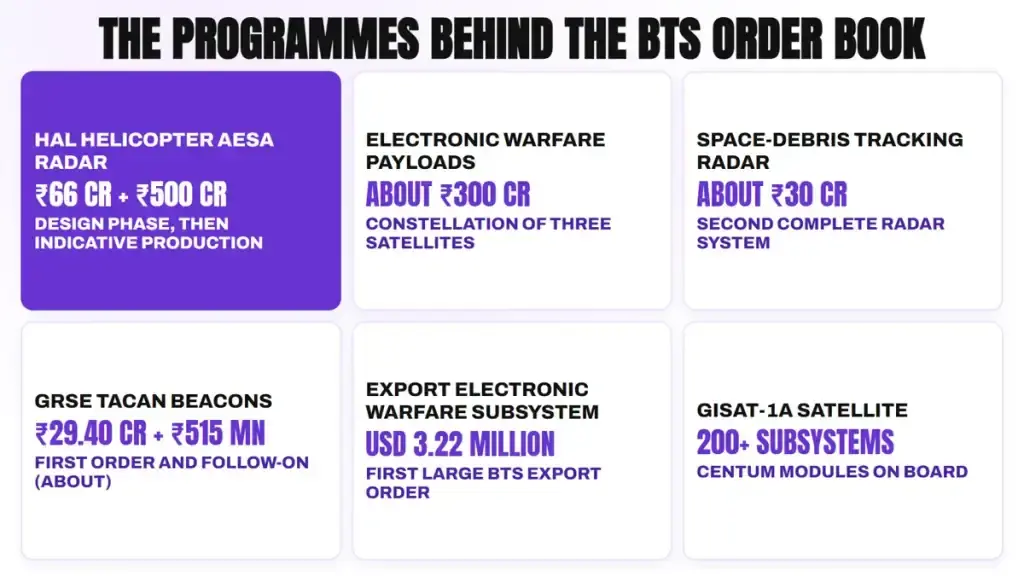
That HAL order is a complete system, from design to certification on the helicopter. Centum also holds an order of about ₹30 Cr for a long-range radar that tracks space debris, its second complete radar system. In a third radar programme, it designs two of the four main subsystems, the antenna array and the exciter-receiver, under a development contract worth less than ₹10 Cr.
Those development orders are small, but they lead to larger production orders. A BTS programme usually begins with a development order, often for about two years of design and qualification. If the product passes, the production orders follow for years, and they go to the company that owns the design. Management says it is also close to repeat production orders for radar and electronic warfare subsystems it has already designed.
Then there is export. Most foreign defence customers want the design work done in their own country, so subsystem orders from abroad are hard to win. The September 2026 order of USD 3.22 million is Centum's first large one, and management expects repeat orders from the same customer. It is also in early talks with a European customer on a similar model.
"The key is to first sell it in India before we can start selling abroad." - Nikhil Mallavarapu, Joint Managing Director, November 2026
Build to Print for Global Equipment Makers
Next, let's look at EMS, the build-to-print business and the one that pays the bills. Here Centum builds circuit board assemblies, complete boxes and line-replaceable units to its customers' designs. Its products range from electronics for a fighter aircraft's electronic warfare suite to battery management systems, digital X-ray machines and grid communication equipment.
These customers rarely switch suppliers. About 30% of revenue comes from customers Centum has served for more than 20 years, and another 40% from customers of 10 to 20 years. Exports make up about 54% of revenue. The flip side is concentration. In FY26 two customer groups brought in ₹4,243.78 Mn, about 43.6% of revenue, and the top five more than 65%.
Today the fastest-growing part is semiconductor equipment. Centum builds boards and boxes that go into the machines that make computer chips, for one of the few global makers of those machines. That business was almost nothing in FY25 and earned over ₹100 Cr in FY26. In Q2 FY27 Centum won a new programme from the same customer, taking it from a supplier in Southeast Asia.
Management now expects that business to reach about $45-50 million a year in about two years, above its earlier estimate of $25-30 million. The demand comes mainly from the build-out of AI data centres, which need more chips. Most of it still comes from one anchor customer, and talks with others are at an early stage.
Centum also added three new EMS customers in Q2 FY27. One is a large global rail supplier that is moving its braking and platform door electronics to India, with Centum as its first EMS partner here. Another is a German maker of measuring machines, and the last is a Middle Eastern defence customer making drones. Management expects each to reach at least $10 million a year within two to three years.
These EMS wins also have a cost. EMS margins stay at about 10% because the work is priced on cost plus a margin. So Centum is trying a third route, design-led manufacturing, where it designs a product for an EMS customer and then builds it. It uses the engineering team kept from the French business for this, and won a first such programme in rail.
Why a Qualified Defence Electronics Maker Is Hard to Copy
Now that we have seen both businesses, let's understand the moat. In defence and space, a part that fails can lose a satellite or a radar, so buyers stay with makers they have already qualified. That qualification takes years, and it is earned one programme at a time. Read this Economic Moat Explained
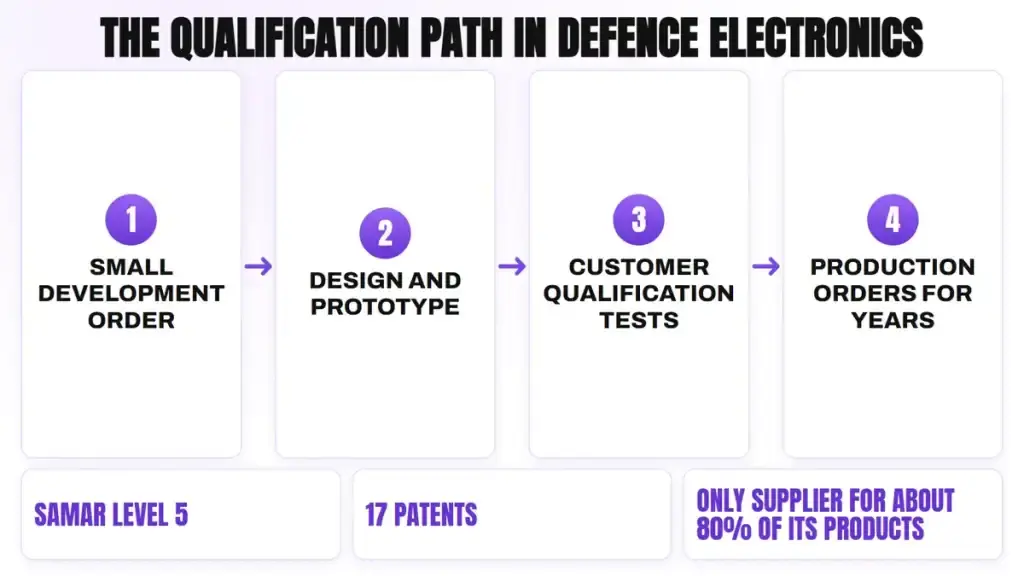
Each step is slow to clear. A new supplier first wins a small development order, then designs the product, then passes the customer's environmental and reliability tests. Only after that do production orders come, often for a decade. Centum holds the SAMAR level 5 certification, the highest level DRDO uses to pick suppliers for its tenders. It also holds medical, automotive and information security certificates.
That same logic works in EMS, as we saw. Centum says it is the only supplier for about 80% of the products it makes. A customer who has qualified one of its boards would have to test a new supplier again before switching. Management says the semiconductor win, which displaced a supplier in Southeast Asia, shows its quality against global EMS players.
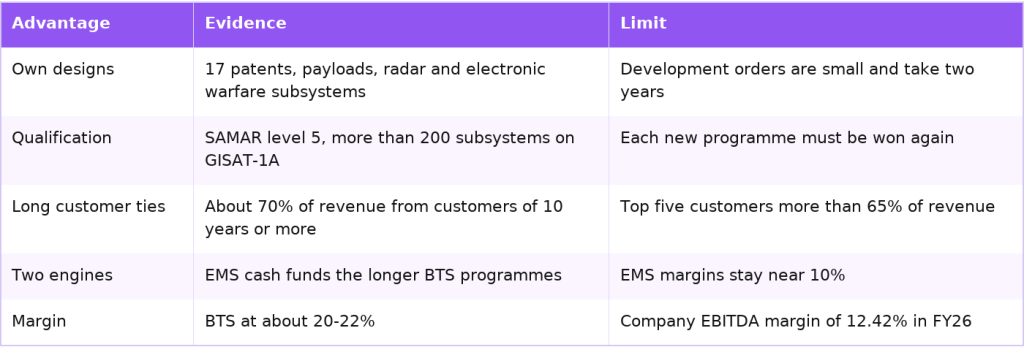
That table also shows why the margin is the test of the moat. A company with its own designs should earn more as BTS grows. So far the standalone EBITDA margin has stayed between about 10.71% and 12.44% for five years, because BTS has stayed under a third of revenue.
Financials: Five Years of Growth, Margins and Cash
One quarter can mislead in a programme business, so let's look at five full years together. These are standalone figures, which now cover the whole company. FY23 and FY24 are before the merger of Centum T&S Private Limited, and FY25 is as restated after it.
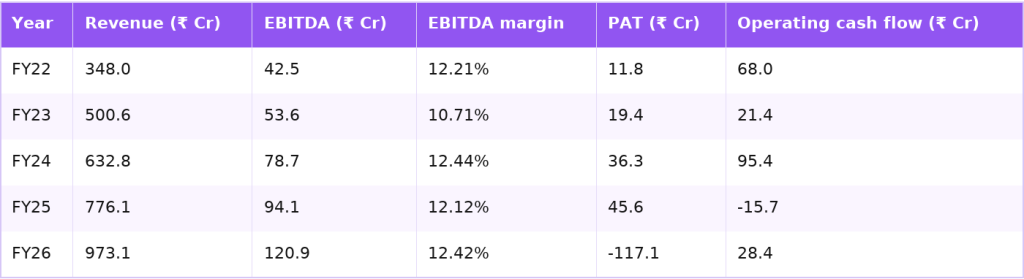
Revenue grew about 2.8 times in four years, from about ₹348.0 Cr in FY22 to ₹973.1 Cr in FY26, and EBITDA grew at about the same pace. That is why the margin has stayed in a narrow band of about 10.7% to 12.4%. FY26 profit after tax was a loss only because of the one-time charge of about ₹203 Cr for the overseas exit; profit before exceptional items was about ₹100.4 Cr.
Cash flow is the weak spot in the table. Over the five years, operating cash flow added up to about ₹197.6 Cr, against about ₹389.8 Cr of EBITDA. BTS programmes and component shortages tie up inventory, and customer advances cover only part of it.
The balance sheet has carried that gap with equity and some debt. Centum raised about ₹210 Cr through a QIP in March 2025, and in September 2026 borrowings of about ₹133.5 Cr were close to its cash of about ₹127 Cr. So collections and inventory are the numbers to watch as BTS grows.
"In the short run, the market is a voting machine but in the long run, it is a weighing machine."
— Benjamin Graham
For Centum, the weight will come from whether five years of steady margins finally move up as the BTS order book turns into revenue.
What FY28 Could Look Like on Management's Numbers
So where does Centum go from here? Management does not give yearly guidance, but it has given a growth range and a margin path, so let's lay them out. It targets revenue growth of 25-30% a year over the medium term. On margins, it aims for 12.5-13% in FY27, at least 13% in FY28 and about 14-15% in three to four years.
Now let's put those numbers against today's. In August 2026 the CFO said Centum was on track for about 25% growth in FY27. That would mean revenue of about ₹12,164 Mn. With ₹5,168 Mn done in H1, the second half would need about ₹6,996 Mn, about 20.1% more than H2 FY26. Management also expects the second half to be stronger than the first in BTS.
Next, the BTS order target is the other number to watch. In November 2025, management said it aimed to book a little over ₹2,000 Cr of BTS orders over three years, starting with FY26. By our count, Centum booked about ₹466 Cr of BTS orders in FY26 and about ₹251 Cr in H1 FY27. That is about ₹717 Cr in the first half of the period, which leaves about ₹1,283 Cr for the next 18 months.
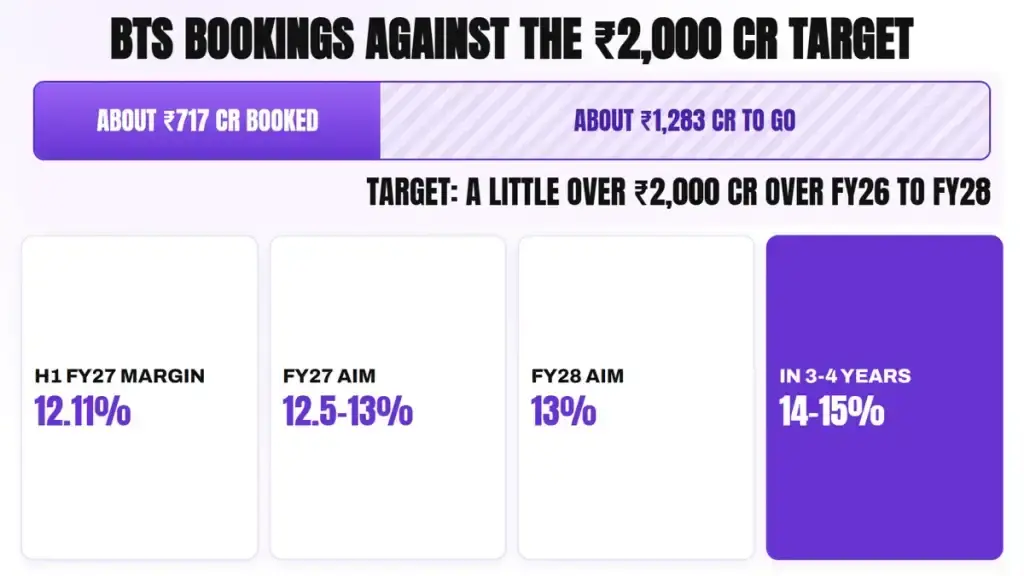
That growth needs more money and space. In November 2026, the board proposed raising the borrowing limit from ₹500 Cr to ₹1,000 Cr, mainly for non-fund-based limits, such as bank guarantees, on larger BTS orders. Capex for FY27 was guided at ₹40-45 Cr. A new BTS plant is planned at the KIADB Aerospace Park in Bengaluru, including a facility to assemble and test complete satellites. In August 2026 the government also approved Centum under the components scheme, for about ₹106 Cr of investment over five years in transducers and filters.
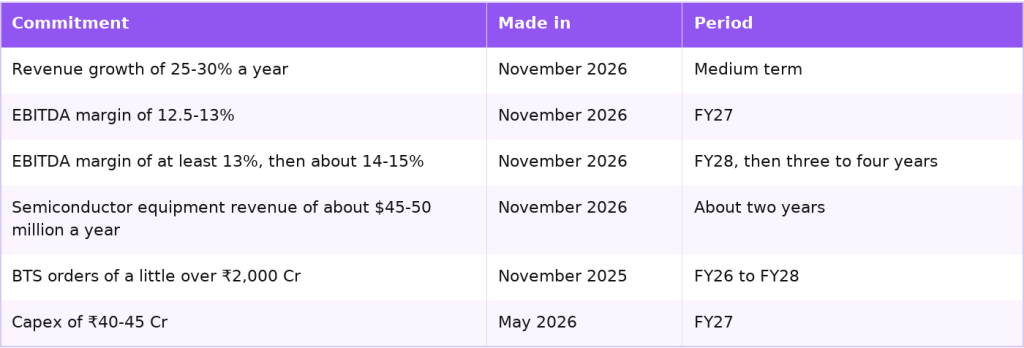
Those commitments are easier to judge against the past. So let's check what management said before against what it delivered.
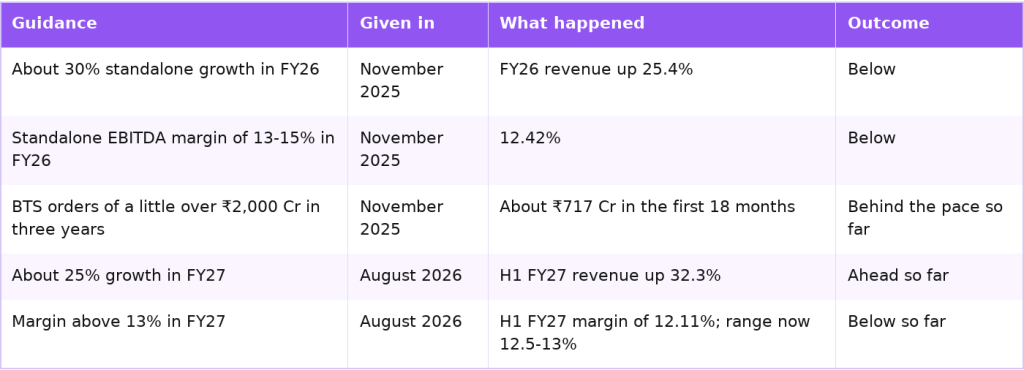
That record is mixed, as you can see. Revenue has grown about 25% a year from FY23 to FY26, close to the target range, but margin targets have slipped more than once. Each time, the reason given was the mix of programmes in a year.
Key Risks
Now let's look at what could go wrong for Centum Electronics, because some of these risks have already shown up in the numbers.
- Margins: the EBITDA margin was 12.42% in FY26 and 12.11% in H1 FY27, below the 13-15% that management targeted for FY26. If BTS stays under a third of revenue, the company margin cannot move far.
- Lumpy BTS revenue: BTS revenue depends on programme milestones, so it swings between quarters. Q1 FY27 margins fell to 11.28% when BTS deliveries slipped.
- Development risk: the HAL radar's ₹500 Cr second phase is only indicative. It depends on the prototypes passing tests and on HAL's production quantities.
- Supply chain: bare circuit board lead times have stretched from 8-12 weeks to 40-50 weeks, and memory chips are short because of AI data-centre demand. That pushes up inventory, prices and working capital.
- Working capital and debt: inventory rose 17.8% in six months, operating cash flow fell to ₹168.20 Mn in H1 FY27 from ₹420.46 Mn, and Centum has nearly used its bank limits of about ₹490 Cr.
- Customer concentration: two customer groups brought in about 43.6% of FY26 revenue, and the semiconductor business depends on one anchor customer.
- Overseas history: the exit from France and Canada cost about ₹203 Cr in FY26. Management expects no further liabilities, but the French liquidation is still running.
- Tax disputes: income tax and indirect tax demands under dispute were ₹45.62 Mn and ₹94.06 Mn in March 2026.
"Supply chain, however, remains the principal near-term bottleneck." - Nikhil Mallavarapu, Joint Managing Director, November 2026
"Invert, always invert."
— Charlie Munger
Turn the story around and ask what would make it fail: a margin that never moves past 13%, a radar that does not reach production, or inventory that keeps rising. The tracking list below is how to watch for each of them.
Explore our Products
Research Framework

Emerging Titans
Combination of quantitative analysis, industry tailwinds, and management assessment - SPRINT investment philosophy

Tiny Titans
Heavy emphasis on scuttlebutt research, plant visits, and early on-ground signals
What to Track Next
If you follow Centum Electronics, these are the signals that will show where it goes next.
- The BTS share of revenue and the EBITDA margin in H2 FY27, against the 12.5-13% range
- BTS bookings against the ₹2,000 Cr three-year target, including more space surveillance orders
- The first prototypes of the HAL helicopter radar, and any production order after them
- Semiconductor equipment revenue against the $45-50 million aim, and any second customer there
- Inventory, operating cash flow and the higher borrowing limit
- Progress on the new Bengaluru plant and the components scheme investment
Conclusion
Let's put it all together. Centum Electronics runs two businesses under one roof. Its BTS arm designs radar, electronic warfare and space electronics that few Indian companies can make, and earns about 20-22%. Its EMS arm builds to customers' designs at about 9-10%, and grows with semiconductor equipment, rail and defence exports. The cautious thread is margin and cash: the company margin has stayed near 12% for five years, and inventory keeps rising with the order book.
With the French and Canadian companies gone, the reported numbers now show that Indian business on its own, with a ₹1,952 Cr order book and revenue up 51.9% in the latest quarter. What happens next depends on whether BTS grows into a larger share of revenue, and whether the margin finally reaches the 13% that management has aimed for.
FAQs
What does Centum Electronics do?
+Centum Electronics runs two businesses. Its build-to-specification arm designs radar parts, electronic warfare systems and satellite payloads for India's defence and space programmes, and its EMS arm builds circuit boards and complete boxes to the designs of global equipment makers. FY26 revenue was ₹973.1 Cr.
How did Centum Electronics do in Q2 FY27?
+Revenue was ₹3,121 Mn, up 51.9% from a year ago, with BTS revenue up 84% and EMS revenue up 41%. EBITDA rose 63% to ₹396 Mn at a margin of 12.69%, and profit after tax rose 76.7% to ₹228 Mn.
What is Centum Electronics' order book?
+The standalone order book was ₹19,522 Mn, about ₹1,952 Cr, in September 2026, up about 37.8% in a year. BTS was ₹9,587 Mn of it and EMS ₹9,935 Mn. BTS orders run for 25 to 30 months and EMS orders for 9 to 12 months.
Why are BTS margins higher than EMS margins at Centum?
+In BTS Centum owns the design, so management puts its margin at about 20-22%. In EMS it builds to the customer's design on a cost-plus basis, at about 9-10%. BTS was about 28.5% of FY26 revenue, so the company margin was 12.42%.
What happened to Centum's French subsidiary?
+The French engineering services group entered a court restructuring in March 2026. On 4 June 2026 a court in Lyon approved the sale of its business to MBDA France and SII, and it left Centum's accounts that day. The exit cost Centum an exceptional charge of ₹2,033.07 Mn in FY26.
What are the main risks for Centum Electronics?
+The company margin has stayed near 12% and was 12.11% in H1 FY27, below management's targets. Component shortages pushed up inventory by 17.8% in six months, two customer groups made up about 43.6% of FY26 revenue, and the HAL radar's ₹500 Cr production phase is only indicative.

High growth stock specialist, Value Educator
Shashank Mahajan is an equity research professional with over 12 years of experience in identifying high-potential SME and micro-cap stocks at an early stage. He follows a rigorous scuttlebutt research–driven approach, combining on-ground insights with deep financial analysis. Shashank specializes in uncovering under-researched and under-owned companies with strong management quality and long-term growth potential. Through disciplined research and early identification, he focuses on spotting tomorrow’s market leaders before they enter the mainstream investor radar.

Syrma SGS: Less Consumer Work, ₹7,420 Cr of Orders

Anup Engineering: Heat Exchanger Maker for Refineries
Highest Order Book Stocks in India 2026: Ranked List
Aerospace Stocks in India 2026: Suppliers and Order Books
EMS Stocks in India 2026: Electronics Makers and Order Books
Data Centre Stocks in India 2026: Suppliers and Operators
Explore our Products
Research Framework
Emerging Titans
Combination of quantitative analysis, industry tailwinds, and management assessment - SPRINT investment philosophy
Tiny Titans
Heavy emphasis on scuttlebutt research, plant visits, and early on-ground signals



Modern Warfare to Multibaggers
Key Trends. Strategic Shifts. Opportunities Ahead.
Don't Miss This Exclusive Webinar!
Join Value Educator to decode the key trends shaping India's defence sector and learn how to identify tomorrow's potential leaders in the space.
- In-depth research on India's defence sector
- Live Q&A session
- Actionable takeaways for long-term investors

 Orders
 Subscription
 Share with friends


Required Details
₹23999.00
(12 month subscription)
As per SEBI regulations, all users are mandated to complete the KYC that is validated for 1 year. Post payment, you will be redirected to the KYC screen


No comments yet. Be the first to comment!