
Elecon Engineering: Gearboxes and ₹1,635 Cr of Orders
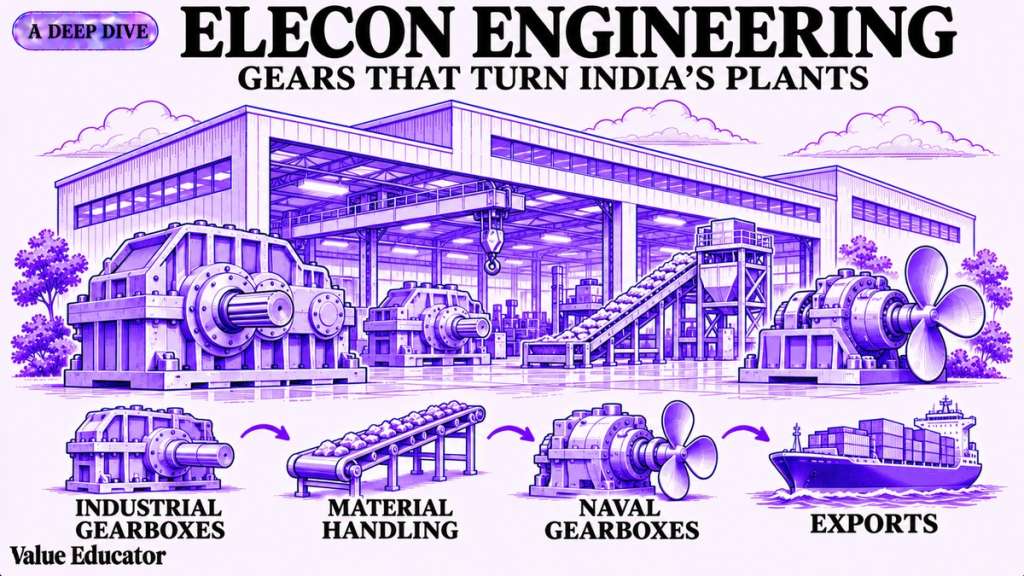
Every tonne of coal that reaches a thermal power plant travels on a conveyor. Every steel mill rolls its sheets with motors, and every cement plant grinds its clinker in a large mill. Between the motor and the machine there is one part that nobody outside the plant sees. That part is the gearbox, which uses sets of toothed wheels to turn a motor's fast, light spin into slow, heavy turning force, so the mill or the conveyor can move.
That gearbox comes in two kinds. A catalogue product is a standard gearbox, picked from a price list by size and ratio and made in large numbers. An engineered product is a gearbox designed for one machine, such as a sugar mill, a coal mill or a ship's propeller shaft. Engineered gearboxes take longer to make, but they carry a better margin.
The same plants also need machines that move bulk material. This is called material handling equipment, or MHE. A wagon tippler is a machine that lifts and turns a full railway wagon upside down to empty its coal into a pit. A stacker reclaimer is a machine that builds huge piles of coal or iron ore in a yard and then digs them back out onto a conveyor.
One company makes both the gearboxes and the equipment that feeds the plants. It is Elecon Engineering Company Ltd (NSE: ELECON). Its own filings describe it as India's largest industrial gear manufacturing company and one of Asia's largest. It makes gearboxes and MHE at a single plant of about 3,35,000 square metres at Vallabh Vidyanagar in Gujarat, and it sells to more than 95 countries through its Benzlers and Radicon businesses abroad.

So Elecon sits early in the chain of a new plant. It does not build the power station or the steel mill. It supplies the gearboxes that turn their machines and the equipment that feeds them coal, ore and limestone.
Elecon Engineering in five numbers
- Q2 FY27 revenue of ₹639 Cr, up 10.5%
- An EBITDA margin of 23.1% in Q2 FY27, up 140 bps
- An open order book of ₹1,635 Cr in September 2026, up about 33%
- Overseas business at 27% of H1 FY27 revenue
- A net cash position of about ₹700 Cr
So a 75-year-old engineering company now carries an open order book more than twice the size it was in March 2023. How did that show up in the latest numbers? Let's first understand the company, and then look at the latest quarter.
Elecon Engineering: Company Overview
Elecon Engineering Company Ltd was established in Mumbai in 1951 and is based at Vallabh Vidyanagar in Gujarat, where it makes industrial gearboxes and material handling equipment at one plant of about 3,35,000 square metres. Prayasvin B. Patel is its Chairman and Managing Director, and the promoter group held 59.27% in September 2026. The gear division sells catalogue and engineered gearboxes, couplings and marine gearboxes; the MHE division makes wagon tipplers, stacker reclaimers, crushers and conveyors for power, steel, cement, ports and mining. Abroad it sells through its Benzlers and Radicon businesses, with assembly centres in the UK, Sweden, the Netherlands and the USA, and it serves more than 95 countries. It had 939 permanent employees in March 2026. Revenue from operations was ₹2,366 Cr in FY26, and it held a net cash position of about ₹700 Cr in September 2026. Read this Power Sector Stocks in India 2026: List by Value Chain
"The stock market is filled with individuals who know the price of everything, but the value of nothing."
— Philip Fisher
A gearbox is a small part of a power plant or a steel mill, but Elecon's results move with every delay in those projects. Knowing what each division sells, and to whom, is the first step to reading its numbers.
The Quarter Revenue Grew 10.5%
Let's look at Q2 FY27, the July to September quarter that the company reported on 14 October 2026. Revenue from operations was ₹639 Cr, up 10.5% from ₹578 Cr a year ago. It was also 22.7% higher than the ₹521 Cr of Q1 FY27.
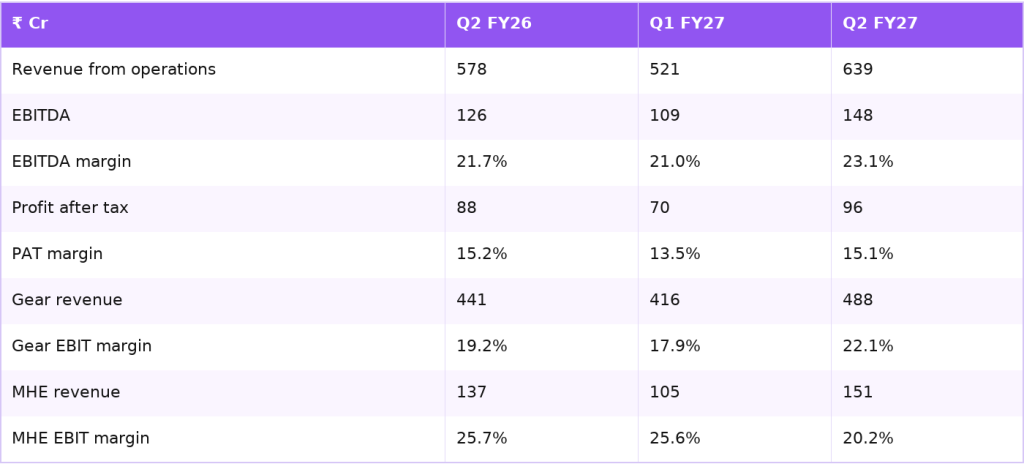
As we can see, the gear division did most of the lifting. Its revenue rose 10.6% to ₹488 Cr, and its EBIT, the profit before interest and tax, rose 27.2% to ₹108 Cr. That took the gear EBIT margin up 290 bps. Management gives three reasons: a price increase, a better product mix and a larger share of export orders, which carry a slightly higher margin. Some export orders planned for Q1 were shipped in Q2, so part of that jump is timing.
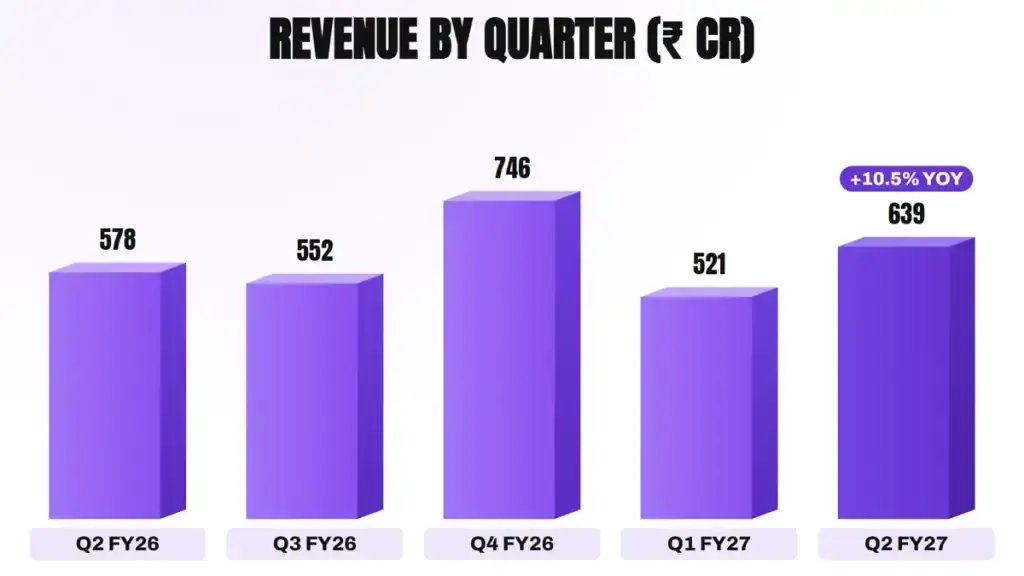
That chart also shows how uneven the path has been. Revenue was ₹552 Cr in Q3 FY26 and then ₹746 Cr in Q4 FY26. It fell to ₹521 Cr in Q1 FY27, when steel prices jumped and customers took longer to place and clear orders, and rose again to ₹639 Cr. In a business where large customers decide when to take delivery, a few weeks of delay move the quarterly numbers.
That growth came with a better margin. Read this EBITDA Explained: Uses and Limits EBITDA rose 17.7% to ₹148 Cr, and the EBITDA margin was 23.1%, against 21.7% a year ago. Profit after tax rose 9.8% to ₹96 Cr, at a margin of 15.1%.
Beyond that line, the MHE division went the other way. Its revenue rose 10.4% to ₹151 Cr, but its EBIT margin fell to 20.2% from 25.7% a year ago. Management puts this down to the type of orders, a low scale of work while customers held back design clearances on two power-sector projects, and costlier inputs that are harder to pass on in project work. Management still expects 22% to 24% for MHE over the full year.
That same pattern shows in the first half. H1 FY27 revenue was ₹1,160 Cr. In H1 FY26 the company booked ₹25 Cr of one-time arbitration income in MHE, and leaving that out, revenue grew 11.1%. EBITDA was ₹257 Cr at a margin of 22.2%, against 22.1% on the same adjusted basis. Profit after tax was ₹167 Cr, and the adjusted profit after tax rose 6.5%.
Beyond the two divisions, overseas sales were the fastest-growing part. Revenue from exports and overseas subsidiaries rose 30.6% to ₹159 Cr in Q2 FY27. In H1 FY27 it reached ₹309 Cr, up 26.2%, and made up 27% of revenue.
That growth also kept the balance sheet strong. Shareholders' funds were ₹2,509 Cr in September 2026, and the company had no conventional borrowings; its debt is mostly lease liabilities. It held a net cash position of about ₹700 Cr. In the half year ICRA moved the outlook on its long-term AA rating to Positive, and the lead bank released the collateral it held against working capital limits.
The Orders Behind the Next Two Quarters
Now let's look at the orders, because they show how much of the coming revenue is already booked. Elecon reports order intake, the value of new orders won in a period, and the open order book, the orders won but not yet delivered.
At the end of September 2026 the open order book was ₹1,635 Cr, up about 33% from a year ago. The gear division held ₹1,056 Cr of it, up 37%, and MHE held ₹579 Cr, up 27.3%. Order intake in Q2 FY27 was ₹746 Cr, up 8.4%, and in H1 FY27 it was ₹1,501 Cr, up 15.3%.

That book was much smaller only three years ago. It was ₹714 Cr in March 2023, ₹796 Cr in March 2024 and ₹948 Cr in March 2025. It crossed ₹1,226 Cr in September 2025 and reached ₹1,518 Cr in June 2026. The book has grown faster than revenue, which tells us that orders are coming in faster than customers are taking delivery.
Overseas orders are growing too. Overseas order intake was ₹230 Cr in Q2 FY27, against ₹172 Cr a year ago, and ₹420 Cr in H1 FY27, against ₹291 Cr. The overseas order book stood at ₹326 Cr. The MHE division, which has only recently started to export, won overseas orders of about $9 Mn in the half year.
Both divisions added to the book in different ways. In the gear division, Q2 FY27 order intake was ₹493 Cr, broadly flat, and H1 intake rose 8.8% to ₹1,063 Cr. In MHE, order intake rose 32.5% to ₹253 Cr in Q2 FY27, including ₹68 Cr of overseas orders, and 34.8% to ₹438 Cr in the half year. So MHE is winning orders faster, while gears still bring in most of the value.
What the order book says: ₹1,635 Cr of open orders is more than the ₹1,297 Cr of revenue Elecon booked in all of H2 FY26. Catalogue gearboxes take two to three months to make and engineered ones four to five months, so most of the gear book can turn into revenue within the year.
Not all of that book is due this year. In June 2026 management said about ₹160 Cr of the gear order book was due for delivery after FY27, which it called normal. MHE orders take longer, because each one depends on site clearances from the main contractor and the end customer.
How a 1951 Trading Business Became India's Largest Gear Maker
Now that we have seen the quarter, let's go back and see how Elecon got here. Late I.B. Patel started the business in Mumbai in 1951 as a trading company. It moved into elevators and conveyors, which is where the name ELECON comes from, and then into bulk material handling. In 1961 it shifted to Vallabh Vidyanagar and became a public limited company, and in 1976 it set up a separate gear division. Prayasvin B. Patel is its Chairman and Managing Director, and the promoter group held 59.27% in September 2026.
That gear division then went abroad. Elecon opened its first international sales office in 2001, and in 2010 it made its first acquisition overseas, the UK-based Benzlers and Radicon group. Today it has assembly centres in the UK, Sweden, the Netherlands and the USA.
That expansion was in gears; the MHE division had a harder road. It once took on full EPC contracts, where the supplier builds the whole system on site and carries the whole site job. In 2017-18 Elecon decided to stop taking fresh EPC contracts and sell only equipment and services. Over six years, the division's EBIT margin went from minus 36.00% to 27.60%.
"The most important thing to do if you find yourself in a hole is to stop digging."
— Warren Buffett
Elecon's MHE division stopped taking fresh EPC contracts in 2017-18 and sold only equipment and services after that. The margin recovered once the project work that carried the losses ended.

Over these years revenue grew at 15.6% a year, from ₹1,530 Cr in FY23 to ₹2,366 Cr in FY26. The EBITDA margin rose to 24.6% in FY25 and then fell to 22.1% in FY26. FY26 revenue includes the ₹25 Cr of one-time arbitration income, and on an adjusted basis it was ₹2,341 Cr at a 21.3% margin.

That FY26 dip came from the gear division. Gear revenue fell 3.6% to ₹1,699 Cr, as customers in steel and other sectors pushed back deliveries and the US raised tariffs on goods from India. In Q4 FY26 alone, gear revenue fell 21.0%. MHE grew 43.6% to ₹667 Cr in the same year, its highest revenue in a decade, and made up about 28% of revenue.
That year's profit after tax of ₹341 Cr also carries two one-time items. One is an ₹80 Cr gain, after tax, when Elecon reclassified its holding in EIMCO Elecon (India) from an associate to a financial asset. The other is a ₹102 Cr write-off of goodwill. Leaving out the impairment, Q4 FY26 profit after tax was ₹108 Cr.
Those profits have also piled up as cash. Management says the business has generated about ₹300 Cr to ₹350 Cr of cash after tax a year over the last two years, more than it has spent on capacity. About ₹800 Cr of the balance sheet is parked in investments that earn about 8%, which pulls down the return on capital. Operating cash flow was ₹314 Cr in FY26, against ₹425 Cr in FY25, as ₹121 Cr went into working capital and trade receivables rose to ₹721 Cr from ₹614 Cr.
"We also have a very, very sophisticated ultramodern manufacturing plant and our infrastructure is extremely good, which the competition does not have." - Prayasvin B. Patel, Chairman and Managing Director, October 2026
Two Divisions, Gears and Material Handling
Now let's split the business into its parts, because each one sells in a different way. Read this Segment-Wise Revenue Analysis Explained Elecon reports two segments, the gear division and the MHE division.

These two lines look different, but they share customers. A thermal power plant needs both, the MHE for its coal yard and the gearboxes for its mills and conveyors. Management says such plants give Elecon business in both divisions.

The Gear Division and Its Two Kinds of Gearbox
Let's start with gears, the larger line. The gear division made 76% of revenue in Q2 FY27. In that quarter about 53% of gear revenue came from catalogue products and 47% from engineered products. The range covers helical, bevel helical, worm and planetary gearboxes, couplings, high-speed gearboxes and mill drives.
Its customers come from many industries. In FY25 power made up 12% of gear revenue, steel 11%, cement 9% and sugar 4%. Power, steel and cement remain the three largest industries for the division. In Q1 FY27 a single large power order made up about 27% of the division's order intake.
That mix also decides how fast costs pass through. Catalogue gearboxes, about half of the business, are sold off a price list that Elecon refreshes every month. For engineered orders, it locks the price of its raw materials with suppliers when it accepts the order. So a sudden rise in steel prices hits catalogue sales first and is passed on within a few months.
Price rises also bring short spells of tougher competition. In Q1 FY27 some rivals held stock bought at older, lower prices and could quote below Elecon, and customers used that to press for lower prices. By Q2 FY27 management said that phase had passed and the market had settled at the new prices.
Beyond pricing, the division's next push is abroad. Overseas sales were about 36% of gear revenue in Q1 FY27. Management says overseas buyers are moving from standard gearboxes to customised ones with condition monitoring, and it names data-centre cooling towers and oil and gas among the newer uses.
Marine Gearboxes for the Indian Navy
Next, let's look at the smallest but most demanding product, the marine gearbox. Elecon supplied the COGAG gearbox for INS Vikrant, India's aircraft carrier. COGAG means two gas turbines driving one shaft together, which needs a gearbox that can handle very high speeds. The company's deck says it is the only company in India able to make complex gearboxes for the Indian Navy.
Its next large Navy order is for the P-17 Bravo frigates, the follow-on to the P-17 Alpha frigates. Elecon has sent budgetary offers to the shipyards. Management expects the final request for proposals in Q2 or Q3 of FY28 and the orders around Q1 of FY29, and says it will be the single bidder because the ships follow P-17 Alpha. Such projects take two to three years to deliver. So marine orders are a large opportunity, but not a near-term one. The first naval order also taught Elecon a lot: management says its margin came in 1% to 2% lower than planned because of the development work. A repeat order on the same design should earn a better margin, though such long projects tie up 15% to 20% more working capital than the rest of the gear business.
Material Handling Equipment for Power, Steel and Ports
Finally, let's look at MHE, the older division. It designs and builds wagon tipplers, stacker reclaimers, crushers, feeders and specialised conveyors, and services them after installation. Its biggest customers are power plants, steel plants, cement makers and ports, and management says most of its business now comes from the power sector.
That business brought in ₹667 Cr in FY26. Since it stopped taking EPC work, it sells equipment to the EPC contractors who build the plants. Management names L&T and TKIL as rivals that also bid as EPC contractors, and TAKRAF and AUMUND in private-sector projects. It says TRF has closed its material handling operations.
The division also earns from after-sales work, such as spares, upgrades and service on equipment it has already installed. Management says this mix of equipment sales and after-market services kept MHE margins healthy in FY26. Order intake was ₹669 Cr in FY26 and ₹438 Cr in H1 FY27, so the division's order flow is now close to its yearly revenue.
Overseas Business Through Benzlers and Radicon
Now let's look at the overseas business, which cuts across both divisions. Elecon sells abroad in two ways: exports from India, and sales by its overseas subsidiaries, which assemble and customise gearboxes close to the customer. Management looks at the two together. For FY26 it gave this split of overseas revenue: about ₹171 Cr from the Benzlers group in Europe, ₹102 Cr from Radicon in the USA, ₹102 Cr from the UK, ₹66 Cr from the Middle East and ₹22 Cr from Singapore.
That overseas business had a slow FY26. US tariffs slowed the order pipeline from the second quarter, and the conflict between the US and Iran held back shipments in Q4. Overseas markets made up 18% of revenue in Q4 FY26. In FY27 the orders that had been on hold began to ship, mostly to the Middle East and the US, and overseas order intake rose 63% to ₹194 Cr in Q1 FY27.
Europe is slower. Management expects it to take at least two more quarters to recover. To reach Latin America, Elecon announced a step-down subsidiary in Mexico in April 2026, since the US tariff does not apply to sales there, and it says it has not put much money into it yet.
Where Elecon Sits in the Power and Industrial Value Chain
Now let's place Elecon in the wider chain. A new power plant, steel mill or cement plant starts with a plan and a budget. Then an EPC contractor or an equipment maker places orders for the machines inside. Elecon fills two layers of that order list: drives for the machines and handling systems for the raw material.

That chain is growing in India. Management, citing industry research, expects India's heavy-duty industrial gearbox market to grow at about 8% a year through FY30. It also points to planned growth in steel capacity and to steady demand from cement and power. In thermal power, coal handling and the coal mills both need Elecon's products.
That demand reaches Elecon through three kinds of buyers. Government-run companies in power, steel and cement place a large part of the orders, either directly or through EPC contractors. Private plants make up much of the rest. Abroad, Elecon sells to equipment makers and plants in the Middle East, the Americas and Europe. No single customer made up more than 10% of revenue in FY26.
Elecon has also chosen where not to play. Management said in 2023 that it had kept away from gearboxes for wind turbines, because demand there swings with government support and puts pressure on suppliers. So its link to power comes mostly from thermal plants, not from wind farms. Its own plant does use wind, though: about 55% of the energy Elecon uses comes from renewable sources, including 13.2 MW of wind and 5.5 MW of solar capacity, with 7 MW more being commissioned.
Why Elecon's Moat Is Hard to Copy
Now that we have seen the parts, let's understand the moat. A gearbox looks simple, a box of toothed wheels. So the question is why a steel plant or the Navy picks Elecon over a smaller Indian maker or a German brand. Read this Economic Moat Explained
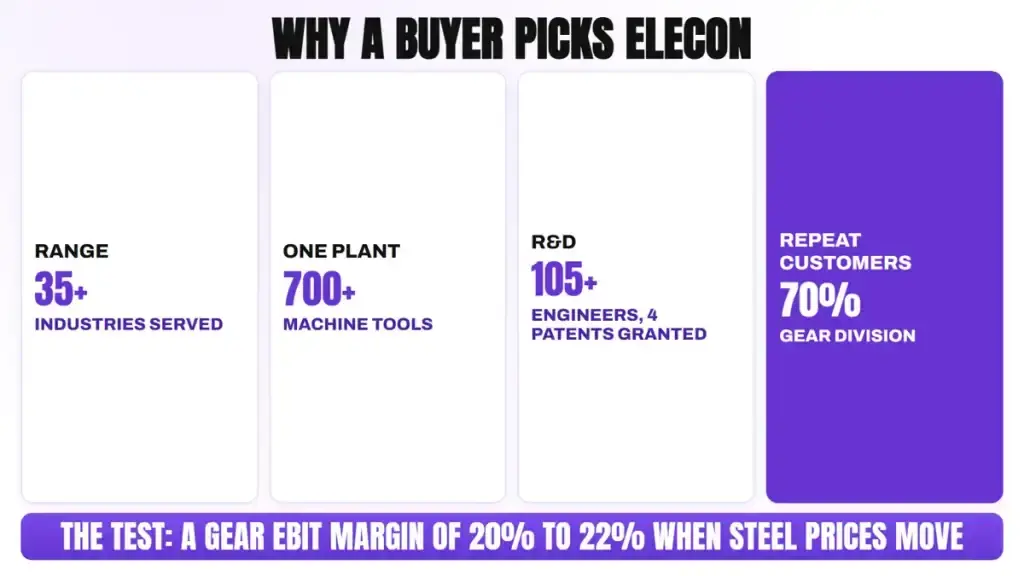
One part of the moat is range. Elecon sells catalogue and engineered gearboxes under one name, across more than 35 industries. A customer can buy a standard reducer and a custom mill drive from the same supplier and get service from the same network.
Another layer comes from doing every step in one place. The Vallabh Vidyanagar plant has its own foundry and fabrication shop and more than 700 machine tools, and BMCE 2, a newer gear plant, has now opened. Elecon says this lets it deliver faster than competitors with long lead times. Its testing laboratory is NABL-accredited, and its R&D centre, approved by the government's DSIR, has more than 105 engineers and holds 4 granted patents, with 3 more applied for.
Beyond range and the plant, the defence work adds a third layer. Very few companies in India can make a gearbox that turns a warship's propellers, and the P-17 Bravo order is expected to come to Elecon as the single bidder. Repeat customers add a fourth: the company puts repeat customers at 70% in its gear division.
"The single most important decision in evaluating a business is pricing power."
— Warren Buffett
Elecon's gear margin was tested when steel prices jumped in 2026. Price increases took the gear EBIT margin back to 22.1% in Q2 FY27, and the next steel cycle will test it again.

That table shows us why the gear margin is the real test of the moat. If buyers value the range and the delivery times, Elecon should hold its margin even when steel prices rise. The gear EBIT margin was 17.9% in Q1 FY27 and 22.1% in Q2 FY27, within the 20% to 22% range management guides. The MHE division gives a second test: after it left EPC work, it held an EBIT margin of 24.7% across FY26, inside its own 22% to 24% guide or above it.
Financials: Five Years of Revenue, Margins and Cash Flow
One quarter can mislead in a business where customers decide when to take delivery, so let's look at the full years together. The figures are consolidated as the company reports them; FY26 includes ₹25 Cr of one-time arbitration income, and the first half of FY27 is shown for comparison.
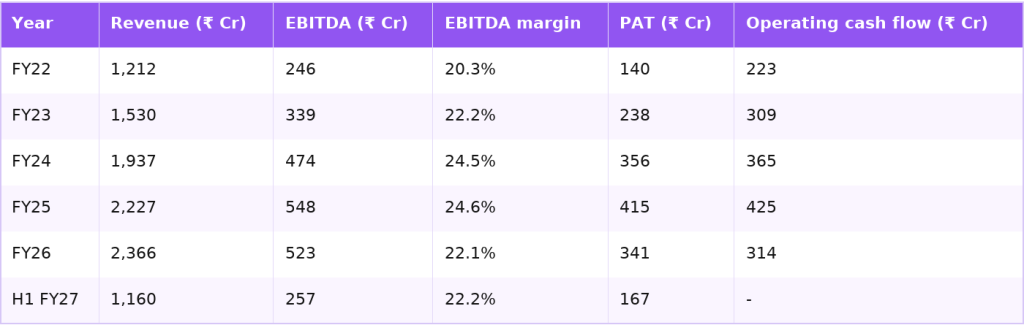
Revenue almost doubled in four years, from ₹1,212 Cr in FY22 to ₹2,366 Cr in FY26, and profit after tax grew about 2.4 times, from ₹140 Cr to ₹341 Cr. The EBITDA margin rose from 20.3% in FY22 to 24.6% in FY25, and then fell to 22.1% in FY26 as gear deliveries were pushed back.
Cash flow has kept pace with profit. From FY22 to FY26, operating cash flow added up to about ₹1,636 Cr, against about ₹1,490 Cr of profit after tax, or about 110%. It fell to ₹314 Cr in FY26 from ₹425 Cr in FY25, as ₹121 Cr went into working capital and trade receivables rose to ₹721 Cr.
The balance sheet carries that growth without conventional debt. Net worth was ₹2,306 Cr in March 2026, the debt on the balance sheet is mostly lease liabilities, and the company held net cash of about ₹700 Cr in September 2026. The open question is how fast the ₹400 Cr capex plan turns that cash into higher revenue and returns.
"Accounting is the language of business."
— Warren Buffett
Elecon's income statement shows a steady business with one soft year. Its cash flow statement and balance sheet show how much cash that business throws off, and how much of it is still waiting to be put to work.
What FY27 to FY30 Could Look Like on Management's Numbers
So where does the business go from here? On 15 October 2026 management said it expects consolidated revenue to grow around 15% in H2 FY27, with an EBITDA margin of at least the FY26 level. On H2 FY26 revenue of ₹1,297 Cr, that would mean about ₹1,492 Cr in H2 FY27 and about ₹2,652 Cr for the year.
For the longer run, management targets ₹5,000 Cr of revenue by FY30, with 50% of it from overseas markets. It expects the gear division, including marine, to make up about 70% to 75% of that revenue. Part of the growth is meant to come from acquisitions of small and mid-sized companies in America and Europe.
Now let's put that target against the record. FY26 revenue was ₹2,366 Cr, so reaching ₹5,000 Cr in FY30 needs growth of about 20.6% a year for four years. Over FY23 to FY26 revenue grew 15.6% a year. Management said in July 2026 that the target looks challenging but still achievable.

Beyond revenue, capacity is not the constraint for now. The plant was running at about 60% of its capacity in October 2026, with a few machines that limit output and are being added to. Elecon has a capex plan of about ₹400 Cr over FY26 to FY28, of which about ₹95 Cr was spent in FY26, and about 80% of the spend goes to the gear division.

Those commitments are easier to judge against the past. So let's check what management said before against what it delivered.
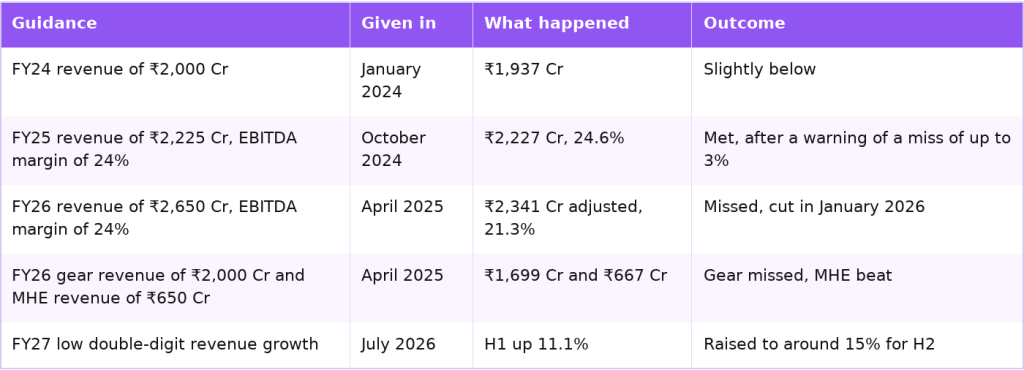
That record shows us a clear pattern. Elecon has usually come close to its revenue targets, but it has missed when customers pushed back deliveries, as in FY26. The MHE division has beaten its numbers since it left EPC work. That makes the timing of gear deliveries and the pace of overseas growth the numbers to watch from here.
Key Risks
Now let's look at what could go wrong for Elecon, because FY26 has already shown some of these risks.
- Delayed deliveries: customers in steel and power pushed back deliveries in FY26, and gear revenue fell 21.0% in Q4 FY26. A large part of demand comes from government-run companies, whose orders depend on budgets and fund releases.
- Steel prices: steel and bearings are the main inputs. Management put the average rise in its bill of materials at about 5% in July 2026, and catalogue gearboxes and MHE projects pass such rises on more slowly.
- Lower returns than before: the EBITDA margin fell from 24.6% in FY25 to 22.1% in FY26, and return on capital employed fell to 20.4% from 26.8%. Part of the capital is cash that earns about 8%.
- Overseas subsidiaries and tariffs: Elecon wrote off ₹102 Cr of goodwill on its overseas business in FY26. Exports from India to the USA face a 50% tariff, and events in the Middle East have delayed orders before.
- MHE project margins: the MHE EBIT margin fell to 20.2% in Q2 FY27, below the 22% to 24% guided range, because project costs are harder to pass on.
- Defence timing: the P-17 Bravo orders are expected only around Q1 of FY29, and naval orders can slip.
- Competition: multinational gear makers have added plants in India, and management expects price pressure from them on new projects. German companies compete with Elecon abroad, and in MHE it competes with large EPC firms.
- Tax dispute: an excise and service tax claim of about ₹49.3 Cr was shown as a contingent liability in March 2026, of which about ₹4.3 Cr has been deposited.
- The FY30 target: ₹5,000 Cr needs about 20.6% growth a year, faster than the past three years, and part of it depends on acquisitions that have not been named.
"A large part of our business is routed through PSUs and typically PSUs are dependent on many factors, the fiscal budgets released by the government and the fund allocation." - Chintan Shah, Chief Financial Officer, July 2026
"Risk means more things can happen than will happen."
— Howard Marks
For Elecon, those things range from a delayed steel plant order to a tariff change in the US or a naval programme that slips by a year. The list below sets out the ones that the last two years have already shown.
Explore our Products
Research Framework

Emerging Titans
Combination of quantitative analysis, industry tailwinds, and management assessment - SPRINT investment philosophy

Tiny Titans
Heavy emphasis on scuttlebutt research, plant visits, and early on-ground signals
What to Track Next
If you follow Elecon, these are the signals that will show where it goes next.
- H2 FY27 revenue growth against the around 15% guided, and the EBITDA margin against FY26's 22.1%
- The gear EBIT margin against 20% to 22%, and the MHE margin against 22% to 24%
- The open order book after ₹1,635 Cr, and the overseas order book after ₹326 Cr
- Overseas revenue as a share of the total, after 27% in H1 FY27
- Spending under the ₹400 Cr capex plan, and any acquisition abroad
- The P-17 Bravo request for proposals, expected in FY28
For the other listed makers of cranes, gears, pumps, machine tools and process equipment, see Capital Goods Stocks in India 2026: The Capex Cycle.
Conclusion
Let's put it all together. Elecon Engineering has grown revenue from ₹1,530 Cr in FY23 to ₹2,366 Cr in FY26, and its open order book has more than doubled from ₹714 Cr in March 2023 to ₹1,635 Cr in September 2026. In Q2 FY27 the gear division led a 10.5% rise in revenue and a 23.1% EBITDA margin, while overseas sales grew 30.6%. The cautious thread is the gap between orders and deliveries, and an EBITDA margin still below the 24.6% of FY25. The next two quarters will show which thread is stronger.
Still, the order book has grown faster than revenue for a reason: customers have been slow to take delivery. What happens next depends on whether that book turns into revenue in H2 FY27, whether the gear margin holds as steel prices move, and whether overseas sales grow fast enough to carry Elecon towards ₹5,000 Cr by FY30.
FAQs
What does Elecon Engineering do?
+Elecon makes industrial gearboxes and material handling equipment at Vallabh Vidyanagar in Gujarat. Its gear division sells catalogue and engineered gearboxes, including marine gearboxes for the Indian Navy, and its MHE division makes wagon tipplers, stacker reclaimers and conveyors. FY26 revenue from operations was ₹2,366 Cr.
How did Elecon Engineering do in Q2 FY27?
+Revenue from operations rose 10.5% to ₹639 Cr. EBITDA rose 17.7% to ₹148 Cr at a 23.1% margin, and profit after tax rose 9.8% to ₹96 Cr. The gear division's EBIT margin rose to 22.1%, while the MHE margin fell to 20.2%.
What is Elecon's order book?
+The open order book was ₹1,635 Cr in September 2026, up about 33% from a year earlier. The gear division held ₹1,056 Cr and the MHE division ₹579 Cr, and the overseas order book was ₹326 Cr.
How is Elecon linked to the power sector?
+Power is one of the three largest industries for its gear division, with steel and cement, and management says most MHE business now comes from power. Thermal power plants need both its coal handling equipment and its gearboxes. Management has kept away from gearboxes for wind turbines.
What are Elecon's targets for FY27 and FY30?
+Management expects revenue growth of around 15% in H2 FY27, with an EBITDA margin at least at the FY26 level. It targets ₹5,000 Cr of revenue by FY30, with half of it from overseas markets, against ₹2,366 Cr in FY26.
What are the main risks for Elecon Engineering?
+Customers in steel and power can push back deliveries, as they did in FY26, and many buyers are government-run companies. Steel prices, US tariffs and the timing of naval orders also matter. The ₹5,000 Cr FY30 target needs about 20.6% growth a year and partly depends on acquisitions.

High growth stock specialist, Value Educator
Shashank Mahajan is an equity research professional with over 12 years of experience in identifying high-potential SME and micro-cap stocks at an early stage. He follows a rigorous scuttlebutt research–driven approach, combining on-ground insights with deep financial analysis. Shashank specializes in uncovering under-researched and under-owned companies with strong management quality and long-term growth potential. Through disciplined research and early identification, he focuses on spotting tomorrow’s market leaders before they enter the mainstream investor radar.
More about Shashank Mahajan →
Azad Engineering vs MTAR vs Unimech: Aerospace Parts
Subros vs Lumax Auto vs Sona BLW: EV Auto Parts Compared
Jyoti CNC vs Macpower CNC: Machine Tool Makers Compared
Data Patterns vs Astra Microwave vs Apollo Micro

Himadri vs PCBL: Carbon Black and Battery Materials

Inox Wind vs Suzlon: Wind Turbine Makers Compared
Explore our Products
Research Framework
Emerging Titans
Combination of quantitative analysis, industry tailwinds, and management assessment - SPRINT investment philosophy
Tiny Titans
Heavy emphasis on scuttlebutt research, plant visits, and early on-ground signals



India's Aerospace Opportunity
Global Demand. Supply Bottlenecks. Opportunities Ahead.
Don't Miss This Exclusive Webinar!
Join Value Educator to decode the key trends shaping India's aerospace sector and learn how to identify tomorrow's potential leaders in the space.
- How the aircraft value chain works, layer by layer
- Indian companies supplying global aircraft makers
- A framework to judge any aerospace company

 Orders
 Subscription
 Share with friends


Required Details
₹23999.00
(12 month subscription)
As per SEBI regulations, all users are mandated to complete the KYC that is validated for 1 year. Post payment, you will be redirected to the KYC screen


No comments yet. Be the first to comment!