
KSB: The Pune Pump Maker With ₹1,235 Cr of Reactor Orders
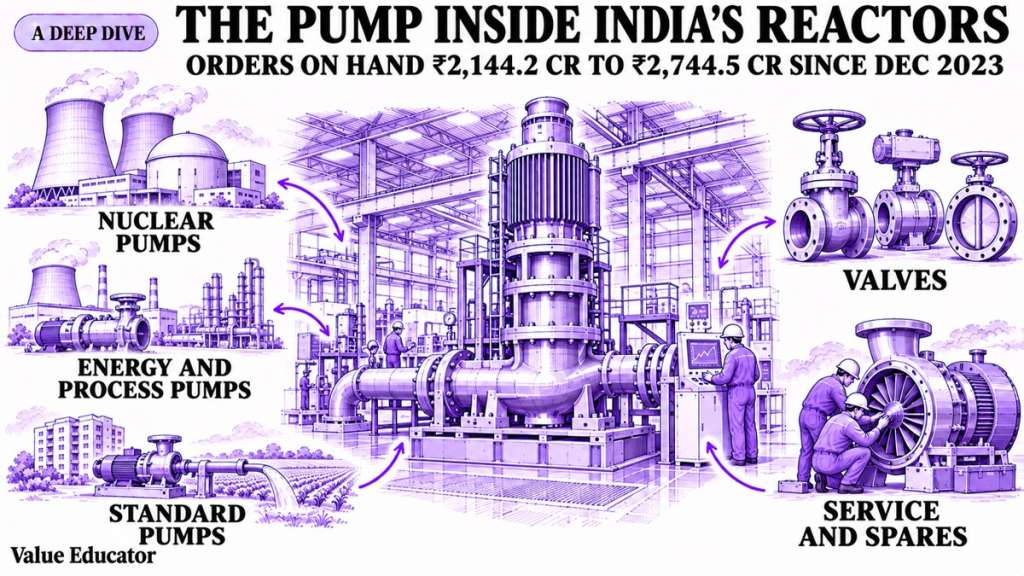
India wants far more nuclear power than it has today. The country runs 24 reactors with about 8.8 GW of capacity, and the plan is 23 GW by 2031 and 100 GW by 2047. Eight reactors with 6.6 GW are already under construction, and ten more with 7 GW are in the pre-project stage. Each of those reactors needs heavy equipment that only a few factories in the country can make.
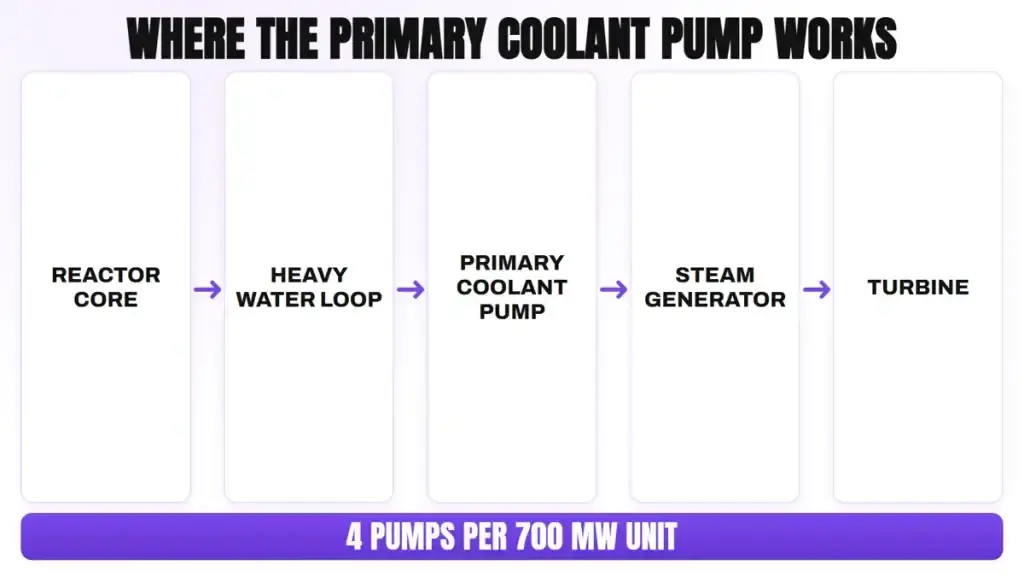
Most of these reactors use one design. A pressurised heavy water reactor, or PHWR, is a reactor that burns natural uranium and uses heavy water to carry heat out of the reactor core. That hot water then boils ordinary water in a steam generator, and the steam turns a turbine. India's 700 MW fleet, the backbone of its nuclear plan, is built on this design.
Those reactors are built and run mostly by Nuclear Power Corporation of India (NPCIL), the government company that owns the country's nuclear plants. NPCIL designs each unit, buys its main equipment, builds the plant through contractors and then sells the electricity to state utilities for decades. It earns from the power, so its income starts only when a reactor is finished and running. That makes every late piece of equipment costly for NPCIL, and it is why NPCIL qualifies its suppliers so slowly.
One of those suppliers is in Pune. KSB Ltd (NSE: KSB), the Indian arm of Germany's KSB Group, makes the primary coolant pump, which is the large pump that pushes heavy water through the reactor core so the fuel never overheats. KSB has supplied these pumps for Indian PHWRs since the first units at Narora. In June 2026, it held ₹1,235 Cr of nuclear orders, out of total orders on hand of ₹2,744.5 Cr.
KSB in five numbers
- Q3 CY 2026 revenue of ₹772.7 Cr, up about 19% from a year earlier
- Orders on hand of ₹2,744.5 Cr in June 2026, including ₹1,235 Cr of nuclear orders
- Primary coolant pumps in eighteen Indian reactors, from Narora to Rawatbhata 7 and 8
- A Shirwal energy plant making about 1,200 pumps a year at 90% use, now getting 20% more capacity
- A safety package of 107 pumps for Kudankulam, now in production
So why has a company with four decades of reactor work earned so little from nuclear in the last two years? Let's first understand the company, and then look at the quarter where its pump sales grew fastest.
KSB Limited: Company Overview
KSB Ltd is a Pune maker of pumps and valves that started in India in 1960 as part of Germany's KSB Group. Canadian Kay Pump, a KSB Group company, holds 40.54% of its shares and the Swarup family's Industrial & Prudential Investment holds 21.55%; Rajeev Jain is managing director. It makes standard pumps for water, farms and buildings, engineered pumps for power plants, refineries and nuclear reactors, and valves, in six plants including the Shirwal energy pump plant opened in 2017. It sells through more than 800 dealers and 350 service centres and had 2,228 permanent employees at the end of 2025. KSB follows a January to December year, and in 2025 it earned ₹2,695.7 Cr of revenue with a net financial position of ₹283.4 Cr. Read this TARIL: The Transformer Maker With ₹6,630 Cr of Orders
"The person that turns over the most rocks wins the game."
— Peter Lynch
For KSB, most of the rocks are outside its two reported segments: the nuclear order book, the test bed at Tarapur and the shift in costs at its foundries.
The Quarter Pump Sales Grew Fastest
Let's look first at the quarter in which pump sales grew fastest, July to September 2026. KSB follows a January to December year, so this is the third quarter of calendar 2026, or Q3 CY 2026. Revenue was ₹772.7 Cr, up about 19% from ₹649.6 Cr a year earlier. Revenue in the June quarter had been ₹690.7 Cr, so sales also grew about 12% from one quarter to the next.
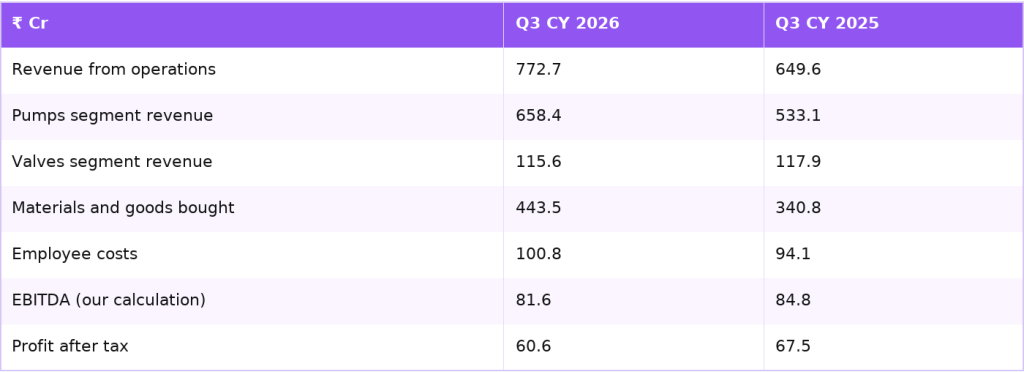
That growth, as you can see, came almost entirely from pumps. Pump revenue rose about 23.5% to ₹658.4 Cr, while valves were about flat at ₹115.6 Cr. For the first nine months of 2026, revenue was ₹2,064.7 Cr, up about 8% from ₹1,911.7 Cr. So the third quarter was the strongest stretch of the year so far.
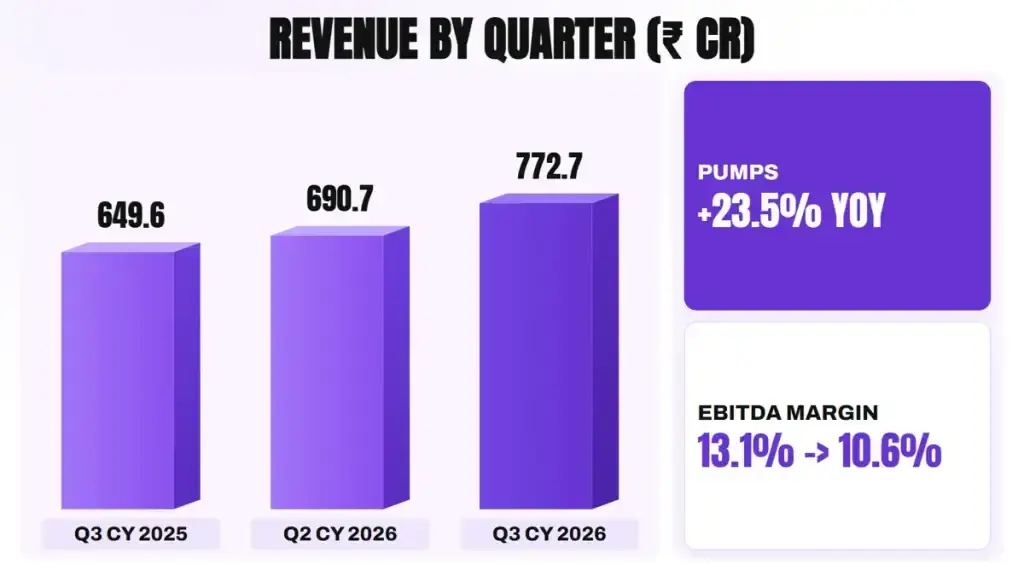
That sales growth, you may notice, did not reach profit. Profit after tax was ₹60.6 Cr, against ₹67.5 Cr a year earlier. Materials and bought-in goods took about 57.4% of revenue, against about 52.5% in the same quarter of 2025. EBITDA, on our own calculation, was ₹81.6 Cr, a margin of about 10.6%. Read this EBITDA Explained: Uses and Limits
That cost jump, we should note, has a clear cause. In early 2026, gas shortages hit Indian foundries, which melt metal in gas-fired furnaces to make pump and valve castings. The foundries raised prices by about 12-15%, and KSB had to accept them to keep supplies flowing. It raised its own prices on standard pumps by only a single-digit amount so far, and fixed-price project orders cannot be repriced at all.
That pricing gap matters more in some places than others. Management says about half of its business is standard pumps sold through dealers, where price rises pass through within three to six months. The other half is project business, where nuclear orders carry a price-variation clause and export orders gain from the rupee. The pressure sits mainly in domestic projects taken at fixed prices.
Why the quarter matters: first-half revenue grew only about 2.4%, to ₹1,292 Cr from ₹1,262.1 Cr. The third quarter alone grew about 19%. Management had said in August that export pumps were stuck because of the war in West Asia and that supply chains were about 85-90% back to normal. The sales jump shows those held-back pumps starting to move.
The Orders Behind the Order Book
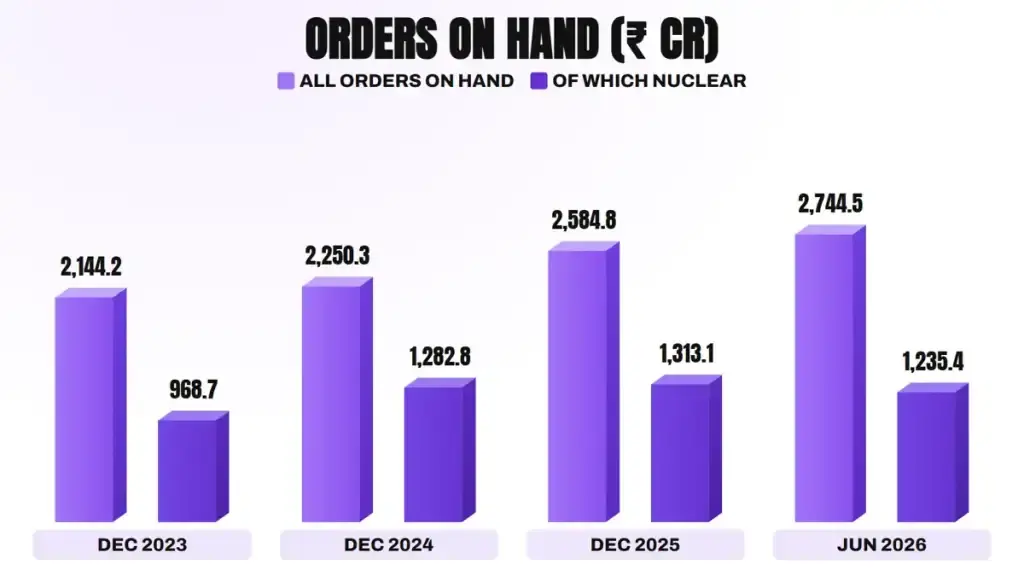
So how much work is waiting? KSB reports its orders on hand twice a year. They stood at ₹2,144.2 Cr in December 2023, ₹2,250.3 Cr in December 2024, ₹2,584.8 Cr in December 2025 and ₹2,744.5 Cr in June 2026. That is about 28% more in two and a half years.
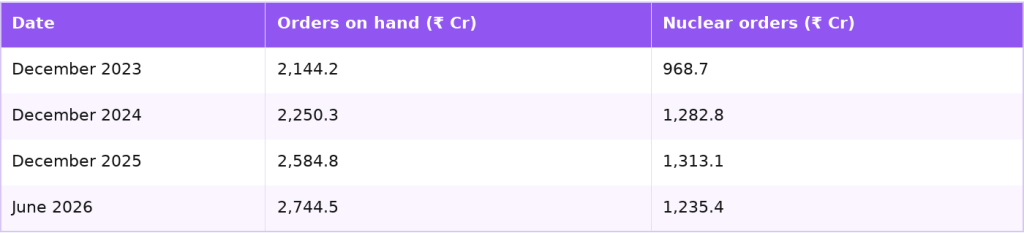
That table shows two different books. Nuclear orders were about 45% of the total in June 2026, against about 57% in December 2024. The nuclear book has sat between about ₹1,235 Cr and about ₹1,313 Cr since 2024, because almost none of it could be billed yet. The non-nuclear book is the part that is turning over, and it reached about ₹1,509.1 Cr in June 2026. Average monthly order intake outside nuclear rose from ₹170.7 Cr in 2022 to ₹249.3 Cr in 2025 and ₹255.2 Cr in the first half of 2026.
Those non-nuclear orders, we should add, now include several large projects. These are the orders KSB has disclosed to the exchanges since mid-2025.
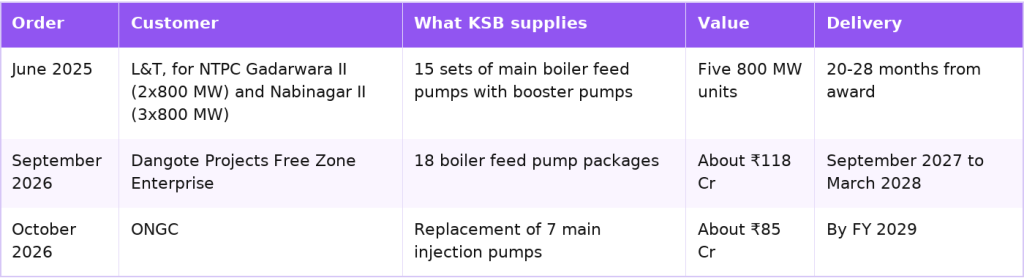
For us, each of these orders is a large engineered package, built to the customer's specification at the Shirwal plant. The two newest ones alone add about ₹203 Cr of work. The Dangote order is an export, paid after installation, and the ONGC order is a replacement job in an oilfield.
How a Pimpri Pump Shop Became a Reactor Supplier
Now let's go back and see how KSB built this business. The company started in 1960 with an industrial pump plant at Pimpri, Pune. It added a captive foundry at Vambori in 1974, a valves division in Coimbatore in 1987 and a standard pump plant at Sinnar, near Nashik, in 1994. In 1997, the group bought MIL Controls, a control valve maker in Kerala that is now an associate.
That base gave KSB its nuclear start in 1977. That year, the Department of Atomic Energy, KSB Germany and KSB India signed a three-way agreement to make coolant pumps in India for 220 MW PHWRs. The pumps for Narora 1 came fully from Germany in 1982, and production of the Narora 2 pumps started in India in 1983. Over the next decades, KSB made more of each pump locally, unit by unit.
That localisation took KSB through India's whole PHWR history. For the 220 MW units, it supplied primary coolant pumps to Narora 1 and 2 and Kakrapar 1 and 2 and then to Rawatbhata 3 to 6 and Kaiga 1 to 4. It then supplied the larger pumps for Tarapur 3 and 4 and for Kakrapar 3 and 4 and Rawatbhata 7 and 8. That is eighteen reactors in all.
"So all pressurized heavy water reactors after Narora that is 1978 are equipped with KSB's main coolant pump or primary coolant pump." - Nitin Patil, Chief Operating Officer, Nuclear Business, KSB, August 2026
That record led to the next step in 2017. KSB opened its Energy Pumps Division at Shirwal, about 60 km from Pune, on a site of 1,00,000 square metres. The plant builds pumps for nuclear plants, thermal power plants and oil and gas. Nuclear orders began arriving in 2018, and in 2021 KSB became the first local company to fully localise the boiler feed pump for a 700 MW unit.
Those steps show up in the yearly numbers, as you can see below. Revenue rose from ₹1,208.1 Cr in 2020 to ₹1,497.3 Cr in 2021, ₹2,247.2 Cr in 2023 and ₹2,695.7 Cr in 2025. Management puts revenue growth over that period at 17% a year and profit growth at 22% a year. EBITDA reached ₹387.3 Cr in 2025, against ₹350.3 Cr in 2024.
The Year 2025 in Numbers
Let's pause on the numbers for 2025, because they show us what KSB earns without nuclear billing. Revenue grew about 6.4% to ₹2,695.7 Cr, and management said the nuclear revenue it had planned moved into 2026. EBITDA was ₹387.3 Cr, a margin of about 14%, and profit after tax was ₹270.5 Cr. Order intake for the year reached ₹2,992 Cr, more than the year's revenue.
That year also showed how far exports had come. Export revenue rose about 33% to about ₹466.6 Cr, about 17% of the total, against about ₹350 Cr in 2024. KSB sold submersible borehole pumps to Africa for the first time, and new Middle East customers such as ADNOC bought its refinery pumps.
Those profits also left the balance sheet strong. KSB ended 2025 with a net financial position of ₹283.4 Cr, return on capital employed of 22.8% and a dividend of 220%. Without the one-time labour code charge, management put the return at 24%. The company had 2,228 permanent employees at the end of the year.
That ownership has also stayed stable for years. Read this High Promoter Holding: What It Signals Canadian Kay Pump, a KSB Group company, holds 40.54% of KSB, and Industrial & Prudential Investment, run by the Swarup family, holds 21.55%. Gaurav Swarup chairs the board, and Rajeev Jain has been managing director since 2016.
That growth also came with new products. In 2023, KSB bought the reciprocating pump technology of BP&CL, an older Indian pump maker with an installed base in nuclear plants. In 2024, it became the first pump company to earn the ISO quality standard for nuclear suppliers. In 2025, it finished its first fully indigenous primary coolant pump for a 700 MW reactor.
Five Businesses Inside Two Reported Segments
Now let's see what KSB actually sells. The company reports only two segments, pumps and valves, but it describes its order intake in four parts. In the first half of 2026, standard pumps were 51% of domestic order intake, valves 19%, SupremeServ aftermarket 16% and engineered pumps 14%.
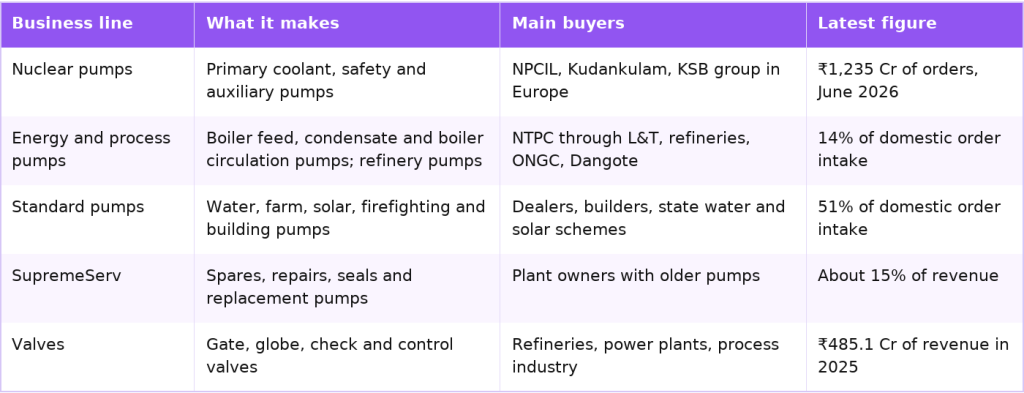
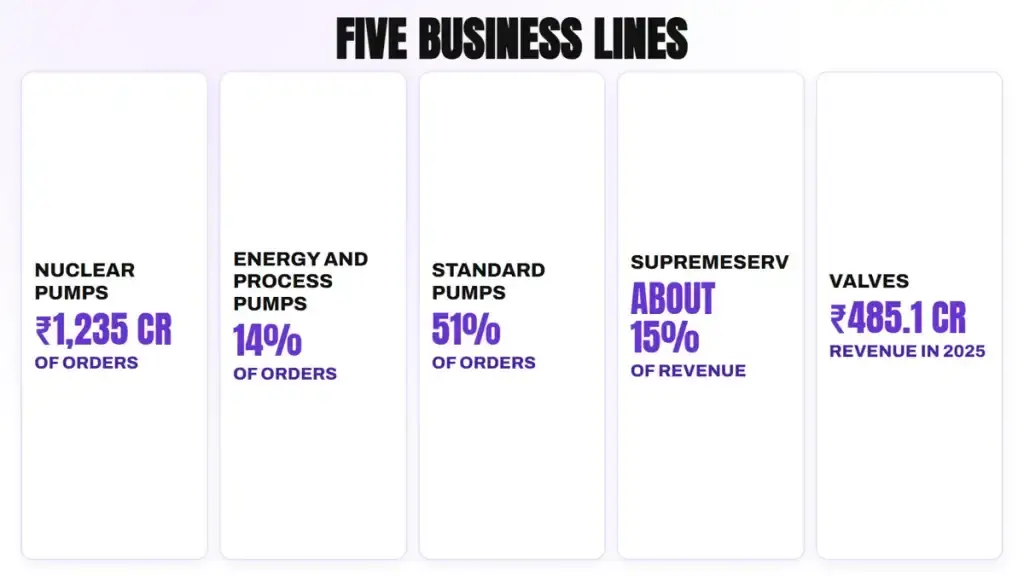
These lines, we should be clear, differ mainly in how each pump is sold. Read this Segment-Wise Revenue Analysis Explained Standard pumps are made in volume at Sinnar and Pimpri and sold through more than 800 dealers. Engineered and nuclear pumps are designed for one project and built at Shirwal, with long delivery times and milestone payments. SupremeServ sells parts and repairs for pumps already installed, and valves come from a separate plant at Coimbatore.
Nuclear Pumps for NPCIL's 700 MW Fleet
Let's start with nuclear, the line that defines KSB's long-term work. India plans to add capacity from about 8.8 GW today to 22,480 MW by 2031-32. Most of that comes from 700 MW PHWRs, built in fleets of identical units. NTPC also plans about 30 GW of nuclear capacity, alone and with NPCIL.
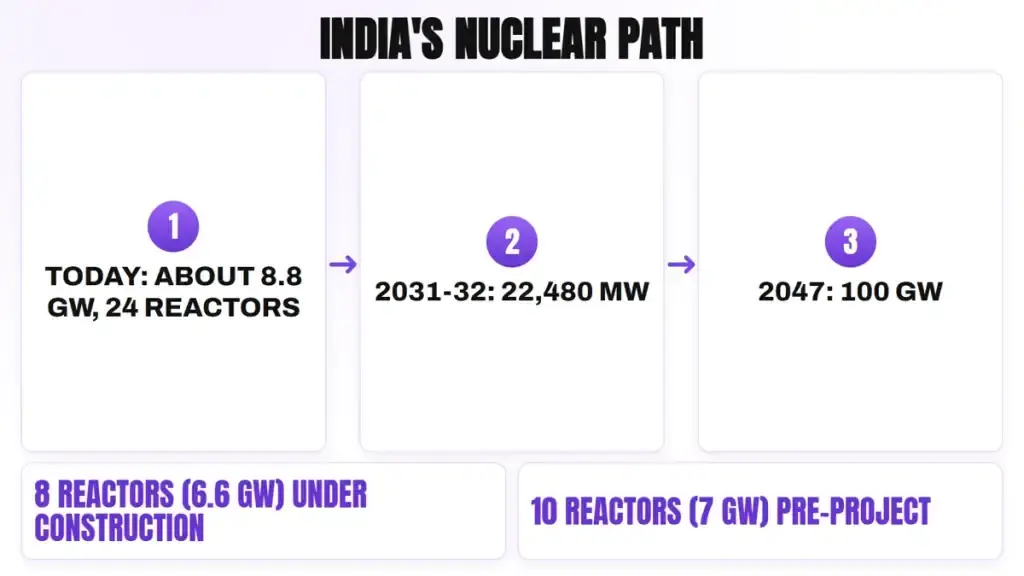
That fleet design suits KSB, because every 700 MW unit needs four primary coolant pumps. In August 2025, KSB put the pump need for ten 700 MW units over three to five years at 40 reactor coolant pumps, 380 primary island pumps and 110 turbine island pumps. The primary island pumps include shutdown cooling, safety and fuel handling pumps, and the turbine island pumps include boiler feed and condensate pumps.
That opportunity, as we will see, is already partly in the order book. KSB won eight primary coolant pumps for Gorakhpur (GHAVP) units 1 and 2 in Haryana in 2018. That first order was worth about ₹400 Cr for eight pumps. In 2022, KSB won eight more for Kaiga 5 and 6 in Karnataka, worth about ₹500 Cr with motors and spares. These are the first fully localised coolant pumps for 700 MW reactors, including castings, rotor parts, mechanical seals and Hurth gear machining that used to be imported.
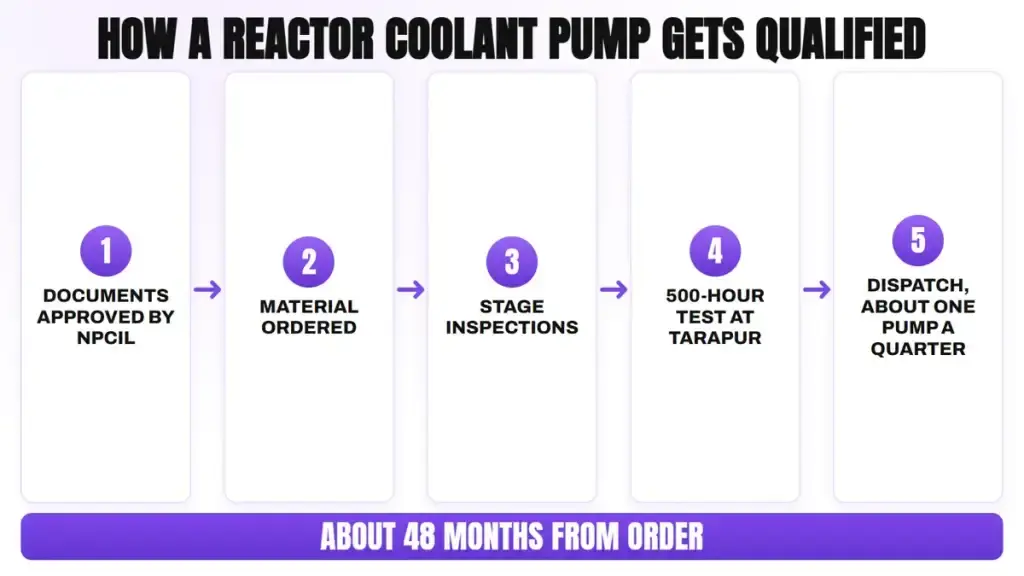
Those two orders, however, depend on a step outside KSB's factory. Each new pump design must run for 500 hours on NPCIL's own test bed at Tarapur before it is accepted. Testing started in April and May 2026, but other equipment on the test bed had problems. Management said in August that NPCIL expected to fix them by the end of August and restart testing in September.
That split of buyers matters for what comes next. NPCIL buys the reactor coolant pumps for its 700 MW units itself, but the other pumps sit with the EPC contractors. BHEL is buying them for Gorakhpur and Megha Engineering for Kaiga, and management said in March 2026 that both orders were close to final. Revenue from those auxiliary pumps would come in 2027 or 2028.
That pattern may also change with the new law. India's SHANTI Act now lets private companies take part in nuclear power, and management expects private plant owners to buy their own pumps under NPCIL's rules. The government has also set aside ₹20,000 Cr for small modular reactors and plans five indigenous ones by 2033. KSB's parent already has small reactor orders abroad, while the Indian company has not yet joined that work.
For you as a reader, that test sets the pace of billing. The first pump needs about two to three months for its 500 hours, because the test does not run non-stop. After that, KSB expects to dispatch about one pump a quarter, and up to six a year if NPCIL wants them faster. The Kaiga pumps will follow once the Gorakhpur test is done.
The second big order is Kudankulam, India's Russian-designed light water plant in Tamil Nadu. KSB won a safety package of 107 pumps there, worth about ₹267 Cr when booked. Its Indian team designed these pumps, because the war ended plans to bring them from Ukraine and other countries. Deliveries started in 2025 and continued in 2026, but only about ₹30-40 Cr was billed in 2025.
That Kudankulam work also opened an export door. Through its parent, KSB won eight Critical Safety Class 2 pumps for units 5 and 6 of a new nuclear plant in Europe, its first nuclear export order. Management has named Kudankulam and Paks as customers that keep placing orders beyond NPCIL.
"We are one company which has all the pumps required in a nuclear power plant." - Rajeev Jain, Managing Director, KSB, March 2026
So what could nuclear be worth each year? In March 2026, the managing director said yearly nuclear revenue could range from ₹100-150 Cr to ₹300 Cr, and ₹300-400 Cr in a good year. He expected the ₹1,300 Cr book of that time to be delivered over about three years. The next tender, for about eight reactors including Mahi Banswara, was expected within a few months of August 2026, with ordering likely in 2027.
Energy and Process Pumps
Next, let's look at the other half of the Shirwal plant, the pumps for thermal power, refineries and oil and gas. India is ordering new coal units of 800 MW, and pumps make up about 3-4% of a thermal plant's cost. KSB puts its share of boiler feed pumps in new thermal units at about 50%, and about 15-20% of the smaller pumps.
That share came with the L&T order of June 2025. L&T, building NTPC's Gadarwara II and Nabinagar II plants, ordered 15 sets of main boiler feed pumps for five 800 MW units. A boiler feed pump pushes water into the boiler at very high pressure, so it is one of the most demanding pumps in a power plant. In the first half of 2026, KSB also won its first order for a localised boiler circulation pump, a pump India had always imported.
These pumps reach overseas buyers as well. In 2025, KSB won an export order worth ₹55.5 Cr from KSB Inc. in the USA, where it also supplies boiler feed pumps for gas-fired power plants. In September 2026, Dangote ordered 18 boiler feed pump packages worth about ₹118 Cr for its fertilizer and energy projects. In October 2026, ONGC ordered seven main injection pumps worth about ₹85 Cr.
That export business runs through the group. About 70-80% of exports are billed to other KSB companies, while large projects like Dangote are billed directly from India. The parent decides which products each factory may sell to which countries, but KSB India's own team wins the orders. Management aims for exports at about 25% of revenue outside nuclear, and says they earn better prices than Indian sales.
That group role is growing in mining too. KSB India is now the group's only maker of a vertical pump for mines, and its Vambori foundry has started casting white iron, a wear-resistant metal for slurry pumps. The group's US mining arm has certified that foundry, and buyers in Australia and Indonesia have started asking for these products.
Standard Pumps for Water, Farms and Buildings
Now let's turn to standard pumps, the largest part of KSB's business by orders. These are catalogue pumps, such as submersible borehole pumps, end-suction pumps and monoblock pumps, made in volume and sold through dealers. Management says this half of the business keeps steady margins because of low fixed cost and fast turnover.
That base, you may notice, is now spreading into newer uses. Solar pumps, sold mainly to state governments under the PM-KUSUM scheme, earned ₹189 Cr in 2024 and ₹245 Cr in 2025. KSB now makes the motor and the controller itself, so its share of each solar pump set has risen to about 30-35% from about 10%. Firefighting pumps gained FM and UL approvals, and water and wastewater orders now include large vertical turbine and split-case pumps for city projects.
Data centres are the newest buyer. KSB supplies pumps for cooling, firefighting and plumbing in data-centre buildings. In India, it has won orders from an international maker of liquid-cooling equipment, and it is in talks with other makers.
SupremeServ Aftermarket
Next, let's look at SupremeServ, the business that services pumps already running. It sells spare parts, repairs, refurbishment, mechanical seals and replacement pumps, from a dedicated plant at Chinchwad. Management says it makes up about 15% of revenue, and it wants that share to keep rising.
That business, we can see, earns more on each rupee. Spare parts carry gross margins two to three times those of new pumps. KSB now also rebuilds parts for pumps made by other companies, and it has won orders to build descaling pumps for steel plants that earlier came from Japanese suppliers. Its own mechanical seal business is about ₹15 Cr a year, from 9,000 to 10,000 seals made at Chinchwad.
Valves
Finally, let's look at valves, KSB's second reported segment. The Coimbatore plant makes gate, globe and check valves for refineries, power plants and process plants. Valves earned ₹485.1 Cr of segment revenue in 2025, with a segment result of ₹69.7 Cr.
That segment, management said in March 2026, grows about 15-18% a year with margins of about 13-14%. In the first nine months of 2026, valves revenue was ₹328.8 Cr. The valves business also relies on castings, so the foundry price rise reached it too.
Why Reactor Pumps Are Hard to Copy
Now that we have seen all five businesses, let's understand KSB's moat. It starts with qualification. A primary coolant pump runs inside the reactor's cooling circuit for decades, so NPCIL approves every design document, inspects each stage of manufacture and tests the first pump for 500 hours on its own bed.
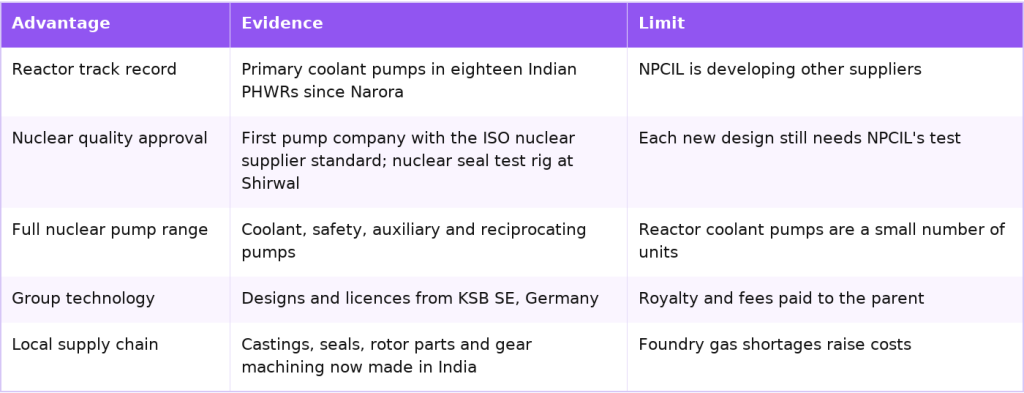
That approval process, as you can see, takes years, and we can count them. Management says delivery to NPCIL takes about 48 months from the order, against a normal cycle of 24-36 months. Documents go back and forth, KSB orders material only after approval, and inspectors visit at each stage. Any new supplier would have to repeat this whole cycle, including its own 500-hour test. Read this Economic Moat Explained
That cycle is why KSB has been the approved supplier for so long.
"In business, I look for economic castles protected by unbreachable moats."
— Warren Buffett
For KSB, the moat is not a patent but a qualification cycle of about four years that every new coolant pump supplier must repeat. Its 47 years of nuclear pump work in India mean it has already been through the learning curve of making these pumps locally. The coolant pump is also one of the first items NPCIL orders for a new reactor, together with the steam generator, so KSB's book fills early in each fleet.
That early start comes with a full range. KSB says it is the one company that can supply every pump a nuclear plant needs, on both the reactor side and the turbine side. With BP&CL's technology, it added reciprocating pumps, and NPCIL has approved its first prototype. So when an EPC contractor buys the auxiliary pumps for a new plant, KSB can bid for every one of them.
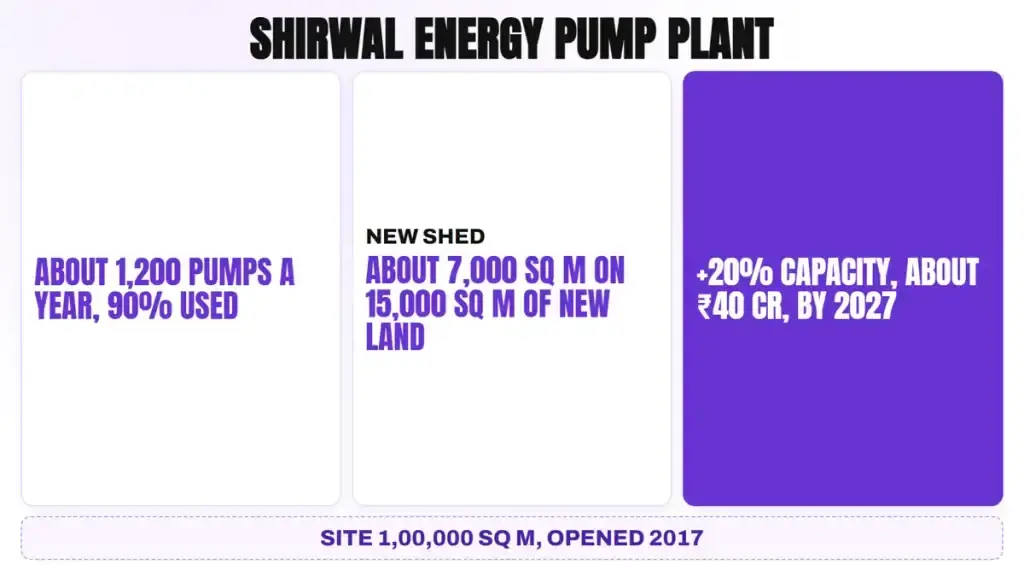
That range needs capacity, and KSB built it ahead of orders. The Shirwal plant was running at 80-90% before its new shed, and customers in thermal and nuclear first ask to see capacity before they negotiate. The new shed of about 7,000 square metres, on 15,000 square metres of land bought next to the plant, adds about 20% to capacity.
The group link, we should add, gives KSB a further layer. KSB SE gives the Indian company access to the latest reactor designs, including the pumps for pressurised water reactors and small modular reactors. Management says the European group, apart from reactor makers that build their own pumps, has the largest share of nuclear pumps worldwide.
"So whenever the next orders come, we will be prepared for that." - Nitin Patil, KSB, August 2026
Financials: Five Calendar Years of Growth and Cash
We have seen the latest quarter and the businesses behind it. Now let's look at five full years, which for KSB run from January to December. Revenue and EBITDA are the company's own figures; profit and operating cash flow are consolidated.
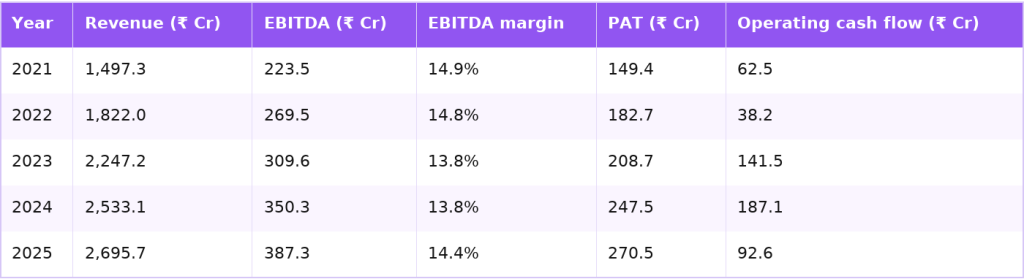
Revenue grew about 1.8 times in four years, from ₹1,497.3 Cr in 2021 to ₹2,695.7 Cr in 2025. The EBITDA margin stayed in a narrow band of about 13.8% to 14.9%, which is close to the 13-14% level management aims for. Profit after tax rose from ₹149.4 Cr to ₹270.5 Cr.
Cash is the weaker line. Over the five years, operating cash flow added up to about ₹521.9 Cr, against profit of about ₹1,058.8 Cr, or roughly half. Inventory and receivables grew with the large engineered orders and slow solar payments, and inventory rose further to ₹961 Cr by June 2026.
The balance sheet still carries no bank borrowings, only lease liabilities, and the company ended 2025 with a net financial position of ₹283.4 Cr. So the growth has been funded from its own cash, but the cash cycle is what to watch as nuclear billing starts.
"Beware of little expenses; a small leak will sink a great ship."
— Benjamin Franklin
For KSB, the leak to watch is working capital: finished pumps waiting for tests and dispatch tie up cash long before they turn into revenue.
What the Next Two Years Look Like on Management's Numbers
So what could all of this add up to for you as a reader following KSB? In August 2026, management said its goal for 2026 was double-digit growth, and it named the NPCIL test bed as the main hurdle. Over the longer run, it put volume growth at 10-15% a year and value growth at about 15-17% on average.
That goal needs a strong fourth quarter. Revenue was ₹2,064.7 Cr in the first nine months, up about 8%. 2025 revenue was ₹2,695.7 Cr, so 10% growth would need about ₹2,965 Cr for the year, or about ₹901 Cr in the December quarter. The first coolant pump invoices would add to that quarter.
Margins are the second part of the plan. Management wants to keep EBITDA at about 13-14% of revenue while it grows sales. Aftermarket and nuclear orders carry better margins, while refinery and coal-power projects carry lower ones because competition for them is intense.
Next, let's look at capital spending, which stays modest. KSB plans to invest about ₹80-120 Cr a year in machines, products and offices. The new Shirwal shed costs about ₹40 Cr, funded from internal cash, and its capacity will be fully added by 2027.
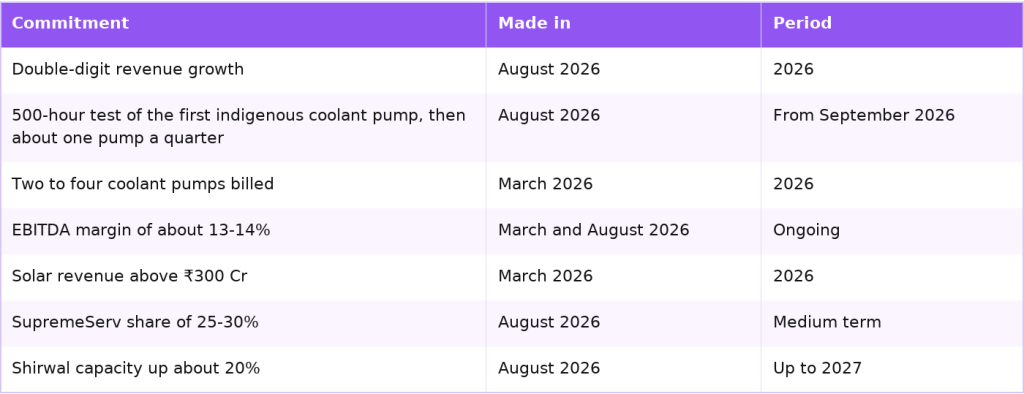
These commitments come with a record we can check, and on nuclear timing it has been poor. In February 2022, management expected its eight coolant pump sets to start shipping from early 2023. In March 2024, it expected two pumps in 2024. In November 2024, it expected testing to finish by March 2025, and in March 2026 it expected testing to start on 22 March.

The delays came from the test bed and the site, which are NPCIL's, rather than from KSB's factory. During the short test in April and May, management said the pump performed as the contract required.
"You can't predict. You can prepare."
— Howard Marks
KSB cannot set the date of NPCIL's test, but it has built the pumps and added capacity so that billing can start as soon as the test bed allows.
Key Risks
No business grows in a straight line, so let's look at what could go wrong for KSB.
- Nuclear billing keeps slipping: the first coolant pump has been at the test site since 2024 and the others are ready, but billing depends on NPCIL's test bed, which has missed every date since 2023. Each delay pushes revenue of about ₹50 Cr a pump into a later year and keeps finished pumps on the balance sheet.
- Margins are under pressure: the EBITDA margin was about 10.6% in Q3 CY 2026 against about 13.1% a year earlier, and the first-half EBITDA fell to ₹146.5 Cr from ₹170.7 Cr. Foundry prices rose about 12-15% while KSB's own price rises were single digit, and fixed-price projects cannot pass on costs. Valves earned a segment result of only ₹3.3 Cr in the quarter, against ₹14.8 Cr a year earlier.
- Cash is tied up in stock and dues: operating cash flow was about ₹92.6 Cr in 2025 against profit of ₹270.5 Cr, and only ₹15.5 Cr in the first half of 2026. Inventory rose by ₹174.9 Cr in six months to ₹961 Cr in June 2026, from export pumps held back by the war and from solar and FGD orders that slowed.
- NPCIL wants more suppliers: management confirmed in March 2026 that NPCIL has given development orders to other companies for coolant pumps. If they qualify, future fleet orders could be split.
- Government schemes: solar pumps depend on PM-KUSUM, and the delay in its second phase cut first-half 2026 solar revenue to ₹50-60 Cr against a plan above ₹300 Cr for the year. Payments from some states, especially Maharashtra, have also been slow.
- Tax claims and parent costs: at December 2025, KSB disputed income tax claims of about ₹54.93 Cr, GST, excise and service tax claims of about ₹130.68 Cr and other claims of about ₹26.38 Cr. It paid royalty of about ₹34.26 Cr in 2025, mostly to its parent, and will also share the group's SAP S/4HANA costs from 2027, an amount not yet fixed.
"The essence of investment management is the management of risks, not the management of returns."
— Benjamin Graham
Most of KSB's risks are about timing: when NPCIL's test bed clears the first pump, when foundry costs settle and when solar schemes restart. The signals below will show each of them early.
Explore our Products
Research Framework

Emerging Titans
Combination of quantitative analysis, industry tailwinds, and management assessment - SPRINT investment philosophy

Tiny Titans
Heavy emphasis on scuttlebutt research, plant visits, and early on-ground signals
What to Track Next
If you follow KSB, these are the signals that will show whether the plan is on track.
- Completion of the 500-hour test at Tarapur and the first coolant pump invoice, then about one pump a quarter
- The next investor meet's nuclear order book, now ₹1,235 Cr, and the tender for about eight new reactors
- The EBITDA margin moving back from about 10.6% towards 13-14% as foundry prices settle
- Revenue for 2026 against double-digit growth, which needs about ₹901 Cr in the December quarter
- Inventory coming down from ₹961 Cr and operating cash flow recovering
- PM-KUSUM's second phase and solar revenue against ₹300 Cr
Conclusion
Let's step back and put it all together. KSB has built the coolant pumps for eighteen Indian reactors over four decades, and it holds ₹1,235 Cr of nuclear orders for the next ones. Its other businesses, from boiler feed pumps to farm and solar pumps, carried revenue to ₹2,695.7 Cr in 2025, and pump sales grew about 23.5% in the latest quarter.
So the next year will show whether the nuclear book finally turns into revenue. The pumps are made, the plant has room to grow and the fleet tenders are coming. The next two investor meets, with the first coolant pump invoices and the result of the next fleet tender, will show how quickly that book can turn into revenue. If NPCIL's test bed clears the first pump, nuclear billing could run for several years, but if testing stalls again, KSB will keep carrying the cost of finished pumps on thin margins.
FAQs
What does KSB Limited do?
+KSB Ltd is a Pune maker of pumps and valves and the Indian arm of Germany's KSB Group. It makes standard pumps for water, farms and buildings, engineered pumps for power plants, refineries and nuclear reactors, valves, and spares and service. It earned ₹2,695.7 Cr of revenue in 2025.
What is KSB's role in India's nuclear power plants?
+KSB makes the primary coolant pumps that push heavy water through the core of India's pressurised heavy water reactors, and has supplied them for eighteen reactors from Narora to Rawatbhata 7 and 8. It is now building fully indigenous coolant pumps for Gorakhpur 1 and 2 and Kaiga 5 and 6, and a safety package of 107 pumps for Kudankulam.
How big is KSB's order book?
+KSB had orders on hand of ₹2,744.5 Cr in June 2026, up from ₹2,144.2 Cr in December 2023. Nuclear orders were ₹1,235 Cr, about 45% of the total. Since then it has also won about ₹118 Cr from Dangote and about ₹85 Cr from ONGC.
Why has KSB's nuclear revenue been delayed?
+Each new coolant pump design must run for 500 hours on NPCIL's own test bed at Tarapur before dispatch. The test bed had problems with equipment outside KSB's scope, so nuclear revenue in 2025 was only about ₹30-50 Cr. Management expected testing to restart in September 2026 and then about one pump a quarter.
How did KSB perform in the September 2026 quarter?
+Revenue was ₹772.7 Cr, up about 19% from ₹649.6 Cr, with pump sales up about 23.5%. Profit after tax was ₹60.6 Cr against ₹67.5 Cr, because materials took about 57.4% of revenue after foundries raised casting prices.
What are the main risks for KSB?
+The main risks are further delays in NPCIL's pump test, margin pressure from foundry costs on fixed-price projects, cash tied up in inventory of ₹961 Cr, NPCIL's plan to develop other coolant pump suppliers, dependence on the PM-KUSUM solar scheme, and disputed tax claims of about ₹185.6 Cr.

High growth stock specialist, Value Educator
Shashank Mahajan is an equity research professional with over 12 years of experience in identifying high-potential SME and micro-cap stocks at an early stage. He follows a rigorous scuttlebutt research–driven approach, combining on-ground insights with deep financial analysis. Shashank specializes in uncovering under-researched and under-owned companies with strong management quality and long-term growth potential. Through disciplined research and early identification, he focuses on spotting tomorrow’s market leaders before they enter the mainstream investor radar.
Macpower CNC: A Rajkot Machine Maker With ₹476 Cr of Orders

Kilburn Engineering: The Dryer Maker With ₹470 Cr of Orders

Rossell Techsys: Boeing and Lockheed Wiring From Bengaluru
Unimech Aerospace: From Engine Tools to Flying Parts
Taneja Aerospace: The Airfield With ₹161 Cr of Rent Signed

Dynamatic Technologies: Airbus Doors, Flap Beams and Pumps
Explore our Products
Research Framework
Emerging Titans
Combination of quantitative analysis, industry tailwinds, and management assessment - SPRINT investment philosophy
Tiny Titans
Heavy emphasis on scuttlebutt research, plant visits, and early on-ground signals



Modern Warfare to Multibaggers
Key Trends. Strategic Shifts. Opportunities Ahead.
Don't Miss This Exclusive Webinar!
Join Value Educator to decode the key trends shaping India's defence sector and learn how to identify tomorrow's potential leaders in the space.
- In-depth research on India's defence sector
- Live Q&A session
- Actionable takeaways for long-term investors

 Orders
 Subscription
 Share with friends


Required Details
₹23999.00
(12 month subscription)
As per SEBI regulations, all users are mandated to complete the KYC that is validated for 1 year. Post payment, you will be redirected to the KYC screen


No comments yet. Be the first to comment!