
TARIL: The Transformer Maker With ₹6,630 Cr of Orders
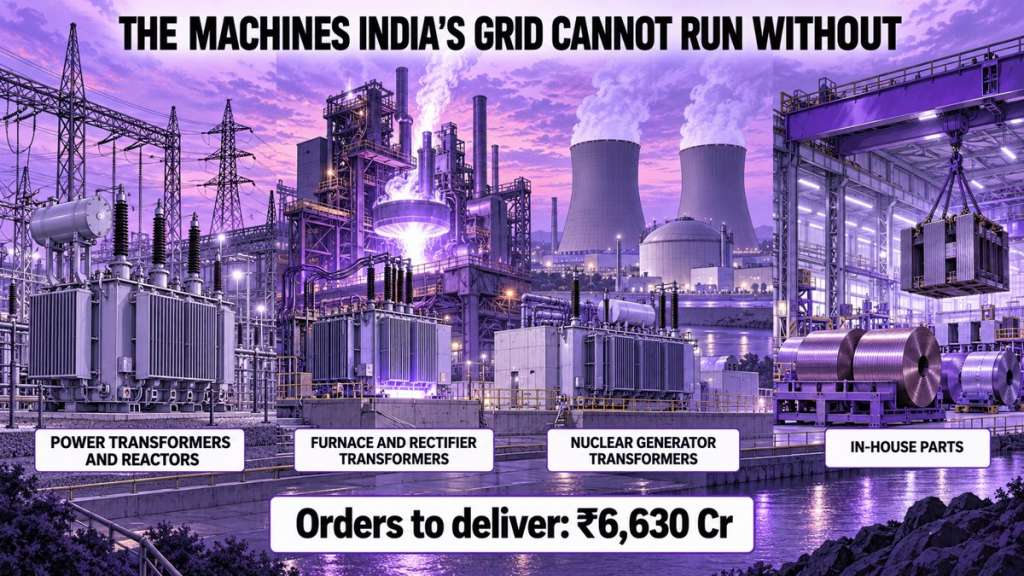
Every unit of electricity India adds has to pass through a transformer, often several times. Power leaves a plant at one voltage, travels across the country at a much higher one, and is stepped down again before it reaches a factory or a home. India plans grid investment of about ₹7.9 lakh Cr to support 900 GW of non-fossil capacity by 2035, and each new line and substation needs transformers.
A power transformer is the large machine at a substation that changes the voltage of electricity, from a few kilovolts up to hundreds of kilovolts and back. It has no moving parts, but it is built from copper windings, special steel cores, insulation and oil, and the largest units weigh hundreds of tonnes. Building them takes months, and testing them takes weeks more.
That grid is also being tied together across regions. India's inter-regional transmission capacity is expected to cross 143 GW, so power from solar parks in the west and coal plants in the east can reach the cities that need it. Every one of those links ends in substations full of transformers and reactors.
That makes transformer makers a bottleneck in the power build-out, as you will see in TARIL's numbers. Utilities such as POWERGRID buy them through tenders, mostly on the lowest price among qualified bidders, so the makers that have passed the tests and have spare capacity win the orders.
One Ahmedabad company has been building them for four decades. Transformers and Rectifiers (India) Ltd (NSE: TARIL) was started by Jitendra Mamtora, who began by repairing transformers and then making 33 kV units, and was incorporated as TARIL in 1994. It now makes power, distribution and special transformers and reactors from 5 kV up to the 1,200 kV class, for utilities, industry and renewable developers in more than 40 countries.

So the company you are looking at sits at the heart of India's grid build-out. At the end of June 2026, it had ₹6,630 Cr of orders still to deliver, its unexecuted order book, which means the value of orders received but not yet billed.
Two more terms will come up often below. A short-circuit test means checking that a transformer survives the huge forces of a sudden fault on the grid without its windings bending or breaking, and utilities ask for it before they trust a design. Backward integration means making the parts a company used to buy, such as conductors, insulation and bushings, in its own plants.
TARIL in five numbers
- Unexecuted order book of ₹6,630 Cr in June 2026, up 26% from a year ago
- Order inflow of ₹2,114 Cr in Q1 FY27, including an order above ₹1,000 Cr from POWERGRID
- Installed capacity of 75,000 MVA a year across three plants
- FY27 target of 25% revenue growth at a 16% EBITDA margin
- ₹23,000 Cr of enquiries under negotiation
That is a large book for a company with ₹2,508.80 Cr of revenue in FY26. So can it build fast enough to deliver it? Let's first understand the company, and then look at the latest quarter and the orders that came in.
Transformers and Rectifiers (India): Company Overview
Transformers and Rectifiers (India) Ltd, or TARIL, is an Ahmedabad transformer maker. Its founder, Jitendra Mamtora, began by repairing transformers and then making 33 kV units, and the company was incorporated as TARIL in 1994. It makes power, distribution, furnace, rectifier and specialty transformers and reactors from 5 kV up to the 1,200 kV class, in three plants at Moraiya, Changodar and Odhav with 75,000 MVA of yearly capacity. Six subsidiaries make parts such as bushings, tanks, radiators and steel cores. The group has more than 1,700 people, more than 18,000 transformers installed in over 40 countries, and earned ₹2,508.80 Cr of consolidated revenue in FY26. Read this Indo Tech Transformers: AI and Solar Power
"In the short run, the market is a voting machine but in the long run, it is a weighing machine."
— Benjamin Graham
For TARIL, the weighing will come from deliveries. A record order book matters only as fast as the plants can build, test and ship it.
The Quarter the Order Book Reached ₹6,630 Cr
Let's look first at Q1 FY27, the April to June quarter, when the order book reached ₹6,630 Cr. On a standalone basis, which covers the transformer business itself, revenue grew 10% to ₹559.28 Cr. EBITDA was ₹87.37 Cr, a margin of 15.62%, and profit was ₹49.92 Cr.

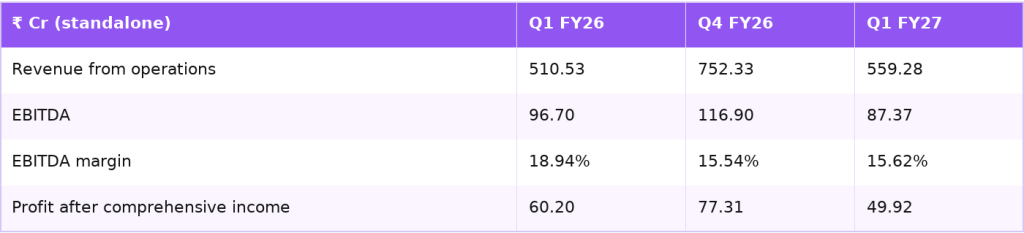
That margin compares with an unusually strong quarter a year ago, when it was 18.94%. Material costs rose to ₹401.58 Cr from ₹344.81 Cr, faster than revenue, while other expenses came down to ₹66.16 Cr from ₹69.74 Cr. Finance costs rose to ₹14.28 Cr from ₹9.19 Cr, as the company borrowed more for working capital.
That revenue was held back by one plant. TARIL is expanding its Changodar plant, and the work cut that plant's use to 27% of its capacity in the quarter. Management expects the expansion to finish by August 2026 and growth to pick up from Q3 FY27. Its main Moraiya plant ran at 57%, and the small Odhav plant at 100%.
That Changodar plant matters because each plant makes different units. Moraiya, with 40,000 MVA a year, makes the largest power transformers up to 1,000 MVA and the 1,200 kV class, reactors up to 765 kV and generator transformers up to 500 MVA. Changodar, with 35,000 MVA, makes medium power transformers up to 160 MVA and 220 kV, renewable-sector units, furnace transformers up to 100 MVA and rectifier and traction units. Odhav, with 2,000 MVA, makes units up to 10 MVA, including distribution transformers.
That plant work also changed the mix of what was shipped. Management says Q1 FY27 deliveries were heavier on 220 kV, 400 kV and 765 kV units, because the smaller units come mostly from Changodar. Once the expansion is over, it expects deliveries to spread again across all ratings, from distribution transformers to the largest units.
That same quarter brought in a record flow of orders. New orders of ₹2,114 Cr were 218% higher than a year earlier, when orders had been slow. The largest was an ultra-mega order from POWERGRID of more than ₹1,000 Cr for transformers of various ratings, to be delivered within 30 months.
"Our immediate priority is not adding further transformer manufacturing capacity, but maximizing utilization and improving throughput and enhancing operational efficiency across all facilities." - Satyen Mamtora, Managing Director and CEO, TARIL
That POWERGRID order sat next to three others. GETCO, Gujarat's transmission company, ordered transformers and reactors worth about ₹228 Cr. RRVPNL, Rajasthan's transmission company, ordered about ₹175 Cr. A US company, PDC AK LPIV, LLC, placed an export order of about ₹150 Cr, to be delivered by mid-2027.
That flow follows a slower patch. The order book was ₹5,132 Cr in March 2025 and ₹5,005 Cr in March 2026, as orders in FY26 only roughly matched deliveries. Even so, FY26 brought a ₹473 Cr order from GETCO for power and EHV transformers.
That flow continued after June. In August 2026, APTRANSCO of Andhra Pradesh placed a letter of intent for transformers to be delivered within 13 months. In October, Damodar Valley Corporation ordered 500 MVA and 200 MVA auto transformers, and GETCO ordered shunt reactors and 500 MVA auto transformers. The company classes each of these as a large order, which by its own policy means ₹100-500 Cr before GST.
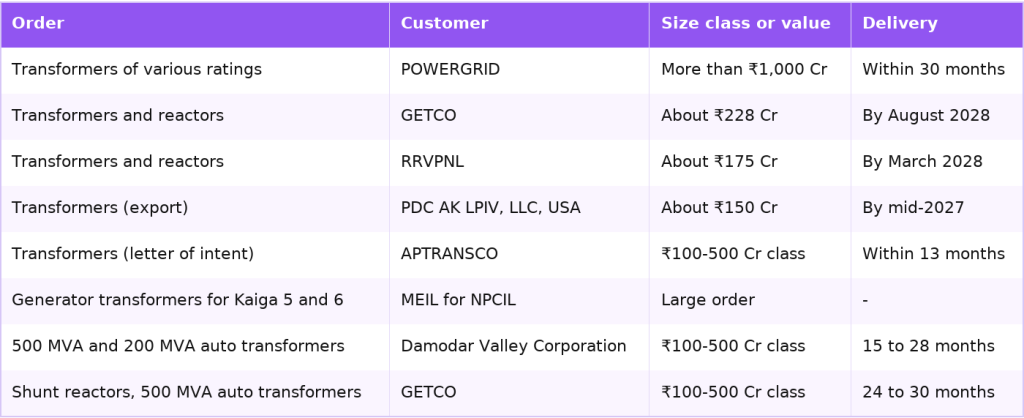
Why the POWERGRID order matters: an order of more than ₹1,000 Cr in a single award is rare for any Indian transformer maker. It shows that India's largest transmission company trusts TARIL with a large share of its substations, and management says it has more POWERGRID enquiries under negotiation.
The Group Numbers
So what does the whole group look like? TARIL has six subsidiaries that make parts such as bushings, tanks, radiators and steel cores, and they earn higher margins than the main business.

That group view shows the subsidiaries at work, and you can see it in the margin. In Q1 FY27, consolidated EBITDA was ₹109.65 Cr against ₹87.37 Cr for the standalone business, so the parts makers added about ₹22 Cr of EBITDA in the quarter. Management expects the consolidated margin to be about 20-21% or more in FY27, with the subsidiaries adding about 100 basis points over the standalone business. In all, the group runs three factories and six subsidiaries with more than 1,700 people.
That FY26 base was itself a record. Consolidated revenue grew 24% to ₹2,508.80 Cr, and profit after comprehensive income grew 26% to ₹272.09 Cr. The company manufactured 33,763 MVA of transformers in FY26, its highest ever, up from 29,118 MVA in FY25 and 16,425 MVA in FY24.
Five Years of Growth
Now let's step back and look at five years of growth in the standalone business. That production rise shows clearly in the numbers. Revenue grew about 27% a year over FY21 to FY26, EBITDA about 38% a year, and profit about 101% a year, from a very small base.

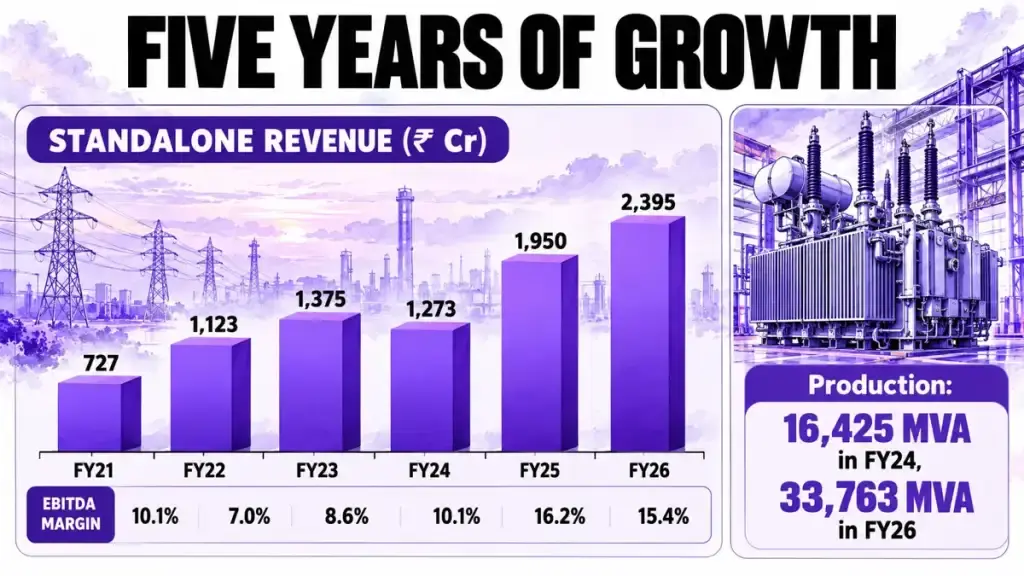
That jump came in FY25, when the margin rose from 10.1% to 16.2%. Bigger and higher-voltage transformers, a tight market for transformers and a doubled revenue base all helped. Returns rose with it: return on capital employed went from 11.1% in FY21 to 19.1% in FY26, and return on equity from 2.1% to 15.7%.
That growth was also funded with fresh equity. TARIL raised ₹120 Cr through a preferential issue in October 2023 and later ₹500 Cr through a QIP, and it bought a parts maker to start its backward integration.
That growth also made the balance sheet stronger. Net worth rose from ₹335 Cr in FY21 to ₹1,440 Cr in FY26, helped by fund raising. Debt to EBITDA came down from 3.3 times to 1.1 times over the same period, and debt to equity from 0.7 to 0.3. Read this Debt to Equity Ratio Explained
Six Kinds of Transformers, One Order Book
Now let's look at what TARIL makes. Its order book is spread across six product lines, and power transformers are by far the largest.
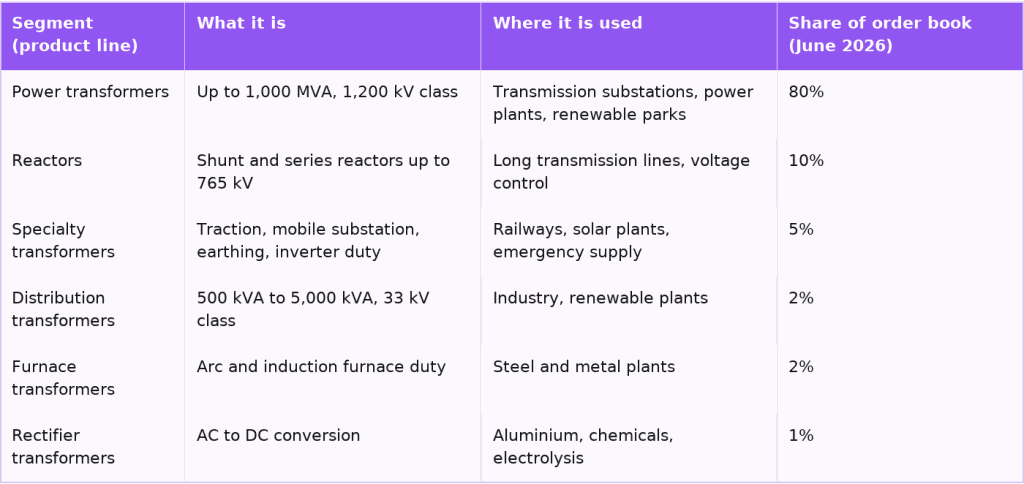
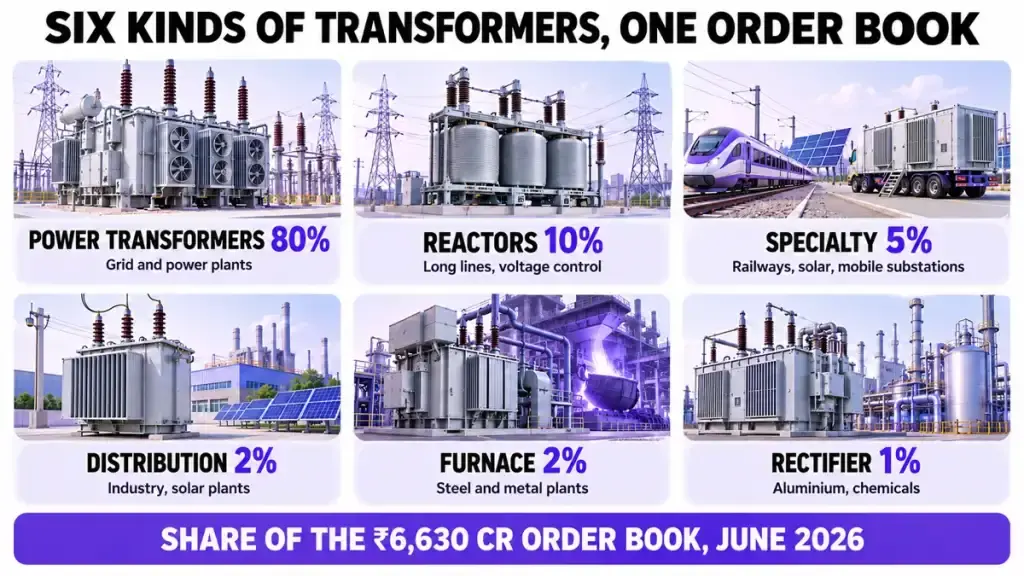
These lines can sound alike, because each one changes voltage. The difference is the job and the customer. Power transformers and reactors serve the grid, distribution and specialty units serve industry and solar plants, and furnace and rectifier transformers feed heavy industry with very high currents.
That list also hides some fast-growing niches. Inverter duty transformers connect solar plants to the grid, traction transformers go into railway locomotives, and mobile substation transformers can be moved by truck to restore power quickly. Rectifier transformers, which feed electrolysis, could also serve hydrogen plants as they come up.
That grid weight has grown over time. In FY22, power transformers were 77% of the order book and reactors 6%. In Q1 FY27 they were 80% and 10%, as utilities placed larger transmission orders.
Power Transformers and Reactors for the Grid
Let's begin with the grid, which drives most of the orders. India's target is 500 GW of renewable capacity by 2030, and peak demand is projected to reach about 459 GW by 2035. India's transformer market is projected to grow about 8.3% a year, from about USD 2.6 billion in 2025 to about USD 5.6 billion by 2034. Read this The Silent Gatekeeper of India's Power Grid
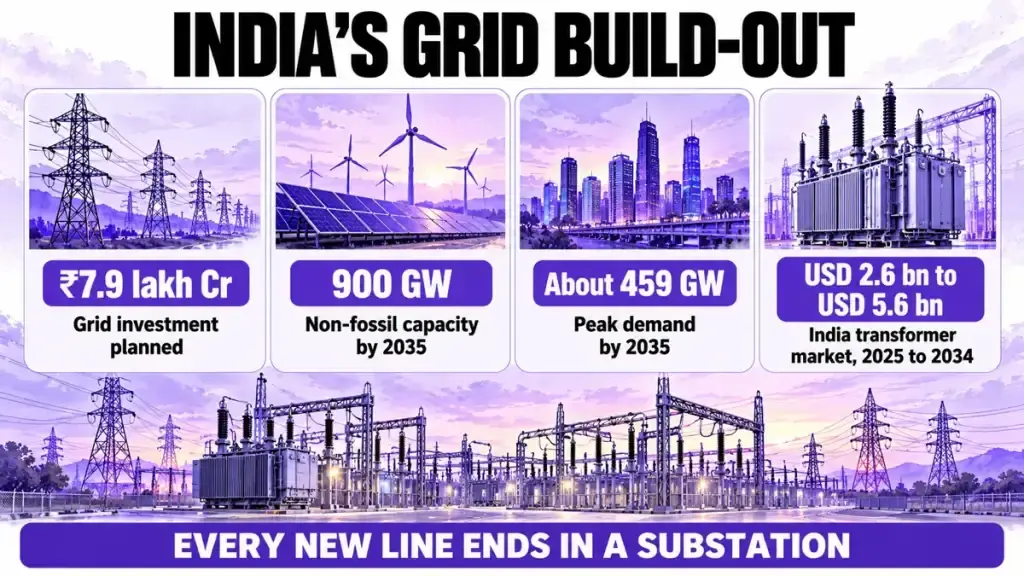
That grid build-out reaches TARIL mainly through POWERGRID and state transmission companies. Its range runs from 33 kV up to the 1,200 kV class, and from 66 kV to 765 kV its orders are fairly evenly spread. It dispatched a 333 MVA, 1,200 kV auto transformer to POWERGRID's National Test Station at Bina, the highest AC voltage in the world.
That grid work also includes newer products. TARIL has also won its first order for 193 MVA single-phase STATCOM transformers, which support devices that keep grid voltage steady as more solar and wind come in. It also built a 220/253 MVA arc furnace transformer, one of the largest ratings made anywhere.
That grid work has brought large orders before. TARIL's highest order until recently was ₹740 Cr from GETCO, and it has executed a maiden order for 400 kV generator transformers. Management also points to new demand from data centres, railway electrification and EV charging.
That demand is also backed by a new team. TARIL's chief marketing officer, Praveen Srivastava, worked earlier at Hitachi Energy India and ABB India, two of its larger multinational rivals in high-voltage transformers.
That range also brings different rivals at each level. At 33 kV, TARIL competes with small makers, at 132-220 kV with other Gujarat makers, and at the highest voltages mostly with multinational companies. Management says it competes with almost all players in India, and that Indian tenders are decided on price among qualified bidders.
That qualification depends on testing. In Q1 FY27, TARIL completed short-circuit tests on four transformer units, a key proof for utilities. It has also tested a 315 MVA, 400/220 kV auto transformer at KEMA in the Netherlands, one of the world's best-known independent test labs.
Industrial, Furnace and Rectifier Transformers
Next, let's look at industry, the second leg of the business. Steel, aluminium, chemicals and mining plants need transformers that handle very high currents and frequent overloads. TARIL makes furnace transformers for arc, induction and ladle furnaces, and rectifier transformers of up to 160 kA DC for electrolysis and smelting.
That industrial work reaches far beyond India. TARIL installed a 132 MVA arc furnace transformer for Grupo in Mexico, built to the 60 Hz grids of the Americas, and its largest furnace transformer, 156 MVA, at Novorross Steel in Russia. It has also tested a 220/253 MVA arc furnace transformer, a size few makers in the world can build.
That reach also shows in its customers. Management says its enquiries under negotiation are split about equally between government, private utilities and industrial customers. Its products go into steel, cement, petrochemicals, pharmaceuticals, railways, mining and hospitals.
Exports, Renewables and New Markets
Now let's turn to the newer markets. The global transformer market was about USD 68 billion in 2025 and is projected to reach about USD 137 billion by 2036, with the US growing about 7-8% a year. TARIL has customers in more than 40 countries and more than 18,000 transformers installed.
That global demand is also shifting towards new loads. Management says data centre expansion, railway electrification, EV charging and renewable energy integration are all adding transformer demand, alongside the core grid build-out. Data centres need transformers that run reliably at high loads, and railways need traction units for electric locomotives.
That export work has a long record in the US. Management says TARIL has supplied 765 kV transformers to US customers for more than 20 years, and US customers value its quality, production capacity and price. The ₹150 Cr US order in Q1 FY27 is the latest of these. Its export list runs from Brazil, Canada and Mexico to Kenya, South Africa, Bangladesh, Saudi Arabia, Australia and New Zealand. Management plans to keep exports at about 10-15% of the business, with growth from North and South America and Australia.
Nuclear and HVDC, the Next Steps
Finally, let's look at two markets TARIL has only just entered. In August 2026, it won its first nuclear order: generator transformers for NPCIL's Kaiga Units 5 and 6 in Karnataka, through Megha Engineering and Infrastructures (MEIL). Kaiga 5 and 6 are two Indian-designed 700 MWe pressurised heavy water reactors that together add 1,400 MW. A generator transformer steps up the power from the plant's generator so it can travel on the grid.
"We are proud to mark our entry into the nuclear power sector with this order for NPCIL." - Satyen Mamtora, Managing Director and CEO, TARIL, August 2026
That order is part of India's own 700 MWe heavy water reactor programme, which repeats one reactor design at several sites. A supplier that has delivered generator transformers for one such plant may be better placed when the next ones are tendered, though each order is won separately.
That nuclear entry sits next to HVDC, where TARIL is still qualifying. HVDC lines carry power over long distances as direct current, and they need special converter transformers. Management says only a few global makers, Hitachi, Siemens, GE and TBEA, build them today. TARIL is repairing an HVDC transformer for POWERGRID, and after that work is complete, POWERGRID may approve it for a first trial order. Management expects it to take another 15-16 months to make HVDC transformers fully on its own. The repair itself needs about nine more months. For its own design, management says it is working on a hybrid approach, and it does not need extra R&D spending for it now.
The Tests and Approvals That Are Hard to Copy
Now that we have seen every product line, let's understand why TARIL's approvals are hard to copy. It starts with how utilities buy. They tender only among makers whose designs have passed type tests and who are approved by POWERGRID, NTPC and the state companies.
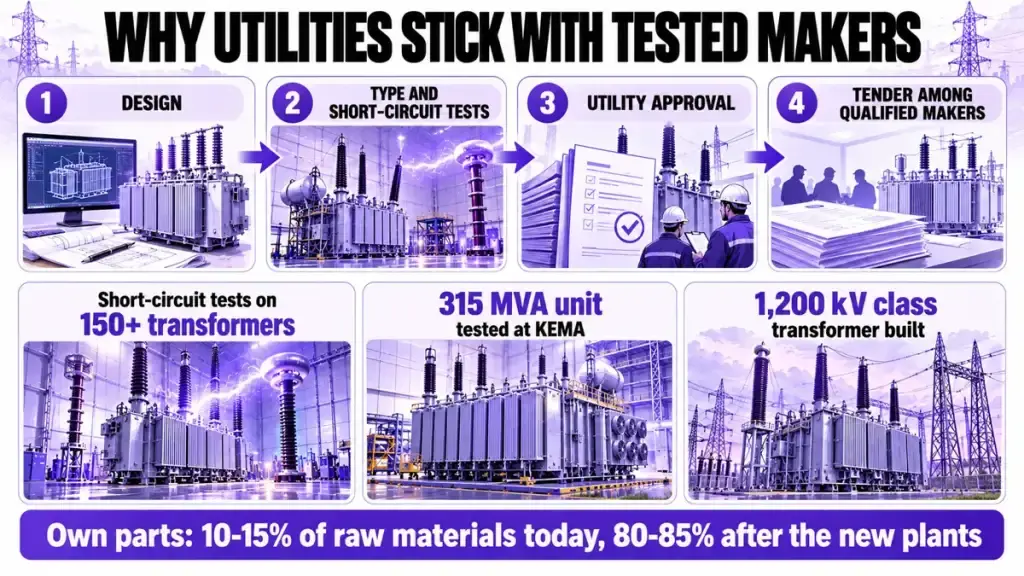
That record is one we can measure. By early 2024, TARIL had completed dynamic short-circuit tests on more than 150 transformers over about two decades, a number few Indian makers can match. Each passed test lets it offer the same design to utilities without testing it again.
"The key to investing is not assessing how much an industry is going to affect society, or how much it will grow, but rather determining the competitive advantage of any given company and, above all, the durability of that advantage."
— Warren Buffett
For TARIL, the advantage is a library of designs that have already survived the short-circuit test. Every new rival has to start that library from zero.
That approval takes years to earn. A new maker has to build a transformer, ship it to a test lab, pass the short-circuit test and then supply units that run for years without failure. TARIL has 40 years of operations, NABL-accredited labs for impulse, temperature and oil tests, and says it is the only Indian transformer company with an NABL-accredited lab for electrical steel testing.
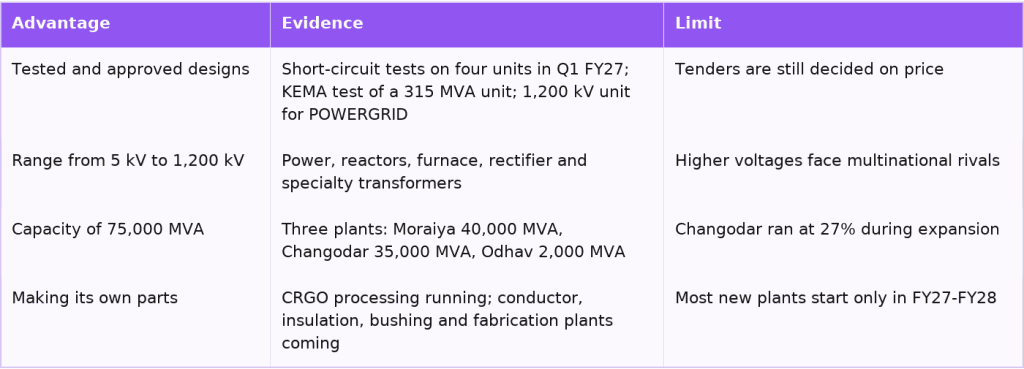
That record also includes some firsts. TARIL successfully commissioned an 1,150 kV transformer, built green transformers and reactors of up to 400 kV that use natural ester fluid instead of mineral oil, and has a technical alliance with ZTR of Ukraine. Each of these is a design that a new rival would have to build and test from scratch. Read this Economic Moat Explained
That last advantage is the one TARIL is building now. It already makes radiators, tanks, some bushings and core-cutting in-house, which cover 10-15% of its raw material needs. Its new plants are meant to raise that to 80-85%.
That backward integration is well under way. A CRGO processing plant for 20,000 tonnes a year is already running. A conductor plant of 8,000 tonnes a year is due in Q2 FY27, an insulation pressboard plant of 5,000 tonnes in Q3 FY27, a bushing plant of 3,000 units a year in Q4 FY27 and a fabrication plant of 25,000 tonnes in Q1 FY28. Each doubles in a second phase.
That integration also covers the most expensive input. CRGO, the special grain-oriented electrical steel that forms a transformer's core, makes up about 30-35% of a transformer's raw material, and much of it is imported. TARIL already processes its own CRGO, so it buys the steel coils and cuts and slits them in-house.
That integration matters because, as we saw, parts are the real bottleneck in the industry. Management calls bushings a large bottleneck today, and says component shortages are a global problem. Making them in-house should help TARIL deliver on time, and it expects the margin to rise by 200-300 basis points from FY28 as the plants come in.
Financials: Returns, Net Worth and Debt
We have already seen five years of revenue and profit. Now let's look at what that growth did to returns and to the balance sheet. These are standalone figures from the company's latest presentation.
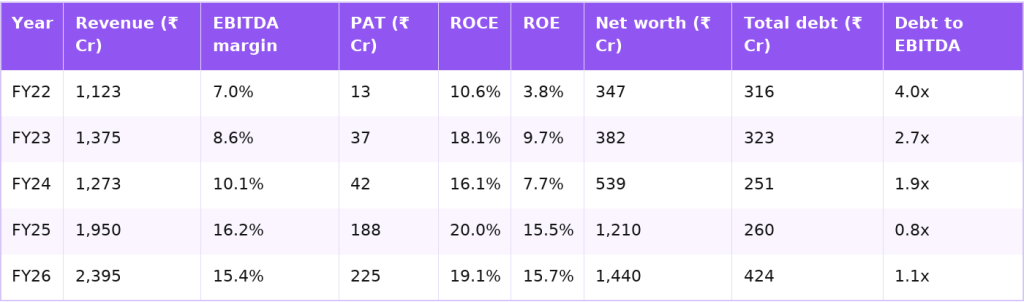
Revenue grew about 2.1 times in four years, from ₹1,123 Cr in FY22 to ₹2,395 Cr in FY26, a growth rate of about 21% a year. Profit grew much faster, from ₹13 Cr to ₹225 Cr, because the EBITDA margin more than doubled from 7.0% to 15.4%. Revenue fell only once, in FY24.
Returns followed the margin. ROE rose from 3.8% in FY22 to 15.7% in FY26, and return on capital employed from 10.6% to 19.1%. ROE stayed below ROCE because net worth grew about 4.1 times, from ₹347 Cr to ₹1,440 Cr, as profits were retained and new money came in through the preferential issue and the QIP.
Debt is the number to watch. Total debt was ₹424 Cr in FY26, more than the ₹316 Cr of FY22, but EBITDA grew faster, so debt to EBITDA fell from 4.0 times to 1.1 times. The rise in FY26 went into working capital: standalone receivables nearly doubled to ₹853.32 Cr from ₹443.15 Cr, and inventory rose to ₹560.88 Cr from ₹399.43 Cr.
"Accounting is the language of business."
— Warren Buffett
For TARIL, the language is clear on profit and returns. What it has not yet shown is whether a much larger order book can be delivered without tying up even more cash.
What FY27 and FY29 Could Look Like on Management's Numbers
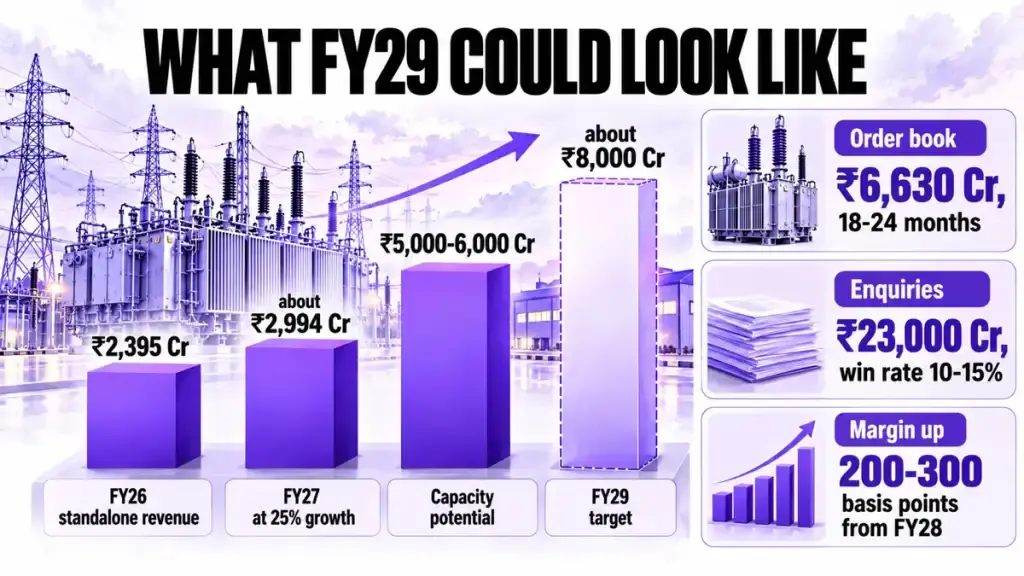
So what could all of this add up to? Management has given a revenue target for FY27, a capacity figure and a revenue goal for FY29, so we can put them side by side.
"I would like to assure all our stakeholders that we are committed to providing only those guidance parameters that we are confident of achieving." - Satyen Mamtora, Managing Director and CEO, TARIL
That plan starts with FY27. Management targets 25% revenue growth, an EBITDA margin of 16% and a profit margin of 9-10% for the standalone business. On FY26 standalone revenue of ₹2,395 Cr, 25% growth would mean about ₹2,994 Cr. Q1 FY27 brought ₹559.28 Cr, so the rest of the year has to carry most of the growth, as the expanded Changodar plant comes in.
That target sits well inside the capacity. Management says its 75,000 MVA of capacity can support revenue of ₹5,000-6,000 Cr over the medium term, about twice FY26. It expects plant use to rise from about 60-65% this year to 80-85% from next year.
That capacity also shows how much room is left. In FY26, TARIL produced 33,763 MVA. If its 75,000 MVA of capacity ran at 80-85%, the level management expects from next year, output would be about 60,000-63,750 MVA, close to twice FY26. That is the arithmetic behind the ₹5,000-6,000 Cr revenue potential.
That capacity also shows in the margin plan. For FY27, management guides a 16% standalone EBITDA margin, against 15.4% in FY26, and a consolidated margin of about 20-21% or more, against 17.70%. The subsidiaries that make parts earn more than the transformer business, so as they grow, the group margin should rise.
That capacity is also what supports the FY29 goal. Management had earlier talked of USD 1 billion of revenue, and now puts it at about ₹8,000 Cr by FY29. It builds that from ₹5,000-6,000 Cr from transformers and about ₹800-1,000 Cr from selling parts to other makers once its new plants have spare output. In the second phase, it expects about 60-65% of the parts output to go into its own transformers and the rest to outside buyers. Selling parts to other makers also keeps the new plants busy in quarters when its own order intake slows.
That goal is large against today's numbers, so let's put it in context. ₹8,000 Cr would be about 3.2 times FY26 consolidated revenue of ₹2,508.80 Cr. Reaching it by FY29 would need growth of about 47% a year for three years, far faster than the 25% guided for FY27.
That plan also needs more plant. Management says an expansion at Moraiya is on track for Q3 2027, and that it will give FY28 guidance with its Q4 FY27 results.
"So we are looking at somewhere around, say, INR8,000 crores." - Mehul Shah, Chief Financial Officer, TARIL
That order book also supports the near term. The ₹6,630 Cr book is executable over 18-24 months, apart from the POWERGRID order of 30 months, and it is about 2.8 times FY26 standalone revenue. Management also has ₹23,000 Cr of enquiries under negotiation, with a historical win rate of 10-15%, which would mean ₹2,300-3,450 Cr of new orders if that rate holds.
That working capital is part of how transformers are sold, so let's see why it runs high. Large orders take months to build, are billed against milestones and need tests and customer approval before the last payments come in. So a maker with a growing order book usually ties up more cash in inventory and receivables before it collects. Read this Days Sales Outstanding (DSO) Explained
That plan is to be funded mostly without new debt, and management wants to free cash from working capital too. It targets working capital of about 120-130 days, against about 170 days at the end of FY26, and says receivables came down by June 2026 as some old dues were paid in April. The Changodar expansion costs about ₹150 Cr, and backward integration ₹900-1,000 Cr. About ₹145 Cr of the QIP money is set aside for it, and leasing will cover about ₹500 Cr.
The Plan for FY27 and FY28
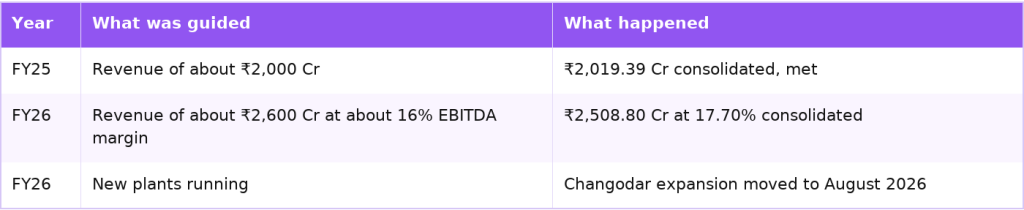
Those targets come with dates, so let's list the plan for FY27 and FY28 that management has committed to.
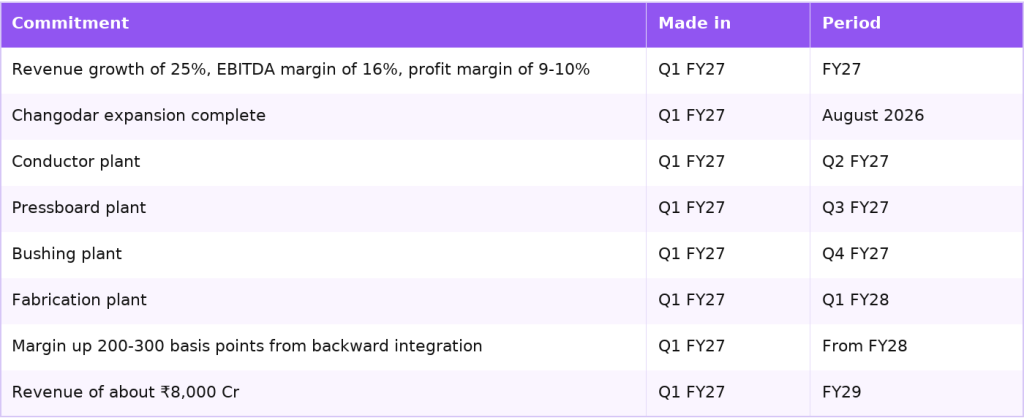
That plan comes with a record we can check. For FY25, management targeted revenue of about ₹2,000 Cr, and consolidated revenue came in at ₹2,019.39 Cr. For FY26, it targeted about ₹2,600 Cr at a margin of about 16% in January 2026, and consolidated revenue was ₹2,508.80 Cr at a 17.70% margin.
"Know what you own, and know why you own it."
— Peter Lynch
For TARIL, knowing why means tracking each plant's start date and each quarter's revenue against the 25% growth target.
Key Risks
No build-out runs without hurdles, so let's look at what could go wrong for TARIL.
- Plant delays: the Changodar expansion was meant to finish earlier and slipped to August 2026, which held back revenue in Q1 FY27. Further delays would push deliveries out.
- Working capital: the standalone business ended FY26 with receivables of ₹853.32 Cr and inventory of ₹560.88 Cr, and working capital days rose to about 170. Management stocked up raw materials until December 2026, which ties up more cash.
- Debt: standalone borrowings rose to about ₹424 Cr in FY26 from about ₹260 Cr, mainly for working capital.
- Order inflow swings: orders were slow in FY26, and management admitted it had miscalculated the orders it expected. Inflow can swing sharply from quarter to quarter.
- Price-based tenders: Indian utility tenders are decided on price among qualified bidders, and many new transformer plants are being built across India.
- Raw materials: CRGO steel and other inputs are volatile, and a trade investigation into CRGO imports could change costs.
- HVDC is not yet earned: TARIL can win HVDC orders only after POWERGRID approves the repaired unit, and it then faces a few large global makers.
- Guidance record: timelines for plants and some revenue targets have slipped before.
"Risk comes from not knowing what you're doing."
— Warren Buffett
None of these risks can be timed in advance. What an investor can do is watch the few numbers below that will show early whether the plan is slipping.
Explore our Products
Research Framework

Emerging Titans
Combination of quantitative analysis, industry tailwinds, and management assessment - SPRINT investment philosophy

Tiny Titans
Heavy emphasis on scuttlebutt research, plant visits, and early on-ground signals
What to Track Next
If you follow TARIL, these are the signals that will show whether the plan is on track.
- Q2 FY27 results, due on 13 October 2026, and revenue against the 25% growth target
- Use of the Changodar plant after the expansion, against 27% in Q1 FY27
- Commissioning of the conductor, pressboard and bushing plants by Q4 FY27
- Order inflow against ₹23,000 Cr of enquiries, and the order book beyond ₹6,630 Cr
- Receivables and operating cash flow as deliveries pick up
- POWERGRID's decision on an HVDC trial order after the repair work
Conclusion
Let's step back and put it all together. TARIL has grown from a transformer repair shop into a maker of 1,200 kV transformers, and India's grid build-out has given it a record order book of ₹6,630 Cr. In Q1 FY27 alone, it won ₹2,114 Cr of orders, including its largest ever from POWERGRID, and it has since added its first nuclear order.
So the next year is about turning orders into deliveries. The company has the capacity, and its new parts plants should make it less dependent on scarce components. If Changodar ramps up and the new plants start on time, revenue could catch up with the order book. If the plants slip again, the orders will simply take longer to become revenue. The cautious thread is cash: receivables nearly doubled in FY26 and debt rose to about ₹424 Cr. The next few quarters, starting with the restart of Changodar and the first new parts plants, will show which thread wins.
FAQs
What does Transformers and Rectifiers (India) do?
+TARIL is an Ahmedabad company, incorporated in 1994, that makes power, distribution, furnace, rectifier and specialty transformers and reactors from 5 kV up to the 1,200 kV class. It has three plants with 75,000 MVA of yearly capacity and earned ₹2,508.80 Cr of consolidated revenue in FY26.
How big is TARIL's order book?
+TARIL had an unexecuted order book of ₹6,630 Cr at the end of June 2026, up 26% from a year earlier and about 2.8 times FY26 standalone revenue. It won ₹2,114 Cr of orders in Q1 FY27, including a POWERGRID order of more than ₹1,000 Cr.
What is TARIL's guidance for FY27?
+For FY27, management targets 25% revenue growth, an EBITDA margin of 16% and a profit margin of 9-10% for the standalone business, and a consolidated margin of about 20-21% or more. It has also talked of about ₹8,000 Cr of revenue by FY29.
What is TARIL's backward integration plan?
+TARIL already processes its own CRGO steel. It is adding plants for conductors, insulation pressboard, bushings and fabrication between Q2 FY27 and Q1 FY28, at a cost of ₹900-1,000 Cr, to raise in-house supply from 10-15% to 80-85% of raw material needs. Management expects the margin to rise by 200-300 basis points from FY28.
Has TARIL entered nuclear power and HVDC?
+In August 2026, TARIL won its first nuclear order, generator transformers for NPCIL's Kaiga Units 5 and 6 through MEIL. In HVDC, it is repairing a converter transformer for POWERGRID, which could lead to a first trial order, and management expects 15-16 months to make HVDC transformers on its own.
What are the main risks for TARIL?
+The main risks are plant delays, high working capital (about 170 days at the end of FY26), rising debt, swings in order inflow, price-based utility tenders, volatile raw material costs, and a guidance record in which some plant timelines have slipped.

High growth stock specialist, Value Educator
Shashank Mahajan is an equity research professional with over 12 years of experience in identifying high-potential SME and micro-cap stocks at an early stage. He follows a rigorous scuttlebutt research–driven approach, combining on-ground insights with deep financial analysis. Shashank specializes in uncovering under-researched and under-owned companies with strong management quality and long-term growth potential. Through disciplined research and early identification, he focuses on spotting tomorrow’s market leaders before they enter the mainstream investor radar.

Zen Technologies: Why Revenue Fell After Its Biggest Win

Data Patterns: India's Radar Designer and Its Waiting Orders

KSH International: The Wire Inside India's Transformers

Krishna Defence: The Steel Behind India's Warship Hulls

PNG Jewellers: A 194-Year-Old Name Goes National

Axiscades: From Services to Missile and Radar Electronics
Explore our Products
Research Framework
Emerging Titans
Combination of quantitative analysis, industry tailwinds, and management assessment - SPRINT investment philosophy
Tiny Titans
Heavy emphasis on scuttlebutt research, plant visits, and early on-ground signals


 Orders
 Subscription
 Share with friends
 Logout


Required Details
₹23999.00
(12 month subscription)
As per SEBI regulations, all users are mandated to complete the KYC that is validated for 1 year. Post payment, you will be redirected to the KYC screen


No comments yet. Be the first to comment!