
Rossell Techsys: Boeing and Lockheed Wiring From Bengaluru

Countries are spending more on their armed forces than at any time in recent memory. World military spending rose 2.9% in 2025 to a record USD 2.89 trillion, the eleventh year of growth in a row. Europe alone spent USD 864 Bn, up 14%. Much of that money buys aircraft, helicopters and missiles, and every one of them is full of wiring.
That wiring comes in a form called a wire harness, which means a bundle of wires, connectors and sleeves cut, crimped and tied to the exact length and path a machine needs. A fighter jet or a helicopter carries hundreds of them. Each one carries power and signals between the cockpit, the engines, the radar and the weapons, so a single faulty joint can ground the aircraft.
Aircraft makers such as Boeing and Lockheed Martin rarely make these harnesses themselves. They give a supplier the drawings and buy the finished harness, which is called build to print. They also sign a long-term agreement, which means a promise to buy a part for three to five years, sometimes seven to ten. Against that agreement they place firm purchase orders six to 12 months before each delivery.
That buying model rewards a supplier that has already been tested and approved. A maker will not move a flight part to a new supplier unless it has to, because the new supplier must pass every test again. So the suppliers that are already inside these programmes tend to stay there for decades.
One Bengaluru company has spent 15 years getting inside them. Rossell Techsys Ltd (NSE: ROSSTECH) builds wire harnesses, electrical panels and test equipment in Devanahalli, near Bengaluru airport. It supplies Boeing on the F/A-18 Super Hornet, the F-15, the AH-64 Apache, the CH-47 Chinook, the P-8 Poseidon and the new T-7A Red Hawk trainer. It supplies Lockheed Martin on the F-16, the C-130J and the MH-60R helicopter, which the Indian Navy also flies. In FY26, 99% of its revenue came from exports.

Rossell Techsys in five numbers
- Q2 FY27 revenue of ₹185.5 Cr, up 48% from a year ago, its highest ever
- EBITDA of ₹29 Cr in the quarter, up 92%
- A confirmed order book of ₹900 Cr on 30 September 2026, plus long-term agreements of over ₹3,100 Cr
- ₹300 Cr of fresh equity raised in November 2026 from SBI Mutual Fund schemes
- Chip-machine and satellite revenue of about ₹140 Cr in the first half of FY27, against about ₹100 Cr in all of FY26
So how did a company that once sold almost everything to one customer reach a record quarter, a record order book and its first outside equity? Let's first understand the company, and then look at the quarter that just ended.
Rossell Techsys: Company Overview
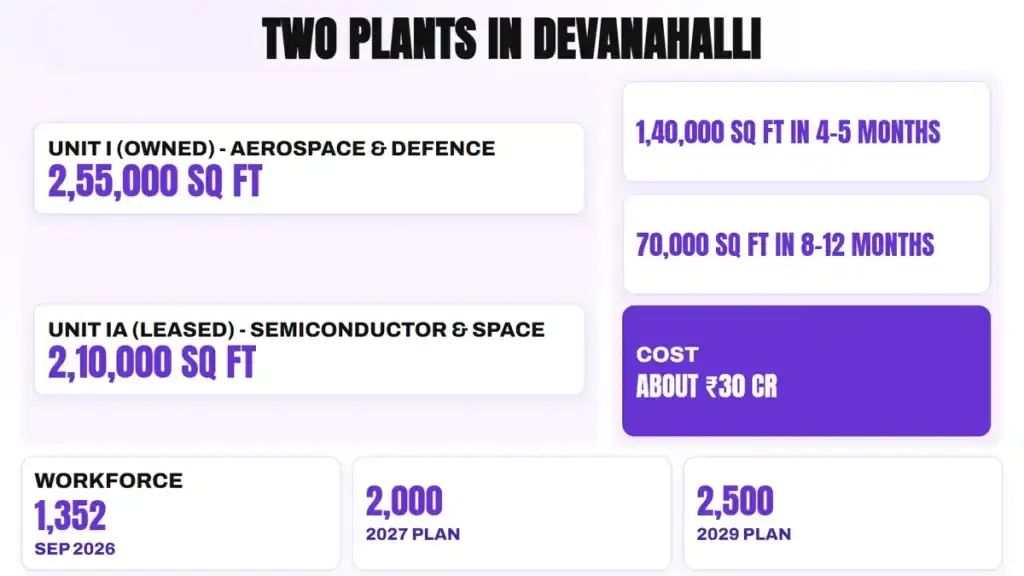
Rossell Techsys Ltd began in 2011 as the aerospace division of Rossell India and became a separate listed company in December 2024. It is based in Bengaluru, where it owns a plant of about 2,55,000 sq ft in the Devanahalli aerospace park and has leased a second building of 2,10,000 sq ft next to it. It also has a small subsidiary, Rossell Techsys Inc., in Tempe, Arizona. The company builds wire harnesses, electrical panel assemblies, electronic systems and automatic test equipment, mostly to its customers' drawings, for aerospace and defence, semiconductor equipment and space customers in eight countries. The promoter group, led by Harsh Mohan Gupta and Rishab Mohan Gupta, held 69.90% after a share sale in July 2026, before the November 2026 share issue. It had 1,352 people in September 2026. Revenue was ₹485 Cr in FY26, up 87%, and 99% of it came from exports. Bank borrowings were ₹409 Cr in March 2026, before the ₹300 Cr equity raise of November 2026. Read this Defence Electronics Stocks to Watch (2026)
"Take a simple idea and take it seriously."
— Charlie Munger
A wire harness is a simple idea: the right wires, cut to length, joined and tested. Rossell has taken it seriously for 15 years, and that is why Boeing and Lockheed Martin let it build parts for their military aircraft.
The Best Quarter in Rossell's Fifteen Years
Let's look at Q2 FY27, the July to September quarter, which was the best quarter in the company's 15 years. Revenue was ₹185.5 Cr, up 48% from ₹125.3 Cr a year ago and up 20% from the June quarter. Profit before tax was ₹12.7 Cr, the first quarter in which it crossed ₹10 Cr.
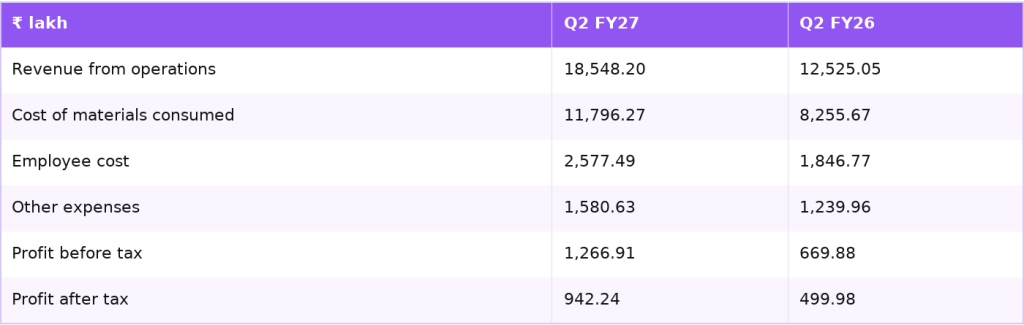
That profit grew almost twice as fast as revenue, and the cost lines show why. Read this How to Read a Profit & Loss Statement Materials, after the change in stock, took about 64% of revenue in both quarters, so the gain did not come from cheaper parts. It came from people and overheads. Employee cost rose about 40% and other expenses about 27%, both slower than revenue. So each worker and each square foot of the plant produced more than a year earlier.
That gain shows up in the company's own measure too. EBITDA was ₹29 Cr, up 92%, and 15.3% of total income, against 12% a year ago. That figure includes about ₹3.6 Cr of other income. Without it, operating profit was about ₹25.3 Cr, or about 13.7% of revenue, against about 11.5% in Q2 FY26.
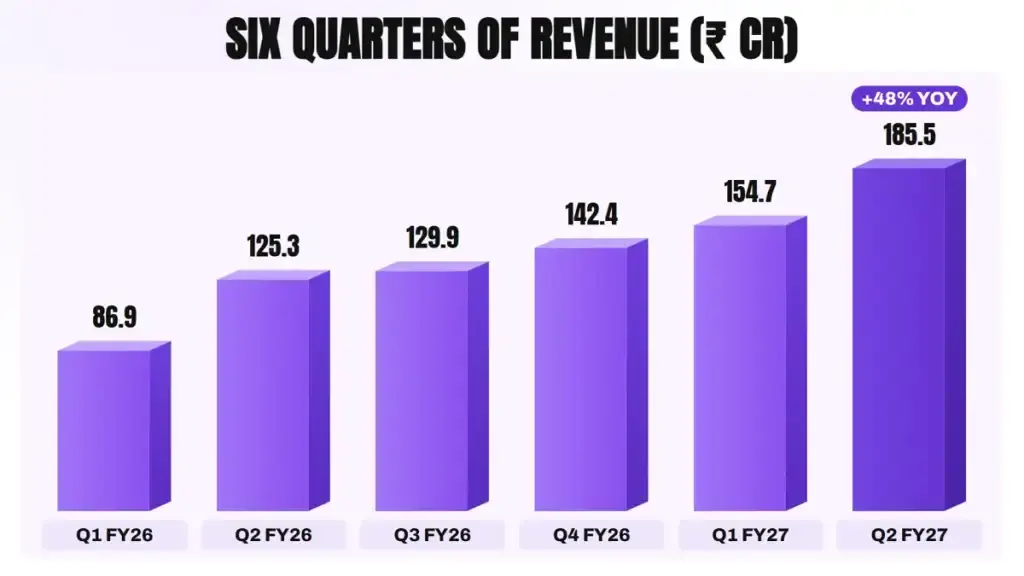
This quarter was also the sixth rise in a row. Revenue was ₹86.9 Cr in Q1 FY26, then ₹125.3 Cr, ₹129.9 Cr, ₹142.4 Cr, ₹154.7 Cr and now ₹185.5 Cr. Management says the third and fourth quarters have always been its strongest, and that has held for ten years.
That run also shows over the half year. First-half revenue was ₹340.2 Cr, up 60%, and EBITDA was ₹52.2 Cr, up 93%. Profit after tax more than doubled to ₹16.4 Cr. With half the year still to go, the company has already booked 70% of FY26's full-year revenue of ₹485.2 Cr.

That half year also tied up less stock for each rupee of sales. Inventory covered 6.67 months of needs in September 2026, against 7.98 months a year earlier and 10 months at March 2025. Management wants to reach four months over the next 24 months, which would free a large part of the money now sitting in stock. Read this Inventory Turnover Ratio Explained
The Orders Behind the ₹900 Cr Book
So where will the next quarters come from? The confirmed order book stood at about ₹715 Cr in March 2026, ₹800 Cr in June and ₹900 Cr in September. In November, management put it at ₹910 Cr and said it would be delivered over the next two and a half years.
That book grew even as revenue grew, because new orders kept coming. The company won about ₹240 Cr of new orders in Q1 FY27 and about ₹190 Cr in Q2, or about ₹430 Cr in the half year. It submitted bids of about ₹350 Cr in Q1 and nearly ₹1,000 Cr in Q2, about ₹1,350 Cr in all, across aerospace, defence, semiconductors and industrial work.
"The person that turns over the most rocks wins the game."
— Peter Lynch
Rossell turns over a lot of rocks: it bid for about ₹4,500 Cr of work in FY26 and about ₹1,350 Cr more in the first half of FY27. The order book shows how many of those bids turn into firm orders.

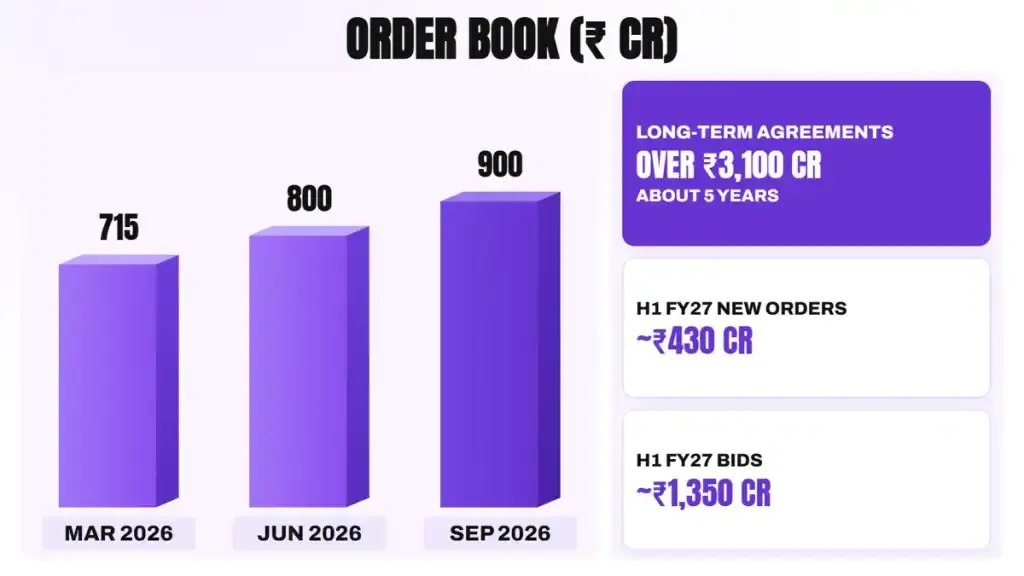
Those long-term agreements sit on top of the order book. They cover programmes such as fighter jets and helicopters, where the buyer plans production years ahead. Each year the buyer turns part of the agreement into firm orders. So the ₹3,100 Cr is not yet in the order book, but it shows where the next firm orders are likely to come from.
The order book also understates the newer businesses. Semiconductor and space customers place orders and expect delivery within months, not years. So those orders turn into revenue quickly and never build up in the book. At March 2026, management said the ₹715 Cr book was split about half and half between aerospace and defence and the newer markets.
Why the book matters: ₹900 Cr of orders against quarterly revenue of ₹185.5 Cr is about 1.2 years of work at today's pace. Add the ₹3,100 Cr of long-term agreements, mostly for aircraft and helicopters, and the company can see its aerospace work for several years ahead.
That quarter also brought the money to fund the work. On 4 November 2026, the company allotted 25,72,898 new shares at ₹1,166 each to six SBI Mutual Fund schemes and an SBI alternative fund. That raised about ₹300 Cr, and the new shares are 6.39% of the enlarged company. In July, Kotak Mutual Fund had bought 18,47,117 existing shares, about 4.9% of the company, from members of the promoter group.
That money has a clear first use. Management says much of it will repay working-capital loans, and the rest will fund capacity, systems and growth. It expects the lower interest cost to show from the third quarter of FY27. It also said it has no plan to raise more equity soon, because this raise covers its needs for about three years.
From a Tea Group's Workshop to Boeing's Supplier List
So let's go back to 2011 to see why such large buyers trust a mid-sized Indian company. That year, Rossell India, a Kolkata group better known for tea, set up a greenfield aerospace division in Bengaluru with a single customer. Within a few years, Boeing had become its anchor buyer.
Boeing came to India partly because of offsets. A foreign defence company that sells to the Indian government must place part of the contract value in India, often 30% to 50% of it. Work given to a registered small or medium enterprise counts 1.5 times its value. So a qualified Indian supplier helps a foreign maker meet its offset duty while also cutting its costs.
That door opened wide. Rossell won Boeing's Supplier of the Year award in 2015 and again in 2019, and it calls itself the only Indian supplier to win it twice in five years. It went on to deliver more than 1,60,000 critical assemblies to Boeing. In September 2025, Boeing gave it a contract to build up to 1,200 sets of electrical panel assemblies for the T-7A Red Hawk through 2033, after an earlier contract for the same aircraft's harnesses.
That long Boeing run also meant one customer for most of the revenue. So the company started adding others. Its customer base grew from just two in 2022 to over 30 across eight countries. Boeing gave about 40% of FY26 revenue, and the rest came from Lockheed Martin, Honeywell, BAE Systems, European and Israeli defence firms, a satellite company and chip-equipment makers.
Its structure changed too. In August 2024, the division was demerged from Rossell India, and Rossell Techsys listed on the stock exchanges on 9 December 2024. Until then, it had never taken outside equity. Growth came from internal cash and bank loans.
That independence came just before the fastest growth in its history. Revenue was ₹217 Cr in FY24 and ₹259 Cr in FY25, then rose 87% to ₹485 Cr in FY26. It took the business fourteen years, from 2011 to 2025, to earn about ₹1,300 Cr of revenue in total. It now expects to earn about the same in just two years. Over the two years to FY26, its workforce grew from about 680 to nearly 1,200. It reached 1,352 in September 2026.
Three Markets for One Wiring Skill
Now let's see where that revenue comes from. Rossell reports one business, wire harnesses and interconnect systems, but it sells that skill into three markets. Aerospace and defence is the base, while semiconductor equipment and space are the two newer markets growing fastest.
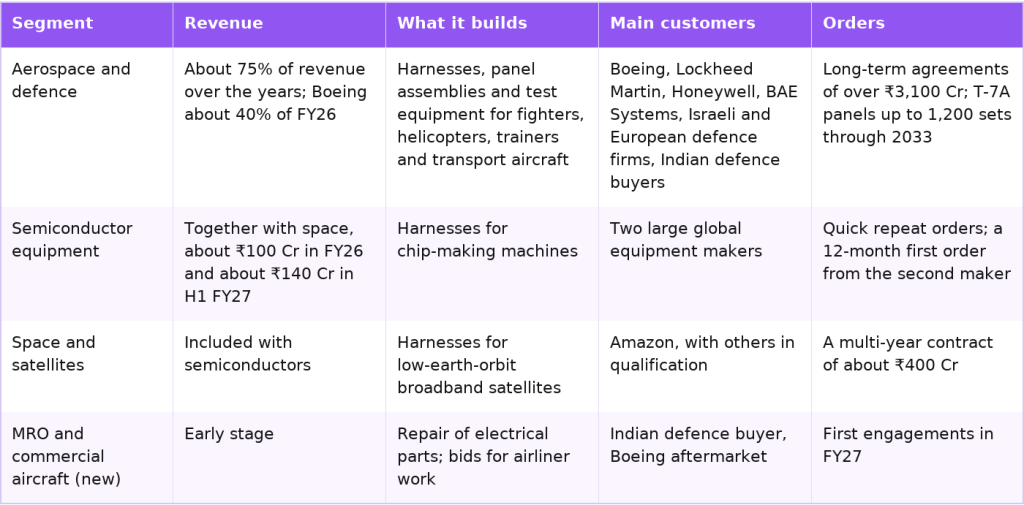
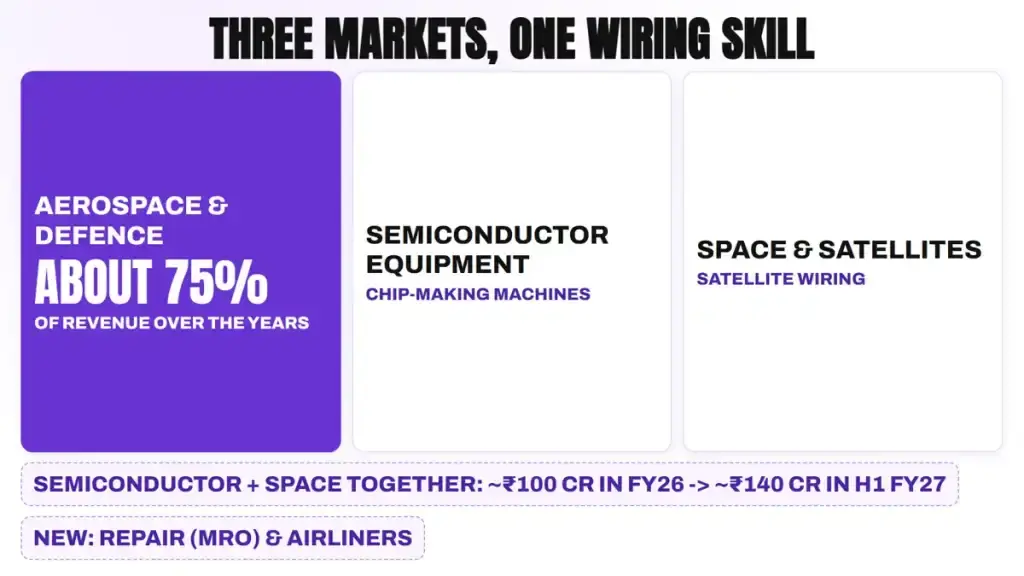
These markets need the same skill but different rhythms. Aerospace and defence work is low volume with many part types, and contracts run for years. Semiconductor and space work is higher volume with fewer part types, and orders turn around in months. Management says margins are similar across all three once a product moves into production.
Aerospace and Defence, Still the Base
Let's start with aerospace and defence, which has given about 75% of revenue over the years. Its demand comes from rising military budgets. Beyond Europe's 14% rise, the US Congress approved defence spending of over USD 1 trillion for 2026. Airliners add to that demand, with a global order backlog of nearly 15,000 aircraft, close to a decade of production.
Rossell's place in that demand is on US military programmes. Its harnesses and panels sit on more than a dozen flagship US platforms, from fighter jets and attack helicopters to tilt-rotor and maritime patrol aircraft. Most of that work comes through Boeing, which has named it Supplier of the Year twice.
The newest Boeing programme is the T-7A Red Hawk, Boeing's new advanced pilot training jet. Rossell holds long-term agreements of about USD 200 million on it, for both harnesses and electrical panel assemblies, which are the cockpit and equipment panels that hold switches, circuit breakers and connectors. Deliveries have started, and the production ramp-up is expected from the later part of FY27.
That Boeing work now sits beside Lockheed Martin. Lockheed builds the F-16 fighter, the C-130J transport and the MH-60R naval helicopter. Rossell makes cable harnesses for Lockheed's aircraft, helicopter, mission systems and missile programmes. In November 2025, Lockheed named it an Outstanding Supplier at its annual supplier conference.
"Today Rossell is nearly on every military platform that comes out of the US." - Rishab Mohan Gupta, Rossell Techsys
Other aerospace buyers have followed. Honeywell, the US maker of aircraft systems, gave the company supplier awards in 2023 and 2024, and BAE Systems, the UK defence group, recognised it in 2025. In May 2026, one of its major overseas defence customers placed a repeat order for harnesses, to be delivered over eight to 12 months.
The next step is more content on each aircraft. Today, Rossell's work covers about 2% of an aircraft build, mainly the wiring and panels. Its stated aim is about 15%, and over time 25%, by adding electro-mechanical assemblies, units that combine wiring with motors, switches and electronics. Management says this could lift its revenue on its current platforms three to five times.
Indian Defence, the New Home Market
Next, let's look at India, where the company is a newcomer despite its Bengaluru base. That may sound odd, but it follows from where the work came from. For 15 years almost all of its output was exported, and in FY26, 99% of revenue still came from abroad.
Now India's own demand is large enough to change that. The country's defence exports reached a record ₹38,424 Cr in FY26. India's growing fleets also need more repair and overhaul work at home. Both trends need local suppliers that already meet foreign makers' standards.
So Rossell spent FY26 getting the papers for that market. It received a defence production licence, which lets it make defence items in India, and an AS9110 certificate for aircraft repair and overhaul. It is also registered with CEMILAC, the Indian centre that certifies military aircraft parts for airworthiness.
Those papers have already brought the first orders. In FY26 it won initial orders from Indian defence and aerospace buyers, which management calls modest in size but important for its record at home. A leading Indian defence customer recognised it for designing and re-engineering advanced automatic test equipment, which checks whether an aircraft's wiring and electronics work before they are fitted. In Q1 FY27, it entered defence repair work through an engagement with a reputed Indian defence company.
That export work already touches India's own forces, since the Navy's MH-60R helicopters come from one of its customers. Tata Lockheed Martin Aerostructures, the Tata and Lockheed venture in India, recognised it in 2021 for helping industrialise a fighter wing. So the company already knows the foreign makers who must place offset work in India.
Why India matters for Rossell: almost all of its revenue is exported today, and most of it rests on US programmes. Each Indian defence order adds a buyer outside US trade rules, and repair work can earn higher margins than building new harnesses.
Its board also brings Indian defence experience. T. Suvarna Raju, an independent director, was chairman and managing director of Hindustan Aeronautics, the state aircraft maker. Shobhana Joshi, another independent director, served as Secretary (Defence Finance) in the Government of India. The CEO, Senthil Balasubramanian, leads the repair business and expects its results to show from Q3 and Q4 of FY27.
Semiconductor Equipment, the Fastest Grower
Now let's turn to semiconductor equipment, the market management now calls its second growth engine. Chip sales are expected to reach about USD 975 Bn in 2026, up 26%, and to cross USD 2 trillion a year by 2036. Every new chip plant needs machines that deposit, etch and test layers on silicon, and each machine is full of harnesses.
Those machine makers are also spreading their supply chains. One of Rossell's customers had a large supply base in South Korea and decided to build a second one in India. Rossell was qualified as a harness supplier in Q2 FY26, and volumes rose quickly after the first articles passed. Revenue from that work started within the same year.
Then a second large customer joined in FY27. Management describes it as one of the largest semiconductor manufacturers in the world. It completed qualification in Q1 FY27, and its first order, to be delivered over 12 months, came in August 2026. So the company now works with two very large multinational chip-equipment makers.
That pair underpins management's largest new target. It expects semiconductor and space revenue together to grow 300% to 400% in FY27. Over three to five years, it wants semiconductor revenue alone to reach about USD 200 million a year. To meet that volume, it is adding automation for these customers, which management says also lifts margins.
Space and Satellites
Next, let's look at space, the smaller of the two new markets. The global space economy was about USD 613 Bn in 2024, and commercial activity made up about 78% of it. Much of the new spending goes into low-earth-orbit constellations, which are thousands of small satellites flying close to the earth to deliver broadband.
Each of those satellites needs harnesses, and they are needed in volume. In FY26, Rossell's space work moved from qualification to volume production. It also won a multi-year space contract worth about ₹400 Cr and delivered the first large production batches. Management named Amazon as the company it deals with for all its space work.
That customer also wants Rossell closer to home. One space customer has asked for a larger presence in the USA, through Rossell Techsys Inc., the company's subsidiary in Tempe, Arizona. In Q1 FY27, that subsidiary was approved to join development projects for a global satellite communications programme and received a letter of intent from an international defence company.
A Second Plant for the New Work
Now, all of this new volume needs space, so the company has taken a second building. In May 2026, it leased 2,10,000 sq ft in the same aerospace park, next to its own 2,55,000 sq ft plant. The plan was to ready 1,40,000 sq ft in four to five months and the other 70,000 sq ft in eight to 12 months, for about ₹30 Cr.
That timeline has held so far. The company inaugurated the new building during its 15-year celebrations in Q2 FY27, and it expects operations there to start shortly. Semiconductor and space work will move into it, which frees the first plant for aerospace and defence. Management expects the new building to reach revenue levels close to the first plant's once it is full.
The Qualification Wall Around a Wiring Supplier
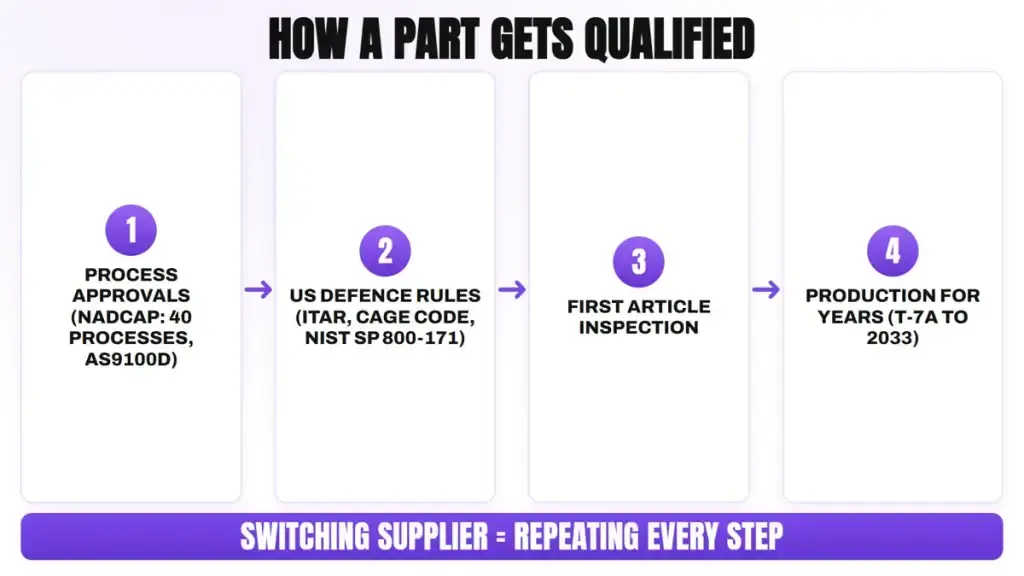
Now that we have seen the three markets, let's understand what keeps customers with Rossell. It comes down to qualification. A harness looks simple, but a defence buyer checks every step of how it is made before it lets a supplier near a flight programme.
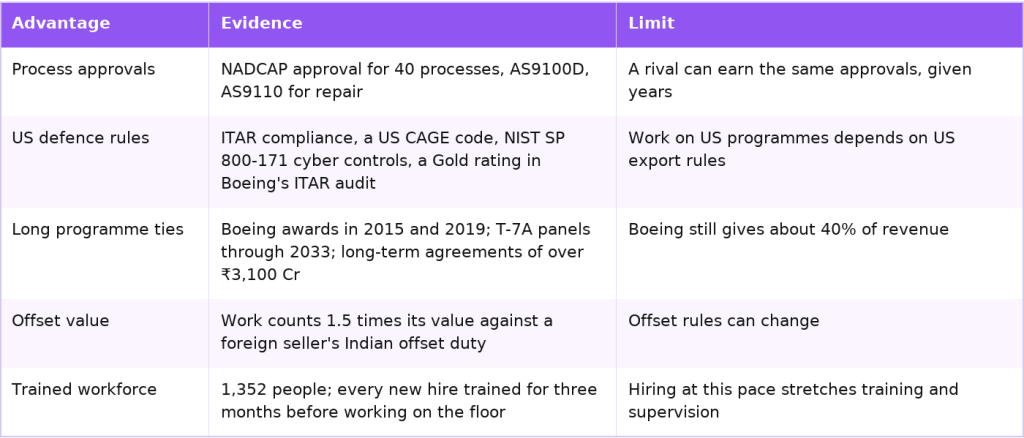
That qualification starts with process approval. NADCAP is an aerospace industry programme that audits special processes such as crimping, soldering and cable testing, and Rossell holds approvals for 40 of them. Each audit checks the method, the machines, the people and the records. A new supplier has to pass the same audits before a buyer will even send drawings.
Next comes the US defence rulebook. Work on US military aircraft comes under ITAR, the US rule that controls who may handle defence data and parts. Rossell is ITAR compliant, is registered with a US CAGE code, and follows the NIST SP 800-171 standard for protecting defence data. It says it received a Gold rating in Boeing's only ITAR audit of its suppliers so far.
"There are significant qualification barriers for anyone to get into the different activities we're in today." - Rishab Mohan Gupta, Rossell Techsys
Then comes the part itself. Each new part goes through a first article inspection, which means the first unit is measured and tested against every line of the drawing before production starts. That work costs money in the year it is done, and the revenue comes in the following years. Once a part has passed, the buyer rarely moves it, because moving it means repeating the whole cycle.
That cycle is why the relationships last. Read this Economic Moat Explained Boeing's awards date back to 2015, and the T-7A contract runs to 2033. Long-term agreements of over ₹3,100 Cr tie the company to its buyers for about five more years.
"A truly great business must have an enduring moat that protects excellent returns on invested capital."
— Warren Buffett
Rossell's moat is its approvals and its long programmes. The returns part is still being built, which is why the margin target matters as much as the order book.
Its people form the last layer, and they take time to build. Every new employee spends three months at the in-house Rossell School of Learning before working on a live programme. The workforce grew to 1,352 by September 2026, and the company plans about 2,000 people in 2027 and 2,500 in 2029. A rival would need years to train a team of that size to aerospace standards.
Financials: Three Years as a Separate Company
Rossell Techsys has separate audited accounts only from FY24, because the business was part of Rossell India before the demerger. So let's look at the three full years it has reported on its own.

Revenue more than doubled in two years, from ₹217.0 Cr in FY24 to ₹485.1 Cr in FY26, and profit after tax nearly doubled to ₹21.9 Cr. The EBITDA in this table leaves out other income and the one-off charge of FY26; the company's own EBITDA figure for FY26, which includes other income, was ₹66 Cr. On either measure, the margin moved down from FY24 to FY26 while new customers and parts went through qualification.
Cash flow is the weak line. Operations used about ₹41.1 Cr of cash in FY25 and about ₹82.8 Cr in FY26, because inventory and receivables grew with sales. Inventory rose to about ₹315 Cr in March 2026, and bank borrowings to about ₹409 Cr, so debt was about 2.7 times equity.
That is the gap the ₹300 Cr equity raise of November 2026 is meant to close. Management says most of it will repay working-capital loans, which should cut interest from the third quarter of FY27.
"Only when the tide goes out do you discover who's been swimming naked."
— Warren Buffett
Fast growth has hidden how much cash Rossell's stock of imported parts needs. The equity raise buys time, but the real test is whether inventory falls towards four months as sales keep rising.
What FY27 Could Look Like on Management's Numbers
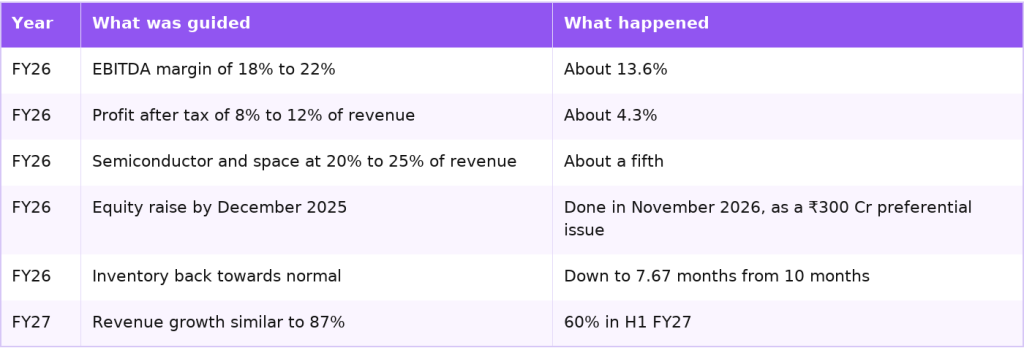
So what could all of this add up to? Management does not give a revenue number. In May 2026, it said it was aiming for growth in FY27 similar to FY26's 87%. In November, it said it would not give a forward outlook, but expected growth every quarter and a stronger second half.
So let's put that aim into numbers. Growth of 87% on FY26 revenue of ₹485.2 Cr would mean about ₹907 Cr in FY27. The first half delivered ₹340.2 Cr, so the second half would need about ₹567 Cr, or about ₹284 Cr a quarter. That is a big step up from ₹185.5 Cr, so the pace of the new markets and the second plant will decide how close the year gets.
Those new markets carry the largest part of that aim. Semiconductor and space revenue was about ₹100 Cr in FY26, so growth of 300% to 400% would mean about ₹400-500 Cr in FY27. The first half has delivered about ₹140 Cr, and management expects these markets to pick up sharply in the third and fourth quarters. By the end of FY27, it wants aerospace and defence and the newer markets to be about half each.
Those markets also matter for the margin plan, which has been raised. In May, management guided an EBITDA margin of 17% to 22% for its current work. In November, it said the target was 18% to 23%, against 15.3% in the first half. Lower interest from the equity raise should also help profit before tax from Q3.
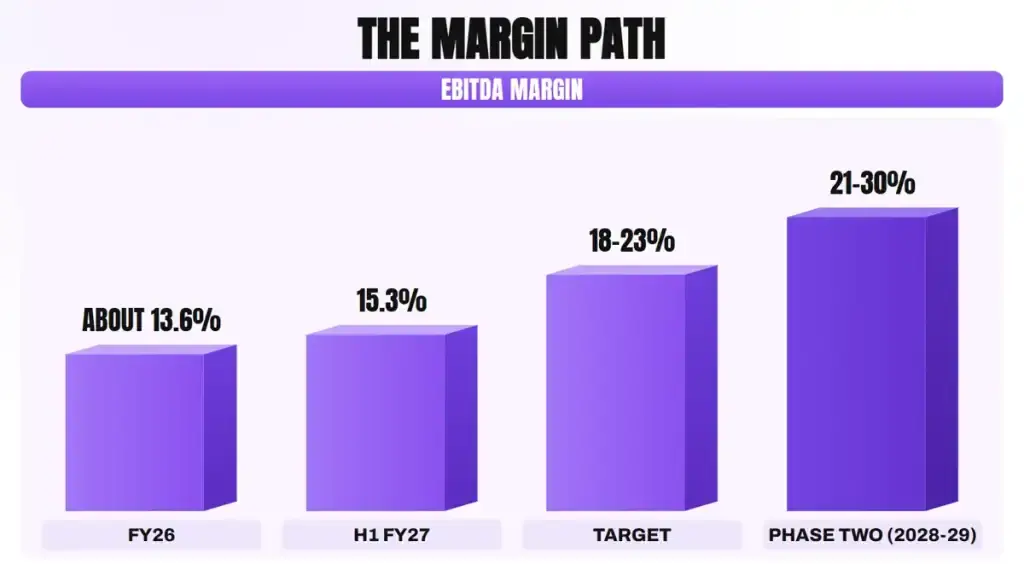
Beyond FY27, management describes a second phase from 2028-29. In that phase, the company wants to build electro-mechanical systems, assemblies that combine harnesses with motors, actuators and electronics. It expects margins of 21% to 30% on that work, higher than on harnesses. Until then, it says it wants to lead in harness scale for at least two years.
"We're expecting this growth at least for the next 12-16 quarters to continue." - Rishab Mohan Gupta, Rossell Techsys
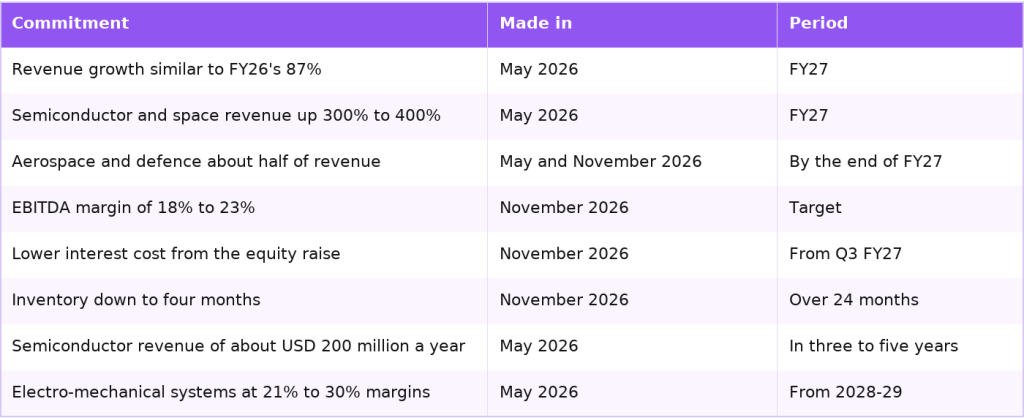
These promises come with a record we can check. In August 2025, management guided an EBITDA margin of 18% to 22% and a profit after tax of 8% to 12% of revenue for FY26. The year came in at about 13.6% on the company's own EBITDA of ₹66 Cr, and about 4.3% after tax. Revenue growth, on the other hand, ran well ahead of most expectations.
Key Risks
No business doubles in a straight line, so let's look at what could go wrong for Rossell Techsys.
- Debt and interest: working-capital loans were about ₹450 Cr at 30 September 2026, about 2.6 times equity of about ₹170 Cr. Finance cost rose to about ₹11.4 Cr in Q2 FY27 from about ₹5 Cr a year ago, and was about ₹21.2 Cr in the half year. If the equity money does not cut this quickly, interest will keep eating most of the gain in operating profit.
- Cash burn from stock: materials take about 63% of revenue, and many are imported with long lead times. Inventory rose to about ₹386 Cr in September 2026, and operations used cash again in H1 FY27, after about ₹82.8 Cr in FY26. Fast growth with this much stock means cash flow stays negative until inventory falls towards four months.
- Margins below guidance: the FY26 margin was well below the guided range, and H1 FY27 was 15.3% against the new 18% to 23% target. Part of Q2's EBITDA was about ₹3.6 Cr of other income. New customers need first article inspections, and each new part costs money before it earns.
- An older contract priced too low: one older Boeing programme ran at a loss. About ₹75 Cr of it was billed in FY26 and about ₹70 Cr remained for FY27, mostly in the first half. It weighs on margins until it ends.
- One customer, one country: Boeing gave about 40% of FY26 revenue, and North America gave about 80%. A slowdown in a large US programme, such as the delays seen earlier on the T-7A, or a change in US trade rules would hit revenue quickly.
- Imports and currency: the company spent about ₹370.6 Cr in foreign currency in FY26, mainly on materials. A jump in component prices or a supply shortage can raise costs before contracts adjust, although newer contracts carry price-adjustment clauses.
- Demerger clean-up and dilution: at March 2026, some customers had not yet moved their contracts from Rossell India, and the auditor drew attention to it. Promoter holding fell from 74.80% to 69.90% after the July sale, and the November issue took it to about 65.4%.
"The essence of investment management is the management of risks, not the management of returns."
— Benjamin Graham
For Rossell, the returns are visible in the order book. The risks sit in its debt, its stock of parts and its dependence on a few large US programmes, and those are the numbers to watch.
Explore our Products
Research Framework

Emerging Titans
Combination of quantitative analysis, industry tailwinds, and management assessment - SPRINT investment philosophy

Tiny Titans
Heavy emphasis on scuttlebutt research, plant visits, and early on-ground signals
What to Track Next
If you follow Rossell Techsys, these are the signals that will show whether the plan is on track.
- Q3 FY27 results, due in late January or early February 2027: finance cost should come down after the ₹300 Cr raise
- Quarterly revenue moving towards the roughly ₹284 Cr a quarter that 87% growth would need in the second half
- Semiconductor and space revenue as the second plant starts, against the ₹400-500 Cr that 300% to 400% growth implies
- The EBITDA margin moving from 15.3% towards 18% to 23%, without help from other income
- Inventory moving from 6.67 months towards four, and operating cash flow turning positive
- The T-7A ramp-up and the first orders from Indian defence repair work
Conclusion
Let's step back and put it all together. Rossell Techsys spent 15 years becoming a qualified wiring supplier to Boeing and Lockheed Martin, mostly on US military aircraft. That work gave it the approvals, the US defence paperwork and the trained people that new buyers in chips, satellites and Indian defence now want. Revenue has risen for six quarters in a row, and the order book is a record ₹900 Cr.
So the next few quarters will show whether that growth can turn into profit and cash. The ₹300 Cr raise should cut interest, and the second plant should lift semiconductor and space volumes. If margins move towards the 18-23% target and inventory comes down, the company's growth will finally show in its cash. If they do not, it will stay a fast-growing harness maker that needs more money for each rupee of new sales. The cautious thread is cash and concentration: operations have used cash in each of the last two years, and Boeing still gives about 40% of revenue. The next two quarterly results, starting with Q3 FY27, will show whether lower interest and the second plant change that.
FAQs
What does Rossell Techsys do?
+Rossell Techsys builds wire harnesses, electrical panel assemblies and test equipment in Bengaluru, mostly to its customers' drawings. Its customers include Boeing, Lockheed Martin, Honeywell and BAE Systems, plus two large semiconductor-equipment makers and Amazon's satellite work. In FY26, 99% of its revenue came from exports.
How did Rossell Techsys do in Q2 FY27?
+Revenue was ₹185.5 Cr, up 48% from a year ago and the highest in its history. EBITDA was ₹29.0 Cr, up 92%, and profit before tax was ₹12.7 Cr. First-half revenue of ₹340.2 Cr was already 70% of FY26's full-year revenue.
How big is Rossell Techsys' order book?
+The confirmed order book was ₹900 Cr on 30 September 2026, to be delivered over about two and a half years. On top of that, the company has long-term agreements of over ₹3,100 Cr, mostly for aerospace and defence, against which buyers place firm orders six to 12 months before delivery.
Who invested in Rossell Techsys' ₹300 Cr fund raise?
+In November 2026, the company issued 25,72,898 new shares at ₹1,166 each to SBI Mutual Fund schemes and an SBI alternative fund, raising about ₹300 Cr, or 6.39% of the enlarged company. In July 2026, Kotak Mutual Fund had bought about 4.9% of the company from the promoter group.
What is Rossell Techsys' margin target?
+Management now targets an EBITDA margin of 18% to 23%, up from 17% to 22% earlier. The margin was 15.3% in the first half of FY27. Later, from 2028-29, it wants to build electro-mechanical systems that it expects to earn 21% to 30%.
What are the main risks for Rossell Techsys?
+The main risks are debt of about ₹450 Cr in September 2026, cash used by a large stock of imported parts, margins below guidance, an older Boeing contract priced too low, and dependence on Boeing for about 40% of revenue and on North America for about 80%.

High growth stock specialist, Value Educator
Shashank Mahajan is an equity research professional with over 12 years of experience in identifying high-potential SME and micro-cap stocks at an early stage. He follows a rigorous scuttlebutt research–driven approach, combining on-ground insights with deep financial analysis. Shashank specializes in uncovering under-researched and under-owned companies with strong management quality and long-term growth potential. Through disciplined research and early identification, he focuses on spotting tomorrow’s market leaders before they enter the mainstream investor radar.
Macpower CNC: A Rajkot Machine Maker With ₹476 Cr of Orders
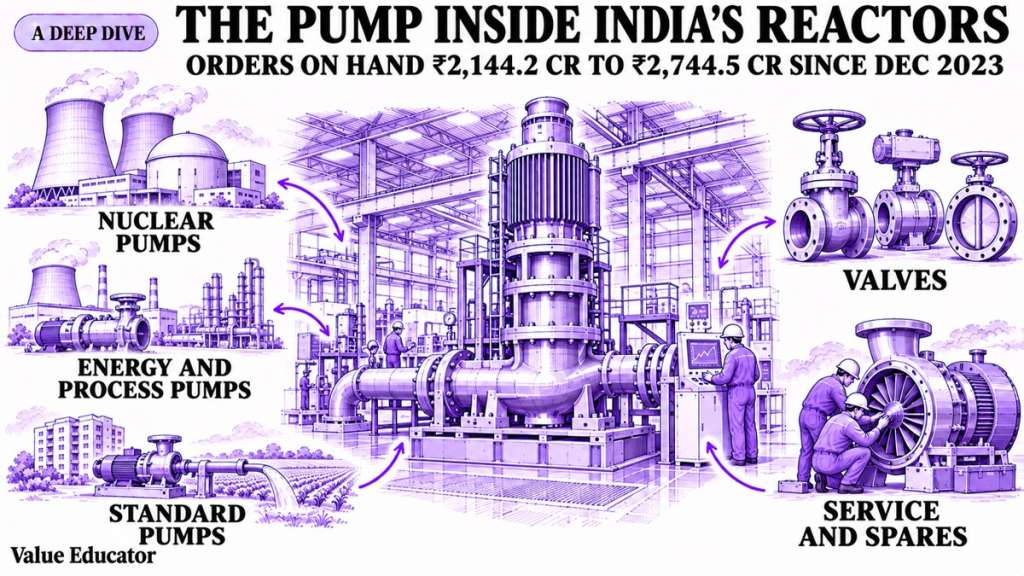
KSB: The Pune Pump Maker With ₹1,235 Cr of Reactor Orders

Kilburn Engineering: The Dryer Maker With ₹470 Cr of Orders
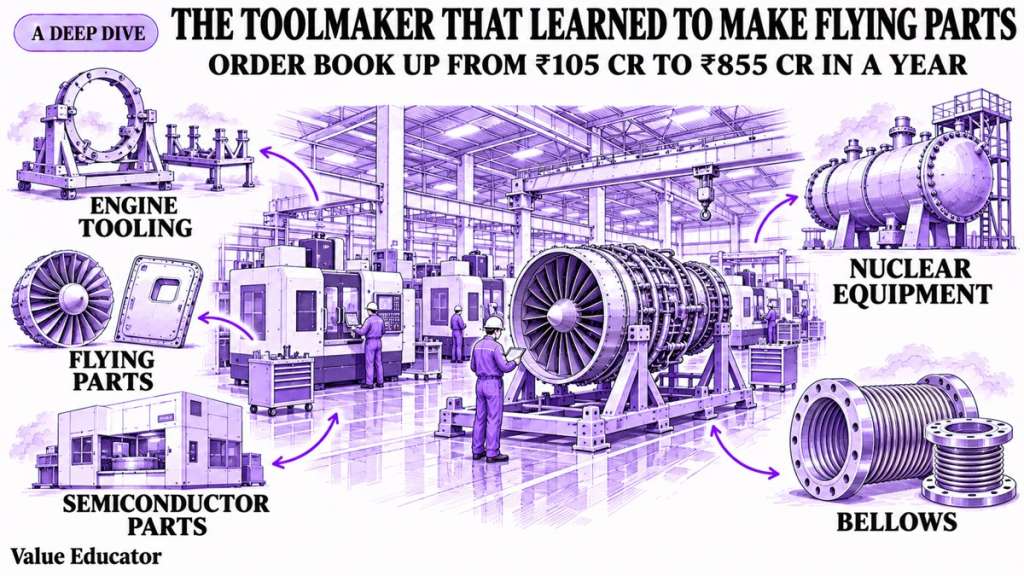
Unimech Aerospace: From Engine Tools to Flying Parts
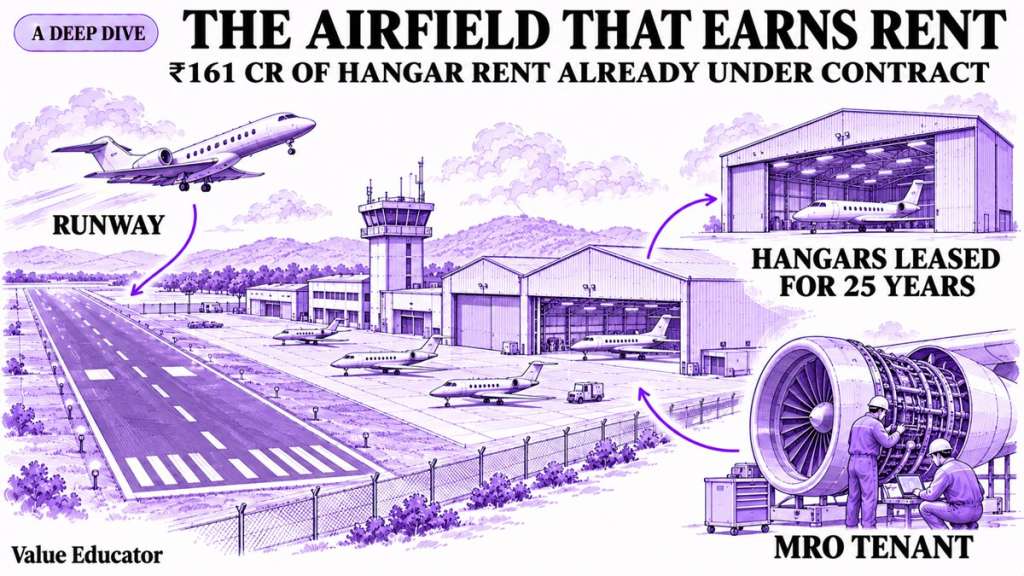
Taneja Aerospace: The Airfield With ₹161 Cr of Rent Signed

Dynamatic Technologies: Airbus Doors, Flap Beams and Pumps
Explore our Products
Research Framework
Emerging Titans
Combination of quantitative analysis, industry tailwinds, and management assessment - SPRINT investment philosophy
Tiny Titans
Heavy emphasis on scuttlebutt research, plant visits, and early on-ground signals



Modern Warfare to Multibaggers
Key Trends. Strategic Shifts. Opportunities Ahead.
Don't Miss This Exclusive Webinar!
Join Value Educator to decode the key trends shaping India's defence sector and learn how to identify tomorrow's potential leaders in the space.
- In-depth research on India's defence sector
- Live Q&A session
- Actionable takeaways for long-term investors

 Orders
 Subscription
 Share with friends


Required Details
₹23999.00
(12 month subscription)
As per SEBI regulations, all users are mandated to complete the KYC that is validated for 1 year. Post payment, you will be redirected to the KYC screen


No comments yet. Be the first to comment!