
Sedemac Mechatronics: 1.45 Million Controllers a Quarter
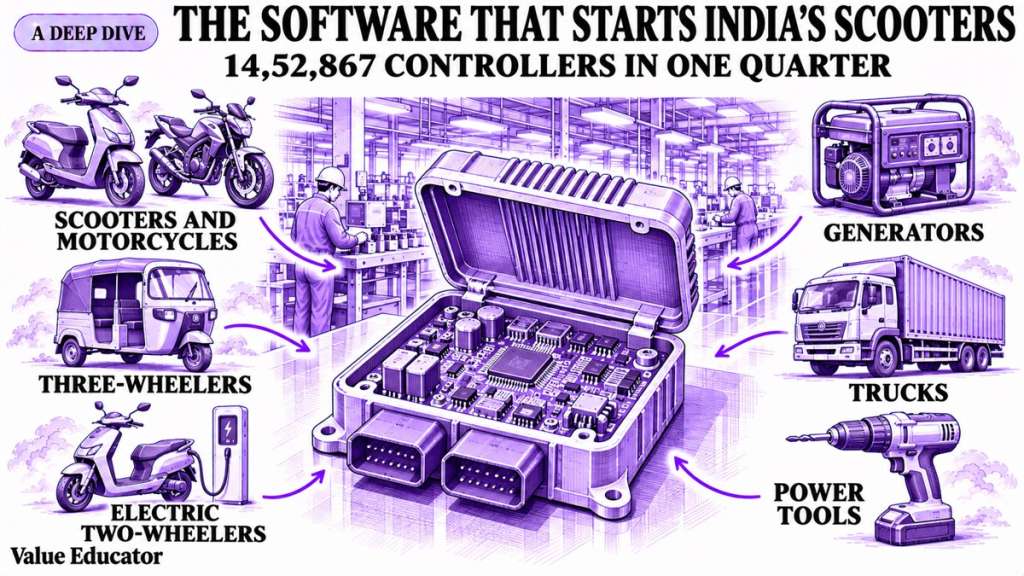
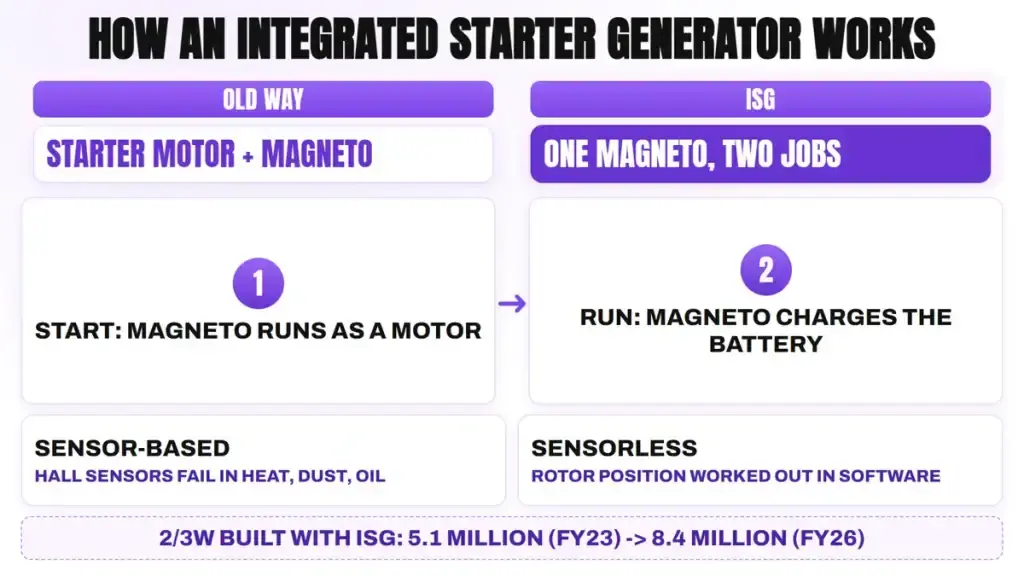
In FY26, 8.4 million two- and three-wheelers made in India started without a starter motor. Three years earlier the number was 5.1 million, and in FY18 it was close to zero. These vehicles start silently with one press, because the same electric machine that charges the battery also turns the engine. And more than 80% of the FY26 increase came from one Pune company's controllers.
That system is called an integrated starter generator, or ISG. A normal scooter carries two machines: a starter motor to crank the engine and an alternator, called the magneto, to charge the battery. An ISG removes the starter motor and runs the magneto both ways. The magneto works as a motor for the start and as a generator once the engine runs. A small electronic control unit, the ISG ECU, decides every switch between the two jobs, thousands of times a second.
That control unit is the hard part. To spin the magneto as a motor, the controller must know where the rotor is at every moment. Most systems use small hall-effect sensors for this, and they fail in heat, dust and oil. Most Indian motorcycles have an oil-dipped, or wet, magneto, so a sensor-based ISG does not suit them. That is what sensorless commutation means: the controller works out the rotor's position from the electrical signals alone. You get the same control in software, with no sensors to fail.
That software belongs to Sedemac Mechatronics Ltd (NSE: SEDEMAC, BSE: 544723). The company began in 2007 in a laboratory at IIT Bombay led by its Managing Director, Prof. Shashikanth Suryanarayanan. It designs and makes control units for engines and electric motors in two-wheelers, three-wheelers and generators. One of them is the motor control unit, which is the controller between the battery and the motor of an electric vehicle. Its customers are vehicle and generator makers in India, the US and Europe, and TVS Motor has been its anchor customer since 2018. It listed on the NSE and BSE on 11 March 2026 through an offer for sale, so the company raised no new money.
That one technology now drives a large business. FY26 revenue was ₹1,058.38 Cr, up about 61%, the first year above ₹1,000 Cr.
Sedemac Mechatronics in five numbers
- Q2 FY27 revenue of ₹400.64 Cr, up about 40%, its highest quarter so far
- 14,52,867 control units sold in the quarter, up 37.5%
- About 35% of India's ISG control unit market by volume
- EV products at 11.4% of two- and three-wheeler revenue in H1 FY27, against 0.3% in FY24
- A new plant of 1,20,000 sq ft, three times the size of its main plant, in pilot production
So a lab project from 2007 now sells about 4.6 million control units a year. Where is that growth coming from, and what does it cost? Let's first understand the company, and then look at the latest quarter.
Sedemac Mechatronics: Company Overview
Sedemac Mechatronics Ltd was incorporated in 2007 and has its registered office and technical centre at Baner in Pune. It grew out of a laboratory at IIT Bombay led by Prof. Shashikanth Suryanarayanan, who is now its Managing Director, with Amit Dixit as Joint Managing Director. It designs and makes electronic control units for engines and electric motors: ISG and EFI ECUs for two- and three-wheelers, motor controllers for electric vehicles, and controllers for generators. It makes them at two plants in Pune today, has started production at a third, MF3 at Chakan, and has bought land at Shoolagiri in Tamil Nadu. Promoters held 26.24% of the shares in March 2026, and the company had 493 permanent employees. Revenue was ₹1,058.38 Cr in FY26, and borrowings stood at ₹245.64 Cr in September 2026 as it funded the new plant and extra inventory. Read this KSH International: Wires for Electrification
"We are stubborn on vision. We are flexible on details."
— Jeff Bezos
Sedemac has spent close to two decades on one idea, sensorless motor control, while letting customers own their software under its CustomECU model. That mix of a fixed goal and flexible terms is how it won the truck after-treatment business.
The Quarter the Mobility Business Grew by Half
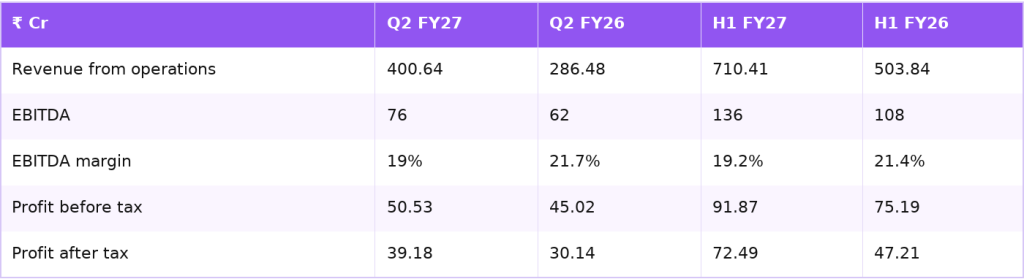
Let's look at Q2 FY27, the July to September quarter, when the mobility business grew fastest. Revenue from operations was ₹400.64 Cr, against ₹286.48 Cr a year ago, and you will see that mobility did almost all of the work. Both Q2 and the half year were the highest in the company's history.
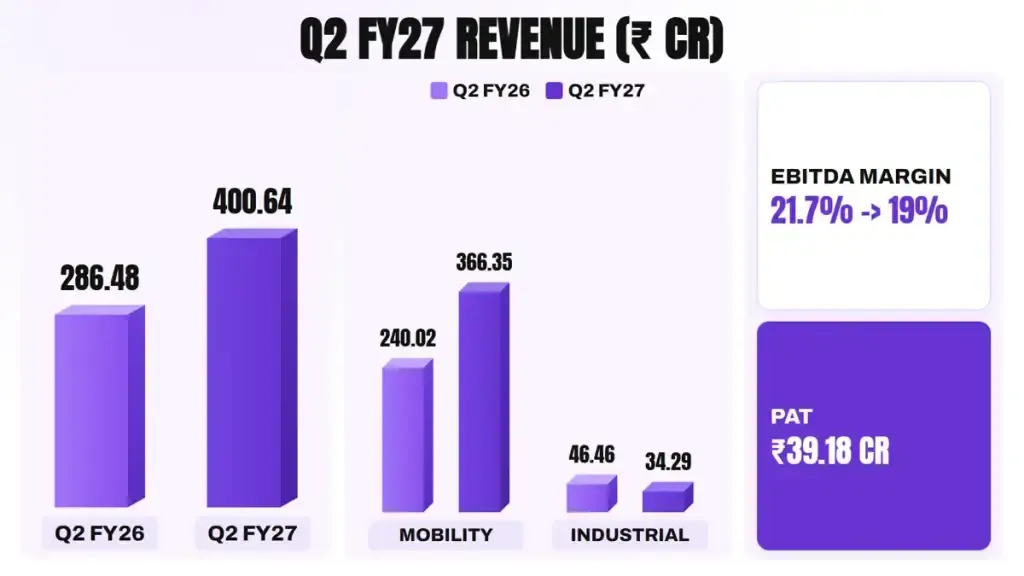
That growth came almost entirely from the mobility segment, which sells to vehicle makers. Mobility revenue was ₹366.35 Cr, against ₹240.02 Cr a year ago, a rise of about 53%. It made up about 91.4% of the quarter's revenue. The industrial segment, which sells generator controls, brought in ₹34.29 Cr.
So what drove mobility? Management names three launches that reached full volume. Its ISG ECU for export three-wheelers, launched in Q4 FY26, is now fully ramped up. Its motor controller for electric two-wheelers, launched in Q3 FY26, has also reached full volume. And its ISG went onto variants of two top-10 motorcycle models, both of which are now fully ramped up.
But profit grew more slowly than revenue this quarter. Why? The EBITDA margin was 19%, against 21.7% a year ago, and the reason is in the material cost line. Materials, net of the change in inventory, took about 64.7% of revenue, against about 61.1% a year ago. Semiconductor supplies have tightened and most commodities have become costlier. Printed circuit boards rose sharply in the last two or three months.
But the other costs grew far more slowly than sales. Employee costs were ₹25.26 Cr, up about 9% on ₹23.16 Cr, while revenue grew about 40%. That operating leverage offset part of the material cost rise. Read this Operating vs Net Profit Margin Explained Profit after tax still grew about 30%, to ₹39.18 Cr. For the half year, profit after tax grew about 53.5%.
That pattern also shows in the twelve months to September 2026. Revenue over that period was ₹1,265 Cr, up 48%, with EBITDA of ₹250 Cr and a margin of 19.8%. Profit after tax was ₹129 Cr. Return on capital employed was 34%, against 38% a year earlier, because two new plants are being built but are not yet in full production.
The Volume Record Behind the Revenue
Now let's look at volumes, because for this company they come before revenue. Sedemac sells against supply schedules from vehicle makers, not against an order book. Each quarter it publishes the number of control-intensive ECUs it sold. These are the units built on its own control technology, such as ISG, EFI and EV motor controllers. Management calls this number a good proxy for revenue.
"Know what you own, and know why you own it."
— Peter Lynch
For Sedemac, what you own is a share of units shipped. The quarterly volume update comes out before the results, so it is the first number to read each quarter.
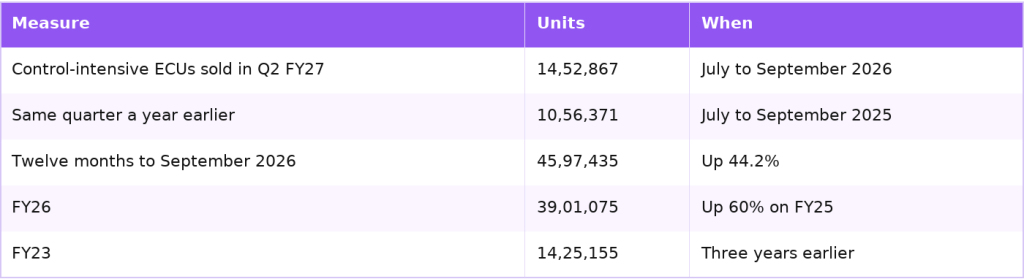
That table shows the growth in units. In August 2026 the company sold more than 5,00,000 control-intensive ECUs in a single month for the first time. It took 97 months from May 2014 to reach 1,00,000 a month, then 124 months to reach 2,50,000 and 147 months to reach 5,00,000. So the last doubling took less than two years. That is fast.
What the volumes say: FY26 revenue works out to about ₹2,713 for each control-intensive ECU sold, and Q2 FY27 to about ₹2,758. That figure includes the smaller non-control products, but it is steady, which is why unit growth and revenue growth track each other so closely.
That steady revenue per unit is also why electric vehicles matter. Management says electrification is good for the company because it raises the revenue per unit. An EV motor controller handles the whole drive power of the vehicle, and management says controller prices scale largely with power rating. We will come back to this in the EV section.
Those volumes now run through a bigger balance sheet. Cumulative tangible investment rose from ₹333 Cr in March 2026 to ₹450 Cr in September 2026, mainly for the new MF3 plant. Working capital rose from ₹135 Cr to ₹258 Cr as sales grew and the company bought components early to secure supplies. Bank borrowings funded part of this and stood at ₹245.64 Cr in September 2026. In September 2026 ICRA upgraded the company's bank loan rating to A with a positive outlook, from A-.
How a Lab Project Became a ₹1,000 Cr Business
Now that we have seen the quarter, let's go back to see how the business got here. The company has built one control technology at a time, and each took years to reach volume. In 2012 it launched SmartIgn, an ignition control that removed the throttle position sensor from carburetted two- and three-wheelers. In 2014 it built electronic governing into its generator controllers, which made that feature affordable across all generator sizes. Then, from 2018, came the sensorless ISG with TVS Motor.
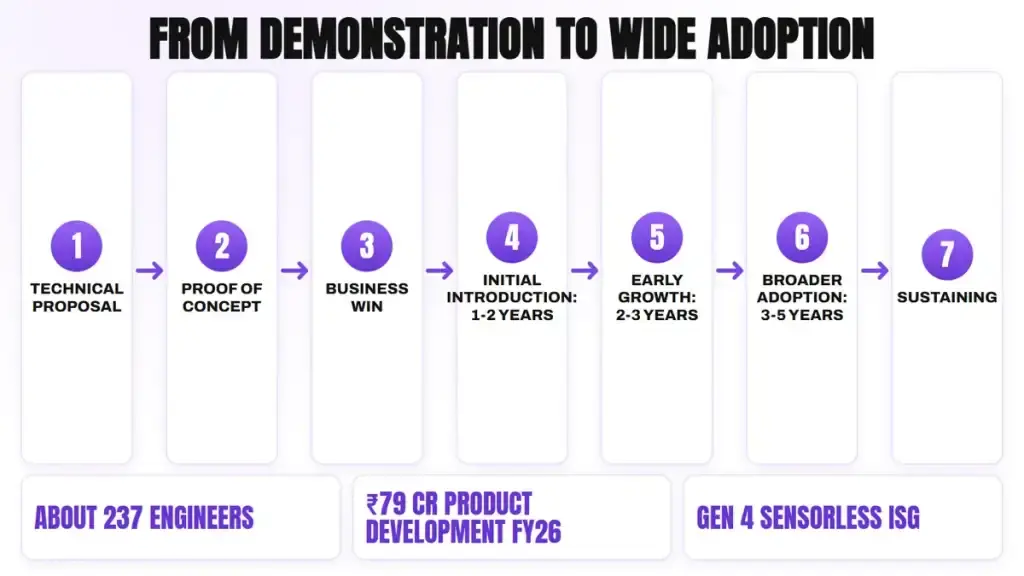
That sequence follows a cycle the company describes for every new technology. First comes a technical proposal and a live trial for a vehicle maker's decision makers. If the maker commits, it becomes the anchor customer, and initial introduction takes one to two years. Early growth with that anchor takes two to three years, and broader adoption by other makers another three to five. Its generator controllers are now in the last, "sustaining" stage, and its ISG is in broad adoption.
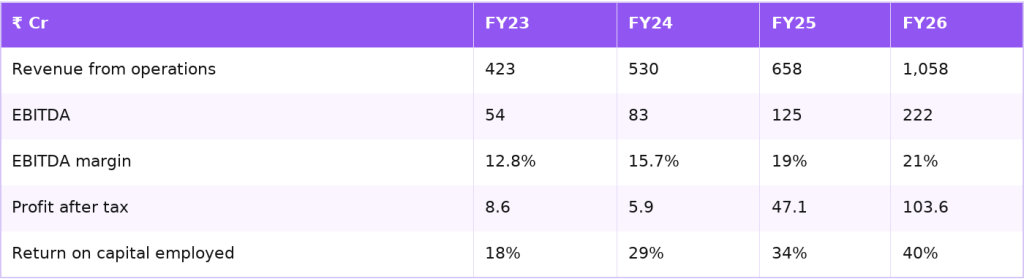
So revenue grew about 36% a year over three years, while EBITDA grew about 60% a year. That gap comes from the product mix. Control-intensive products were 72.20% of revenue in FY23 and 86.53% in the nine months to December 2025. The rest is simpler parts such as flashers, voltage regulators and fuel gauges, which earn less.
"ISG plus EFI will win on numbers and on performance, it will win." - Prof. Shashikanth Suryanarayanan, Managing Director, May 2026
That FY26 jump also came with a cleaner balance sheet. Debt to equity was 1.37 in FY24 and 0.21 in FY25, after equity raised from investors and retained profits. In FY26 operating cash flow was ₹128.02 Cr, against a profit of ₹103.58 Cr. The engineering team grew from about 132 people in FY23 to about 237 in FY26, and the company had 493 permanent employees in March 2026.
Two Segments and Six Kinds of Controllers
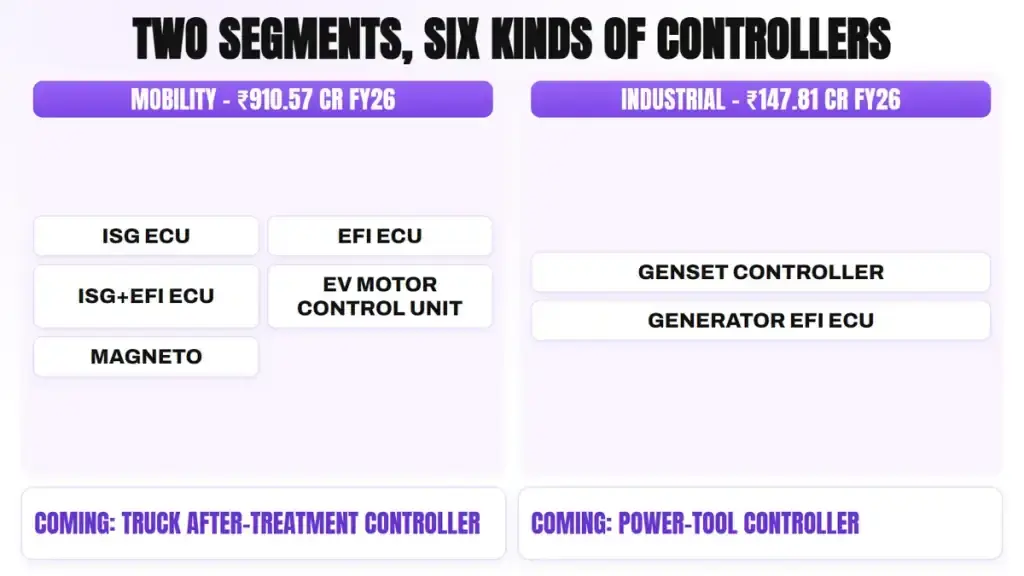
Now let's split the business into its two segments and see what each controller does. The company reports mobility and industrial. Read this Segment-Wise Revenue Analysis Explained Mobility covers engine-powered and electric two- and three-wheelers, plus the new commercial vehicle work. Industrial covers generators and, soon, power tools.
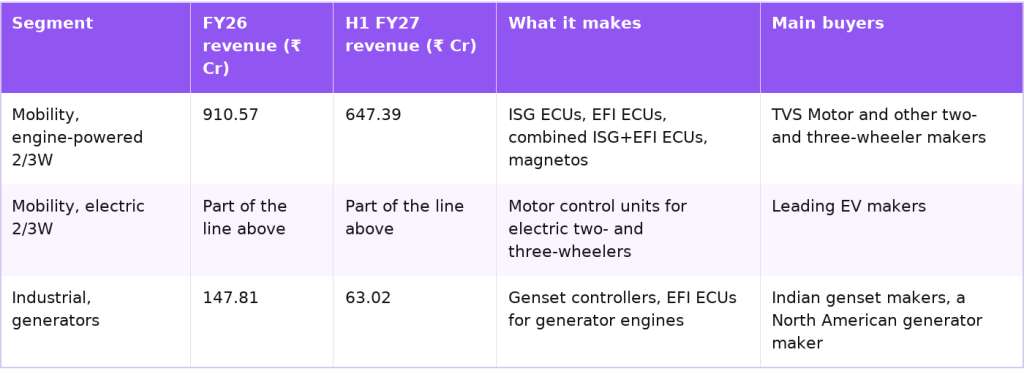
These controllers sound alike, but each one controls a different machine. An ISG ECU runs the magneto that starts the engine. An EFI ECU runs the engine itself, deciding how much fuel to inject and when to spark. An MCU, as we saw, sits between the battery and the motor, so it handles all of the drive power. A genset controller watches the grid and starts a generator when the power fails.
Engine-Powered Two- and Three-Wheelers
Let's start with the largest business, controllers for engine-powered vehicles. India produces about 27 million two- and three-wheelers a year, including exports. ISG use in these vehicles rose from 0% in FY18 to about 36% in FY25. The ISG control unit market was worth ₹11,672 million in the nine months to December 2025 and is projected at ₹30,000-31,000 million by FY31. Volumes are projected to reach 14,200-14,700 thousand units by FY31, as ISG passes half of engine-powered vehicles.
That market is where Sedemac began. Its sensorless ISG went into production with TVS Motor in 2018 and has since spread across scooters, motorcycles, mopeds and three-wheelers. By December 2025 it had shipped ISG and ISG+EFI units for more than 9.2 million vehicles. It held about 35% of the domestic ISG control unit market by volume in the nine months to December 2025. Its main rivals, Shindengen and Denso, mostly use sensors.
So who buys it? As you might expect, TVS Motor is by far the largest customer. Three of the top four two-wheeler makers in India now use its sensorless ISG, and in FY26 it ran on four of the ten best-selling two-wheeler models. Scooters were the first big market. In October 2026 its cumulative sales of motor controllers for scooters passed 5 million, from a start in August 2020.
Motorcycles are the newer step, and they are where sensorless control counts most. The first wet-magneto motorcycle to get ISG was the Raider in 2021, followed by the Ronin. Management says Pulsars and Super Splendors have now adopted its ISG too. In May 2026 it expected ISG on variants of three popular top-10 motorcycles from three of the top four makers. Two of those launches are done, and one more is expected in Q4 FY27.
Three-wheelers moved even faster. Much faster. After the OBD-2B emission rules took effect from April 2025, most domestic engine-powered three-wheelers adopted its ISG. Three-wheelers rose from 6.56% of mobility revenue in FY25 to 18.31% in the nine months to December 2025. Its export three-wheeler ISG, launched in Q4 FY26, is now fully ramped up, and cumulative three-wheeler motor controller sales passed 1 million in Q2 FY27.
So what comes next in this business? The combined ISG+EFI unit. It puts the starter controller and the fuel injection controller in one box, which removes duplicated electronics and lowers the cost of adopting ISG. EFI control units have long come from large global suppliers, so a maker has to trust a new source for the heart of its engine. Even so, sales went from the first unit in October 2024 to 1 million in September 2026. That took 23 months, and close to half a million of them were shipped in the last eight months.
That combined unit also wins extra business. One of the two motorcycle models that took its ISG this year is expected to move to ISG+EFI in FY28, so the company would supply the fuel injection control as well. A European two- and three-wheeler maker has also chosen its ISG ECU and magneto kit, with production likely in H1 FY28. Its new MF4 plant will make these magnetos, the electric machines, from Q3 FY27.
Electric Two- and Three-Wheelers
Next, let's look at electric vehicles, where the same motor control know-how goes into a bigger part. The Indian market for EV motor controllers was worth ₹6,920.3 million in FY25 and is projected at ₹44,000-45,000 million by FY30. Worldwide, electric models made up 29.1% of two-wheeler sales in 2025, and that share is projected at 41-43% by 2030. Every one of those vehicles needs a motor controller.
That market is where Sedemac now sells. It entered in steps. It has supplied MCUs for European electric bicycles since Q3 FY23 and for Indian electric two- and three-wheelers since Q4 FY25. Its range runs from 500 W for e-bicycles to 2.5 kW for electric two-wheelers and 11 kW for electric three-wheelers. The hardware design is close to its ISG ECU, so it shares components, suppliers and testing with a product already made in millions.
That reuse shows up fast in the numbers. EV MCU units rose from 9,364 in FY25 to 45,731 in the nine months to December 2025. EV products went from 0.3% of two- and three-wheeler revenue in FY24 to 1.7% in FY25, 7.4% in FY26 and 11.4% in H1 FY27. Management says this share is broadly in line with how fast electric models are selling in that market.

So who are the EV buyers? We do not know, because the company does not name them. Management says it works only with the leaders in each market. Its MCUs today use hall sensors like everyone else's. But it is in talks with these makers to bring sensorless control to EV motors too, where sensor failures can leave a rider stranded.
"this much I can tell you is that the SLC for EV MCUs, it is far sharper proposition than SLC for ICE vehicles back in 2018-2019 when we first introduced it." - Prof. Shashikanth Suryanarayanan, Managing Director, November 2026
That scale already gives it a base to build on. In May 2026 management said the company makes more than 3 million motor controllers a year, counting ISG and EV units. It named only Shindengen as a producer of similar volumes for vehicles. In Q1 FY27 it sold more than 1 million motor controllers in a single quarter for the first time.
Generator Controllers and US Home Standby
Now let's move to the industrial segment, which began in 2010. A generator needs a supervisory controller, the auto mains failure controller, which watches grid power, starts the engine when the grid fails and moves the load. The Indian market for genset controllers was worth ₹834.5 million in FY25. The global market was worth USD 185.7 million in 2024, and the global market for generator EFI ECUs was USD 25.1 million, projected at USD 35-45 million by 2030.
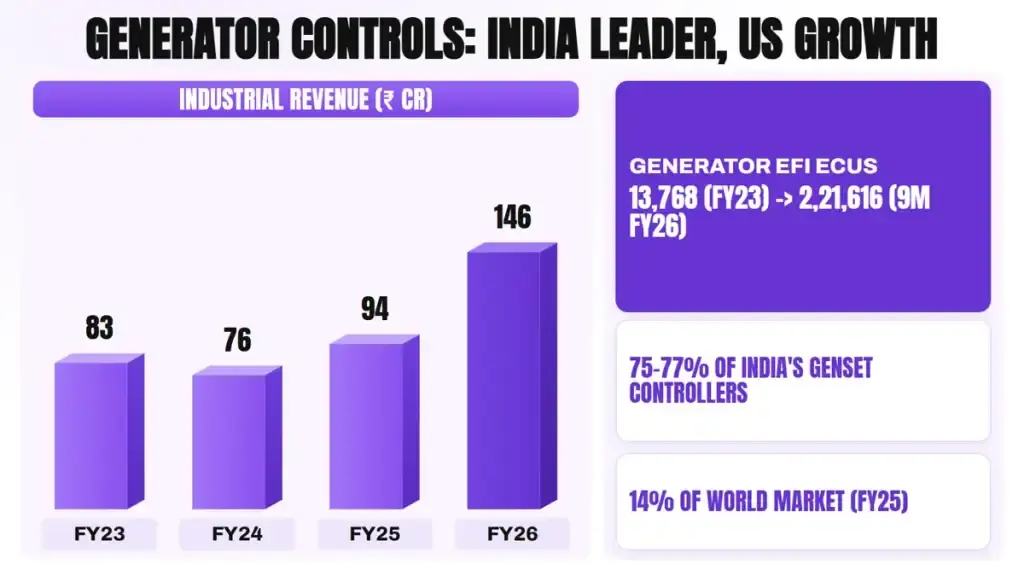
That niche is where the company leads. It is the largest supplier of genset controllers in India, with about 75-77% of the market in the nine months to December 2025. With its controllers and EFI ECUs it held about 14% of the world market in FY25. It has supplied more than 1.5 million parts to this market in all.
That growth came from the US. Mostly from storms. Gas-powered home standby generators, which switch on in a storm, are moving from carburettors to fuel injection. The dominant maker of these generators in North America made Sedemac's EFI ECU the default on some key models. Generator EFI ECUs rose from 13,768 units in FY23 to 2,21,616 in the nine months to December 2025, and 68.85% of its generator units were exported in that period.
That US link explains the swings you see in this segment. Industrial revenue was ₹83 Cr in FY23, ₹76 Cr in FY24, ₹94 Cr in FY25 and ₹146 Cr in FY26. Home standby demand follows the Atlantic hurricane season, because people buy generators after outages. The 2025 season had less activity, and management says demand has begun to recover.
Commercial Vehicles and Power Tools
Finally, let's look at the two markets still under development, which use the same control know-how. In medium and heavy commercial vehicles, the company is bringing an after-treatment controller, which runs the exhaust clean-up system that diesel trucks need for emission rules. Its first production start, in H1 FY28, would be its first in the truck market. An EFI ECU for these trucks is also due in H1 FY28, and an MCU for electric light commercial vehicles in H2 FY27.
That truck win came from a flexible business model. Under its CustomECU model, a maker can write and own its application software while Sedemac supplies the hardware and base software. Management says this flexibility won the after-treatment business. The incumbents here are large global suppliers, so a share in the BS7 era is still to be earned.
Then come power tools. This is the larger idea. Global power tool sales were 334.7 million units in 2024, and battery tools use brushless motors that need commutation, just like an ISG. The global market for motor controllers in power tools was worth USD 2,292 million in 2024 and is projected at USD 3,700-4,700 million by 2030. The company's first business win is with a small but established maker, for a motor controller with sensorless control. The first tool, a concrete grinder, is likely to reach production in H1 FY28.
Why a Sensorless Starter Controller Is Hard to Copy
Now that we have seen every business, let's understand the moat. A vehicle maker treats a starter controller as a core part: if it fails, the vehicle does not start. So makers change core parts rarely, and only after long testing. A new controller goes through concept checks, prototypes, field trials and limited-volume runs before mass production.
That process takes years. Once you are through it, the controller stays for the life of the platform. The company's own cycle runs from one to two years of initial introduction to three to five years of broader adoption. A rival would have to repeat all of it with each maker. Read this Economic Moat Explained Management says competitors have tried to crack sensorless control for seven or eight years, and it is already on its fourth generation.
That technology is also protected. The company owns its hardware, base software, application software and control methods, with no technical collaboration. Its control method is patented, and it had applied for 11 more patents in India at the time of listing. ICRA notes that the patented nature of the sensorless ISG has meant no material competition in this segment over the years.
Its engineering bench explains why it keeps adding products. About 237 engineers work in two technical centres in Pune, and spending on product development was ₹79 Cr in FY26, against ₹52.54 Cr in FY25. Cumulative investment in products meant for production reached about ₹256 Cr by March 2026.
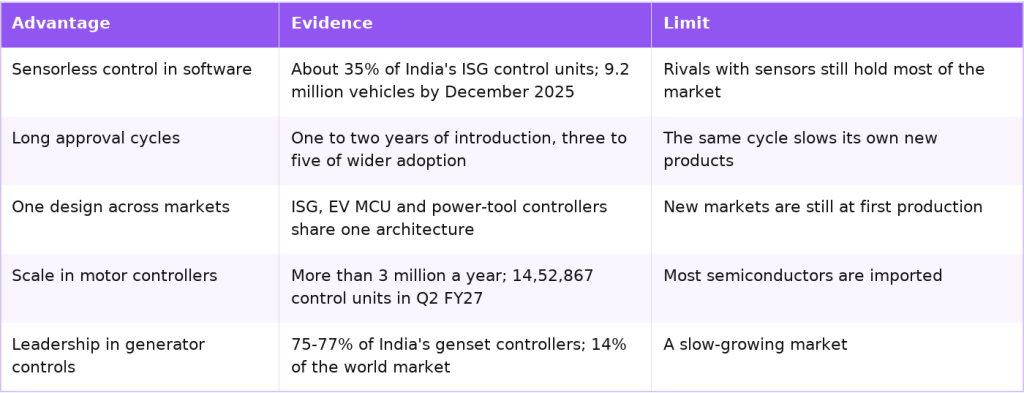
That table also shows why the margin is a test of the moat.
"The key to investing is not assessing how much an industry is going to affect society, or how much it will grow, but rather determining the competitive advantage of any given company and, above all, the durability of that advantage."
— Warren Buffett
Electrification will change two-wheelers either way. What matters here is whether sensorless control keeps its edge as rivals and costlier chips test it. A part that customers cannot easily replace should earn more than a plain assembler. Over FY23 to FY26 the EBITDA margin rose from 12.8% to 21%. The H1 FY27 margin of 19.2% shows how far costlier chips can press on that edge.
Financials: Sedemac's Four Years of Growth, Margins and Cash
Let's put four full years and the latest half year side by side. FY23 to FY25 are the restated figures from the offer document, and FY26 and H1 FY27 come from the latest results. EBITDA here is profit after tax plus tax, finance costs and depreciation, the company's own measure.
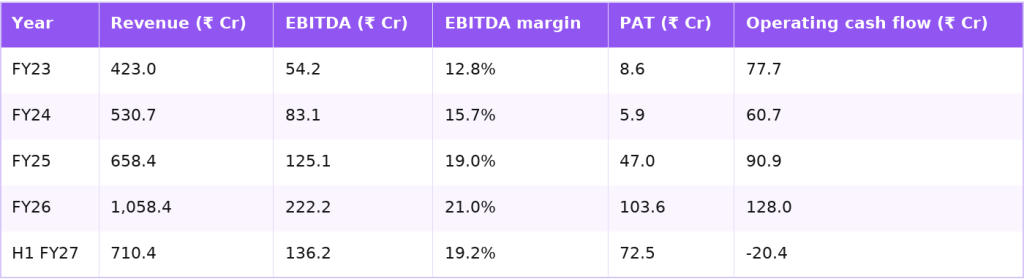
Revenue grew about 2.5 times in three years, from about ₹423.0 Cr in FY23 to about ₹1,058.4 Cr in FY26. EBITDA grew about four times over the same years, as the margin rose from about 12.8% to 21.0%. Control-intensive products, which earn more than the simpler parts, became a larger share of sales.
Cash flow kept up with profit until FY26. Operating cash flow was about ₹357.4 Cr over FY23 to FY26, against about ₹165.1 Cr of profit after tax. In H1 FY27 it turned negative, at about ₹20.4 Cr, because inventory rose by ₹100.84 Cr and receivables by ₹78.35 Cr while the company bought components early.
The balance sheet now carries more debt. Borrowings rose from ₹50.63 Cr in March 2026 to ₹245.64 Cr in September 2026, and lease liabilities to ₹106.47 Cr with the new plant. Total equity was about ₹522.1 Cr, so the second half's cash flow is the number to watch.
"Beware of little expenses; a small leak will sink a great ship."
— Benjamin Franklin
For a company that imports most of its chips, small rises in component and board prices add up fast. The H2 FY27 margin will show how well Sedemac plugs those leaks.
What FY27 and FY28 Could Look Like on Management's Numbers
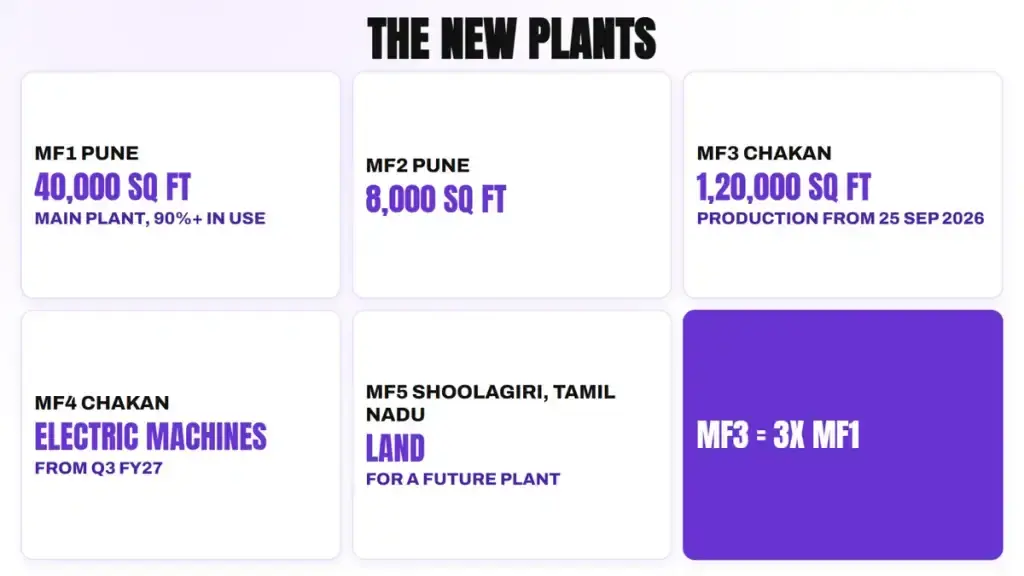
So where does the company go from here? Management gives drivers and plants, not revenue targets, so let's lay out what it has said. The base is plant space. MF1 is its main plant, at 40,000 sq ft, with a second unit of 8,000 sq ft. The new MF3 at Chakan is 1,20,000 sq ft, and limited commercial production began there on 25 September 2026.
That plant changes how much the company can make. MF1 has been running at 90% or more of its capacity. Management says that if MF3 is fully fitted out and revenue stays at today's level, the plant would run at about 65-70% of its capacity. It expects most production to have moved to MF3 by the end of FY27.
That capacity comes with a rule of thumb for funding. Management says each ₹100 Cr of extra revenue needs about ₹20 Cr of plant investment and about ₹12-15 Cr of working capital. With an EBIT margin of about 15%, most of that can come from internal cash, topped up with debt. Capex in H2 FY27 is expected to be lower than in H1, because MF3 is nearly ready.
That leaves margin as the open question for H2, and it is the one we would watch most closely. Management expects the H2 FY27 EBITDA margin to hold at the H1 level, which was 19.2%. Higher printed circuit board costs will press on it. Price talks with customers and a newer generation of its ISG controller should help offset that.
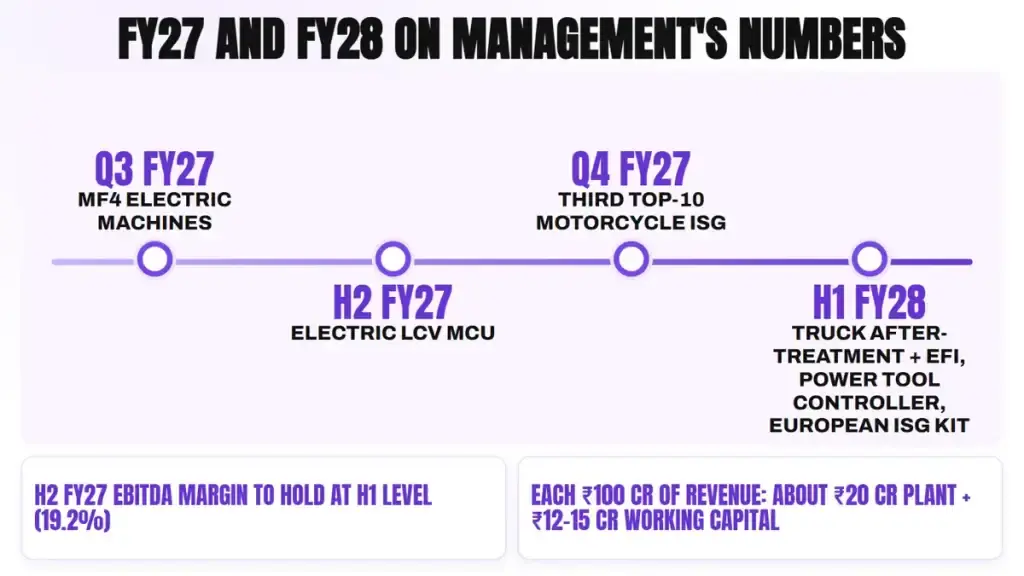
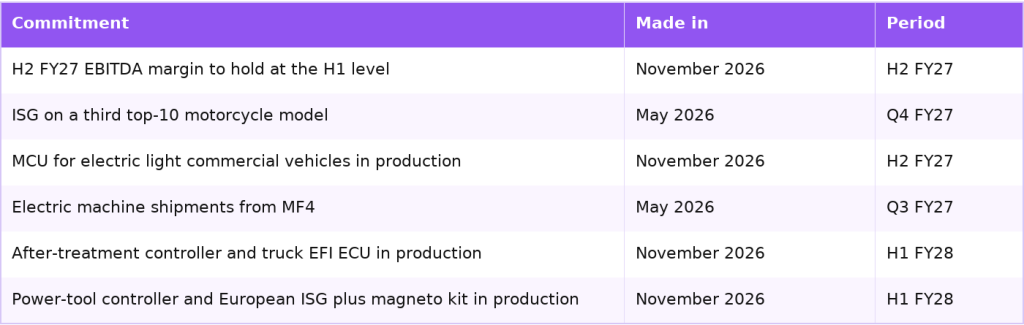
Those commitments are easier to judge against the past. So let's check what management said in May and July 2026 against what it delivered.
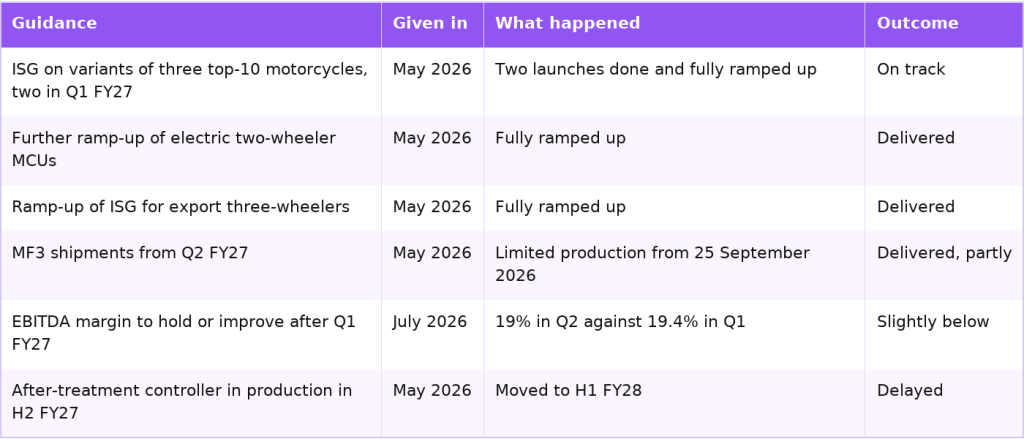
That record, as we read it, is mostly good on volumes and products. The growth drivers named in May all came through, and management says H1 revenue was better than it expected. The two areas that slipped were the margin, by a small amount, and the timing of the truck controller.
Key Risks
Now let's look at what could go wrong for Sedemac Mechatronics, because some of these risks already show in the latest half year.
- One large customer: TVS Motor was 79.05% of revenue in FY23, 83.46% in FY24, 80.46% in FY25 and 75.48% in the nine months to December 2025. ICRA put the largest customer at 77% of FY26 revenue. The top three customers were 91.22%. Any cut in that customer's volumes, or a decision to add a second ISG source, would hit revenue directly. The company's own measure, the largest customer's share minus the next four, was 54% in H1 FY27. It also had to correct that measure upward for FY24-FY26 in July 2026, from 49% to 58% for FY26.
- Costlier chips and boards: materials took about 64.7% of revenue in Q2 FY27, against about 61.1% a year ago. There is no automatic pass-through of costs: prices are negotiated, with only a currency formula built in. Around 75% of raw materials are imported, and printed circuit board costs are still rising.
- Cash flow and debt: operating cash flow was negative ₹20.38 Cr in H1 FY27, against positive ₹120.73 Cr in H1 FY26, as inventory rose by ₹100.84 Cr and receivables by ₹78.35 Cr. Borrowings rose from ₹50.63 Cr in March 2026 to ₹245.64 Cr, and lease liabilities from ₹21.81 Cr to ₹106.47 Cr with the new plant. Cash and bank balances were only ₹10.92 Cr. Read this Cash Flow Statement Explained Finance costs were ₹5.87 Cr in Q2, against ₹2.47 Cr a year ago.
- The industrial segment: industrial revenue fell to ₹34.29 Cr in Q2 FY27 from ₹46.46 Cr, and to ₹63.02 Cr in H1 from ₹80.56 Cr. It depends on one North American generator maker and on the hurricane season, which the company cannot control.
- Programme delays: the after-treatment controller moved from H2 FY27 to H1 FY28. Vehicle makers set the timing of every launch, so new markets can take longer than planned.
- Plant move and quality: shifting production from MF1 to MF3 can disrupt output in a business with month-by-month firm orders. In FY26 faulty capacitors from a Japanese supplier caused some product failures.
- Competition: management says no one keeps a monopoly forever, and some technically strong rivals may solve sensorless control over time. Large global suppliers dominate EFI and truck controls.
- Capitalised development: ₹40.89 Cr of the FY26 development spend was capitalised rather than expensed, and the auditor named it a key audit matter. Impairment of intangible assets was ₹1.67 Cr in H1 FY27.
- Tax matters: an income tax penalty of ₹74,93,508 for FY18 is under appeal, and a GST notice from Tamil Nadu claims ₹2,34,96,553 for FY23 and FY24. The GST department also searched its Pune offices and plants from 8 to 11 September 2026. The company says it expects no material impact.
"First of all, there is no pass-through. It is negotiated broadly and secondly, our pricing is quite different from typical auto ancillary, where it's cost plus." - Prof. Shashikanth Suryanarayanan, Managing Director, November 2026
"Invert, always invert."
— Charlie Munger
Turn the question around and ask what would hurt Sedemac most: a cut by its largest customer, chips that keep getting costlier, or cash that stays tied up in stock. The tracking list below follows exactly those signals.
Explore our Products
Research Framework

Emerging Titans
Combination of quantitative analysis, industry tailwinds, and management assessment - SPRINT investment philosophy

Tiny Titans
Heavy emphasis on scuttlebutt research, plant visits, and early on-ground signals
What to Track Next
If you follow Sedemac Mechatronics, these are the signals that will show where it goes next.
- The Q3 FY27 volume update in early January 2027, against 14,52,867 units in Q2
- The H2 FY27 EBITDA margin against 19.2% in H1, as board costs rise
- Operating cash flow and borrowings after ₹245.64 Cr in September 2026
- The third top-10 motorcycle launch in Q4 FY27, and the move of one model to ISG+EFI in FY28
- EV share of two- and three-wheeler revenue after 11.4%, and any first sensorless EV motor controller
- First production of the truck after-treatment controller, the power-tool controller and the European ISG kit in H1 FY28
- Industrial revenue after ₹63.02 Cr in H1, as US generator demand recovers
Conclusion
Let's put it all together. Sedemac Mechatronics turned one piece of control software into a business with FY26 revenue of ₹1,058.38 Cr and a 21% EBITDA margin. Its sensorless ISG is now on scooters, three-wheelers and, since this year, popular motorcycles. The same design is moving into EV motor controllers, trucks and power tools.
But there is another side. It is just as clear in the numbers. One customer still brings in about three-quarters of revenue, chips and boards have become costlier, and the new plant and stock of components are now funded partly with debt. What happens next depends on whether the motorcycle and EV launches keep the volumes rising while the margin holds near 19% and cash flow turns positive again.
FAQs
What does Sedemac Mechatronics make?
+Sedemac Mechatronics designs and makes electronic control units for engines and electric motors. Its main products are sensorless ISG ECUs, EFI ECUs, combined ISG+EFI ECUs, motor controllers for electric two- and three-wheelers and genset controllers. FY26 revenue was ₹1,058.38 Cr.
What is a sensorless integrated starter generator?
+An integrated starter generator lets the magneto both start the engine and charge the battery, so the starter motor is not needed. Sensorless commutation works out the rotor's position in software, so the hall sensors that fail in heat, dust and oil are not needed. Sedemac held about 35% of India's ISG control unit market by volume in the nine months to December 2025.
How did Sedemac Mechatronics do in Q2 FY27?
+Revenue from operations was ₹400.64 Cr, up about 40% from ₹286.48 Cr. Mobility revenue rose about 53% to ₹366.35 Cr. The EBITDA margin was 19% against 21.7% as material costs rose, and profit after tax was ₹39.18 Cr.
How big is the EV business at Sedemac?
+EV products were 11.4% of two- and three-wheeler revenue in H1 FY27, against 0.3% in FY24 and 7.4% in FY26. EV motor controller units rose from 9,364 in FY25 to 45,731 in the nine months to December 2025. Its range runs from 500 W for e-bicycles to 11 kW for electric three-wheelers.
Who is Sedemac's largest customer?
+TVS Motor, which adopted its sensorless ISG in 2018, is the largest customer. It was 75.48% of revenue in the nine months to December 2025, against 83.46% in FY24. Three of the top four two-wheeler makers in India now use Sedemac's sensorless ISG.
What are the main risks for Sedemac Mechatronics?
+One customer still brings in about three-quarters of revenue, and costlier chips and circuit boards are pressing on margins. Operating cash flow was negative ₹20.38 Cr in H1 FY27 and borrowings rose to ₹245.64 Cr. The industrial segment depends on US home standby generator demand, and the truck controller launch has moved to H1 FY28.

High growth stock specialist, Value Educator
Shashank Mahajan is an equity research professional with over 12 years of experience in identifying high-potential SME and micro-cap stocks at an early stage. He follows a rigorous scuttlebutt research–driven approach, combining on-ground insights with deep financial analysis. Shashank specializes in uncovering under-researched and under-owned companies with strong management quality and long-term growth potential. Through disciplined research and early identification, he focuses on spotting tomorrow’s market leaders before they enter the mainstream investor radar.
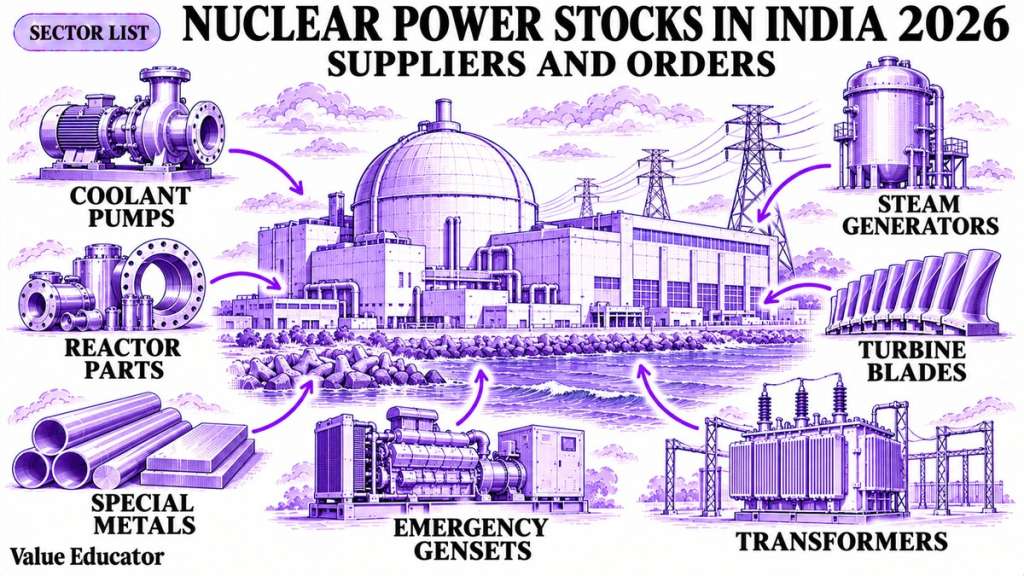
Nuclear Power Stocks in India 2026: Suppliers and Orders
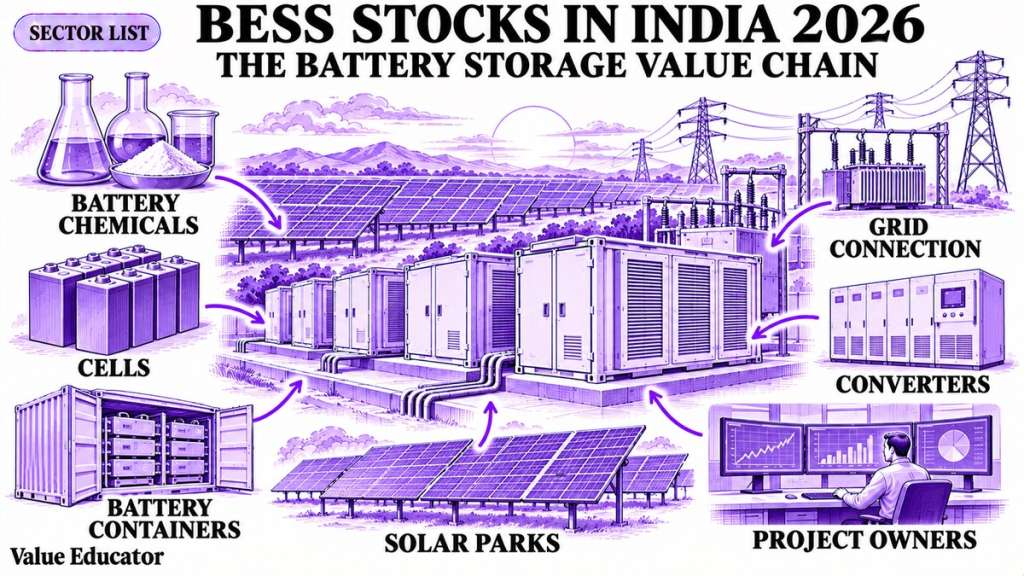
BESS Stocks in India 2026: Battery Storage Value Chain
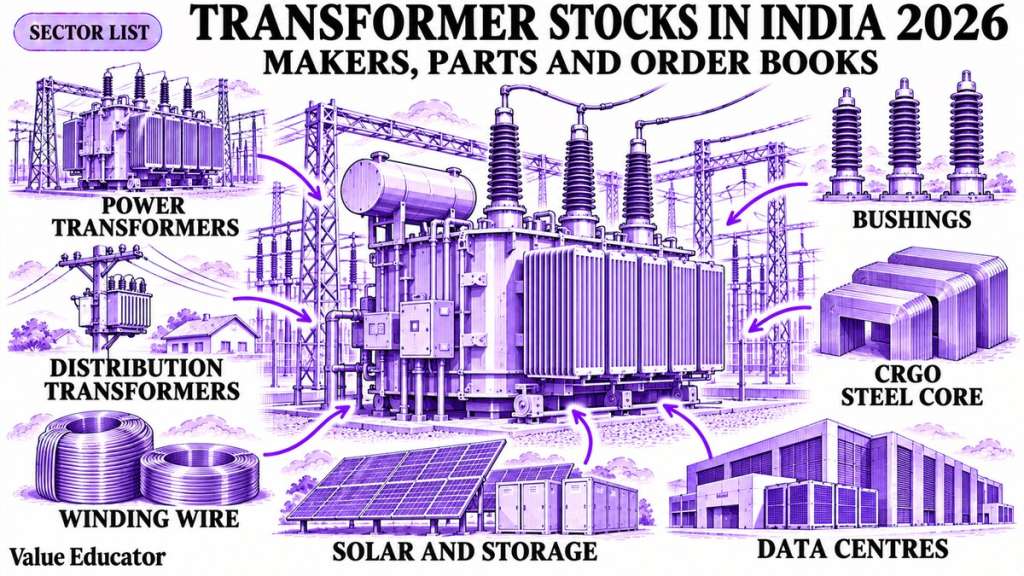
Transformer Stocks in India 2026: Makers and Order Books

RACL Geartech: Gears for KTM, BMW and Royal Enfield

Transrail Lighting: A Line Builder With Its Own Tower Plants

Skipper Limited: A Tower Maker With ₹10,066 Cr of Orders
Explore our Products
Research Framework
Emerging Titans
Combination of quantitative analysis, industry tailwinds, and management assessment - SPRINT investment philosophy
Tiny Titans
Heavy emphasis on scuttlebutt research, plant visits, and early on-ground signals



Modern Warfare to Multibaggers
Key Trends. Strategic Shifts. Opportunities Ahead.
Don't Miss This Exclusive Webinar!
Join Value Educator to decode the key trends shaping India's defence sector and learn how to identify tomorrow's potential leaders in the space.
- In-depth research on India's defence sector
- Live Q&A session
- Actionable takeaways for long-term investors

 Orders
 Subscription
 Share with friends


Required Details
₹23999.00
(12 month subscription)
As per SEBI regulations, all users are mandated to complete the KYC that is validated for 1 year. Post payment, you will be redirected to the KYC screen


No comments yet. Be the first to comment!