
Supriya Lifescience: APIs, Ambernath and a 22% Margin
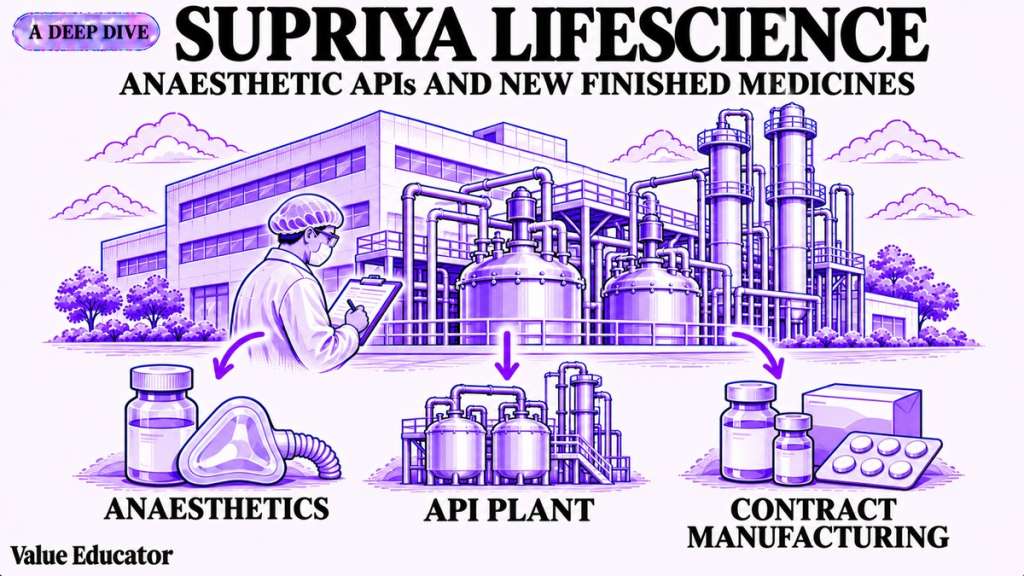
In FY22, China was the largest export market of an Indian maker of drug ingredients. It brought in about 11% of the company's revenue, and much of that was high-value work. Then COVID returned in China, and the country locked down. In FY23 the company's revenue fell 13%, to ₹460.9 Cr, and its EBITDA margin dropped from 40% to 28%. In that year's annual report the chairman set a new goal anyway: double revenue to about ₹1,000 Cr by FY27.
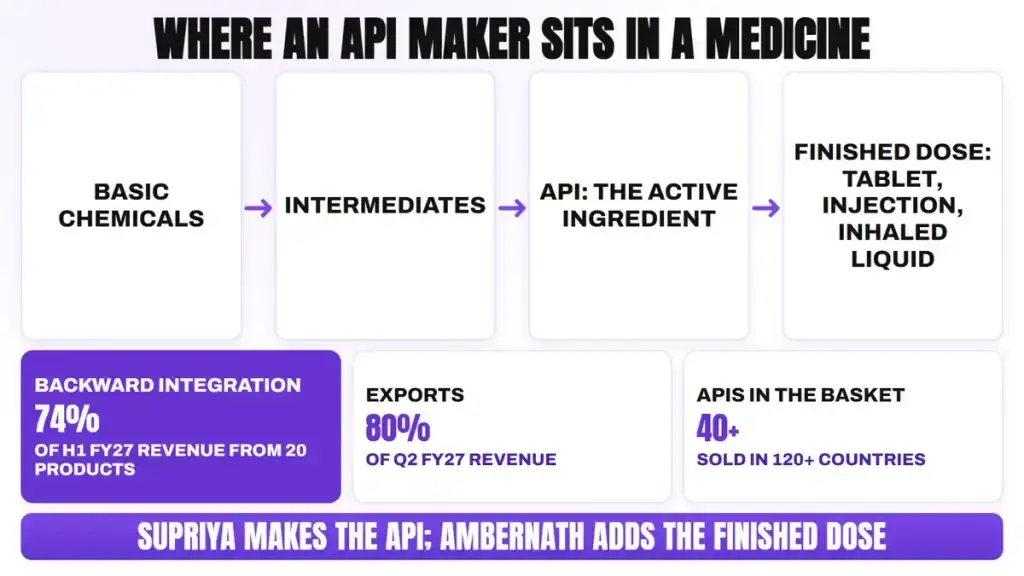
To see why that goal matters, we need to understand what this company sells. It makes active pharmaceutical ingredients, or APIs. An API is the chemical inside a medicine that does the actual work, such as the antihistamine in a cold tablet or the anaesthetic in a hospital injection. Drug companies buy the API in kilograms or tonnes, then turn it into tablets, syrups and injections under their own brands.
In this business, a buyer cannot switch suppliers overnight. Every API that goes into a medicine sold in Europe or the US has to be named in that medicine's approval file. A new supplier means new tests, new paperwork and months of waiting. So once a drug company has approved an API maker, it tends to stay with it, and the approved maker can earn a high margin on a small, specialised molecule.
That drug-ingredient maker is Supriya Lifescience Ltd (NSE: SUPRIYA). It makes more than 40 APIs at Lote Parshuram in Ratnagiri, Maharashtra, and sells them in more than 120 countries to more than 1,500 customers. About 80% of its revenue comes from exports. In FY26 its revenue was ₹827.9 Cr, up 18.9%, at an EBITDA margin of 35.5%.
That FY26 figure brought the company within reach of its goal. But FY27 has been harder so far, and the company is also in the middle of a bigger change: from selling only APIs to also making finished medicines and running contract manufacturing for larger drug companies.
Supriya Lifescience in five numbers
- Q2 FY27 revenue of ₹206.3 Cr, up 3.2%
- Q2 FY27 EBITDA margin of 22.0%, against 36.4% a year ago
- 74% of H1 FY27 revenue from products it makes from its own intermediates
- 22 US drug master files and 16 European CEPs
- A target of ₹1,000 Cr of revenue in FY27, against ₹396.0 Cr in H1, at a cut margin guidance of 23-25%
So a company that earned more than a third of its revenue as EBITDA in FY26 earned about a fifth in the latest quarter, and it has now cut its margin guidance for the year. What changed? Let's first understand the company, and then look at the latest quarter.
Supriya Lifescience: Company Overview
Supriya Lifescience Ltd makes active pharmaceutical ingredients. Its main plant is at Lote Parshuram in Ratnagiri district, Maharashtra, where it has made chemicals since 1987; the company became a public limited company in 2008 and listed on the NSE and BSE in December 2021. It makes more than 40 APIs across anaesthetics, antihistamines, vitamins, anti-asthmatics and analgesics, and sells them in more than 120 countries to more than 1,500 customers. Exports were 82% of FY26 revenue, with Europe its largest market at 40%. A second site at Ambernath, in Thane district, makes finished dosage forms and contract products. Dr. Satish Wagh is the Executive Chairman, Dr. Saloni Wagh the Managing Director and Shivani Wagh the Joint Managing Director. Revenue from operations was ₹827.9 Cr in FY26, and the company had no borrowings in September 2026. Read this Small and Micro Cap Stocks: Risk vs Reward
"The stock market is a device for transferring money from the impatient to the patient."
— Warren Buffett
Supriya took years to collect the filings and approvals that regulated buyers ask for. Its new Ambernath plant will need the same patience before it pays back.
The Quarter the EBITDA Margin Fell to 22%
Let's look at Q2 FY27, the July to September quarter, which the company reported on 6 November 2026. Revenue from operations was ₹206.3 Cr, up 3.2% from ₹199.8 Cr a year ago and 8.7% higher than the ₹189.7 Cr of Q1 FY27. EBITDA fell 37.5% to ₹45.4 Cr, and profit after tax fell 42.0% to about ₹29.3 Cr.

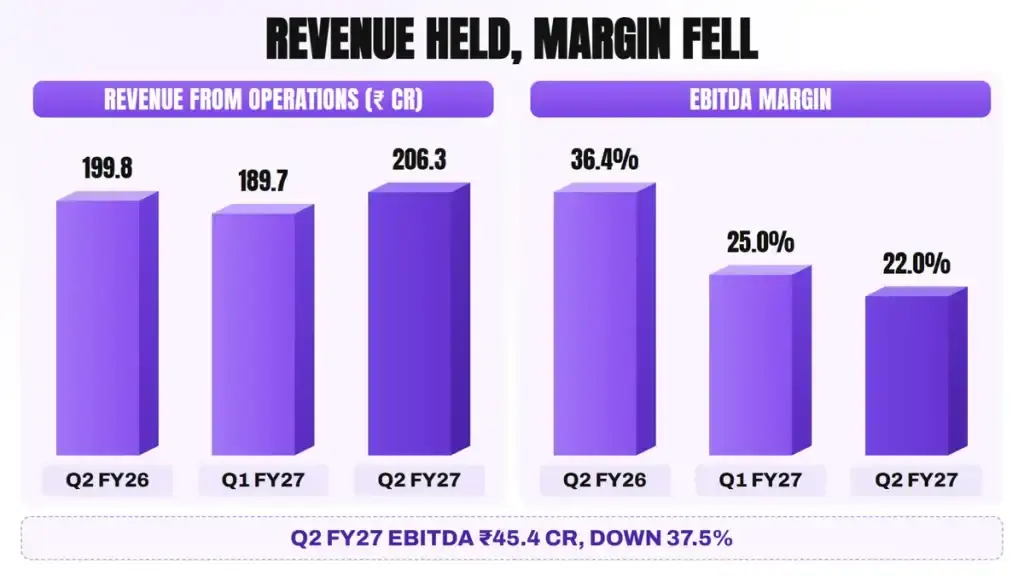
As we can see, the fall came from costs, not from sales. Read this EBITDA Explained: Uses and Limits Cost of goods sold rose 27.5% while revenue rose 3.2%, so the gross margin, revenue left after materials, fell to about 65.6% from about 72.1%. Other expenses, which include power, fuel, solvents and the running costs of the new Ambernath plant, rose 35.6%. Depreciation rose 42.5% to ₹9.5 Cr, because Ambernath now sits in the asset base.
Management gave three reasons on 6 November. First, several Latin American countries, including Colombia, Peru and Uruguay, reclassified some of Supriya's higher-margin products as controlled substances with immediate effect. Its customers there now need import authorisations, which typically take a couple of months, so more of the quarter's sales went to semi-regulated markets at lower prices. Second, the new Ambernath plant is running with its costs but little revenue. Third, raw material and solvent prices stayed high because of the war and other geopolitical tension.
Management also split the drop in margin. Against a usual margin of about 34-35%, it put about 6 points down to Ambernath's expenses, about 3 points to the Latin American rule change and the product mix, and about 3 points to raw material and solvent prices. It expects Ambernath's expenses to be about ₹60 Cr for the full year.
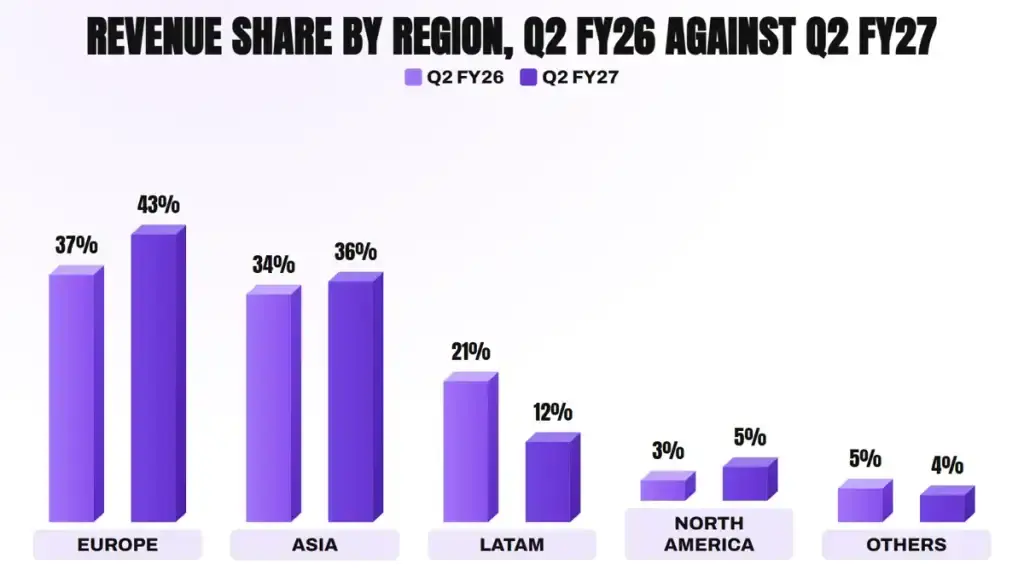
The mix inside the quarter also moved. Europe rose to 43% of revenue from 37% a year ago, and Asia to 36% from 34%. Latin America fell to 12% from 21%. Exports were 80% of revenue. Across the first half, anaesthetics made up 48% of revenue against 54% in H1 FY26, while vitamins rose to 16% from 12% and analgesics to 6% from 2%.
That half-year view also shows the size of the margin gap. H1 FY27 revenue was ₹396.0 Cr, up 14.8%. But EBITDA fell 25.3% to ₹92.9 Cr, and the margin was 23.4% against 36.1%. Profit after tax fell 37.5% to ₹53.3 Cr.
Q1 had its own one-offs, which management described in August. A water shortage in the Lote industrial belt stopped production for about 15-20 days and pushed out sales of about ₹30-35 Cr. A change in Maharashtra's solar power policy added about ₹8 Cr of cost, part of it a back-dated charge. Higher solvent and power costs added about ₹10.5 Cr in all.
Inventory Up, Receivables Down
Now let's look at the balance sheet, because it moved in the opposite direction to the profit. Inventory rose to ₹265.2 Cr in September 2026 from ₹159.6 Cr in March. Management had built stock ahead of a maintenance shutdown it later chose to do in phases, and said in August that it would run this stock down over three to four quarters. Trade receivables fell to ₹125.6 Cr from ₹219.4 Cr as customers paid for the strong March quarter.
That swing helped cash. Read this Inventory Turnover Ratio Explained Operating cash flow for the half was ₹60.9 Cr, and capital spending was ₹35.4 Cr. The company has no borrowings. It held about ₹41.0 Cr of cash, ₹34.9 Cr of other bank balances and ₹106.6 Cr of investments at the end of September.
One more item from the quarter needs a mention. A consignment meant for export in Q1 FY27 was detained by Customs in transit. Management said in August that the product is a psychotropic drug, that each shipment needs its own export permit, and that the permit on this one had lapsed by two days before the shipping bill was raised. After clearance, the material was exported on 2 October 2026.
How a Lote API Plant Grew to ₹828 Cr
Now that we have seen the quarter, let's go back and see how the company was built. Supriya began making chemicals at Lote Parshuram in 1987, became a public limited company in 2008, and began making ketamine hydrochloride, an anaesthetic, in 2009. Over the next decade it added European certificates and US approvals for antihistamines such as chlorpheniramine maleate and pheniramine maleate. It listed on the NSE and BSE in December 2021.
Its first year as a listed company was its hardest. China had been its largest export market, at about 11% of FY22 revenue. When Chinese cities locked down, that demand went away at once. The company sold more in India and ASEAN, but at lower margins than it had earned in China.
"Know what you own, and know why you own it."
— Peter Lynch
Supriya's margin has always depended on where it sells and to whom. Knowing which markets and which buyers bring in the revenue is the first step to understanding this company.
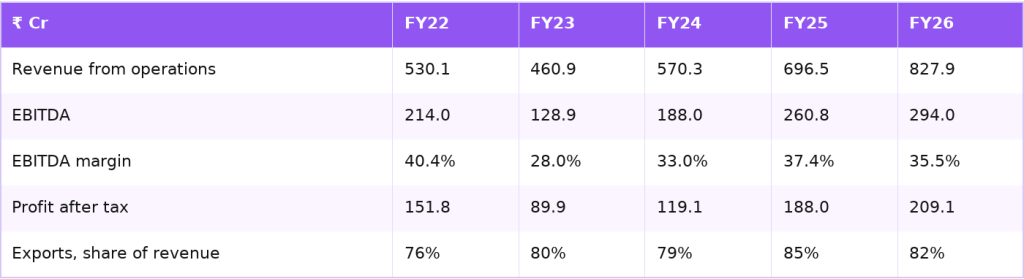

After FY23, the company moved towards regulated buyers. Europe became its largest market, at 40% of FY26 revenue. Revenue grew 23.7% in FY24, 22.1% in FY25 and 18.9% in FY26, and the margin came back to between 33% and 37.4%. Its top ten customers made up 52% of FY26 revenue, against 58% in FY25.
That recovery was paid for with capacity. The company spent between about ₹94.9 Cr and ₹162.3 Cr a year on capex from FY22 to FY26, including a new production block, Module E, that took reactor capacity at Lote from 597 KL to 932 KL a day. It did all of this without borrowing.
"Earlier, it was only an API business. Now, we are trying to add finished formulation vertical. We are trying to add CMO, CDMO vertical." - Dr. Saloni Wagh, Managing Director, August 2026
Five Therapies, One Plant
Now let's split the business by therapy, because each one has its own buyers and its own growth path. Supriya reports a single segment, APIs, but it shows the share of each therapy in its revenue every quarter. Read this Segment-Wise Revenue Analysis Explained
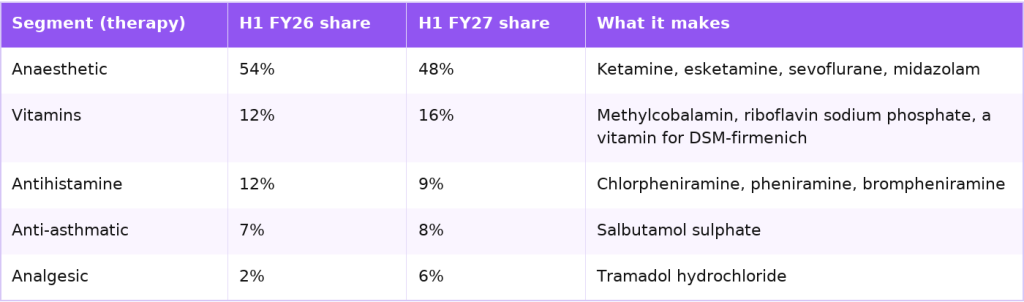
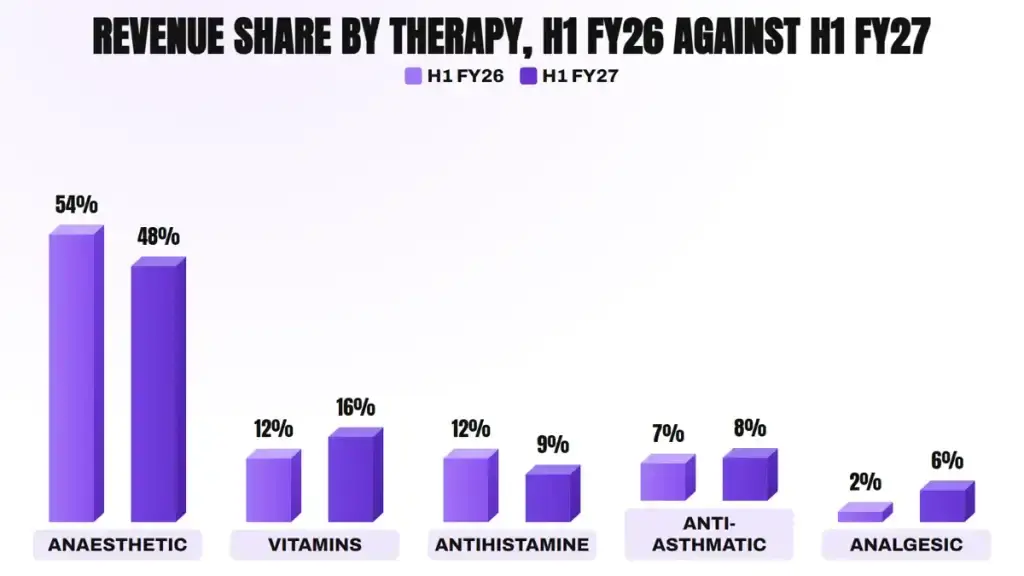
These therapies sound alike, but as you will see, they are at very different stages. Antihistamines are the old base, steady and growing slowly. Anaesthetics are the largest and fastest-changing part. Vitamins carry the company's first large contract-manufacturing deal.
Anaesthetics
Let's start with anaesthetics, about half of revenue. Ketamine, the company's first anaesthetic, is used to put patients to sleep for short procedures. Because it is a controlled drug, every shipment needs a government export permit, and buyers usually pay in advance. Supriya holds a European certificate for ketamine and for esketamine, a related molecule.
In FY26 the company added two newer anaesthetics. One is sevoflurane, a liquid that a patient breathes in through a mask during surgery. The company commercialised the API in FY26 with steady monthly supplies, and in Q2 FY27 it launched two liquid inhaled anaesthetics as finished products from Ambernath. Its annual report says it has also signed up a global company for contract manufacturing of an anaesthetic for that company's worldwide needs. In November 2026 management said one of its newer anaesthetic APIs had just received its European certificate.
Antihistamines and Anti-asthmatics
Next, the antihistamines, the products the company was first known for. Chlorpheniramine maleate is the antihistamine in many cold and allergy tablets. Supriya sold 219 MT of it in FY26, and its annual report puts market growth at only 3-4% a year. The company also makes salbutamol sulphate, the drug in many asthma inhalers, which has its own European certificate.
These are mature products. In the related anti-allergic range, the company says competition from China is strong. That is why their share of revenue is slipping as newer products grow faster.
Vitamins and the DSM-firmenich Contract
Now let's move to vitamins, the fastest-growing therapy in the first half. Supriya makes forms of vitamin B12 such as methylcobalamin, and riboflavin sodium phosphate, a form of vitamin B2, for which it added capacity in FY26.
The larger part here is a contract with DSM-firmenich, the global nutrition company. Supriya makes a vitamin for it in a dedicated production block. The contract brought in about ₹30-35 Cr in FY26 at about 3 tons a month, and management expected it to reach its peak of about ₹60 Cr in FY27. In August 2026 management said the contract was close to peak volumes and that pharma validation was done.
Newer Cardiovascular and ADHD Molecules
Finally, let's look at the newest cardiovascular and ADHD molecules. In Q3 FY26 Supriya launched ATS-8, an advanced intermediate used to make atorvastatin, a common cholesterol drug. It has contracts with three or four large users that cover about 300 MT of capacity. Management has said the 250 MT level will take about two years to reach, because each buyer has to validate the new source.
The company also launched lisdexamfetamine, an ADHD drug, with demand from Latin America and Europe, and it plans about two more ADHD launches. A contrast media product, the dye injected before some scans, is due in H2 FY27 after a delay of two quarters to improve the process.
Why a Regulated Buyer Rarely Changes Its API Supplier
Now that we have seen the products, let's understand the moat. A drug company that sells in Europe or the US names its API supplier in its approval file. Changing the supplier means new stability tests, new filings and a new approval, which can take a year or more. So the supplier that is already in the file has an advantage.
"In business, I look for economic castles protected by unbreachable moats."
— Warren Buffett
For an API maker, the moat is the paperwork: drug master files, European certificates and inspection records, each earned over years and named in a customer's own approval file. Read this Economic Moat Explained
That position is built through filings. A drug master file, or DMF, is a confidential file on how an API is made that the supplier submits to the US regulator. A CEP, or Certificate of Suitability, is the European equivalent. Supriya holds 22 US DMFs, 16 CEPs, 10 Brazilian and 7 Korean filings, and 4 Chinese approvals. It has also passed more than 500 customer audits.

That paperwork is backed by inspections. In February 2026 the US FDA walked into the Lote site without notice and inspected it for seven days across seven manufacturing blocks. It left one minor observation and classed the site Voluntary Action Indicated, which means no regulatory action was needed.
A second layer is backward integration. That means the company makes the intermediates, the chemicals one or two steps before the API, instead of buying them. 20 of its products are made this way, and they made up 74% of H1 FY27 revenue. That gives it lower costs and less dependence on Chinese suppliers.
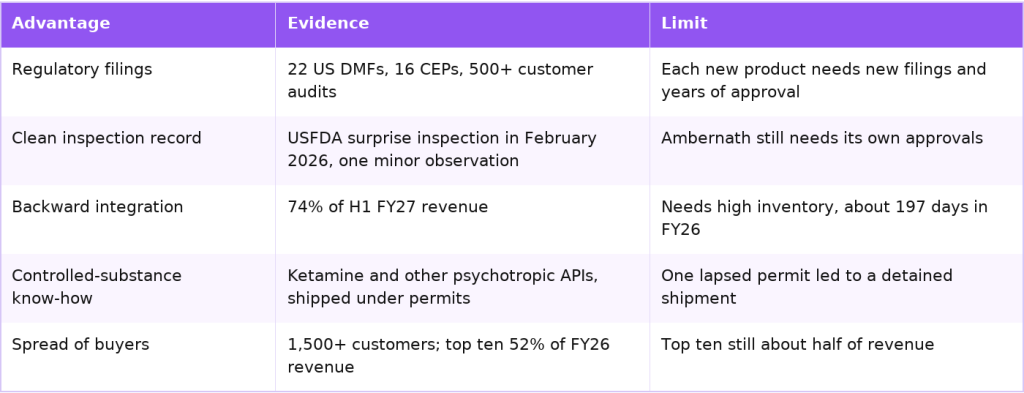
That table shows us why the margin is the test of this moat. From FY24 to FY26 the margin held between 33% and 37.4%. The question now is whether it returns to that range once Ambernath earns revenue.
Ambernath, Contract Work and Patalganga
Now let's look at the three projects that are meant to change what Supriya is. The first is Ambernath, a 5,000 sq m site in Thane district. Unlike Lote, it is built for finished dosage forms, the tablets, capsules, liquids, nasal sprays, inhalation liquids and injections that a patient actually takes.
Ambernath has five finished-dose lines running and commercial manufacturing has started. Its R&D team has about 30 products under development and has completed five exhibit batches, the trial batches that go into a regulatory filing. The company plans to file six dossiers in the EU this year. An EU audit of the site is scheduled for November 2026, and it has an exhibit batch order for other markets.
That plant costs money before it earns any. Management said in May 2026 that Ambernath's expenses had started while its revenue had not, and that its full contribution would take three to four years. Depreciation from Ambernath alone is about ₹14-15 Cr a year.
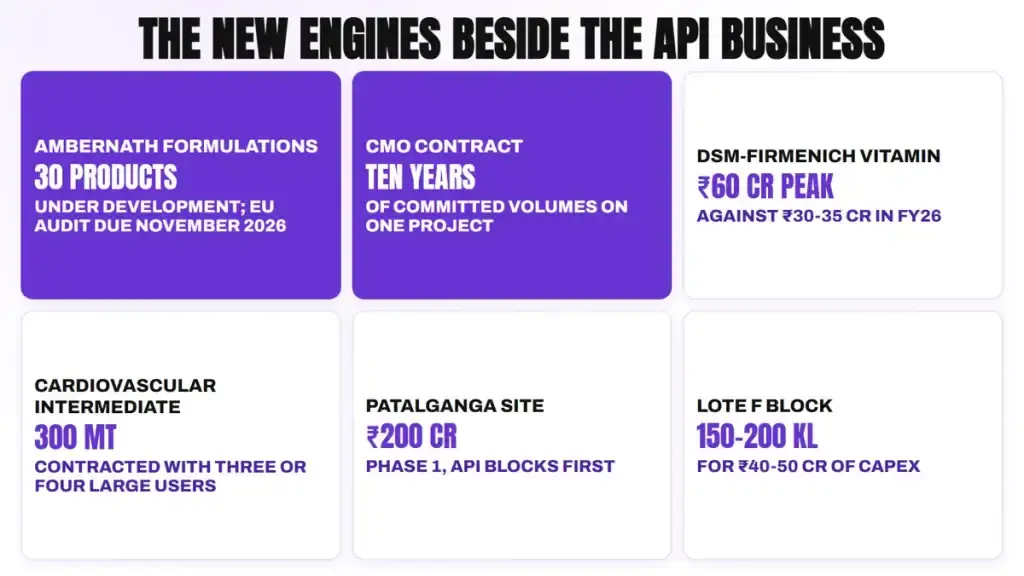
The second project is contract work. CMO means contract manufacturing organisation: a company makes a product to another company's design. CDMO adds development, so the contractor also works out how to make it. Supriya says one CMO project has moved into commercial supply with committed volumes for the next decade, and it built a dedicated production block for that customer. In November 2026 management said a large anaesthetic CMO contract was very close to signing, and in August it said it expected CMO and CDMO to become one of its strongest businesses in three to four years.
Other projects are earlier. Supriya is developing GLP-1 products for a leading Indian generics company, has filed a patent on a semaglutide tablet formulation, and is discussing a combination product with an innovator. Management said in May that GLP-1 revenue would take at least two years.
The third project is capacity. Management said in August that Lote was close to full, and the deck shows capacity use of 73% in H1 FY27. A new F block at Lote should add about 150-200 KL for about ₹40-50 Cr. At Isambe in Patalganga, on an 80,000 sq m site near the new Navi Mumbai airport, phase 1 will cost about ₹200 Cr and will start with API blocks, with formulation blocks in phase 2.
Why Ambernath matters for margins: the EBITDA margin was 35.5% in FY26 and 23.4% in H1 FY27, partly because Ambernath's costs arrived before its revenue. If the EU audit in November 2026 goes well and the first dossiers are approved, those costs start to earn revenue. If it is delayed, the gap lasts longer. Management puts Ambernath's share of the margin drop at about 6 points.
Financials: Five Years of Revenue, Profit and Returns
One quarter can mislead in a business where approvals and shipments move between quarters, so let's look at five full years together. These figures are the company's standalone numbers; it has no subsidiaries.
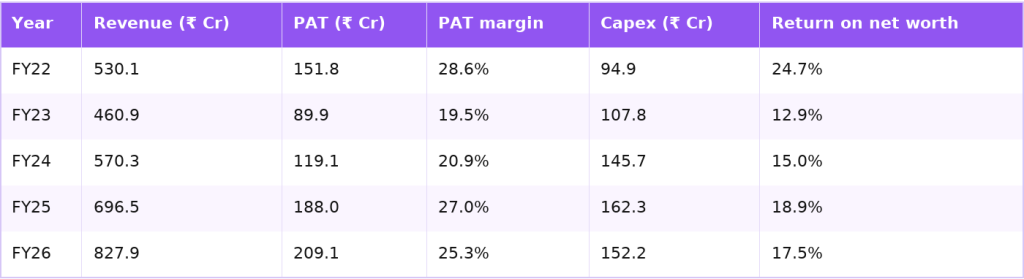
Revenue grew about 1.56 times in four years, from ₹530.1 Cr in FY22 to ₹827.9 Cr in FY26, and profit after tax grew about 1.38 times. The gap comes from FY23, when the China lockdown cut both revenue and margin, and from rising depreciation as new blocks came into use.
Capital spending was heavy for a company of this size. It added up to about ₹662.9 Cr over the five years, close to the ₹757.9 Cr of profit after tax in the same period. Return on net worth came down from 24.7% in FY22 to 17.5% in FY26, as the equity raised and earned went into plants that are still filling up.
The balance sheet carried that spending without debt. Net working capital stood at 170 days in FY26, against 124 days in FY24, because the company holds more inventory for its backward-integrated products. That is the line to watch as Ambernath adds its own stock.
"In the short run, the market is a voting machine but in the long run, it is a weighing machine."
— Benjamin Graham
Supriya's five-year table shows why: one bad year in FY23 changed the picture for a while, but over time the revenue, the margin and the return on capital are what get weighed.
What FY27 Could Look Like on Management's Numbers
So where does Supriya go from here? Since FY23 management has kept one target: ₹1,000 Cr of revenue in FY27. Until August 2026 it paired that with an EBITDA margin of 33-35%, and said the second half would be much stronger.
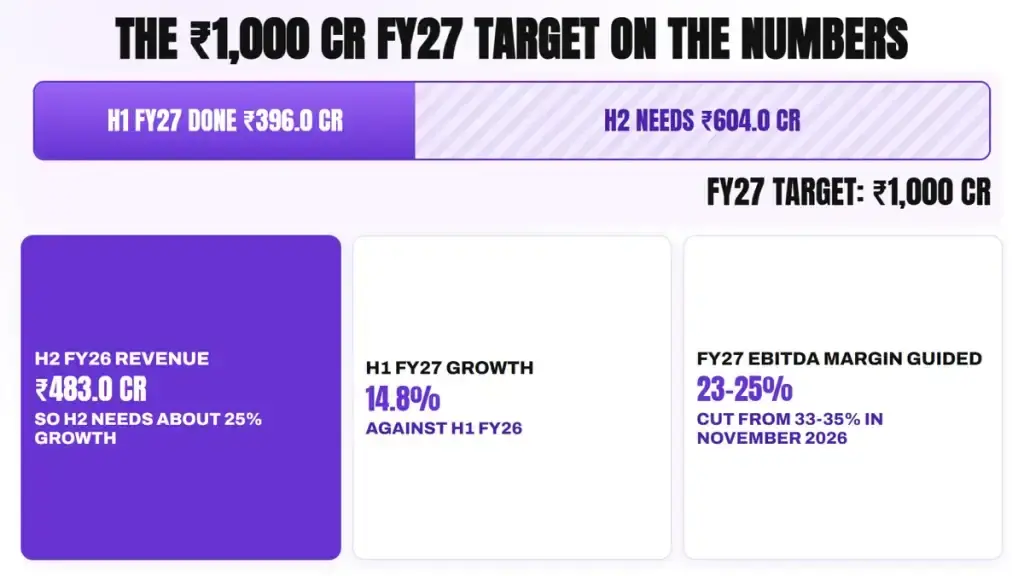
On 6 November 2026 that changed in part. Management kept the ₹1,000 Cr revenue target and said the order book was in place. But it cut the FY27 EBITDA margin guidance to 23-25%, from 33-35%, and said it expects about 25% for the rest of the year. It expects margins to return towards normal in FY28, once Ambernath is approved, sales to Latin America are regularised and new products scale up in regulated markets.
Now let's put that target against the first half. H1 FY27 revenue was ₹396.0 Cr. Reaching ₹1,000 Cr needs ₹604.0 Cr in H2, against ₹483.0 Cr in H2 FY26. That is growth of about 25%, against 14.8% in the first half. The best quarter so far was ₹277 Cr, in Q4 FY26, so H2 would need two quarters above that level.
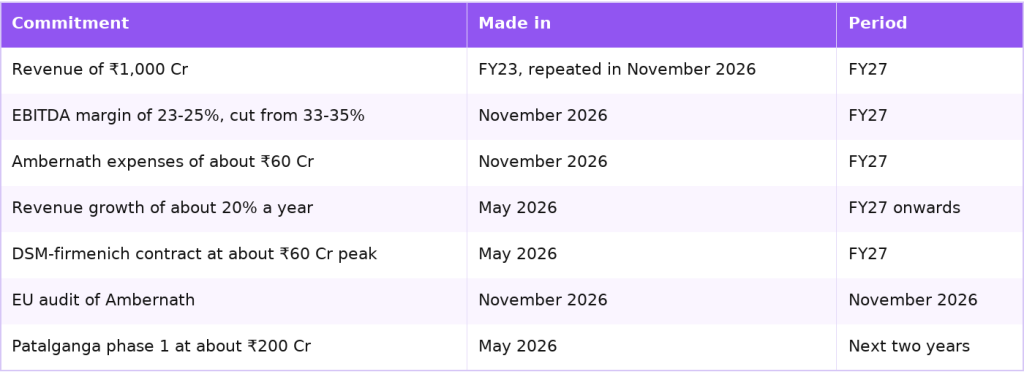
Those commitments are easier to judge against the past. So let's check what management said before against what it delivered.
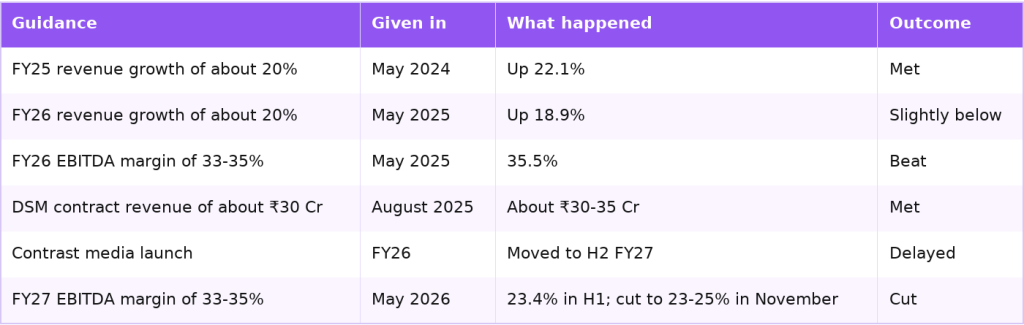
That record shows us a clear pattern. On revenue growth and full-year margins, the company met its targets in FY25 and FY26, even after weak first halves. But launches and approvals have often taken longer than first said, and the FY27 margin guidance has now been cut by about ten points. That makes Ambernath's approval the number to watch from here.
Key Risks
Now let's look at what could go wrong for Supriya Lifescience, because the first half of FY27 has already shown some of these risks.
- Margins: the FY27 EBITDA margin guidance has been cut to 23-25% from 33-35%. Ambernath's expenses of about ₹60 Cr this year cannot be recovered until the site is approved and its products scale up.
- The ₹1,000 Cr target: it needs about 25% growth in H2, against 14.8% in H1. Missing it would be the first big gap since FY23.
- One plant: almost all API output comes from Lote. A water shortage stopped production there for about 15-20 days in Q1 FY27, and a planned maintenance shutdown had to be redone in phases.
- Controlled drugs: ketamine and other psychotropic APIs need a permit for each shipment. A consignment was detained by Customs in Q1 FY27 after a permit lapsed, and the matter was before the High Court in August 2026, with an employee in judicial custody.
- Inventory: inventory rose to ₹265.2 Cr from ₹159.6 Cr in six months. If demand is slower than planned, cash stays locked up longer.
- Approval delays: the EU audit of Ambernath took longer to schedule than expected, the USFDA audit date is not yet known, and the contrast media launch slipped two quarters.
- Latin American rules: several countries made some of Supriya's higher-margin products controlled substances overnight. Sales there depend on customers getting import authorisations, and other markets could follow.
- Competition and tariffs: antihistamines face strong competition from China, and management expects the US to put tariffs on pharma products in a few years, though North America was only 5% of Q2 FY27 revenue.
"So, getting the right regulatory approvals for the products, for the new facilities, is very important for that scale-up to happen." - Dr. Saloni Wagh, Managing Director, August 2026
"All I want to know is where I'm going to die, so I'll never go there."
— Charlie Munger
For Supriya, the places to avoid are clear from the list above: a single main plant, controlled-drug permits and a new site whose costs come before its revenue. The tracking list below shows how to see which way each one goes.
Explore our Products
Research Framework

Emerging Titans
Combination of quantitative analysis, industry tailwinds, and management assessment - SPRINT investment philosophy

Tiny Titans
Heavy emphasis on scuttlebutt research, plant visits, and early on-ground signals
What to Track Next
If you follow Supriya Lifescience, these are the signals that will show where it goes next.
- H2 FY27 revenue against the ₹604.0 Cr needed for ₹1,000 Cr
- The EBITDA margin against the new 23-25% guidance, after 22.0% in Q2 FY27
- The result of the EU audit of Ambernath, due in November 2026, and the first dossier filings
- A signed term sheet for the large anaesthetic CDMO contract
- Inventory after ₹265.2 Cr, and operating cash flow in H2
- The start of building work at Patalganga and the Lote F block
Members can read our full Research Desk report on Supriya Lifescience, with its detailed scorecard and section-by-section analysis.
Conclusion
Let's put it all together. Supriya Lifescience grew from ₹460.9 Cr of revenue in FY23 to ₹827.9 Cr in FY26 at margins above 33%, helped by regulated-market filings and products made from its own intermediates. Its first half of FY27 grew 14.8%, but its margin fell to 23.4% as Ambernath's costs arrived before its revenue, and management cut its FY27 margin guidance to 23-25%. The steady thread is revenue, which grew 14.8% in the half and which management still expects to reach ₹1,000 Cr. The next two quarters will show whether the margin starts to recover with it.
Still, the next step is bigger than one weak half. What happens next depends on whether Ambernath clears its EU audit and starts earning, whether the anaesthetic and vitamin contracts grow into a real CDMO business, and whether the margin climbs back from the 23-25% now guided towards the 33-35% of earlier years.
FAQs
What does Supriya Lifescience do?
+Supriya Lifescience makes active pharmaceutical ingredients, the chemicals inside medicines, mainly anaesthetics, antihistamines, vitamins, anti-asthmatics and analgesics. It sells more than 40 APIs in more than 120 countries, and exports were 82% of FY26 revenue of ₹827.9 Cr.
How did Supriya Lifescience do in Q2 FY27?
+Revenue from operations rose 3.2% to ₹206.3 Cr. EBITDA fell 37.5% to ₹45.4 Cr, and the EBITDA margin was 22.0% against 36.4% a year ago. Profit after tax fell 42.0%.
Why did Supriya Lifescience's margin fall?
+Management named three reasons: about 6 points from the costs of the new Ambernath plant, about 3 points from Latin American rule changes that hit higher-margin products, and about 3 points from higher raw material and solvent prices.
What is Supriya Lifescience's FY27 guidance?
+In November 2026 management kept its target of ₹1,000 Cr of revenue for FY27 and cut its EBITDA margin guidance to 23-25%, from 33-35%. H1 FY27 revenue was ₹396.0 Cr, so H2 needs about ₹604.0 Cr.
What is the Ambernath facility?
+Ambernath is Supriya's new site in Thane district for finished dosage forms such as tablets, injections and inhalation liquids, and for contract manufacturing. It has about 30 products under development, launched two liquid inhaled anaesthetics in Q2 FY27, and has an EU audit scheduled for November 2026.
What are the main risks for Supriya Lifescience?
+The FY27 margin guidance has been cut to 23-25%, almost all API output comes from one plant at Lote, controlled-drug exports need a permit for each shipment, and inventory rose to ₹265.2 Cr in September 2026 from ₹159.6 Cr in March.

High growth stock specialist, Value Educator
Shashank Mahajan is an equity research professional with over 12 years of experience in identifying high-potential SME and micro-cap stocks at an early stage. He follows a rigorous scuttlebutt research–driven approach, combining on-ground insights with deep financial analysis. Shashank specializes in uncovering under-researched and under-owned companies with strong management quality and long-term growth potential. Through disciplined research and early identification, he focuses on spotting tomorrow’s market leaders before they enter the mainstream investor radar.
Glenmark: The USD 700 Mn Cancer Deal and Its Brands
Pharma Stocks in India 2026: Generics, APIs and CDMOs
Granules India: From Paracetamol to a 65% Gross Margin
Natco Pharma: After Revlimid, 29 Patent Challenges
Shilpa Medicare: Cancer APIs, Films and Biosimilars
Alembic Pharma: US Plants Pay Back, Margin Hits 22.2%
Explore our Products
Research Framework
Emerging Titans
Combination of quantitative analysis, industry tailwinds, and management assessment - SPRINT investment philosophy
Tiny Titans
Heavy emphasis on scuttlebutt research, plant visits, and early on-ground signals



Modern Warfare to Multibaggers
Key Trends. Strategic Shifts. Opportunities Ahead.
Don't Miss This Exclusive Webinar!
Join Value Educator to decode the key trends shaping India's defence sector and learn how to identify tomorrow's potential leaders in the space.
- In-depth research on India's defence sector
- Live Q&A session
- Actionable takeaways for long-term investors

 Orders
 Subscription
 Share with friends


Required Details
₹23999.00
(12 month subscription)
As per SEBI regulations, all users are mandated to complete the KYC that is validated for 1 year. Post payment, you will be redirected to the KYC screen


No comments yet. Be the first to comment!