
Small and Micro Cap Stocks: Risk vs Reward

In 2003, you had two choices: buy a Bullet for Rs 55,000 or buy shares of Eicher Motors - “the company behind” it. The bike would have gathered dust, in contrast the shares would be worth about Rs 4.75 crore today. Small caps don’t whisper, they quietly rewrite destinies.
“Big companies have small moves. Small companies have big moves.” — Peter Lynch
In this article, we’ll break down why India’s small and micro-cap space keeps producing these unbelievable stories. We’ll decode what makes these companies grow so fast, why the market ignores them early, and how investors can spot the next Eicher before the crowd wakes up.
What Are Small and Micro-Cap Stocks?
Small and micro-cap stocks are defined based on market capitalization. Small cap & micro cap stock usually have smaller market cap compared to established giants, giving them a huge head room for growth.- Small-cap stocks are defined by SEBI as companies ranked 251st and below by market cap, typically valued under ₹5,000 crores. They are past the startup stage but haven’t yet become large, stable companies.
- Micro-cap shares are a small part of the small-cap universe. SEBI does not officially define them. They usually have very low market value and thin trading, which makes them riskier, but they can also deliver big rewards.
Many investors ignore them, so patient early buyers can find good opportunities. These buckets help build portfolios by risk, return, and time for everyone.
If you’re new to equities and wondering how to even begin, you can start extremely small. Here’s a practical beginner's guide: How to Start Investing in the Indian Stock Market with Just ₹1,000
What Makes Small and Micro-Caps Investing Attractive?
1. Room for Expansion & Agility
Small companies and micro-cap companies are just starting out. They have a way to go. The road ahead of companies and micro-cap companies is much longer than the road they have already traveled.Companies like Asian Paints and Titan were also small once. They were businesses that served markets that were growing very fast. These markets were growing faster than small companies and micro-cap companies like Asian Paints and Titan were growing.
The difference between the size of companies and micro-cap companies like Asian Paints and Titan and the opportunity in the market is what helped them become big companies.
That same logic makes micro-caps attractive today. They operate in markets that are not yet crowded, so even a small gain in market share can drive big growth. They are also more flexible because they are not slowed down by layers of management. They can enter new cities, launch new products, and change direction quickly when something works. In young and evolving industries, this speed helps them stay ahead of larger competitors and build strong positions early.
2. Undiscovered & Under-Researched: Early-Spotting Advantage:
Small and micro-cap stocks sit in a part of the market most investors ignore. Few analysts track them, concalls are rare, and institutional money stays away, creating a real information gap. When a company’s fundamentals improve but no one is watching, the price doesn’t reflect it.At Value Educator, this is exactly the space we specialise in. Limited coverage and scarce concalls don’t bother us; they create the information asymmetry we exploit. Our scuttlebutt approach plant visits, management conversations, on-ground checks often reveals what the market hasn’t noticed yet. In one instance, our scuttlebutt contradicted what a company claimed in its Draft Red Herring Prospectus
The DRHP claimed the company had a dedicated R&D setup, but when we visited the facility, we found no R&D setup at all.
That mismatch became the key insight behind a high-conviction investment call, because it told us early that the company’s innovation capability and competitive edge were overstated.
“If you can find small companies that are growing fast, that’s where the real multibaggers come from.” — Peter Lynch
3. small base effect
To see how this plays out, take a simple example.
Revenue in Cr
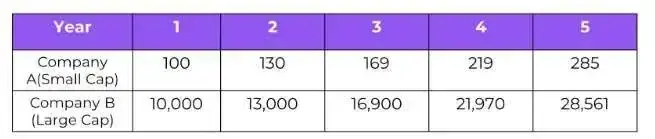
When a business is small, even modest wins can move the needle in a big way. A new customer segment, one successful product, or one new city can meaningfully lift its revenues. But for a very large company, those same wins barely make a dent-it needs massive expansion or entirely new lines of business to show the same percentage growth. That difference in scale is why smaller companies often grow much faster.
That’s the core of the small-base effect. Small caps can post high growth because every increase moves the needle. Large caps need massive additions just to show the same percentage jump.
4. Small-Cap Investing: How Retail Investors Win Before Institutions Even Enter?
Why do the best small-caps often start with almost no institutional ownership?It’s not because funds dislike them. It’s because they simply can’t buy them in the early stages.
SEBI classifies companies ranked 251 and below as small-caps. Most of these are tiny, illiquid, and so volatile that even a moderate buy order can push the stock price up.
Large institutions need liquidity.
This creates an interesting window. Retail investors get the earliest shot not because they are more insightful, but because they can take small, experimental positions that institutions are structurally unable to take.
The real shift happens later. As the company grows, improves governance, and becomes more liquid, institutions finally get the green light to participate. When they enter in size, the stock often rerates sharply.
That “institutional discovery” moment is what rewards early retail investors who understood the story before the big money had the capacity to step in.
5. Market Inefficiencies and Re-Rating Potential
Small-cap stocks are often very cheap because big investors and analysts do not pay attention to them. When something good happens to a cap stock, like they make a new product or start selling things in a new country, people who invest money might not even notice. This means the price of the cap stock stays low even when it should really be higher. Small-cap stocks can be a deal because of this.Let me tell you about Garware Hi-Tech Films. This company was seen as another company that made BOPP and BOPET films, which is a business that does not make a lot of money.. Garware Hi-Tech Films has changed its focus to making special kinds of films that protect things from the sun and paint, which is a part of the Consumer Product Division. These special films are more profitable and valuable, than the kinds of films they used to make. Garware Hi-Tech Films is now doing something better in the Consumer Product Division.
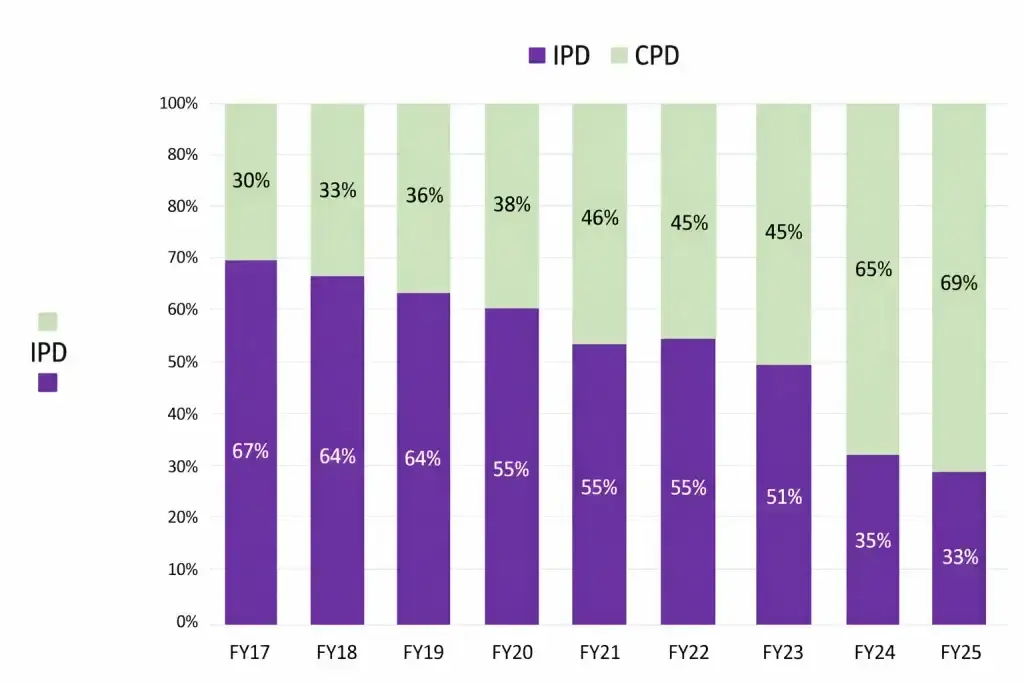
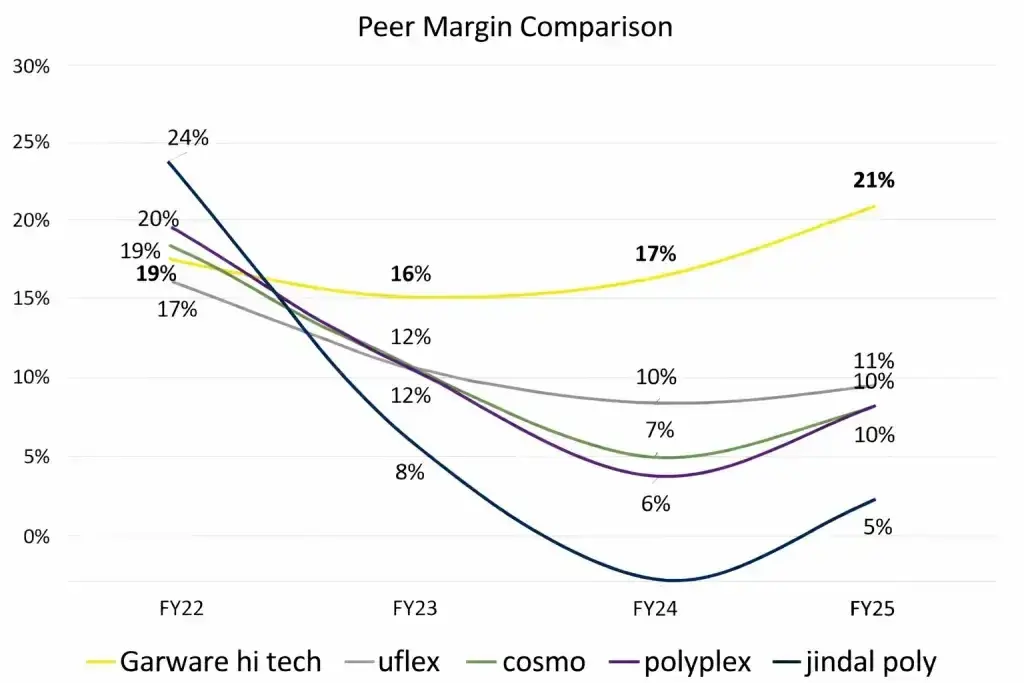
Garware became a stronger business as its products turned more profitable and its operations more focused. Early signs like improving margins, rising chemical revenues, and better management made investors see its future more clearly. As analysts and institutions took notice, demand for the stock increased, pushing its valuation and P/E higher along with the company’s growth.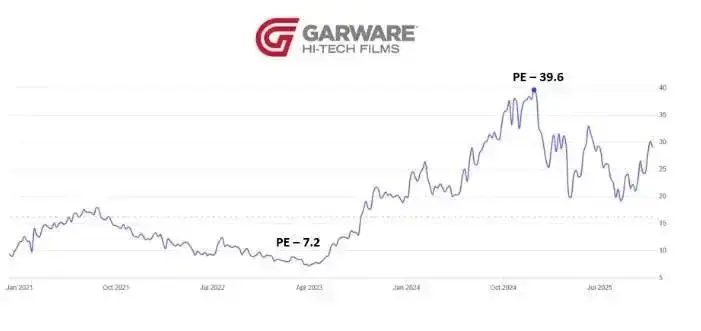
This illustrates how market inefficiencies in small-caps create opportunities for patient investors who identify hidden value early.
Royal Enfield: A Classic Case of Small-Cap Wealth Creation in India
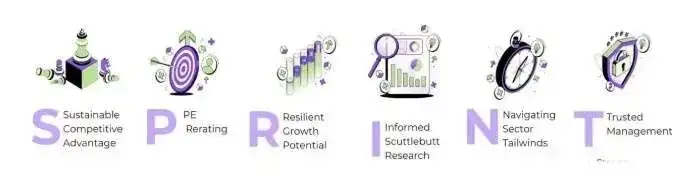
And to understand how this transformation really happened, let’s break it down using our SPRINT philosophyOver the years, we have developed a simple but effective philosophy to understand what truly makes a small or micro-cap company worth betting on. We call it SPRINT a lens that helps us identify businesses quietly building long-term strength long before the market assigns them value. And the best way to see SPRINT in action is through a real company that once looked ordinary, even unexciting, but eventually turned into a category leader.
Few stories capture this kind of transformation as clearly as Royal Enfield’s. Today it’s a global name, but two decades ago it was much closer to fading away than becoming iconic. That’s what makes the journey worth understanding. It shows how small beginnings, steady fixes, and patient execution can turn an overlooked company into a multi-decade compounder.
It also shows how a business can quietly build a sustainable competitive advantage through brand, community, and product focus long before the market catches on. The “thump” isn’t just a sound, it’s an identity.
“In investing, you don’t need many big winners. You just need a few, and you need to ride them fully.” — Rakesh Jhunjhunwala
Buy a Bullet for Rs 55,000 or buy shares of the company making it.
The bike would’ve rusted.
The shares would be worth Rs 4.75 crore today.
If someone had told you back in the 1990s that Royal Enfield would become the motorcycle brand that India loves the most and that people who invested a money in Royal Enfield would end up with a lot of money you would probably have not believed them. The truth is, Royal Enfield was in bad shape, at that time so it seemed like the company would shut down rather than get better. Royal Enfield was doing poorly and it seemed like there was no hope for Royal Enfield to survive.
Yet this old British brand, which India adopted back in 1949, went on to deliver one of the most impressive turnarounds in Indian business history. What makes the story special is that it wasn’t built on cutting-edge technology or big advertising budgets, but on something much simpler — a clear vision, bold decisions, and deep belief in a product with real character.
Before we break down Royal Enfield using SPRINT, you may want to understand the broader logic behind identifying multibaggers: The Multibagger Framework: A Step-by-Step Guide to Finding 10x Stocks
The Beginning: From Needles to Motorcycles
Royal Enfield’s history goes back to 1891, when two entrepreneurs took over a small needle manufacturing unit that had just started tinkering with bicycles and motorbikes. Ten years later, in 1901, the first Royal Enfield motorcycle rolled out, unknowingly launching a brand that would outlive empires.Within a decade, they built their first V-twin. When World War I erupted, their rugged machines were shipped to the British, French, Belgian, American, and Russian armies. Reliability became their identity. By the 1930s, Royal Enfield wasn’t just a motorcycle company anymore; it was a symbol. Eleven models, engines going all the way to 976cc, and in 1932 came the motorcycle that would define them forever: the Bullet.
After World War II, the company expanded aggressively and entered India through Madras Motors in 1949. The Indian Army soon placed an order for 500 Bullets, sealing a partnership that would shape the brand’s destiny. By 1956, production shifted to Chennai. By the 1970s, India was exporting Bullets back to the UK. In 1993, Enfield India even built the world’s only mass-produced diesel motorcycle.
The real turning point, however, came in 1994, when the Eicher Group acquired Enfield India.
Phase 1 Eicher Motors - A Company Without Direction
Before the turnaround, Eicher Motors was in over the place with about fifteen different businesses. Eicher Motors sold tractors, Eicher Motors sold trucks, Eicher Motors even sold footwear, garments, and components too. Eicher Motors was doing a bit of everything. But the thing is, Eicher Motors was not really good at any of these things; they were just okay. Everything was a mess the energy of Eicher Motors was spread thin and Eicher Motors did not really have a clear idea of what they were about.Royal Enfield was a problem. It lost money every year. The Royal Enfield bikes broke down a lot. Not many people wanted to buy Royal Enfield bikes. Young people who liked bikes did not like Royal Enfield. By the 1990s, the people at Eicher were thinking about closing down the part of the company that made Royal Enfield motorcycles.
Then in 2000, someone unexpected came forward: a 26-year-old man named Siddhartha Lal.
The Arrival of Siddhartha Lal — The Man Who Said No to 13 Businesses
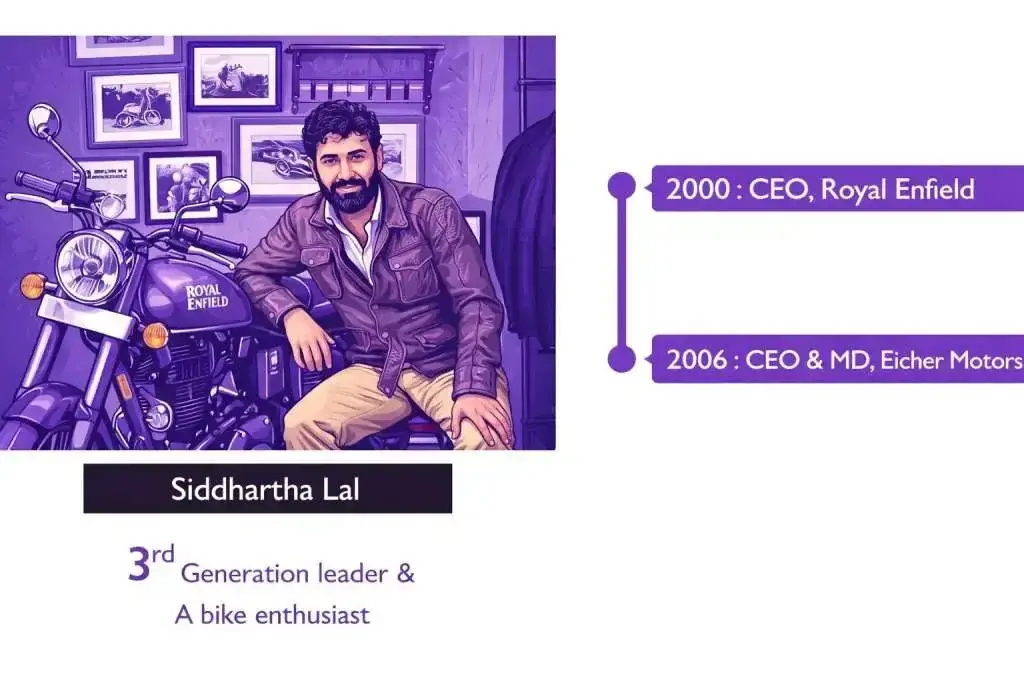
Most CEOs play it safe. Siddhartha Lal did the opposite.
When he took charge in 2000, he found a company trying to be everything at once. Eicher made shoes, clothes, tractors, components, gearboxes, motorcycles, and a dozen other things. But it wasn’t great at any of them.
Lal took a blank sheet of paper and asked a simple question:
“What can we become the best at in the world?”
The answer was obvious but bold: certainly not footwear, not clothing, not components, but maybe one thing… Royal Enfield motorcycles.
Great investments begin as uncomfortable ideas.” — Howard Marks
In 2006, he made the toughest call a young CEO could make. He shut down or sold off thirteen businesses and poured all the money, talent, and attention into just two divisions. People thought he was crazy. But that clarity unlocked the next chapter.
And this is exactly where smaller companies have an edge over large, established players. They can move fast, take tough calls, and shift focus without getting stuck in long approval cycles. That speed often becomes their biggest advantage.
“Deciding what not to do is as important as deciding what to do.” — Steve Jobs
Phase 2 (2000–2010): Fix the Motorcycle, Fix the Perception
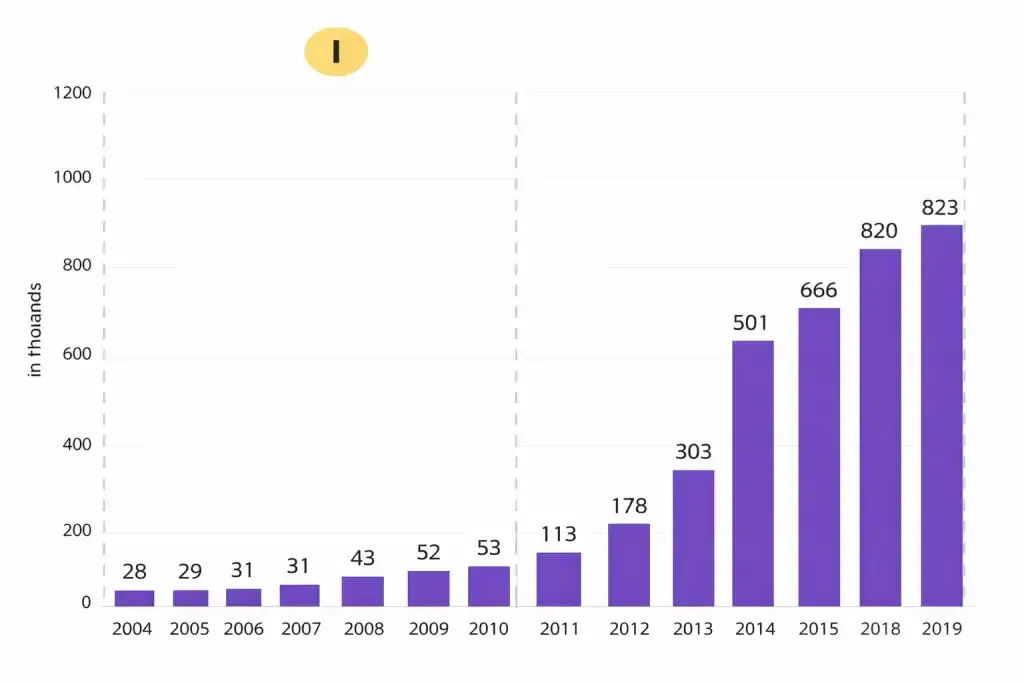
At the start of the 2000s, Royal Enfield bikes had a charm, but also a long list of problems. They leaked oil, vibrated heavily, needed constant tinkering, and had a right-side gear shift when the world had moved on. Emission norms were tightening and the old engines were simply outdated.
Sales reflected this. In 2005, they sold only 28,000 motorcycles. By 2010, barely 52,000.
Most young Indians saw Enfield as a bike for “older uncles,” not something to aspire to. The brand had heritage but no relevance.
Mr.Lal approached the problem like a rider, not a CEO. He got the engineering team to rethink the entire architecture of the bike. Gear shifts moved to the left. Engines were redesigned. Quality standards improved. Service networks expanded. And slowly, the old negatives began disappearing.
Then, in 2010, came the moment that changed everything the Royal Enfield Classic. It looked vintage, felt modern, and rode beautifully. It bridged nostalgia with practicality. And the market responded instantly.
The sleeping giant had woken up.
Phase 3 (2010–2019): When the Brand Took Off Like a Bullet
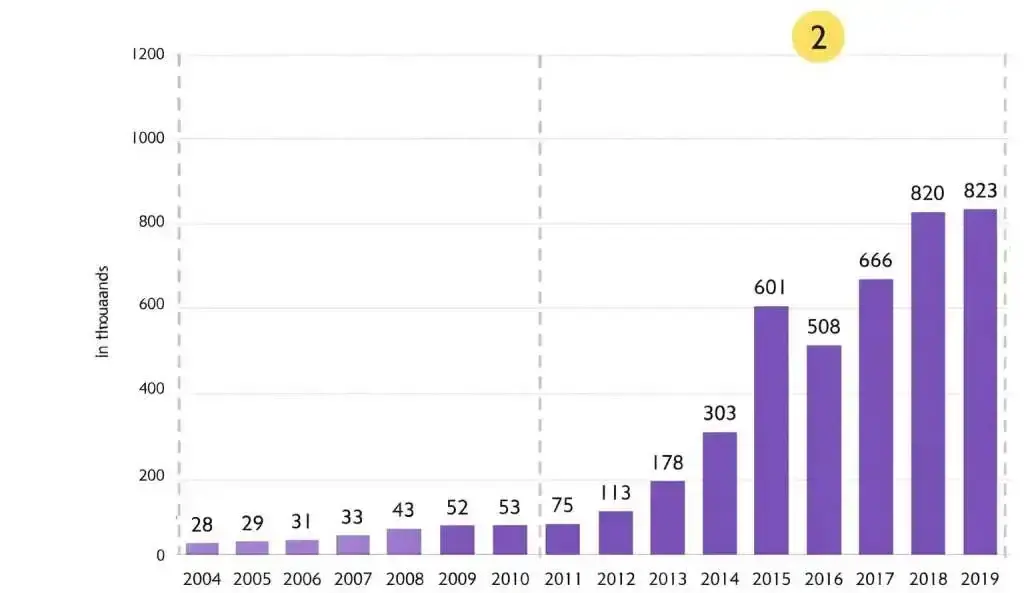
Once the Classic clicked, the company realized something important: India didn’t just want a motorcycle. It wanted identity. And Royal Enfield was perfectly placed to deliver that.
The next decade was about turning Royal Enfield from a niche heritage maker into a global mid-size motorcycle powerhouse.
The product line expanded, not randomly, but with a clear purpose. The Himalayan for adventurers. The Hunter for young urban riders. The Scram for light exploration. The 650 Twins for riders dreaming of premium machines. Every new launch added a fresh layer to the brand’s persona.
But the masterstroke wasn’t the motorcycles. It was the community.
Royal Enfield didn’t just sell bikes; it built a tribe. Rides like the Himalayan Odyssey, the Continental GT Cup, local Sunday meet-ups turned customers into storytellers. Word-of-mouth became their biggest marketing engine.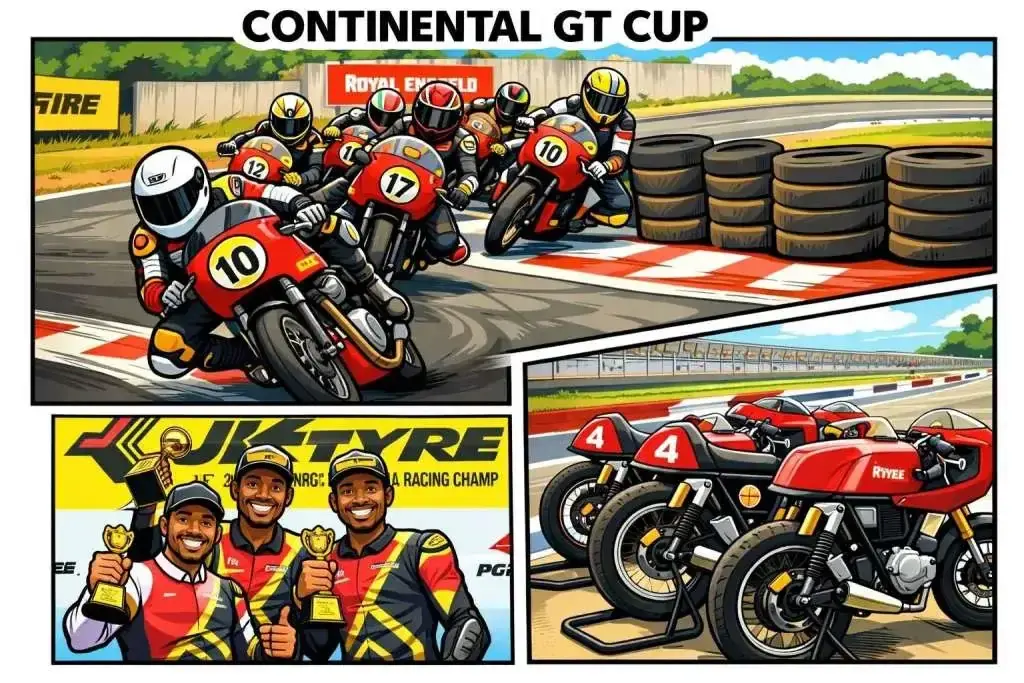

The distribution network exploded as well. From about 500 stores in 2015, they crossed over 1,500 by 2020. New formats like studio stores and vintage stores created unique buying experiences. The brand even extended into apparel riding jackets, helmets, merchandise, strengthening its lifestyle appeal.
Behind the scenes, operations had scaled dramatically. New plants at Vallam, Oragadam, and Cheyyar pushed production capacity past a million units. CAPEX shot up. Two global tech centers (one in Chennai, one in the UK) ensured design and engineering were world-class.
By 2018, Eicher Motors wasn’t just doing well it was soaring. Revenue crossed nine thousand crore. Profits touched two thousand crore. And that famous line became the talk of every investor circle:
“If you bought a Bullet in 2001, you’d have a bike.
If you bought Eicher shares instead, you’d be a millionaire.”
The stock had gone up almost a thousand times.
This wasn’t luck. It was the “Lollapalooza effect”: when many small, sensible decisions compound into a result that looks magical.
Time is the friend of great businesses.” — Warren Buffett
But Why Didn’t Competitors Beat Them?
For nearly two decades, Royal Enfield enjoyed the mid-size segment almost alone. The reasons were surprisingly simple.Honda stayed focused on commuters and scooters. Bajaj chased performance but not emotion. TVS strengthened its racing DNA, not retro charm. Mahindra misfired with Jawa and Yezdi. Harley came in strong but priced itself out of reach for most Indians.
They all underestimated one thing: The Indian rider didn’t want the fastest bike. They wanted a bike that made them feel something.
Royal Enfield delivered exactly that and at an accessible price.
When a Great Business Becomes a Great Investment
2010–2015: The golden window
Sales were compounding at nearly 63% a year, while the stock raced ahead at almost 89% a year.This was the phase when the company was scaling aggressively, competition was thin, and the market was only beginning to understand how big the opportunity could become.
It was that rare moment when the underlying business was exploding in size and the stock price was lifting in sync.
Anyone who entered during this stretch captured the entire curve of growth, rerating, and market recognition.
2020–2025: A strong company, but a different kind of investment
Sales grew at a steady 7.5% a year, and the stock delivered about 28% a year. The company was now much larger, growth was more predictable, and the market had already priced in a good part of its strengths.The business was still solid, but the “early multibagger” runway had naturally narrowed. As companies mature, growth slows, expectations rise, and the gap between business performance and stock returns becomes more reasonable.
During this phase, mutual funds and FIIs were finally able to enter, adding liquidity and stability, but also reducing the outsized upside that early investors enjoyed.
It shows a simple truth: the biggest rewards usually appear when growth is sharp and the market is still discovering the story. After that, the opportunity becomes steadier rather than spectacular.
The biggest wealth creation usually happens when a company is growing fast and the market is still waking up to its potential.
Once the business matures, it can remain great, but the investment opportunity becomes steadier rather than spectacular.
What We Should Learn From This
Royal Enfield’s journey shows what long-term value creation actually looks like. A company doesn’t need to chase trends or burn cash to scale. It needs clarity, patience, discipline, and the courage to stay true to what makes it special.Eicher didn’t win by being the fastest. It won by being the most focused.
From a struggling motorcycle maker to the global face of mid-size bikes, the story proves a simple rule:
great brands are built slowly, but the rewards for getting them right can last decades.
And for investors, the lesson is just as clear. You don’t need to find hundreds of ideas. You need to find the few companies that quietly strengthen their advantage long before the market recognises it.
Royal Enfield was one of those rare stories. The next one will look just as ordinary in the beginning.
Royal Enfield isn’t an isolated story. India has produced multiple such wealth creators. Studying past winners reveals repeatable patterns: Top Multibagger Stocks of the Last 10 Years – What We Can Learn
The Real Secret Behind the Turnaround
Here’s how the entire Eicher–Royal Enfield revival fits perfectly into our SPRINT philosophy:- S – Sustainable Competitive Advantage
Deep community, strong brand heritage, wide distribution, sticky identity, and an aftermarket ecosystem rivals can’t replicate. - P – PE Rerating
Years of low valuations followed by a major re-rating as reliability improved, demand soared, margins expanded, and category leadership became undeniable. - R – Resilient Growth Potential
Consistent volume growth, premium product mix, high ROCE, stable margins, rising exports, and diversified revenue beyond motorcycles. - I – Informed Scuttlebutt Research
Real on-ground signals: rising waitlists, fuller workshops, thriving riding clubs, strong word-of-mouth, and continuous customer engagement. - N – Navigating Sector Tailwinds
Premiumisation in India, adventure touring culture, younger aspirational buyers, Make-in-India cost advantages, and global interest in mid-size motorcycles. - T – Trusted Management
Disciplined capital allocation, clear brand understanding, thoughtful EV approach, transparent communication, and a long-term mindset.
Eicher Motors shows what truly drives long-term wealth. Small companies don’t become giants through luck; they do it by fixing what matters, finding a niche they can own, and compounding quietly while no one is watching. The SPRINT lens simply helps you notice these journeys earlier when the story is still small, but the potential is already big.
“Know what you own, and know why you own it.” — Peter Lynch
Associated Risks of Small and Micro Cap Stocks
Small-cap investing can be rewarding, but it comes with risks that you must understand before committing capital.- Volatility: Small-cap prices move sharply in both directions. Even normal market news can trigger large swings, which can be uncomfortable for investors who prefer steady returns.
- Low Liquidity: These stocks often have fewer buyers and sellers. Placing a large buy or sell order can move the price noticeably, and exiting during a market downturn can be difficult.
- Weaker Financial Stability: Many small companies are still building their business models and don’t have the balance-sheet strength of large firms. They may face pressure during slowdowns, struggle to raise capital, or take longer to return to profitability.
- Limited Information: Small-caps generally have less analyst coverage and fewer detailed disclosures. With fewer people tracking them, it becomes harder to judge management quality, competitive positioning, or the underlying strength of the business.
Most small-cap losses don’t happen because the idea was wrong — they happen because of avoidable behavioural mistakes: Common Mistakes Every Small-Cap Investor Makes (And How to Avoid Them)
Pro tip: Diversification is the key in small and micro-cap investing.
Small and micro caps are like early-stage saplings. Some grow into strong trees, some stay weak, and a few don’t survive at all. The problem is you never know which one will break out. Even the best research can’t eliminate every risk because these businesses often have:- concentrated promoters
- limited track record
- dependence on a few customers
- thin liquidity
- higher volatility
So the smartest way to play this space is to spread your bets.
A simple way to explain it:
If you hold one or two small caps, you’re gambling.
If you hold ten to fifteen, you’re investing.
You don't need every company to work. In this segment, one big winner can pay for a few average performers and still leave you with strong overall returns. Diversification lets you participate in the upside of the category without letting one mistake sink your portfolio
Explore our Products
Research Framework

Emerging Titans
Combination of quantitative analysis, industry tailwinds, and management assessment - SPRINT investment philosophy

Tiny Titans
Heavy emphasis on scuttlebutt research, plant visits, and early on-ground signals
Conclusion
Small and micro-cap investing is not about chasing volatility or short-term price moves. It is about recognising businesses that are quietly strengthening their foundations while the market is focused elsewhere. The strongest outcomes tend to emerge when growth is accelerating, competitive intensity is limited, and institutional participation is still light.Most small-cap losses don’t happen because the idea was wrong — they happen because of avoidable behavioural mistakes: Common Mistakes Every Small-Cap Investor Makes (And How to Avoid Them)
Comment “small and micro-cap investing” if you actively invest in this segment or if this article resonated with your approach. Comment which trait you prioritise most while analysing such businesses.
If this article helped you rethink how wealth is created in small and micro-cap stocks, consider sharing it with investors who value long-term business understanding over short-term noise. The most durable insights in this space are often shaped through collective experience and disciplined discussion.
FAQ’s
What exactly are small-cap and micro-cap stocks?
+Small-caps are companies ranked 251 to 500 by market cap in India. Micro-caps are beyond 500, often tiny, early-stage businesses. They are smaller, less discovered, and more volatile than large or mid caps.
Why do these stocks carry higher risk?
+Because the businesses are young, their earnings swing more, liquidity is thin, and the information flow is limited. Even small shocks in demand, regulation, or management can move the stock sharply. Yet this very uncertainty creates an opportunity. It allows deeper scuttlebutt, on-ground checks, and early research to uncover companies the market hasn’t noticed. That’s where the real edge lies.
Why do investors still prefer small and micro caps?
+They have more room to grow. Even a small improvement in revenue, margins, or market share can create meaningful compounding because the starting base is tiny.
What makes research more important in small-caps?
+Big institutions usually avoid early-stage companies due to size/liquidity limits.
This leaves mispriced opportunities.
Good scuttlebutt talking to distributors, customers, competitors gives you an edge that isn’t available in large-caps.
Why do small-caps fall harder during corrections?
+Because fewer buyers exist during panic.Low liquidity magnifies downside moves.
But the strongest companies recover fastest once fundamentals reassert.
How do I know if a small-cap can become big?
+Look for:
Large and expanding TAM
Unique product or niche
Strong unit economics
Improving ROCE
Management clarity
Clean balance sheet
Consistent execution
If the pond is huge and the fish is small, growth becomes easier.
How do I reduce the risk while investing in them?
+Stick to companies with:
A clear business model
Clean accounting
Promoter skin in the game
High ROCE/ROE
Low debt
Industry tailwinds
Consistent growth
Avoid companies that depend on one customer, one plant, or one product.

High growth stock specialist, Value Educator
Shashank Mahajan is an equity research professional with over 12 years of experience in identifying high-potential SME and micro-cap stocks at an early stage. He follows a rigorous scuttlebutt research–driven approach, combining on-ground insights with deep financial analysis. Shashank specializes in uncovering under-researched and under-owned companies with strong management quality and long-term growth potential. Through disciplined research and early identification, he focuses on spotting tomorrow’s market leaders before they enter the mainstream investor radar.

Glenmark: The USD 700 Mn Cancer Deal and Its Brands

Pharma Stocks in India 2026: Generics, APIs and CDMOs

Granules India: From Paracetamol to a 65% Gross Margin

Natco Pharma: After Revlimid, 29 Patent Challenges

Shilpa Medicare: Cancer APIs, Films and Biosimilars

Alembic Pharma: US Plants Pay Back, Margin Hits 22.2%
Explore our Products
Research Framework
Emerging Titans
Combination of quantitative analysis, industry tailwinds, and management assessment - SPRINT investment philosophy
Tiny Titans
Heavy emphasis on scuttlebutt research, plant visits, and early on-ground signals



Modern Warfare to Multibaggers
Key Trends. Strategic Shifts. Opportunities Ahead.
Don't Miss This Exclusive Webinar!
Join Value Educator to decode the key trends shaping India's defence sector and learn how to identify tomorrow's potential leaders in the space.
- In-depth research on India's defence sector
- Live Q&A session
- Actionable takeaways for long-term investors

 Orders
 Subscription
 Share with friends


Required Details
₹23999.00
(12 month subscription)
As per SEBI regulations, all users are mandated to complete the KYC that is validated for 1 year. Post payment, you will be redirected to the KYC screen


No comments yet. Be the first to comment!