
Tega Industries: Mill Liners and the Molycop Deal
On 1 June 2026, a Kolkata company that makes rubber and steel linings for mining mills took control of Molycop, a global maker of the steel balls that tumble inside those same mills. In FY26 the Kolkata company had revenue of ₹1,691.9 Cr. In the July to September quarter of 2026, the first full quarter with Molycop, its group revenue was ₹4,254.0 Cr. About 89% of that came from the new business.
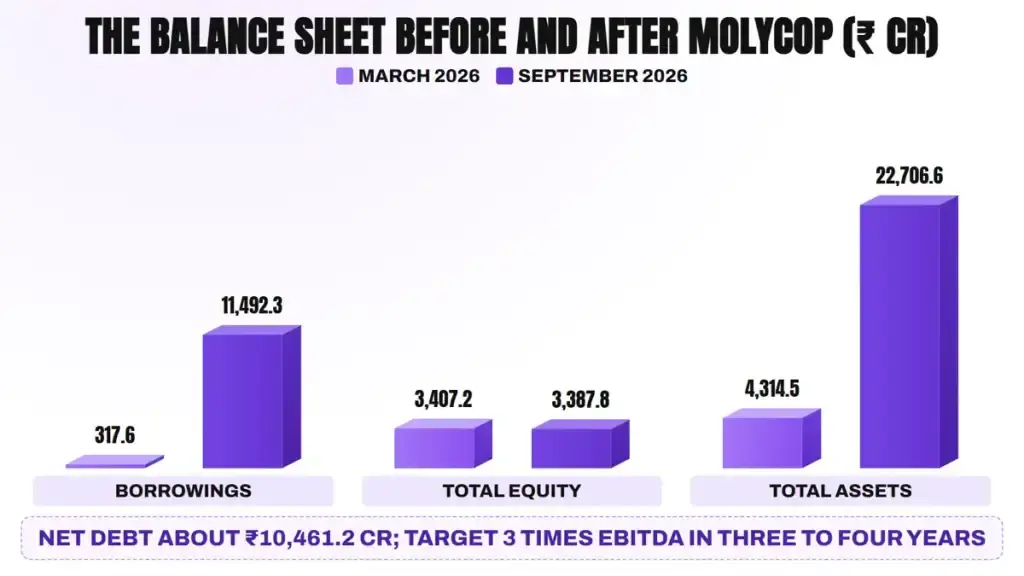
That deal changed the size of the company in one step. Total assets rose to ₹22,706.6 Cr in September 2026, from ₹4,314.5 Cr in March. Borrowings rose too, and net debt stood at about ₹10,461.2 Cr. So to understand this company today, we first need to see what a mining mill does, and why both businesses sell into it.
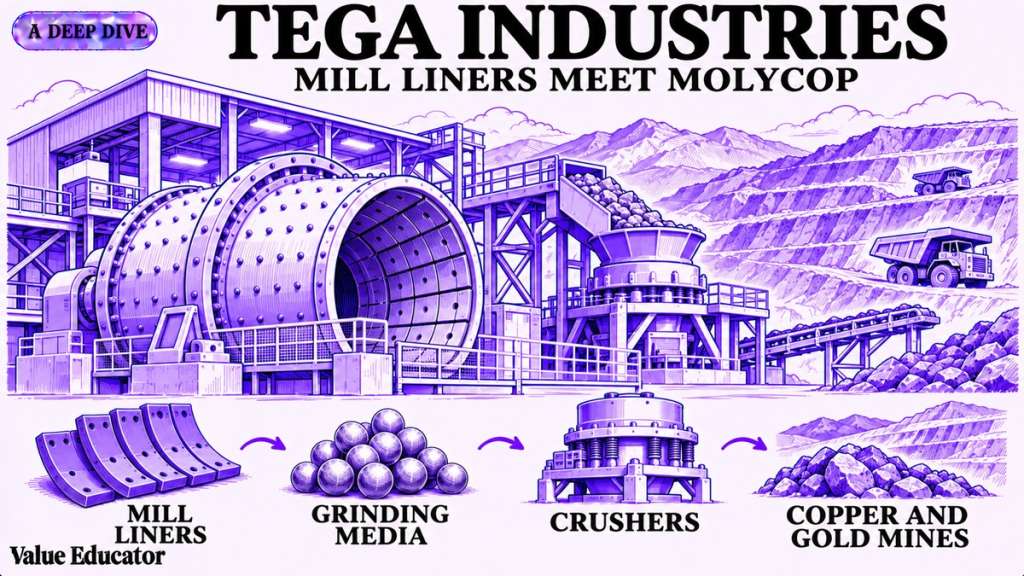
Most metal ore comes out of the ground as rock. Gold or copper makes up a tiny part of it. Before the metal can be pulled out, the rock has to be crushed and then ground into a fine powder. This step is called comminution, which means breaking ore into smaller and smaller pieces. It takes place in giant rotating drums called grinding mills.
So inside such a mill, two things wear out all the time. A mill liner is the thick lining of rubber, steel or both that covers the inside wall of the drum and protects the steel shell. Grinding media refers to the steel balls or rods that tumble with the ore and do the actual grinding. Both are eaten away by the rock, so a mine has to replace them again and again for as long as the mill runs.
That makes them aftermarket products. Aftermarket refers to the spares and consumables a customer keeps buying after the main machine is installed. The company says that over the life of a mill, a miner spends about three times as much on such aftermarket items as on the mill itself.
That Kolkata company is Tega Industries Ltd (NSE: TEGA). It makes mill liners, screens, hydrocyclones, conveyor parts and other wear products, with 6 plants in 4 countries and customers in more than 92 countries. Through Tega McNally, bought in 2023, it also makes crushers, mills and other equipment in India. And through Molycop, it now makes grinding media at 15 facilities in 9 countries.
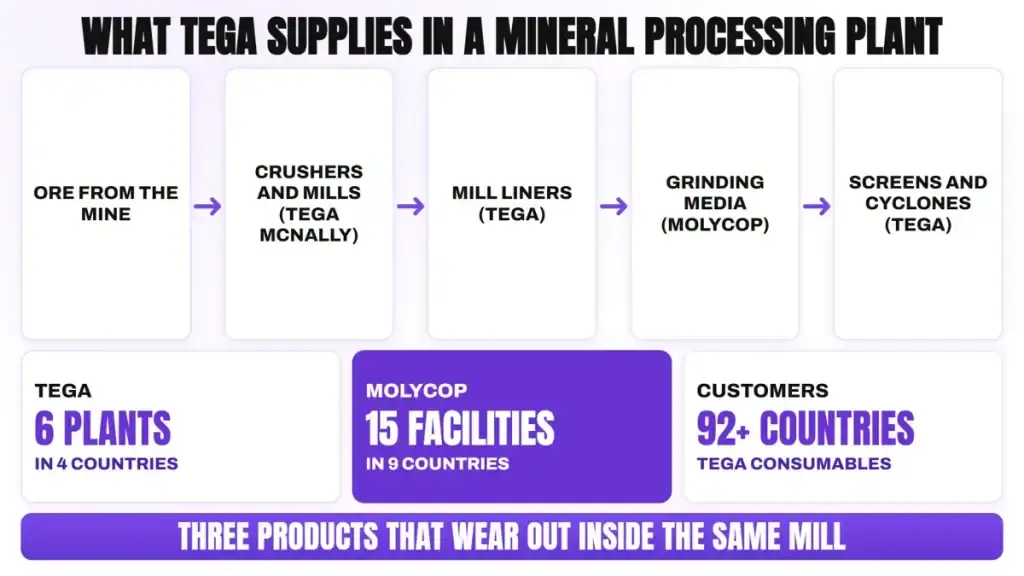
So Tega now sells three things into the same plant: the machines, the linings that protect them, and the steel balls that do the grinding. Each of them wears out at a different pace, and each brings a different margin.
Tega Industries in five numbers
- Q2 FY27 group revenue of ₹4,254.0 Cr, with Molycop for the full quarter
- Legacy revenue of ₹482.5 Cr, up 19%, its highest for a second quarter
- An order book of ₹1,397.6 Cr outside grinding media, up 21% from a year ago
- Molycop bought for ₹4,242.2 Cr, or $442.7 million
- Net debt of about ₹10,461.2 Cr in September 2026
So a business that earned ₹1,691.9 Cr in all of FY26 now reports more than twice that in a single quarter. How did the first full quarter look? Let's first understand the company, and then look at the latest numbers.
Tega Industries: Company Overview
Tega Industries Ltd is based in Kolkata, West Bengal, and has built its brand since 1976; it began operations in India in 1978 in collaboration with Skega AB of Sweden. Madan Mohan Mohanka is the founder and chairman, and Mehul Mohanka is the Managing Director and Group CEO. Tega makes mill liners, screens, trommels, hydrocyclones, conveyor and wear parts for mineral processing plants, with 6 plants in 4 countries and customers in more than 92 countries. Its equipment arm, Tega McNally Minerals, makes crushers, mills and screens at 4 plants in India, and since 1 June 2026 Tega has controlled Molycop, a maker of grinding media with 15 facilities in 9 countries. It listed on the NSE and BSE in 2021. Revenue from operations was ₹1,691.9 Cr in FY26, and group revenue was ₹4,254.0 Cr in Q2 FY27, the first full quarter with Molycop, when net debt stood at about ₹10,461.2 Cr. Read this Elecon Engineering: Gearboxes and ₹1,635 Cr of Orders
"Know what you own, and know why you own it."
— Peter Lynch
Tega today is three businesses under one name: mill liners, grinding media and equipment. Each earns a different margin, so knowing which one drives the numbers is the first step to reading its results.
The First Full Quarter With Molycop
Let's look at Q2 FY27, the July to September quarter that Tega reported on 5 November 2026. It is the first quarter with all three months of Molycop. The quarter before had only June, because the deal closed on 1 June 2026.

As we can see, the group numbers are now a mix of two very different businesses. Molycop brought in ₹3,771.6 Cr of revenue in the quarter, or about $396 million. Its adjusted EBITDA was ₹514.4 Cr, or about $54 million, at a margin of 14%. The legacy Tega business, which means the mill liners and other consumables plus the equipment arm, brought in ₹482.5 Cr.

As you can see, that legacy business had a good quarter on its own. Revenue rose 19% to ₹482.5 Cr, its highest for any second quarter, and 11% above Q1 FY27. Adjusted EBITDA rose 11% to ₹93.7 Cr, at a margin of 18.8%. The gross margin, the share of revenue left after the cost of materials, stayed at about 60%.
Within that legacy business, consumables did most of the work. Consumables revenue rose 26% to ₹420.9 Cr, and its EBITDA rose 28% to ₹90.5 Cr. Equipment revenue was ₹61.5 Cr. That was 72% higher than the ₹35.8 Cr of Q1 FY27, and the arm moved back to a positive EBITDA.
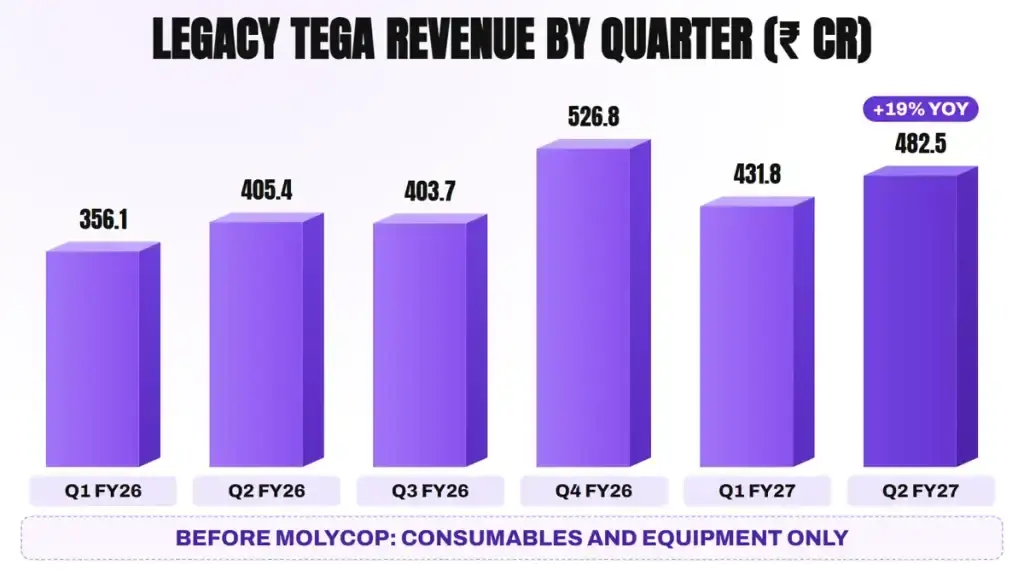
That chart shows the legacy business on its own, before Molycop. Revenue was ₹356.1 Cr in Q1 FY26 and ₹405.4 Cr in Q2 FY26. It reached ₹526.8 Cr in Q4 FY26, as orders that had moved out of Q3 were shipped. Since then it has been ₹431.8 Cr and ₹482.5 Cr. In a business that ships to mines on their own timetables, one quarter can move a lot.
Now let's go below the EBITDA line, where the deal changed the picture more. Read this EBITDA Explained: Uses and Limits Finance cost was ₹291.9 Cr in the quarter, against ₹5.8 Cr a year ago. This includes a dividend on redeemable preference shares at Molycop, which the accounting rules treat as interest. Tax was ₹131.7 Cr on a profit before tax of ₹72.9 Cr, because some costs were not allowed for tax in some countries. Management expects the tax rate to come back to normal in the coming quarters.
Then there are the deal costs. Tega spent ₹66.6 Cr on one-time acquisition costs in Q2 FY27, against ₹191.0 Cr in Q1 FY27. It also booked a one-time charge of ₹11.7 Cr for raising the value of Molycop's inventory on the books, which has no cash effect. So the reported loss after tax was ₹58.8 Cr, while the adjusted loss, before these items, was ₹9.5 Cr. Management says H1 was the last half with such one-time costs, and that Q3 onwards will be business as usual.
The first half shows the same pattern at a larger scale. H1 FY27 group revenue was ₹5,977.5 Cr. For the legacy business, revenue rose 20% to ₹914.3 Cr, its highest for any first half. Adjusted EBITDA rose 25% to ₹194.9 Cr, at a margin of 20.4% against 19.7% a year ago. Consumables revenue rose 30% to ₹811.7 Cr, with EBITDA up 42% to ₹191.6 Cr and a margin of 22.4%. For the group, the reported loss after tax was ₹167.0 Cr, while adjusted profit after tax was ₹45.2 Cr.
"Our core business delivered its highest-ever first-half revenue, with healthy double-digit growth in both revenue and EBITDA." - Mehul Mohanka, Managing Director and Group CEO, November 2026
The Order Book Outside Grinding Media
Now let's look at the orders, because they show how much of the coming legacy revenue is already booked. Tega reports an order book for its consumables and equipment business, which means confirmed orders that it has not yet delivered. It does not report one for grinding media, where mines buy steel balls on running supply contracts.
At the end of September 2026, that order book stood at ₹1,397.6 Cr. It was 14% higher than the ₹1,231.3 Cr of June, and 21% higher than a year earlier. Of this, ₹1,157.6 Cr can be delivered within the next 12 months.

That book has more than doubled in two and a half years. It was ₹632.0 Cr in March 2024, ₹1,029.2 Cr in March 2025 and ₹1,206.0 Cr in March 2026. In FY26, orders for both spares and new liner fittings moved towards the end of the year, so the March 2026 book was 18% higher than a year before. Those orders are now turning into the revenue we saw in H1 FY27.
What the order book says: ₹1,157.6 Cr of orders can be delivered within 12 months. That is more than the ₹914.3 Cr of legacy revenue in all of H1 FY27. The equipment arm also won a ₹126.0 Cr order in the half, to be delivered over 14 months.
That visibility matters most for the equipment arm. Equipment orders are large projects, and revenue comes only when the customer clears the machine for shipping. We will come back to this in the section on the next two years.
How a Kolkata Liner Maker Became a Global Mining Supplier
To see how Tega reached this point, let's go back to its start. Tega began operations in India in 1978 in collaboration with Skega AB of Sweden, a maker of rubber mill liners. The founder and chairman is Madan Mohan Mohanka, and Mehul Mohanka, also a promoter, is the Managing Director and Group CEO. Over the years the family bought out the Swedish partner's stake, and Tega built its own designs.
Those designs then went abroad. Tega set up or bought plants close to the large copper and gold mines in Chile, South Africa and Australia. In 2018 it launched DynaPrime, a liner that combines rubber and steel in one piece. The company describes itself as the world's second-largest maker of polymer-based mill liners by revenue. It listed on the NSE and BSE in 2021.
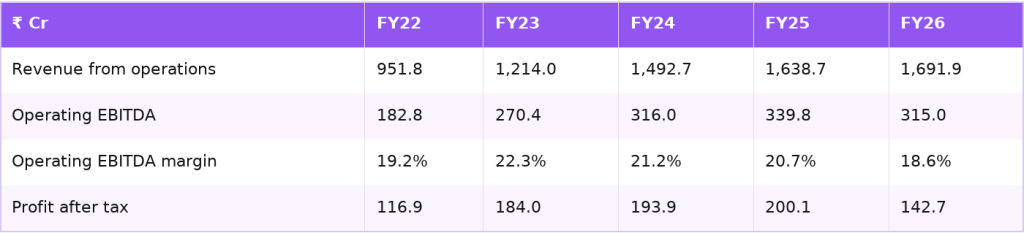
That operating EBITDA excludes other income, as the older decks showed it. For FY26 it is before ₹83.9 Cr of one-time costs for the Molycop deal and India's new labour codes.
That table shows a steady business. Revenue grew from ₹951.8 Cr in FY22 to ₹1,691.9 Cr in FY26, or about 15.5% a year. The operating EBITDA margin stayed close to 20% for most of that time. About 78% of FY26 revenue came from outside India, and no single customer made up 10% or more of revenue.
Still, FY26 itself was a quieter year. Revenue grew 3.3%, as consumables stayed flat at ₹1,434.0 Cr and equipment grew 24.6% to ₹268.8 Cr. Management says customers moved orders for both spares and new liner fittings to the end of Q3 and Q4. Reported profit after tax was ₹142.7 Cr, after the one-time costs. Before them, it was ₹226.6 Cr.
Besides liners, Tega also added an equipment arm through an acquisition in India. In 2023 Tega bought McNally Sayaji Engineering, now called Tega McNally Minerals, through the insolvency process. It was Tega's first acquisition in India and its fourth worldwide. Tega McNally makes crushers, mills, screens and feeders, the machines into which Tega's liners and screens are fitted.
After that came Molycop, the largest step by far. Tega announced its plan to buy Molycop on 10 September 2025, and signed the final agreements on 28 November 2025, in partnership with Apollo funds as a minority investor. In February 2026, management said Tega's stake had been raised to 84%. The deal closed on 1 June 2026, for a purchase consideration of ₹4,242.2 Cr, or $442.7 million, for the controlling stake.
To pay for it, Tega raised equity first. In November 2025 it issued 85,92,206 new shares at ₹1,994 each to promoters and other investors, raising about ₹1,713.3 Cr. It also took about ₹1,500 Cr of loans at the parent level, and it took on Molycop's own debt of about $838 million.
Three Segments After the Molycop Deal
Now let's look at the business line by line. Since the deal, Tega reports three segments, and here is how they compared in H1 FY27, which has four months of Molycop and six months of the legacy business.
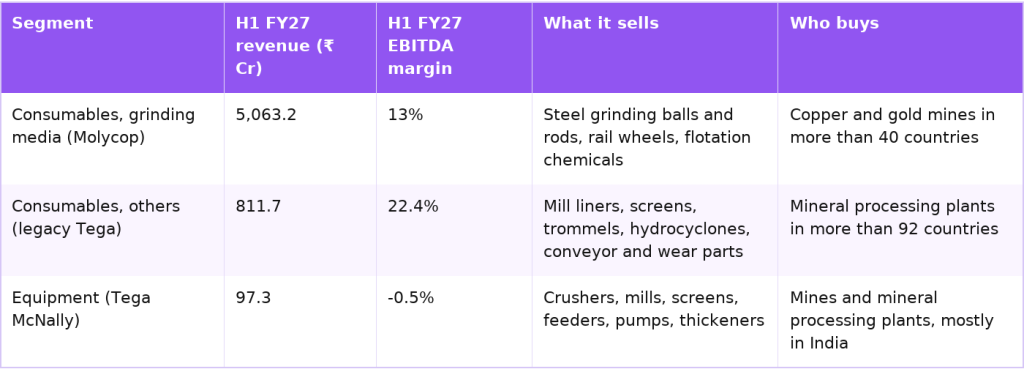
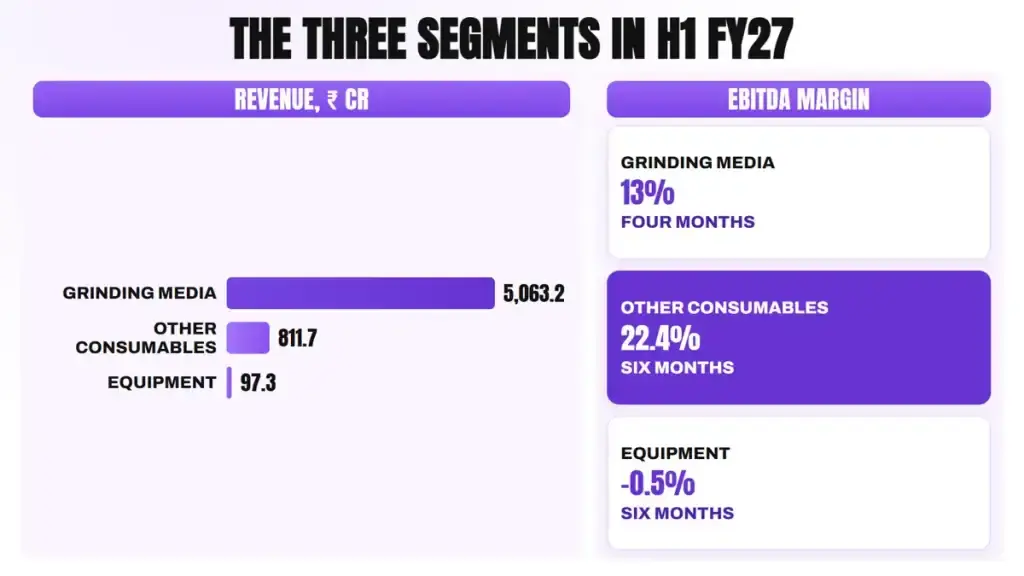
As we can see, the three segments are very different in size and margin. Grinding media is the largest by far, at a margin close to 13%. Mill liners and other legacy consumables earn more than 20%. The equipment arm is the smallest and was close to breakeven in H1 FY27.
Mill Liners, Screens and Wear Parts
So let's start with the business Tega built itself. Its consumables range covers mill liners in rubber, steel and both, screens and trommels that sort ground ore by size, hydrocyclones that separate fine particles from coarse ones in a slurry, and conveyor parts. Each one is made to fit a particular mill.
That design work is what keeps customers. The company says about 75% of its orders over three years were repeat orders. Gold and copper mines bring in about 75% to 77% of this revenue, and most of it comes from outside India. Consumables revenue was ₹1,434.0 Cr in FY26, and in H1 FY27 it grew 30% to ₹811.7 Cr.
You can also see that those consumables earn the best margin in the group. Their EBITDA margin was 22.4% in H1 FY27, against 20.5% a year earlier. Management guides growth of about 15% a year for this segment.
Grinding Media From Molycop
Next comes Molycop, which now makes up most of the revenue. Molycop started as a steel maker and now makes grinding media, rail wheels and flotation chemicals, with 13 manufacturing facilities and 2 joint ventures. It serves more than 400 mines across 40 countries, and South America, the largest copper region in the world, is where it sells the most.
As we will see, its numbers are large but thin in margin. Molycop's revenue was about $1,539 million in its previous year. For the four months from June to September 2026, it shipped 415.6 thousand tonnes of grinding media, and its revenue was ₹5,063.2 Cr with an adjusted EBITDA of ₹677.2 Cr. Management tracks this business by EBITDA per tonne, not by margin, because steel scrap prices move the selling price. Last year it averaged about $155 a tonne.
We should note that this steel link runs through the whole business. Steel bar is about 80% of Molycop's cost of goods, and its contracts pass changes in steel and scrap indices to customers with a time lag. So when steel prices rise, revenue rises too, but the margin as a share of revenue can look lower.
Equipment From Tega McNally
Then we come to the equipment arm, the smallest of the three. Tega McNally has four plants in India, at Vadodara, Bengaluru, Asansol and Kumardubi. It grew revenue 24.6% to ₹268.8 Cr in FY26, and its EBITDA margin rose to about 13%.
But H1 FY27 was harder for this arm. Revenue was ₹97.3 Cr, against ₹135.0 Cr a year ago, because customers had not yet given clearance to ship machines that were ready. Q2 FY27 revenue of ₹61.5 Cr was well above Q1, and management expects a strong Q3 and Q4. It has also lowered its growth goal for this arm for FY27 to 15%, from 25%.
Where Tega Sits in the Mining Value Chain
Now let's place Tega in the wider mining chain. A mine digs out rock, crushes it, grinds it into powder in a mill, and then separates the metal from the waste. Tega McNally makes crushers and mills for the first steps. Legacy Tega makes the liners, screens and hydrocyclones used in grinding and sorting. Molycop makes the steel balls that do the grinding.
For us, the key point is that this chain is driven by the amount of ore that mines process, more than by the number of new mines. A new mill is bought once, but its liners and grinding media are bought again and again over its life. As ore grades get lower, mines have to grind more rock to get the same amount of metal. Management says this raises the demand for grinding consumables.
Copper and gold are the two metals that matter most here. Management expects copper demand to grow about 4.8% a year through FY30 and gold about 2.2%, a blended market growth of nearly 3%. It also points to an industry projection that copper demand will rise by more than 40% by 2040, as electrification, power grids and AI infrastructure use more of it.
Those metal prices also give miners room to run their mills hard. In November 2026 copper was around $14,500 a tonne, after highs above $14,800. Gold traded around $4,000 to $4,100 an ounce. When metal prices are high, miners focus on keeping their mills running at full throughput, and that uses up liners and grinding media faster.
That is also why the cross-selling plan matters. Tega sells liners to many mines that buy grinding media from someone else, and Molycop sells grinding media to mines that buy liners elsewhere. Four months after the deal, Molycop made a first trial supply of 500 tonnes of grinding media to a Tega liner customer. If it passes the trial, management says it could become a supply of up to 30,000 tonnes a year.
"It is an early proof of our cross-selling strategy, offering our combined portfolio to customers who already trust the Molycop and Tega brands." - Mehul Mohanka, Managing Director and Group CEO, November 2026
Why Tega's Moat Is Hard to Copy
Now that we have seen the parts, let's understand the moat. A rubber liner looks like a simple product. So the question is why a mine should keep buying it from Tega, and not from a cheaper local maker. Read this Economic Moat Explained
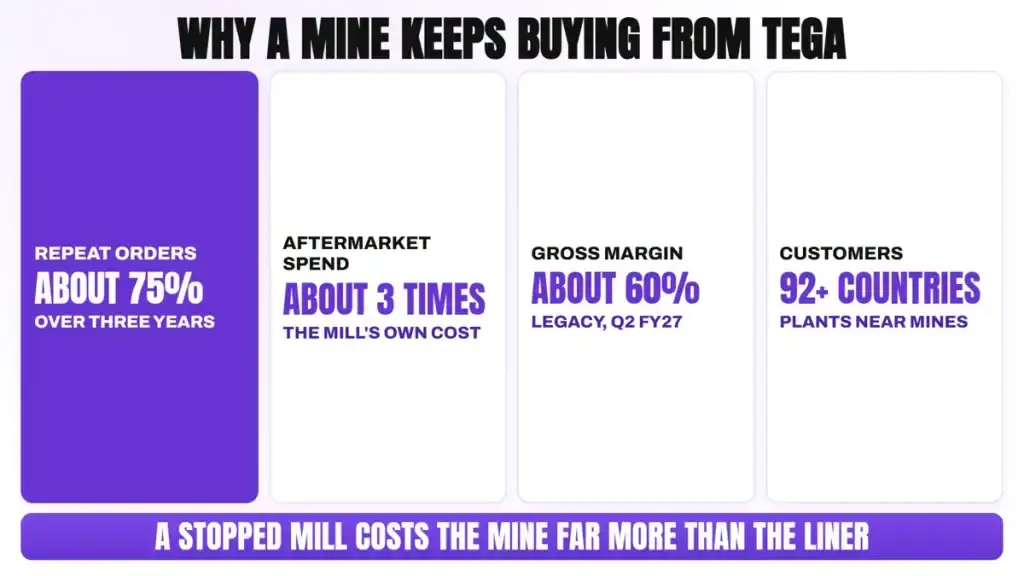
Part of it is the cost of a stopped mill. A large grinding mill is the heart of a mineral processing plant. If a liner wears out early or cracks, the mill has to stop, and the whole plant loses output for every hour it is down. So a mine cares more about how long the liner lasts and how fast it can be changed than about its price.
Another layer is site-specific design. Tega designs each liner for one mill and one kind of ore, after a plant audit at the site. The design then goes through the customer's own testing and approval before a full order. A new supplier has to go through the same process, mill by mill.
Over time, we see that this process builds a long record.
"In business, I look for economic castles protected by unbreachable moats."
— Warren Buffett
For Tega, the moat is the cost of a stopped mill. A mine that trusts a liner design for years has little reason to test a new supplier on its most important machine. The company says about 75% of its orders over three years were repeat orders, and in several cases its ties with key customers go back more than ten years. With plants in Chile, South Africa and Australia, it can also supply quickly to the largest copper and gold regions.

On top of this, Molycop adds a second layer of scale. Grinding media is a heavier, more commodity-like product, but Molycop's 15 facilities near the mines matter a great deal when each tonne is costly to ship. Together, the two can offer a mine a combined package of liners and grinding media, which is what the 500-tonne trial tests.
Why Return on Capital Looks Low Right Now
Now let's look at returns, because that moat shows up in margins but not yet in returns. Return on capital employed, or ROCE, means the operating profit a company earns for every rupee of equity and debt it uses. On our own arithmetic, using profit before tax plus finance cost against equity, debt and deferred tax, Tega's consolidated ROCE was about 18.6% in FY23, 19.4% in FY24 and 17.2% in FY25. In FY26 it was about 6.0%.
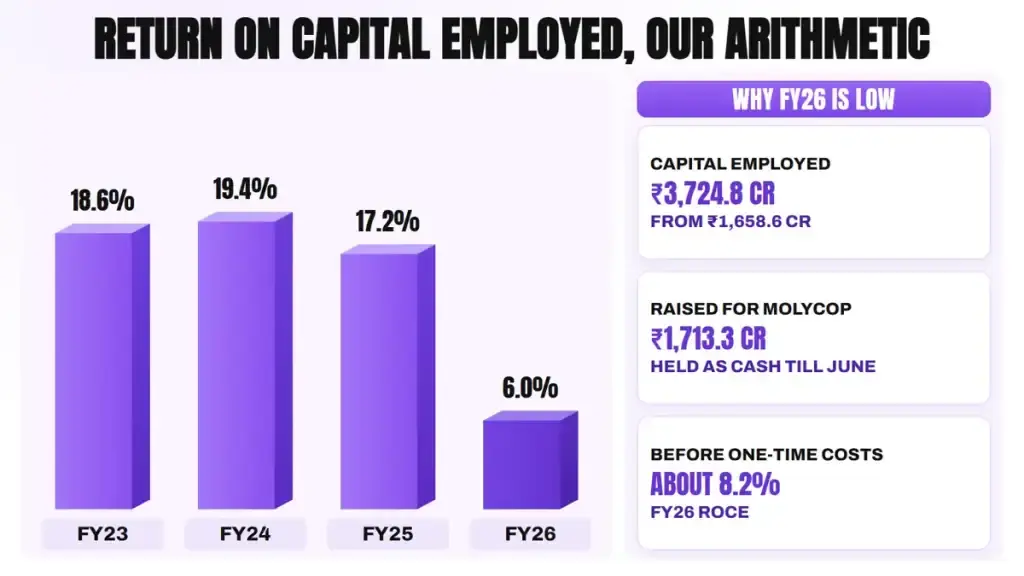
So what changed in FY26? Capital employed rose 224.57% to ₹3,724.8 Cr in March 2026, from ₹1,658.6 Cr a year earlier. That rise included the ₹1,713.3 Cr raised through the share issue for Molycop, and this money sat in cash and bank deposits until the deal closed in June. The FY26 profit also carried ₹83.9 Cr of one-time costs. Before those costs, ROCE was about 8.2%.
That was only the first step. After the deal, the balance sheet now carries ₹5,132.9 Cr of goodwill and ₹3,479.6 Cr of other intangible assets in September 2026. These come from paying more than the book value of Molycop's plants and stock. Molycop also earns a lower margin on each rupee of sales than Tega's own consumables, at about 14% against more than 20%.
Then the equipment arm adds to the drag. Its segment assets were ₹315.4 Cr in March 2026, while its segment result was ₹34.0 Cr for FY26. In H1 FY27, the arm was close to breakeven. So two of the three businesses earn less on their capital than the original liner business.
The Debt That Came With Molycop
Now let's look at the debt, because it decides how fast returns can recover. Gross borrowings were ₹11,492.3 Cr in September 2026, against ₹317.6 Cr in March. About 96% of this, or ₹11,034.6 Cr, is long-term debt. With cash, bank balances and liquid investments of about ₹1,031.1 Cr, net debt was about ₹10,461.2 Cr.
As you can see, that debt is large next to the profits so far. Net debt was about 3.1 times the group's equity of ₹3,387.8 Cr. Read this Debt to Equity Ratio Explained On the Q2 FY27 adjusted EBITDA of ₹608.1 Cr a quarter, net debt was about 4.3 times a full year's EBITDA. Management aims to bring this to 3 times within three to four years.
"When you combine ignorance and leverage, you get some pretty interesting results."
— Warren Buffett
Tega has taken on leverage knowingly, with a stated target and a plan to sell non-core assets. The next few quarters will show whether cash flow keeps pace with that plan.
So how will Tega get there? It has three levers. It plans to sell non-core assets over 12 to 18 months and use the money only to cut debt. It plans to free up working capital, mainly inventory, which stood at ₹5,543.2 Cr in September 2026. And it expects about $20 million of cost savings at Molycop over two to two and a half years. In October 2026 it also repaid ₹100 Cr of a term loan at Tega from the proceeds of a share issue.
Financials: Five Years Before Molycop
Before the Molycop deal, Tega was a steady business with little debt, so let's look at its full years first. Operating EBITDA here excludes other income, as the older decks showed it, and FY26 is shown before ₹83.9 Cr of one-time costs.
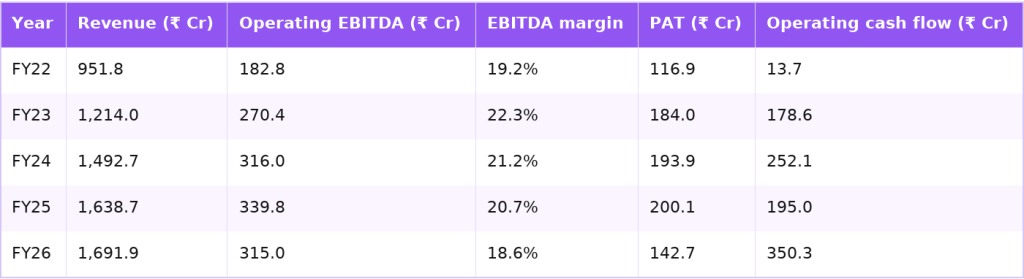
Revenue grew from ₹951.8 Cr in FY22 to ₹1,691.9 Cr in FY26, or about 15.5% a year, and the operating EBITDA margin stayed close to 20% for most of that time. FY26 was the slow year: revenue grew 3.3%, and reported profit after tax came down to ₹142.7 Cr after the one-time costs for Molycop and the new labour codes.
Cash flow kept up with profit over the five years. Operating cash flow added up to about ₹989.8 Cr from FY22 to FY26, against about ₹837.6 Cr of profit after tax, or about 118%. It was only ₹13.7 Cr in FY22, when working capital took up a lot of cash, and it rose to ₹350.3 Cr in FY26 as working capital was released.
The balance sheet is where the change shows. In March 2026 the net debt-equity ratio was 0.09. After Molycop, net debt was about ₹10,461.2 Cr in September 2026. Operating cash flow was ₹712.6 Cr in H1 FY27, and that cash now has to service a much larger debt.
"Take a simple idea and take it seriously."
— Charlie Munger
The simple idea in Tega's numbers is that liners and grinding media are bought again and again. Whether that recurring cash can pay down the new debt is the question the next two years will answer.
What the Next Two Years Could Look Like on Management's Numbers
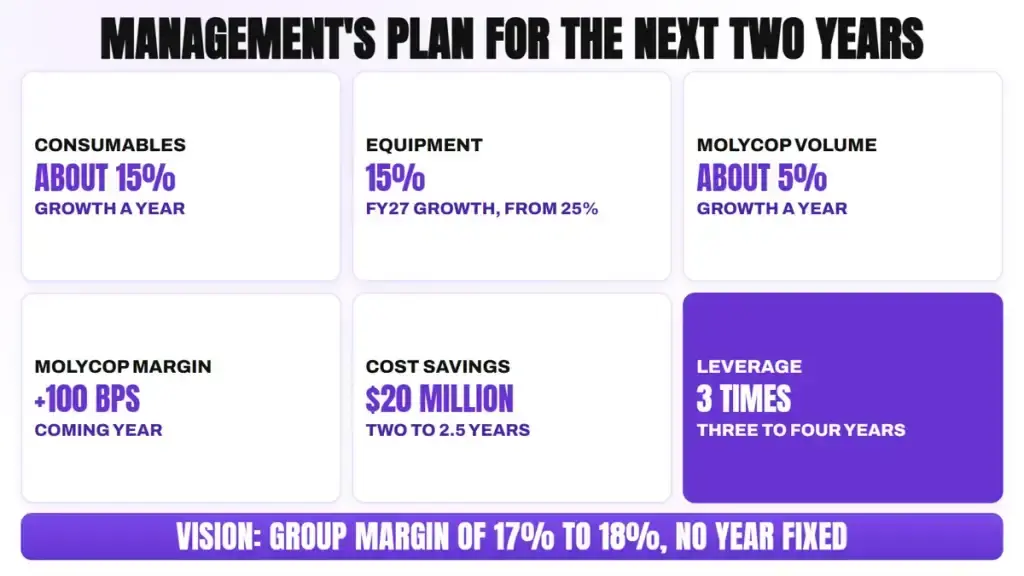
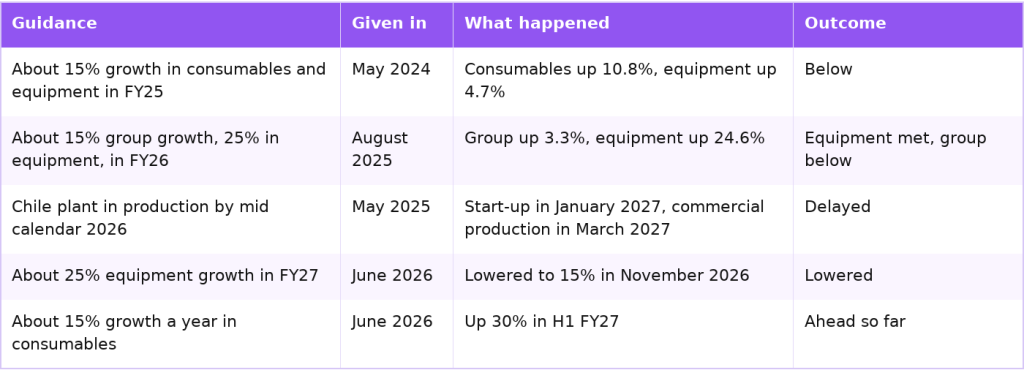
So what has management promised from here? Let's put its own numbers side by side. For legacy consumables, it guides growth of about 15% a year. For equipment, it now expects 15% growth in FY27, down from 25%. For Molycop, it keeps a volume growth plan of about 5% a year, with EBITDA per tonne broadly flat in the near term.
Next, let's look at margins, the other lever. Management expects Molycop's margin to rise by about 100 basis points in the coming year, from four steps: a global capability centre, moving a headquarters to a lower-cost base, lower selling and general costs, and better plant efficiency. For the group, the Managing Director said the 14% consolidated margin should keep moving up, with a vision of 17% to 18% over time. He did not tie it to a year.
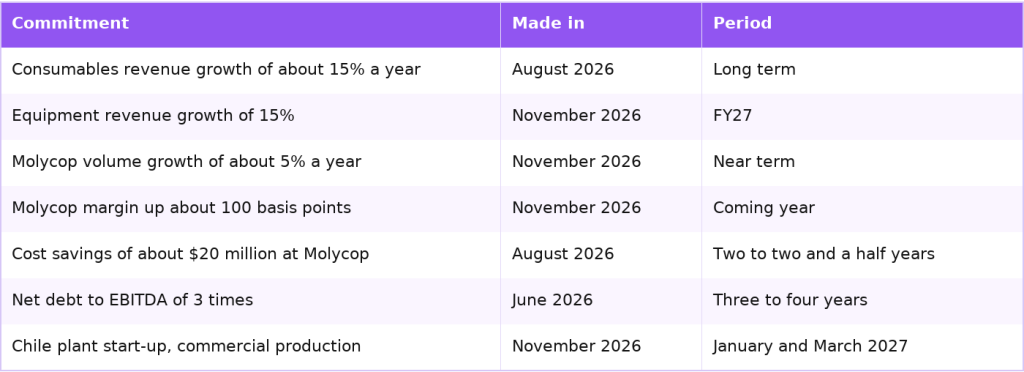
So far, the record on guidance is mixed. Here is how earlier promises compared with what happened.
Here we should add a word on the Chile plant. It is a $30 million to $35 million project. Management does not expect extra revenue from it, because it is built to meet Tega's own plant needs for the next four to five years.
Key Risks
Any company that grows through a large debt-funded deal carries real risks. Here are the main ones for Tega.
- High debt: net debt was about ₹10,461.2 Cr in September 2026, about 4.3 times the Q2 FY27 EBITDA run rate. Finance cost was ₹291.9 Cr in Q2 FY27 alone. If profits grow slower than planned, the 3 times target could take longer.
- Integration: Molycop is far larger than Tega, with its own plants, people and systems in many countries. The $20 million of cost savings and the cross-selling plan are still early. A first trial of 500 tonnes is not yet a contract.
- Two large mines: the Grasberg mine in Indonesia ran at about 67% of its normal throughput after a mud rush in September 2025, and Cobre Panamá is processing only stockpiles. The deal also includes extra payments to the former owners if these mines return to normal. Management says these are not yet triggered.
- Steel and scrap prices: steel bar is about 80% of Molycop's cost of goods. Contracts pass on price changes with a lag, so a sharp rise in steel prices can squeeze the margin for a few quarters.
- Lower returns for some years: goodwill and intangibles of more than ₹8,600 Cr, plus a lower-margin product, keep ROCE far below the earlier levels of about 17% to 19% until debt comes down.
- Equipment delays: equipment revenue was ₹97.3 Cr in H1 FY27, against ₹135.0 Cr a year earlier, and the FY27 growth goal was lowered to 15%. Large projects depend on customer clearances.
- Tax and accounting items: tax was ₹131.7 Cr in Q2 FY27 on a profit before tax of ₹72.9 Cr, after some costs were not allowed. Tega also carries a ₹710.1 Cr liability linked to Apollo's option to sell its stake in the Molycop holding company.
- Mining cycle: about 75% to 77% of legacy revenue comes from gold and copper mines. A deep fall in metal prices would lead miners to delay spares and new equipment.
"I would continuously see this 14% march upwards strongly as we continue to deliver." - Mehul Mohanka, Managing Director and Group CEO, November 2026
"The essence of investment management is the management of risks, not the management of returns."
— Benjamin Graham
Tega's returns depend on how well it handles debt, integration and steel prices. The list below sets out what an investor can watch each quarter.
Explore our Products
Research Framework

Emerging Titans
Combination of quantitative analysis, industry tailwinds, and management assessment - SPRINT investment philosophy

Tiny Titans
Heavy emphasis on scuttlebutt research, plant visits, and early on-ground signals
What to Track Next
If you follow Tega, these are the signals that will show where it goes next.
- Net debt after ₹10,461.2 Cr, and the pace of non-core asset sales
- Group adjusted EBITDA margin after 14.2%, and Molycop's EBITDA per tonne
- Finance cost after ₹291.9 Cr a quarter, and whether one-time costs stop from Q3 FY27
- The order book after ₹1,397.6 Cr, and equipment revenue in H2 FY27
- Legacy consumables growth against the 15% goal
- The Chile plant start-up in January 2027, and progress on the 500-tonne cross-selling trial
For the other listed makers of cranes, gears, pumps, machine tools and process equipment, see Capital Goods Stocks in India 2026: The Capex Cycle.
Conclusion
Let's put it all together. Tega Industries built a mill liner business from Kolkata that grew from ₹951.8 Cr of revenue in FY22 to ₹1,691.9 Cr in FY26, at an operating EBITDA margin close to 20%. With Molycop, it now sells liners, grinding media and equipment into the same mills, and its quarterly revenue is ₹4,254.0 Cr. The cautious thread is the debt, at about 4.3 times a full year's EBITDA on the Q2 FY27 run rate, and a ROCE that was about 6.0% in FY26. The next few quarters will show whether the one-time costs stop and finance cost starts to come down.
That scale came with debt and a lower margin. What happens next depends on whether Molycop's cost savings and cross-selling arrive on time, whether the legacy business keeps growing near 15%, and whether cash flow brings net debt down from about ₹10,461.2 Cr.
FAQs
What does Tega Industries do?
+Tega makes mill liners, screens, hydrocyclones, conveyor and wear parts that mineral processing plants replace again and again. Its Tega McNally arm makes crushers, mills and screens in India, and since June 2026 it has controlled Molycop, a maker of grinding media. FY26 revenue from operations was ₹1,691.9 Cr.
What is the Molycop acquisition?
+Tega, with Apollo funds as a minority investor, bought a controlling stake in Molycop for a purchase consideration of ₹4,242.2 Cr, or $442.7 million. The deal closed on 1 June 2026. Molycop makes grinding media, the steel balls that grind ore inside mills, at 15 facilities in 9 countries.
How did Tega Industries do in Q2 FY27?
+Group revenue was ₹4,254.0 Cr and adjusted EBITDA was ₹608.1 Cr, a margin of 14.2%. The legacy business grew revenue 19% to ₹482.5 Cr. After finance cost of ₹291.9 Cr and one-time costs, the reported loss after tax was ₹58.8 Cr.
Why is Tega's return on capital low?
+On our arithmetic, ROCE was about 6.0% in FY26, against about 17% to 19% in FY23 to FY25. Capital employed rose to ₹3,724.8 Cr as ₹1,713.3 Cr raised for Molycop sat in cash, and FY26 carried ₹83.9 Cr of one-time costs. After the deal, goodwill and intangibles of more than ₹8,600 Cr and a lower-margin product weigh on returns.
How much debt does Tega have after Molycop?
+Gross borrowings were ₹11,492.3 Cr in September 2026, about 96% of it long-term, and net debt was about ₹10,461.2 Cr. Management aims to bring net debt to 3 times EBITDA within three to four years, through cash flow, working capital and non-core asset sales.
What are the main risks for Tega Industries?
+The main risks are the high debt, the integration of a much larger Molycop, steel and scrap prices, and delays in equipment orders. Two large mines linked to the Molycop deal terms, Grasberg and Cobre Panamá, are not yet back to normal, and the business depends on gold and copper mining.

High growth stock specialist, Value Educator
Shashank Mahajan is an equity research professional with over 12 years of experience in identifying high-potential SME and micro-cap stocks at an early stage. He follows a rigorous scuttlebutt research–driven approach, combining on-ground insights with deep financial analysis. Shashank specializes in uncovering under-researched and under-owned companies with strong management quality and long-term growth potential. Through disciplined research and early identification, he focuses on spotting tomorrow’s market leaders before they enter the mainstream investor radar.
More about Shashank Mahajan →
PCBL Chemical: Carbon Black Margins and Battery Materials

KEC International: Record Orders, Weak Margin, High Debt

Sona BLW: EV Revenue Now Tops Half of Its Auto Sales

HPL Electric & Power: Smart Meters, Wires and Two Engines

Kaynes Technology: EMS, Chip Plants and ₹10,563.5 Cr Orders

Sterlite Technologies: Glass Rods to Hyperscaler Deals
Explore our Products
Research Framework
Emerging Titans
Combination of quantitative analysis, industry tailwinds, and management assessment - SPRINT investment philosophy
Tiny Titans
Heavy emphasis on scuttlebutt research, plant visits, and early on-ground signals



India's Aerospace Opportunity
Global Demand. Supply Bottlenecks. Opportunities Ahead.
Don't Miss This Exclusive Webinar!
Join Value Educator to decode the key trends shaping India's aerospace sector and learn how to identify tomorrow's potential leaders in the space.
- How the aircraft value chain works, layer by layer
- Indian companies supplying global aircraft makers
- A framework to judge any aerospace company

 Orders
 Subscription
 Share with friends


Required Details
₹23999.00
(12 month subscription)
As per SEBI regulations, all users are mandated to complete the KYC that is validated for 1 year. Post payment, you will be redirected to the KYC screen


No comments yet. Be the first to comment!