
Pricol: The Dashboard You Never Notice

Consider the time you last glanced at your bike's dashboard. Perhaps you were waiting in a traffic jam, were late, looked at the speedometer or wondered how much gasoline is in the tank. You likely didn't think twice about the screen that you're looking at right now. Now that's the interesting part though someone had to create that screen!
And not just the screen.
The sensors that indicate the amount of fuel available. The electronic instruments that measure the internal activities. All the pumps that circulate fluid in the engine. Even the latest and more complex digital dashboards of top-of-the-range motorcycles and cars.
And there's a good chance that some of these parts came from a company you've probably never heard of: Pricol Limited. It's what makes this business interesting. It's possible you may not have heard its name, but you've probably used its products; each time you ride a bike, drive a car, or sit in the driver's seat of a commercial vehicle. This firm has now reached a scale that it's been aiming for for years, despite rising costs, currency volatility and geopolitical uncertainty.
"Price is what you pay. Value is what you get." — Warren Buffett
Let's find out what's actually behind the dashboard.
Meet Pricol
The company is Pricol Limited, a Coimbatore-headquartered auto-components manufacturer founded in 1975, listed on both the BSE and NSE. It's spent five decades making the instruments and small mechanical-turned-electronic systems that sit between a vehicle and the person driving it — instrument clusters, fuel sensors, fluid-management systems, and increasingly, the software-and-display-heavy cockpits that modern vehicles are built around.
Pricol is structured around three verticals: Driver Information & Connected Vehicle Solutions (DICVS), which houses clusters, displays, e-cockpits and telematics; Actuation, Control & Fluid Management Systems (ACFMS), which covers pumps, valves and — in time — disc brakes; and Precision Products, largely built around the Pricol Precision Products (P3L) business acquired from Sundaram Auto Components in early 2025. According to management, on the call discussing FY26 results, DICVS contributes roughly 60% of consolidated revenue, ACFMS about 20%, and P3L the remaining 20%.
The company operates 15 manufacturing plants in India and 1 in Indonesia (including subsidiaries) and two technology centers, with facilities spread across Coimbatore, Pune, Pantnagar, Sri City, Manesar, Sanand, Oragadam, Hosur, Mysuru, Bhiwadi and Nalagarh in India, and a plant in Indonesia. It counts Bajaj, Hero MotoCorp, TVS, Royal Enfield, Tata Motors, Ashok Leyland, Mahindra, Suzuki, BMW and Caterpillar among its customers — a spread across two-wheelers, passenger vehicles, commercial vehicles and off-road equipment that matters more than it might first appear, because it means no single OEM's fortunes can single-handedly make or break the year.
As of December 31, 2025, the Promoter Group held 38.51% of the equity, with Foreign Institutional Investors holding 16.91% and Domestic Institutional Investors 12.28%.
There's also a small but telling leadership note from the FY26 earnings call: Vanita Mohan has stepped back from an active operating role at Pricol and now serves as chairperson of Pricol Holdings, while Vikram Mohan — previously Managing Director — has taken over as Chairman. It's the kind of transition that doesn't move a stock price on the day it happens, but it's worth filing away as part of the company's ownership and governance story.
The Business Model: Selling to the People Who Sell to You
Pricol doesn't manufacture vehicles, and it doesn't manufacture anything a consumer walks into a showroom and asks for by brand name. It's a Tier-1 supplier — it builds a component to an OEM's specification, wins a place on that vehicle's "program" (auto-industry language for a specific model or platform), and then earns revenue for as long as that program stays in production and Pricol keeps its share of the business.That has two consequences worth sitting with. First, revenue visibility comes from nominations — being designed into a vehicle program — rather than from one-off orders. Once you're on a program, you tend to stay on it, because switching a supplier mid-cycle is expensive and risky for the OEM. Second, growth doesn't only come from vehicles selling more units. It also comes from content per vehicle rising — a mechanical, analog fuel gauge earns Pricol a few hundred rupees; a full digital cluster with connectivity earns considerably more. Management framed this vividly on the FY26 call, noting a basic cluster in an entry-level car might be worth around ₹4,000, while a premium two-wheeler cluster can run to ₹30,000 or more, with plastics and fluid-pump content adding further on top depending on the vehicle.
"Know what you own, and know why you own it." — Peter Lynch
This is really the crux of understanding Pricol as a business: it's less a bet on Indian auto volumes alone, and more a bet on Pricol's wallet share per vehicle rising as vehicles become more electronic — layered on top of whatever the underlying auto cycle happens to be doing.
Pricol's Value Chain
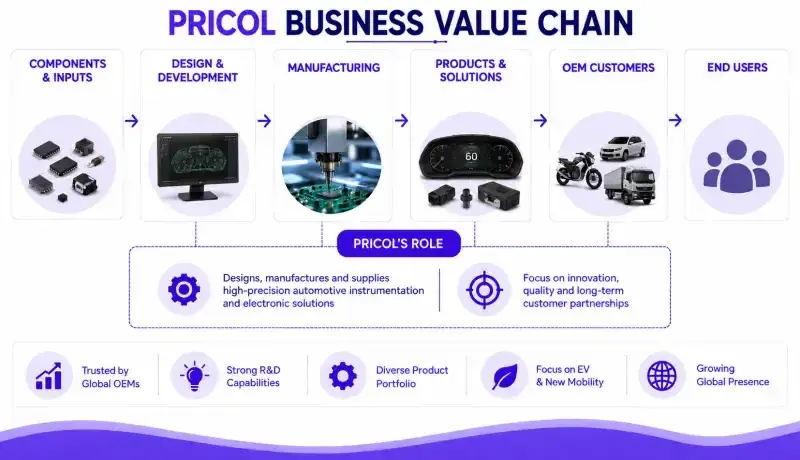
Think of the value chain as three links. At one end sit Pricol's raw-material and component suppliers — providers of polymers, aluminum, semiconductors, memory-control devices and electronic components that go into a cluster or a pump. In the middle sits Pricol itself, doing design, engineering, assembly and increasingly software integration for e-cockpits and connected features. At the far end sit the OEMs — the two-wheeler, passenger-vehicle, commercial-vehicle and off-road-equipment makers who bolt Pricol's output onto a finished vehicle and sell it to the end customer.
What's changed over the last few years is that the middle link has gotten more complex. Pricol used to sell largely mechanical hardware. Now it's assembling hardware, firmware, display technology and — through technology partnerships — licensed capabilities it didn't develop in-house. That shift matters for margins, for capital intensity, and for how exposed the company is to global electronics-component pricing, which is exactly what bit into costs during FY26.
That rising complexity also makes it important to understand how capital intensity can affect returns, cash generation and the economics of a growing manufacturing business. Capital-Intensive Businesses Explained: Risks, Economics, and Investor Insights
What Pricol Actually Makes
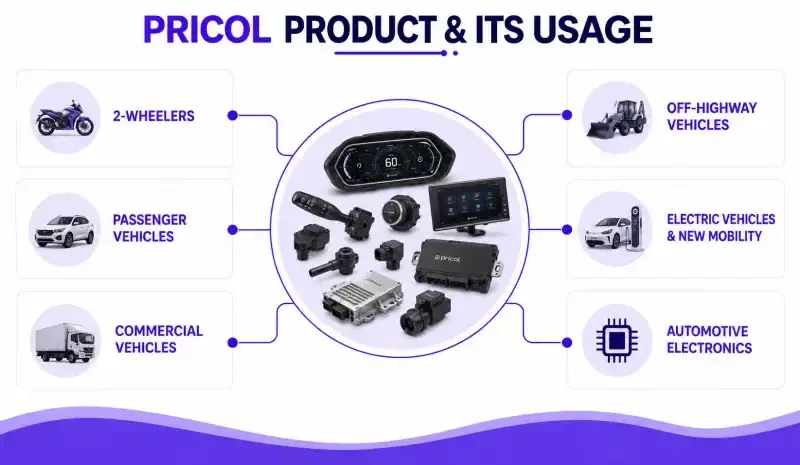
Under DICVS, the portfolio spans digital and TFT instrument clusters, e-cockpit platforms, heads-up displays and telematics. The e-cockpit roadmap itself splits in two directions: an HPC (high-performance-computing)-based platform for mid-to-premium vehicles supporting multiple full-HD displays, infotainment, ADAS-related functions, 5G telematics and phone projection running on Android and QNX architecture; and a lighter, cost-effective version for entry-level vehicles built around an IVI (in-vehicle infotainment) platform with an added microcontroller, so the same broad capability can be offered down-market at a price that makes sense.Under ACFMS, the products are electrical oil pumps, electrical coolant pumps and electronic purge valves — the fluid-management side of the business — along with a disc-brakes program still being built out with key customers. Management has been clear that Pricol has no plans to enter the anti-lock braking system (ABS) market; on the FY26 call, when asked directly, the Chairman stated the company was never in that product and has no near-term intention of entering it, preferring to let disc brakes mature first. Precision Products, through P3L, adds plastic and polymer-based components to the mix, expanding what was previously a narrower product base.
And then there's the newest piece: Battery Management Systems (BMS), developed through a partnership under which, according to management, Pricol licenses BMS product and process technology and manufactures the complete unit in-house. The BMS platform is designed to support 14S–18S battery configurations and, per the FY26 outlook material, is ready for customer handover for vehicle-level integration and testing — an early-stage but genuine EV-specific product line rather than a retrofit of existing hardware.
Growth Drivers
There are, broadly, five things doing the heavy lifting here, and it's worth being honest that they pull in the same direction but at different speeds.Rising electronic content per vehicle is the slow-moving, structural driver — as displays, connectivity, ADAS features and electronic controls become standard rather than premium, the value Pricol can capture per unit sold rises, independent of whether the underlying auto market grows 5% or 8% in a given year. Management's stated ambition, expressed on the FY26 call, is to lift wallet share with roughly ten strategic customers so that content per vehicle across the portfolio is at least 50% higher within three years — a target management itself flagged as directionally difficult to pin down precisely, given how much cluster and component pricing varies by vehicle segment.
The EV transition is the newer, less proven driver — BMS, electronic controls, connected systems and displays all stand to benefit, but as the company's own materials note, this depends on affordability, charging infrastructure, localisation and policy support falling into place, none of which is fully in Pricol's control.
The P3L integration is the most immediate and mechanical driver, having added roughly a fifth of consolidated revenue in a single year. Management has guided to doubling P3L's revenue within three years of the January 2025 acquisition, and stated on the FY26 call that the business is "well on track" to hit or exceed that target, having won new business and begun building capacity for customers that didn't exist under the previous ownership.
Technology partnerships — with BMS PowerSafe on battery management, Sibros Technologies on cloud connectivity, and separately with BOE and Domino on display and print technologies — let Pricol add capability without building every piece of intellectual property from scratch. Management described the BOE tie-up specifically as backward integration into backlight-module manufacturing rather than a source of incremental revenue, with commercial production expected in roughly 10–12 months from the May 2026 call, and the Domino relationship pegged at 18–24 months before early revenue starts.
Localisation — reducing dependence on imported components and building supplier capability domestically — is the defensive driver, one that matters more in a year like FY26, when the rupee weakened sharply and imported inputs got materially more expensive. For investors, the bigger question is how these localisation efforts and the coming capacity expansion affect the capital intensity of the business and ultimately its returns. Capital-Intensive Businesses Explained: Risks, Economics, and Investor Insights.
"The big money is not in the buying and the selling, but in the waiting." — Charlie Munger
That patience framing fits Pricol's own capex language well. Management indicated on the FY26 call that the company's previous capex cycle has run its course, capacity utilisation has "reached a peak" — so much so that the plastics business was constrained from growing further this year purely on lack of capacity — and a new, larger capex cycle is beginning, with roughly ₹680–700 crore planned for FY27, according to management. That's a meaningful step-up from the ₹241.46 crore in consolidated gross PPE additions and the ₹323.38 crore in cash-flow capex (purchase of PPE and investment property) reported for FY26 — figures that, per the FY26 annual report, replace an earlier, lower FY25 PPE-addition estimate of roughly ₹104.90 crore with the correct figure of ₹189.49 crore. It's worth being precise here: the ₹241.46 crore is the gross PPE-additions figure from the fixed-asset note, while the ₹323.38 crore is the cash outflow figure from the consolidated cash-flow statement — the two aren't interchangeable, and mixing them up overstates or understates the capex picture depending on which one gets quoted.
It's also worth flagging, for anyone who's seen a much larger number floating around: the ₹28,000–32,000 crore capex figure sometimes attached to Pricol is an industry-level expectation for the broader Indian auto-ancillary sector's spending on EV components and localisation — not a Pricol-specific number. The FY26 annual report does not provide a multi-year, company-specific capex guidance figure beyond the FY27 plan management gave on the earnings call.
Order Book and Pipeline
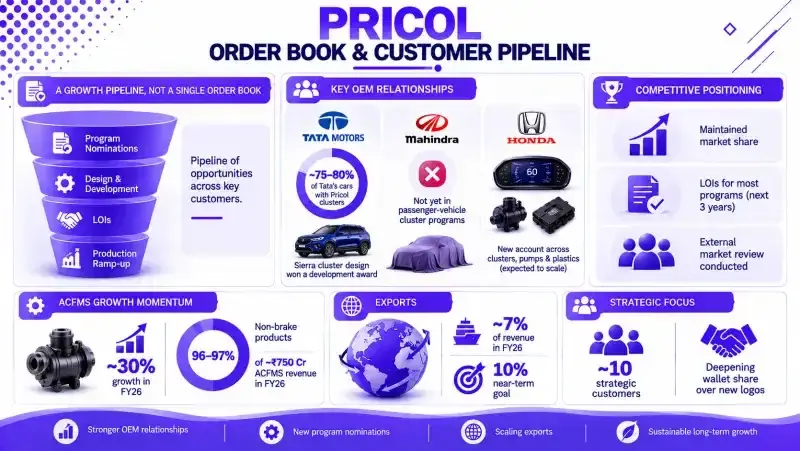
Pricol doesn't disclose a single consolidated order-book number the way, say, a capital-goods company might. What exists instead is a pipeline of program nominations and customer relationships at various stages of maturity, and it's worth walking through where things stand.On the passenger-vehicle side, Tata Motors has become a meaningfully deeper relationship — management stated that around 75–80% of Tata's cars now ship with Pricol clusters, and the company's cluster design for the new Tata Sierra won a development award from Tata Motors, according to management. Pricol has not yet entered Mahindra's passenger-vehicle cluster programs, which the Chairman confirmed directly when asked. A newer account with Honda — spanning clusters, pumps and plastics — was also flagged as a relationship the company expects to scale from a low base.
On competitive positioning, management addressed a pointed analyst question about a group company entering the instrument-cluster business at Pricol's largest OEM customer, along with new competition emerging at another OEM. The response was that Pricol commissioned an external market-analyst review and, per management, has maintained its market share by volume and increased it by value, with confirmed letters of intent (LOIs) covering most existing programs for the next three years. That's a claim worth tracking rather than simply accepting — LOIs are indicative, not binding contracts, and "barring degrowth or slowing of the market" is a real qualifier management itself attached.
On ACFMS, the business delivered roughly 30% growth in FY26, according to management, in line with (if at the lower end of) the 30–35% range guided on an earlier call, with non-brake products contributing 96–97% of the segment's roughly ₹750 crore in FY26 revenue, per management commentary. Management has flagged that headwinds since early 2026 — a falling rupee and volatile crude prices among them — make it harder to commit to that growth rate holding through FY27, pending some stabilisation expected, in management's words, "after September."
Exports remain a work in progress relative to an earlier ambition. Management acknowledged on the FY26 call that an earlier aspiration of exports reaching 20% of revenue has not been met, that exports currently stand at roughly 7% of revenue, and that the revised near-term goal is 10%.
"I don't want a lot of good investments; I want a few outstanding ones." — Philip Fisher
That's a useful lens for the order book specifically: Pricol's pipeline isn't a long tail of small wins, it's concentrated around a handful of strategic OEM relationships (management referenced roughly ten strategic customers) where deepening wallet share matters more than adding logos.
Financials
Let's walk through the numbers as they stand, being careful about which source each figure comes from.
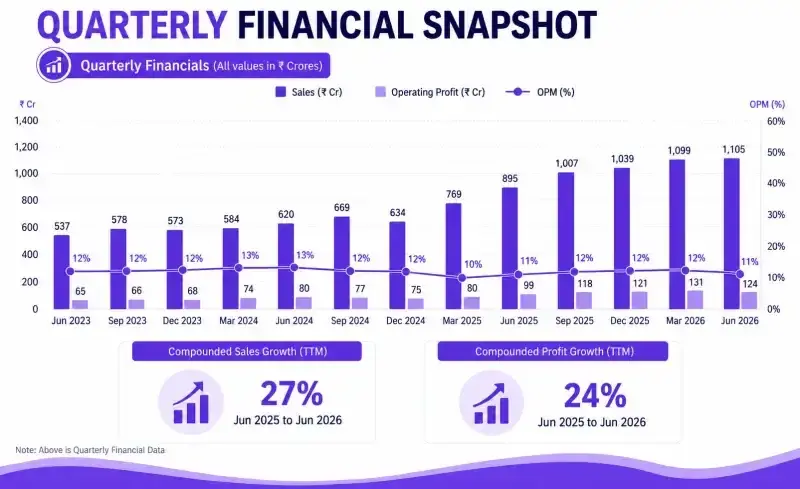
Consolidated FY26 : Sales of ₹4,041 crore against ₹3,571 crore in expenses, yielding an operating profit of ₹469 crore at a 12% OPM. After interest of ₹30 crore and depreciation of ₹120 crore, profit before tax came to ₹331 crore, and net profit after tax landed at ₹251 crore, translating to an EPS of ₹20.58.
It's worth flagging a discrepancy here rather than papering over it: management, on the FY26 earnings call, described full-year revenue from operations as "just shy of INR 4000 crores" with EBITDA of ₹492.91 crore (a 12.44% margin) and PAT of ₹250.80 crore (EPS ₹20.57) — figures that are close to, but not identical with, Sales (₹4,041 crore) and Operating Profit (₹469 crore) numbers. The PAT and EPS figures are near-identical across both sources (the difference is rounding), but the revenue and EBITDA figures differ by a modest amount, most likely because "revenue from operations" and "Sales" line, and "EBITDA" versus "Operating Profit," aren't always defined identically operating profit is typically sales less expenses before other income, while management's EBITDA figure may be calculated on a slightly different base. Both figures point to the same broad picture — revenue growing just over 50% year-on-year, in line with the +51.2% YoY growth to ₹3,963.85 crore cited in the company's own MD&A materials — but the precise decimal shouldn't be over-relied upon from either source in isolation.
Year-on-year, per annual figures, this represents a jump from ₹2,692 crore in Mar 2025 sales — growth overwhelmingly driven by the consolidation of P3L, which contributed roughly ₹923–924 crore of revenue in its first full year within the group (the annual report cites ₹923.10 crore; management, on the call, cited ₹924 crore with a 9.24% EBITDA margin for the year). Because P3L was only consolidated from February 2025, the FY25 comparison base includes barely two months of its contribution, which inflates the apparent YoY growth rate to some degree — a point worth keeping in mind when reading the "+51.2%" headline.
Quarterly Q4 FY26, ended Mar 2026): Sales of ₹1,099 crore, operating profit of ₹131 crore (12% OPM), and net profit of ₹73 crore, with an EPS of ₹6.01. Management's own figures for the same quarter — revenue from operations of ₹1,077.9 crore, EBITDA of ₹143.28 crore (13.29% margin) and PAT of ₹73.23 crore (6.79% margin, EPS ₹6) — are close but again not identical on the top line, for the same likely reason of differing revenue and EBITDA definitions between the two sources. The most recent quarter available, Q1 FY27 (ended Jun 2026, as of data), shows sales of ₹1,105 crore, operating profit of ₹124 crore, and net profit of ₹67 crore with EPS of ₹5.50 — sequentially softer on operating profit and PAT despite marginally higher sales, consistent with management's own caution about margin softening from cost inflation and currency pressure heading into FY27.
Balance sheet: Total assets/liabilities of ₹2,475 crore, up from ₹1,949 crore a year earlier. Borrowings rose sharply to ₹379 crore from ₹279 crore in FY25 and just ₹61 crore in FY24. This is worth unpacking rather than taking at face value: management explained on the FY26 call that a change in accounting treatment (a new IndAS-related circular) required customer and vendor bill-discounting arrangements — previously classified as trade payables — to be reclassified as borrowings. Excluding that reclassification, management stated that actual net debt as of March 31, 2026 stood at just ₹63.11 crore — a very different picture from the ₹379 crore gross borrowings figure on the balance sheet. Both figures are real; they're just measuring different things, and conflating them would materially overstate the company's leverage.
Cash flow (consolidated): Operating cash flow was strong at ₹281 crore in FY26, up from ₹223 crore in FY25, representing a CFO/Operating-Profit ratio of 78%. However, free cash flow was negative at ₹38 crore, reflecting cash used in investing activities of ₹298 crore — consistent with the step-up in capex the company has been undertaking, including the P3L acquisition's aftermath and new capacity investment.
A brief note on quality of earnings: operating cash flow of ₹281 crore against a reported PAT of ₹251 crore is a reasonably healthy ratio, suggesting profits are, broadly, being converted into cash rather than sitting in receivables or inventory. That said, the CFO/OP ratio of 78% is down from 103% in FY23 and 73% in FY25 territory over recent years, and free cash flow has been negative or thin in several of the last five years (₹117 crore in FY24, ₹27 crore in FY25, -₹38 crore in FY26) as the company has moved through successive capex cycles, first for organic capacity and now, per management, into a new and larger one.
This isn't unusual for a business investing ahead of growth, but it does mean dividend capacity and balance-sheet flexibility over the next year or two will depend more on how efficiently that capex converts into revenue than on cash generated purely from existing operations. This is why cash flow deserves to be examined alongside reported profits: accounting earnings can look healthy while investment requirements consume substantial amounts of cash. Cash Flow Statement Explained: The Most Honest Financial Report
On R&D: the FY26 annual report breaks this down as ₹13.61 crore of capital R&D and ₹72.95 crore of revenue R&D, for a total of ₹86.56 crore, or 2.87% of sales. It's worth flagging that this differs meaningfully from a separately sourced business-profile figure suggesting R&D spend of approximately 4.5% of revenue — given the annual report's more granular, itemised breakdown, the 2.87% figure is treated as the more reliable one here, and readers should be aware the two don't reconcile.
On capacity utilisation specifically: while Pricol doesn't disclose a single company-wide utilisation percentage (its product mix — clusters, pumps, plastics, precision products — spans too many different capacity units to aggregate meaningfully), management's own commentary makes utilisation a live constraint rather than a footnote. The plastics business, specifically, was described as capacity-constrained through FY26, unable to grow further purely due to a lack of available capacity — which management said is part of why return on capital employed came in well above earlier guidance, since existing assets were being "sweated" harder than planned. That dynamic — capacity utilisation running high enough to cap growth in at least one segment — is precisely why the new capex cycle beginning in FY27 matters as much as it does; the near-term investment thesis leans partly on whether that new capacity gets absorbed by real, incremental demand rather than sitting underutilised. For investors, the key question is not simply whether a company is adding capacity, but whether that capital ultimately generates attractive returns. Return on Equity (ROE) Explained: A Step-by-Step Guide for Investors
Dividend policy: the Board declared an interim "Golden Jubilee" dividend of 200% during the year and, per the FY26 call, chose to retain the total payout at that level rather than adding a further final dividend, citing a wish to conserve cash given the scale of planned capital investment — with a further review contemplated after six months of FY27 performance.
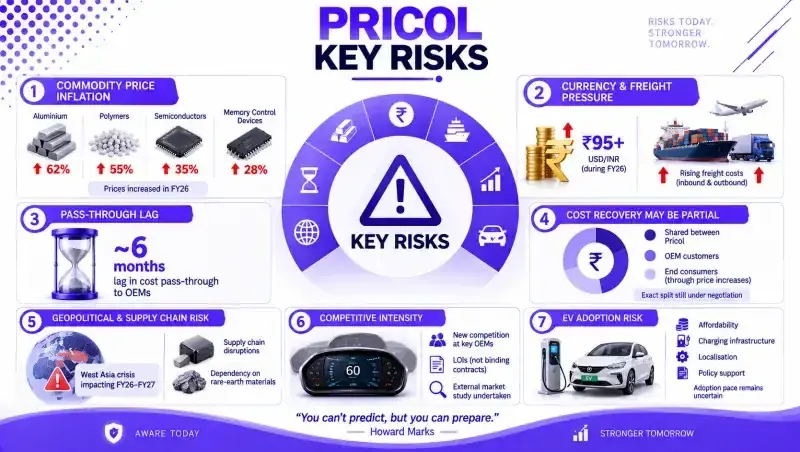
Key Risks for Pricol
Commodity and currency exposure sits at the top of the list, and FY26 gave a live demonstration of why. Management described, on the earnings call, aluminum prices rising roughly 62%, polymer prices roughly 55%, semiconductor costs roughly 35%, and memory-control-device costs roughly 28% during the year, alongside a sharply weakening rupee (the CFO referenced the currency crossing ₹95 to the US dollar) and rising freight costs on both inbound and outbound shipments. Management has stated it does not expect to recover the full cost impact from OEM customers — framing cost absorption as likely to be split, in some proportion, between the company, its OEM customers, and end consumers through vehicle price increases, with the exact split still being negotiated as of the call.There's a real lag in how quickly cost increases get passed through. Management noted a roughly six-month lag between when currency and commodity costs move and when contractual pass-through mechanisms with OEMs catch up, meaning margin pressure can show up well before compensation does.
Geopolitical disruption is an explicit, named risk in the company's own materials — management referenced a "West Asia crisis" as a live headwind through FY26 and into FY27, alongside broader supply-chain disruption and rare-earth-material dependency for certain electronic components.
Competitive intensity in the instrument-cluster segment is worth watching rather than dismissing. An analyst on the FY26 call specifically raised the entry of a group company into instrument clusters at Pricol's largest OEM customer, and new competition emerging at another OEM. Management's response — that market share has been maintained by volume and grown by value, backed by confirmed LOIs — is reassuring on its face, but LOIs are not firm contracts, and the underlying competitive dynamic is real enough that management itself chose to commission an external market study in response. That competitive question leads to a broader one: does Pricol have a durable advantage that can protect its customer relationships and market position as competition intensifies? Economic Moat Explained: Why Some Companies Stay Dominant for Decades
EV-adoption risk cuts both ways for Pricol: it's a growth driver if EV penetration accelerates, but the company's own materials note that adoption still depends on affordability, charging infrastructure, localisation and policy support — factors outside Pricol's control, and ones that could push out the BMS and connected-vehicle revenue ramp if they don't materialise on schedule.
More broadly, management's own tone on the FY26 call was notably candid about near-term softness: the Chairman described the overall situation as "quite bleak" in the near term, explicitly guided toward "softening of earnings" in the coming quarters, and declined to reaffirm the previously cited 13–15% company-wide growth guidance, citing genuine uncertainty tied to global crude prices, currency movements and geopolitical developments.
"You can't predict, but you can prepare." — Howard Marks.
That's arguably the most honest way to read management's own posture through this results call — not offering false precision on FY27 growth, while still committing to the underlying capex and R&D programs regardless of near-term turbulence.
Explore our Products
Research Framework

Emerging Titans
Combination of quantitative analysis, industry tailwinds, and management assessment - SPRINT investment philosophy

Tiny Titans
Heavy emphasis on scuttlebutt research, plant visits, and early on-ground signals
Conclusion
Pricol's FY26 was, in the plainest terms, a year of two very different stories layered on top of each other. One story is straightforwardly strong: consolidated revenue crossing the ₹4,000-crore mark for the first time, a debt-equity ratio management describes as comfortably below 1x even after a large acquisition, an operating-cash-flow-to-profit ratio that suggests earnings are largely translating into real cash, and a business that has clearly succeeded in bolting P3L onto its existing operations without derailing the rest of the company. The other story is more cautious, and it's one management itself chose to foreground rather than paper over: a sharp run-up in input costs, a currency that moved against the company faster than pass-through mechanisms could keep pace with, and a leadership team unwilling to reaffirm its own multi-year growth guidance in the face of genuine macro uncertainty.
What's working is reasonably clear from the numbers and from management's own commentary — the P3L integration is ahead of or on track against its stated three-year doubling target, the ACFMS business delivered growth broadly in line with guidance despite a difficult back half, and the balance sheet, once the bill-discounting reclassification is properly understood, remains lightly levered heading into a much larger capex cycle. What's less proven is largely concentrated in the newer, more technology-dependent parts of the business: BMS is still pre-commercial, the BOE and Domino partnerships won't contribute meaningfully to revenue for another one to two years by management's own timeline, and the broader bet on rising electronic content per vehicle — while structurally sound — depends on customer nominations and program wins that are, by nature, lumpy and hard to forecast precisely.
The next several quarters will likely hinge on three things converging or failing to converge. First, whether the six-month lag between cost inflation and contractual price recovery closes without materially denting margins in the interim. Second, whether the ₹680–700 crore FY27 capex program gets deployed into capacity that's genuinely absorbed by new business, rather than sitting idle the way the plastics constraint suggests older capacity briefly wasn't. And third, whether the currency and commodity headwinds that dominated the FY26 call — the rupee's weakness, aluminum and polymer price spikes, freight inflation — begin to ease as management has cautiously suggested they might "after September," or whether they persist and compress margins further into FY27. None of these are questions the current data set can answer definitively; they're precisely the kind of thing next quarter's results, and the commentary that comes with them, should start to clarify.
FAQs
What does Pricol Limited do?
+Pricol Limited is an auto-components manufacturer that supplies products such as instrument clusters, digital displays, e-cockpits, telematics, fuel sensors, pumps, valves and other precision components to automotive OEMs. Its business is broadly divided into Driver Information & Connected Vehicle Solutions (DICVS), Actuation, Control & Fluid Management Systems (ACFMS), and Precision Products.
How did Pricol perform in FY26?
Pricol reported consolidated FY26 sales of around ₹4,041 crore, compared with ₹2,692 crore in FY25, while net profit was approximately ₹251 crore. The sharp revenue growth was substantially supported by the consolidation of P3L, which contributed roughly ₹923 crore during its first full year within the group.
What are the key growth drivers for Pricol?
Key growth drivers include higher electronic content per vehicle, EV adoption, P3L integration, technology partnerships and localisation. Pricol is also targeting higher wallet share from its strategic OEM customers as vehicles increasingly adopt digital clusters, connected features and electronic systems
What is Pricol's FY27 capex plan?
+Management indicated plans to invest approximately ₹680–700 crore in FY27, marking the beginning of a new and larger capex cycle. The investment is intended to support capacity expansion and future growth, particularly as some existing capacity, including plastics, has become constrained.
What are the key risks for Pricol?
+The major risks include commodity-price inflation, currency volatility, geopolitical disruptions, competitive pressure, EV-adoption uncertainty and margin pressure from delayed cost pass-throughs. Management indicated that there can be roughly a six-month lag before higher input costs and currency impacts are recovered through customer pricing mechanisms.

High growth stock specialist, Value Educator
Shashank Mahajan is an equity research professional with over 12 years of experience in identifying high-potential SME and micro-cap stocks at an early stage. He follows a rigorous scuttlebutt research–driven approach, combining on-ground insights with deep financial analysis. Shashank specializes in uncovering under-researched and under-owned companies with strong management quality and long-term growth potential. Through disciplined research and early identification, he focuses on spotting tomorrow’s market leaders before they enter the mainstream investor radar.

Zen Technologies: Why Revenue Fell After Its Biggest Win

Data Patterns: India's Radar Designer and Its Waiting Orders

KSH International: The Wire Inside India's Transformers

Krishna Defence: The Steel Behind India's Warship Hulls

PNG Jewellers: A 194-Year-Old Name Goes National

Axiscades: From Services to Missile and Radar Electronics
Explore our Products
Research Framework
Emerging Titans
Combination of quantitative analysis, industry tailwinds, and management assessment - SPRINT investment philosophy
Tiny Titans
Heavy emphasis on scuttlebutt research, plant visits, and early on-ground signals


 Orders
 Subscription
 Share with friends
 Logout


Required Details
₹23999.00
(12 month subscription)
As per SEBI regulations, all users are mandated to complete the KYC that is validated for 1 year. Post payment, you will be redirected to the KYC screen


No comments yet. Be the first to comment!