
PTC Industries: Parts for Critical Machines

Here's a strange little fact: the metal in your kitchen sink and the metal used to build a rocket engine can start out looking almost the same. Same shine. Same weight. Sometimes even a similar price per kilogram.
And yet, one of them can only handle boiling water. The other survives fire hot enough to melt rock, spinning at incredible speeds, for years, without ever giving up.
So what's the actual difference between them?
It's not the metal. It's what someone did to it. In India, one company that does this is PTC Industries.
Turning an ordinary block of raw metal into something that can survive space, or the inside of a missile, or the heart of a power plant, is one of the hardest, least-talked-about skills in the world. It takes melting the metal in a way that removes every trace of weakness. Shaping it with a precision so exact that a single hair's width of error is considered a failure. And testing it again and again, until it can be trusted with a job where there's no room for a second attempt.
Very few companies on Earth have actually mastered this. And for a long time, India wasn't one of them — depending instead on other countries for materials this critical.
That's quietly changing, in a factory in Lucknow, where a company has spent over sixty years learning exactly how to turn ordinary metal into something extraordinary.
The company behind it is PTC Industries.
"Whatever is rightly done, however humble, is noble." — Sir Henry Royce, co-founder of Rolls-Royce
PTC Industries: The Company Behind Mission-Critical Components
Building components that survive extreme environments takes more than standard manufacturing. It takes decades of engineering depth, advanced metallurgy, and a level of precision where "close enough" simply isn't an option.
Founded in 1963, PTC Industries has spent over six decades earning its place as one of India's leading manufacturers of precision metal components for critical and supercritical applications. It started out as one of India's early investment casting foundries and has since evolved into a technology-driven engineering enterprise built for industries where a single component failure isn't a minor setback it's catastrophic.
Today, PTC serves civil aviation, aerospace, defence, space, energy, oil & gas, and industrial engineering, manufacturing high-performance components in stainless steel, titanium, nickel, cobalt, and a range of specialty alloys and superalloys. Its customer base reads like a who's who of the sector HAL, DRDO, BrahMos Aerospace, Safran, Dassault Aviation, BAE Systems, and Honeywell Aerospace each relying on PTC for mission-critical parts engineered to hold up under extreme heat, pressure, and mechanical stress.
What's easy to overlook is that none of this is as simple as melting metal and pouring it into a mould. Every turbine blade, every defence-grade component, every part that ends up in a system that genuinely cannot fail, is the output of a manufacturing process with very little room for shortcuts one where precision at every step decides whether the final piece is strong, reliable, and fit for purpose.
India's defence manufacturing ecosystem is evolving rapidly, creating opportunities for companies like PTC. To understand the broader sectoral tailwinds, read Future of Defence Sector in India – 2025 and Beyond.
From Digital Blueprint to Flight-Ready Component: Inside PTC's Manufacturing Process
Every mission-critical component starts life as a digital blueprint, not a block of metal. The entire process is built to catch defects before the first furnace even switches on, because aerospace and defence applications leave no margin for finding out about a flaw after the part is in service.
It begins with engineers building a 3D model of the component and running it through advanced simulation software to study how molten metal will flow inside the mould. This lets them spot potential defects well before production starts. It's a digital-first approach that cuts material wastage while improving dimensional accuracy and structural integrity problems solved on a screen are far cheaper than problems solved on the factory floor.
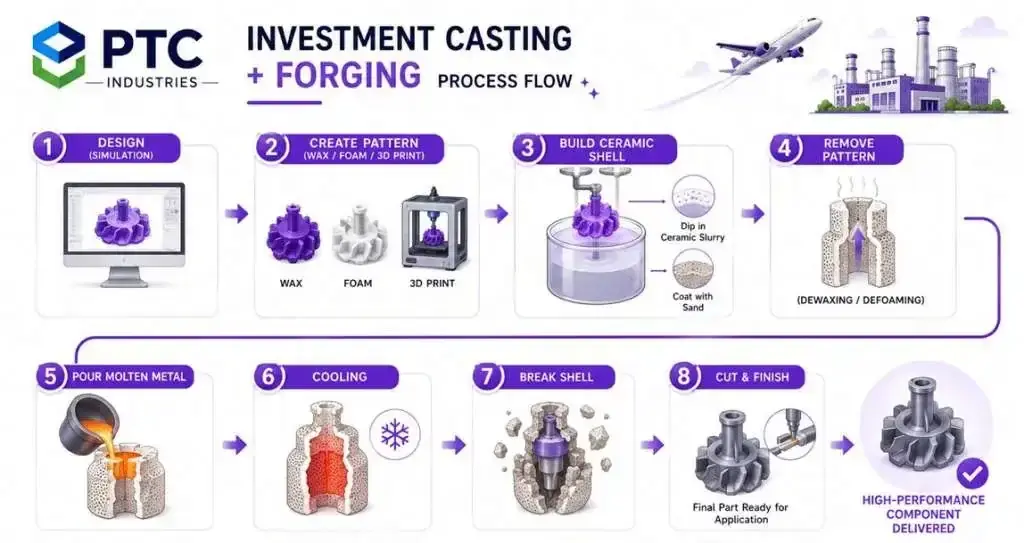
Once the design is locked, a replica of the component, called a pattern, is created using wax, foam, or 3D printing, depending on how complex the part is. This pattern is coated repeatedly in ceramic to build up a strong mould. Once the pattern is removed, molten metal is poured into the cavity, where it cools and solidifies into a near-net-shape component that already closely resembles the final part.
From there, the casting goes through forging and heat treatment, steps that refine the metal's internal grain structure and meaningfully improve its strength, toughness, and fatigue resistance. This stage matters most for components operating under extreme pressure, high temperature, and constant mechanical stress, where even a microscopic imperfection can be the difference between a part that performs and one that fails.
Before anything leaves the factory, every component goes through rigorous quality checks, X-ray radiography, ultrasonic inspection, and other non-destructive testing methods, to rule out hidden defects. Precision machining then brings the part to its exact final dimensions before it ships to customers.
"One good test is worth a thousand expert opinions." — Wernher von Braun, aerospace engineer, NASA
Over the years, PTC has built out this manufacturing backbone through sustained investment in advanced melting technologies, robotics, digital simulation, and proprietary casting processes such as RepliCast®, RapidCast™, ForgeCAST™, and PrintCast®. These capabilities now allow the company to manufacture complex near-net-shape castings weighing over 6,000 kilograms a scale and precision benchmark that few players in critical engineering applications can match.
But all of this process discipline only goes so far. The strength of the final component is ultimately capped by the quality of the raw material that goes into it. Which raises the more interesting question: what if a company didn't just manufacture the component, but also controlled the aerospace-grade material it's made from?
Manufacturing the Material: The Birth of Aerolloy Technologies
For decades, PTC Industries mastered the art of shaping metal into precision components. But as the company moved deeper into aerospace and strategic defence programmes, shaping the metal stopped being enough. Aerospace-grade applications demand complete control over the material itself, right down to the atomic level, where even a microscopic impurity can quietly undermine strength, fatigue life, and long-term reliability.
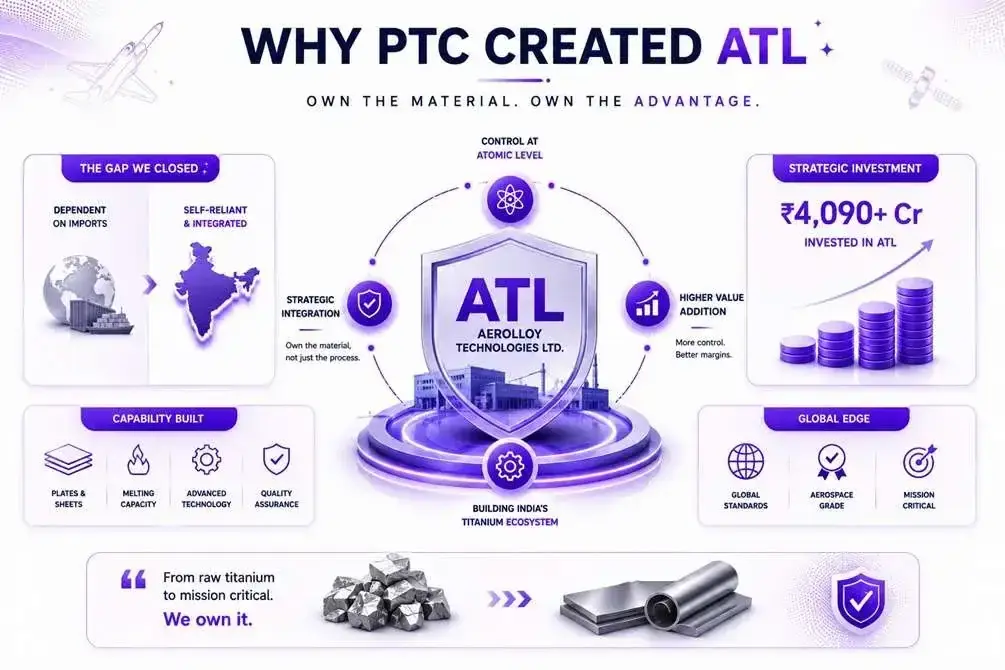
That's the gap PTC set out to close when it incorporated Aerolloy Technologies Limited (ATL) as a wholly owned subsidiary in February 2020, a move aimed squarely at backward integration. Since then, the company has committed over ₹4,090 crore to ATL to build indigenous capability in manufacturing aerospace-grade titanium and superalloys, essentially trying to own the material, not just the process. Adding to this, ATL acquired a Hot Rolling Mill from the United States, which now enables in-house production of titanium alloy plates and sheets. Combine that with casting, forging, machining, and advanced testing capabilities under one roof, and ATL is effectively laying the groundwork for a fully integrated titanium value chain within India, something the country has largely lacked so far.
But building an ecosystem like this starts at the most unforgiving stage of metallurgy: turning raw titanium sponge into aerospace-grade titanium through tightly controlled melting and refining, a process where there's very little room for error and even less room for shortcuts.
"If India aspires to become a developed nation, it must achieve self-reliance in critical sectors such as energy, technology and defense." — Dr. A.P.J. Abdul Kalam, aerospace scientist and former President of India
From Titanium Sponge to a Fully Integrated Aerospace Ecosystem
Every aerospace-grade component starts with something most people have never heard of, titanium sponge. It's produced from titanium ore through a series of refining steps, and it forms the base raw material for the high-performance titanium alloys that go into aerospace, defence, and other strategic applications. To strengthen India's self-reliance on this front, PTC has signed an MoU with the Government of Odisha to set up a titanium sponge production facility, while its partnership with global producer AMIC TOHO helps secure a reliable, sustainable supply in the meantime.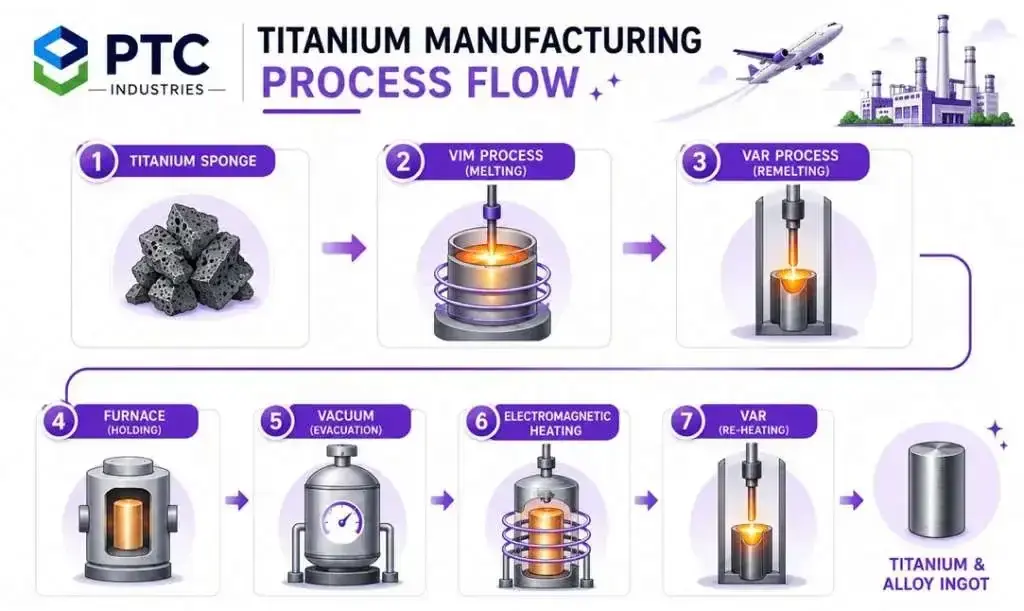
At Aerolloy Technologies Limited (ATL), that titanium sponge, along with other alloying elements, is turned into aerospace-grade material through two tightly controlled metallurgical processes. The first, Vacuum Induction Melting (VIM), melts the raw material using electromagnetic induction inside a vacuum furnace, producing a homogeneous molten alloy free of contamination. That molten metal then goes through Vacuum Arc Remelting (VAR), where it's remelted under vacuum to strip out dissolved gases and impurities, the step that ultimately determines the strength, fatigue life, and reliability aerospace and defence applications demand.
What comes out the other end is a high-purity titanium ingot, which is then forged or investment cast into near-net-shape components, before moving through machining, heat treatment, and rigorous quality checks. It's this chain of capabilities that lets PTC manufacture mission-critical products like torque tubes, propulsion nozzles, bearing housings, turbine oil tanks, suspension arms, pumps, pump castings, and engine gearboxes, supplied across aerospace, defence, and industrial customers.
None of this is being built as a standalone capability. It's part of a much larger plan, PTC's Strategic Materials Technology Complex (SMTC), envisioned as a fully integrated ecosystem for advanced materials and critical engineering components. Once complete, the complex will house titanium and superalloy melting and remelting facilities, aerospace casting and forging units, precision machining centres, powder metallurgy lines, a hot rolling mill, and specialised technologies like Plasma Arc Melting and Hot Isostatic Pressing (HIP). The logic is straightforward: by bringing all of this under one roof, PTC wants to control the entire value chain, from strategic raw material to finished aerospace and superalloy component, putting it in a small club of global manufacturers with genuine end-to-end capability in advanced materials.
Closing the Loop: The Trac Precision Solutions Acquisition
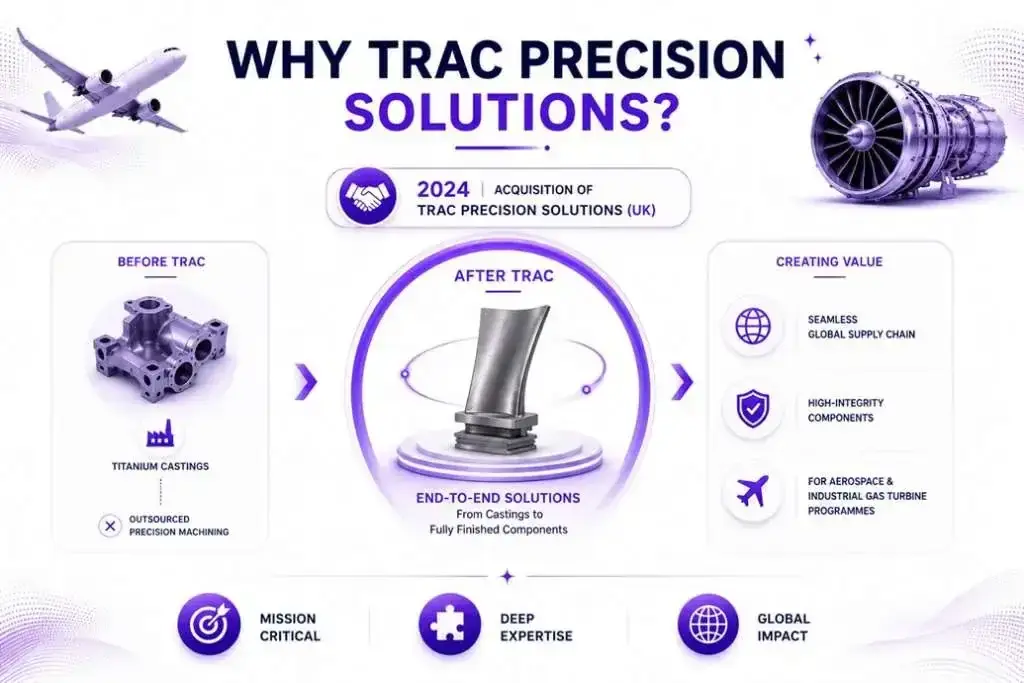
There was still one gap in PTC's aerospace platform, and it was a fairly obvious one in hindsight. The group could already make aerospace-grade titanium alloys through Aerolloy Technologies, and turn those alloys into highly engineered castings at PTC Industries. But here's the thing about global aerospace OEMs, they're increasingly not interested in buying semi-finished castings. They want a supplier who can hand them a fully machined, ready-to-bolt-on component. That last mile, precision machining and finishing, was missing. And that's precisely the gap the Trac Precision Solutions acquisition was built to close.
PTC picked up Trac, a UK-based specialist, in 2024. Its core business is machining and finishing complex titanium and superalloy parts for aerospace and industrial gas turbines, things like turbine blades, nozzle guide vanes, heat shields, and airfoils. These aren't forgiving components. Tolerances are often measured in microns, and the quality bar in this segment is about as high as manufacturing gets.
Strive for perfection in everything you do. Take the best that exists and make it better.
"When it does not exist, design it." — Sir Henry Royce
What the acquisition really does is let PTC stop handing off the final, highest-value step of the process to someone else. Instead of stopping at near-net-shape castings, the group can now take a component all the way through to fully machined, qualified, and fit-for-installation. Practically, that means a customer could source the entire journey, alloy production at Aerolloy, casting and forging at PTC, machining and final qualification at Trac, from one group. That's a meaningfully different value proposition than being one vendor in a longer chain, and it keeps more of the margin in-house instead of leaking out to third-party machining shops.
There's also a less obvious piece of value here that doesn't show up neatly on a balance sheet: Trac comes with years of customer relationships and engineering know-how built specifically around serving demanding aerospace and gas turbine programmes. That kind of trust isn't something you buy off a shelf, it's earned over years of consistent delivery, and it's arguably as valuable as the machining equipment itself. Combined with PTC's existing base, this sets up something close to an integrated India-UK manufacturing platform, which is a genuinely useful positioning for courting global OEMs who'd rather deal with one accountable supplier than five.
Structurally, the Trac side of things sits under Trac Precision Solutions Ltd as the operating business, with Trac Holding Ltd, Trac Group Ltd, and Broomco Ltd functioning as holding entities in the UK corporate structure, worth knowing, though not where the real story is.
Step back, and the bigger picture becomes clear. Between Aerolloy Technologies, the Strategic Materials Technology Complex, and now Trac Precision, PTC has essentially closed the loop, raw material, casting, machining, all under one group. What started as a specialised investment casting business has turned into something closer to a full-stack aerospace materials and manufacturing platform, one that owns the value chain from strategic raw material to a part that's ready to fly.
Financial Performance: Does the transformation show up in the numbers ?
PTC Industries' strategic transformation is finally showing up in the numbers. FY26 was the first year consolidation of Aerolloy Technologies (ATL) and Trac Precision Solutions gave investors the full picture of the group.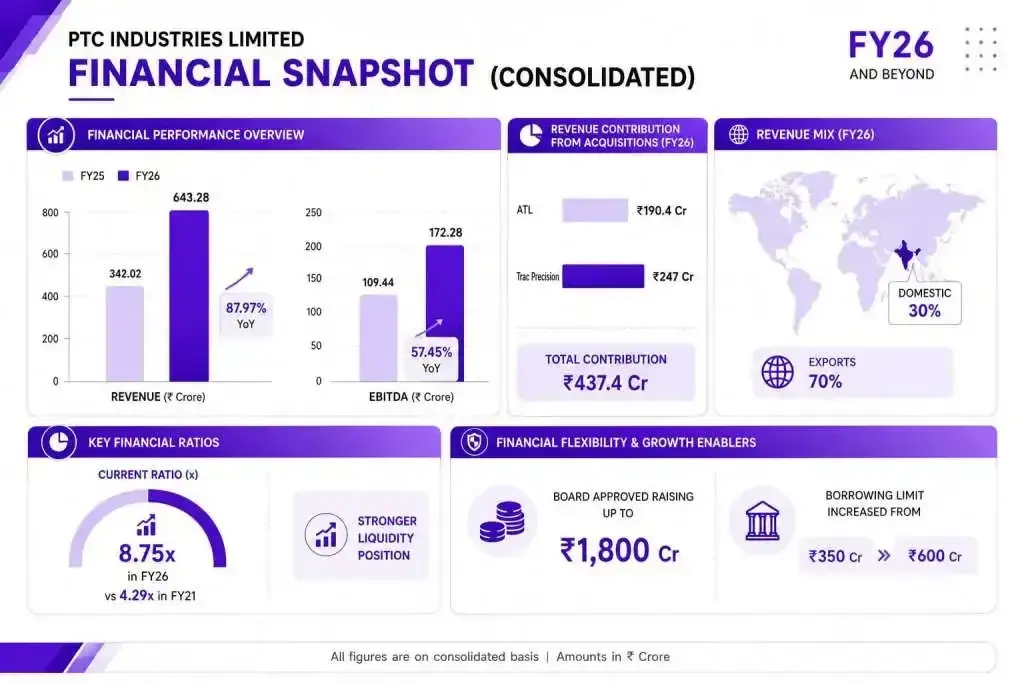
Consolidated revenue came in at ₹643.28 crore, up 87.97% YoY. That's the headline, but the more useful number is underneath it, ATL added ₹190.4 crore and Trac Precision added ₹247 crore. In other words, most of this growth is consolidation, not organic expansion of the core casting business. That matters because it tells you the story is now about integration paying off, not just the base business getting bigger. Majority of the revenue are from exports 70% and 30% is domestic
EBITDA grew 57.45% to ₹172.28 crore, but margin fell from 31.97% to 26.78%. Worth being precise about why, this isn't operational slippage, it's mix. Trac's machining business simply runs at lower margins than PTC's legacy casting work. So the relevant question isn't "why did margins drop," it's whether that mix improves as Trac scales, or whether 26-27% becomes the new normal for the blended business.
EBITDA can sometimes paint a different picture from actual profitability. Learn when it helps and when it can mislead in EBITDA Explained: Why Investors Use It And When It Misleads.
The current ratio moved from 4.29x in FY21 to 8.75x in FY26. That's not really a liquidity story anymore, at this level, it signals PTC has raised capital ahead of deploying it, which is fine for a business in build-out mode but means the return on that idle capital is a real question until it's put to work. More telling is trade receivables at nearly 32% of current assets, that's the number to actually track, because it's a direct read on whether revenue growth is converting into cash or just sitting on the balance sheet.
Liquidity ratios are only one part of financial analysis. If you're learning how professionals evaluate businesses, our guide How to Read a Balance Sheet Like a Professional Investor explains the key metrics investors should never ignore.
On funding, the Board approved raising up to ₹1,800 crore and lifted the borrowing limit from ₹350 crore to ₹600 crore. The relevance here isn't the size of the number, it's the signal, management is positioning for another leg of capex, which means the current investment phase isn't close to done.
Put together, the financials confirm the platform is built. What they don't yet answer is whether PTC can convert that platform into utilization and cash flow, that's the metric that will define the next few years, not capacity anymore.
Opportunities & Key Risks
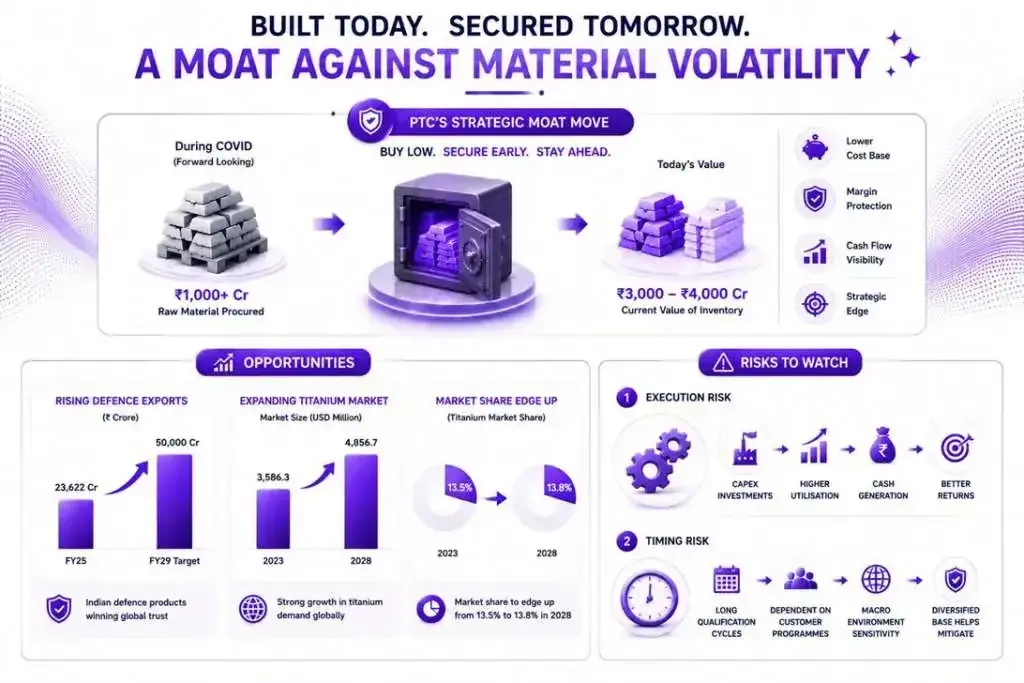
PTC Industries sits at the intersection of several structural tailwinds in global aerospace, defence, and advanced materials, and that positioning is worth spelling out before getting to the risks. The global titanium market is expected to keep expanding at 6.3% through 2028, the titanium market is forecast to expand from USD 3,586.3 Million in 2023 to USD 4,856.7 Million in 2028 the market share is expected to edge up from 13.5% to 13.8% in 2028 pulled along by demand from aerospace, defence, EVs, and renewable energy. The metal casting industry more broadly is headed the same way, as manufacturers lean harder into lightweight, high-strength, geometrically complex components. Both trends play directly to what PTC actually does.
India's own defence manufacturing story adds another layer to this. Defence exports hit ₹23,622 crore in FY25, a clear sign that Indian-made defence products are finding real acceptance abroad, and the government's target of ₹50,000 crore by FY29 suggests there's meaningful room left to run. Add in Make in India, the broader push toward import substitution, and global OEMs actively looking to diversify supply chains away from traditional hubs, and PTC is arguably sitting in the right place at the right time. Its relationships with Safran, BAE Systems, Dassault Aviation, Honeywell Aerospace, and IAI, backed by proprietary casting technology and deep metallurgical know-how, give it a genuine shot at capturing this shift. And it's not a one-sector bet either, the company also serves energy, oil & gas, marine, and industrial customers, which adds a useful layer of diversification.
India's defence ecosystem is evolvin rapidly, creating opportunities across multiple listed companies. Learn more in How to Invest in Defence Sector.
That's the opportunity side. The risk side deserves equal attention, and there are really three worth flagging.
The most obvious one is raw materials, specifically the availability and pricing of titanium sponge, nickel, and other superalloys. Any disruption or sustained price spike here hits manufacturing economics directly. PTC has taken real steps to blunt this, backward integration, long-term sourcing tie-ups, the hot rolling mill acquisition, and the SMTC build-out all point the same direction. Management has also pointed out that strategic materials and critical equipment worth over ₹1,000 crore, procured in the post-COVID period, would now cost an estimated ₹3,000-4,000 crore to replace, a genuine cost advantage, though one that's easier to cite than to independently verify.
The second risk is execution, plain and simple. PTC has poured significant capital into Aerolloy Technologies, SMTC, and Trac Precision Solutions. That capital only creates value if it converts into higher utilisation, real cash generation, and better returns, capacity on paper doesn't pay down debt or fund the next expansion.
Evaluating risks like execution, capital allocation, and industry dynamics is essential before investing. Our article A Fundamental Checklist: How to Research a Stock in 1 Hour provides a practical framework for analyzing companies.
The third is timing risk, tied to how aerospace and defence programmes actually work. Qualification cycles in this industry are long by nature, which means order execution is partly out of PTC's hands, dependent on customer programme schedules and the broader macro environment. A diversified customer base helps cushion this, but it doesn't eliminate it.
Put together, the opportunity here is real and reasonably well-supported by structural trends. Whether it turns into sustainable value creation comes down to execution on all three fronts, not just one.
Explore our Products
Research Framework

Emerging Titans
Combination of quantitative analysis, industry tailwinds, and management assessment - SPRINT investment philosophy

Tiny Titans
Heavy emphasis on scuttlebutt research, plant visits, and early on-ground signals
From Qualification to Commercial Execution: Order Book & Management Guidance
With most of the manufacturing ecosystem now built out, PTC's investment case has shifted. It's no longer about "can they build it," it's about "can they run it." FY27 onwards is really going to be a story of utilisation, not capacity.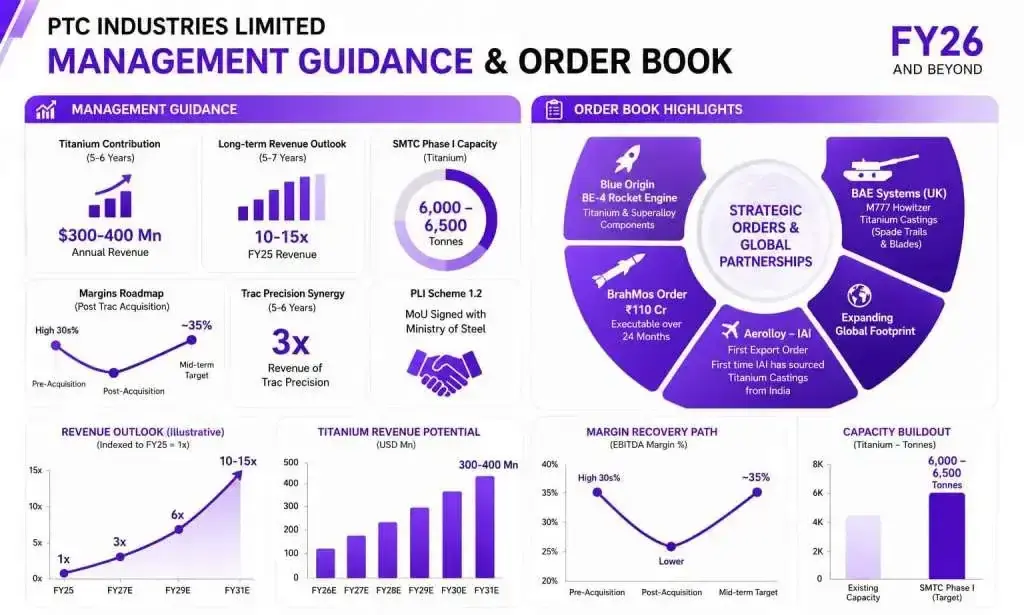
The order pipeline backs this up. PTC has supplied titanium and superalloy components for Blue Origin's BE-4 rocket engine, its entry into space-launch propulsion, and continues serving DRDO, HAL, BrahMos Aerospace, Safran, Dassault Aviation, BAE Systems, Honeywell Aerospace, and IAI, a genuinely diversified base across domestic and global OEMs. Recent wins reinforce the momentum: a ₹110 crore BrahMos order executable over 24 months, a BAE Systems (UK) order for M777 Howitzer titanium castings including Spade Trails and Blades, and Aerolloy's first export order from IAI, the first time IAI has sourced titanium castings from India. Safran also placed a long-term order for seven cast aero-engine components.
Upstream, the company keeps tightening its integration, an MoU with the Ministry of Steel under PLI Scheme 1.2, a sourcing partnership with AMIC TOHO, and a Hot Rolling Mill acquisition for in-house titanium plate and sheet production.
The bigger swing factor is the Strategic Materials Technology Complex in Lucknow, PTC's largest single investment at over ₹1,000 crore. Management notes that equipment procured post-COVID would cost ₹3,000-4,000 crore to replace today, a real cost edge if it holds. Phase I alone targets 6,000-6,500 tonnes of titanium capacity, and management believes titanium could contribute $300-400 million in annual revenue within five to six years, part of a broader 10-15x long-term revenue guidance over FY25 levels, with near-term revenue expected to roughly double.
Margins dipped after the Trac acquisition, but management expects them to recover toward 35% as forecasting to 3x the revenue of the Trac Precision for the next 5-6 years . The thesis now hinges entirely on execution.
"The best way to predict the future is to invent it." — Alan Kay, computer scientist
FAQs
What does PTC Industries do?
+PTC Industries is a Lucknow-based precision metal components manufacturer, founded in 1963, serving aerospace, defence, space, energy, oil & gas, and industrial sectors. Through its subsidiaries Aerolloy Technologies (aerospace-grade titanium and superalloys) and Trac Precision Solutions (UK-based precision machining), the company has built a vertically integrated platform covering raw material production, casting, forging, and finished component manufacturing.
Who are PTC Industries' major clients?
+PTC supplies to HAL, DRDO, BrahMos Aerospace, Safran Aircraft Engines, Dassault Aviation, BAE Systems, Honeywell Aerospace, and Israel Aerospace Industries (IAI), along with Blue Origin for its BE-4 rocket engine. This spread across domestic defence and global aerospace OEMs is a key diversification point for the company.
Is PTC Industries' revenue growth sustainable, or is it acquisition-driven?
+FY26 revenue grew 87.97% YoY to ₹643.28 crore, but a large share came from the first-time consolidation of Aerolloy Technologies (₹190.4 crore) and Trac Precision Solutions (₹247 crore) rather than organic growth in the base casting business. Whether this converts into sustainable, repeatable growth depends on utilisation and order conversion going forward, not just the acquisitions themselves.
Why did PTC Industries' EBITDA margin decline in FY26?
+Margin moderated from 31.97% to 26.78% mainly due to the inclusion of Trac Precision's machining business, which currently runs at a lower margin than PTC's legacy casting operations. This is described as a mix effect rather than an operational or competitive issue, and management expects margins to recover as Trac scales.
What are the key risks in the PTC Industries investment thesis?
+Three stand out: raw material risk (availability and pricing of titanium sponge, nickel, and superalloys), execution risk (whether the heavy capex across Aerolloy, SMTC, and Trac converts into utilisation and returns), and programme timing risk (aerospace/defence qualification cycles are long and partly outside PTC's control).

High growth stock specialist, Value Educator
Shashank Mahajan is an equity research professional with over 12 years of experience in identifying high-potential SME and micro-cap stocks at an early stage. He follows a rigorous scuttlebutt research–driven approach, combining on-ground insights with deep financial analysis. Shashank specializes in uncovering under-researched and under-owned companies with strong management quality and long-term growth potential. Through disciplined research and early identification, he focuses on spotting tomorrow’s market leaders before they enter the mainstream investor radar.

Zen Technologies: Revenue Fell After a Big Win




PNG Jewellers: A 194-Year-Old Name Goes National

Explore our Products
Research Framework
Emerging Titans
Combination of quantitative analysis, industry tailwinds, and management assessment - SPRINT investment philosophy
Tiny Titans
Heavy emphasis on scuttlebutt research, plant visits, and early on-ground signals


 Orders
 Subscription
 Share with friends


Required Details
₹23999.00
(12 month subscription)
As per SEBI regulations, all users are mandated to complete the KYC that is validated for 1 year. Post payment, you will be redirected to the KYC screen


No comments yet. Be the first to comment!