
KSH International: Wires for Electrification
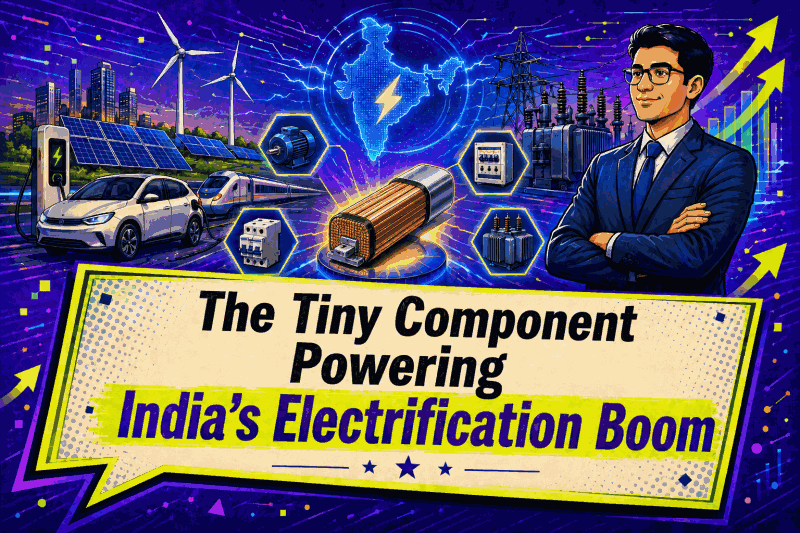
Let's play a quick game. Think of the biggest investment themes everyone's talking about right now — artificial intelligence, data centers, electric vehicles, railways, manufacturing, renewable energy. Now ask yourself: what do any of these actually have in common? At first glance, genuinely nothing. Different industries, different business models, different risks.
Except there's one thing. Electricity.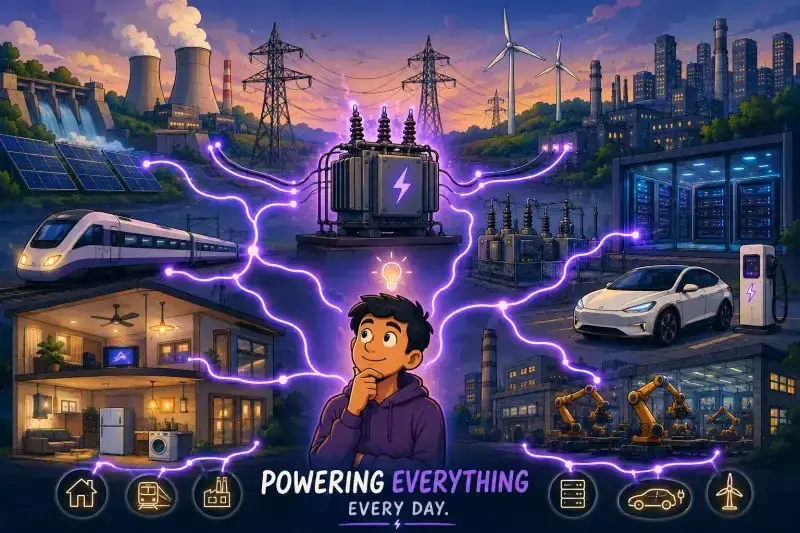
Strip away the complexity and it becomes almost embarrassingly obvious. Data centers? They're essentially just very expensive rooms full of computers that need constant power. EVs? Batteries that need charging. Factories under the Make in India push? Running on electricity. Renewable energy? The whole point is generating it and getting it somewhere useful. Without electricity flowing reliably, none of these themes actually work. They just... collapse.
Which is why it's strange that investors spend so much energy thinking about power generation — and almost none thinking about what happens next. The moment electricity leaves a plant, most people's mental model goes blank. It shows up at home somehow. Switch on, lights on. Done.
The actual process is messier and more interesting than that.
Think of India's power grid as a water distribution system — not because it's a perfect analogy, but because it's the most intuitive one. Power plants are the reservoirs. NTPC thermal stations, solar parks out in Rajasthan, wind farms along the coasts, hydro projects in the hills — all of them are just sources feeding into a larger system. Generation is step one, and honestly, it's the step everyone already understands.
Here's where it gets underappreciated. Electricity produced at a plant comes out at roughly 11 kV. That's fine locally, but try sending it across hundreds of kilometres at that voltage and transmission losses eat you alive. So before it enters the national grid, a transformer steps it up — all the way to nearly 400 kV. Higher voltage, same power, dramatically lower losses over long distances. Think of it like cranking up water pressure before pushing it through a cross-country pipeline. The physics just works better.
Then it travels. Transmission towers, transmission lines, the whole sprawling infrastructure — carrying power from where it's produced to where it's actually needed. Cities, industrial corridors, railway networks, ports, everything. Eventually though, it has to come back down. Nobody's refrigerator runs on 400 kV. So the voltage gets stepped down in stages — 400 kV to 220 kV, then 66 kV, then 11 kV, finally landing at around 230 volts by the time it hits a household socket.
So the full picture: reservoir (power plant), high-pressure pump (step-up transformer), pipeline (transmission grid), pressure regulator (step-down transformer), tap (consumer). Clean loop.
Now. Inside every single transformer in that chain — the step-up ones, the step-down ones, the ones sitting in substations you've driven past a hundred times without noticing — there are copper windings. Coiled wire, essentially. They generate the magnetic field that makes voltage conversion physically possible. Pull them out and the transformer does nothing. It's just a box.
No windings → no working transformer. No transformer → no efficient transmission. No transmission → electricity stays at the plant and the entire downstream economy built on electrification simply doesn't function.
"The best place to hide a good investment is where nobody is looking."
—Howard Marks
The supply chain, laid out plainly: Power Plant → Transformer → Grid → Transformer → Consumer.
Go one level deeper: Copper Producers → KSH International → Transformer Manufacturers → Power Infrastructure → End Users.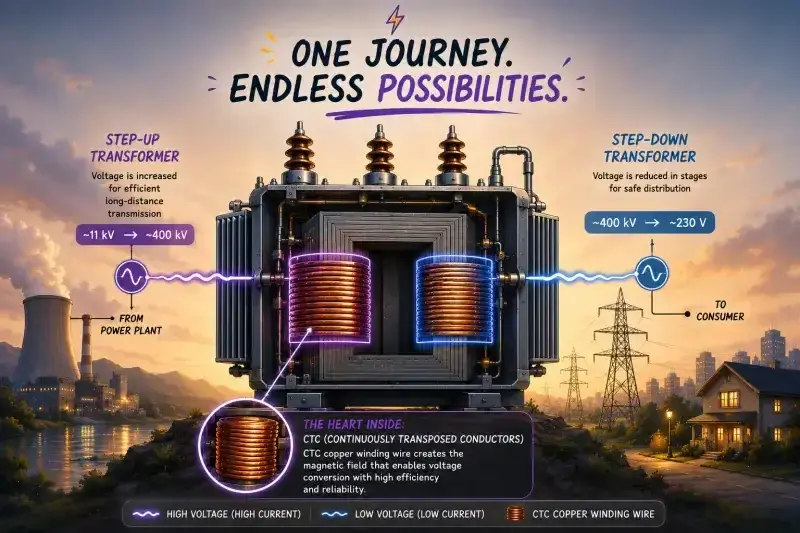
KSH International sits right there — between raw copper and the transformer manufacturers who are about to have a very, very busy decade. Most people who've heard of the company write it off as a copper wire maker. Which, technically, isn't wrong. But it's a bit like calling a semiconductor fab a "sand processor." Accurate. Incomplete.
What KSH actually represents — if you're willing to look past the surface — is a company embedded in the infrastructure layer of India's electrification story. Not at the glamorous end where solar panels and EV brands get the press. At the unglamorous, load-bearing end. The kind of position that tends to matter a lot more than it looks.
Understanding KSH
KSH becomes surprisingly easy to understand once you zoom out a little. Electricity starts its journey at a power plant, moves through transformers and transmission networks, and eventually lands at homes, factories, railways, EV charging stations, and data centers. Most investors naturally gravitate toward the companies generating that electricity or manufacturing the transformers. KSH, though, operates one level deeper in the chain. It supplies the specialized conductors that sit inside transformers and make voltage conversion physically possible. Pull those conductors out and a transformer is essentially just a metal structure. Expensive, inert, useless.
The company's place in the broader ecosystem maps out like this: Copper Producers → KSH International → Transformer Manufacturers → Power Infrastructure → End Users. KSH is not building transformers. What it does is take copper and aluminium and convert them into highly engineered winding wires and conductors used inside transformers, motors, and generators. That puts it at a genuinely interesting point in the value chain — bridging the gap between raw materials and finished electrical equipment, quietly but critically.
What makes this position worth paying attention to is that virtually every major electrification trend ultimately circles back to demand for KSH's products. Renewable energy buildout, railway electrification, data center expansion, EV infrastructure, grid modernization — follow any of these threads far enough and you hit the same requirement: more transformers.
Railway electrification is particularly interesting because it represents one of the largest long-term electricity demand drivers in the country. We discussed another company benefiting from this theme in "The Railway Components Manufacturer Riding India's Rail Infrastructure Expansion."
More transformers need more specialized conductors. And more demand for specialized conductors benefits companies like KSH that have carved out a niche here.
This is exactly why slapping a "wire manufacturer" label on KSH leads you somewhere incomplete. A more honest description would be something like a specialized supplier of transformer components, or better yet, a copper engineering company serving the power infrastructure ecosystem. Its job isn't to generate electricity or transmit it. Its job is to supply the components that let the entire electrical system actually function — efficiently, reliably, at scale.
This is precisely why some of the most interesting opportunities in the power ecosystem aren't always visible to end consumers. Often, they are hidden deep within the infrastructure layer itself. We recently explored a similar business benefiting from India's industrial and power capex cycle in "The Industrial Power Equipment Company Benefiting from India's Capex Cycle."
In a lot of ways, KSH is producing the electrical veins and nerves embedded inside transformers and motors. Nobody sees them. End users certainly don't think about them. But without them, electricity cannot move efficiently from the power plant through the grid and out to the final consumer. That invisibility is actually part of what makes the company's position so interesting. And it's also precisely where the investment story begins.
The Hidden Moat: Why Ordinary Copper Wire Won't Work
Most people hear "copper wire" and immediately think of a commodity. Interchangeable, price-driven, no real edge. If that assumption held, KSH would have very little going for it. But the reality is considerably more nuanced than that first impression suggests.Conductors inside large power transformers don't live easy lives. They carry massive currents, handle high voltages, endure continuous thermal stress, and have to stay reliable across operating lifespans that can stretch several decades. Ordinary copper wire isn't built for any of that. Transformer manufacturers need highly engineered conductors that minimize energy losses, enhance thermal performance, and hold up consistently under some of the most punishing operating conditions in the entire power industry.
The clearest illustration of this is CTC — Continuously Transposed Conductors — which is KSH's flagship specialized product. Instead of using one thick copper conductor, CTC is made by combining multiple insulated copper strands that continuously interchange positions along the full length of the conductor. Sounds almost simple when you describe it that way. The engineering benefits are anything but. The structure improves electrical performance, cuts heat generation, lowers transmission losses, and lets transformers run more efficiently in ultra-high voltage applications.
Manufacturing these things is genuinely hard. Standard winding wires pass through roughly two major production stages. CTC conductors go through five to six highly specialized processes — precision wire drawing, flattening, insulation, transposition, and rigorous quality testing. Tolerances are significantly tighter. Precision requirements are far higher. Only a relatively small number of companies worldwide can produce these consistently and at commercial scale. That manufacturing complexity is itself a meaningful barrier to entry.
But production capability is only part of the story. In this industry, technical approvals matter just as much as the ability to manufacture. Over the years KSH has built relationships with Hitachi Energy, GE Vernova, BHEL, Siemens, and CG Power. These didn't come quickly. They developed over long periods through product performance, reliability, and consistent execution. Once a supplier earns approval, customers are genuinely reluctant to switch — transformer reliability is critical, testing requirements are extensive, and qualification processes are both costly and time consuming. The company reports that repeat business exceeds 95%, with several customer relationships running for nearly 40 years.
The qualification process itself acts as another wall. A new entrant can't just build a factory and start shipping conductors for high-end transformer applications. Products going into critical power infrastructure need approvals not just from transformer OEMs but from utilities like Power Grid and NTPC. Moving up from lower-end applications to conductors used in 765 kV transformers can take anywhere between 5 to 7 years of testing, field validation, and customer qualification. Installing capacity is the easy part. Achieving commercial acceptance is a separate challenge entirely.
Which brings us to what is probably KSH's strongest competitive position right now. The company is currently the only Indian manufacturer approved to supply CTC conductors for HVDC (High Voltage Direct Current) transformer projects. Other manufacturers hold approvals within the 765 kV category, but KSH occupies a distinct position in the HVDC segment — one of the most technically demanding areas of the entire transmission ecosystem. Historically a significant portion of these conductors was imported from global suppliers, which makes KSH's approval a meaningful endorsement of both its engineering depth and its manufacturing credibility.
So no — this is not a commodity wire business. Copper itself is a commodity. Engineering know-how, customer approvals, qualification cycles, manufacturing precision, and four decades of accumulated trust are not. KSH's moat has nothing to do with the metal it buys. It has everything to do with the complexity of what it turns that metal into before it reaches some of the most critical components in India's power infrastructure.
"The key to investing is not assessing how much an industry is going to affect society, but rather determining the competitive advantage of any given company."
— Warren Buffett
How KSH Makes Money
At first glance KSH looks like a conventional wire manufacturer. Dig a little deeper and what you find is a business built around two distinctly different product segments. Understanding the difference between them is really the key to understanding the company's economics. Both segments use copper and aluminium as primary raw materials, but the complexity, profitability, customer relationships, and competitive dynamics are fundamentally different on each side.
The first segment, and by far the more important earnings engine, is Specialized Wires. This contributes roughly 75 to 77% of KSH's revenue. The portfolio here includes Continuously Transposed Conductors (CTC), Paper Insulated Copper Conductors (PICC), enamelled winding wires, and other specialized conductors used in transformers, transmission infrastructure, railway systems, renewable energy projects, and industrial power equipment. These are not products you pick off a shelf. They are highly engineered solutions built to meet demanding technical specifications and, in many cases, require years of testing, qualification, and customer approval before commercial supply can even begin.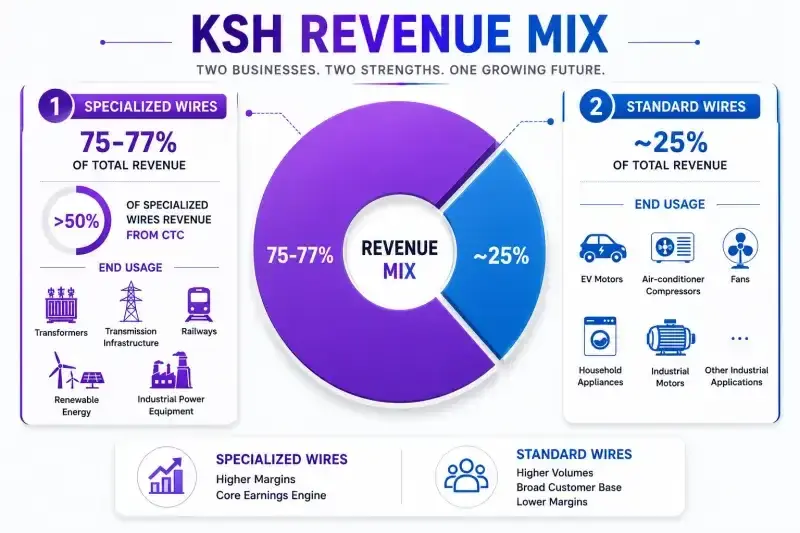
What makes this segment genuinely compelling is its direct connection to India's long-term electrification story. Every new transformer added to the grid, every transmission project commissioned, every railway electrification initiative, every renewable energy installation — all of it increases demand for exactly the kinds of specialized conductors KSH produces. The company isn't just selling copper-based products. It is supplying critical components that help electricity move efficiently and reliably throughout the power ecosystem.
The second segment is Standard Wires, serving applications like EV motors, air-conditioner compressors, fans, household appliances, and various industrial motors. This side operates at larger volumes and serves a broader customer base. It is also more competitive and typically generates lower margins than the specialized conductor business. The distinction matters more than it might initially seem. In standard wire applications, customers are largely buying a product. In the specialized segment, they are buying performance, reliability, efficiency, technical approvals, and long-term operational confidence. Those are very different commercial relationships.
This gap is important because not every tonne KSH produces creates the same economic value. A tonne supplied into a highly specialized transformer application can generate meaningfully higher profitability than a tonne sold into a conventional motor or appliance application. This is exactly why management has consistently emphasized growing the share of value-added and specialized products within the overall portfolio. The goal isn't simply volume growth. It's improving the quality, durability, and profitability of earnings over time.
Looked at this way, KSH's business model becomes much easier to map out. One side benefits from broad industrial demand tied to motors, appliances, and EV-related applications. The other, considerably more important side, is anchored to long-term structural themes — power infrastructure expansion, grid modernization, renewable energy deployment, transformer demand. Together they create a diversified and balanced business. But it is the specialized conductor segment that continues to set KSH apart, and it remains the core foundation of whatever competitive advantage the company has built.
The Demand Explosion Ahead
The most important question for investors isn't what KSH manufactures today. The more relevant question is whether demand for those products can keep expanding over the next decade. On that front, the industry backdrop looks remarkably supportive right now.
KSH's products sit inside transformers, and transformers are increasingly becoming one of the most critical building blocks of the global electrification cycle. Here's what makes that particularly interesting — it doesn't matter whether electricity is generated from coal, solar, wind, or hydro. It still relies on transformers to move efficiently across the grid. Which means transformer demand is no longer tied to any single industry or end market. It is being pulled forward by several powerful structural trends simultaneously.
One of the clearest signals of this opportunity is what's happening in India's transformer manufacturing industry itself. According to management, domestic transformer capacity is expected to expand from roughly 110 GVA today to nearly 300 GVA by FY28. That is one of the most significant capacity expansions the industry has seen in recent memory. Every additional transformer produced needs winding wires, paper insulated conductors, and CTC conductors — a direct demand tailwind for suppliers positioned exactly where KSH is.
The CTC market makes this even more interesting. Current Indian demand for CTC conductors sits at approximately 40,000 tonnes per year. Management expects that number to climb to around 70,000 to 75,000 tonnes in the near term, with demand potentially reaching 100,000 to 120,000 tonnes by FY30 to FY32 as transformer manufacturing capacity continues scaling up. For one of KSH's most specialized product categories, that implies demand could double or even triple over the coming years.
Several long-term megatrends are feeding into this simultaneously. Renewable energy is the obvious one. Every solar park and wind project needs transformers, substations, and transmission infrastructure to actually get electricity from where it's generated to where it's consumed. As renewable capacity grows, the supporting electrical infrastructure grows right alongside it.
Then there's AI and data centers. Data centers are among the most electricity-intensive facilities being built anywhere in the world today, and they need highly reliable power infrastructure to maintain uninterrupted operations. Every new data center adds incremental demand for transformers, switchgear, and related electrical equipment — which flows back through the supply chain to conductor manufacturers like KSH.
Electric vehicles are another piece of this. EV adoption tends to get discussed almost entirely through the lens of automobile sales, but the supporting infrastructure matters just as much. A growing network of charging stations increases electricity consumption and puts additional pressure on local distribution systems. That requires investment in substations, transformers, and distribution infrastructure. The electrification of transportation, in other words, feeds directly back into the same ecosystem KSH serves.
And then there's grid modernization, which might actually be the largest opportunity of all. India's transmission and distribution network is currently going through one of the biggest investment cycles in its history, as the country prepares for higher electricity consumption, greater renewable integration, and sustained industrial growth. Every grid expansion or upgrade needs transformers. Every transformer needs specialized conductors. Every conductor is a potential revenue opportunity for companies sitting where KSH sits.
Looked at individually, each of these drivers is attractive. Looked at together, they create something considerably stronger. Renewable energy expansion, AI-driven data center growth, rising EV adoption, transmission infrastructure development, and large-scale grid modernization are all pushing demand in the same direction at the same time. Sitting quietly at the intersection of all of it is KSH International — a company whose products most end consumers will never see or think about, yet are becoming increasingly indispensable to the infrastructure that keeps the modern economy running.
"The big money is not in the buying or selling, but in the waiting."
— Charlie Munger
While this article focuses on a critical component supplier within that ecosystem, investors looking at the broader electrification opportunity may also find value in our analysis of "Top Power Sector Stocks in India for 2026."
Why Is Management Expanding Aggressively?
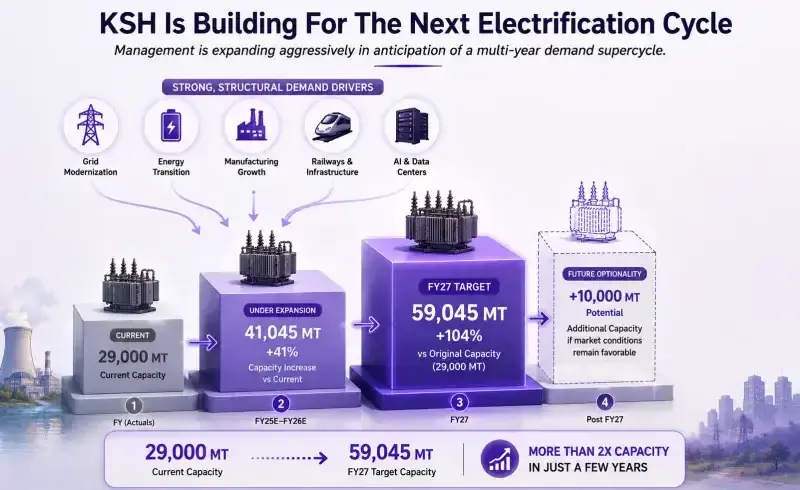
If there's one thing management seems genuinely convinced about, it's that the current demand environment isn't just a short-term upswing. Over the past few years KSH has undertaken one of the most significant expansion programs in its history — steadily adding capacity in anticipation of demand that hasn't fully arrived yet. Installed capacity, which stood at around 29,000 MT, is being expanded to 41,045 MT, with a defined roadmap to reach 59,045 MT by FY27. Management has also indicated that an additional 10,000 MT could be layered on top of that if market conditions continue to remain favorable.
"The future is already here — it's just not evenly distributed."
— William Gibson
On the surface, it's tempting to file this under "standard industrial capacity expansion." Companies add manufacturing capacity when order books strengthen. Nothing unusual there. But the scale and pace of what KSH is doing suggests something more deliberate than just reacting to a good cycle. Management isn't responding to current demand so much as betting on what demand looks like three, four, five years from now — specifically around transformer manufacturing, power infrastructure investment, and the broader electrification wave.
The timing makes this worth paying attention to. Transformer manufacturing capacity in India is expected to grow from roughly 110 GVA to nearly 300 GVA by FY28. Simultaneously, demand for CTC conductors is projected to rise from around 40,000 tonnes annually today to potentially 100,000 to 120,000 tonnes by FY30 to FY32. If those numbers even partially materialize, the companies that already have approved products, established customer relationships, technical qualifications, and manufacturing capacity in place are going to be in a very different position than those scrambling to catch up.
And that's really the crux of why KSH's expansion strategy starts to make a lot of sense. Qualification cycles in this industry routinely run 5 to 7 years. You can't just flip a switch, build a factory, and start supplying conductors for high-end transformer applications the moment demand shows up. By the time approvals are secured, testing is completed, and commercial acceptance is achieved, years have already gone by. Businesses in this space have to invest well ahead of demand — not after it becomes obvious. KSH's current expansion looks very much like a company that understands this dynamic.
So the real question isn't whether management is adding capacity. The more interesting question is whether they are positioning KSH for what could turn into a genuine multi-year transformer and electrification supercycle. If India's grid expansion plans, renewable energy investments, data center growth, transmission infrastructure spending, and industrial electrification initiatives continue progressing as expected — today's capacity additions might look very different in hindsight. What reads as aggressive right now could, a few years from now, look less like expansion and more like preparation for something considerably larger.
The Backward Integration Story
Here's something about KSH that doesn't get talked about enough. Management isn't just focused on adding capacity. They're also quietly working to improve the economics of every single tonne the company produces — and that's a meaningfully different kind of ambition.Right now, KSH's manufacturing process follows a fairly straightforward path: Copper Cathode → Rod Manufacturer → KSH → Finished Conductors. In plain terms, the company buys copper rods from external suppliers and processes them into specialized winding wires and conductors. That model has worked well for years. But it also means a portion of the value chain sits outside KSH's direct control, which in an industrial business is always a bit of an uncomfortable position to be in.
Management wants to change that. The company is setting up an Upcast Copper Rod facility that would let it convert copper cathodes directly into rods before processing them further into finished conductors. If it works as planned, the chain becomes: Copper Cathode → KSH Upcast Rod Facility → KSH Conductors. One less middleman. One more manufacturing stage brought in-house. A larger share of the value created staying within KSH's own operations.
It sounds like a modest tweak. In reality, changes made at the beginning of a value chain tend to have a disproportionate impact on profitability over time — that's just how industrial economics work. According to management, the Upcast facility has the potential to improve EBITDA by roughly ₹2,000 to 3,000 per tonne. Beyond the financial benefit, it also means greater control over product quality, better supply security, and smoother production planning. Those things compound quietly in the background but matter a lot over a full business cycle.
There's another angle here worth noting. Copper scrap generated during manufacturing can be recycled more effectively within an integrated production setup, reducing wastage and improving resource utilization. In a business where margins get evaluated on a per-tonne basis, even small efficiency gains have a habit of accumulating into something meaningful over time.
In a lot of ways this mirrors what GPIL did when it moved closer to the source of its key raw material through captive iron ore mines, reducing dependence on external suppliers and strengthening its cost position. KSH appears to be following a similar line of thinking with copper. The goal isn't to speculate on copper prices or reinvent itself as a mining business. It's about gaining greater control over a critical input, improving unit economics, and sitting more firmly within the broader value chain.
And honestly, that's how most durable competitive advantages get built in industrial businesses. Rarely through one big dramatic decision. More often through a series of incremental improvements that strengthen the business one layer at a time, quietly and without much fanfare. In that context, this additional step toward integration might end up being considerably more significant than it appears on the surface today.
"The essence of investment management is the management of risks, not the management of returns."
— Benjamin Graham
Financial Performance: Does The Story Reflect In The Numbers?
Up until this point, the focus has been largely on the narrative. But every investment thesis eventually arrives at the same question: do the numbers actually back it up? In KSH's case, the answer is looking increasingly positive — and what's particularly encouraging is that growth isn't coming from just one place.
And when evaluating whether growth is actually creating shareholder value, few metrics matter more than return ratios. For readers newer to financial analysis, our guide on "Return on Equity (ROE) Explained: A Step-by-Step Guide for Investors" is a useful companion.
The company is benefiting from rising industry demand, sure. But it's also seeing a gradual shift toward higher-value products like CTC conductors, HVDC conductors, and other specialized winding wires. So growth is no longer being driven purely by volumes. Increasingly, it's being driven by a richer product mix and greater value addition per tonne sold. That's a meaningfully different and better kind of growth.
The clearest evidence shows up in operating performance. Management highlighted that 9M FY26 revenue had already surpassed KSH's entire FY25 revenue — which says something about the pace at which demand is accelerating across transformer manufacturing, power infrastructure projects, and specialized conductor applications. Volume growth held up strongly too, with FY26 volumes increasing by roughly 21% year on year. That distinction matters because it suggests genuine end-market demand is doing the heavy lifting here, not simply copper price fluctuations inflating the topline.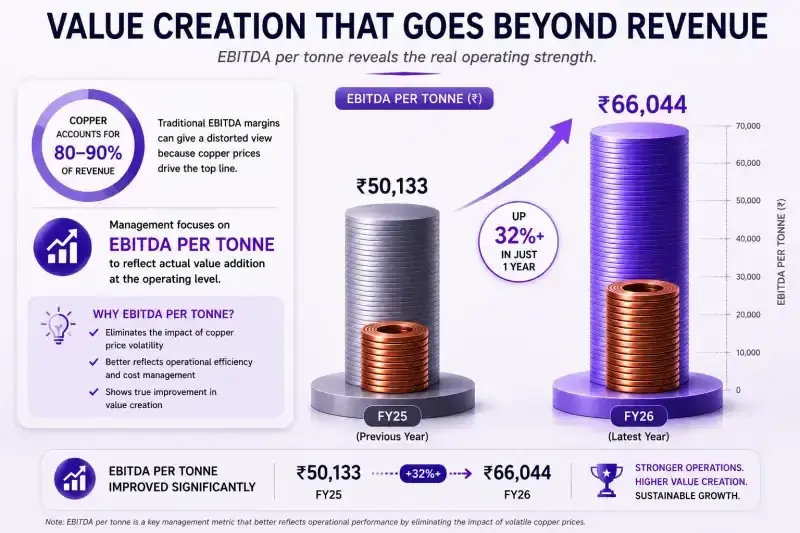
The profitability picture is even more interesting. Since copper accounts for roughly 80 to 90% of revenue, traditional EBITDA margins can give a distorted view of what's actually happening at the operating level. Management therefore places greater emphasis on EBITDA per tonne, which cuts through the noise and reflects actual value addition more clearly. On that measure, the improvement has been meaningful. EBITDA per tonne increased from ₹50,133 to ₹66,044 within a single year, a jump of more than 32%. The momentum then continued into Q4 FY26, when EBITDA per tonne hit a record ₹74,018. That kind of trajectory suggests the product mix is genuinely shifting toward higher-value specialized conductors, where KSH has stronger pricing power and a more defensible position.
Capacity expansion tells its own story. KSH historically operated at around 29,000 MT. That has already moved up to 41,045 MT and is expected to reach 59,045 MT by FY27. The willingness to keep investing aggressively in new capacity — even before demand fully arrives — reflects management's conviction that this isn't a short cycle. They appear to believe transformer demand, grid infrastructure spending, and electrification-linked growth have a long runway ahead.
Exports have quietly become another meaningful contributor. KSH currently serves customers across 24 countries, with exports historically accounting for 30 to 40% of total revenue. Management continues to prioritize domestic opportunities, but export performance has been hard to ignore. In Q4 FY26, export revenue grew by 92% year on year. Almost all of that export revenue comes from specialized winding wires, particularly CTC products — which further reinforces the point that KSH's edge is in engineering and specialized manufacturing, not commodity processing.
Then there's the customer base, which might be the most underappreciated part of the story. KSH serves approximately 120 OEM customers globally. Repeat business exceeded 94.5% in FY25 and crossed 95% in FY26. Some of these relationships have been running for nearly 40 years. In an industry where approvals, technical qualifications, and performance track records genuinely matter, those retention numbers are telling you something important about the durability of the business — arguably just as much as the revenue growth figures are.
Taken together, what KSH's financials reflect is the same theme that keeps coming up throughout this story. The company isn't trying to create value by predicting copper prices. It's creating value through engineering expertise, product specialization, technical approvals, and deeper participation in the electrification value chain. Rising volumes, higher EBITDA per tonne, strong export growth, expanding capacity, and remarkably sticky customer relationships are all pointing in the same direction. At least for now, the numbers appear to be doing a pretty good job of validating the broader narrative.
Risks Investors Must Understand
Every investment thesis tends to look compelling when demand is strong and industry conditions are playing along. The harder and more important exercise is asking what happens when they don't. KSH is currently riding some powerful electrification tailwinds, but no business is immune to risk — and in KSH's case, several of the same factors supporting growth today could flip into headwinds under a different environment.
The first risk is the transformer cycle itself. A significant chunk of KSH's growth story is tied to transformer manufacturing, transmission infrastructure, and grid expansion. Industry transformer capacity is expected to grow from roughly 110 GVA to nearly 300 GVA by FY28, which creates substantial demand for specialized conductors. But if utility spending slows, infrastructure projects face delays, or transformer demand falls short of those projections, conductor demand moderates alongside it. KSH may well continue gaining market share — but it still operates within a larger industry cycle that sits outside its direct control. That's just the reality of where it sits in the value chain.
Copper supply is another variable worth taking seriously. Copper is KSH's largest raw material, typically contributing around 80 to 90% of revenue. The company generally passes price fluctuations through to customers, but disruptions in copper availability can still affect production schedules, working capital requirements, and timely order execution. Supplier concentration adds another layer here. The largest supplier accounted for 48.07% of raw material purchases in FY25 and 67.86% in FY24. Management's upcoming 60,000 TPA Upcast rod facility is expected to reduce this dependence over time, but until that transition is fully complete, the concentration risk is real and worth watching.
Then there's competition in the standard winding wire segment. KSH's position in specialized products like CTC and HVDC conductors is genuinely strong — technical expertise, approvals, and qualification cycles create real barriers there. Standard winding wires are a different story altogether. Entry barriers are lower, competition is more intense, and pricing is less favorable. A large part of KSH's profitability advantage comes precisely from specialized conductors, which can generate roughly 3x higher EBITDA per tonne than standard winding wires. Any slowdown in the company's transition toward higher-value products could cap future margin expansion.
Execution risk is becoming increasingly relevant as KSH enters what is probably the most ambitious investment phase in its history. Manufacturing capacity is being scaled from roughly 29,000 MT to 59,045 MT, while simultaneously a 60,000 TPA copper rod facility is being developed as part of the backward integration strategy. Large projects rarely go entirely to plan. Delays in commissioning, cost overruns, operational hiccups, or slower than expected capacity utilization could push out the earnings benefits investors are currently pricing in.
Exports deserve a mention here too — they represent both a genuine growth opportunity and a potential source of volatility. KSH currently exports to 24 countries, with specialized winding wires accounting for almost all of that export revenue. Export revenue grew 92% year on year in Q4 FY26, which is an impressive number. But global market conditions can shift quickly. Slower infrastructure investment, trade restrictions, geopolitical developments, or weaker industrial activity in key markets like the US, UAE, Saudi Arabia, and Europe could affect export growth in ways that are difficult to anticipate from here.
There's also the possibility of industry-wide capacity overbuild — a risk that tends to get ignored precisely when demand is strongest. CTC demand is expected to grow from roughly 40,000 tonnes today to 100,000 to 120,000 tonnes by FY30 to FY32. Strong demand like that historically encourages competitors to expand aggressively. If industry capacity grows faster than end-market demand actually materializes, pricing power weakens, margins come under pressure, and returns on capital can disappoint — even in industries with genuinely attractive long-term prospects.
None of this necessarily breaks the investment thesis. In many ways these risks are natural consequences of operating in a rapidly growing and evolving industry. But understanding them honestly is non-negotiable. Good investing was never really about finding businesses completely free of risk. It's about judging whether the opportunity is sufficiently attractive relative to the risks involved. For KSH, that ultimately means weighing electrification-driven growth against the real uncertainties around execution, competition, industry cycles, and capacity expansion.
After everything discussed so far, the investment thesis really does come down to a surprisingly simple question.
Explore our Products
Research Framework

Emerging Titans
Combination of quantitative analysis, industry tailwinds, and management assessment - SPRINT investment philosophy

Tiny Titans
Heavy emphasis on scuttlebutt research, plant visits, and early on-ground signals
What exactly is KSH International?
On the surface, the answer seems straightforward. The company buys copper, processes it into conductors, and supplies customers across the electrical equipment industry. Looked at purely through that lens, KSH can easily read like another industrial manufacturer operating in a competitive and cyclical market. Nothing particularly special.But that reading misses most of what's actually going on.
Throughout this piece, a different picture has emerged. KSH occupies a genuinely critical position within the broader power infrastructure ecosystem. Its products sit inside transformers that allow electricity to move efficiently across the grid. The company supplies leading OEMs, operates in highly specialized product categories like CTC and HVDC conductors, maintains customer relationships that stretch across decades, and benefits from qualification cycles that take 5 to 7 years to replicate. Those aren't the characteristics of a commodity business. They're the traits of a company supplying mission-critical components to a technically demanding and deeply specialized industry.
And then there's the demand side, which is arguably the most compelling part of the story.
Renewable energy projects need transmission infrastructure. Data centers depend on reliable power networks. Railway expansion requires electrification. EV adoption needs charging infrastructure. Grid modernization means new substations and transformers.
In fact, transmission infrastructure has quietly become one of the largest investment themes in the country. We explored another company benefiting directly from this trend in "The Power Engineering SME Riding India's Transmission Expansion Cycle."
Each of these themes looks distinct on the surface, but follow any of them far enough and they all converge on the same underlying requirement — a stronger, more extensive electrical infrastructure network. Every single one of these trends increases demand for the specialized conductors that KSH manufactures. That's not a coincidence. That's the entire point.
Which is why the most accurate way to think about this business is probably as a pick-and-shovels play on India's electrification journey. Rather than depending on the success of any single technology, customer segment, or end market, KSH operates one layer deeper in the value chain. It supplies products that remain essential regardless of whether electricity is ultimately consumed by a factory, a railway system, a renewable energy installation, a data center, or an EV charging network. The end application almost doesn't matter. The conductor inside the transformer is needed either way.
So that's really the question investors need to sit with.
Is KSH simply a winding wire manufacturer participating in a growing industry? Or is it a specialized electrification infrastructure supplier quietly positioned at the intersection of multiple long-term megatrends?
Because if India's electrification story unfolds anything like the way industry participants expect it to, the most valuable businesses may not turn out to be the ones generating electricity.
They may well be the companies supplying the critical components that allow the entire system to function in the first place.
FAQs
Is this just another copper wire manufacturer?
+Not quite. While copper is the primary raw material, the company operates in highly specialized products used inside transformers, generators, and critical power infrastructure. These products require years of engineering expertise, approvals, and customer qualification, making the business very different from a standard wire manufacturer.
Why is the transformer industry so important to this story?
+Because every major electrification trend eventually needs transformers. Whether it's renewable energy, AI data centers, EV charging infrastructure, railways, or industrial manufacturing, electricity must be transmitted efficiently through the grid. And every transformer requires specialized conductors to function.
What is the company's biggest competitive advantage?
+Its moat comes from technical approvals, manufacturing complexity, and long qualification cycles. In certain high-end applications, new entrants may require 5–7 years to obtain approvals. The company is also the only Indian supplier approved for specific HVDC transformer conductor applications, creating a significant barrier to entry.
Why does the company focus so heavily on specialized conductors?
+Because not all tonnes are created equal. Specialized conductors account for roughly 75–77% of revenue, and products such as CTC conductors generate significantly higher profitability than standard winding wires. In fact, management has indicated that specialized products can generate roughly 3x higher EBITDA per tonne, which is why the company continues to prioritize this segment.
What is the single most important thing investors should track going forward?
+The key variable is demand for transformers and specialized conductors. If trends such as grid modernization, renewable energy expansion, data center growth, railway electrification, and EV infrastructure continue as expected, demand for specialized conductors could rise substantially over the next decade. Ultimately, the investment thesis depends on whether electrification demand translates into sustained growth for critical transformer components.

High growth stock specialist, Value Educator
Shashank Mahajan is an equity research professional with over 12 years of experience in identifying high-potential SME and micro-cap stocks at an early stage. He follows a rigorous scuttlebutt research–driven approach, combining on-ground insights with deep financial analysis. Shashank specializes in uncovering under-researched and under-owned companies with strong management quality and long-term growth potential. Through disciplined research and early identification, he focuses on spotting tomorrow’s market leaders before they enter the mainstream investor radar.

Zen Technologies: Revenue Fell After a Big Win



PNG Jewellers: A 194-Year-Old Name Goes National
Explore our Products
Research Framework
Emerging Titans
Combination of quantitative analysis, industry tailwinds, and management assessment - SPRINT investment philosophy
Tiny Titans
Heavy emphasis on scuttlebutt research, plant visits, and early on-ground signals


 Orders
 Subscription
 Share with friends


Required Details
₹23999.00
(12 month subscription)
As per SEBI regulations, all users are mandated to complete the KYC that is validated for 1 year. Post payment, you will be redirected to the KYC screen


No comments yet. Be the first to comment!