
Shilchar: The Transformer Specialist
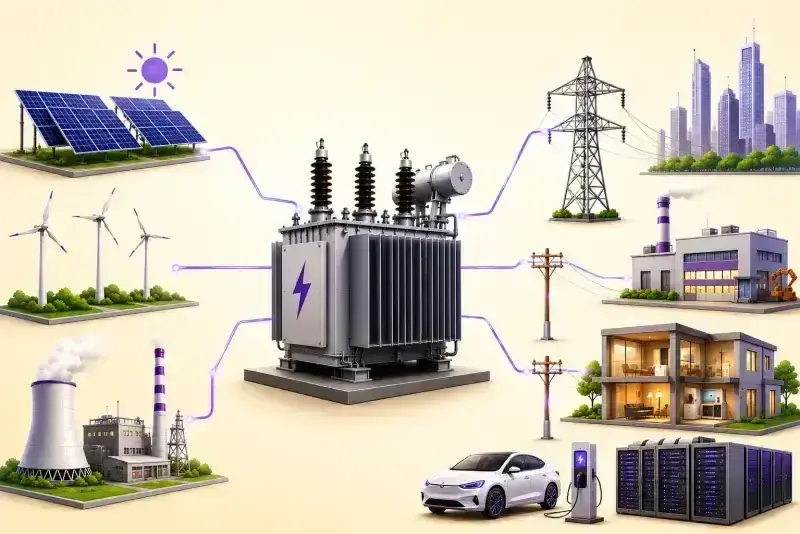
Nobody talks about transformers.
Every solar panel baking in the Rajasthan sun, every wind turbine spinning off the Gujarat coast, every thermal unit still grinding away in Jharkhand — the electricity they produce is completely useless until a transformer steps it up, moves it, steps it back down, and delivers it somewhere a human being can actually use it. You don't get to skip that step. There's no workaround, no software patch, no startup disrupting it away. Physics just doesn't allow it.
So when India decided to go big on power, it accidentally created one of the most boring sounding and genuinely lucrative industrial stories of the decade.
What changed?
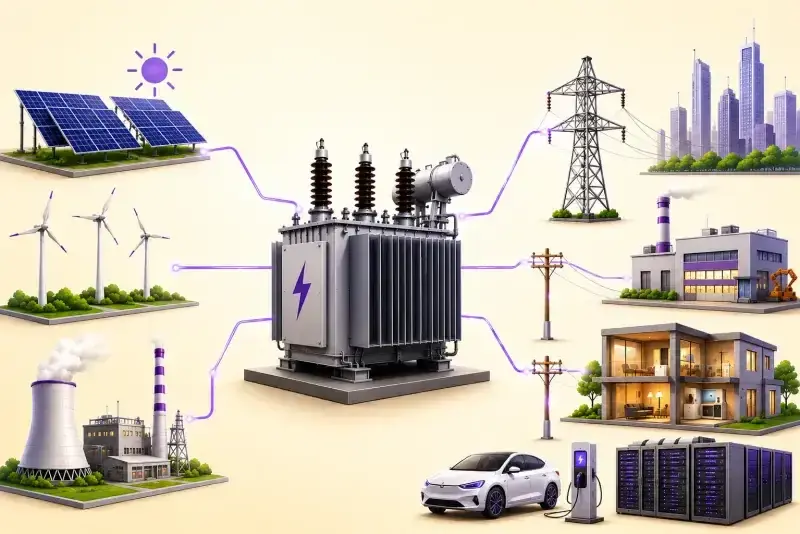
Everything.
Urbanization didn't slow down, it accelerated. Factories that left China needed somewhere to land, and a lot of them picked India. The government started throwing serious money at renewables, not pilot-project money, real money. EVs went from a niche conversation to a mainstream one.
Data centers showed up with the electricity appetite of small cities, multiplying across Navi Mumbai, Pune, Chennai, Hyderabad, in a way that nobody's grid planning from 2018 had accounted for.
All of it runs on electricity.
All of that electricity passes through transformers.
The manufacturers who saw this coming or who happened to already be positioned correctly when it arrived are now sitting inside a demand cycle that isn't a spike. It's a ramp. The kind that doesn't reverse when the next quarterly GDP number disappoints. The kind built on ten overlapping structural tailwinds rather than one good policy.
Which finally brings us to our company, and why a company most people haven't heard of deserves a much closer look.
While competitors kept adding product lines — cables today, switchgear tomorrow, maybe some metering equipment next year — our company dug deeper into transformers. Specifically into inverter duty transformers, the type that solar projects can't function without. They didn't try to be everything to the power sector. They tried to be indispensable to one critical part of it.
That bet has paid off in numbers that are almost suspicious in how clean they look.
This structural demand cycle is one of the biggest reasons investors have turned their attention toward power companies. If you're interested in the broader sector, you may also like "Power Sector Stocks in India 2026: List by Value Chain."
Among every listed transformer manufacturer in India, Shilchar sits at or near the top on profitability metrics. The balance sheet carries zero debt. Cash generation has been consistent in a way that capital-intensive manufacturing businesses rarely manage. No dramatic acquisitions. No headline-grabbing pivots. Just a company that picked its lane, got very good at it, and found itself in exactly the right place when India's power buildout shifted from ambition to execution.
"Behind every stock is a company. Find out what it's doing." Peter Lynch
India's Transformer Industry Is Entering a Multi-Year Growth Cycle
In the past, the transformer industry has always expanded in accordance with electricity demand. But the expansion of the current growth cycle is being fueled by a number of structural forces that are driving growth far beyond traditional power generation.
India keeps on investing big in renewable energy with the target to ramp up solar and wind power installations in the next couple of years. Transformers are crucial components in the renewable energy value chain, as all renewable energy projects need to integrate the electricity generated with the transmission network, making transformer manufacturers an integral part of the clean energy value chain.
Meanwhile, the government is spending heavily on improving the country's T&D network. Thousands of new transformers in various voltage ranges are needed for programmes to modernize substations, minimize transmission losses and enhance the reliability of the grid.
This is because there are other big requirements coming from industrial expansion. Power transformers are needed for reliable power infrastructure in new manufacturing facilities, semiconductor projects, steel plants, metro rail systems, commercial developments, and large infrastructure projects, among others.
The international market is also becoming more favorable, in addition to the domestic market. A number of developed countries are both enhancing their existing electrical infrastructure and increasing their levels of renewable energy. This has given an opportunity to Indian transformer companies that can produce transformers which fit the high quality standards set in the overseas markets.
The transformer industry has a number of long-term demand drivers working at once, unlike other industry cycles, which relied on a single market trigger. Therefore, the demand is expected to persist for a few years as investments are planned in the renewable energy, transmission network, electrification of industrial systems, and export segments.
The company we are going to discuss today is Shilchar Technologies
For investors looking to explore other companies benefiting from these long-term industry trends, read "Top Power Sector Stocks in India for 2026."
Company Overview
Founded in 1986 in Gujarat, Shilchar Technologies has grown from being a traditional transformer manufacturer to one of the largest transformer manufacturers of specialized power and distribution transformers in India. The company has accumulated a solid technical base to design and manufacture transformers for renewable energy projects, utilities, industrial applications and global customers over the years.
Instead of scaling in all the transformer segments, the company has decided to adopt a focused approach, targeting the technically challenging products where quality, engineering prowess and customer relationship matters more than price. It has allowed Shilchar to carve out a niche in product categories and consistently achieve profitability that is significantly higher than many of its listed counterparts.
One of the main advantages of the company is its leadership in Inverter Duty Transformers (IDTs). These are transformers that are specially made for renewable energy, where the electricity created by solar panels goes through an inverter prior to it being sent to the power grid. Inverter duty transformers are required to have a more complex design than conventional transformers because of the high harmonic distortion, varying electrical loads, and challenging operating conditions.
The company also produces power transformers for utility, wind power, industrial and export applications in addition to inverter duty transformers. This diversified product portfolio has helped the business to minimize dependence on any particular segment over the years, and also provided ample growth opportunities in the power sector.
In FY26 the company continued to run at high capacity utilization, debt free, with healthy cash flows and announced another major manufacturing expansion to further support growth in the company.
Business Model
Shilchar Technologies operates according to a specialized manufacturing model – it makes products of high value rather than competing in the low margin and commodity manufacturing business. The firm focuses on customized, technically advanced and reliable transformer solutions for customers and is able to stand out from the crowd with engineering skills and not necessarily with lower prices.
Much of its trade is in the renewable energy market, where inverter duty transformers are now a crucial part of solar energy initiatives. The renewable energy segment has been one of the fastest growing areas for the company as the addition of renewable energy installations continues to ramp up in India.
Apart from renewable power, Shilchar is exporting transformers to various export markets, to the utilities, and also in various infrastructure projects. This diversified customer base minimizes the risk of relying on any one industry, while also providing the company with a way to engage in a number of long-term investment themes that are driving change in the power sector.
Shilchar is following a disciplined capital allocation strategy, unlike several manufacturing firms that take on a lot of borrowing for quick expansion. The company has added capacity with internal cash generation efforts, so it remains debt free despite expanding manufacturing capacity. This conservative finance stance has helped to improve the balance sheet and flexibility with investing in future growth opportunities without elevating financial risk.
Products and Manufacturing Capabilities
Shilchar Technologies produces a variety of transformers for various applications in the power sector. It has its product range expanded with inverter duty transformers, power transformers, distribution transformers, wind power transformers and customized transformer solutions based on the customer requirements.
Of these, inverter duty transformers are probably the most popular product category that the company is known for. These transformers are essential in solar energy plants for an efficient transfer of electricity produced by the inverter to the transmission network. They have greater technical sophistication than standard transformers, and pose a significant hurdle for rivals because they can operate in challenging conditions.
The company has been gradually expanding their manufacturing capacity to meet the rising demand of the business. Earlier capacity additions were used to their full capacity due to the strong demand from the industry and not because of the excess capacity. This momentum picked up further, and Shilchar announced another huge project to be expanded in FY26.
The Gavasad Expansion Phase III will expand the manufacturing capacity from about 7,500 MVA to 14,000 MVA, approximately 200% of its current manufacturing capacity. The project is planned to be commissioned in FY27 and will be funded completely from internal accruals, showcasing the company's solid financial standing and confidence in the industry need for such projects in the long term.
The growth will not only boost production capacity but make Shilchar even more capable of handling bigger projects and make the most of the market demand for special transformers within the nation, as well as in the international market.
Competitive Advantages
Shilchar Technologies has developed several competitive advantages, which are unique that make it stand out from many different transformer manufacturers.
It has the best technical expertise on the inverter duty transformer market. The company has been selling renewable energy for several years, allowing it to build up a niche where engineering skills and product reliability may be more critical than price.
The company's profitability is also one of the best in the listed transformer industry. Shilchar's EBITDA margins have always been higher than many of its peers due to the emphasis on specialized products rather than commoditized ones and operational efficiency.
Consistently high profitability is often supported by efficient capital allocation and strong returns on shareholder capital. Learn how to evaluate this metric in "Return on Equity (ROE) Explained: A Step-by-Step Guide for Investors."
Another key strength is a debt free balance sheet. Though manufacturing houses have taken loans from outside to expand their capacities, Shilchar has been able to finance most of its expansion from internal cash generation. This strategy of conserving funds offers more stability when the industry slows down and offers flexibility in future investments.
Another competitive edge that customers may offer is through their relationships. The procurement of transformers involves a long process of qualification, testing and quality standards. After the transition of customers to a manufacturer for critical applications, changing the supplier can be costly and risky. This can lead to lasting connections that foster potential recurring business and improve revenue visibility over time.
Last but not least, the company has been established in the export field and is building up its home business. This diversified income portfolio gives Shilchar the flexibility to tap into opportunities created by India's infrastructure spending and also help it avail the benefits as world nations gear up for modernizing their power grid to meet the growing demand for transformers.
"Quality means doing it right when no one is looking." Henry Ford
FY26 Financial Performance
In FY26, Shilchar Technologies achieved another year of positive financial results, maintaining its impressive growth pattern that has been consistent over the last few years. The company's growth slowed from the very impressive levels seen in FY25; however, it continued to report high levels of profitability, solid operating cash flows and improving balance sheet metrics in a dynamic global environment.
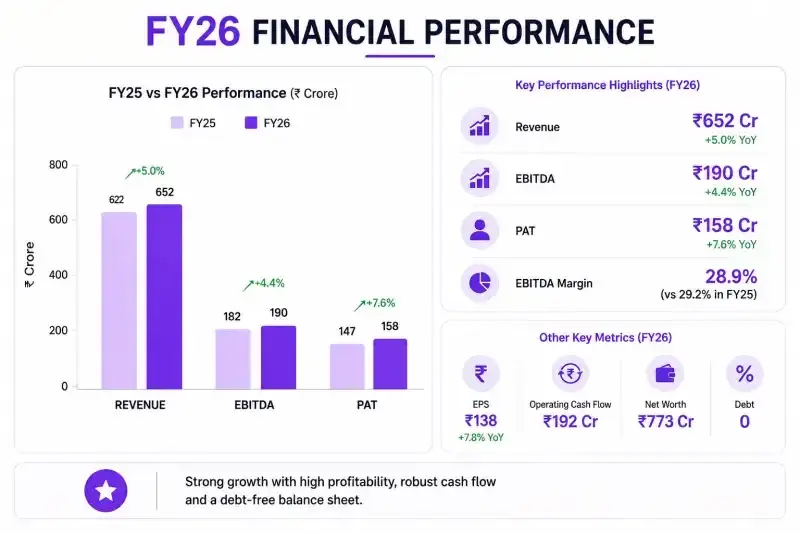
The company's revenue from operations for the financial year 2026 ended at ₹652 crore, which is 5% higher than in FY25. EBITDA was ₹190 crore and PAT rose to ₹158 crore, which represents around 29% EBITDA margin, one of the best among other listed transformer manufacturers in India. Shareholder earnings have continued to rise with the Earnings per share also standing at ₹138.
The FY26 revenue growth was lower than the previous year but management stated that there was underlying business demand strength throughout the year. The timing of some dispatches was affected by temporary external factors such as logistics problems with exports to the Middle East and uncertainty over US tariff policies during part of the year, but not by customer demand. Such shipments were not cancelled, but delayed, giving confidence that the demand fundamentals were intact.
The true gauge of Shilchar's performance should be measured over several financial years. Revenue has grown at a 41% compound annual growth rate (CAGR) over the past five years and EBITDA and PAT have grown at around 77% and 83% CAGR over the same period, respectively. The remarkable boost in profits over revenue growth is a testament to the power of operating leverage, premium positioning and discipline.
Shilchar has been able to continuously enhance its earnings over the industry cycles as it has been concentrating on the special categories of transformers that fetches better realizations in the market and is relatively less competitive.
Balance Sheet and Cash Flow
The most appealing feature of Shilchar Technologies is its robust balance sheet.Although the company has made large investments to increase manufacturing capacity, it does not have any long-term debt, thus it is one of the financially strongest companies in the transformer sector. This conservative capital allocation policy has enabled the management to grow without raising financial leverage, minimized the risk on the balance sheet and kept scope for future investments.
The company had cash and cash equivalents of about ₹246 crore at the end of FY26, which were sufficient to meet its current working capital needs and to finance its continued expansion initiatives. Shilchar also posted operating cash flows of approximately ₹192 crore during the year, reinforcing its earnings on the bottom line to create healthy cash flows as well.
In the case of capital goods, strong cash flows are of specific significance because in a capital goods business, the company may have to buy raw materials well ahead of the time when it is able to receive payment from customers. Shilchar has adequate cash to support these working capital needs and can invest in growth without needing to increase debt significantly.
Revenue growth alone rarely tells the full story. Understanding which business segments are driving profitability is equally important. You may also enjoy reading "Segment-Wise Revenue Analysis: How to Find a Company's True Growth Engine."
Order Book and Business Visibility
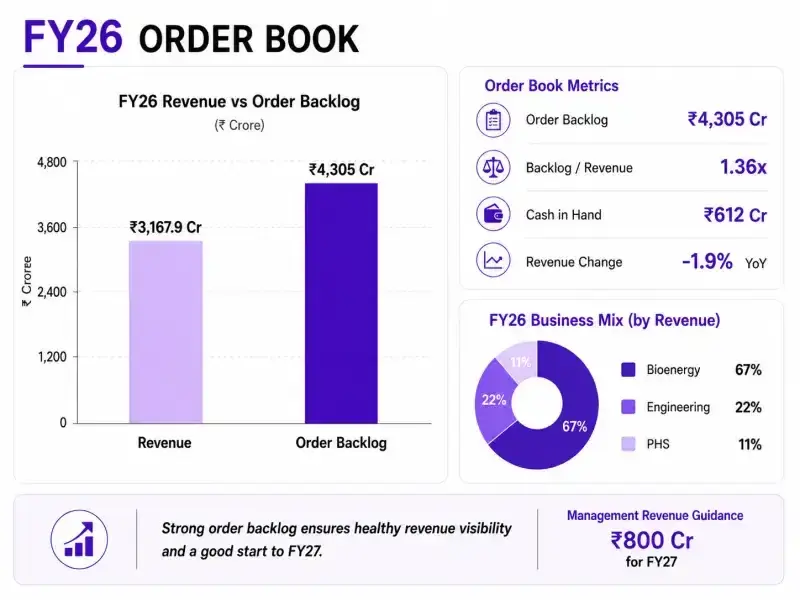
Shilchar started FY27 with an order book worth of around ₹452 crore, which also ensures a good order book in the upcoming financial year. On the customer side, there has been strong demand for specialized transformers, despite a few challenges faced in the market during FY26, as management indicated, customer enquiries have been satisfactory across both domestic and international markets.
The firm has a diverse set of structural growth catalysts, such as renewable energy initiatives, transmission expansion, industrial electrification and exports. The industry had been driven by a single or two sectors in the past, but today demand is coming from multiple end markets at once, enhancing the visibility of transformer manufacturers' revenues.
Management has guided revenue of around ₹800 crore for FY27 based on the cumulative order position and the current discussions with customers, which management has confidence in remaining favorable.
Capacity Expansion
One of the Shilchar's growth strategies is that it has been disciplined in its capacity building efforts.
The company has not increased capacity ahead of demand, but has increased capacity only when there are good utilization numbers at the existing capacity. This formal approach has led to adequate profitability and prevented underutilized resources.
The company's previous expansion had been successful; and the industry demand was strong, allowing the company to reach full capacity utilization much earlier than expected. This positive demand pattern led to management announcing another big brownfield expansion during FY26.
The current Gavasad Expansion Phase III will expand the manufacturing capacity from 7,500 MVA to around 14,000 MVA, which will add 6,500 MVA to the existing capacity. The project is to be done at a capital cost of around ₹120 crore, which is to be funded from the internal accruals and not any debt. As per management, civil works are already completed, major production equipment has been ordered and the plant is still on track for commissioning in April 2027.
This expansion is not just about expanding capacity, but also about the importance it has for the industry. With the new facility, Shilchar will not only be able to produce bigger and more advanced transformers, but also expand its market address and future revenue stream. The company plans to utilize the existing facility at close to its capacity in FY27, and the additional capacity will be the next driver of growth for the company from FY28 onwards.
Operational Strength
Shilchar's consistent high profitability rate is in part due to their focus on being operationally efficient.
In contrast to a pure price war, the company has developed expertise in the specialized fields of transformer types where engineering skills, product quality, and reliability are important buying factors. This helps Shilchar in negotiating with relatively better pricing, keeping the customer base intact.
The other important factor has been capacity utilization. Most manufacturing companies have an operating leverage that means fixed costs do not change greatly with changes in production quantities. Increased output means that fixed costs will be divided by more units of output, which will increase the profit.
The company's existing manufacturing plant is expected to run at close to the full utilization rate for FY27, meaning that the company will be optimizing returns on its existing assets until the new expansion facility comes on stream.
These operational strengths, coupled with disciplined cost management, healthy pricing and a favorable product mix, have helped Shilchar to have one of the best margin profiles in the listed transformer industry in India.
Growth Drivers
Shilchar Technologies operates in an industry that is benefiting from several long-term structural trends rather than a single cyclical demand driver. This provides the company with multiple avenues for growth over the coming years and reduces dependence on any one customer segment or end market.
One of the biggest opportunities for the company is India's renewable energy expansion. The country continues to increase its investments in solar and wind power as it works toward its clean energy targets. Every large-scale renewable energy project requires transformers to connect generated electricity to the transmission network, this makes transformer manufacturers an important part of the energy transition.
This is particularly significant for Shilchar because inverter duty transformers form one of its core product categories. These transformers are specifically designed for renewable energy applications and require higher engineering expertise than conventional transformers. As renewable installations continue to increase, the demand for such specialized products is expected to remain strong.
Another growth driver is the government's continued investment in transmission and distribution infrastructure. India's electricity demand is growing due to industrialization, urbanization, increasing consumption, and digital infrastructure. To support this demand, the country is expanding substations, strengthening transmission corridors, and modernizing grid infrastructure. These investments create demand for power transformers across multiple voltage classes.
Industrial capital expenditure also provides an opportunity for the company. New manufacturing plants, chemical complexes, steel facilities, metro projects, railways, and commercial developments all require trusted electrical infrastructure. As private and public sector investments increase, transformer manufacturers stand to benefit from higher equipment demand.
Data centers represent another emerging growth avenue. Growth of artificial intelligence, cloud computing, and digital services is attracting investments in hyper scale data centers across India. These facilities require reliable electrical infrastructure and specialized transformers capable of handling continuous power loads. Although this market is still developing, it could become an important source of demand over the coming years.
Foreign markets continue to offer opportunities. Several developed economies are upgrading ageing electrical infrastructure while simultaneously investing in renewable energy integration. This has created favorable demand conditions for manufacturers capable of meeting international quality standards. Shilchar's established export presence positions it to benefit from these global investment trends alongside domestic growth.
"The big money is not in the buying or the selling, but in the waiting." Charlie Munger
Risks Investors Should Consider
Despite the favorable long-term outlook, investors should recognize that Shilchar Technologies operates in a capital goods industry where earnings can fluctuate due to several external factors.
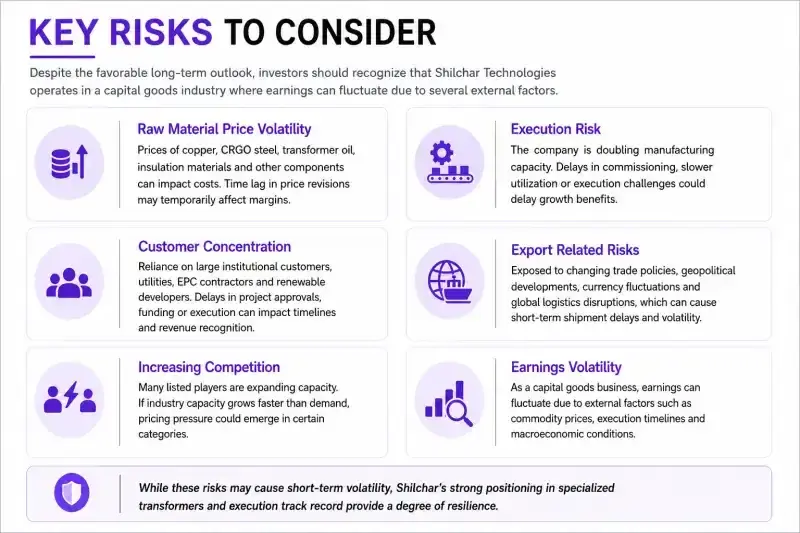
One of the biggest risks is volatility in raw material prices. Copper, CRGO steel, transformer oil, insulation materials, and other specialized components account for a significant portion of manufacturing costs. Although the company is often able to negotiate price revisions with customers, there can still be a time lag between raw material inflation and price recovery, temporarily affecting margins.
Execution risk is another important part to consider. The company is currently working on major capacity expansion that will double its manufacturing capacity. While management has a strong execution record, delays in commissioning, slower than expected utilization, or project execution challenges could delay the expected growth benefits.
Customer concentration also deserves attention. The transformer industry typically involves large institutional customers, utilities, EPC contractors, and renewable energy developers. Delays in project approvals, funding, or execution by these customers can impact order execution timelines and quarterly revenue recognition even when demand remains healthy.
Export related risks should also be observed. International business makes the company vulnerable to changing trade policies, geopolitical developments, currency fluctuations, and global logistics disruptions. FY26 demonstrated how external events can temporarily delay shipments despite strong customer demand. While these disruptions may not permanently affect business, they can create short-term volatility in reported financial performance.
Competition within the transformer industry is also increasing. Many listed manufacturers have announced significant capacity expansion plans in response to the favorable demand environment. If industry capacity grows faster than demand over the medium term, pricing pressure could emerge across certain transformer categories. Shilchar's focus on specialized products provides some protection, but increased competition remains a factor investors should monitor.
"You can't predict. You can prepare." Howard Marks
Explore our Products
Research Framework

Emerging Titans
Combination of quantitative analysis, industry tailwinds, and management assessment - SPRINT investment philosophy

Tiny Titans
Heavy emphasis on scuttlebutt research, plant visits, and early on-ground signals
Conclusion
Shilchar Technologies hasn't built its reputation overnight. What the company has quietly put together over the years is a genuinely strong position in specialized transformer manufacturing, one built on technical expertise, disciplined capital allocation, and an operational consistency that frankly doesn’t get enough credit in a market that tends to reward flashier stories.
The approach has been unfashionable. No aggressive debt-fueled expansion. No pivots into unrelated businesses chasing the next theme. Just a sustained focus on high-value transformer segments where engineering capability and product quality actually mean something where they translate into margins and customer relationships that competitors can't easily replicate.
FY26 was a decent test of that thesis. External disruptions showed up, as they always do. Yet the business kept generating healthy profits, held onto industry-leading margins, stayed debt free, and continued investing in future capacity without flinching. That kind of consistency during a difficult period tells you more about a business than a clean year ever could.
Looking ahead, the foundation seems solid. A strong balance sheet, healthy cash generation, expanding manufacturing capacity, and meaningful exposure to long-term themes of renewable energy, transmission infrastructure, industrial electrification, and exports give the company plenty of runway. These aren't short-cycle tailwinds. They're the kind of structural shifts that tend to play out over a decade or more.
If you're building a long-term watchlist of fundamentally strong businesses, don't miss "How to Analyze a Mid-Cap Company – A Complete, Practical Framework"
That said, capital goods businesses don't get to opt out of reality. Raw material inflation, project execution risks, export uncertainties, and intensifying industry competition will keep showing up and influencing results. Order inflows, capacity utilization, margin sustainability, and execution of the ongoing expansion are all worth watching closely over the coming years. The story isn't on autopilot.
For long-term investors, Shilchar Technologies is interesting in what a niche engineering company can become when it resists the temptation to overreach. Whether it can sustain the earnings trajectory it has built will depend partly on industry conditions but probably more on whether management continues executing with the same discipline that got it here in the first place.
"The stock market is a device for transferring money from the impatient to the patient." Warren Buffett
FAQs
What does the company primarily manufacture?
+The company specializes in manufacturing power and distribution transformers, with a strong focus on inverter duty transformers used in renewable energy projects. Its products also cater to utilities, industrial customers, wind energy projects, and export markets.
Why is the transformer industry expected to grow over the long term?
+The industry is benefiting from several structural trends, including renewable energy expansion, transmission and distribution upgrades, industrial electrification, data center investments, and the modernization of aging power infrastructure across both domestic and international markets.
What are the company's biggest competitive strengths?
+Its key strengths include expertise in specialized transformers, industry-leading profitability, a debt-free balance sheet, healthy operating cash flows, long-standing customer relationships, and a growing presence in both domestic and export markets.
What are the key growth drivers investors should watch?
+The biggest growth drivers include rising investments in renewable energy, expansion of India's transmission network, increasing industrial infrastructure spending, growing demand from data centers, higher export opportunities, and the commissioning of the company's new manufacturing capacity.
What are the major risks investors should consider?
+Investors should monitor raw material price volatility, execution of the ongoing capacity expansion, customer project delays, export-related uncertainties such as geopolitical or logistics disruptions, and increasing competition as more transformer manufacturers expand their production capacities.

High growth stock specialist, Value Educator
Shashank Mahajan is an equity research professional with over 12 years of experience in identifying high-potential SME and micro-cap stocks at an early stage. He follows a rigorous scuttlebutt research–driven approach, combining on-ground insights with deep financial analysis. Shashank specializes in uncovering under-researched and under-owned companies with strong management quality and long-term growth potential. Through disciplined research and early identification, he focuses on spotting tomorrow’s market leaders before they enter the mainstream investor radar.

Glenmark: The USD 700 Mn Cancer Deal and Its Brands

Pharma Stocks in India 2026: Generics, APIs and CDMOs

Granules India: From Paracetamol to a 65% Gross Margin

Natco Pharma: After Revlimid, 29 Patent Challenges

Shilpa Medicare: Cancer APIs, Films and Biosimilars

Alembic Pharma: US Plants Pay Back, Margin Hits 22.2%
Explore our Products
Research Framework
Emerging Titans
Combination of quantitative analysis, industry tailwinds, and management assessment - SPRINT investment philosophy
Tiny Titans
Heavy emphasis on scuttlebutt research, plant visits, and early on-ground signals



India's Aerospace Opportunity
Global Demand. Supply Bottlenecks. Opportunities Ahead.
Don't Miss This Exclusive Webinar!
Join Value Educator to decode the key trends shaping India's aerospace sector and learn how to identify tomorrow's potential leaders in the space.
- How the aircraft value chain works, layer by layer
- Indian companies supplying global aircraft makers
- A framework to judge any aerospace company

 Orders
 Subscription
 Share with friends


Required Details
₹23999.00
(12 month subscription)
As per SEBI regulations, all users are mandated to complete the KYC that is validated for 1 year. Post payment, you will be redirected to the KYC screen


No comments yet. Be the first to comment!