
Waaree Renewable Technologies: Solar EPC Steps Into the Grid

In FY26, an Indian company that builds solar power plants for other companies earned ₹641.10 Cr of EBITDA on ₹3,331.42 Cr of revenue. That is an EBITDA margin of 19.24%. That is high for building work. It owns very few of the plants it builds. It designs them, buys the parts, puts them up on the customer's land and hands them over.
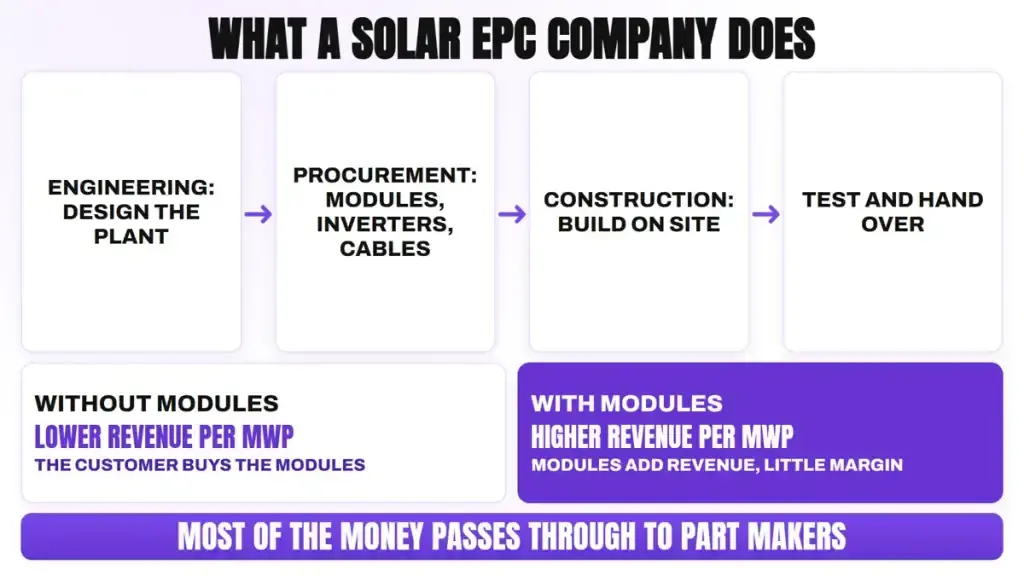
That kind of work has a name. It is called EPC, short for engineering, procurement and construction. The EPC company draws the plant and buys the solar modules, inverters, steel structures and cables. Then it builds the plant on site and tests it before the owner takes charge. Most of the money it collects goes straight out again to the people who make those parts. So it earns only on the design, the buying and the building.
Those plants are sized in megawatt peak, or MWp, which means the power the panels can produce in full sunlight. A plant of 1,000 MWp is a very large site, often spread over thousands of acres. When the EPC company also buys the modules for the customer, its revenue per megawatt is much higher than when the customer buys them. So revenue can swing from one quarter to the next even when the same amount of work is done.
That solar builder is Waaree Renewable Technologies Ltd (NSE: WAAREERTL). It is a subsidiary of Waaree Energies, which holds 74.32% of its shares and calls itself India's number one solar module maker. The company has commissioned more than 6.35 GWp of solar EPC projects. In FY26 its revenue rose 108.51%, and it executed 2,727 MWp of projects, its highest for any year.
Then, in June 2026, the company did something new. It bought 55% of Associated Power Structures for about ₹1,225 Cr. That company works in transmission and distribution, which means the high-voltage lines and substations that carry power from plants to the places that use it. The July to September 2026 quarter was the first full quarter with that business inside.
Waaree Renewable Technologies in five numbers
- Q2 FY27 revenue of ₹1,057.84 Cr, up 36.53%
- An order book of about ₹5,500 Cr in September 2026, solar and transmission together
- FY26 EBITDA margin of 19.24%, against 15.12% in Q2 FY27
- About ₹1,225 Cr for 55% of Associated Power Structures, about 75% of it with debt
- Borrowings of about ₹1,412.99 Cr in September 2026, against about ₹81.67 Cr in March 2026
So a solar builder with a high margin and almost no debt has now taken on debt to buy a lower-margin grid business. How did that show up in its numbers? Let's first understand the company, and then look at the latest quarter.
Waaree Renewable Technologies: Company Overview
Waaree Renewable Technologies Ltd was incorporated in 1999 and has its registered office at Borivali East in Mumbai. It is a subsidiary of Waaree Energies, which held 74.32% of its shares in March 2026. The company designs, buys for and builds solar power plants for other companies: large ground-mounted plants, rooftop and floating solar, and battery storage projects. It also runs operations and maintenance for about 1.5 GWp of plants and owns 82.82 MWp of solar plants that sell power. Since 18 June 2026 it has owned 55% of Associated Power Structures, a Vadodara-based builder of transmission lines, substations and lattice towers. Pujan Doshi is the Managing Director and Manmohan Sharma the Chief Financial Officer, and the company had 399 permanent employees in March 2026. Revenue from operations was ₹3,331.42 Cr in FY26, and borrowings were about ₹1,412.99 Cr in September 2026 after the acquisition. Read this BESS Stocks in India 2026: Battery Storage Value Chain
"Behind every stock is a company. Find out what it's doing."
— Peter Lynch
Waaree Renewable is no longer only a solar builder. To follow it now, you need to know what each of its parts does and what each one earns.
The Quarter the Transmission Arm Carried the Revenue
Let's look at Q2 FY27, the July to September quarter, which the company reported on 19 October 2026. Revenue from operations was ₹1,057.84 Cr, up 36.53% from ₹774.78 Cr a year ago. It was also higher than the ₹924.25 Cr of Q1 FY27. But as you will see in the table, profit moved the other way.

As we can see, the growth came from the new business, not from solar. You can see it in the segment split, because the company now reports three segments. Solar EPC revenue fell about 42% to ₹444.98 Cr, from ₹769.19 Cr a year ago and ₹803.39 Cr in Q1 FY27. Transmission and distribution EPC, which is Associated Power Structures, added ₹606.13 Cr. That was about 57.3% of the quarter's revenue. Power sale from the company's own solar plants was ₹6.73 Cr.

That shift in mix also explains the margin, because the two EPC businesses earn very different returns. The solar EPC segment earned a result of ₹101.71 Cr in the quarter, about 22.9% of its revenue, against about 19.8% a year ago. The transmission segment earned ₹28.86 Cr, about 4.8% of its revenue. So the solar work that remained was more profitable than before, but the new revenue came in at a much thinner margin.
"Price is what you pay. Value is what you get."
— Warren Buffett
Waaree Renewable paid about ₹1,225 Cr for 55% of a transmission builder. What it gets for that money will show up in the segment margins, one quarter at a time. EBITDA in rupees was almost flat, up 1.29%, while revenue grew 36.53%. The mix did that.
Below EBITDA, the acquisition added two new costs. Finance cost rose to ₹36.83 Cr from ₹3.62 Cr, because most of the purchase was paid for with borrowed money. Read this Debt to Equity Ratio Explained Depreciation and amortisation rose to ₹26.97 Cr from ₹2.18 Cr. The balance sheet now carries ₹598.85 Cr of intangible assets and ₹464.02 Cr of goodwill, against ₹2.65 Cr and almost nil in March 2026. The intangible part is written off over time.
Those two costs together took profit after tax down 29.98% to ₹81.48 Cr. Of that, ₹7.59 Cr belongs to the other 45% owners of Associated Power Structures. So profit for Waaree Renewable's own shareholders was ₹73.89 Cr, against ₹116.31 Cr a year ago. Those outside owners also show up on the balance sheet. Total equity was ₹1,745.57 Cr in September 2026, and ₹627.14 Cr of it belonged to them.
That same pattern shows in the first half too. H1 FY27 revenue was ₹1,982.09 Cr, up 43.84%. EBITDA was ₹333.46 Cr at a 16.82% margin, against 19.99% a year ago, and profit after tax was ₹200.44 Cr, down 1.13%. The company executed 1,345 MWp of solar projects in the half, against 1,621 MWp in H1 FY26. Since it executed 888.81 MWp in Q1, the second quarter's solar execution was about 456 MWp.
That makes Q1 FY27 the better of the two quarters. In Q1, revenue was ₹924.25 Cr, up 53.23%, and profit after tax was ₹118.96 Cr, up 37.7%. The transmission business was inside the group for only twelve days of that quarter and added ₹112.81 Cr of revenue. So you can read Q2 as the first clean picture of the new mix: a smaller solar quarter and a full quarter of transmission.
Cash flow changed too. Operating cash flow for the half was negative ₹16.27 Cr, against positive ₹83.73 Cr a year ago. Taxes paid were ₹105.76 Cr, and trade payables were cut by ₹167.55 Cr. The purchase of the stake took ₹829.02 Cr net of the cash it brought in, and new borrowings brought in ₹846.78 Cr. Trade receivables stood at ₹1,877.56 Cr in September 2026, against ₹1,172.01 Cr in March, partly because the new business came in with its own customers.
The Orders Behind the ₹5,500 Cr Book
Now let's look at the orders, because they show how much work is already booked. The consolidated unexecuted order book was about ₹5,500 Cr in September 2026. About ₹3,300 Cr of it was solar and battery EPC, and about ₹2,200 Cr was transmission. At the end of June 2026 it was about ₹5,300 Cr.
In megawatts, the solar book was 3,226 MWp in September 2026. It was 2,365 MWp in March 2024, 3,263 MWp in March 2025 and 2,832 MWp in March 2026. So the solar book is back close to where it was eighteen months ago, after a dip in FY26. That is a recovery.

That rise came from a busy quarter for orders. In July 2026 the company won two plants of 530 MWp and 552 MWp, 1,082 MWp in all. They came from one of India's leading renewable energy companies and are due for completion in FY28. In August it won a 291 MWp solar plant with a 280 MWh battery system from a thermal power generating company. It also won a 124 MWp plant. A 210 MWp plant came from Solaris Horizon Energy, a step-down subsidiary of Waaree Energies.
Before those, in the quarter before, two large orders came from inside the group. Waaree Forever Energies, a subsidiary of Waaree Energies, gave it a 350 MW / 1,400 MWh battery storage project. Sunsational Power, the company's own wholly owned subsidiary, gave it a 450 MWp solar plant. Orders from its own subsidiaries do not show up as revenue at the consolidated level, because they cancel out. In July 2026 management said about 30% to 40% of the solar order book came from group companies.
Outside the group, the customer list is mostly private. Government projects are less than 10% of the order book by capacity, and most orders come from private developers and companies.
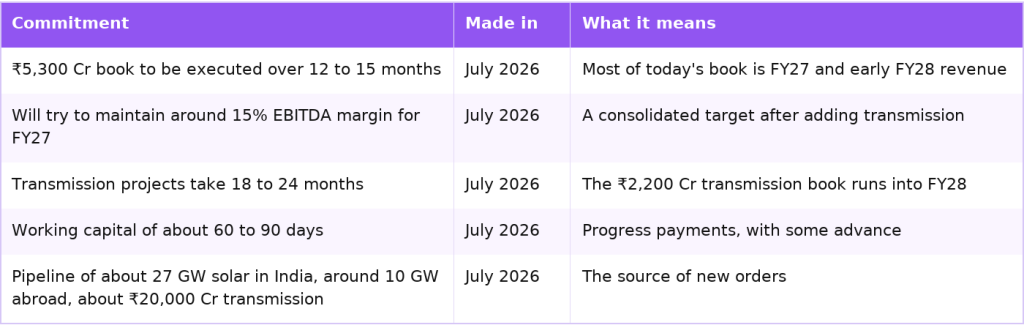
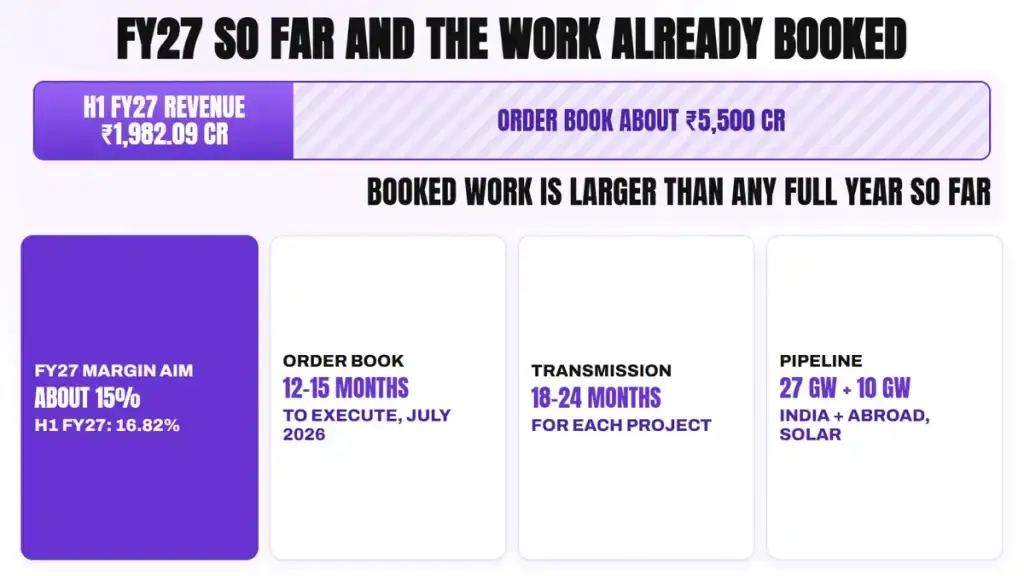
What the order book says: ₹5,500 Cr is about fifteen months of revenue at the Q2 FY27 rate of about ₹4,231 Cr a year. Management expects the book to be executed over 12 to 15 months, and a transmission project to take 18 to 24 months.
Beyond the firm book, management talks of a much larger pipeline. In July 2026 it said it was chasing about 27 GW of solar work in India and around 10 GW abroad. It is also chasing about ₹20,000 Cr of transmission work. In the same month it signed an early contractor agreement with a global power producer for a solar and battery project in New Zealand. That is a design-stage agreement, and an EPC contract may follow only after it is done. It is early.
How Waaree Renewable Technologies Became a Gigawatt Builder
Now that we have seen the quarter, let's go back and see how the company got here. Waaree Renewable Technologies was incorporated in 1999 and is based in Mumbai. For years it was a small business. In FY22 its revenue was ₹161.5 Cr.
That changed with its first big projects in 2023. It built 296 MWp for AM Green, 153 MWp for DRPL at Tuticorin and 150 MWp for Continuum. In 2024 the orders were of a different size: 2,012.47 MWp for Jindal Renewables, 980 MWp for Greenko, 450 MWp on a turnkey basis for NEEPCO and 412 MWp for Acciona Energy. Its largest ongoing site today is a 2,012 MWp plant at Bikaner, in Rajasthan.
That pace of orders carried on in 2025. The company won ground-mounted plants of 1,000 MWp, 435 MWp, 255 MWp, 217.5 MWp and 39.8 MWp, and a battery project of 90 MWh. CARE upgraded its rating to A with a stable outlook that year, and to A+ in 2026.
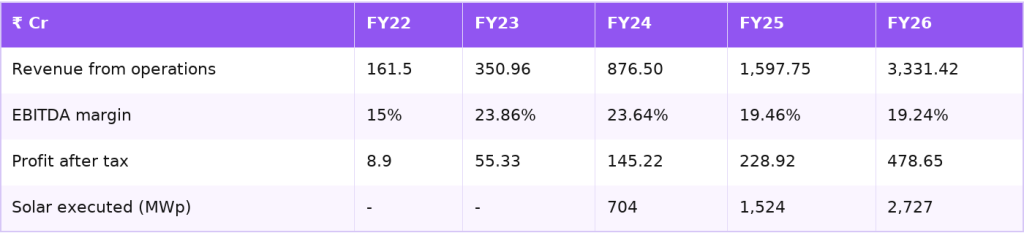
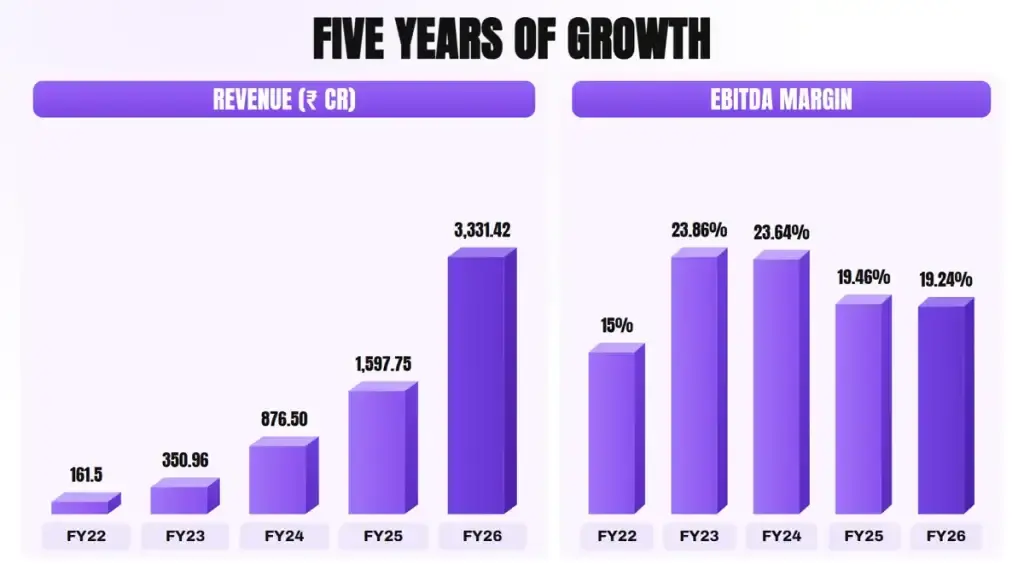
So, as you can see, revenue grew about twenty times in four years. Execution almost doubled in each of the last two years, from 704 MWp in FY24 to 1,524 MWp in FY25 and 2,727 MWp in FY26.
That growth also brought cash in, which is not always true of EPC companies. Operating cash flow was ₹65.15 Cr in FY23, ₹127.91 Cr in FY24, ₹302.70 Cr in FY25 and ₹286.95 Cr in FY26. Over those four years it added up to about ₹782.71 Cr, against about ₹908.12 Cr of profit after tax. So about 86% of the profit came back as cash, even while revenue grew this fast. Read this Cash Flow Statement Explained In April 2026 management said most of its receivables were less than six months old, and many contracts were backed by letters of credit.
The margin did come down as the company grew, from 23.86% in FY23 to 19.24% in FY26. Some of that is the type of order. In Q4 FY26, around half of the quarter's execution revenue came from orders where the company also bought the modules. Modules bought for a customer add revenue with little margin, so the percentage can come down even when the rupees earned rise. Management has said for years that it plans for an EBITDA margin of about 14% to 16% when it takes an order. So far, every year has come in above that range.
"But always we are mentioning that the EBITDA margin should remain around 15%, but definitely we are delivering on a continuous basis." - Manmohan Sharma, Chief Financial Officer, April 2026
You can see that record in the FY26 balance sheet. Return on equity was 68.93% and return on capital employed was 62.54%. Net worth rose to ₹933.83 Cr from ₹454.95 Cr. Borrowings were about ₹81.67 Cr at the end of March 2026. That balance sheet is what paid for the next step.
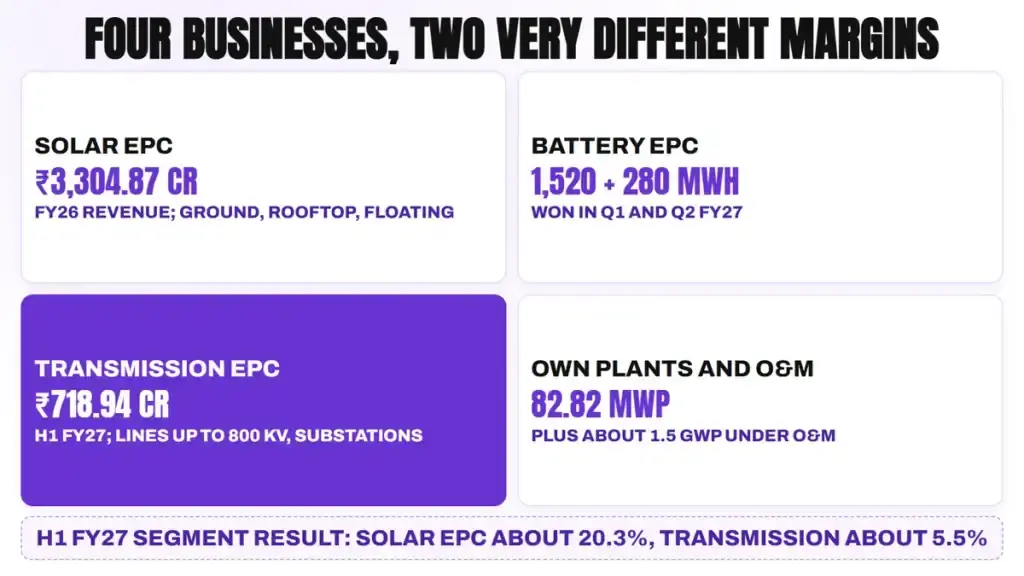
Four Businesses, Two Very Different Margins
Now let's split the business into its parts, because each one earns a different margin. Read this Segment-Wise Revenue Analysis Explained The company reports three segments: solar EPC, transmission and distribution EPC, and power sale. Operations and maintenance work is reported within the solar EPC segment.
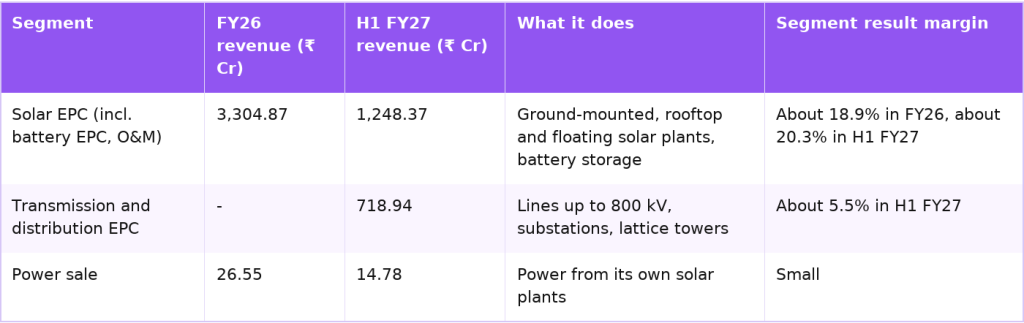
These parts sound alike, but as you will see, each one has its own economics. Solar EPC is asset-light work with a margin set when the order is taken. Transmission involves steel towers that are made and galvanised in-house, longer projects and thinner margins. Power sale is a small annuity that grows slowly as the company adds its own plants.
Utility-Scale Solar EPC
Let's start with solar EPC, the business that built the company. Most of its work is large ground-mounted plants for developers and power producers. Its ongoing sites include 2,012 MWp at Bikaner, 1,000 MWp at Solapur in Maharashtra and 980 MWp at Kurnool in Andhra Pradesh. In April 2026 management said Rajasthan was the heavy weight in its order book, with Maharashtra, Madhya Pradesh and Andhra Pradesh also large.
To see why these sites keep coming, let's look at the national build-out. In FY26 India added over 44 GW of solar, against 23.83 GW the year before, and solar made up about 82% of new renewable capacity. Total solar capacity was over 150 GW in March 2026, and the government targets about 280 GW by 2030. The company says it tracks a bidding pipeline of over 36 GWp, with 5-6 GW of live tenders open at any time.
Those plants also take time to build. In April 2026 management said a project of 500 MW to 2 GW can take 12 to 15 months from design to completion. So an order won today usually turns into revenue over the next four or five quarters.
Alongside the large plants, the company also does rooftop and floating plants, but they are small for it. It has commissioned 59.26 MWp of rooftop projects and 2.29 MWp of floating solar.
Battery Storage EPC
Next, let's look at battery storage, the newest part of solar EPC. A battery energy storage system, or BESS, is a yard of batteries that stores solar power in the day and releases it in the evening. Most new solar tenders now ask for one to two hours of storage alongside the plant. In July 2026 management put India's battery storage need at around 208 GWh by 2030.
For the company, battery work is still young. An early battery order was a 90 MWh project at Jaisalmer, won in 2025. Since then it has won 1,520 MWh in Q1 FY27, which is a combination of orders including the 1,400 MWh group project, and 280 MWh in Q2 FY27. In July 2026 management said about ₹200 Cr of battery work was still to be executed. It expects battery EPC margins to stay in line with its solar margins.
Transmission and Distribution Through Associated Power Structures
Now let's look at the business the company bought. Associated Power Structures, or APSPL, was founded in 1996 and is based in Vadodara, Gujarat. It builds high-voltage transmission lines up to 800 kV, and substations of both the air-insulated and gas-insulated kind. It has executed more than 10,461 circuit kilometres of transmission line and has worked in more than 16 countries. It has executed over ₹2,909 Cr of transmission projects.
As you would expect from a tower builder, it also makes its own steel. Its plants at Bamangam and Manglej in Gujarat can make 108,000 tonnes a year of lattice towers and structures, with galvanising in-house. A third plant of 100,000 tonnes a year is under construction at Azamnagar. Those plants make transmission towers, and also lattice towers for wind turbines, telecom towers and solar panel structures. In FY25, before the deal, APSPL had a turnover of ₹1,226.64 Cr and a net worth of ₹339.53 Cr.
The deal itself was a mix of new shares issued by APSPL and shares bought from its existing owners, for about ₹1,225 Cr in all. It was not a related-party deal, and no Waaree group company had an interest in APSPL before. APSPL's three founders, who have run it since 1996, stay on as directors. In July 2026 management said that improving APSPL's margins would be an ongoing exercise across the company.
In its first full quarter inside the group, the two transmission companies earned a net profit of ₹32.61 Cr on revenue of ₹606.12 Cr, before consolidation adjustments. That is a thin margin next to the solar business, and you should expect it to pull the group's margins toward its own level as it grows.
That thin margin is the price of the grid, and the grid is the reason for the deal. New solar parks need lines and substations to carry their power out. India's national electricity plan has 76,787 circuit kilometres of new lines and 4,97,855 MVA of substations planned from 2027 to 2032. The estimated cost is ₹4,90,920 Cr. Management says the two businesses can now bid for each other's work. The company's ongoing transmission projects include 400 kV lines in Madhya Pradesh, Odisha and Uttar Pradesh and a 765 kV line in Maharashtra.
Own Power Plants and O&M
Finally, let's look at the two smaller businesses that give the company steady income. It owns 82.82 MWp of solar plants that sell power, is setting up another 233.6 MWp, and is developing 450 MWp more through a subsidiary. In April 2026 management said the plants under construction were being funded from internal accruals. In October 2026 the board also approved a 35 MWp plant at Wardha, in Maharashtra. Power sale brought in ₹26.55 Cr in FY26, so these plants matter more for steady cash than for growth. Its operations and maintenance portfolio is about 1.5 GWp, built mostly from plants it has handed over. To win more of that work, the company offers services such as drone thermography, which finds faulty panels from the air, and underground cable fault finding. It also wants to take on O&M for plants built by others.
We should also note that in September 2026 the company set up data-centre subsidiaries under Waaree Green Data Centers. In July 2026 management said it had not yet received any data-centre order and was still building the team.
Why a Bankable Solar Builder Is Hard to Copy
Now let's look at what protects this business, and where that protection ends. Anyone can hire engineers and bid for a solar plant. What is harder to build is the trust of the people who pay for it. A developer building a 1,000 MWp plant borrows most of the money. Lenders are careful. They want an EPC partner with a record of finishing large plants on time, because a late plant cannot repay its loan.
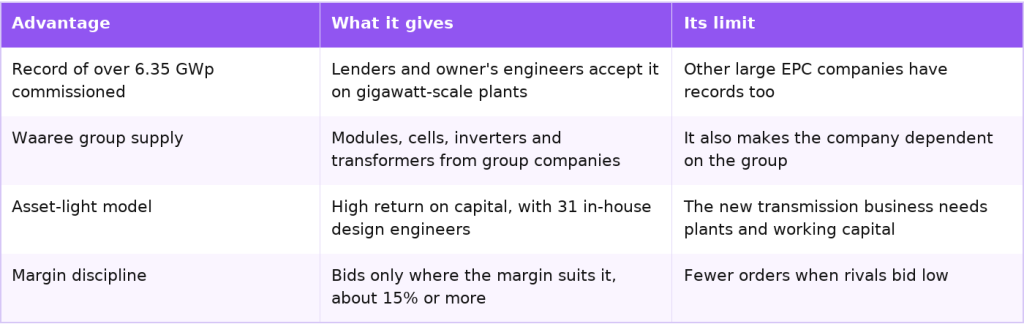
That group supply is a real link. In FY26 the company bought ₹731.57 Cr of goods from Waaree Energies, mostly for its projects. India's approved list of models and manufacturers, or ALMM, pushes solar projects toward modules from listed domestic makers. Having the country's largest module maker as a parent helps the company get modules on time.
"Your margin is my opportunity."
— Jeff Bezos
A solar builder earning close to 20% margins invites rivals. What keeps them out is the trust of lenders and a secure supply of modules, built over gigawatts of finished plants.

That supply link is matched by a record on site. A company that has handed over 6.35 GWp of plants, across many states and up to 2,012 MWp in one place, is a safer choice for a lender than a new bidder. And once a plant is built, the owner often hands its upkeep to the same builder, which is how the 1.5 GWp O&M portfolio grew.
That record also builds ties beyond the customer. The company works with the lenders who fund developers, and with the consultants and owner's engineers who check a plant's design and quality for them. A new EPC company has to earn each of those ties, one finished plant at a time.
Still, the moat has limits, and the company has said so itself. When asked in July 2026 whether more competitors were entering solar EPC, management said it takes only projects that suit its own return targets. And in April 2026 it said it bids in tenders only when the margin is right. That discipline is why its margin has held, but it also means fewer orders when rivals bid low.
Financials: Five Years of Solar Growth and Cash
One quarter can mislead in an EPC business, where revenue swings with the type of order, so let's look at five full years together. All figures are consolidated; FY24 is the restated figure the company gives after a merger in its group.

Revenue grew about 20 times in four years, from ₹161.5 Cr in FY22 to ₹3,331.42 Cr in FY26, and profit after tax grew from ₹8.9 Cr to ₹478.65 Cr. The EBITDA margin peaked at 23.86% in FY23 and settled a little above 19% in the last two years, as larger orders that included modules came in.
Cash flow kept up for most of that climb. Over FY23 to FY26, operating cash flow added up to about ₹782.71 Cr, against about ₹908.12 Cr of profit after tax. FY26 was the exception: profit roughly doubled, but operating cash flow was ₹286.95 Cr, below the ₹302.70 Cr of FY25, as trade receivables rose to ₹1,172.01 Cr from about ₹497.75 Cr.
Until March 2026 the company carried borrowings of only about ₹81.67 Cr. The purchase of Associated Power Structures changed that, and the next few years of this table will show how the new debt and the lower-margin transmission work change both profit and cash.
"The worst sort of business is one that grows rapidly, requires significant capital to engender the growth, and then earns little or no money."
— Warren Buffett
For five years Waaree Renewable was the opposite: it grew fast without much capital and turned most of its profit into cash. The transmission business needs plants and working capital, so that record now gets tested.
What FY27 and FY28 Could Look Like on Management's Numbers
Now let's look ahead, using management's own statements. The company does not give revenue guidance. What it has said in the last two calls is about the order book, the pipeline and the margin.
Abroad, the picture is at an earlier stage. The solar pipeline includes around 10 GW outside India, and the New Zealand agreement is the first step there. APSPL also brings work in more than 16 countries, so the transmission side starts with some foreign experience. Until a foreign EPC contract is signed, though, we should treat this as an option rather than revenue.
So on those numbers, the next year is mostly booked. H1 FY27 revenue was ₹1,982.09 Cr, and the book of about ₹5,500 Cr is larger than any full year the company has reported. The 1,082 MWp order won in July is due by FY28, and the 291 MWp plus 280 MWh order is due in FY28 too.
We can also see new capacity coming on the transmission side. APSPL's 100,000-tonne plant at Azamnagar will add to its tower making, and the company's own plants of 233.6 MWp and 450 MWp will add to power sale once they are running. The company is also developing an 80 MWac / 120 MWp solar park in Maharashtra.
Those same transmission orders also set the margin path, which is the harder question. In H1 FY27 the consolidated EBITDA margin was 16.82%, and in Q2 it was 15.12%, close to the 15% management is aiming for. The company itself says that as transmission grows, consolidated percentage margins may come down, even as rupee earnings grow. So the margin of the past, above 19%, is unlikely to be the margin of the next two years. That is the test.
So let's check how past statements compare with what was delivered.
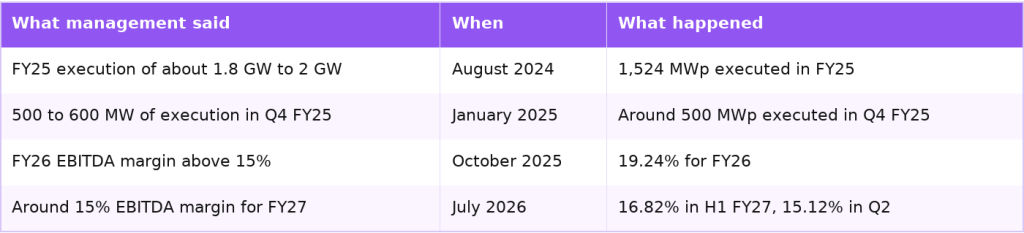
So the margin promise has been kept with room to spare, while execution in megawatts has sometimes come in below what was said. The next two quarters will show whether the solar business recovers from about 456 MWp in Q2.
Key Risks
Now let's look at what could go wrong for Waaree Renewable Technologies, because the latest quarter has already shown some of these risks.
- Shrinking solar revenue: solar EPC revenue fell about 42% in Q2 FY27, and solar execution in H1 was 1,345 MWp against 1,621 MWp a year ago. Without the new transmission business, the quarter's revenue would have fallen.
- Margin dilution: transmission earned a segment result of about 4.8% in Q2, against about 22.9% for solar EPC. As it grows, the consolidated margin moves toward the lower figure.
- Debt and interest: borrowings rose to about ₹1,412.99 Cr in September 2026 from about ₹81.67 Cr in March. Finance cost was ₹36.83 Cr in Q2 alone, against ₹13.29 Cr in all of FY26.
- Cash flow and receivables: operating cash flow was negative ₹16.27 Cr in H1 FY27, and receivables rose to ₹1,877.56 Cr. In FY26, receivables were about 128 days of revenue, against about 114 days in FY25.
- Group dependence: about 30% to 40% of the solar order book came from group companies, and the company bought ₹731.57 Cr of goods from Waaree Energies in FY26. Group orders are related-party deals, which the company says are at arm's length.
- Goodwill and intangibles: the deal added about ₹1,062.87 Cr of goodwill and intangible assets. If transmission profits disappoint, part of that could have to be written down.
- Outside owners: 45% of APSPL belongs to others, so part of its profit does not reach Waaree Renewable's shareholders. In Q2 FY27 that share was ₹7.59 Cr.
- Grid and policy delays: solar parks need substations to send out their power, and many of the company's projects are in Rajasthan. Changes in approved-list rules, tender timing or land approvals can delay orders and execution.
"So, we have taken around 75% debt for the entire acquisition." - Manmohan Sharma, Chief Financial Officer, July 2026
"Risk means more things can happen than will happen."
— Howard Marks
None of these risks has to play out. But with new debt, a thinner-margin business and a weaker solar quarter arriving together, the tracking list below shows which way each one is moving.
Explore our Products
Research Framework

Emerging Titans
Combination of quantitative analysis, industry tailwinds, and management assessment - SPRINT investment philosophy

Tiny Titans
Heavy emphasis on scuttlebutt research, plant visits, and early on-ground signals
What to Track Next
If you follow Waaree Renewable Technologies, these are the signals that will show where it goes next.
- Solar EPC revenue and megawatts executed in H2 FY27, after about 456 MWp in Q2
- The consolidated EBITDA margin against about 15%, and the transmission margin after about 4.8%
- New orders, the order book after about ₹5,500 Cr, and the share of group orders
- Borrowings after about ₹1,412.99 Cr and quarterly finance cost after ₹36.83 Cr
- Operating cash flow in H2 FY27 and receivables after ₹1,877.56 Cr
- The first data-centre or international EPC order
For the other listed solar and wind companies, from glass and cells to turbines and power producers, see Renewable Energy Stocks in India 2026: Solar and Wind.
Conclusion
Let's put it all together. Waaree Renewable Technologies grew from ₹161.5 Cr of revenue in FY22 to ₹3,331.42 Cr in FY26 by building ever larger solar plants. It kept an EBITDA margin above 19% for the last two years with very little debt. In June 2026 it used that strength to buy a transmission builder, and in Q2 FY27 the new business brought more than half of the revenue. The cautious thread is the balance sheet: borrowings of about ₹1,412.99 Cr and negative operating cash flow in H1 FY27. The next two quarters will show whether solar execution and cash collection catch up.
That step now has a visible price. In the same quarter, profit fell, debt rose and the solar business shrank. What happens next depends on whether solar execution recovers from the Q2 dip, whether the transmission margin can rise from about 4.8%, and whether cash flow comes back fast enough to pay down the new debt.
FAQs
What does Waaree Renewable Technologies do?
+Waaree Renewable Technologies is the solar EPC company of the Waaree group. It designs, buys for and builds solar plants and battery storage projects for other companies, runs operations and maintenance, and owns 82.82 MWp of its own solar plants. Since June 2026 it also builds transmission lines and substations through Associated Power Structures.
How did Waaree Renewable Technologies do in Q2 FY27?
+Revenue from operations rose 36.53% to ₹1,057.84 Cr, with ₹606.13 Cr from the new transmission business. Solar EPC revenue fell about 42% to ₹444.98 Cr. EBITDA was ₹159.98 Cr at a 15.12% margin, and profit after tax fell 29.98% to ₹81.48 Cr as finance cost and amortisation rose.
Why did Waaree Renewable Technologies buy Associated Power Structures?
+New solar parks need transmission lines and substations to carry their power out. The company bought 55% of Associated Power Structures for about ₹1,225 Cr, funded about 75% with debt, so it can bid for grid work alongside solar EPC. The transmission business earned a segment result of about 4.8% of revenue in Q2 FY27, against about 22.9% for solar EPC.
What is Waaree Renewable Technologies' order book?
+The consolidated order book was about ₹5,500 Cr in September 2026: about ₹3,300 Cr of solar and battery EPC and about ₹2,200 Cr of transmission work. The solar book was 3,226 MWp. Management expects the book to be executed over 12 to 15 months, with transmission projects taking 18 to 24 months.
How much of Waaree Renewable Technologies' business comes from the Waaree group?
+Waaree Energies holds 74.32% of the company. In July 2026 management said about 30% to 40% of the solar order book came from group companies, and in FY26 the company bought ₹731.57 Cr of goods from Waaree Energies. Group orders are related-party deals that the company says are at arm's length.
What are the main risks for Waaree Renewable Technologies?
+Solar EPC revenue fell about 42% in Q2 FY27, and the new transmission business earns a much thinner margin. Borrowings rose to about ₹1,412.99 Cr from about ₹81.67 Cr, operating cash flow was negative ₹16.27 Cr in H1 FY27, and the deal added about ₹1,062.87 Cr of goodwill and intangible assets.

High growth stock specialist, Value Educator
Shashank Mahajan is an equity research professional with over 12 years of experience in identifying high-potential SME and micro-cap stocks at an early stage. He follows a rigorous scuttlebutt research–driven approach, combining on-ground insights with deep financial analysis. Shashank specializes in uncovering under-researched and under-owned companies with strong management quality and long-term growth potential. Through disciplined research and early identification, he focuses on spotting tomorrow’s market leaders before they enter the mainstream investor radar.
More about Shashank Mahajan →
PCBL Chemical: Carbon Black Margins and Battery Materials

KEC International: Record Orders, Weak Margin, High Debt

Sona BLW: EV Revenue Now Tops Half of Its Auto Sales

HPL Electric & Power: Smart Meters, Wires and Two Engines

Kaynes Technology: EMS, Chip Plants and ₹10,563.5 Cr Orders

Sterlite Technologies: Glass Rods to Hyperscaler Deals
Explore our Products
Research Framework
Emerging Titans
Combination of quantitative analysis, industry tailwinds, and management assessment - SPRINT investment philosophy
Tiny Titans
Heavy emphasis on scuttlebutt research, plant visits, and early on-ground signals



India's Aerospace Opportunity
Global Demand. Supply Bottlenecks. Opportunities Ahead.
Don't Miss This Exclusive Webinar!
Join Value Educator to decode the key trends shaping India's aerospace sector and learn how to identify tomorrow's potential leaders in the space.
- How the aircraft value chain works, layer by layer
- Indian companies supplying global aircraft makers
- A framework to judge any aerospace company

 Orders
 Subscription
 Share with friends


Required Details
₹23999.00
(12 month subscription)
As per SEBI regulations, all users are mandated to complete the KYC that is validated for 1 year. Post payment, you will be redirected to the KYC screen


No comments yet. Be the first to comment!