
How to Open a Demat Account
There was a time when investing in India was a paper-based process, long before Demat accounts made everything digital. Instead of seeing numbers on a screen, investors received fragile documents where a single spelling mistake, delay, or missing paper could lock their money for months. As historian Niall Ferguson once said, “The history of finance is largely the history of reducing friction,” and back then, friction was everywhere - highlighting the urgent need for a safer and more streamlined way to invest.
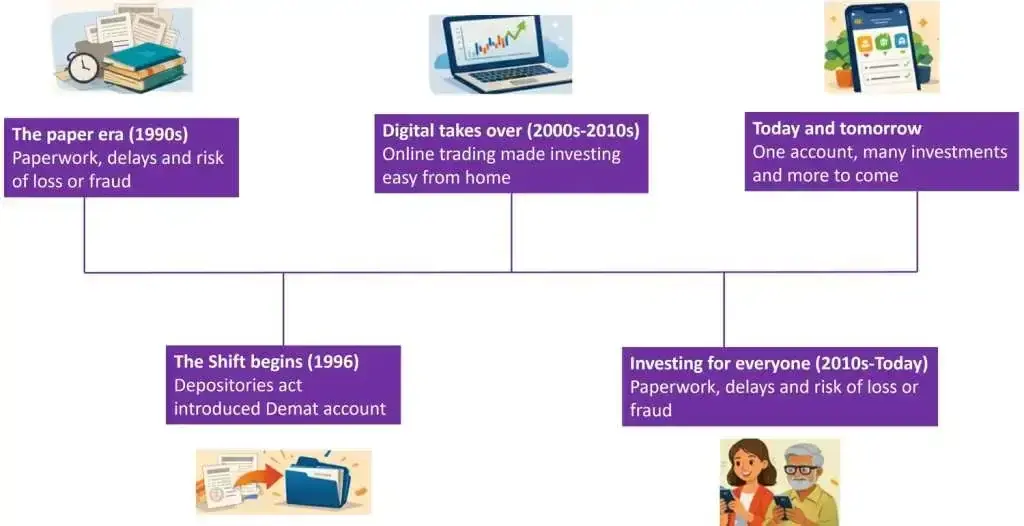
That friction is precisely what SEBI aimed to remove. Back in 1996, a new law, the Depositories Act, changed everything. We stopped using paper share certificates and started holding shares digitally in Demat accounts. People were a bit unsure at first, but soon realized it was much better: safer, faster, and clearer. This digital shift made investors feel more secure, and the market worked much more smoothly. The picture below shows how we went from paper to the easy, digital investing we do now:
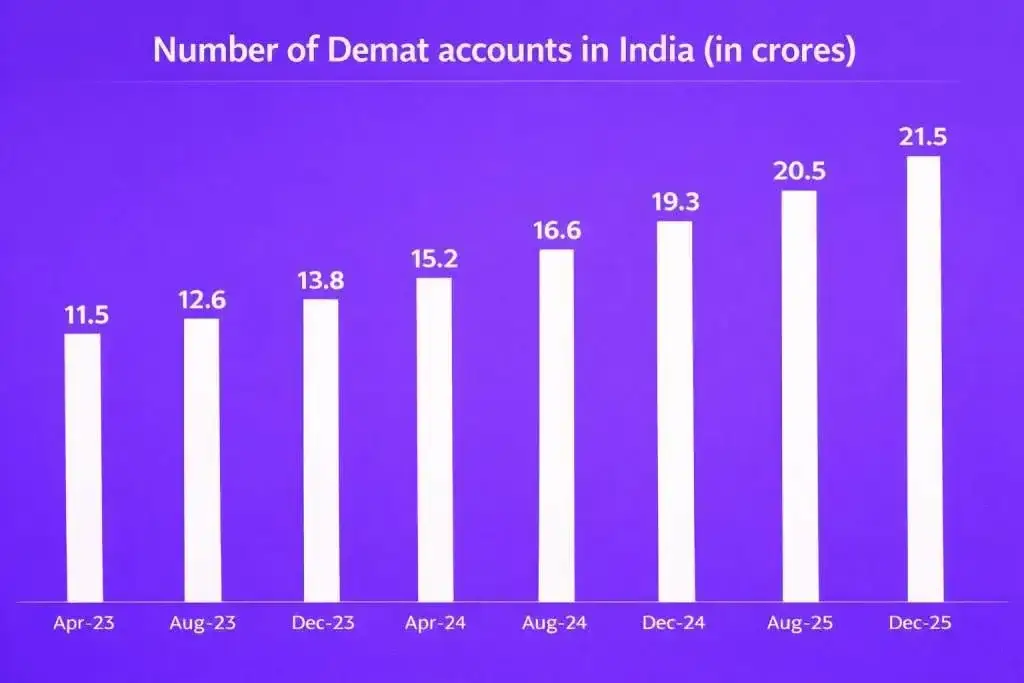
The scale of this transformation becomes clearer when you look at the numbers in the chart below. In just over two years, the number of Demat accounts in India rose from 11.5 crore in April 2023 to 21.5 crore by December 2025 - nearly doubling in a short span of time. This steady rise shows how investing, once confined to a limited segment, has become mainstream as internet access and digital platforms expanded across the country.
As economist Amartya Sen aptly said, “Development is about expanding the choices people have.” Demat accounts did exactly that for Indian investors - quietly becoming the backbone of India’s capital markets by making participation simple, fast, and widely accessible.
If you're completely new, start with our detailed guide to understanding how the Indian stock market works.
Read our article on: A Beginner's Guide to the Indian Stock Market
What exactly is a Demat Account?
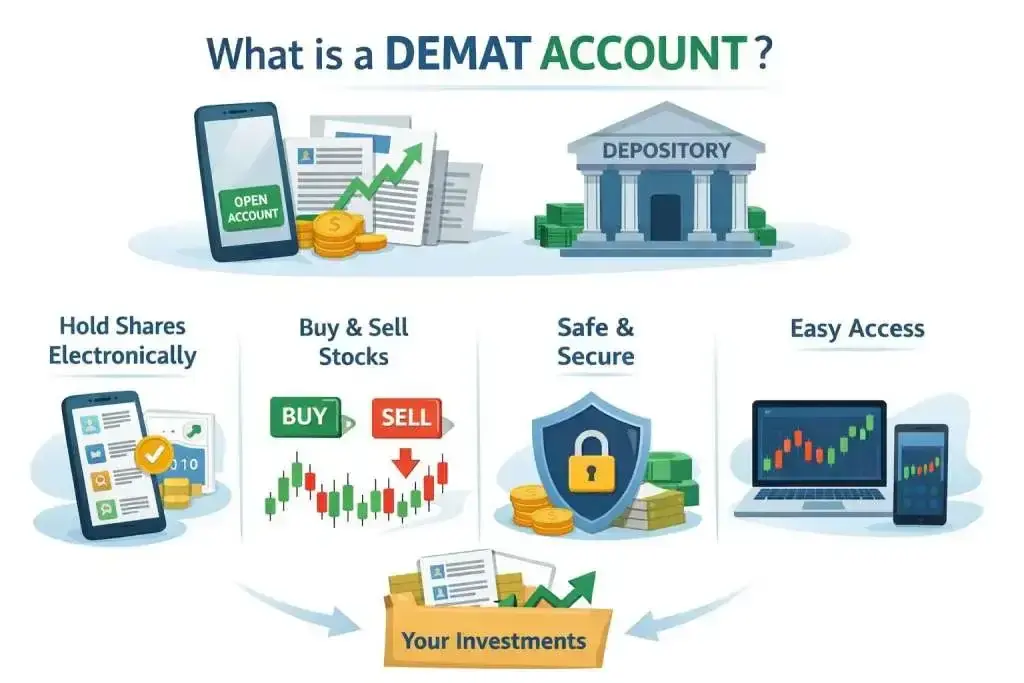
A Demat account is like a digital cupboard for your investments.
Earlier, shares were held as paper certificates that could be lost, damaged, or forged, making investing a complicated process. Demat accounts solved this by converting shares into electronic form. As the saying goes, “Simplicity is the ultimate sophistication.”
Think of a Demat account like a digital safe for your investments. Instead of cash, it holds your shares, funds, and bonds. When you buy, they go in; when you sell, they come out. It keeps all your securities online, secure, and simple to manage.
Now, the question arises: Do we really need a demat account?
The short answer is: Yes, if you want to invest in the stock market. In India, a Demat account is mandatory for holding market-linked investments.
You need a Demat account to invest in:
- Shares (equity stocks)
- ETFs
- IPOs
- Market-linked mutual funds
- Bonds and debentures
Whereas you don't need a Demat account for:
- Fixed Deposits (FDs)
- Savings accounts
- PPF / EPF
- Traditional insurance products
Once your account is ready, understanding market indices and income-generating stocks becomes the natural next step.
Read our article on: What is Nifty, Sensex & Market Indices?
Demat vs Trading Account: What’s the Difference and Which Comes First?
If you're new to investing, it's easy to confuse a Demat account and a trading account, but they actually serve different purposes.
Think of a Demat account as your digital vault—it's where your investments are safely stored electronically. The trading account, on the other hand, is the actual tool you use to buy and sell those investments.
Think of it like online shopping: the trading account helps you place the order, and the Demat account stores what you buy. The trading account connects your bank account to your Demat account, while the Demat account ensures safe ownership of shares, mutual funds, ETFs, and more.
Even small amounts can get you started — here’s exactly how.
Refer to our article on: How to start investing with just ₹1,000
So, which one comes first?
In practice, you don’t need to choose. Most brokers open both accounts together since you need one to transact and the other to hold investments. However, if you only want to hold shares - such as IPO allotments - and don’t plan to trade, a Demat account alone is sufficient.

In the next section, let us try to understand the basics of a demat account and some common mistakes that new investors make while setting one up.
Read our article on: 10 Stock Market Terms Every Beginner Must Know Before Investing
Demat Account Basics: Smart Choices, Common Mistakes
When opening a Demat account, most beginners focus on just one question: “Which broker is the cheapest?” While cost does matter, choosing the right Demat account is far more about clarity, ease of use, and long-term comfort than chasing the lowest fee. This is where many first-time investors make avoidable mistakes - often not because the information is hidden, but because it is overlooked. Some frequent mistakes that you should avoid while setting up a demat account are listed below:
- Look Beyond “Free” and Try Understanding the Real Cost: One of the most common traps for new investors is falling for advertisements that promise “free trades” or “zero brokerage,” which at first glance appears to be a clear win. In reality, free rarely means costless.
For instance, Zerodha charges zero brokerage on delivery trades but levies an Annual Maintenance Charge (AMC) of around ₹300 per year, while Groww currently offers zero AMC for many users - neither approach is right or wrong, just different. Don't be fooled by "zero brokerage" claims! You'll still have to pay other fees (like AMC or DP charges). It's not about hiding the costs; people just misunderstand them.
The main point: Low fees are nice, but knowing exactly what you'll pay is much better. Always check all the costs before you sign up.
- Platform ease is a hidden cost: Another factor beginners underestimate is platform ease. A Demat account requires repeated interaction. If the app is confusing, order placement is unclear, or the platform fails during market hours, even a cheap broker adds significant stress and frustration, negating any cost savings. This is why many retail investors eventually gravitate towards platforms that are simple, stable, and intuitive.
- Customer support is a silent advantage: Customer support is another area that is often ignored - until something goes wrong. A failed order, a delayed IPO refund, or a login issue can quickly test your patience. At that moment, the real question becomes: Can you raise a ticket easily, and do they respond in hours or days? Good customer support may not matter on Day 1, but it matters a lot on Day 100, when real money and real problems are involved.
- One Demat account is usually enough: Encouraged by comparisons, referral links, and constant promotions, many beginners also make the mistake of opening multiple Demat accounts.
One friend recommends Zerodha, another suggests Groww, and soon you have three accounts. Add numbers to this, and three accounts with an average AMC of ₹300 each mean nearly ₹900 every year in fixed costs, even if you barely use them. On top of that, your investments get scattered, making tracking and decision-making harder. Unless you have a clear reason, such as separating long-term investing from active trading, one Demat account is more than enough for most retail investors.
Choosing the perfect Demat account isn't about finding a broker with zero flaws. It's really about picking one that feels honest, is easy to navigate, and genuinely fits the way you like to invest. Sure, opening the account is the easy part, but being a successful investor? That takes a good dose of patience and a solid understanding of the game.
Get a handle on the basics now, and you'll save yourself a ton of headaches, wasted time, and that "I wish I had known this earlier" feeling down the road.
Read More : What are Dividend Stocks? Are they good for Passive Income?
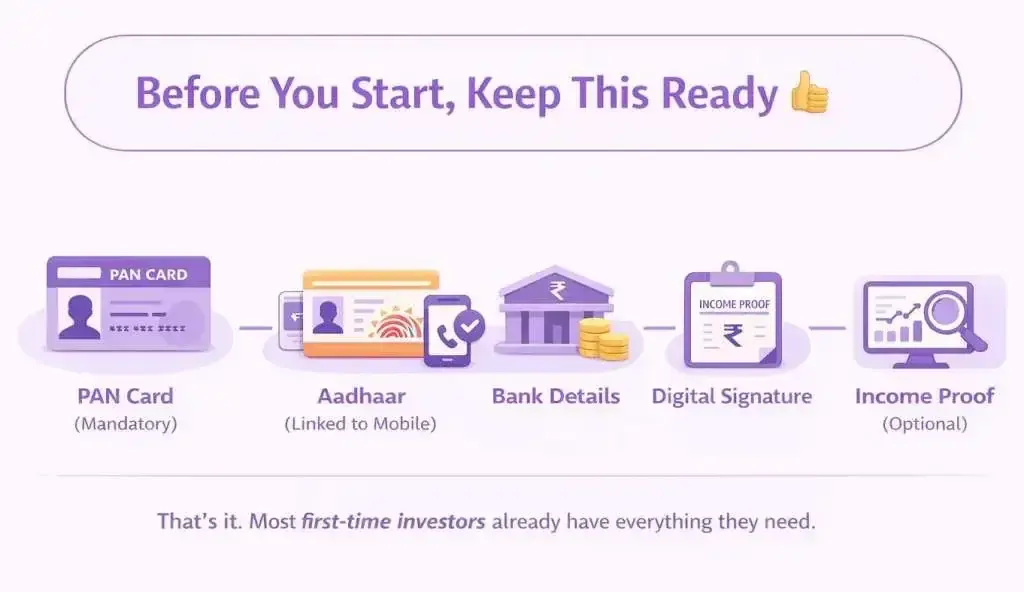
Documents required to open a Demat Account
Now that you have your documents ready, let’s deep-dive into the process of setting up a demat account.
Step-by-Step Process to Open a Demat Account
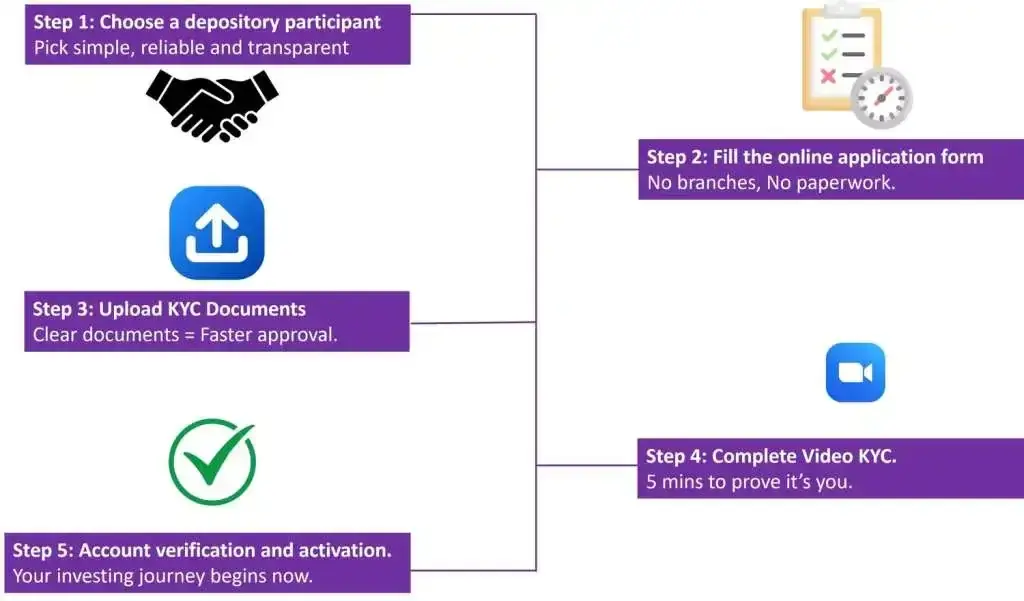
Step 1: Choose a Depository Participant (Broker)
You don’t open a Demat account directly with the stock exchange. Instead, you do it through a Depository Participant, basically your broker. Think of your broker as the friendly, essential bridge connecting you to the stock market playground.
Pick a platform that's simple to use, doesn't hide its fees, has quick-to-respond customer support, and is generally well-regarded. Seriously, don't get stuck in analysis paralysis; the main thing is just to get started! In India, brokers generally fall into two categories:
If you invest in securities based on your own research and require minimal to no advisory support, you can opt for Discount brokers who focus on low costs and a clean, tech-driven experience. Platforms like Zerodha and Groww charge minimal or zero brokerage on delivery trades and are popular among investors who prefer simplicity and cost efficiency.
If you prefer guidance and ongoing support, full-service brokers can be a better fit. They provide a broader set of offerings - such as investment advice, detailed research reports, dedicated relationship managers, and offline assistance. Well-known examples include HDFC Securities and Axis Direct.
Step 2: Fill the Online Application Form
Once you select a broker, the application process is completely online. For example, when signing up on Zerodha or Groww, you’ll be asked to enter basic details such as your name, mobile number, PAN, Aadhaar, and bank account information. This allows your account to be verified and ensures that money can move smoothly when you invest. For most people, this step takes about 10–15 minutes and feels similar to opening any other financial app - no paperwork, no branch visits.
Step 3: Upload KYC Documents
You'll need to upload clear pictures of your KYC documents, usually your PAN card, Aadhaar card, and signature. Keep them clear and well-lit—a blurry photo can easily delay your approval by a day or two! Clear photos upfront mean a faster account opening.
Step 4: Complete Video KYC
Next comes video KYC, which is a short identity verification done through your phone or laptop. On platforms like Groww or Zerodha, opening a demat account is a quick process, often taking less than five minutes. It primarily involves a swift identity confirmation. You will typically need to confirm your name, briefly display your PAN card, and answer a few basic questions. This fast and efficient digital verification step is what has significantly streamlined the Demat account opening process, eliminating the need for in-person checks.
Step 5: Account Verification & Activation
Upon successful completion of all checks, your Demat and trading accounts will be promptly activated. You can expect to receive your login credentials via email or SMS, often within 1–3 working days, and in some cases, as quickly as 24 hours. With your accounts active, you can now log in, familiarise yourself with the platform, review your initial empty portfolio, and begin learning before executing your first investment.
What Happens After Your Demat Account Is Opened?
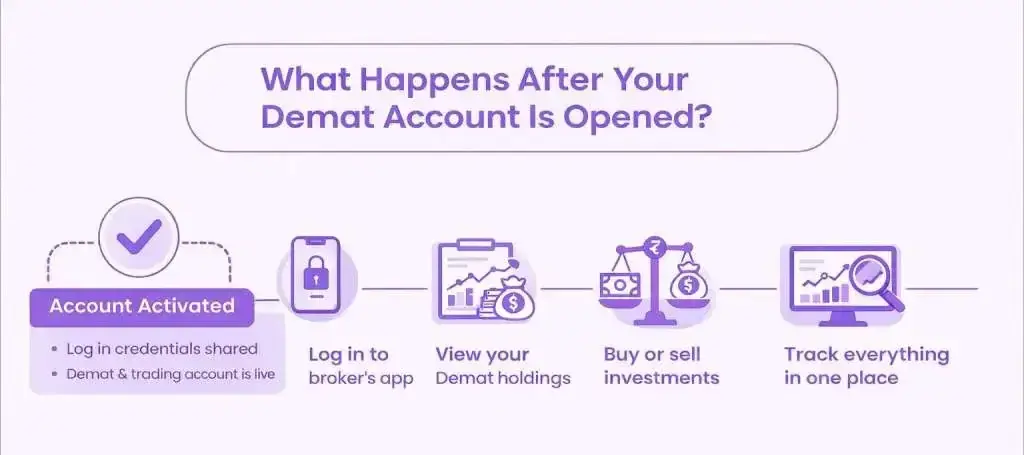 Now that your Demat account is active, all your investments can be tracked in one place. But there’s an important distinction to understand at this stage: your broker helps you transact, but does not actually hold your investments.
The custody of your securities rests with regulated institutions called depositories. In India, there are only two - National Securities Depository Limited (NSDL) and Central Depository Services Limited (CDSL) - which securely store your investments and maintain ownership records.
To understand how investor protection really works, let’s now look at what NSDL and CDSL do, and whether there’s any meaningful difference between them from an investor’s point of view.
Read More : 10 Stock Market Terms Every Beginner Must Know Before Investing
What Role do NSDL and CDSL play?
Think of NSDL and CDSL as digital vaults for your investments. Their role is simple but critical:
- Store your shares safely in electronic form
- Keep accurate records of who owns what
- Ensure every buy and sell is properly recorded
- Protect investors even if a broker shuts down
When you buy a stock, it doesn’t sit with your broker - it goes straight into your Demat account held with NSDL or CDSL. When you sell, it’s debited from there. This separation exists for one reason: safety.
As investing author Morgan Housel rightly says, “The most important part of every plan is planning for things not going according to plan.” India’s Demat system is built exactly with that mindset.
Now, let’s address the next question. Is there any difference between NSDL and CDSL from an investor’s point of view?
In simple terms, not really.
- Both are SEBI-regulated
- Both provide electronic storage of securities
- Both offer the same level of security
- Both follow identical rules
And the real catch is: You also can’t choose between them directly - your broker is already linked to one depository, and your Demat account is created accordingly. This creates the stage for our next discussion: Do our investments get affected if our broker shuts down?
What Happens If Your Broker Shuts Down?
This is where many new investors feel anxious - and rightly so. If a broker shuts down, the app may stop working, and you may need to shift to another broker. But your investments? They remain untouched, because as we have noted earlier, your shares are not held by the broker; they are stored with India’s depositories - NSDL or CDSL.
As G. N. Bajpai, former Chairman of SEBI, rightly observed, “An efficient and secure depository system is the backbone of a modern capital market.” This is exactly what India’s depository structure delivers—moving ownership away from fragile paper-based systems to one built on safety, transparency, and technological reliability.
Because your investments stay secure and unchanged, you can simply link your existing Demat account to a new broker and continue investing without disruption. Your ownership does not change, even if the intermediary does.
This design is precisely why Demat accounts are considered one of the safest financial holding systems in India - and why the system matters so deeply for long-term investors. When your wealth is not dependent on a single broker and is protected by a regulator-backed framework, investing becomes less about constant monitoring and more about peace of mind. And it is this clarity, not activity, that allows wealth to grow quietly over time.
Read More : A Fundamental Checklist: How to Research a Stock in 1 Hour
Explore our Products
Research Framework

Emerging Titans
Combination of quantitative analysis, industry tailwinds, and management assessment - SPRINT investment philosophy

Tiny Titans
Heavy emphasis on scuttlebutt research, plant visits, and early on-ground signals
Conclusion: The first step is simpler than you think
Opening a Demat account doesn’t make you an investor — but it removes the biggest friction between learning and action. When the structure is right, investing becomes less about fear and more about process, patience, and long-term thinking. Get this first step right, and you avoid years of avoidable mistakes later.
Comment “DEMAT” if this guide helped clarify the process.
If you’ve already opened one, tell me which broker you chose and why — and if this helped, like the post and share it with someone starting their investing journey.
FAQs ( Frequently Asked Questions )
What is the minimum amount required to open a Demat account?
+Can I open more than one Demat account?
+How long does it take to open a Demat account?
+Can I open a Demat account without income proof?
+Is a Demat account mandatory for mutual fund investments?
+
High growth stock specialist, Value Educator
Shashank Mahajan is an equity research professional with over 12 years of experience in identifying high-potential SME and micro-cap stocks at an early stage. He follows a rigorous scuttlebutt research–driven approach, combining on-ground insights with deep financial analysis. Shashank specializes in uncovering under-researched and under-owned companies with strong management quality and long-term growth potential. Through disciplined research and early identification, he focuses on spotting tomorrow’s market leaders before they enter the mainstream investor radar.

Glenmark: The USD 700 Mn Cancer Deal and Its Brands

Pharma Stocks in India 2026: Generics, APIs and CDMOs

Granules India: From Paracetamol to a 65% Gross Margin

Natco Pharma: After Revlimid, 29 Patent Challenges

Shilpa Medicare: Cancer APIs, Films and Biosimilars

Alembic Pharma: US Plants Pay Back, Margin Hits 22.2%
Explore our Products
Research Framework
Emerging Titans
Combination of quantitative analysis, industry tailwinds, and management assessment - SPRINT investment philosophy
Tiny Titans
Heavy emphasis on scuttlebutt research, plant visits, and early on-ground signals



Modern Warfare to Multibaggers
Key Trends. Strategic Shifts. Opportunities Ahead.
Don't Miss This Exclusive Webinar!
Join Value Educator to decode the key trends shaping India's defence sector and learn how to identify tomorrow's potential leaders in the space.
- In-depth research on India's defence sector
- Live Q&A session
- Actionable takeaways for long-term investors

 Orders
 Subscription
 Share with friends


Required Details
₹23999.00
(12 month subscription)
As per SEBI regulations, all users are mandated to complete the KYC that is validated for 1 year. Post payment, you will be redirected to the KYC screen


No comments yet. Be the first to comment!