
Start Investing With Just ₹1,000

You Don’t Need Lakhs to Start Investing – Start Small but Start Early
“The best time to start investing was yesterday. The next best time is today.” – Anonymous
When Warren Buffett bought his first stock at just 11 years old, it wasn’t with a large sum of money. It was whatever little he had managed to save. There was no grand plan, no special knowledge, just an early start. What’s even more surprising is that Buffett didn’t become wealthy quickly. In fact, over 90% of his net worth was created after the age of 50, not because he suddenly became smarter, but because he stayed invested for decades.

This is why the real risk is not starting with too little money, it’s waiting too long to begin. As Buffett once quoted: “If you don’t find a way to make money while you sleep, you will work until you die.” Investing is how your money starts working in the background, even while you focus on your career or studies. And contrary to popular belief, this doesn’t require a high salary or expert-level knowledge. All it requires is a starting point, a simple plan, and the discipline to stay consistent.
That’s where ₹1,000 makes a real difference. It’s not the size of your first investment that matters, but how long you allow it to grow. When invested early and consistently, ₹1,000 stops being just a number and becomes the starting point of a habit that can steadily shape your financial future.
To understand why this small sum is far more powerful than you think, let’s break down what ₹1,000 can actually do over time.
Why ₹1,000 Is More Powerful Than You Think
What really makes the bigger difference, investing more money or giving your money more time?
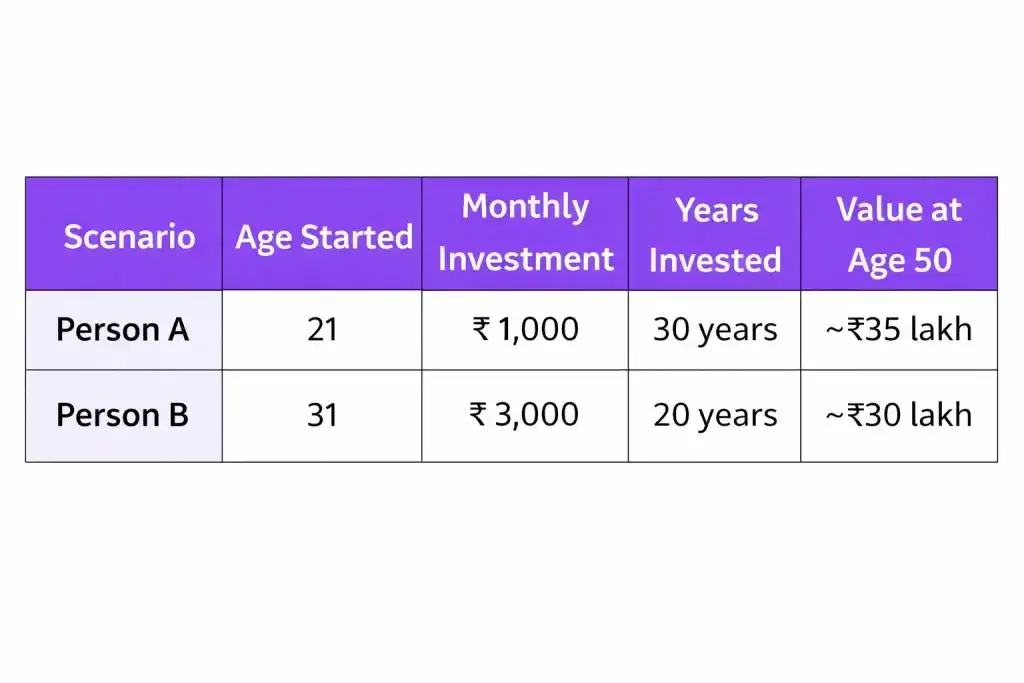
At first glance, Person B looks smarter. Investing ₹3,000 a month sounds far better than ₹1,000. But compounding doesn’t reward who invests more at the start, it rewards who starts earlier. Person A gives money 30 years to grow, while Person B gives it only 20. That extra decade quietly changes everything.
Here’s what happens behind the scenes. Person A’s early investments get more time to grow, and those gains themselves start generating gains. Over the years, the growth builds on top of growth. Person B invests more each month, but much of that money simply doesn’t get enough time to multiply. By the time Person B starts, Person A’s money has already been growing for years.
This is the real lesson of compounding: time creates the advantage, not the amount. Starting early turns small, regular investments into a powerful engine. You don’t need to chase bigger numbers, you need to give your money a longer runway. That’s why starting with ₹1,000 today can beat starting with much more tomorrow.
Now that you understand the power of ₹1,000, the next step is knowing how to use it wisely. Let’s look at the simple rules that can help you grow your money.
The Simple Rule That Grows Your Money

Most people believe you need a higher salary to invest more. In reality, people invest more because they follow a rule, not because they earn more.
If you wait for motivation or the “right time,” your investments will stay small.
But if you use a simple system, your investment amount grows automatically—without stress or overthinking.
Here are five rules that work especially well for beginners.
Rule 1: The Power of Compounding
The Rule of 72 is a simple way to understand the power of compounding without using complicated formulas. By dividing 72 by your expected annual return, you can estimate how long it takes for your money to double. For instance, at around 12% annual returns, which aligns closely with long-term stock market returns in India, your investment can double in roughly 6 years. This makes it clear that compounding is less about skill and more about giving time to your money.
When you invest ₹1,000 consistently, every rupee begins compounding from the day it’s invested. Money invested earlier has more time to double multiple times, while money invested later has fewer chances to grow.
Read more on the magic of Compounding: The Power of Compound Interest: How to Create Wealth in the Stock Market
Rule 2: Increase Your Investment as Your Income Increases
Never increase your investment just because markets are doing well. Increase it only when your income increases.
Think of this as a Step-up SIP, a simple habit where your investments grow in small steps as your income grows. A simple and practical rule is to increase your investments only when your income increases. Instead of investing the entire raise, channel about 20–30% of it into your monthly investments.
For example, if your income increases by ₹5,000, then increase your SIP by around ₹1,000. You can still get to enjoy a better lifestyle, while your investments quietly level up in the background. Over time, these small, regular step-ups add up, keeping lifestyle inflation in check and allowing compounding to work more effectively.
Rule 3: Automate Everything and Don’t Touch It
Once you decide an amount, automate it.
Set up a monthly SIP or automatic transfer and treat it like a non-negotiable bill. When investing is automatic, emotions are removed from the process, and consistency becomes effortless. Do not stop or reduce your SIP during market falls. Those periods are when your money actually works harder for you. Automation turns good intentions into long-term results.
Rule 4: Increase Slowly, But Never Decrease
You don’t need to double your investment overnight. Even small increases make a big difference over time. Increase your investment once or twice a year by a small amount—₹500 or ₹1,000 is enough. But once increased, do not reduce it unless there is a genuine financial emergency. This slow, steady approach keeps your plan realistic and sustainable.
Rule 5: Avoid Trading. Focus on Investing
Trading and intraday strategies may look attractive, but they are far riskier than investing, especially for beginners. Trading depends on short-term price movements, timing, and emotions, and the use of leverage which can magnify small losses into big ones very quickly. Starting your market journey with leverage is risky and unnecessary when your biggest advantage is time.
It’s also worth understanding the incentive structure. Brokers earn more when you trade frequently, because every trade generates fees and charges whereas Long-term investing involves fewer transactions, which means lower costs and less stress for you. For beginners, slow and boring investing beats fast and exciting trading almost every time.
Once you understand the rules, the biggest question isn’t “how much” to invest, it’s “where” to invest. Let’s simplify that choice without overthinking it.
Where to Invest Your First ₹1,000
This is the point where many beginners get confused, not because they lack money, but because they fear making the wrong decision. The good news is that your first investment does not need to be perfect. It only needs to be sensible.
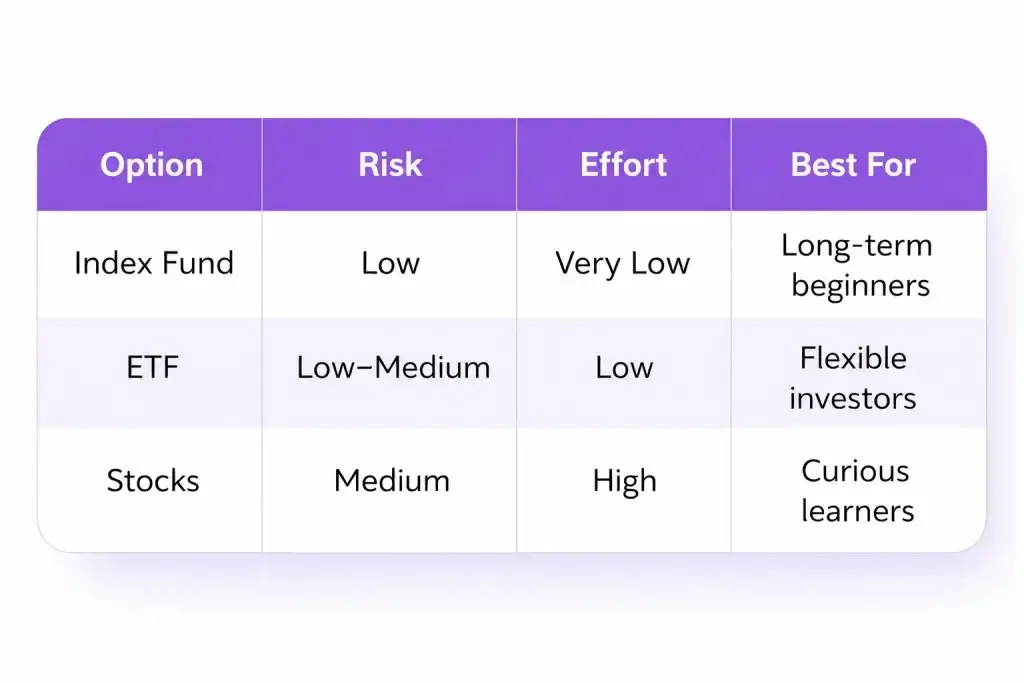
Below are three practical options for investing your first ₹1,000, ranging from the safest and most hands-off option to a more learning-focused approach. You can choose one that fits your personality and comfort level, because consistency matters far more than complexity.
“Simplicity is the master key to financial success.” – Jack Bogle
Option 1: Index Funds – The “Set It and Forget It” Route
This approach is ideal for people who want to build wealth without constantly tracking market movements or stock prices. Instead of trying to pick individual companies, you invest in the overall growth of India’s economy.
A Nifty 50 Index Fund is designed to do exactly that. It automatically invests in the 50 largest and most established companies in India, such as Reliance, HDFC Bank, Infosys, and TCS. As these companies grow over time, your investment grows with them. There is no need to analyze balance sheets or follow daily market news.
“For most investors, the best thing to do is own the index fund.” – Warren Buffett
Most index funds allow Systematic Investment Plans (SIPs), which let you start investing from as little as ₹100. A simple and effective approach is to set up a monthly SIP of ₹1,000, or split it into two SIPs of ₹500, into a Nifty 50 Index Fund – Direct Growth option. Splitting the amount into two SIPs improves rupee cost averaging by investing on different dates, reduces the risk of investing everything at a market high, and adds flexibility to modify or pause one SIP later if needed. This method encourages discipline and long-term thinking, which are far more important than short-term returns when you are starting out.
Read More : What Is Nifty and Sensex? A Beginner’s Guide to Market Indices
Option 2: ETFs – The “Smart Shopper” Route
This option works for investors who want the benefit of diversification like an index fund but prefer the flexibility of buying and selling like a stock. Exchange Traded Funds (ETFs) combine features of both mutual funds and shares.
One of the most popular choices in India is Nifty BeES, an ETF that tracks the Nifty 50 index. It works similarly to an index fund, but instead of investing through an SIP, you can buy it directly during market hours using your trading account.
This approach gives you instant diversification across India’s top companies while retaining control over when you buy or sell. ETFs are especially useful for beginners who want transparency, low costs, and simplicity without the commitment of a long-term SIP right away.
Option 3: Individual Stocks – The “Future Owner” Route
This option works best for beginners who are genuinely curious about how businesses operate and are willing to learn over time. Investing in individual stocks comes with higher risk than index-based options as your returns depend entirely on how one specific company performs.
If you choose this path as a beginner, it’s better to start with large-cap or blue-chip companies. These are well-established businesses with strong balance sheets, steady cash flows, and a long track record. While they may not give quick short-term gains, they tend to be more stable and less volatile, which is ideal when you’re still learning how markets behave.
As your understanding grows, you can slowly expand into mid-cap, small-cap, and micro-cap stocks. These offer higher growth potential, but they also come with higher risk, so moving step by step is the smarter approach.
Read more: How to Analyze a Mid-Cap Company – A Complete, Practical Framework
Knowing where to invest is only half the battle. Avoiding these mistakes is what actually protects your money.
Hidden Mistakes That Hurt New Investors
Most new investors don’t lose money because they picked the wrong investment option, they lose money because they react emotionally in a market that rewards patience.
“Good investing is not necessarily about making good decisions. It’s about consistently not screwing up.” – Morgan Housel
If you avoid the five mistakes below, you’ll already be ahead of the majority of first-time investors regardless of whether you start with ₹1,000 or ₹1 lakh.

- Waiting for the “Perfect Time” to Start: Many beginners delay investing while waiting for markets to fall or salaries to rise. In reality, no one can consistently predict market movements. Starting small and early matters far more than starting big at the “right” time.
- Chasing Stock Tips and Quick Profits: Tips from friends, Telegram channels, or social media create false confidence. You don’t know the risk, exit plan, or reasoning behind them. What feels like easy money often turns into an expensive lesson.
- Panic Selling When Market Falls: The first market correction feels frightening, especially for new investors. Selling quality investments during temporary declines locks in losses that could have recovered with time.
- Checking Prices Often: Constantly tracking your portfolio increases anxiety and leads to impulsive decisions. Long-term investors benefit more from checking their investments occasionally, not daily.
- Trying to Recover Losses Quickly: After seeing a small loss, beginners often take bigger risks to “get back to zero.” This emotional response usually causes more damage than the original loss.
Read more on : Small-Cap Investing - Mistakes That Cost Investors Money
The biggest reason beginners quit isn’t losses, it’s unrealistic expectations. Here’s what investing actually feels like in the beginning.
What to Expect in Your First 6–12 Months
Your first year of investing will not feel exciting. And that’s exactly how you’ll know you’re doing it right.
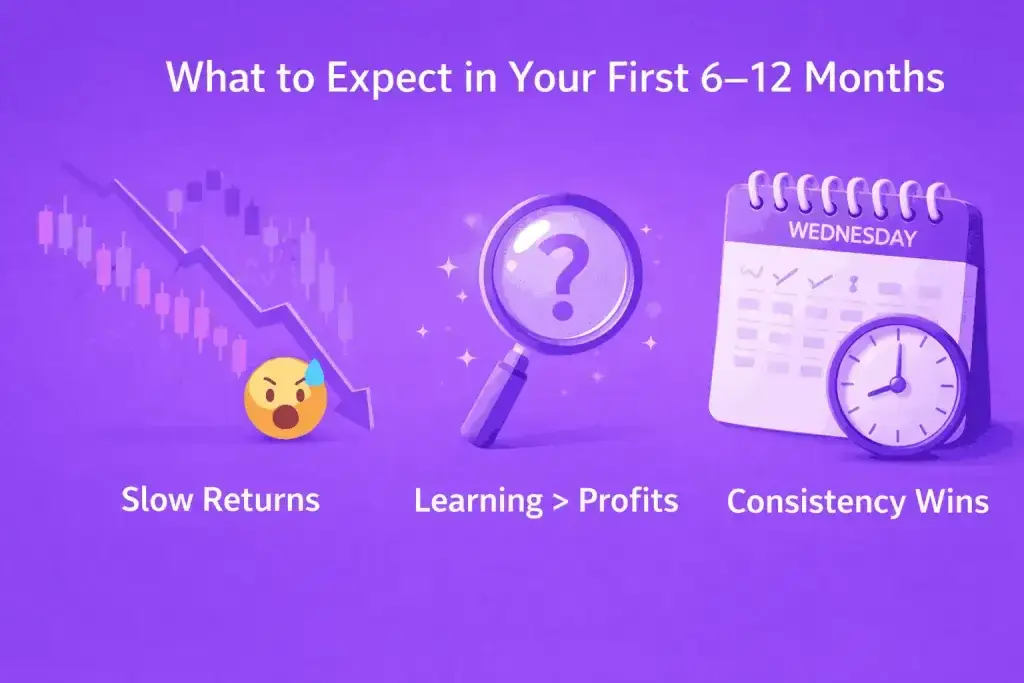
Most beginners expect quick results, constant growth, and visible progress every month. The reality is quieter. The first 6–12 months are not about making money, they’re about learning how the market behaves and how you behave inside it. Here’s what you should realistically expect.
1. Returns Will Look Slow (Sometimes Disappointing)
“The first rule of compounding is to never interrupt it unnecessarily.”– Charlie Munger
In the beginning, your portfolio may move very little. Some months it will be up, some months it will be down, and many times it will look unchanged. This does not mean your strategy is failing. It means compounding hasn’t had enough time to work. Early investing feels boring because the base is small. That’s normal.
2. Learning Will Matter More Than Profits
You’ll start understanding over time, how markets react to news, how emotions affect your decisions and how important it is to have patience. These lessons are far more valuable than short-term gains. Think of the first year as paid education, not a performance test.3. Consistency Will Matter More Than Confidence
You don’t need to feel confident every month. You just need to stay consistent. Showing up regularly, even when results aren’t visible, is what separates successful investors from those who quit early. Confidence comes later. Discipline comes first.
You’ve seen how investing works, where to invest and what to expect. Now let's bring it all together.
Explore our Products
Research Framework

Emerging Titans
Combination of quantitative analysis, industry tailwinds, and management assessment - SPRINT investment philosophy

Tiny Titans
Heavy emphasis on scuttlebutt research, plant visits, and early on-ground signals
Conclusion: Start Small, Stay Patient, Let Time Work
“Someone is sitting in the shade today because someone planted a tree a long time ago.” — Warren Buffett
Most investors delay wealth creation not because they lack money, but because they wait for the “right time.” Knowledge matters, but action matters more. If this summary reinforced the importance of starting early and staying disciplined, comment “START” below. Like the post to support practical investing education, share it with someone who is still waiting to begin, and comment with the one habit you believe matters most in long-term investing
As a beginner, learning is your greatest investment.
Read: A Beginner’s Roadmap to Stock Market Investing
FAQs ( Frequently Asked Questions )
Is ₹1,000 really enough to start investing?
+What if the market falls right after I invest?
+Should I invest all ₹1,000 at once or spread it out?
+How often should I check my investments?
+Can I lose all my money in stocks?
+When should I increase my investment amount?
+
High growth stock specialist, Value Educator
Shashank Mahajan is an equity research professional with over 12 years of experience in identifying high-potential SME and micro-cap stocks at an early stage. He follows a rigorous scuttlebutt research–driven approach, combining on-ground insights with deep financial analysis. Shashank specializes in uncovering under-researched and under-owned companies with strong management quality and long-term growth potential. Through disciplined research and early identification, he focuses on spotting tomorrow’s market leaders before they enter the mainstream investor radar.

Zen Technologies: Revenue Fell After a Big Win




PNG Jewellers: A 194-Year-Old Name Goes National

Explore our Products
Research Framework
Emerging Titans
Combination of quantitative analysis, industry tailwinds, and management assessment - SPRINT investment philosophy
Tiny Titans
Heavy emphasis on scuttlebutt research, plant visits, and early on-ground signals


 Orders
 Subscription
 Share with friends


Required Details
₹23999.00
(12 month subscription)
As per SEBI regulations, all users are mandated to complete the KYC that is validated for 1 year. Post payment, you will be redirected to the KYC screen


No comments yet. Be the first to comment!