
FIIs vs DIIs: How Markets Changed

“Indian markets don’t move on news. They move on money.”
To understand why this is true, we need to go back to how Indian markets quietly changed and how FIIs came to dominate them.
Today, seeing lakhs of crores move in the stock market feels normal, but this wasn’t always the case. In the early 1990s, Indian markets were mostly run by Indian institutions. UTI and a few bank-backed mutual funds were in charge. Foreign investors weren’t even part of the picture.
That changed in 1992-93, when India allowed FIIs to enter. They came in slowly, investing just ₹13 crore. At the same time, DIIs already had around ₹45,000 crore invested. Most people believed Indian money would always dominate Indian markets.
In 1998, something changed.

UTI ran into trouble with its assured-return schemes. Investor trust in mutual funds broke. Domestic money almost stopped flowing into equities. For years, DII investments barely moved. Foreign investors stepped in.
While Indian institutions struggled, FIIs kept buying. By the end of the 1990s, their investments had crossed ₹70,000 crore. Over the next decade, one simple rule became clear:
FIIs buy - markets rise
FIIs sell - markets fall
By 2014, FIIs had invested nearly ₹6.6 lakh crore. DIIs were still around ₹42,000 crore. For almost 20 years, Indian markets leaned heavily on foreign money.
Then came a silent shift.
Around 2014-15, domestic investments surged. SIPs picked up. Mutual fund awareness grew. Insurance and pension money entered the market. This started well before Covid, not after it.
Over time, DIIs kept buying steadily, even when FIIs sold. After Covid, this trend became stronger.
By 2025, DIIs held about ₹14 lakh crore in equities. FIIs were at roughly ₹10 lakh crore clearly behind domestic investors.
FIIs haven’t disappeared. They’ve just become more selective. High valuations, strong US bonds, and a strong dollar make them cautious. They don’t exit because India is bad, they exit because global options look better.
Indian markets are far more stable today. But foreign money still decides when markets feel cheap or expensive. Which brings us to the real question-Who exactly are these FIIs, and why does their money carry so much weight?
What are FIIs?
FIIs, or Foreign Institutional Investors, are large investors based outside India who invest in Indian markets. They are not individual traders. They are big institutions managing huge pools of global money.
They follow the principle like “In investing, what is comfortable is rarely profitable.”
- Robert Arnott
Think of FIIs like big global money managers sitting in places like the US, Europe, Japan, or the Middle East. Every day, they’re comparing countries and deciding where their money should go next.
When they invest in India, they usually buy:
- Indian equities - listed stocks, especially large-cap and index heavyweights
- Indian debt instruments - government securities, corporate bonds
- Other listed financial instruments - ETFs, derivatives, and market-linked securities
“Know what you own, and know why you own it.” - Peter Lynch
This is exactly how large investors think. Different assets behave differently, carry different risks, and serve different purposes. That’s why FIIs diversify not just across assets, but also across countries. Their decisions are driven by structure and logic, not excitement.
They don’t follow Indian news cycles or social media debates. They don’t invest based on emotions or stories.
Their thinking is very simple: Where can my money earn the best risk-adjusted return right now?
If you’re beginning your own investing journey and want to understand how different asset classes work and why they exist, our article Stock Market Terms Every Beginner Must Know Before Investing can help you build that foundation with clarity.
Who Comes Under FIIs?
FIIs are large global institutions, such as:
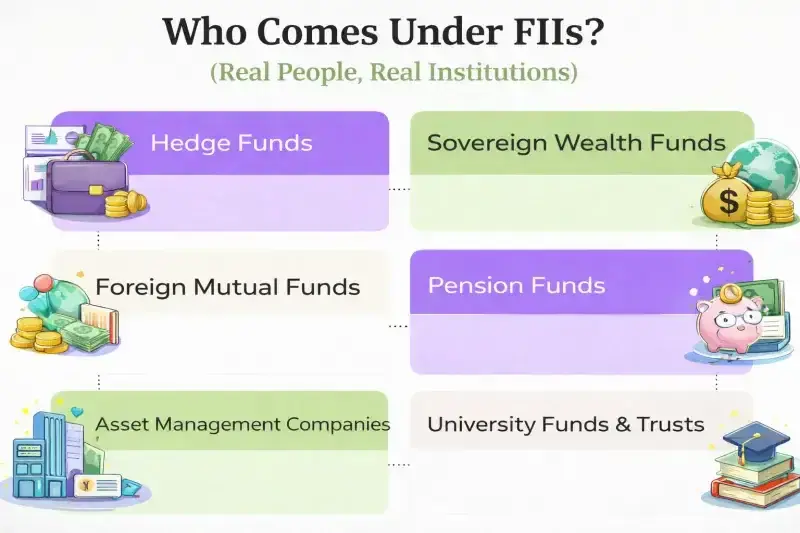
- Hedge Funds- These are fast movers. They enter when they see opportunity and exit the moment the risk changes.
Example: Bridgewater, Citadel, Millennium
- Sovereign Wealth Funds- This is government money. It’s patient, long-term, and usually invested in big, stable companies.
Example: Norway’s fund, ADIA, GIC Singapore
- Foreign Mutual Funds- These funds collect money from investors worldwide and park a part of it in India when it looks attractive.
Example: Vanguard, BlackRock, Fidelity, Franklin Templeton
- Pension Funds- This is retirement money. It moves slowly and avoids unnecessary risk.
Example- CalPERS (USA), CPPIB (Canada)
- Asset Management Companies- Large global fund houses that constantly shift money between countries based on returns and risk.
Example: BlackRock, JPMorgan, Morgan Stanley
- University Funds and Trusts- Long-term capital meant to grow steadily for decades, not to chase quick profits.
Example: Harvard and Yale endowment funds
Different in style, but common in one thing: they move very large amounts of money.
The Most Important Thing to Understand
FIIs don’t “buy India”. They compare India with other options:
- India vs US bonds
- India vs China
- India vs Brazil
- India vs global risk
India is just one choice in a global portfolio.
FIIs don’t invest based on loyalty or stories. They allocate capital by comparison.
As the saying goes, “Every investment has an opportunity cost.” Their job is to constantly compare options and move money to where the risk-adjusted return looks most attractive.
Before entering any market, FIIs usually run through a basic checklist:
- Is the economy stable and growing?
They prefer countries with strong GDP and low inflation. - Is the currency stable?
A falling currency can eat into their profits. - Are interest rates in other countries more attractive?
If US bonds offer 5%, India has to look even better to compete. - Are valuations reasonable?
They avoid markets that look too expensive. - Is there enough liquidity to exit safely?
They want to know they can pull out quickly if needed.
We’ve seen how foreign investors quietly took over Indian markets during the 1990s and 2000s. But here’s the part most people forget: “money that enters quickly can also leave just as quickly.”
Let’s see what happened when that money suddenly started leaving.
Case Study 1: 2008 – When FIIs Left, and the Market Crashed
Let’s rewind to 2007. India was glowing.
The stock market was at an all-time high. The rupee was strong. Global investors couldn’t get enough of the India story. FIIs invested more than $20 billion in that one year alone. It felt like the good days were here to stay.
This FII-driven pattern was clearly visible in how benchmark indices moved during that period. If you are new and don't know terms like Nifty, Sensex, and other indices, you can read our article What is Nifty, Sensex & Market Indices? Beginners Guide
Then came 2008.

Oil prices were climbing sharply. India's trade deficit was widening. That put pressure on the rupee, and suddenly, foreign investors weren’t so comfortable anymore. See, FIIs don’t just look at how much money they make in India; they look at how much of that money stays intact when they convert it back into dollars.
And when the rupee weakens, their returns shrink.
So they started pulling out.
By the middle of 2008, FIIs had withdrawn over $6 billion, the biggest exit since they were first allowed into Indian markets back in 1993. And the Sensex? It tanked, falling over 8,000 points, in what became one of the deepest and most painful market crashes in Indian history.
It was a perfect storm.
Even though many Indian businesses were doing just fine, it didn’t matter. Because the money was leaving, markets always followed the money.
By 2009, things started to turn around. Global panic eased, FIIs cautiously returned, and the rupee stabilised.
But the message was loud and clear:
When FIIs sell, markets don’t need a second reason to fall. And when FIIs buy, markets rarely need extra justification to rise.
That’s why understanding FII flows matters so much. It’s not just about individual stocks; it’s about money, timing, and global forces that often have little to do with India itself.
But 2008 wasn’t an exception. That leads us to the next episode.
Case Study 2: 2013 - When the Fed Sneezed and India Caught a Cold
By 2012, Indian markets had largely recovered from the global financial crisis.
FIIs were back. Confidence was returning. The Sensex rose nearly 25% in 2012, supported by over $20 billion of FII inflows. Once again, it felt like stability had returned.
But in mid-2013, nothing inside India had suddenly broken.
There was no corporate earnings collapse.
No banking crisis.
No domestic shock comparable to 2008.
Yet markets fell sharply.
What Changed?
In May 2013, the U.S. Federal Reserve signalled that it might start slowing down its money-printing bond-buying program. And just like that, the easy global liquidity that had been flowing into emerging markets started to look shaky and uncertain.
For FIIs, this changed the math overnight.
Higher U.S. yields meant-
- Better risk-free returns in dollars
- Less incentive to stay invested in volatile emerging markets
India, despite its long-term potential, became less attractive relative to global alternatives.
The Exit Begins
Starting in June 2013, FIIs turned aggressive sellers.
- ₹21,657 crore was withdrawn in June alone, the largest monthly outflow since 2008
- Over the next three months, India saw its biggest FII sell-off since the global crisis

Markets reacted instantly.
The Sensex and Nifty fell 10–15% by August 2013. The rupee collapsed to record lows. Confidence evaporated.
All this, despite no immediate collapse in Indian business fundamentals.
The Lesson Became Clear.
FIIs weren’t selling because India was failing. They were selling because global capital had found a better home.
This pattern didn’t end in 2013 - it clearly replayed during the COVID shock of 2020. When fear spread globally, FIIs sold aggressively, not because Indian businesses suddenly weakened, but because global money always runs to safety during panic. That selling added extra pressure and made the Indian market fall more sharply than expected. Then, when liquidity returned and confidence improved, the same foreign money rushed back in, and markets bounced just as fast.
So even though the trigger changed, the behaviour stayed the same. FII selling deepened the fall, and FII buying accelerated the rise. Once again, Indian markets weren’t moving on domestic stories - they were moving in sync with global money flows.
Now let’s slow down and look at the numbers.
For many years, the Indian stock market moved closely with foreign money. When FIIs bought, markets usually went up. When they sold, markets often fell. That link was easy to see.
But around 2015, the market began to look a little different.
To see this shift clearly, we move away from opinions and look at simple data - how money flows and how markets move. When we compare these across different periods, a changing pattern starts to appear, showing how the market’s drivers have evolved.
What is the Mathematics behind it?
For a long time, it felt like FIIs (Foreign Institutional Investors) were the puppeteers of Indian markets. If they bought, markets went up. If they sold, everything crashed. But guess what? That’s not how it works anymore — and the numbers back it up.
Let’s break it down with a simple idea: correlation.
Think of correlation as a way to measure how closely two things move together.
If FII flows and the Sensex moves in sync, we get a high correlation.
If they move in opposite directions or not together at all, the correlation drops.
Here’s what the data tells us:
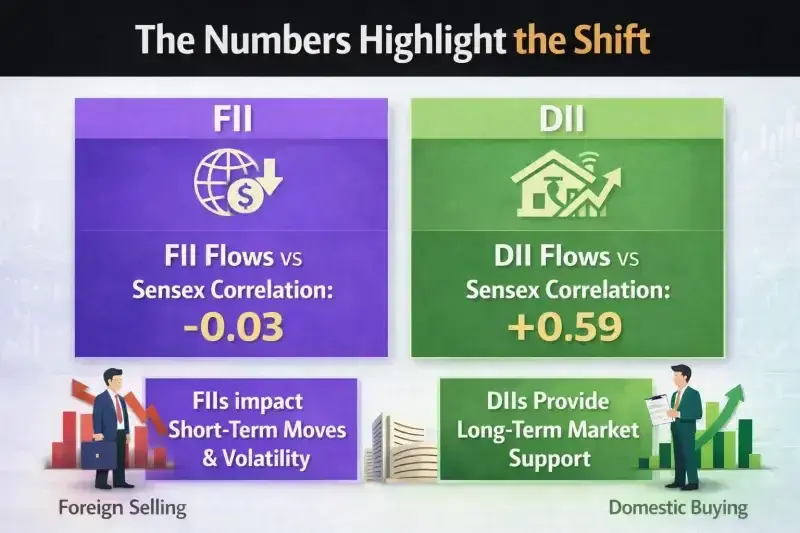
- From 2000 to 2014, FII flows and the Sensex had a 0.37 correlation - meaning FIIs had a noticeable impact.
- But from 2014 to 2025, that correlation dropped to just -0.03 - almost zero. FIIs just don’t move the market like they used to.
Now let’s look at DIIs (Domestic Institutional Investors):
- Their correlation with the Sensex was -0.20 before 2014 - very weak.
- But after 2014, it shot up to +0.59 - meaning DIIs are now tightly linked to market movements.
What changed?
SIPs, mutual funds, pension money, and insurance flows started pouring in consistently. This gave Indian markets a strong, stable support system. So even when FIIs sell, the market doesn’t crash because DIIs are there, buying steadily.
Don’t stress every time FIIs sell. Long-term Indian investors are now strong enough to hold the fort. And that’s a big win for market stability — and for anyone looking to build wealth with patience.
This steady domestic participation allows long-term investors to stay invested and benefit from the power of compounding over time. If you also want to learn about long term investing you can read our article The Power of Compound Interest: How to Create Wealth in the Stock Market.
We’ve put together 5 simple checkpoints to help every investor make smarter decisions by understanding how big institutions buy and sell.
What Retail Investors Can Learn from Big Money Moves
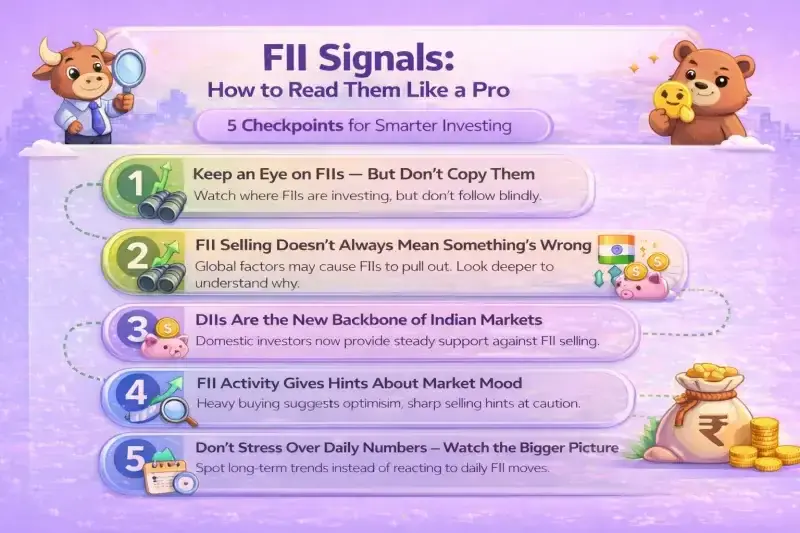
1. Keep an Eye on FIIs - But Don’t Copy Them
FIIs can move markets, so it's smart to watch where their money is going. But don’t blindly follow. Always check the basics, is the company you're investing in still doing well? If yes, don’t rush just because FIIs are buying or selling.
2. FII Selling Doesn’t Always Mean Something’s Wrong
Sometimes FIIs sell because things are changing globally, like rising interest rates in the US or a stronger dollar. It’s not always about India or its economy. So if the news says “FIIs are pulling out,” don’t panic. Look deeper.
3. DIIs Are the New Backbone of Indian Markets
Today, Indian investors - like mutual funds, LIC, and retail investors - are playing a much bigger role. Thanks to SIPs and long-term money, domestic investors help support the market even when FIIs leave. This makes our market more stable.
4. FII Activity Gives Hints About Market Mood
When FIIs are buying heavily, it usually means the market is getting expensive. If they start selling a lot, it might be a sign that things are overheated. Use their moves to sense when it’s time to be careful not as buy/sell orders.
5. Don’t Stress Over Daily Numbers - Watch the Bigger Picture
FIIs might buy one day and sell the next. That doesn’t mean much. What really matters is the trend over a few months. Are they consistently buying or selling? That’s what gives you a better idea of where the market is headed.
If you want to align market trends with high-growth opportunities, this framework helps: The Multibagger Framework: A Step-by-Step Guide to Finding 10x Stocks
Final Thoughts:
FIIs still matter in the Indian stock market, but they no longer decide everything. Their buying and selling is mostly about global opportunities, not about whether India is doing well or badly. What has really changed is the steady flow of Indian money. SIPs, mutual funds, and long-term domestic investors now help keep the market stable even when foreign investors sell.
For retail investors, the key takeaway is simple: don’t panic when FIIs sell and don’t get carried away when they buy. Use their activity to gauge the market’s mood, not to make rushed decisions. Focus on the bigger trend over time, stay patient, and keep your goals clear.
If this guide helped you see FII and DII flows more clearly, comment “CLARITY” below.
Like the post to support more beginner-friendly market insights, share it with someone who worries about daily market moves, and tell me — what confuses you most right now: FII selling, market volatility, or timing your investments?
Explore our Products
Research Framework

Emerging Titans
Combination of quantitative analysis, industry tailwinds, and management assessment - SPRINT investment philosophy

Tiny Titans
Heavy emphasis on scuttlebutt research, plant visits, and early on-ground signals
FAQs ( Frequently Asked Questions )
If Indian investors are strong now, why do markets still fall when FIIs sell?
+Why did the market crash in 2008 and 2013 even when Indian companies were doing well?
+Do FIIs care about Indian news or company results?
+Should we check FII buying and selling every day?
+Can Indian investors now stop big market crashes like before?
+
High growth stock specialist, Value Educator
Shashank Mahajan is an equity research professional with over 12 years of experience in identifying high-potential SME and micro-cap stocks at an early stage. He follows a rigorous scuttlebutt research–driven approach, combining on-ground insights with deep financial analysis. Shashank specializes in uncovering under-researched and under-owned companies with strong management quality and long-term growth potential. Through disciplined research and early identification, he focuses on spotting tomorrow’s market leaders before they enter the mainstream investor radar.

Zen Technologies: Why Revenue Fell After Its Biggest Win

Data Patterns: India's Radar Designer and Its Waiting Orders

KSH International: The Wire Inside India's Transformers

Krishna Defence: The Steel Behind India's Warship Hulls

PNG Jewellers: A 194-Year-Old Name Goes National

Axiscades: From Services to Missile and Radar Electronics
Explore our Products
Research Framework
Emerging Titans
Combination of quantitative analysis, industry tailwinds, and management assessment - SPRINT investment philosophy
Tiny Titans
Heavy emphasis on scuttlebutt research, plant visits, and early on-ground signals


 Orders
 Subscription
 Share with friends
 Logout


Required Details
₹23999.00
(12 month subscription)
As per SEBI regulations, all users are mandated to complete the KYC that is validated for 1 year. Post payment, you will be redirected to the KYC screen


No comments yet. Be the first to comment!