
Portfolio Rebalancing: Why and When
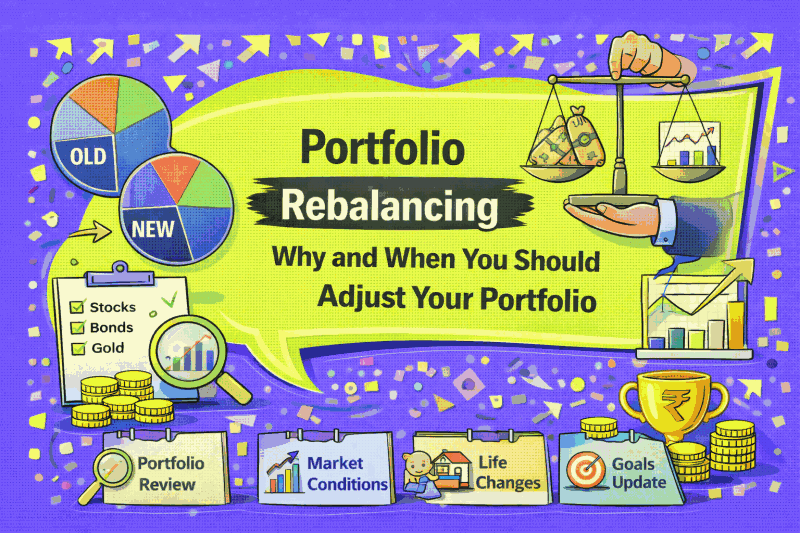
What is the Need to Maintain your Portfolio?
“Risk comes from not knowing what you’re doing,” as Warren Buffett once said, and it’s something that quietly shows up even in a portfolio that looks like it’s doing everything right.
Imagine settling into an investment mix that feels perfect : half your money out there chasing growth through stocks, while the other half sits in bonds, keeping things well balanced.
Then markets do what they do best. Stocks surge. Bonds barely move. You make no trades, take no action, yet something important shifts beneath the surface. The portfolio you trusted is no longer the portfolio you built.
This is how risk usually enters, not during crashes, but during rallies, when confidence is highest. Your portfolio has silently changed from what you had actually planned for.
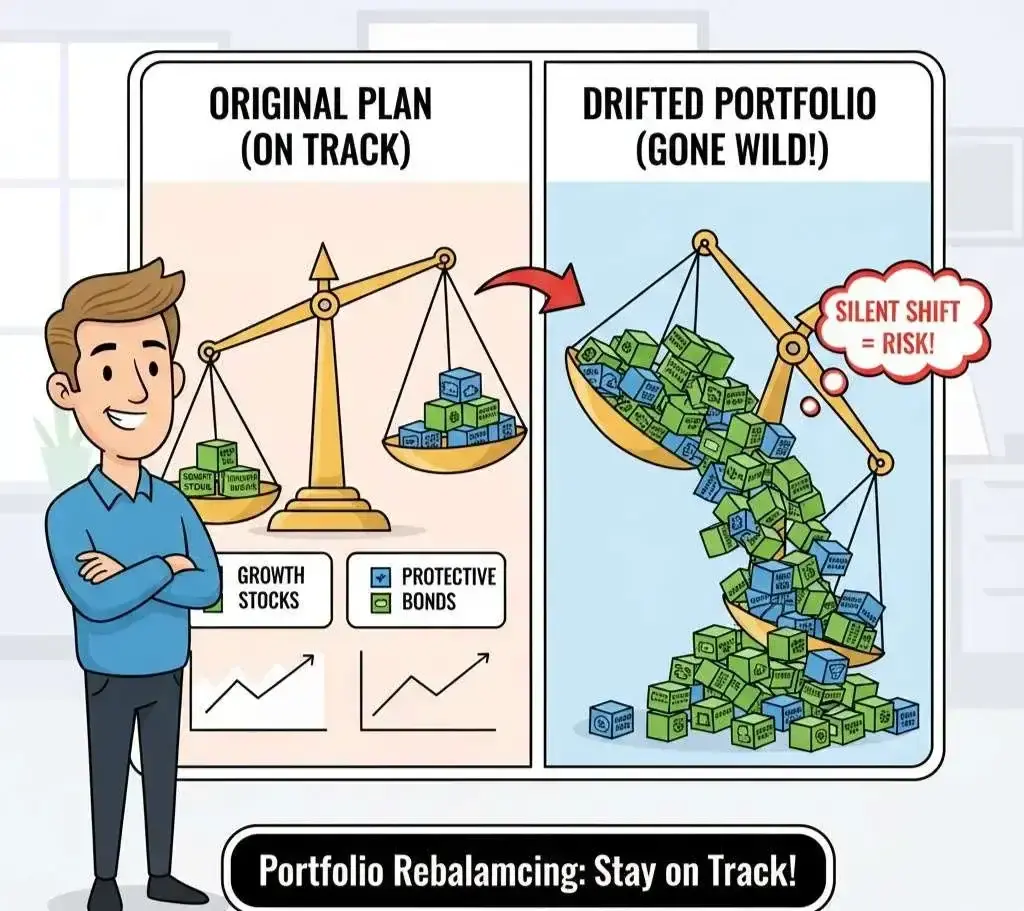
Ever peeked at your own statements lately, wondering how they shifted behind your back? What if one simple adjustment could fix it, keeping your original plan alive?
Let's discover what portfolio rebalancing really means and how it can help you avoid your potential financial losses.
What Portfolio Rebalancing Really Means
Rebalancing is basically making changes to your portfolio when it diverges from its original plan. Let's understand this through an example.

If equities have run ahead, rebalancing means cutting back. If bonds have lagged, it means adding to them. Not because bonds look attractive, but because balance has quietly been lost.
Here is the key question.
Did the investor consciously decide to take on more risk?
No.
The market decided for them.
Howard Marks says it best: “Risk controlling is the art of understanding risk, not running from it”.
Peter Bernstein adds, “managing risks matters more than chasing returns”.
But why should you bother with all this?
The drift quietly sets you up for bigger losses down the road, but rebalancing flips the game. It grabs profits from those top performers early and quietly rebuilds your safety net before trouble hits.
Now you must be wondering, how is rebalancing different?
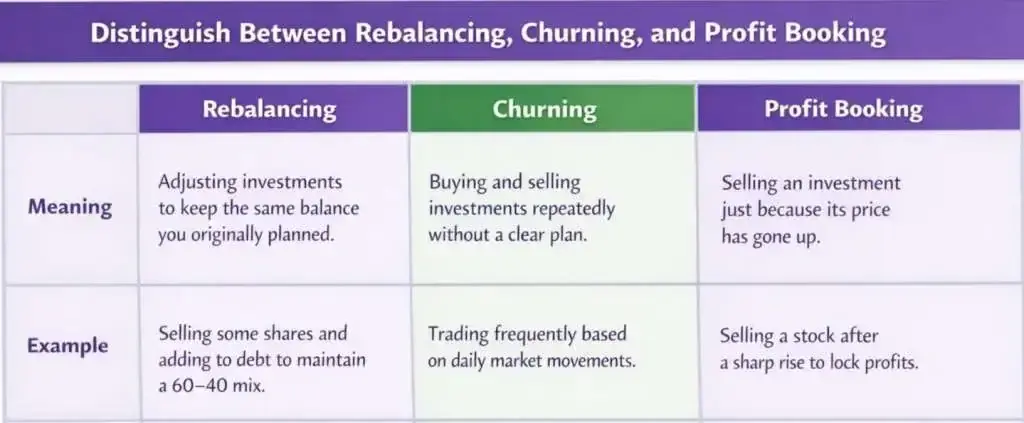
Rebalancing pulls your goals into the desired track, calmly and deliberately. But what makes it so important to rebalance your portfolio?
Why Rebalancing Is Necessary (What Real Investors Teach Us)
When Rakesh Jhunjhunwala started buying Titan, it wasn’t a bet for quick profits. It was a conviction built patiently over years. As Titan grew, that single stock began occupying a massive portion of his portfolio. The returns were extraordinary, but so was the concentration risk.For a retail investor, one winning stock, one booming sector, one great year, and suddenly your portfolio is no longer diversified. Not because you chose to change it, but because you let success run unchecked and take over your original allocation.
So the real question is not whether your investments are doing well.
It is whether any single one has quietly started doing too much.
And that leads us to the next idea of how the risk changes in our portfolios even when we make no changes.
Why Do Portfolios Change Even When Investors Do Nothing?
Here is a question most investors never ask themselves.If you did not buy or sell anything this year, did your portfolio really stay the same?
On the surface, it feels like it should. No trades. No trimmings. No interference. Just patience. But markets do not reward patience evenly, and that is where the quiet change begins.
read more about small/mid caps in our article Why Mid Cap Stocks are the Sweet Spot for Long-Term Investors
Lets understand with a help of few examples :
1)The Silver Bloodbath Cycle
Different assets/stocks grow at different speeds. During expansionary phases, equities accelerate. Cyclical businesses outperform. At times, gold and silver rally sharply as fear or inflation expectations rise.Bonds, meanwhile, stay steady, doing their job in the background.
In a matter of just three trading days, silver corrected by nearly 30% wiping out millions of dollars in a period of days. Portfolios that had allowed exposure to drift suddenly felt the impact far more sharply than expected. What had felt like a safe diversification asset revealed its volatility the moment conditions shifted
Read more about diversification in our article Portfolio Diversification – How Many Stocks Should You Hold?
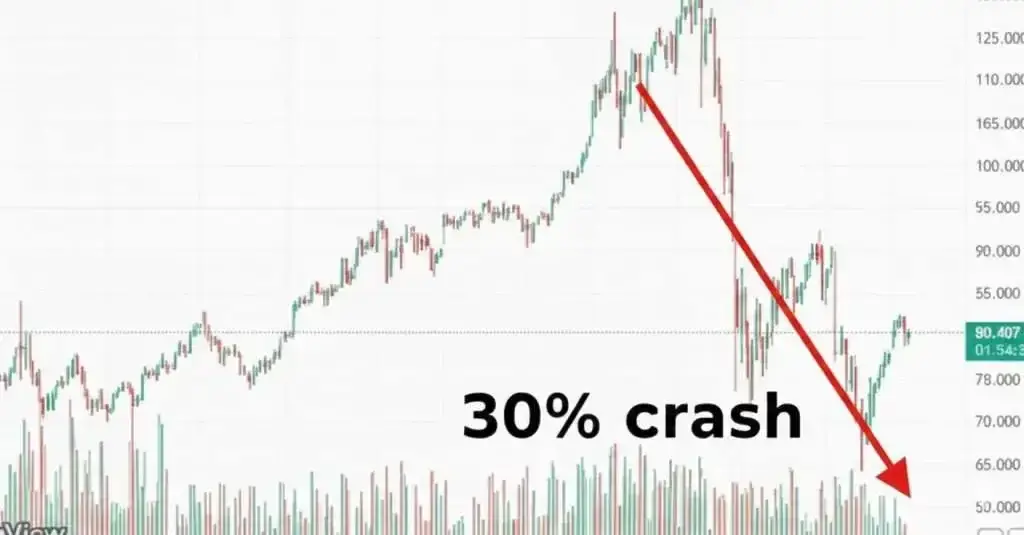
Nothing was wrong with owning silver. The issue was position size.
Without any trading activity, the faster-growing assets begin to dominate. What once felt balanced gradually becomes tilted. Most investors interpret this rising value as success.
This is exactly what happened in the years that eventually led to the 2008 crisis.
2)The Well-Known Subprime Crisis
Between 2003 to 2007, global equity markets delivered strong returns. Investors who stayed invested felt rewarded. Portfolios grew rapidly. But beneath the surface, many of those portfolios had drifted far away from their original design.Equity exposure had expanded. Defensive assets had shrunk in relative importance.
Then the correction arrived.
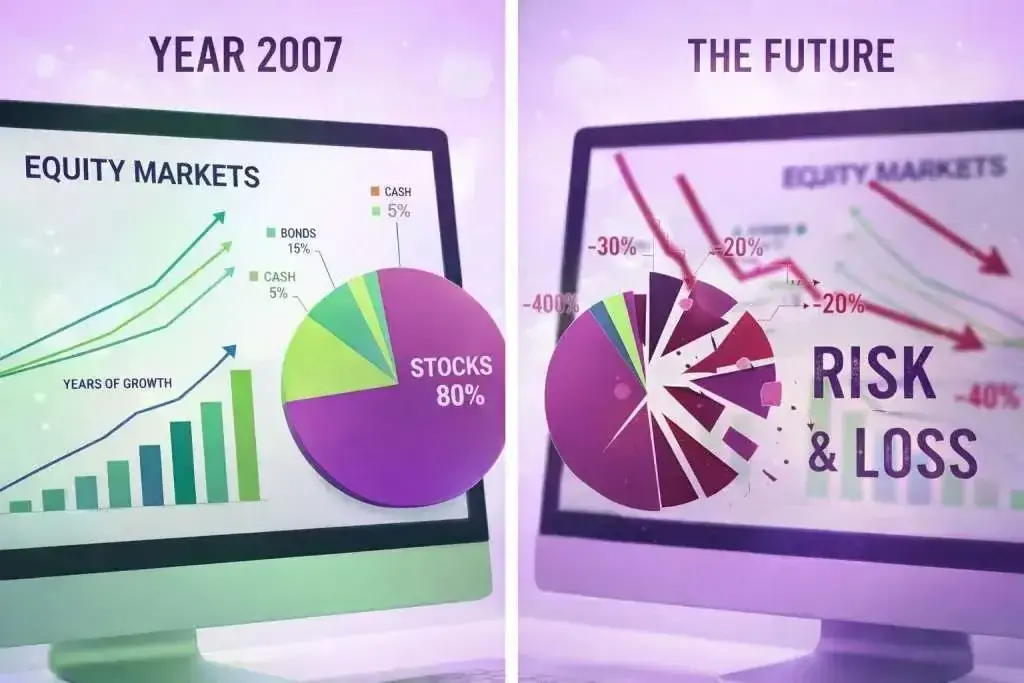
When markets collapsed in 2008, the losses felt shockingly large to the investors - not because investors had been reckless, but because their portfolios had quietly become more aggressive than they realised.
This is why portfolio drift remains invisible in good times and brutally obvious in bad ones. Calm markets hide structural risk. Corrections expose it.
But if rebalancing does not improve returns, why does it matter so much when markets fall, and should you rebalance your portfolio?
Why Rebalancing Matters More Than Returns
Why do two people investing in the same market end up feeling completely different about their journey?To answer that, returns alone are not enough. You need to look at the structure.
Rohan and Vikram both start the same way. Each invests ₹1,00,000 with a sensible allocation of sixty per cent in equities and forty per cent in debt. Same markets. Same starting point. Same intentions. Here is a visual representation:

This is why rebalancing matters more than returns.
Asset allocation determines how a portfolio behaves in both good and bad markets. When allocation drifts, the portfolio may no longer reflect the investor’s true comfort with risk. The danger is not lower returns. The danger is losing the ability to stay invested.
However, is it really practical to stay rebalanced amidst changing market cycles? Continue reading for the answer in our article Bull Market vs Bear Market – How Investors Should React.
How Market Cycles Reveal The Need For Rebalancing
Every market cycle has favourites. In one phase, equities dominate. In another, commodities shine. At times, your debt quietly outperforms while growth stocks remain stable or underperforming. What feels like consistency is often just the market rotating leadership beneath the surface.
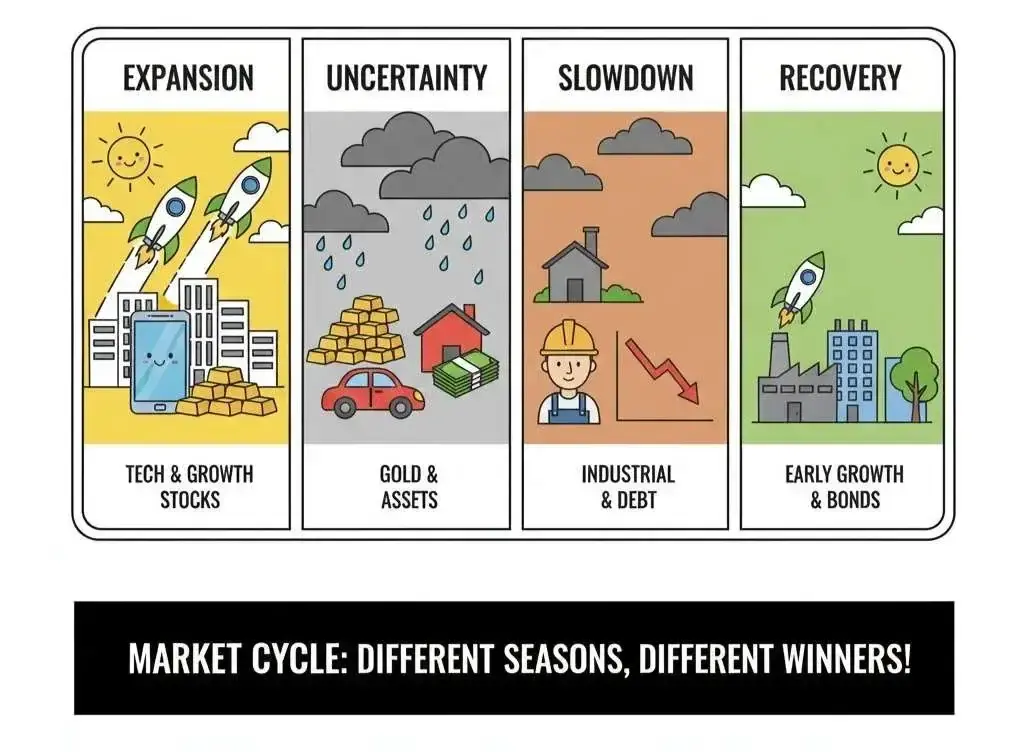
This is why portfolios behave very differently across cycles, even when investors remain disciplined.
Rakesh Jhunjhunwala once said, “Markets are about common sense, patience and courage.” What often goes unnoticed is that common sense includes recognising when success itself is changing the nature of your portfolio.
Radhakishan Damani’s investing philosophy offers a quiet lesson here. His emphasis on patience and balance has always been about surviving multiple cycles, not maximising excitement in one. Staying invested through volatility is less about forecasting and more about portfolio structure. This is where rebalancing reveals its real value.
Staying invested in small-cap or mid-cap companies through these cycles ultimately rewards the investors with multibagger returns. All it requires is patience and consistency, which most investors tend to lack.
And that leads to the most practical question of all.
If market cycles are inevitable, how exactly should rebalancing be done, and when does stepping in actually make sense?
That takes us to a question of how a person like you or me would rebalance their portfolio and what's the right time to actually do so?
How and When Rebalancing Should be Done
Warren Buffett is often quoted for buying great businesses and holding them forever, and Coca-Cola is the classic example.From the time Buffett built his position, Coca-Cola delivered extraordinary gains through the 1990s, compounding at well over 20% annually during its strongest phase as earnings and valuations expanded together. But after that golden period, the stock entered long stretches of slower growth and muted price action.
Even then, Buffett never sold. Over the entire holding period of more than three decades, Coca-Cola’s total return has settled into a much steadier pace, roughly around a low double-digit CAGR when dividends are included. Had Buffett exited near the highs, the numbers on paper would have looked far more impressive.
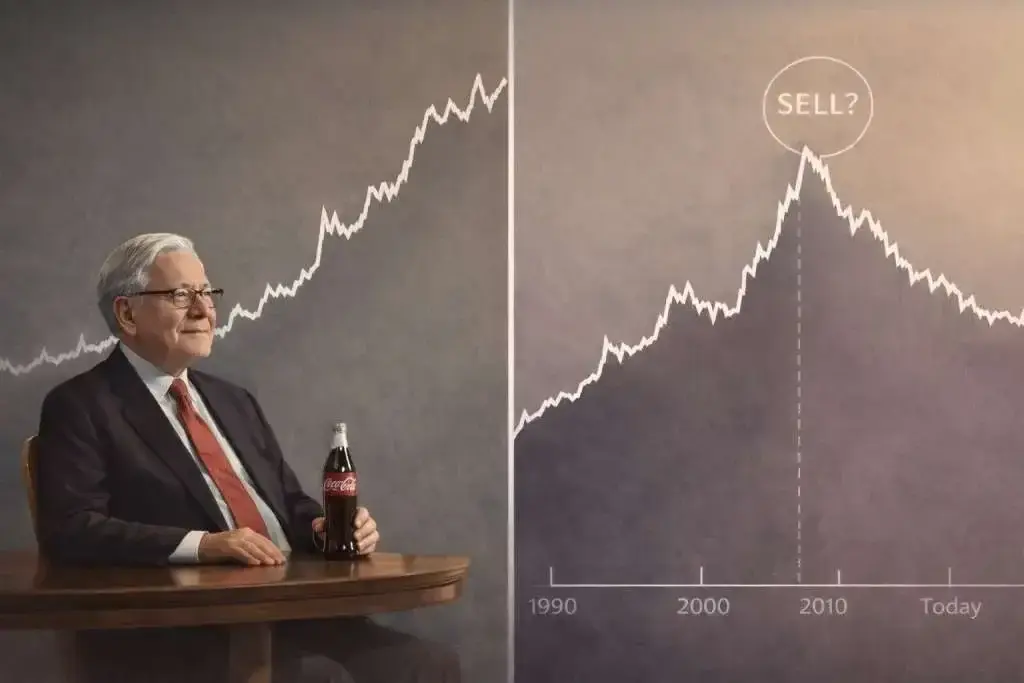
So when will you rebalance your portfolio, and how are you going to do it? Well, this is how:
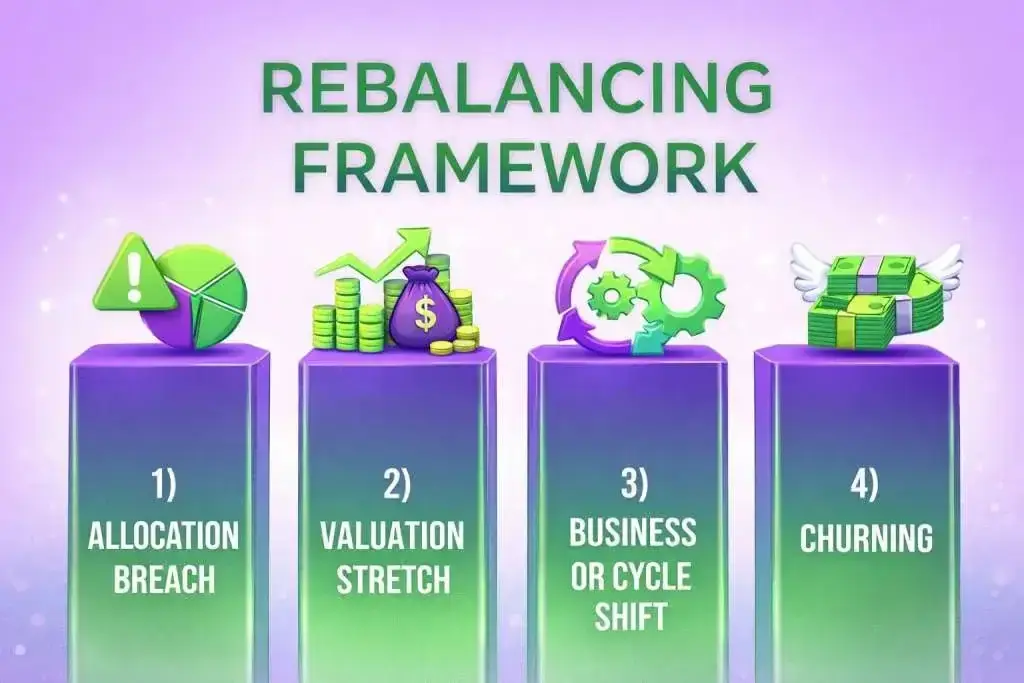
1) Allocation Breach
Review portfolio allocation quarterly or annually. If any sector exceeds the target range by 10 percentage points (e.g., industrials at 25% when the target is 10-15%), trim positions back to the upper end of the range. If any position exceeds 12% of the portfolio through appreciation, trim to 8-10% regardless of fundamental outlook.Rebalance when any position moves more than 40% from the target weight. If a 5% position doubles to 10%, trim back to 6-7%. If a 6% position falls to 3%, evaluate whether to average down or exit entirely.
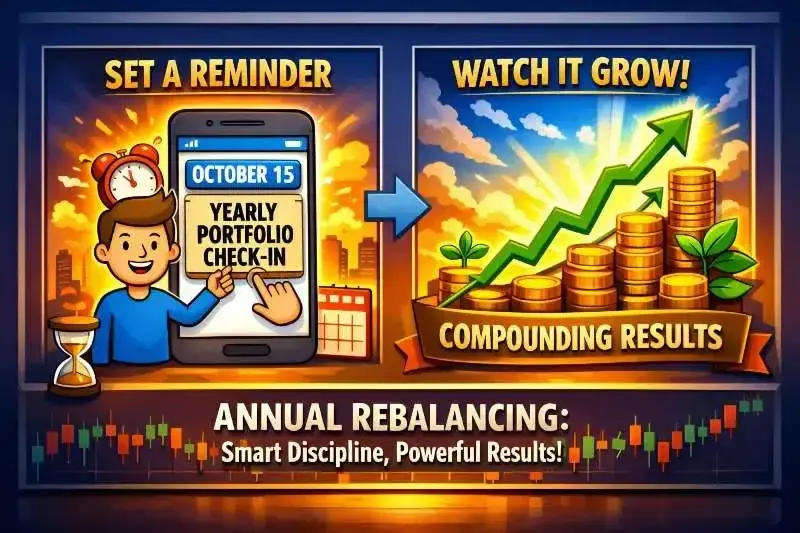
2) Valuations Running Ahead of Reality
The second trigger comes when prices outrun reality. Businesses grow steadily, but stock prices sprint ahead. Valuations stretch, expectations rise, and future returns become more dependent on sentiment than fundamentals.However, if a company that expands its operating margins or secures a contract worth 50% of its current revenue earns a higher allocation, while one that loses a key customer or faces regulatory scrutiny deserves an immediate trim.
3) Business and Cycle Shifts
Every investment begins with a story you believe in. But industries change. Demand slows, margins peak, competition intensifies. What once felt obvious starts needing justification.The test is simple: if you were seeing this company for the first time today, would you still buy it with the same confidence? If the answer is no, rebalancing isn’t about predicting the market. It’s about accepting that the story has changed.
4) Opportunity or Churning
Finally comes the most overlooked trigger. Opportunity. Sometimes doing nothing feels safe, but it quietly costs you quality. A strong business you always admired finally becomes available at reasonable valuations during a correction.Rebalancing allows you to fund that upgrade without adding fresh capital. Companies wherein Promoter Holdings has increased quarterly, and the debt has been reducing, should be kept in the checklist. An increase in the sales growth of companies is another positive indicator.
Rebalancing as a Quiet Edge in Long-Term Investing
Howard Marks wisely said - “Investment success doesn’t come from buying good things, but from buying things well and managing them wisely.”Think of an investor who kept trimming equity exposure during the 2021 rally and re-adding after the 2022 fall. Nothing dramatic in the moment, yet over time the portfolio stayed investable when others froze. The discipline mattered more than the asset itself.
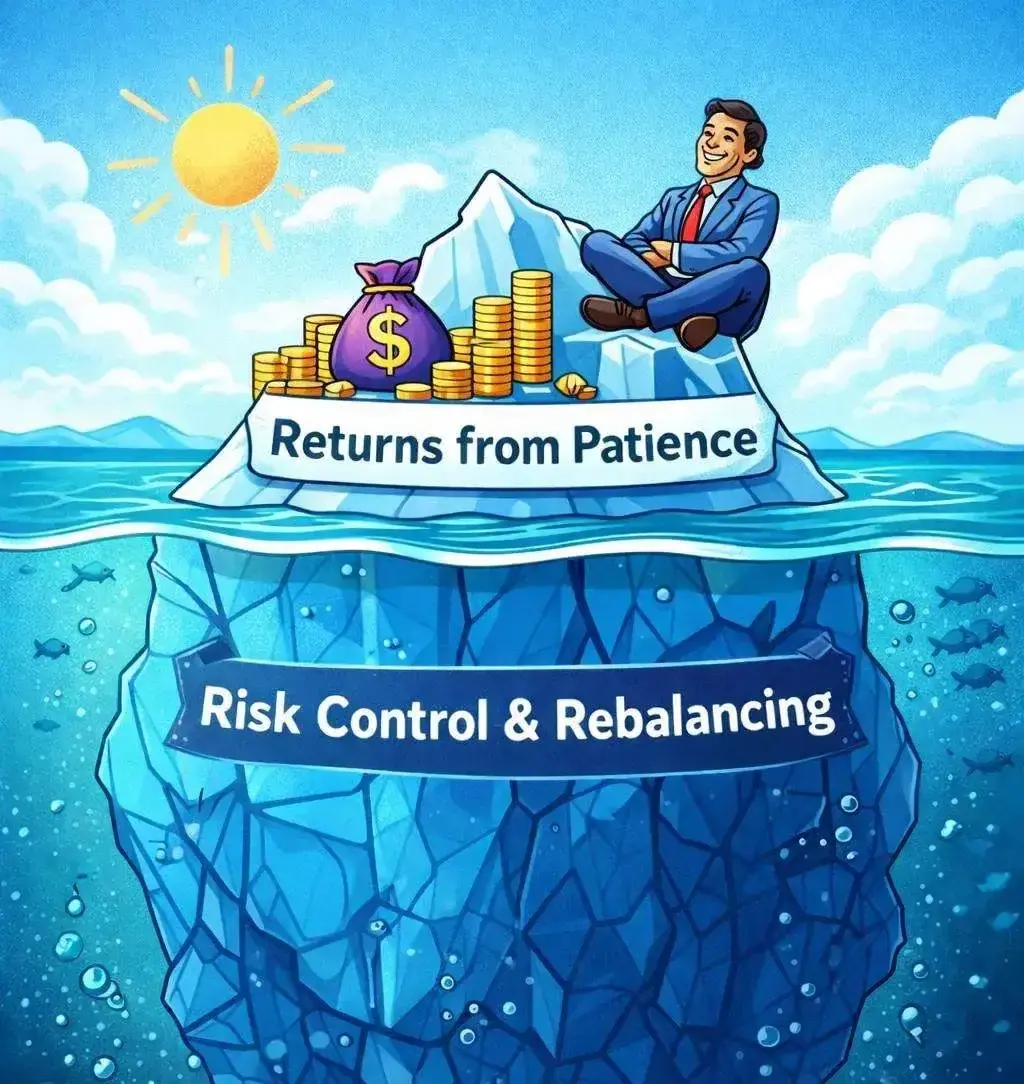
Warren Buffett puts it simply: “The most important quality for an investor is temperament, not intellect.” Rebalancing is temperament turned into a process.
Over the years, this quiet discipline often becomes the difference between sustainable wealth and temporary success.
You might already be making a few rebalancing mistakes without realising it.
Curious to know which ones quietly hurt long-term returns?
Common Mistakes which you must avoid
- Rebalancing is treated like something to do later, after the market gives a warning. But markets rarely send warnings. They reward excess first and punish it later.
- The second mistake happens when markets fall and investors act out of fear instead of discipline. Instead of trimming oversized positions, they sell whatever is in reds, turning risk control into loss locking.
- Another common error is mistaking rebalancing for activity. Some investors trade frequently, believing they are being disciplined, when in reality they are reacting to noise. True rebalancing is boring. It happens infrequently and only when allocations drift meaningfully from the original plan.
- An investor who rebalances without considering exit loads or capital gains may end up giving away a chunk of the benefit they were trying to protect. The intent is right, but the execution weakens the outcome.

Explore our Products
Research Framework

Emerging Titans
Combination of quantitative analysis, industry tailwinds, and management assessment - SPRINT investment philosophy

Tiny Titans
Heavy emphasis on scuttlebutt research, plant visits, and early on-ground signals
Conclusion
Most investors don't lose sleep over poor stock picks , they suffer from preventable rebalancing failures: ignoring portfolio drift during bull markets, panic selling in corrections, or treating allocation discipline as optional. Simply holding investments doesn't maintain safety; what matters is the systematic process that preserves your original asset allocation when market cycles, emotions, and silent risk shifts pull everything off course.If this guide clarified why untouched portfolios turn risky and how rebalancing locks in your goals, comment "REBALANCE" below. Like if you found the drift examples eye-opening, share with friends building Shares and Mutual Fund SIP portfolios ( read more about SIPs in our Systematic Investment Plan (SIP) in Stocks: Is it Possible and How? , and tell us your biggest rebalancing lesson in the comments.
The real edge in long-term investing comes not from chasing hot sectors but avoiding drift-induced drawdowns consistently ; structuring portfolios to control volatility while compounding steadily. Rebalancing isn't occasional cleanup; it's your process for ambition with protection, balance through cycles, and discipline that turns market noise into wealth preservation. By implementing rebalancing disciplines, investors can construct small-cap portfolios that capture upside from individual multibaggers while surviving the inevitable disappointments.
FAQs
Is portfolio rebalancing a good idea?
+Can I rebalance my portfolio without selling?
+Do I pay capital gains when I rebalance my portfolio?
Is rebalancing too often bad?
Does rebalancing really pay off?
+Rebalancing is not about getting the highest return. It is about keeping returns steady. It helps control risk, reduces emotional decisions, and keeps investors invested through market ups and downs. Over time, this consistency often leads to better results.

High growth stock specialist, Value Educator
Shashank Mahajan is an equity research professional with over 12 years of experience in identifying high-potential SME and micro-cap stocks at an early stage. He follows a rigorous scuttlebutt research–driven approach, combining on-ground insights with deep financial analysis. Shashank specializes in uncovering under-researched and under-owned companies with strong management quality and long-term growth potential. Through disciplined research and early identification, he focuses on spotting tomorrow’s market leaders before they enter the mainstream investor radar.

Zen Technologies: Why Revenue Fell After Its Biggest Win

Data Patterns: India's Radar Designer and Its Waiting Orders

KSH International: The Wire Inside India's Transformers

Krishna Defence: The Steel Behind India's Warship Hulls

PNG Jewellers: A 194-Year-Old Name Goes National

Axiscades: From Services to Missile and Radar Electronics
Explore our Products
Research Framework
Emerging Titans
Combination of quantitative analysis, industry tailwinds, and management assessment - SPRINT investment philosophy
Tiny Titans
Heavy emphasis on scuttlebutt research, plant visits, and early on-ground signals


 Orders
 Subscription
 Share with friends
 Logout


Required Details
₹23999.00
(12 month subscription)
As per SEBI regulations, all users are mandated to complete the KYC that is validated for 1 year. Post payment, you will be redirected to the KYC screen


No comments yet. Be the first to comment!