
Why Mid Caps Suit Long-Term Investors
Imagine someone starting their fitness journey for the first time. They often chase quick results. Crash diets, extreme workouts, sudden lifestyle changes — everything feels intense and exciting, but the body burns out fast. On the other hand, a very light and slow routine feels safe and comfortable, but progress is barely visible. Nothing really changes. The real transformation usually happens in the balanced middle zone — a steady workout plan, consistent habits, moderate effort, and sustainable progress that compounds quietly over time.
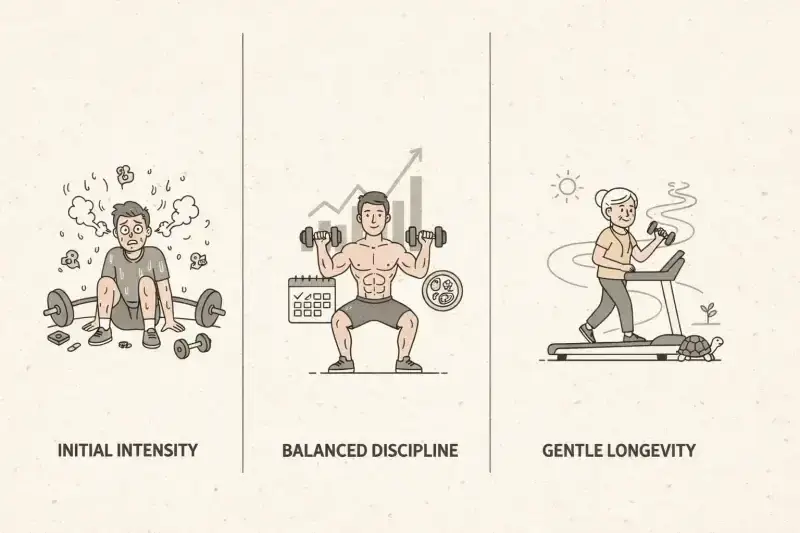
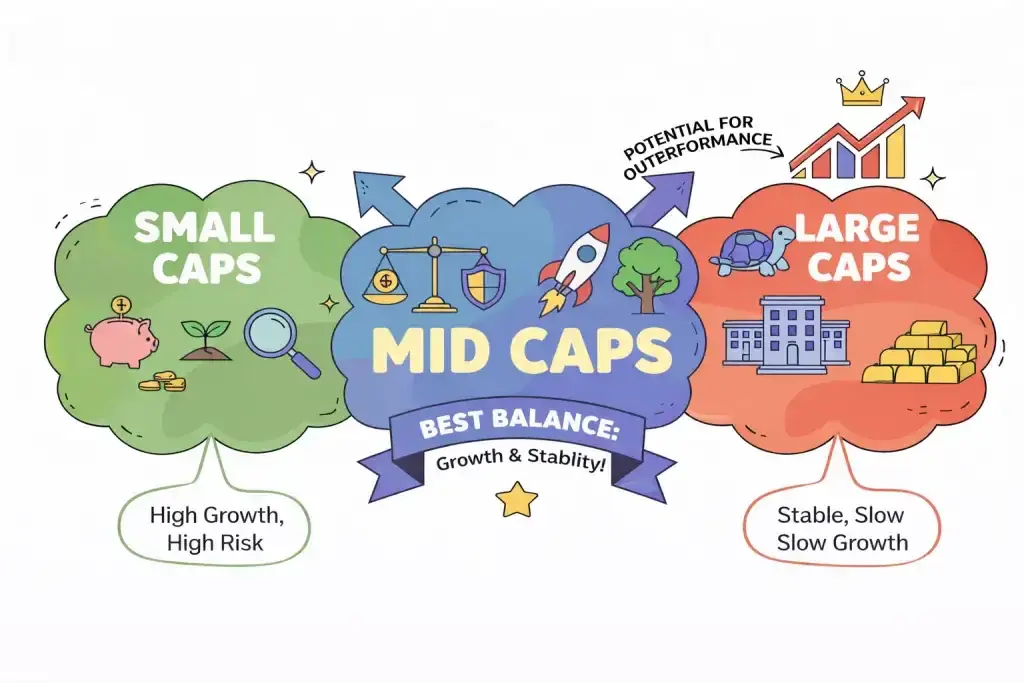
Investing works in a very similar way. Small-cap stocks are like extreme workouts — full of excitement, high risk, high swings, and plenty of uncertainty. Large-cap stocks are like slow, mild routines — stable, predictable, but with limited growth ahead. Mid-cap stocks sit right in the middle, just like a disciplined and consistent fitness plan. They are at a stage where businesses are stronger than early-stage companies, yet still have enough growth runway ahead — making this phase one of the most powerful wealth-building stages for long-term investors.
Before we move deeper, it’s worth remembering something timeless about how real progress works in life and in investing.
“Someone is sitting in the shade today because someone planted a tree a long time ago.”
— Warren Buffett
Mid-caps represent that period where companies move from potential to performance — where execution improves, earnings grow steadily, and market trust begins to build over time. This is the stage where compounding works quietly in the background, just like a consistent fitness routine that delivers real, lasting results — not overnight changes.
To understand why this stage is so powerful for investors,we first need to understand — in simple terms — what mid-cap companies really are, and what stage of the business journey they represent.
Let’s break it down in a way even a beginner can relate to.What Exactly Are Mid-Cap Stocks — and Where Do They Sit in the Business Growth Journey?
Mid-cap companies sit between small caps and large caps in their business growth journey. They have already crossed the fragile early stage where survival is uncertain, and now operate with a proven business model, stronger management, and growing customer trust. These companies are still expanding, scaling operations, and gaining market share — but they are not yet fully mature or saturated like large-cap giants.In simple words, mid-caps are businesses that are no longer trying to prove they can survive — they are now proving they can grow, execute, and scale consistently. They are big enough to be credible, yet small enough to grow meaningfully, which is what makes this phase so interesting for long-term investors.
This is not just a size category — it is a very specific compounding stage in a company’s life cycle. And that stage is exactly where the real investing opportunity often lies.This phase isn’t built on speed — it is built on steady, thoughtful progress.
“Growth and success come when you build steadily — not when you chase speed.” — Ratan Tata
Read More : How to Analyze a Mid-Cap Company – A Complete, Practical Framework
Why the Mid-Cap Phase Is So Special — The Growth-Stability Intersection
Mid-cap companies usually operate in what can be called the scaling and consolidation phase — a stage where the business has already survived the risky startup years but hasn’t yet reached the maturity plateau of large-caps. This is a powerful zone for long-term investors, because the company is now strong enough to execute consistently, financially more stable, and still small enough to grow meaningfully. As it transitions from an emerging player into a credible market leader, operating leverage improves, margins strengthen, and earnings begin compounding — quietly, steadily, and often before the broader market fully recognizes it.
Instead of looking at this phase as just a market-cap category, it helps to see it as a business transition stage built on three pillars — growth runway, improving stability, and consistent compounding.
1. Growth Potential Still Alive — The Story Is Still Unfolding
Mid-caps are still in the expansion phase. Markets are opening up, product categories are scaling, distribution is widening, and relevance within the industry is increasing year after year. They’ve already moved past the “Will this business survive?” stage — but they haven’t yet reached the phase where growth slows down like many large-caps. That means the company still has meaningful headroom for earnings to compound over the coming years.
The story isn’t finished — it’s still being written, often quietly, long before the world fully notices.
“The future belongs to those who see possibilities before they become obvious.”
— John D. Rockefeller
2. Stability Improves — Execution Becomes More Predictable
By the time a business reaches mid-cap scale, it has already lived through volatility, cash-flow pressure, and execution mistakes — and learned from them. Management maturity improves, capital allocation becomes more thoughtful, systems get stronger, and the business model becomes more predictable in the real world.
Customer trust deepens. Processes become repeatable. Behavior becomes more disciplined.
These companies have survived the fragile years — and are now learning to run with confidence.
Stability here doesn’t come from size — it comes from experience.
“Excellence is not a single act — it is a habit built over time.”
— Azim Premji
3.The Compounding Window — Where Growth Meets Consistency
This is the true sweet spot.
The company is still small enough to grow fast — but mature enough to deliver results consistently. Earnings expand, profitability improves with scale, cash flows strengthen, and market credibility compounds over time. Institutions start taking notice, valuation begins to re-rate, and the business gradually shifts from “growing company” to “emerging leader.”
Wealth here isn’t created through sudden price spikes — it builds quietly through steady execution.
Not too risky.
Not too slow.
Exactly the right stage for long-term compounding.
“Compounding is the eighth wonder of the world — those who understand it, earn it.”
— attributed to Albert Einstein
In many mid-cap companies, this phase doesn’t look exciting on the surface. There are no sudden breakouts, no dramatic headlines, no instant price movements. What really changes first is the way the business runs — execution improves, stores or plants scale better, cash flows strengthen, and earnings begin compounding quietly in the background. The stock price reacts much later, only after years of consistent proof.
And that is where most investors misread mid-caps — they look for price action, while real wealth is being built inside the business.
To see how this plays out in real life, let’s look at a company that went through this exact journey — one where execution strengthened first, earnings compounded next, and only then did the market truly wake up to the story.
Read More : Small-Cap Investing: Mistakes That Cost Investors Money
Case Study — Trent Ltd: How Quiet Execution Built the Foundation Before the Market Noticed
When people talk about Trent today, they usually talk about Zudio scaling fast, profits compounding, and the stock becoming a market favourite. But the real story didn’t begin in the breakout years — it began much earlier, in a phase where growth was modest, emotions were muted, and nothing looked extraordinary on the surface.That pre-2022 period is exactly what makes Trent one of the best examples of why the mid-cap phase matters. Before it became a “compounding story,” Trent was still learning how to:
- scale retail profitably
- build a repeatable store model
- balance expansion with discipline
- convert growth into sustainable earnings
Nothing looked glamorous back then — but that was the phase where the foundation was being built. And like many mid-caps, the business was evolving faster than the stock price.
Phase 1 : Till 2022
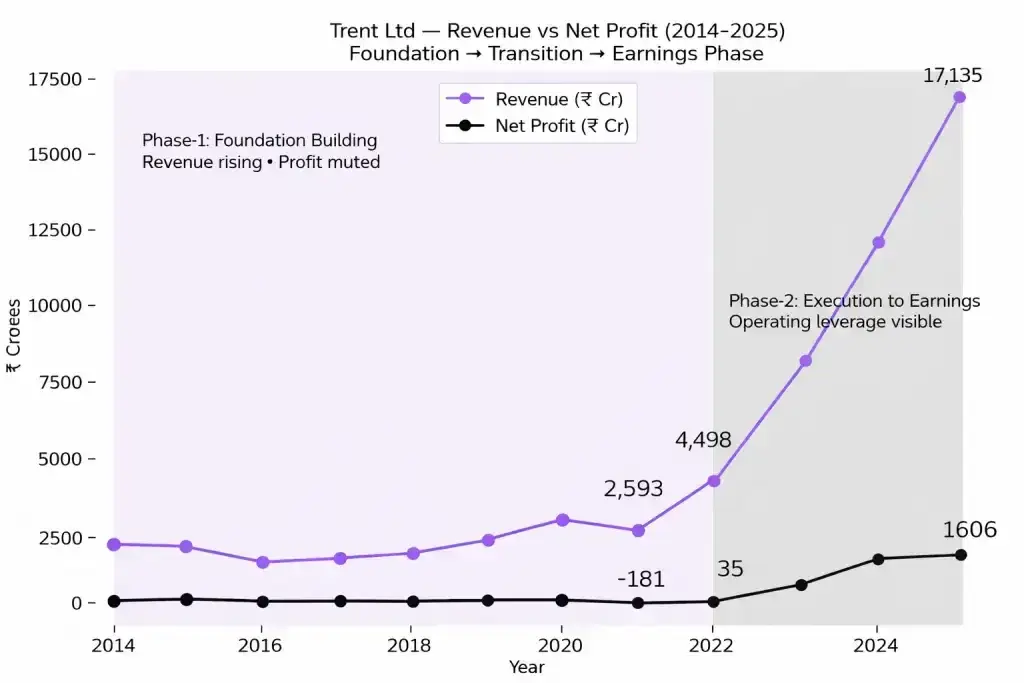
Before 2022, Trent didn’t look like a high-growth retail engine ready to create wealth. Revenues were rising, but not aggressively; margins improved at times but without sustained acceleration; profitability lacked consistency and even slipped into a loss in FY2021 despite respectable sales growth.
From the outside, it looked like a steady, disciplined, operationally sound company — but not an exciting one. Beneath the surface, however, Trent was not struggling with demand. It was still maturing its ability to run retail profitably at scale — a stage where many mid-caps quietly evolve without looking impressive in the numbers.
Revenue growth existed, but operating leverage hadn’t fully switched on. The business had scale — but it was still in transition. Westside was well-established, yet for the next growth leg, the company needed:
- tighter store-level economics
- stronger sourcing reliability
- better merchandise planning
- smoother supply-chain coordination
Every incremental expansion brought upfront costs — rent, staffing, inventory, logistics — while scale benefits flowed in gradually. New stores took longer to stabilise, productivity varied across locations, and performance differed by cluster.
This was the kind of groundwork that rarely looks exciting on paper. Breakeven cycles were longer, inventory turns hadn’t reached optimal velocity, backend systems were still maturing, and cluster economics were evolving. Contribution margins were stable — but not yet expanding — and fixed costs often ran ahead of earnings momentum.
To an impatient investor, it looked like “nothing is happening.”
To someone studying the business closely, it was clear:
Trent was strengthening the engine before pressing the accelerator.
Margins reflected this reality — stable but not explosive — because the company was consciously prioritising capability-building over short-term profitability. Through this phase, the company kept refining:
- assortment strategy
- fashion cycle discipline
- vendor partnerships
- backend processes
- working-capital behaviour
These choices temporarily capped margins — but made the business more repeatable and scalable.
Management commentary reinforced this mindset. The tone was cautious, execution-focused, and operational rather than promotional. The priorities were clear:
- store productivity before store count
- execution depth before expansion
- discipline before excitement
That approach often frustrates markets in the short term — but it prevents retail businesses from scaling incorrectly.
Because of this, the numbers looked modest — and many investors lost interest. Trent’s pre-2022 P&L wasn’t marked by explosive growth or rerating. Net profits moved between modest gains and occasional losses, and margins mostly stayed in single digits until execution became more consistent.
But this was the most important phase — where Trent sharpened capital allocation, stabilised format economics, matured backend systems, and built organisational confidence in its operating model.
It was not yet the phase of rapid earnings compounding — it was the quiet foundation-building period that ensures, when growth does arrive, it is both profitable and sustainable.
And that’s the hidden truth about many successful mid-caps:
They don’t become wealth creators when earnings accelerate —
They become wealth creators when execution becomes repeatable.
Trent’s pre-2022 journey was exactly that — a business strengthening from within, learning to scale the right way, and building structural discipline long before the market realised what was taking shape.
Only after this foundation was in place… did the next phase truly begin.
Phase 2 — 2022 to 2025
When Execution Turned Into Earnings — And The Market Finally Aligned
If the years before 2022 were about learning, stabilising, and quietly strengthening the retail engine beneath the surface, then the period from 2022 onward was the phase where Trent finally began converting scale into profitability in a visible, structural, and repeatable way. This was not a sudden breakout or a lucky tailwind — it was the point where years of groundwork translated into operating leverage, stronger unit economics, and earnings that started moving in the same direction as growth.
From here, the numbers stopped looking “decent” and started looking decisive — because execution maturity had reached a stage where the model no longer needed to prove itself every year.
The real shift in Trent’s story becomes visible after FY22. Revenue didn’t just rise — it accelerated meaningfully, growing ~3.8x over the next three years. But the inflection was not only in growth; it was in quality. Operating profit began compounding faster than sales, and margins, which earlier hovered inconsistently in the single-digit zone, stabilised in a healthier 13–16% range — signalling that store economics, assortment, and backend execution had started scaling in a repeatable way.
The earnings profile transformed in parallel. Net profit moved from volatility to structural compounding, and EPS expansion reflected credibility rather than one-off tailwinds — indicating that profitability was now being driven by operating discipline and business maturity, not financial leverage.
In essence, post-FY22, Trent shifted from “growing” to “scaling” — and the business started compounding by design, not by luck.
Store expansion stopped being experimental and became systematic. Breakeven cycles compressed, new stores stabilised faster than in the earlier years, and productivity variation across locations reduced materially.
Where expansion previously diluted profitability because fixed costs scaled ahead of store maturity, post-2022 the pattern flipped — scale began reinforcing margins. Fixed costs spread more efficiently across a larger and more productive network, contribution margins strengthened, and overhead intensity declined as operating leverage finally worked in Trent’s favour.
This was also the phase where strategic focus sharpened rather than diversified. The company leaned into the formats that worked instead of chasing adjacencies. Zudio — earlier a promising but evolving concept — transitioned into a high-velocity value retail engine with faster stock turns, tighter price-value positioning, and store economics that scaled without compromising discipline.
Expansion shifted toward cluster-based rollouts, improving replenishment efficiency, logistics utilisation, and backend cost absorption. Inventory behaviour also improved — cycles tightened, stock refresh cadence accelerated, and execution relied more on process systems than on trial-and-error.
The real inflection, however, was not in revenue growth alone — it was in the way revenues began converting into profits. Operating margins held firm around 14%–16% through FY2023–25 even as the store base expanded aggressively — something that earlier phases could not sustain. Cash flows strengthened alongside earnings, working-capital stretch reduced relative to scale, and capital allocation became more calibrated — aggressive expansion, but without destabilising economics.
Before 2022, Trent looked like a mid-cap retailer still proving whether growth could translate into reliable profits. After 2022, the narrative flipped — the business began to look like a disciplined retail franchise with stable unit economics and earnings consistency. The rerating wasn’t driven by hype; earnings credibility improved first, and valuation followed only after the market believed the fragility phase was behind it.
This phase also revealed a behavioural divide among investors. Those who exited during the earlier sideways years reacted to price stagnation and near-term noise. Those who stayed anchored to operating leverage, store-level economics, and execution discipline — rather than price movement — were the ones who participated in the compounding that unfolded here. Because Phase-2 was not about explosive narrative-led growth — it was about growth becoming profitable, predictable, and defensible.
This was the true crossover moment in Trent’s journey — the point where growth no longer needed justification, execution no longer needed validation, and the business stopped merely expanding and began compounding with confidence. It was no longer just a company adding stores — it was a franchise that had earned the right to scale.
And once that threshold was crossed, the core question for investors shifted from
“Can the model work consistently?”
to
“How far, how fast, and how sustainably can this model scale from here?”
Read More : Top SME Stocks That Created Millionaires in the Last 3 Years – Krishna Defence
Phase 3 — Beyond 2025
From Compounding Business to Enduring Franchise — The Discipline Test
If the period from 2022 to 2025 was about Trent proving that its formats could scale profitably, then the journey beyond 2025 moves into a different zone — where the question is no longer “Can the business grow?” but “Can it keep growing without losing what made it successful?” At this stage, Trent operates on a much larger base, store networks are dense, and every incremental expansion decision carries deeper implications for profitability, unit economics, and customer experience. This is the discipline phase — where success needs to be protected as carefully as it is extended.
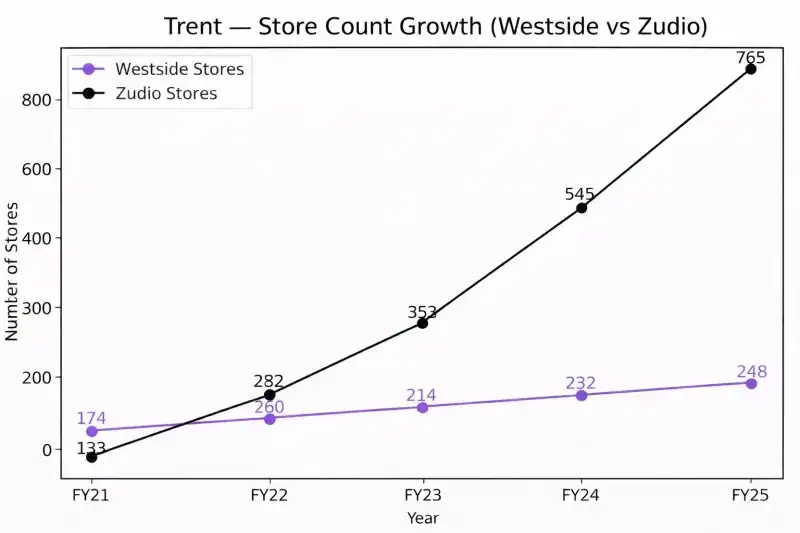
Zudio captures this transition well. Its rise was built on sharp pricing, scale-led sourcing, and a highly standardised product model. That worked brilliantly during its acceptance phase — but rapid visibility also creates a cultural risk. For a young fashion audience, identity matters as much as affordability. When too many people wear the same designs, novelty fades — and that can show up as softer productivity in some clusters or slower rotation in specific categories. This isn’t structural weakness — it is the natural “design fatigue” risk that appears only at scale.
Phase 3 is therefore less about rollout speed and more about selectivity — cluster economics, saturation risk, working-capital discipline, and whether new stores remain earnings-accretive, not just footprint-accretive. From here, thoughtful compounding matters more than aggressive expansion. Businesses that navigate this stage well don’t just grow larger — they evolve into enduring retail franchises by scaling without losing discipline.
How Wealth Actually Compounds in Mid-Caps — The Business-First Flywheel
In many mid-cap businesses, the wealth-creation journey starts long before the market notices anything. It begins quietly with steady profit growth — factories expand capacity, distribution widens, product mix improves, and operating leverage slowly kicks in.
Earnings don’t explode overnight; instead, they rise year after year in a disciplined manner. As this continues, something subtle starts happening — the market begins to trust the company more. Analysts track it more closely, institutional investors start participating, and the company moves from being “just another player” to a business with visible execution credibility.
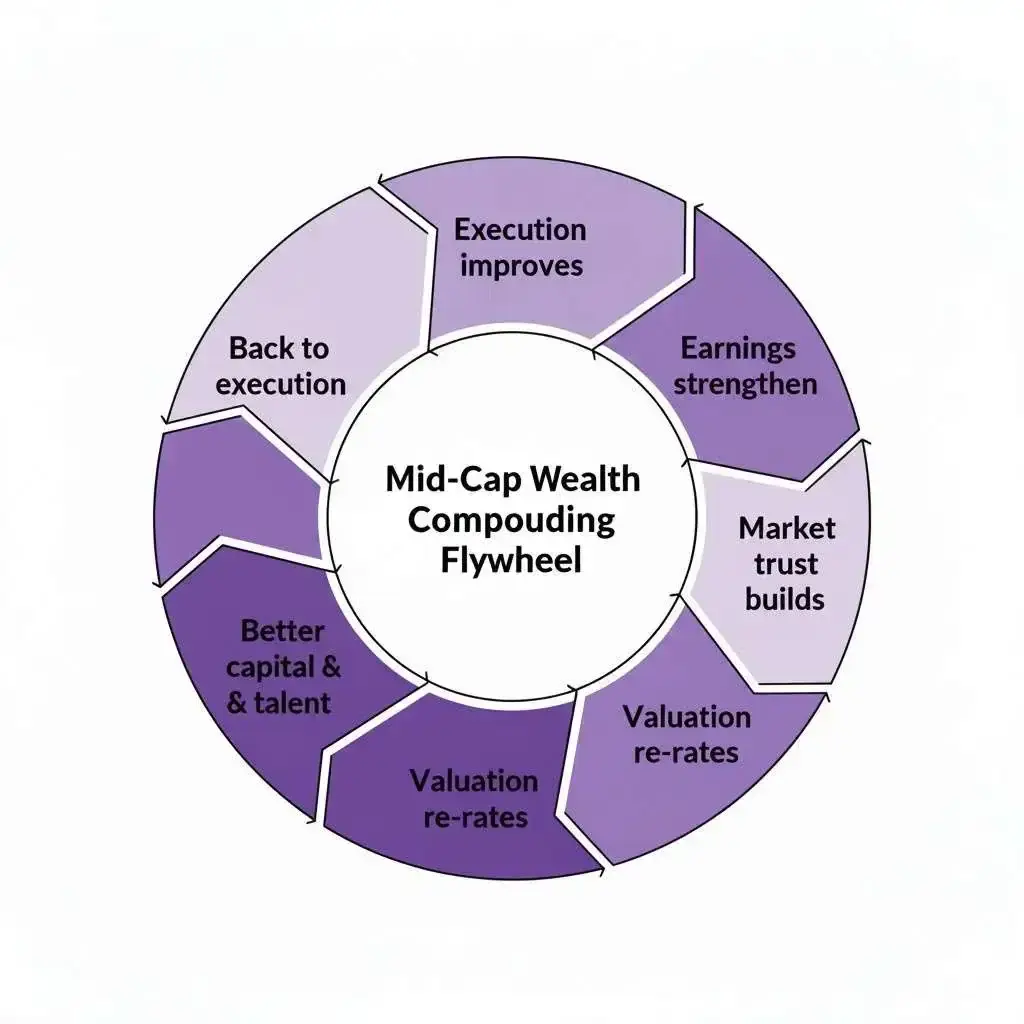
Over time, this trust becomes a turning point. The company gradually transitions from being a growing mid-cap to an emerging industry leader. Customers rely on it more, suppliers prioritise it, banks lend more confidently, and management begins to think in terms of long-term capital allocation rather than survival.
At this stage, wealth creation is no longer driven only by earnings growth — it is driven by a combination of earnings + valuation re-rating. The market is no longer paying for hope — it is paying for consistency.
This creates what many investors call a compounding flywheel. Better execution leads to stronger earnings. Stronger earnings attract better capital and better talent. Better capital allows smarter expansion. Smarter expansion strengthens execution further. And the cycle keeps reinforcing itself — quietly, patiently, and powerfully.
To understand this in simple terms, imagine a mid-cap company earning ₹200 crore in profits today and compounding earnings at around 15% annually. Over 8–10 years, those profits can grow to roughly ₹600–700 crore — not because of any magic event, but because of steady execution and scale expansion.
In the early years, the stock price may barely move, because the market is still sceptical. But as profits triple and balance sheet quality improves, the market not only values higher earnings — it also assigns a better multiple to the same business. That dual effect — earnings growth + valuation re-rating — is where real wealth creation emerges.
The key insight is simple — in mid-caps, compounding doesn’t shout. It doesn’t show up every quarter. It builds in silence, inside the business first, and in the stock price later. And the investors who understand this journey don’t look for excitement — they look for evidence of progress.
Read More : Why 95% Penny Stock Investors Lose Money (And How to Avoid It)
How Smart Investors Look at Mid-Caps — A Practical, Long-Term Lens
When looking at mid-cap stocks, the goal is not to search for “the next multibagger,” but to identify businesses that are gradually becoming stronger year after year.
The companies that compound well in this space usually show a quiet, structural improvement in the way they operate — not through dramatic announcements, but through steady progress that reflects in earnings, governance, and business depth over time.
What Makes a Strong, Long-Term Mid-Cap?
A good mid-cap story starts with business quality. These companies operate in industries where demand is durable and recurring, not seasonal or speculative. Their products solve real problems, and they carry some edge — brand strength, distribution reach, cost leadership, or technical capability. Earnings typically grow in a steady, upward trend — not every year perfectly — but with improving scale, margins, and operating leverage over time.
Strong mid-caps also use capital sensibly. Growth is funded largely through internal cash flows or calibrated borrowing instead of aggressive, debt-heavy expansion. This keeps fragility low and helps them survive business cycles. Equally important is management behaviour — transparent communication, disciplined capital allocation, and no unnecessary diversification for the sake of “growth.”
Finally, enduring mid-caps usually ride structural industry tailwinds — formalisation, rising consumption, infrastructure build-out, or technology adoption. As the sector expands, these companies grow with it — and often faster — because every incremental step meaningfully strengthens their scale and positioning.
Put together, these are not checkboxes — they are traits of mid-caps that compound beautifully over time. When investors focus on these strengths instead of short-term excitement, they begin to see mid-caps not as risky bets or lucky opportunities, but as evolving businesses quietly moving toward leadership.
Read More : Penny Stocks vs Small Caps – What’s the Difference and Which Is Better?
Final Take — Why the Middle Zone Often Delivers the Most Meaningful Compounding
Because in the end, real leadership — in business or in life — is rarely loud or rushed. As N.R. Narayana Murthy said, true success is built quietly, through consistency, discipline, and time.
Mid-cap companies operate at a powerful middle stage — past the fragile early phase, yet still far from maturity. This is where growth potential and stability begin to rise together. Earnings strengthen, execution improves, and credibility compounds — not through flashy moves, but through steady progress.
For patient investors, this is where real wealth is built — slowly, quietly, and meaningfully — as promising businesses evolve into dependable long-term leaders.
If this perspective helped you look at mid-caps as a business journey rather than a price category, comment “MIDCAP” below . Like the post to support research-driven investing insights, share it with investors who value process over noise, and tell me — which part of the mid-cap journey resonates most with how you think about long-term compounding?
Explore our Products
Research Framework

Emerging Titans
Combination of quantitative analysis, industry tailwinds, and management assessment - SPRINT investment philosophy

Tiny Titans
Heavy emphasis on scuttlebutt research, plant visits, and early on-ground signals
FAQs ( Frequently Asked Questions )
Are mid-cap stocks good for long-term growth?
+Yes. Mid-caps operate in a phase where the business has moved beyond survival but still has meaningful room to scale. Earnings visibility improves, execution strengthens, and growth compounds more consistently than in early-stage companies.
Which market cap is best for long-term investment?
+Each category serves a different purpose — large caps provide stability, small caps offer higher upside with higher risk, and mid caps sit in the sweet spot of growth + credibility. For many investors, mid caps often deliver stronger wealth creation over time.
Which is better — mid-cap or flexicap?
Flexicap funds shift between large, mid, and small caps based on market conditions, making returns smoother. Mid-cap funds stay focused on scaling businesses — potentially higher growth, but with more volatility during weak cycles.
What is the ideal holding period for mid-cap stocks?
+Typically 5–7 years or more. Business expansion, operating leverage, and valuation re-rating play out gradually — mid-caps reward patience rather than short-term trading.
Are mid-cap stocks risky?
+They carry more risk than large caps but are generally more stable than small caps. Risk reduces when companies have healthy cash flows, prudent leverage, disciplined capital allocation, and consistent earnings growth.

High growth stock specialist, Value Educator
Shashank Mahajan is an equity research professional with over 12 years of experience in identifying high-potential SME and micro-cap stocks at an early stage. He follows a rigorous scuttlebutt research–driven approach, combining on-ground insights with deep financial analysis. Shashank specializes in uncovering under-researched and under-owned companies with strong management quality and long-term growth potential. Through disciplined research and early identification, he focuses on spotting tomorrow’s market leaders before they enter the mainstream investor radar.

Glenmark: The USD 700 Mn Cancer Deal and Its Brands

Pharma Stocks in India 2026: Generics, APIs and CDMOs

Granules India: From Paracetamol to a 65% Gross Margin

Natco Pharma: After Revlimid, 29 Patent Challenges

Shilpa Medicare: Cancer APIs, Films and Biosimilars

Alembic Pharma: US Plants Pay Back, Margin Hits 22.2%
Explore our Products
Research Framework
Emerging Titans
Combination of quantitative analysis, industry tailwinds, and management assessment - SPRINT investment philosophy
Tiny Titans
Heavy emphasis on scuttlebutt research, plant visits, and early on-ground signals



India's Aerospace Opportunity
Global Demand. Supply Bottlenecks. Opportunities Ahead.
Don't Miss This Exclusive Webinar!
Join Value Educator to decode the key trends shaping India's aerospace sector and learn how to identify tomorrow's potential leaders in the space.
- How the aircraft value chain works, layer by layer
- Indian companies supplying global aircraft makers
- A framework to judge any aerospace company

 Orders
 Subscription
 Share with friends


Required Details
₹23999.00
(12 month subscription)
As per SEBI regulations, all users are mandated to complete the KYC that is validated for 1 year. Post payment, you will be redirected to the KYC screen


No comments yet. Be the first to comment!