How a ₹25,500 Crore Order Book and Monopoly in Guided Missiles Make BDL India’s Most Strategic Defence Stock
The Company That Makes What Money Can’t Buy
March 26, 2026. Bharat Dynamics Limited (BDL) announced the completion of Final Operational Performance Measurement (FOPM) of the Advanced Akash Weapon System. Deliveries to the Indian Armed Forces would commence shortly. For most investors reading regulatory filings, this looked like routine corporate news — another milestone cleared, another product ready for delivery.
But for anyone who understands India’s defence ecosystem, this announcement represented something far more significant. The Advanced Akash is a surface-to-air missile system with 360-degree coverage, upgraded seeker technology, and reduced signature profile that makes it nearly impossible for enemy aircraft to detect before being engaged. And Bharat Dynamics is the only company in India — and one of very few globally — that can manufacture it at scale.
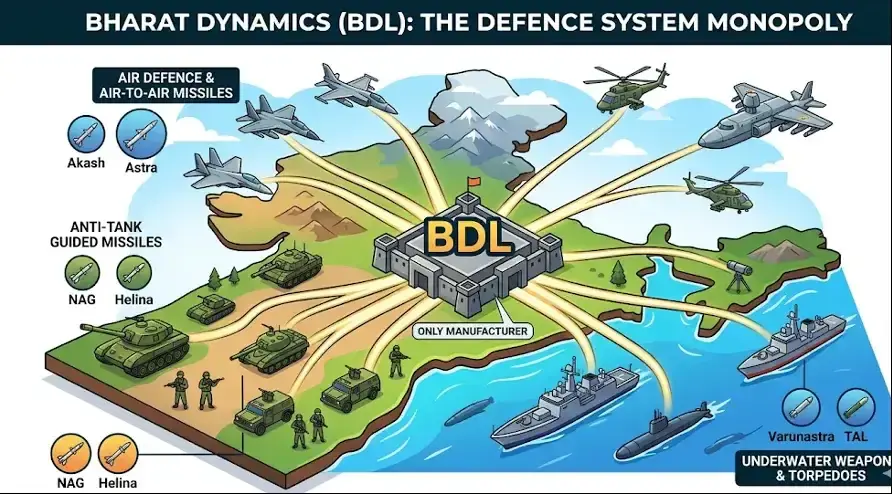
This is the reality that separates BDL from every other defence stock in India. While companies like HAL and BEL compete in crowded aircraft and electronics segments with alternatives available domestically and internationally, BDL operates in a category where alternatives barely exist. The company holds virtual monopoly status as the prime production agency for guided missile systems and underwater weapons developed by DRDO.
When the Indian Army needs Akash surface-to-air missiles, when the Air Force needs Astra beyond-visual-range air-to-air missiles, when the Navy needs heavyweight torpedoes for submarines — there is exactly one domestic supplier. That supplier is Bharat Dynamics. This isn’t just competitive advantage — it’s irreplaceability in critical national security infrastructure.
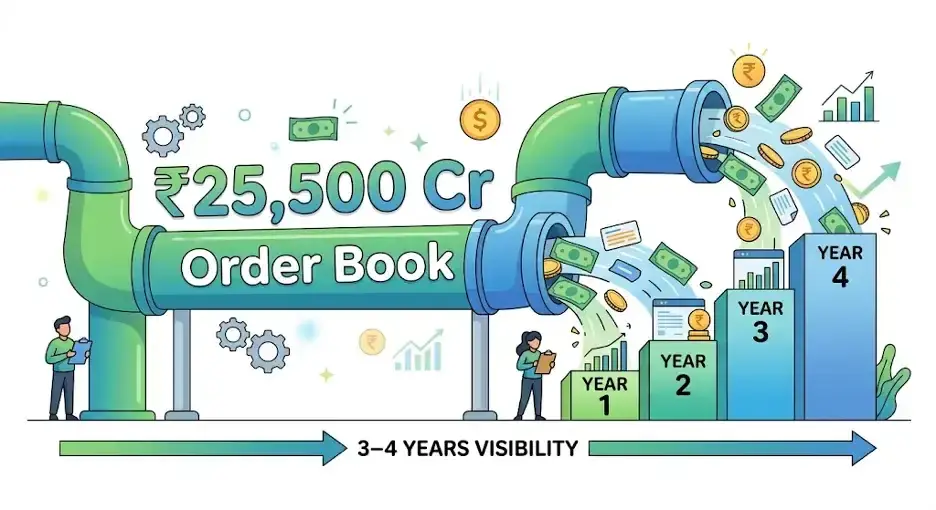
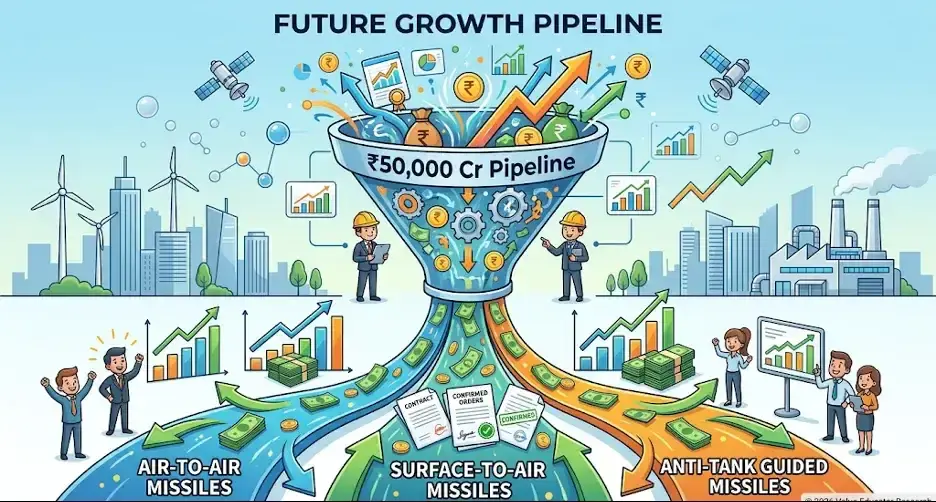
The order book as of early 2026 stood at ₹25,500 crore, providing revenue visibility for the next 3-4 years. Management is targeting ₹20,000 crore of additional orders over the next 18 months from a ₹50,000 crore pipeline currently in advanced trials and procurement stages. If just half of this pipeline converts to firm orders,
BDL’s order book would exceed ₹35,000 crore — representing 8-10 years of current annual revenue. This isn’t speculative growth — it’s contracted, government-backed, essential-to-national-security revenue that will materialize regardless of economic cycles, consumer sentiment, or market conditions.
If you’ve ever wondered why defence stocks trade at premium valuations despite being PSUs with government ownership constraints, BDL’s monopoly positioning in missile manufacturing explains it perfectly. If you’re trying to build a portfolio of companies with genuine moats that competitors can’t easily replicate, understanding that BDL is the sole manufacturer of India’s most sophisticated guided weapons gives you conviction to hold through market volatility.
And if you thought government enterprises are slow, bureaucratic, and can’t deliver shareholder returns, BDL’s financial performance — upgrading facilities with Industry 4.0, robotics, and AI-based technologies while maintaining almost debt-free status — shows that strategic PSUs in defence operate very differently from loss-making PSU banks or telecom companies.
If you want a broader understanding of the sector, Best Defence Stocks in India 2026 is a good starting point.
To fully understand why companies like BDL are gaining importance, it’s important to look at the broader structural shifts happening in India’s defence sector.
India’s defence sector is currently benefiting from strong structural tailwinds that directly support Bharat Dynamics’ growth visibility. The Union Budget for FY26 allocated over ₹6.2 lakh crore to defence, with capital expenditure growing at a faster pace than overall spending. A significant policy shift under Atmanirbhar Bharat mandates that more than 75% of capital procurement be sourced domestically, while multiple import embargo lists now restrict foreign purchases of missile systems, torpedoes, and air defence platforms.
This effectively secures long-term demand for indigenous manufacturers like BDL. In addition, rising geopolitical tensions and the increasing importance of air defence and missile systems in modern warfare further reinforce sustained procurement cycles. This is not cyclical demand — it is policy-driven, strategic, and long-term in nature.
Recent developments further strengthen Bharat Dynamics’ positioning within India’s defence ecosystem. In March 2026, the company successfully completed the Final Operational Performance Measurement (FOPM) of the Advanced Akash Weapon System, marking a critical milestone before full-scale deliveries to the armed forces.
The commissioning of the RF Seeker Facility enhances indigenous manufacturing capability by reducing reliance on imported components, which can improve margins over time. At the same time, progress in key programs such as QRSAM and Akash-NG, along with increasing engagement in export markets across Southeast Asia and the Middle East, indicates that BDL is gradually transitioning from a domestic-focused manufacturer to a globally relevant defence supplier. These developments signal not just execution capability, but also long-term strategic evolution.
When your customer is the Government of India and your product is missiles that defend the nation’s airspace and coastline, revenue and margin certainty is as high as it gets in equity investing.
1. The Business Model: Monopoly in Missiles, Dominance in Torpedoes
What Nobody Else Can Manufacture
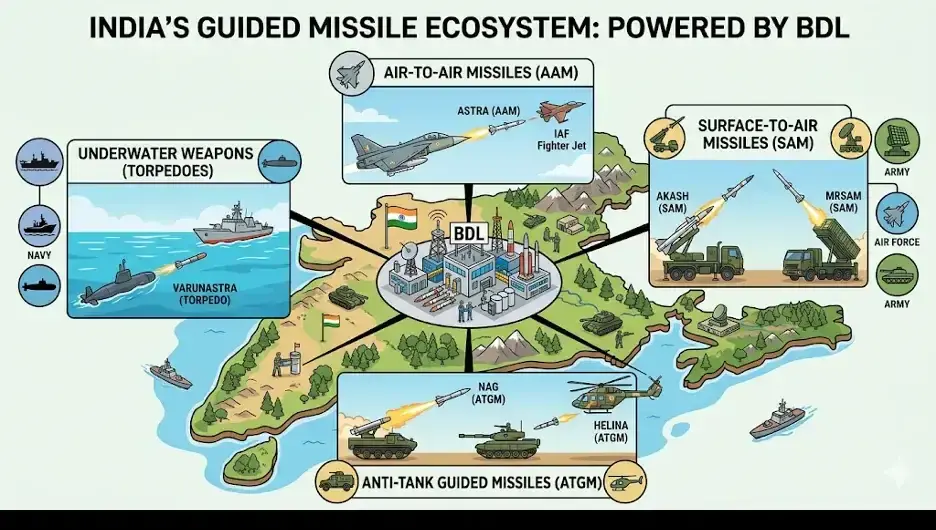
Bharat Dynamics’ product portfolio reads like India’s strategic weapons inventory — because that’s exactly what it is. The company manufactures surface-to-air missiles (Akash, QRSAM, MRSAM), air-to-air missiles (Astra), anti-tank guided missiles (NAG, Konkurs-M, Milan 2T, Amogha III, Helina), underwater weapons including light and heavy-weight torpedoes, and specialized systems like counter-measure dispensing systems, smart anti-airfield weapons, and anti-submarine warfare suites. This isn’t a company building commodity products competing on price. These are weapon systems where performance specifications are measured in kill probabilities, detection ranges, and terminal velocities — and where failure means loss of aircraft, ships, or lives rather than just lost revenue.
The Akash weapon system is the crown jewel demonstrating BDL’s manufacturing capability and strategic importance. Akash is a medium-range surface-to-air missile system that can engage aerial targets at ranges up to 25-30 kilometers and altitudes up to 18 kilometers. The Advanced Akash variant adds 360-degree coverage, upgraded RF seeker technology produced at BDL’s newly commissioned Seeker Facility Centre in Hyderabad, and compact configuration with reduced radar signature. When the Defence Acquisition Council approved procurement of two regiments of Akash missiles in September 2018, the contract value wasn’t publicly disclosed — but industry estimates placed it at ₹6,000-8,000 crore. For perspective, that single order represents more revenue than most mid-cap companies generate in 5-7 years. And Akash-NG (Next Generation) is currently in advanced trials, which could trigger orders worth ₹15,000-20,000 crore over the next 5-7 years.
The Astra missile represents India’s entry into the elite club of nations with indigenous beyond-visual-range (BVR) air-to-air missile capability. Only a handful of countries — US, Russia, China, France, UK, Israel — have successfully developed and deployed BVR air-to-air missiles. Astra gives Indian Air Force fighters like Sukhoi Su-30MKI and Tejas the ability to engage enemy aircraft at 80-110 kilometer ranges before visual contact, creating first-strike advantage in air combat.
BDL signed the licensing agreement with DRDO for Astra Mk-1 production in April 2018 and flagged off the first deliveries to the Indian Air Force in January 2024. The Astra Mk-2 variant under development will extend range to 160+ kilometers, putting it in the same league as advanced Russian R-77 and American AIM-120 missiles. Every Su-30MKI squadron integration, every Tejas fighter inducted, creates recurring demand for Astra missiles — and BDL is the sole production source.
The underwater weapons segment — torpedoes and anti-submarine warfare systems — represents BDL’s second monopoly domain. The company manufactures both light-weight and heavy-weight torpedoes for the Indian Navy’s surface ships and submarines. Heavy torpedoes like the Varunastra are wire-guided weapons designed to sink enemy submarines and surface vessels at ranges of 20-40 kilometers, traveling at speeds over 40 knots.
Light-weight torpedoes like the TAL (Torpedo Advanced Light) are deployed from ships and helicopters for anti-submarine warfare. When India inducts a new Scorpene-class submarine or commissions a destroyer, those platforms require torpedo inventory — and BDL supplies 100% of that requirement. The competitive moat isn’t just manufacturing capability; it’s integration with Indian Navy’s combat management systems, compatibility with launch tubes and fire control systems, and adherence to specific tactical requirements that foreign suppliers can’t match without years of re-engineering.
For investors, the key insight is that BDL doesn’t compete — it fulfills requirements. The Indian military doesn’t issue tenders for Akash missiles where BDL competes against Lockheed or Rafael for price. The military places orders with DRDO for specific missile systems, and DRDO contracts BDL for production under nominated source provisions.
This isn’t crony capitalism; it’s the reality of weapon system integration where missiles must interface with radars, launchers, command systems, and doctrine that are India-specific. Foreign systems could theoretically be purchased, but integration complexity, technology transfer restrictions, lifecycle support costs, and strategic autonomy considerations make domestic production the only viable long-term option. BDL inherited this position through government ownership, but it has sustained and expanded that position through execution capability that meets military specifications consistently.
The broader missile systems market is also expanding steadily, with global demand growing at an estimated 5–7% CAGR driven by rising defence spending and evolving warfare technologies such as drones and precision-guided systems. India is expected to remain among the top three defence spenders globally, with increasing emphasis on indigenous capability development.
Within this context, BDL’s role becomes even more critical, as missile systems and air defence platforms are no longer optional assets but essential components of modern military strategy. This structural demand environment ensures that BDL’s products remain relevant and necessary across multiple defence programs.
“The best business to own is one that over an extended period can employ large amounts of incremental capital at very high rates of return. And missiles qualify because the government will keep ordering them for decades.”
— Warren Buffett (adapted)
Like this analysis? Get powerful insights like this every week. No spam.
2. The ₹25,500 Crore Order Book: Multi-Year Revenue Visibility
Contracted Growth Through 2029
As of early 2026, BDL’s order book stood at approximately ₹25,500 crore, providing revenue visibility extending 3-4 years at current execution rates. To put this in context, BDL’s annual revenue runs at ₹5,500-6,000 crore based on recent quarters. A ₹25,500 crore order book represents over 4 years of current revenue already contracted and awaiting production. This isn’t pipeline or potential — this is signed contracts with advance payments received, production schedules finalized, and delivery timelines committed. In an equity market where quarterly earnings volatility drives most stock movements, BDL investors can look at the order book and know with near-certainty what revenue will be for the next 3-4 years.
The composition of the order book reveals BDL’s product diversification and the recurring nature of missile demand. Major programs include multiple regiments of Akash weapon systems for the Indian Army and Air Force, Astra Mk-1 deliveries for integration with Su-30MKI and Tejas fighters, anti-tank guided missile systems including NAG and Helina for infantry and helicopters, and heavyweight torpedoes for submarine and surface ship platforms.
Each of these programs involves multi-year production cycles because missiles aren’t one-time purchases — they’re continuous inventory replenishment. Fighter squadrons maintain peacetime missile inventories and replace expended rounds during training. Army air defence regiments rotate missile stocks as they approach shelf-life limits. Navy submarines carry torpedo loads that get refreshed periodically.
The ₹50,000 crore pipeline that management highlighted in early 2026 represents programs in advanced trials, government budget allocations awaiting formal contract signing, or weapons systems where DRDO has completed development and production clearance is pending. The most significant pipeline program is QRSAM (Quick Reaction Surface-to-Air Missile), a short-range mobile air defence system designed for rapid deployment and all-weather operation. QRSAM fills the gap between man-portable air defence missiles (range 5-6 km) and medium-range Akash systems (range 25-30 km), providing army formations with 15-30 km range mobile air defence. Industry estimates place
QRSAM’s total procurement requirement at ₹25,000-30,000 crore over 8-10 years as the Army replaces aging Russian Strela and Osa systems with indigenous alternatives. If QRSAM orders materialize in FY27-28 as expected, BDL’s order book could jump to ₹40,000+ crore.
From an analytical perspective, BDL’s order book to revenue ratio stands at approximately 4.5x, which is among the strongest in the defence sector. This indicates multi-year revenue visibility with relatively low demand uncertainty. Defence contracts typically operate on execution cycles ranging from 24 to 48 months depending on system complexity, and many agreements include cost escalation clauses that provide partial protection against inflation. This combination of long execution cycles and contractual safeguards contributes to both revenue stability and margin predictability over time.
Another major pipeline item is Akash-NG, the next generation variant with improved kinematics, longer range (35-40 km versus 25-30 km for current Akash), and faster reaction time. Akash-NG completed successful trials in 2024-2025 and received positive assessment from the Indian Air Force. The production clearance process typically takes 12-18 months post-trial completion, suggesting orders could flow in late FY27 or FY28.
Given that Akash-NG will eventually replace the current Akash inventory across multiple Air Force bases and Army air defence units, total procurement over the system’s lifecycle could exceed ₹20,000 crore. Add in variants for export to friendly nations (several Southeast Asian and Middle Eastern countries have expressed interest in Akash systems), and the addressable market expands further.
For investors analyzing BDL’s growth trajectory, the framework is straightforward: current ₹25,500 crore order book supports ₹6,000-7,000 crore annual revenue through FY28-29 assuming steady execution. If ₹20,000 crore from the ₹50,000 crore pipeline converts to firm orders by FY27, the order book jumps to ₹35,000-40,000 crore, supporting ₹8,000-10,000 crore annual revenue by FY29-30. This is a 40-50% revenue increase over 3-4 years driven entirely by order conversions that are already in advanced stages. The market cap of ₹46,000-49,000 crore (March 2026 levels) prices in some of this growth but likely underestimates the durability and certainty of missile demand given geopolitical tensions and India’s expanding defence budgets.
“In the short run, the market is a voting machine. In the long run, it’s a weighing machine. And BDL’s order book keeps getting heavier.”
— Benjamin Graham (adapted)
Be part of the
Value Educator
community
Get exclusive insights tailored to
sharpen your investment decisions.
3. The Strategic Advantage: Government Ownership Meets Operational Excellence
Why PSU Status is an Asset, Not a Liability
Most investors approach PSU stocks with skepticism — bureaucratic management, political interference in decision-making, suboptimal capital allocation, and lack of shareholder focus are the typical concerns. Bharat Dynamics challenges every one of these stereotypes. Government of India shareholding stood at 74.93% as of March 2024, which technically makes BDL a PSU. But the operational reality more closely resembles a strategic defense prime contractor than a typical PSU. The company operates with almost debt-free balance sheet, has upgraded manufacturing facilities with Industry 4.0 technologies including robotics and AI-based automation, and maintains margins and capital efficiency that match or exceed private sector defence companies.
The capex program underway demonstrates BDL’s commitment to world-class manufacturing capability. The company is investing ₹2,500-3,000 crore cumulatively over the next few years to expand and modernize production facilities. This includes the Radio Frequency Seeker Facility at Kanchanbagh Unit in Hyderabad, the Warhead Manufacturing Facility at Bhanur Unit, and the Central Storage Facility at Visakhapatnam.
The RF Seeker Facility is particularly strategic — seeker technology is the “brain” of guided missiles that enables target detection, tracking, and terminal homing. Developing indigenous seeker capability eliminates dependence on imported seeker modules from Israel and France, reduces per-unit missile costs by 15-20%, and opens export opportunities to countries that face technology transfer restrictions from Western suppliers.
The financial performance validates that government ownership doesn’t constrain operational efficiency when the business operates in a strategic domain with clear performance metrics. BDL maintains Return on Equity in the 18-22% range despite carrying minimal debt, indicating strong capital efficiency.
Debtor days increased from 55 to 90 days in recent periods, which sounds negative but actually reflects the reality of government procurement — delayed payments are common but virtually risk-free since the customer is the Ministry of Defence with unlimited ability to pay. Unlike private companies where rising debtor days signal collection risk, for BDL it’s simply timing of government payment releases which eventually materialize with interest compensation for delays.
The government ownership actually creates competitive advantages in BDL’s specific business. First, access to DRDO technology on favorable licensing terms without royalty pressures that private companies might face. Second, nominated source status for DRDO-developed weapon systems where BDL is designated as the production agency without competitive bidding. Third, implicit government backing for export sales, which matters significantly in defence where sovereign guarantees and government-to-government protocols facilitate international deals. Fourth, ability to invest in long-gestation R&D and manufacturing capabilities without quarterly earnings pressure that plagues publicly listed private companies. When BDL invests ₹500 crore in a Seeker Facility with 5-7 year payback, government ownership provides patient capital that accepts delayed returns for strategic autonomy.
Financially, Bharat Dynamics maintains a strong profile compared to most public sector enterprises. The company operates with EBITDA margins in the range of 20–25% and generates Return on Equity of approximately 18–22%, despite maintaining a near debt-free balance sheet. This reflects efficient capital utilization and disciplined operational management.
To understand what these margins actually mean and how they differ at each level, see Operating Profit Margin vs Net Profit Margin.
The absence of leverage reduces financial risk, while steady cash flows from government contracts provide additional stability. Such a combination of high margins, strong returns, and low debt is relatively rare among PSUs and strengthens BDL’s investment case from a financial standpoint.
The export opportunity is where BDL’s government backing converts to commercial advantage. Several Southeast Asian countries including Vietnam, Philippines, and Indonesia have expressed interest in Akash air defence systems to counter aerial threats in contested regions. Middle Eastern nations facing drone and missile attacks are evaluating Indian weapon systems as alternatives to expensive Western systems or politically sensitive Russian/Chinese equipment.
BDL is actively pursuing export orders, and while current export revenue is modest (under 10% of total revenue), the pipeline includes potential deals worth ₹5,000-10,000 crore over the next 5-7 years. For customers, buying from BDL means dealing with a government-backed entity that won’t disappear, won’t be sanctioned by Western powers, and provides politically neutral supplier relationships. That positioning is valuable and difficult for private companies to replicate.
“The investor of today does not profit from yesterday’s growth. And yesterday’s PSU inefficiency doesn’t predict today’s BDL execution.”
— Warren Buffett (adapted)

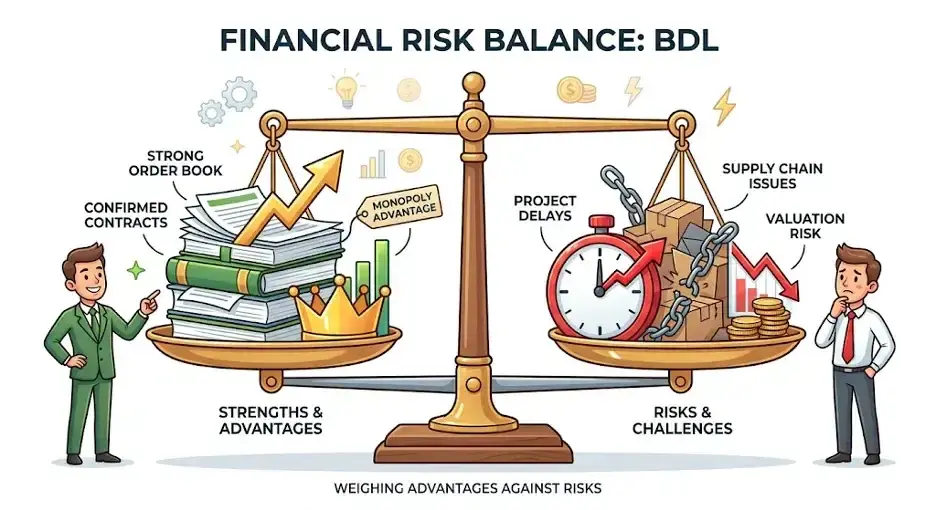
4. The Risks: Execution Delays, Import Dependence, and Valuation Concerns
What Could Go Wrong Despite the Monopoly
The order book visibility and monopoly positioning create a compelling bull case, but BDL faces real risks that investors buying at ₹1,200-1,300 levels in early 2026 need to understand. The stock touched 52-week highs above ₹2,000 in mid-2024 before correcting 40%+ to ₹1,200-1,300 range by early 2026. This volatility reflects market uncertainty about execution timelines, component supply chains, and whether current order book can translate into proportional earnings growth given fixed cost structures and government pricing constraints. The bears argue that BDL trades at 35-40x P/E (depending on whether you use trailing or forward earnings), which is expensive for a company growing revenue at just 1.5% over the past five years.
Join 1,45,000+ investors discovering under-researched small caps before they rerate.
Execution risk is the first major concern. Defence production operates on multi-year timelines with strict quality and testing protocols. When BDL commits to delivering missiles, those deliveries face potential delays from component sourcing issues, testing failures requiring redesign, regulatory certification processes, or customer-induced changes in specifications.
The company’s debtor days increasing from 55 to 90 signals that revenue recognition is happening but payment realization is slowing, which could indicate delivery schedule slippages. If the ₹25,500 crore order book takes 5-6 years to execute instead of the 3-4 years management projects, annual revenue stays flat at ₹5,500-6,000 crore range rather than ramping to ₹7,000-8,000 crore. Flat revenue with rising costs compresses margins and disappoints earnings expectations.
Import dependence on specialized components is the second critical risk despite BDL’s indigenization efforts. While the company is building RF Seeker Facility to produce seeker modules domestically, many sub-systems still rely on imported components — guidance electronics from Europe, propulsion system components from strategic partners, specialized alloys and composite materials for airframes and rocket motors.
Global supply chain disruptions, sanctions on dual-use technologies, or geopolitical tensions with supplier nations can halt production. The semiconductor shortage of 2021-2022 affected defence manufacturers globally, and BDL wasn’t immune. Future disruptions in chip supply, rare earth materials, or precision manufacturing components could delay missile deliveries regardless of how large the order book looks.
The export opportunity represents a significant growth lever that is still in early stages for BDL. India’s defence exports crossed ₹21,000 crore in FY25, with a government target of ₹50,000 crore by 2029, indicating a strong push toward global market penetration. Missile systems and air defence platforms are high-value segments within this export strategy, where BDL has a natural advantage due to its established manufacturing capabilities and government backing. Even a modest share of this expanding export market can meaningfully diversify BDL’s revenue base beyond domestic orders and reduce long-term dependence on a single customer.
The valuation risk is perhaps most pressing for new investors considering entry at current levels. BDL’s market cap of ₹46,000-49,000 crore on annual profits of ₹1,200-1,400 crore implies a P/E ratio of 33-40x. For comparison, HAL trades at 25-30x P/E and BEL at 28-32x P/E. BDL’s premium valuation assumes faster growth than peers, which is questionable given the 1.5% revenue CAGR over the past five years. The bulls argue that past slow growth reflected limited order inflows and that the current order book will drive 12-15% revenue CAGR going forward.
The bears counter that government procurement timelines are unpredictable, QRSAM orders keep getting delayed despite “advanced trials” status for 2+ years, and BDL’s margins are constrained by cost-plus pricing where the defence ministry controls profitability through procurement contract terms.
The competitive risk from private sector defence companies is emerging slowly but could intensify. While BDL enjoys monopoly status for DRDO-developed missiles, the government is actively encouraging private sector participation in defence manufacturing. Companies like L&T, Tata Advanced Systems, and Adani Defence are investing in missile and munitions capabilities. If future missile programs open to competitive bidding rather than nominated production,
BDL’s pricing power weakens. The company would need to compete on cost and delivery timelines rather than relying on sole-source contracts. This transition won’t happen overnight given the integration complexity of weapon systems, but over a 10-15 year horizon, BDL’s monopoly could erode to duopoly or oligopoly as private players build capability.
Going forward, several key triggers will determine the trajectory of Bharat Dynamics’ growth. The conversion of QRSAM from trials to confirmed orders remains one of the most important catalysts, along with production clearance and large-scale procurement of Akash-NG systems. Progress in export deals and faster execution of the existing order book can further improve revenue growth and market confidence. These factors will play a critical role in determining whether the company’s strong order visibility translates into sustained earnings expansion over the next few years.
“Risk comes from not knowing what you’re doing. And buying at 35-40x P/E without understanding execution risks means not knowing what you’re doing.”
— Warren Buffett
Market Cap focus
No. of ideas in a year
Holding period
Pricing

Emerging Titans
Combination of quantitative analysis, industry tailwinds, and management assessment - SPRINT investment philosophy
Multi Cap
20-25
3+ Years
Rs. 23,999/year

Tiny Titans
Heavy emphasis on scuttlebutt research, plant visits, and early on-ground signals
Exclusively for SME's
15-20
3+ years
Rs. 31,999/year
5. Future Outlook: What Will Drive BDL’s Next Phase of Growth
Bharat Dynamics’ growth over the next 3–5 years will largely depend on how effectively it converts its strong pipeline into executable orders and maintains delivery timelines. Management has indicated a ₹50,000 crore opportunity pipeline, with expectations that a meaningful portion will convert into firm contracts over the next 18–24 months.
The speed of this conversion — particularly for key programs like QRSAM and Akash-NG — will be the single biggest determinant of revenue acceleration.
In recent concalls and management commentary, the company has emphasized scaling production capacity, improving indigenization, and reducing dependence on imported components. Facilities such as the RF Seeker plant are expected to play a critical role in improving margins over time while also ensuring supply chain stability. If executed well, this transition can strengthen both profitability and execution reliability.
From a financial perspective, the current order book supports stable revenue visibility in the ₹6,000–7,000 crore range over the medium term. However, meaningful growth toward ₹9,000–10,000 crore annually will depend on new order inflows and faster execution cycles. This creates a two-phase outlook — near-term stability driven by existing orders, and medium-term growth driven by pipeline conversion.
Another important lever is exports. Management has indicated increasing focus on international markets, particularly in Southeast Asia and the Middle East. While exports currently form a small portion of revenue, even moderate success in this segment can diversify income streams and reduce long-term dependence on domestic defence procurement cycles.
That said, investors should closely monitor a few key triggers over the next 12–24 months:
- Conversion of QRSAM and Akash-NG into confirmed large-scale orders
- Execution pace of the existing ₹25,500 crore order book
- Progress in indigenization and margin improvement
- Export deal announcements and order inflows
These factors will determine whether Bharat Dynamics transitions from a stable defence manufacturer into a faster-growing, execution-driven compounder.
CONCLUSION
Bharat Dynamics stands in a rare position within India’s defence ecosystem. It operates in a highly specialized space with limited competition, supported by a strong order book that provides visibility over the next few years. Its ability to deliver complex missile systems and expand indigenous capabilities highlights both its strategic importance and long-term potential.
At the same time, the investment decision today depends less on business quality and more on execution and expectations. A large pipeline of potential orders creates optimism, but actual returns will depend on how efficiently these orders are converted and executed over the coming years. If growth projections play out, current valuations may appear reasonable in hindsight. If execution slows or order inflows are delayed, returns could remain muted despite the company’s strong positioning.
This makes BDL a classic case of a high-quality business where future performance is closely tied to delivery on expectations. For long-term investors who believe in the structural growth of India’s defence sector, it offers meaningful exposure. However, for those more cautious about valuation or execution risks, waiting for better entry points may provide a more comfortable margin of safety.
At its core, Bharat Dynamics represents a rare combination of strategic importance, strong visibility, and limited competition — a profile that few companies in any sector can replicate. However, at current valuations, the investment case is no longer just about the business, but about execution. The real question is not whether BDL will grow, but whether it can deliver that growth at the pace the market expects. That distinction will ultimately decide returns.
At current levels, how do you see Bharat Dynamics — a strong long-term opportunity or fairly valued for now?
Comment “BUY” if you believe in the long-term growth story, or “WAIT” if you’d prefer a better entry point — and share your reasoning so we can look at different perspectives together.
FAQs
Should I buy BDL at ₹1,200-1,300 after 40% correction from highs?
+
The correction from ₹2,000+ to ₹1,200-1,300 improves risk-reward but doesn’t automatically make it cheap. At 33-40x P/E, BDL still commands premium valuation for a company with 1.5% historical revenue growth. If you believe the ₹25,500cr order book will drive 12-15% revenue CAGR for next 4-5 years, current levels offer entry. If you’re skeptical about execution or think QRSAM orders will delay further, wait for ₹1,000-1,100 levels.
How does BDL compare to HAL or BEL for defence portfolio allocation?
+
BDL offers pure-play missile exposure with monopoly positioning but slower historical growth. HAL provides aircraft manufacturing with Tejas ramp-up driving growth. BEL offers diversified electronics across radars, communication, EW with broader revenue base. For concentration on guided weapons, BDL wins. For diversification, BEL wins. For aircraft exposure, HAL wins. Optimal strategy: 40% BEL, 30% HAL, 30% BDL for balanced defence allocation.
What’s the biggest risk to BDL’s investment thesis?
+
Execution delays on existing order book are the biggest near-term risk. If ₹25,500cr takes 5-6 years to execute vs 3-4 years, revenue growth disappoints and the stock de-rates. Medium-term risk is component import dependence — semiconductor shortages, sanctions, or supply disruptions could halt production. Long-term risk is private sector competition eroding monopoly as government opens missile programs to competitive bidding.
Does BDL’s 0.72% dividend yield matter?
+
Not really for growth-oriented investors. The dividend provides modest income but BDL’s case is order book conversion driving revenue growth, not dividend payouts. If you want defence exposure with 2-3% dividend yields, HAL or BEML are better options. BDL is a capital appreciation story, not an income stock.
Should I hold BDL for 5-10 years or treat it as a tactical defence trade?
+
Depends on conviction about sustained defence spending and BDL’s ability to maintain monopoly. If you believe India will keep expanding missile arsenals through 2035 and BDL retains sole production status, it’s a 5-10 year hold. If you think execution risks or private competition will materialize, treat it as a 2-3 year trade — book profits when order conversions drive stock to ₹1,600-1,800 range.
About the author

Shashank Mahajan
High growth stock specialist, Value Educator
Shashank Mahajan is an equity research professional with over 12 years of experience in identifying high-potential SME and micro-cap stocks at an early stage. He follows a rigorous scuttlebutt research–driven approach, combining on-ground insights with deep financial analysis. Shashank specializes in uncovering under-researched and under-owned companies with strong management quality and long-term growth potential. Through disciplined research and early identification, he focuses on spotting tomorrow’s market leaders before they enter the mainstream investor radar.
Join 1,45,000+ investors discovering under-researched small caps before they rerate.








 Orders
 Subscription
 Share with friends
 Logout


No comments yet. Be the first to comment!