
Aerospace Stocks in India 2026: Suppliers and Order Books
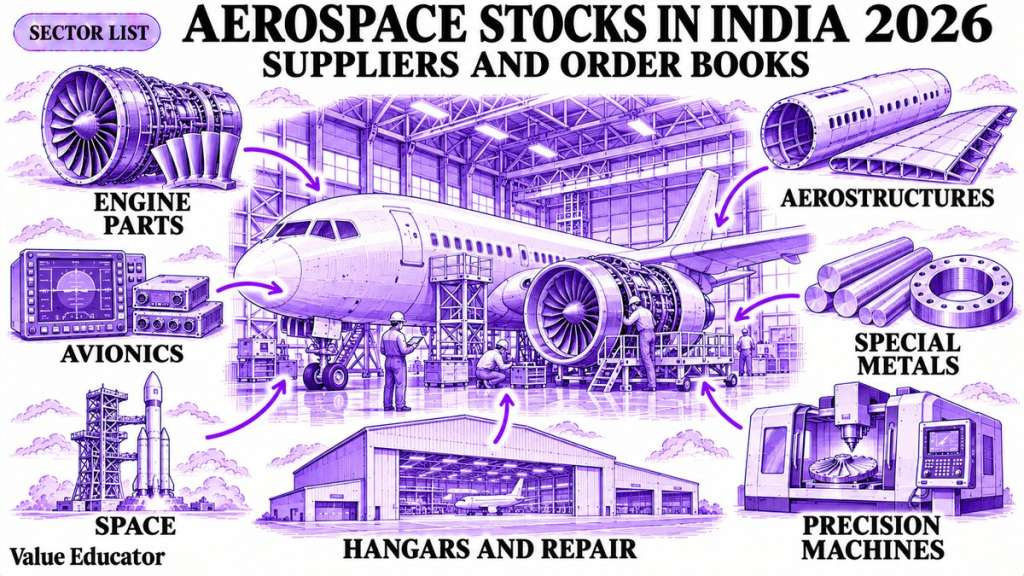
On 10 June 2026, the first C295 transport aircraft assembled in India made its maiden flight from the Tata Advanced Systems line in Vadodara. It came as the world's airlines wait for more than 17,000 aircraft that the makers have not yet built, and Indian airlines alone have about 1,800 on order against a fleet of about 730. Airbus now sources over USD 1.5 bn a year from India, and Boeing over USD 1.4 bn.
Much of that work goes to listed Indian companies that make engine parts, aircraft structures, special metals, wiring and electronics, and to the airfields and shops that repair aircraft. This page lists the aerospace and space suppliers we have studied in depth, with each one's order book or main aerospace figure. Each row links to our full research on that company. For missile, radar and naval companies, see our Defence Stocks in India 2026: List by Segment and Order Book.
Figures as of 13 November 2026. This page is research, not a recommendation to buy or sell any stock.
Aerospace Stocks in India at a Glance
The order book is the value of contracts a company has signed but not yet delivered. Dividing it by FY26 revenue shows roughly how many years of work are already in hand.
| Company | Where it sits | What it makes | Order book or key aerospace figure (date) | Order book ÷ FY26 revenue |
|---|---|---|---|---|
| Azad Engineering | Engines | Airfoils for jet engines and turbines; built the 350 kg-thrust turbojet designed by DRDO's GTRE | About ₹6,500 Cr (Mar 2026), of which about USD 200 million is aerospace and defence | about 11x |
| PTC Industries | Materials and engine castings | Titanium and superalloy melting; castings for Safran's LEAP engine and for Airbus | Order book not disclosed; titanium arm Aerolloy's FY26 income ₹190.4 Cr | - |
| MIDHANI | Materials | Superalloys, titanium alloys and maraging steel for aero engines and rockets | ₹2,164 Cr (1 Oct 2026); space orders ₹488 Cr (1 Apr 2026) | about 1.8x |
| MTAR Technologies | Engines, space and precision assemblies | Rocket engine assemblies for ISRO, actuators for Tejas, a landing-gear test box for AMCA | ₹5,143 Cr in all (30 Jun 2026), of which about ₹381 Cr aerospace and defence | about 5.9x (whole book) |
| Unimech Aerospace | Engine tooling and flying parts | Tools used to build and service aero engines; precision parts that fly | ₹855 Cr, incl. ₹589 Cr of long-term agreements and award letters (30 Sep 2026) | about 3.6x |
| Dynamatic Technologies | Aerostructures | Flap track beams for the A320 family, all eight A220 doors, Falcon 6X rear fuselage | Order book not disclosed; aerospace revenue ₹775.61 Cr in FY26 | - |
| Sansera Engineering | Aerostructures and parts | Aircraft door beams, cargo latch parts, avionics housings; parts for chip-making machines | ADS backlog ₹5,869.7 Cr (30 Sep 2026), over about five years | not comparable |
| Rossell Techsys | Wiring | Wire harnesses and panels for Boeing and military aircraft | ₹900 Cr confirmed, plus over ₹3,100 Cr of long-term agreements (30 Sep 2026) | about 1.9x (confirmed) |
| Cyient DLM | Avionics manufacturing | Electronic boards, cables and boxes for aircraft makers | ₹2,813.7 Cr (30 Sep 2026); aerospace revenue up 62% in Q2 FY27 | about 2.2x |
| Data Patterns | Avionics | Mission computers and displays for military aircraft and helicopters, plus radar | ₹927.7 Cr firm (30 Jun 2026) | about 1.0x (firm) |
| Astra Microwave | Space and radar electronics | Satellite subsystems, weather radars and fighter radar arrays | About ₹4,300 Cr (Aug 2026) | about 3.7x |
| Axiscades | Aircraft parts and electronics | Defence electronics; bought 90% of Cloud Wave, an aircraft parts maker, for ₹234 Cr | Assured visibility ₹4,557 Cr to FY30 (not an order book) | not comparable |
| Sigma Advanced Systems | Engine and airframe sub-assemblies | Heat shields, exhaust parts and cowls for Rolls-Royce engines and Airbus and Boeing aircraft, through its UK arm Nasmyth | Not disclosed; FY26 revenue ₹492 Cr | - |
| Jyoti CNC | Machines for aerospace plants | 5-axis machining centres | ₹5,082 Cr, of which about ₹1,830 Cr aerospace and defence (Sep 2026) | about 2.4x |
| Taneja Aerospace | Airfield and repair hangars | Private airfield near Hosur; hangars leased to a repair company for 25 years | Rent due ₹161.3 Cr (Mar 2026), not an order book | - |
| INOX India | Space ground equipment | Cryogenic tanks and subcoolers for rocket launch pads | ₹2,268 Cr (Sep 2026), of which about ₹1,100 Cr from space customers | about 1.4x |
Azad's ratio is high because most of its long-term contracts are for energy turbines, not aircraft. Sansera's backlog covers its whole ADS business, which also makes parts for chip-making machines, and is due over about five years. Read each ratio together with the company's delivery record, which our research covers.
How the Aerospace Supply Chain Works
An aircraft is built by a long chain of companies, and each layer is called a tier.
- Aircraft makers such as Airbus, Boeing and HAL design the aircraft and assemble it.
- Engine makers such as CFM (a joint venture of GE and Safran), Pratt & Whitney and Rolls-Royce build the engines.
- Tier 1 suppliers build large sections, such as fuselages and wings, and complete systems. In India, Tata Advanced Systems and L&T work at this level.
- Tier 2 and Tier 3 suppliers make machined parts, sub-assemblies, harnesses and electronics. Most listed Indian aerospace companies sit here.
- Tier 4 suppliers make the metals: titanium, superalloys, castings and forgings. MIDHANI and PTC Industries work here.
- MRO companies (maintenance, repair and overhaul) service the aircraft and engines for their whole working life.
The engine is about 25% of the value of a new aircraft, and the wings, fuselage, tail and engine housings together are about 40%. That is why so many Indian suppliers aim at engine parts and aerostructures, the load-bearing body of the aircraft.
Why Approvals Take Years
A new supplier cannot simply quote a lower price. It must pass a quality audit, get each special process approved, and make a first article, a sample part checked line by line against the drawing, before it can supply that part. This takes about 3-6 years. Bharat Forge, for example, says the approval and validation cycle takes 2 to 4 years.
Once a part is approved, the work tends to stay. Only four all-new airliners have been launched since 2010, so aircraft makers rarely get the chance to switch suppliers. This is why qualified parts are a useful number to watch: Azad has about 1,700 qualified parts, and Unimech has 250 parts qualified with 346 more in the pipeline.
Why Indian Aerospace Is Growing
The world cannot build aircraft fast enough. The global backlog is over 17,000 aircraft, almost 60% of the active fleet. Airbus alone had 9,352 aircraft on order in July 2026, about 10.7 years of work at its planned build rate. Engines are a bottleneck too: CFM delivered 1,802 LEAP engines in 2025 and plans over 2,000 in 2026. Before 2022, Russia's VSMPO-AVISMA supplied about 35% of Boeing's titanium and about 50% of Airbus's, so aircraft makers are now looking for new qualified sources of metal and parts.
Indian airlines are among the biggest buyers. IndiGo has nearly 1,000 aircraft on order and Air India about 600. India had about 150 operating airports in 2025, against about 70 in 2014.
India is building its own military aircraft. HAL received an order for 83 Tejas Mk1A fighters in 2021, worth about ₹48,000 Cr, and 97 more in September 2025 for over ₹62,370 Cr. Of the 56 C295 aircraft ordered for the Air Force, 40 are to be built in Vadodara. The prototype stage of the AMCA, India's planned fifth-generation fighter, is worth about ₹15,000 Cr.
Repair work is coming home. About 85% of the repair work on Indian aircraft is still done abroad. The GST on MRO services was cut from 18% to 5% in 2020, and in November 2025 Safran opened a shop in Hyderabad that can service up to 300 LEAP engines a year. The government expects India's MRO market to grow from USD 2 bn to USD 4 bn by 2030.
Space is a new market. The global space economy reached USD 613 bn in 2024, about 78% of it commercial. In the September 2026 quarter, INOX India won an order of more than ₹1,000 Cr for launch pad tanks from a US space company, and Rossell Techsys holds a multi-year space contract worth about ₹400 Cr. MIDHANI supplies maraging steel and titanium for ISRO's rockets.
Other Listed Companies in Aerospace
These companies also work in aerospace but are not yet covered in our in-depth research. The details come from their own filings, calls and presentations.
| Company | Where it sits | Aerospace work |
|---|---|---|
| Hindustan Aeronautics (HAL) | Aircraft maker and MRO | Builds Tejas, helicopters and engines, and overhauls Air Force aircraft; order book ₹2,54,538 Cr at March 2026, about 7.7 times FY26 revenue |
| Aequs | Aerostructures | Machined parts and assemblies for Airbus, Boeing and Safran at Belagavi; aerospace revenue ₹1,046 Cr in FY26, about 85% of the group |
| Raymond (JK Maini Global Aerospace) | Engine parts | Titanium and Inconel engine parts, with 350+ parts for LEAP engines; aerospace and defence revenue ₹392 Cr in FY26 |
| Bharat Forge | Forgings and landing gear | Aerostructure forgings, landing gear and engine parts; aerospace revenue about ₹400 Cr, as per its Q1 FY27 call |
| Samvardhana Motherson | Aerostructure parts | Machining and assemblies for Airbus and Boeing through CIM Tools and AD Industries; a small part of the group |
| Centum Electronics | Space and radar electronics | Radar, electronic warfare and space payload sub-systems for DRDO, ISRO and HAL |
| Kaynes Technology | Avionics boards | Avionics sub-assemblies and boards as one part of a broad electronics business; aerospace not reported separately |
| Sika Interplant Systems | MRO and systems | Licensed by Collins Aerospace since June 2025 to overhaul A320 and A321 flight-control actuators; FY26 revenue ₹211 Cr |
How to Read an Aerospace Supplier's Numbers
- Firm orders or long-term agreements? A long-term agreement fixes the part and price for years, but the customer releases orders as its build rate allows. Check how much of the book is firm.
- How much is really aerospace? Many suppliers also serve energy turbines, cars or chip-making machines. Azad's book is mostly energy, and Sansera's backlog includes chip-equipment parts.
- Which programmes? Revenue follows the build rate of a few aircraft and engines, such as the A320neo, the LEAP engine or Tejas. A cut in one rate hits every supplier on it.
- How many parts are in qualification? Parts still being approved are tomorrow's revenue. Companies such as Unimech and Azad report these counts.
- How much cash is tied up? Aerospace suppliers hold large stocks of costly metal and parts. MIDHANI, for example, held about 402 days of inventory at March 2026. Check operating cash flow, not just profit.
Key Risks for Aerospace Stocks
- Build-rate cuts: aircraft makers change their plans often. Airbus cut the A220 rate to 12 a month in 2026 from 14.
- Engine problems: a powder-metal flaw in Pratt & Whitney's GTF engine sent about 700 engines to the shop between 2023 and 2026, and grounded about 70 IndiGo aircraft at various points.
- Slow qualification: new parts and new engines can run late. Military aircraft deliveries also depend on engine supply.
- Few customers: Boeing gives about 40% of Rossell Techsys' revenue, and Taneja Aerospace earns 59% of its revenue from one customer.
- Exports and currency: many suppliers export most of what they make. About 90% of Unimech's output is exported, so currency moves and trade rules matter.
- Valuations: aerospace stocks often trade at high prices for their current revenue, which leaves little room for delays.
Explore our Products
Research Framework

Emerging Titans
Combination of quantitative analysis, industry tailwinds, and management assessment - SPRINT investment philosophy

Tiny Titans
Heavy emphasis on scuttlebutt research, plant visits, and early on-ground signals
Conclusion
India is becoming a real supplier to the world's aircraft and engine makers, from titanium castings and engine parts to doors, wiring and rocket launch pad tanks. Order books and long-term agreements are at records for many of these companies. But aerospace revenue follows a few build rates and takes years to qualify, so delivery matters more than the headline order. Use the tables above to see where each company sits, then read our research on each one for its orders, margins and risks.
FAQs
Which are the aerospace stocks in India?
+Listed aerospace suppliers include Azad Engineering, PTC Industries, MIDHANI, MTAR Technologies, Unimech Aerospace, Dynamatic Technologies, Sansera Engineering, Rossell Techsys, Cyient DLM and Taneja Aerospace, along with HAL, the aircraft maker. The tables on this page show what each one makes.
Which Indian companies make aircraft engine parts?
+Azad Engineering makes engine airfoils, PTC Industries makes titanium castings for Safran's LEAP engine, and Raymond's JK Maini Global Aerospace machines LEAP engine parts. Unimech Aerospace makes the tools used to build and service engines, and MIDHANI makes the superalloys used in engine hot sections.
Which aerospace companies have the largest order books?
+HAL had ₹2,54,538 Cr of orders at March 2026. Among smaller suppliers, Azad Engineering had about ₹6,500 Cr, Sansera Engineering an ADS backlog of ₹5,869.7 Cr and MTAR Technologies ₹5,143 Cr in its latest data, though much of Azad's and MTAR's books is outside aerospace.
Why do aerospace suppliers take years to win orders?
+Every part must pass a quality audit, special process approvals and a first article check before supply begins, which takes about 3-6 years. Once approved, suppliers often keep the work for the life of the aircraft programme.
Which listed companies are in India's space sector?
+MTAR Technologies makes rocket engine assemblies for ISRO, MIDHANI supplies rocket steel and titanium, INOX India makes launch pad tanks, Astra Microwave makes satellite subsystems, and Rossell Techsys has a space contract worth about ₹400 Cr.
What are the risks in aerospace stocks?
+Aircraft and engine build rates can be cut, new parts take years to qualify, many suppliers depend on a few customers, and most export a large share of their output. High valuations add to the risk if deliveries slip.

High growth stock specialist, Value Educator
Shashank Mahajan is an equity research professional with over 12 years of experience in identifying high-potential SME and micro-cap stocks at an early stage. He follows a rigorous scuttlebutt research–driven approach, combining on-ground insights with deep financial analysis. Shashank specializes in uncovering under-researched and under-owned companies with strong management quality and long-term growth potential. Through disciplined research and early identification, he focuses on spotting tomorrow’s market leaders before they enter the mainstream investor radar.
EMS Stocks in India 2026: Electronics Makers and Order Books
Data Centre Stocks in India 2026: Suppliers and Operators
Nuclear Power Stocks in India 2026: Suppliers and Orders
BESS Stocks in India 2026: Battery Storage Value Chain
Transformer Stocks in India 2026: Makers and Order Books

RACL Geartech: Gears for KTM, BMW and Royal Enfield
Explore our Products
Research Framework
Emerging Titans
Combination of quantitative analysis, industry tailwinds, and management assessment - SPRINT investment philosophy
Tiny Titans
Heavy emphasis on scuttlebutt research, plant visits, and early on-ground signals



Modern Warfare to Multibaggers
Key Trends. Strategic Shifts. Opportunities Ahead.
Don't Miss This Exclusive Webinar!
Join Value Educator to decode the key trends shaping India's defence sector and learn how to identify tomorrow's potential leaders in the space.
- In-depth research on India's defence sector
- Live Q&A session
- Actionable takeaways for long-term investors

 Orders
 Subscription
 Share with friends


Required Details
₹23999.00
(12 month subscription)
As per SEBI regulations, all users are mandated to complete the KYC that is validated for 1 year. Post payment, you will be redirected to the KYC screen


No comments yet. Be the first to comment!