
Unimech Aerospace: From Engine Tools to Flying Parts
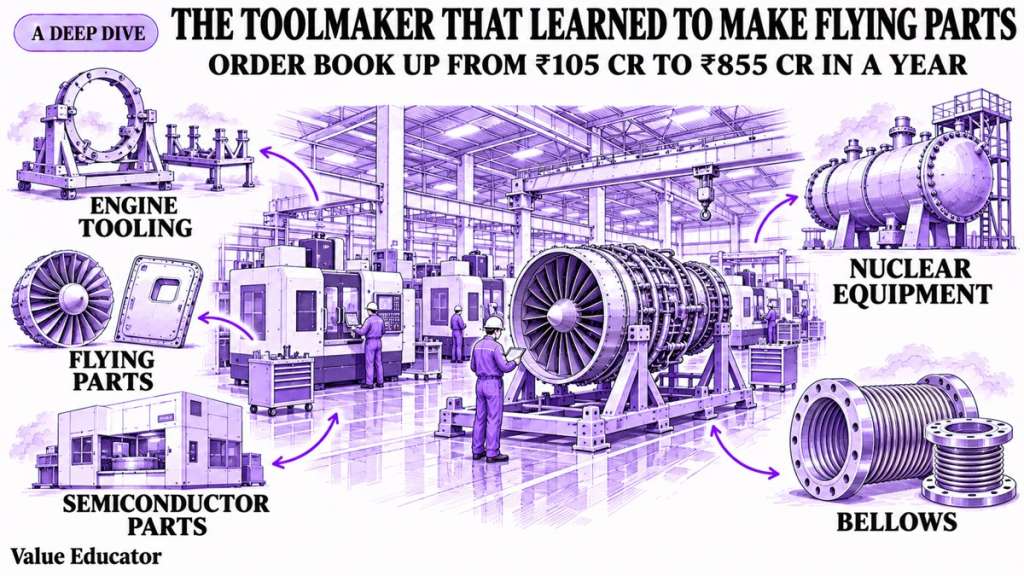
The world's aircraft makers are trying to build planes faster than their suppliers can keep up. Airbus alone is targeting almost 75 A320 family aircraft a month by 2027, up from 60. Every one of those planes needs two engines, and every engine has to be assembled, tested and later repaired.
That last step is growing in India too. In November 2025, Safran opened a LEAP engine repair shop in Hyderabad, built with an initial investment of around ₹1,300 Cr. It is designed to service up to 300 LEAP engines a year. LEAP is the engine made by CFM, a joint company of GE and Safran, for narrow-body airliners.
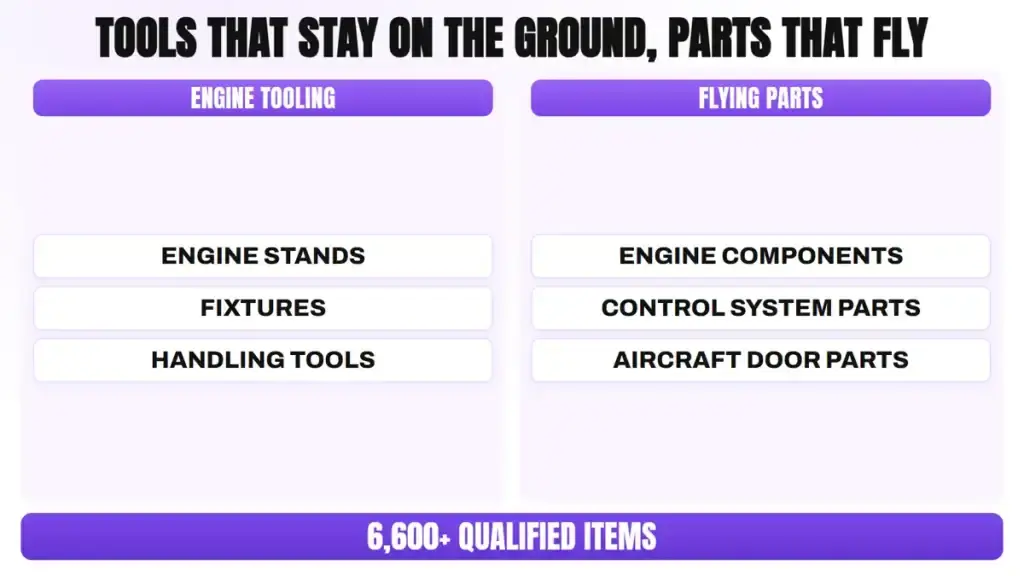
Neither an engine line nor a repair shop can start work without engine tooling, which means the special stands, fixtures and handling tools used to build, move and repair an engine. Each engine model needs its own set. The engine maker designs each tool and approves who may make it. So engine makers often work with licensed tool suppliers, who then buy the tools from approved workshops.
That approval is what makes the business valuable. An engine maker earns from an engine for decades, because each engine keeps coming back for overhaul. Every repair shop that services that engine needs the same approved tools. A workshop that has made those tools without fault for years is hard to replace.
One such workshop is Unimech Aerospace and Manufacturing Ltd (NSE: UNIMECH), set up in Bengaluru in 2016. It makes engine tools for LEAP, Pratt & Whitney and Rolls-Royce engines, and airframe tools for Airbus and Boeing. It has more than 6,600 qualified parts and tools on its books. Each new item must first pass a first article inspection, or FAI, which means the customer checks the first piece made against every requirement on its drawing. Now it is moving into a flying part, which is a part that goes into the aircraft and flies, unlike a tool that stays on the factory floor.
Unimech Aerospace in five numbers
- H1 FY27 revenue of about ₹231 Cr, up 85% from a year ago
- A Q2 FY27 EBITDA margin of 40%
- An order book of ₹855 Cr on 30 September 2026, of which ₹589 Cr is long-term agreements and award letters
- 250 parts qualified for its precision parts customers, with 346 more in the pipeline
- An award of about USD 43 million over 10 years from a French aircraft-door maker
So how does a toolmaker win the right to make parts that fly? Let's first understand the company, and then look at the quarter that showed how fast the business is now growing.
Unimech Aerospace: Company Overview
Unimech Aerospace and Manufacturing Ltd was founded in Bengaluru in 2016 by five aerospace industry veterans, led by Chairman and Managing Director Anil Kumar Puttan, and listed on the NSE and BSE on 31 December 2024. It makes aero-engine and airframe tooling, engine stands and ground support equipment for engine makers, their licensed tool suppliers, aircraft makers and repair shops, and precision parts for aerospace, semiconductor, nuclear and oil and gas customers. Through Hobel Bellows, bought in April 2026, it also makes metallic bellows and exhaust parts for gensets, locomotives and power plants. It works from five plants with more than 155 CNC machines and had 1,332 employees in September 2026. It serves 41 customers in eight countries, and about 95% of its revenue comes from exports. Revenue was about ₹240 Cr in FY26 and about ₹231 Cr in just the first half of FY27. Read this Best Defence Stocks in India for 2026
"Know what you own, and know why you own it."
— Peter Lynch
Unimech is easy to describe but harder to judge: a tooling business that earns today, and a flying-parts business that is still being qualified. The sections below separate the two.
The Quarter That Nearly Matched a Whole Year
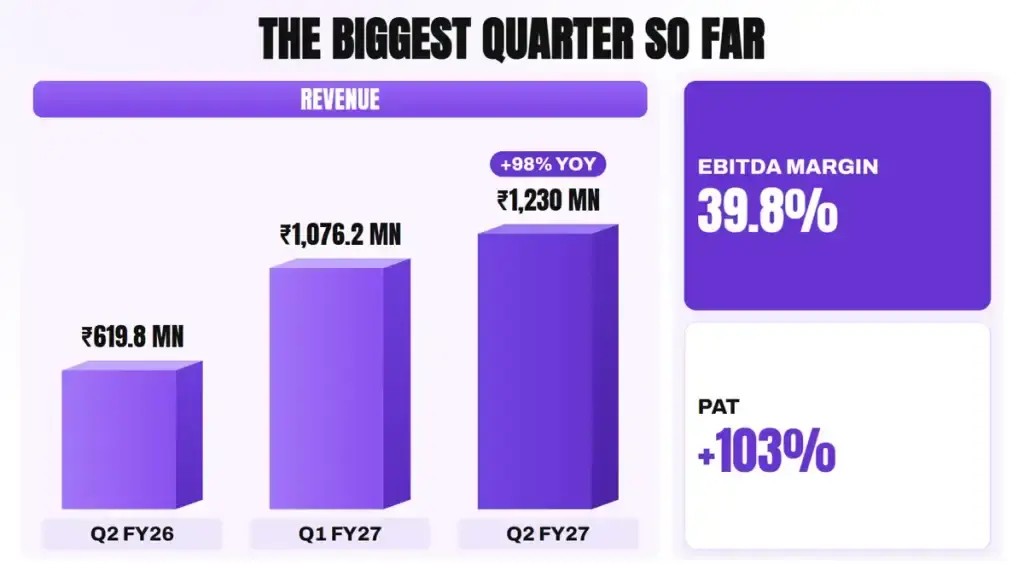
Let's look at Q2 FY27, the July to September quarter, which took Unimech's first half close to the revenue of a whole year. Revenue was about ₹123 Cr, up 98% from a year ago and 14% above Q1 FY27. These numbers include Hobel Bellows, the bellows maker Unimech bought in April 2026, from 1 May 2026.
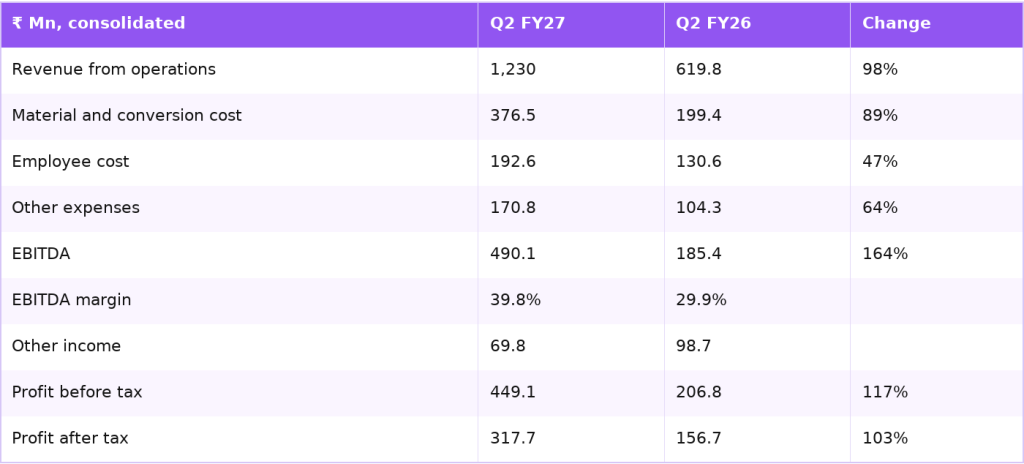
Those numbers show profit growing much faster than revenue. Total operating costs rose 70%, while revenue rose 98%. So about half of the extra revenue reached EBITDA. That is operating leverage at work, where the plants and the engineering team stay much the same while output grows. Read this Operating vs Net Profit Margin Explained
That leverage is clearest in staff costs. Employee cost was 21.1% of revenue in Q2 FY26 and 15.7% in Q2 FY27. The CFO said employee cost and other operating costs held at 15% and 14% of revenue in the first half, and he called this the sustainable range for the year.
That margin also came from what was sold. Gross margin was 69% in Q2 and 67% for the half year, which the CFO linked to high-value orders and a better mix. Subcontracting, the work sent to outside vendors, stayed at about 2% of revenue.
That step-up was also clear against the previous quarter. Revenue rose 14% from Q1 FY27, while EBITDA rose 25%, with Hobel in the numbers for all three months.
So profit after tax rose 103% to about ₹32 Cr in the quarter. Other income was smaller than a year ago, because much of the cash that earned interest went into buying Hobel. So the growth in profit came from the business itself, not from treasury income.
That pace looks even sharper over the half year. H1 FY27 revenue was ₹2,306.2 Mn, up 85%. That is about 96% of the revenue of the whole of FY26 in just six months. Profit after tax for the half was about ₹60 Cr, up 71%, and nearly 94% of FY26's full-year profit.
That half year also brought cash in. Cash flow from operations was about ₹53 Cr in H1 FY27, against about ₹14 Cr in H1 FY26. On an annual basis, management put return on capital employed at about 20% and return on equity at about 15% for the half.
The Orders Behind the ₹855 Cr Book
So who is placing all this work? Let's look at the order book, which stood at ₹855 Cr on 30 September 2026. That is up 715% from a year ago. It has two parts, and they mean different things.
The first part of the book is ₹266 Cr of confirmed purchase orders. A year earlier, in September 2025, the confirmed book was ₹105 Cr, so it grew 153%. Tooling orders are usually delivered within one quarter, and precision part orders within about six months.
The second part, about ₹589 Cr, comes from long-term agreements and award letters with three aerospace customers. These spread over five to ten years. Here the customer gives a forecast schedule, and the purchase orders come as each part is qualified and moves into production.

That table shows how the book has changed in a year. In June 2025, the confirmed book was about ₹81 Cr. In early November 2025 it was about ₹105 Cr, almost all of it tooling. By May 2026, with Hobel added, it reached ₹3,137 Mn. Then the long-term agreements lifted it to ₹855 Cr.

Why the two parts of the book differ: the ₹266 Cr of confirmed orders turns into revenue within months. The ₹589 Cr of agreements turns into revenue only as parts pass qualification and move into serial production. So the confirmed part shows the next two quarters, and the agreements show FY28 and beyond.
That mix of short and long orders is what we will keep coming back to.
"The big money is not in the buying and selling, but in the waiting."
— Charlie Munger
Most of Unimech's new agreements pay only after qualification, so much of the order book is a promise that takes years to turn into revenue. Before looking at each business, let's see how the company got here.
From a Small Tool Room to Six Industries
Let's go back to where Unimech started. It was founded by five aerospace industry veterans, with experience in high-mix, low-volume manufacturing. That means making thousands of different items in small numbers, each to a customer's drawing. They started in a small facility and offered aero-engine and airframe tools to engine makers and their suppliers.
That base then grew in steps. A subsidiary, Innomech Aerospace Toolings, set up the main tooling plant in the aerospace special economic zone at Devanahalli, north of Bengaluru. The company onboarded Boeing Commercial Airplanes and Collins Aerospace, and it entered nuclear engineering through NPCIL, India's nuclear power company. It listed on the NSE and BSE on 31 December 2024.
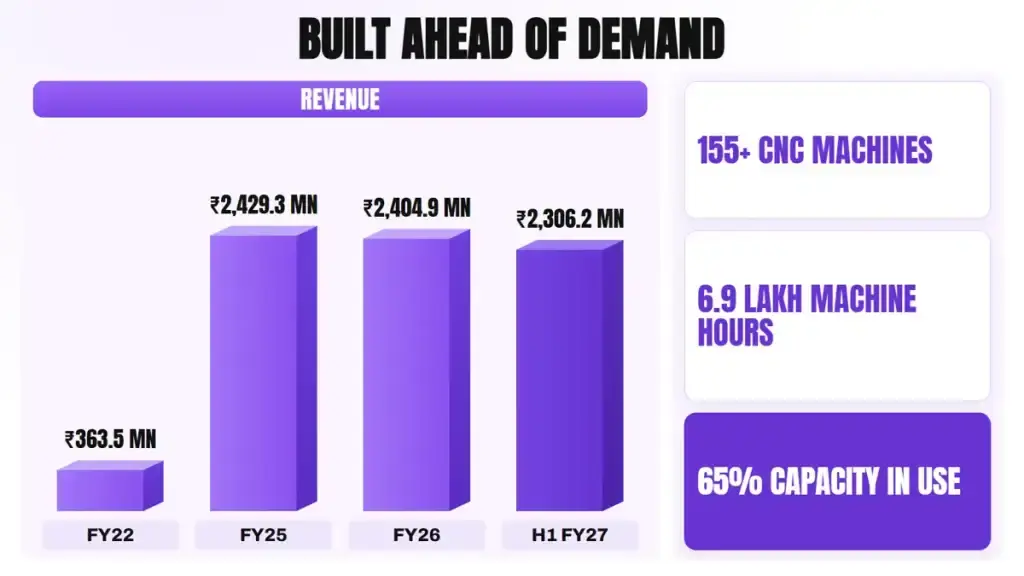
Those steps show up in revenue. Consolidated revenue rose from ₹363.5 Mn in FY22 to ₹2,429.3 Mn in FY25, a rise of about 6.7 times in three years. FY26 revenue was ₹2,404.9 Mn, close to the FY25 level. Over the four years from FY22 to FY26, revenue grew at a compound rate of 60.4% a year.
That growth also needed machines. By FY25, after the IPO money arrived, Innomech's tooling plant had about six times the installed machine hours it had in FY23. Today the group runs more than 155 CNC machines across five plants, with about 6.9 lakh machine hours of capacity in H1 FY27.
Then came acquisitions and partners. In April 2026, Unimech bought Hobel Bellows of Visakhapatnam for ₹450 Cr in cash. Hobel reported revenue of ₹123.7 Cr in FY26 on a provisional basis, with close to 90% of its business from exports. In Saudi Arabia, Unimech is building a machining plant with the Kanoo Group, holding 51% of the joint company.
That Saudi partner is one of the oldest family businesses in the Gulf, founded in Bahrain in 1890. The joint company plans an investment of about USD 30 million. Unimech put in SAR 15.3 Mn and Kanoo SAR 14.7 Mn as the first tranche of equity, and the plant will serve oil and gas, utility and mining customers.
That split of roles is clear. Kanoo brings customer relationships in the region, local procurement and regulatory know-how, and a sales and aftermarket network. Unimech brings high-precision CNC machining, reverse engineering and aerospace-grade quality systems. Construction is on schedule, and management targets commercial production by March or April 2027.
The newest piece is an engine maker of its own. Unimech holds about 27% of Dheya Engineering Technologies, which develops small gas turbine engines for drones. Unimech is Dheya's exclusive manufacturer. On 26 September 2026, Avaana Capital invested in Dheya at a value of about ₹200 Cr.
Those engines are close to production. Dheya's 40 kg thrust engine is at an advanced stage, and serial manufacturing has started with Unimech. Dheya plans engines of 20 kg, 40 kg, 50 kg and 100 kg thrust by March 2027. It says it is the first private company in India to get a prototype certification pathway from CEMILAC, the military airworthiness authority, and it targets final design approval by February 2027.
Five Businesses Inside One Precision Shop
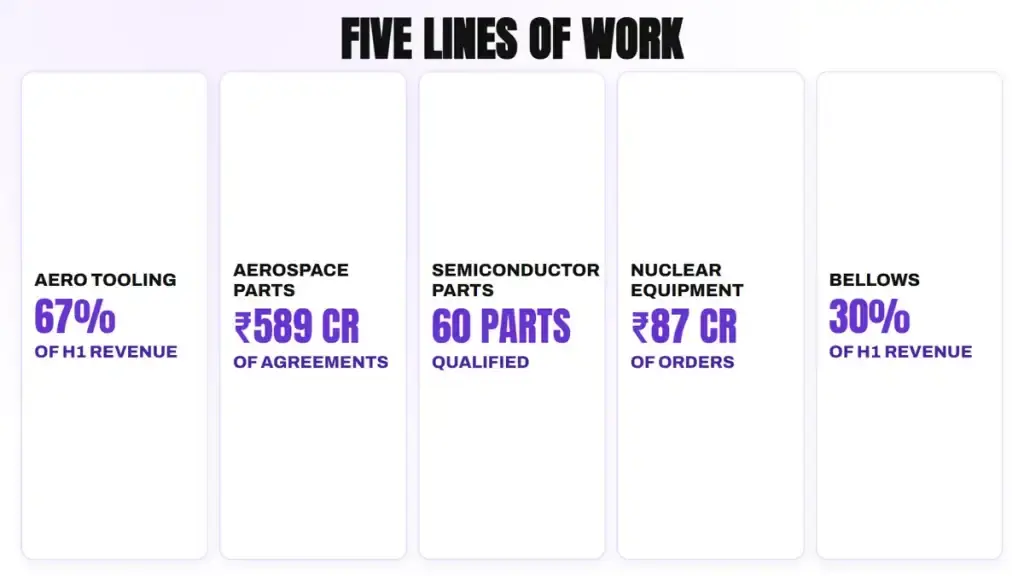
Now let's see what Unimech actually makes, because each business earns in a different way. The company reports one business segment, which covers tools, metallic bellows and engineering parts. In practice, its work divides into five lines with different customers.
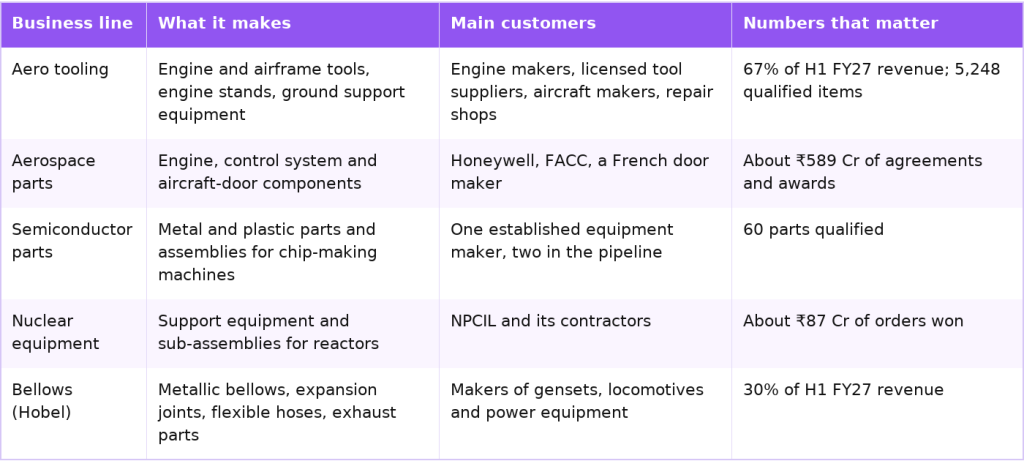
These lines differ in what Unimech delivers. In tooling, it makes equipment that stays on a factory or repair-shop floor, ordered one purchase order at a time. In aerospace, semiconductor and nuclear work, it makes parts and assemblies that go inside the customer's own product. These are called precision components and assemblies, or PCA. Hobel makes formed metal parts for engines and power plants.
That difference also shows in the revenue split. In H1 FY27, tooling gave about 67% of revenue and PCA about 33%. Within PCA, Hobel alone gave 30% of group revenue, so aerospace, semiconductor and nuclear parts gave only about 3%. Most of the new agreements belong to that last 3%, which is why the book matters more than today's revenue.
Aero Tooling
Let's start with tooling, Unimech's oldest work. Global aircraft production is rising, and so is the number of engines in service that need repair. Management puts the market for aero tooling at about $2-2.5 billion. India's MRO market, the business of maintenance, repair and overhaul, was about $1.7 billion in 2021, and a NITI Aayog report expects it to reach about $4 billion by 2031.
That demand reaches Unimech through a few kinds of buyers. Engine makers buy tools for their own assembly lines. Licensed tool suppliers buy tools that they sell to engine makers and repair shops worldwide. Aircraft makers buy airframe tools for Airbus and Boeing assembly, and repair shops buy tools to service engines.
For each engine, there are many different tools. The tooling business holds 5,248 qualified items, and each is made to the customer's drawing. A tool can be a stand that holds a whole engine during repair, a fixture that holds a fan blade in place, or a sling that lifts a module. The business has 791 people.
That base also reaches customers outside the US. Since early FY27, a free trade warehousing zone has let customers keep stock of Unimech's products in India without paying duty, and draw from it as they need. Management says this helps with tools and parts that are used outside the US.
That base keeps adding new kinds of work. In October 2025, Unimech won a ₹35 Cr export order for ground support equipment for the aerospace sector, to be delivered over five to 12 months. Now it is negotiating long-term agreements with existing customers for high-demand tools such as engine stands.
That tooling work is also crossing into a new industry. Unimech is in early talks with a Dutch semiconductor equipment maker to supply tools for its installed machines. Management says that if this works, it could later lead to orders for high-volume precision parts from the same customer.
Aerospace Parts
Next, let's turn to the parts that fly. Global aircraft makers are buying more from India. Boeing's sourcing from India grew from $250 million a year to $1.25 billion in less than a decade, on management's numbers. That gives Indian suppliers more chances to qualify on Western aircraft.
That sourcing shift shows in Unimech's own book, where three customers now carry this business. Honeywell Aerospace is a US maker of aircraft engines, auxiliary power units and control systems. Its long-term agreement with Unimech runs from 1 April 2026 to 1 November 2036. Unimech will make components that go into Honeywell's engines and APUs, the small engines that power an aircraft on the ground.
The second customer, FACC, is an Austrian Tier-1 supplier that builds aircraft parts for the large aircraft makers. Its agreement is worth about USD 7.5 million over five years for aerostructure parts. Management says the term and value could both double as more parts are qualified.
The largest of the three awards came from France. A French Tier-1 supplier, which makes aircraft doors, gave Unimech an award of about USD 43 million spread over 10 years. Unimech makes components for those doors, which go on Boeing, Airbus and Embraer platforms. Once qualified on these platforms, Unimech can bid for work with other suppliers to the same aircraft.
Each of these parts must first pass an FAI before serial orders start. Across its aerospace customers, Unimech has completed 160 FAIs and has 322 more in the pipeline. It aims to qualify more than 320 aerospace parts in FY27 alone.
Semiconductor Parts
Next, let's look at chips, a newer area for Unimech. India's second semiconductor mission, ISM 2.0, has a fiscal outlay of ₹1,27,500 Cr. More chip plants planned in India need more of the machines that make chips, and those machines need precision parts.
That is where Unimech fits. Semiconductor equipment makers build the machines that turn a silicon wafer into chips. Unimech machines metal and plastic parts that go inside these machines, and it now also puts together mechanical sub-assemblies for them. The surface finish differs from aerospace, but the machining work is similar.
That work took about 20 months of development before it earned revenue. So far, Unimech has qualified 60 semiconductor parts with one established customer, and another 20 parts and assemblies are targeted by the end of December 2026. Two more semiconductor customers are in the pipeline. Management expects a sharp step-up in semiconductor revenue in H2 FY27.
Nuclear Equipment
Next, let's turn to nuclear power. India's Nuclear Energy Mission targets 100 GW of nuclear capacity by 2047. NPCIL, which runs India's nuclear plants, is both building new reactors and refurbishing old ones, and each needs special equipment.
That is Unimech's entry point. In January 2026, NPCIL gave Innomech an order worth ₹72.20 Cr to supply and deliver support equipment for units 3 and 4 of the Tarapur Atomic Power Station, with staggered deliveries up to December 2028. Unimech's cumulative nuclear orders stood at about ₹87 Cr in August 2026.
Most of that work is to be delivered from H2 FY27 into the next year. Management says about 13 to 15 different nuclear sub-assemblies and systems have been qualified so far. That lets the company bid for a larger share of each tender.
Now new reactors are in play. Four new reactors are in the bidding stage, and Unimech plans to take part through the large Tier-1 bidders. Management said the opportunity could come before the end of this year.
Hobel Bellows
Finally, let's look at Hobel, the newest line. A metallic bellows is a thin, ridged metal tube that can stretch and bend, so that pipes and exhaust lines do not crack when an engine heats up or vibrates. Hobel's bellows go into high-horsepower diesel engines, locomotives, marine engines and power generation units.
That demand is now coming from data centres. Large data centres keep diesel generators ready for power cuts, and Hobel's key customers have asked for more capacity because of strong demand for genset engines in the data-centre industry. Unimech is meeting this with its existing buildings and some new machines.
Hobel also brings customers and skills that Unimech did not have. It was set up in 2007 and has a plant of about 2,00,000 sq ft in the Visakhapatnam special economic zone. It has 13+ years of relationships with global makers across Europe, North America and India. Wabtec, a large US maker of locomotives, is exploring a wider partnership with the group beyond bellows.
That cross-selling works in both directions. Existing Unimech customers such as Honeywell and NPCIL have visited Hobel, and some of its products are in qualification with them. Hobel is working toward AS9100, the aerospace quality approval, by February 2027, which would open aerospace bellows work. Management expects Hobel to make up about 20% of the ₹1,000 Cr revenue it is aiming for.
Why a Qualified Supplier Is Hard to Replace
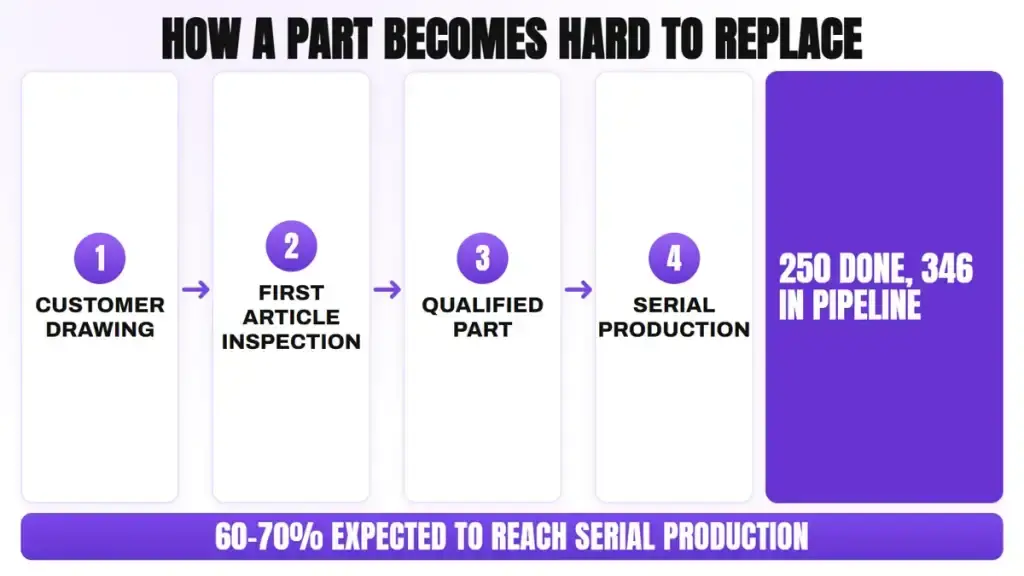
Now that we have seen all five lines, let's understand why customers keep coming back to Unimech. It starts with qualification. In aerospace, a part or tool is made to the customer's drawing, and its first piece must pass a first article inspection before regular orders start. Each change of supplier means repeating that work. Read this Economic Moat Explained
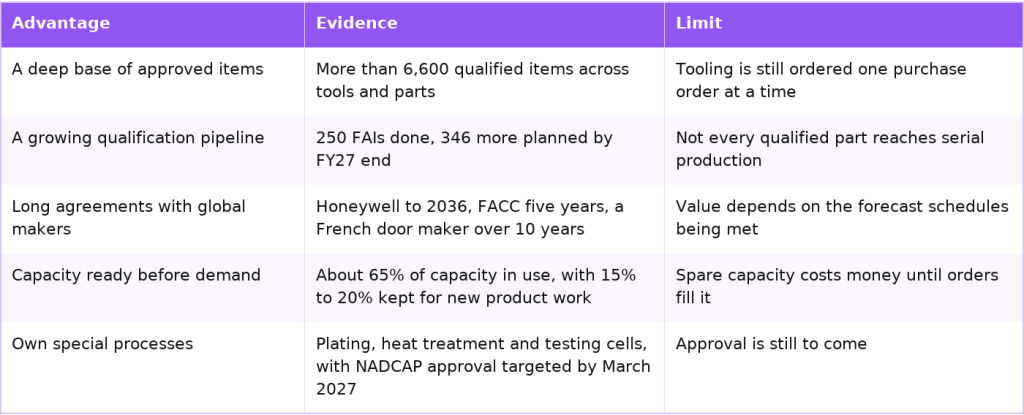
That qualification work is a large share of what the plants do today. About 15% to 20% of available capacity is set aside for new products, prove-outs and customer qualification. Management expects 60% to 70% of the 250 qualified parts to move into serial production, with most of the revenue coming in FY28.
"The harvesting would happen next year. This is a qualification year." - Rajanikanth Balaraman, Unimech Aerospace
That same discipline decides which work Unimech takes. Some customers ask suppliers to keep making trial pieces without promising any production volume. Management says it turned down one or two such requests in the past year, and it agrees to first articles only when there is a path to serial production.
"we will not be a shop where we will just keep doing FAIs for you with no horizon for serial production." - Rajanikanth Balaraman, Unimech Aerospace
That position also needs space and machines that a customer can see. Management says customers want to see the plant, the equipment and the spare capacity before they place larger programmes. It has found this pattern again and again over the past decade. So Unimech builds capacity before the orders arrive.
"In business, I look for economic castles protected by unbreachable moats."
— Warren Buffett
For Unimech, the moat is approval: each tool and part is qualified to a customer's drawing, and a new supplier would have to repeat that work.
"customers will not, appreciate or show interest on new RFQs unless you show the capacity" - Ramakrishna Kamojhala, Unimech Aerospace
That logic now extends to special processes. Anodising, plating, heat treatment and non-destructive testing used to go to outside vendors. Unimech is installing its own automated cells for these steps, with commissioning by December 2026. That gives it control over quality, lead times and the record of each part, which aerospace and semiconductor customers ask for.
Those approvals add up across industries. Unimech is certified to AS9100, ISO 9001, IATF 16949 and ISO 45001. Its work for one aerospace customer helps it qualify with another on the same aircraft. Its nuclear sub-assemblies, once approved by NPCIL, can be offered in the next tender.
Financials: Five Years From a Small Tool Shop to a Listed Group
One strong quarter can hide a lot, so let's look at five full years together. These are consolidated figures from the company's presentations, converted to ₹ Cr, with operating cash flow from the annual reports.
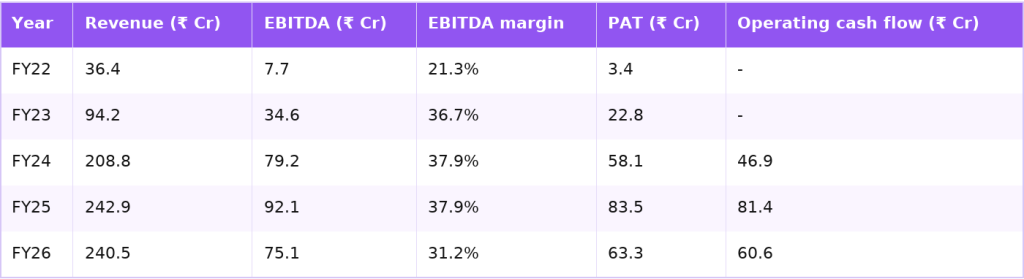
Revenue grew more than six times in four years, from about ₹36 Cr in FY22 to about ₹240 Cr in FY26, a compound rate of 60.4% a year. Most of that growth came by FY24. FY26 revenue stayed close to FY25, and the EBITDA margin moved to 31.2% from 37.9% as costs for the new plants and staff came in before the orders.
Cash has broadly followed profit. Over FY24 to FY26, operating cash flow added up to about ₹189 Cr against about ₹205 Cr of profit after tax. In H1 FY27, operating cash flow was about ₹53 Cr. Receivables and inventory are now rising with Hobel and the longer aerospace and nuclear programmes.
The balance sheet changed with the IPO and Hobel. The IPO in December 2024 brought in fresh equity, and much of that cash was used to pay ₹450 Cr for Hobel in April 2026. Short-term borrowings rose to about ₹131 Cr in September 2026, and an equity raise is planned for early 2027.
"Accounting is the language of business."
— Warren Buffett
Unimech's numbers show a business that grew fast, paused in FY26 and is growing again. The cash flow line is the one to watch as the long programmes start.
What the Next Two Years Look Like on Management's Numbers
So what could all of this add up to for you as a reader following Unimech? Management does not give a full-year revenue number for FY27. It expects H2 FY27 revenue to be higher than H1, with similar margins. That would mean FY27 revenue of more than about ₹461 Cr, against FY26 revenue of ₹2,404.9 Mn.
That H2 step-up has three named sources. Management expects higher deliveries to the semiconductor equipment customer, the execution of nuclear orders and a steady run-rate in the other businesses. The nuclear orders alone are about ₹87 Cr, mostly due from H2 FY27 into FY28.
Beyond FY27, qualification is the number to watch. Unimech expects more than 590 qualified parts by the end of FY27, from 250 today. If 60% to 70% of them move into serial production, as management expects, the revenue from the long-term agreements would start in FY28.
Beyond two years, management has a larger aim. It is working toward revenue of ₹1,000 Cr, which it calls an aspiration and not guidance. By the end of FY27, its gross block, the total cost of its plants and machines, should be about ₹500 Cr including the Saudi joint company, and it expects about two times asset turns on it.
That aim also changes the mix. At ₹1,000 Cr, management expects tooling and precision parts to be roughly 50-50. Precision parts carry slightly lower margins than tooling, and research costs could take another 1% to 2% off the margin. Management does not expect a large change in the margin profile.
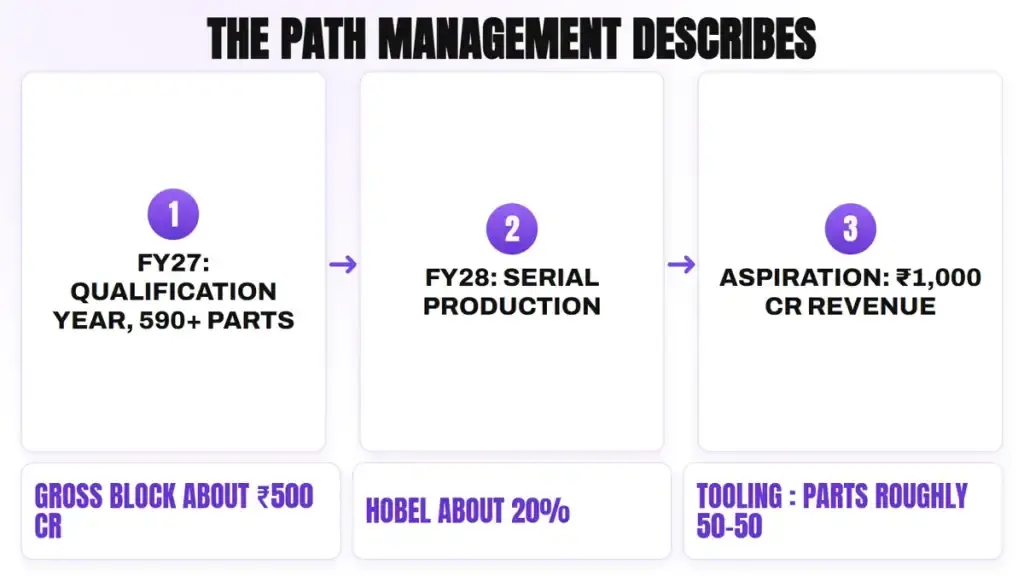
That plan needs more capacity after the ₹1,000 Cr level. The CFO said the plants for that aim are already built and can be funded from internal accruals. For the next stage, Unimech expects to consider an equity fundraise in early 2027. It would also help the promoters bring their holding down to the level required for listed companies.
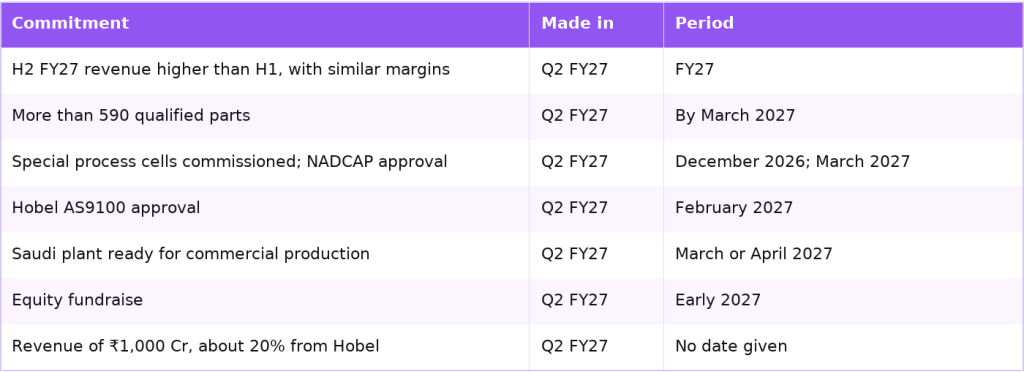
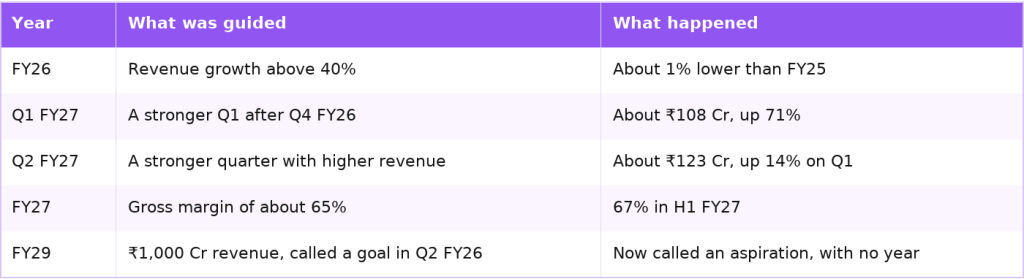
These commitments come with a record we can check. In May 2025, management expected revenue growth of above 40% in FY26. Revenue instead came in about 1% lower than FY25. Since then, the near-term promises have been met. After Q4 FY26, management said Q1 FY27 would be stronger, and in August it said Q2 would be stronger again.
Key Risks
No precision supplier grows in a straight line, so let's look at what could go wrong for Unimech.
- Most of the book is not firm orders: of the ₹855 Cr order book, about ₹589 Cr is long-term agreements and award letters, not purchase orders. They become revenue only as each part passes qualification. If qualification takes longer, or a customer's aircraft output slows, that revenue moves out.
- A missed target in FY26: management guided growth of above 40% for FY26, and revenue fell about 1%. US tariffs held back tooling orders, and revenue before tariff concessions to customers was ₹257 Cr against the ₹240 Cr reported. The company still shares about 5% tariffs on parts and tools used in the US.
- Tooling is short-cycle: tooling gave about 67% of H1 FY27 revenue, and most tooling orders are delivered within a quarter. So the confirmed book covers only a few months of tooling work, and a pause in engine-maker spending would show up fast.
- Cash tied up in growth: receivables rose to ₹1,226 Mn in September 2026 from ₹648 Mn in March 2026, and inventory to ₹381.9 Mn from ₹251.1 Mn, partly because Hobel joined. Management expects working capital days to rise from about 110 to 150-160 by March 2027, as nuclear and aerospace programmes take longer to bill. Read this Days Sales Outstanding (DSO) Explained
- More borrowing and new shares: short-term borrowings rose to ₹1,307 Mn from ₹846.1 Mn in six months, while cash and treasury investments went into Hobel. An equity raise is planned for early 2027, and the promoters must cut their holding to meet the public shareholding rule. Each new share spreads profit more thinly.
- Acquisition and new ventures: the Hobel deal added goodwill of ₹3,219.9 Mn to the balance sheet. The Saudi plant needs a capex outlay of ₹200-250 Cr before it earns, and Unimech's share of losses at associate Dheya was ₹8.9 Mn in H1 FY27.
- Little detail by customer: Unimech reports margins only for the whole group, not by business line or customer, and agreements such as Honeywell's are under confidentiality. So readers cannot see how much depends on any one engine maker or tool supplier, or how profitable the new parts are.
"You can't predict. You can prepare."
— Howard Marks
For Unimech, the main unknown is how fast qualified parts move into serial production. The signals below show early whether that is happening.
Explore our Products
Research Framework

Emerging Titans
Combination of quantitative analysis, industry tailwinds, and management assessment - SPRINT investment philosophy

Tiny Titans
Heavy emphasis on scuttlebutt research, plant visits, and early on-ground signals
What to Track Next
If you follow Unimech Aerospace, these are the signals that will show whether the plan is on track.
- H2 FY27 revenue above H1's ₹2,306.2 Mn, with a similar margin
- The number of qualified parts reaching 590 by March 2027
- The first serial-production revenue from Honeywell, FACC and the French door maker
- New nuclear orders from the four reactors now in bidding
- Working capital days, against management's 150-160 and about 110 today
- The size and pricing of the equity fundraise planned for early 2027
Conclusion
Let's step back and put it all together. For a decade, Unimech built approved tools for the world's engine and aircraft makers, and it has more than 6,600 qualified items to show for it. That record has now won it long agreements to make flying parts for Honeywell, FACC and a French door maker. Hobel, nuclear work and semiconductor parts add three more industries.
So FY27 is the year of qualification, and FY28 is when the new parts are meant to earn. Q2 FY27 gave a record quarter and an order book of ₹855 Cr. If the 590 parts qualify on time, the business could look very different in two years. If qualification or aircraft output slips, Unimech will still have a profitable tooling business, but it will carry more debt, more shares and more cash tied up while it waits.
FAQs
What does Unimech Aerospace do?
+Unimech Aerospace is a Bengaluru company set up in 2016 that makes engine and airframe tooling, engine stands and ground support equipment for LEAP, Pratt & Whitney and Rolls-Royce engines and for Airbus and Boeing. It also makes precision parts for aerospace, semiconductor and nuclear customers, and metallic bellows through Hobel Bellows. It has more than 6,600 qualified items.
How did Unimech Aerospace do in Q2 FY27?
+Revenue was about ₹123 Cr, up 98% from a year ago, with an EBITDA margin of 39.8%. Profit after tax rose 103% to about ₹32 Cr. In the first half of FY27, revenue of about ₹231 Cr was about 96% of the whole of FY26.
How big is Unimech Aerospace's order book?
+The order book was ₹855 Cr on 30 September 2026, up 715% from a year ago. Of this, ₹266 Cr is confirmed purchase orders and about ₹589 Cr comes from long-term agreements and award letters with three aerospace customers, spread over five to ten years.
Who are Unimech Aerospace's new aerospace customers?
+Honeywell Aerospace signed a long-term agreement running to November 2036 for engine and control system components. FACC of Austria signed a five-year agreement worth about USD 7.5 million, and a French aircraft-door maker gave an award of about USD 43 million over 10 years. These parts must pass first article inspection before serial production.
What is Unimech Aerospace's guidance?
+Management expects H2 FY27 revenue to be higher than H1, with similar margins, and more than 590 qualified parts by March 2027. It is working toward revenue of ₹1,000 Cr, which it calls an aspiration, with about 20% from Hobel. An equity fundraise is planned for early 2027.
What are the main risks for Unimech Aerospace?
+Most of the order book is long-term agreements, not firm orders, and depends on qualification. FY26 revenue came in about 1% lower than FY25 against guidance of above 40% growth, partly because of US tariffs. Working capital days are expected to rise from about 110 to 150-160, and borrowings, goodwill and a planned share issue have increased.

High growth stock specialist, Value Educator
Shashank Mahajan is an equity research professional with over 12 years of experience in identifying high-potential SME and micro-cap stocks at an early stage. He follows a rigorous scuttlebutt research–driven approach, combining on-ground insights with deep financial analysis. Shashank specializes in uncovering under-researched and under-owned companies with strong management quality and long-term growth potential. Through disciplined research and early identification, he focuses on spotting tomorrow’s market leaders before they enter the mainstream investor radar.
Macpower CNC: A Rajkot Machine Maker With ₹476 Cr of Orders
KSB: The Pune Pump Maker With ₹1,235 Cr of Reactor Orders

Kilburn Engineering: The Dryer Maker With ₹470 Cr of Orders

Rossell Techsys: Boeing and Lockheed Wiring From Bengaluru
Taneja Aerospace: The Airfield With ₹161 Cr of Rent Signed

Dynamatic Technologies: Airbus Doors, Flap Beams and Pumps
Explore our Products
Research Framework
Emerging Titans
Combination of quantitative analysis, industry tailwinds, and management assessment - SPRINT investment philosophy
Tiny Titans
Heavy emphasis on scuttlebutt research, plant visits, and early on-ground signals



Modern Warfare to Multibaggers
Key Trends. Strategic Shifts. Opportunities Ahead.
Don't Miss This Exclusive Webinar!
Join Value Educator to decode the key trends shaping India's defence sector and learn how to identify tomorrow's potential leaders in the space.
- In-depth research on India's defence sector
- Live Q&A session
- Actionable takeaways for long-term investors

 Orders
 Subscription
 Share with friends


Required Details
₹23999.00
(12 month subscription)
As per SEBI regulations, all users are mandated to complete the KYC that is validated for 1 year. Post payment, you will be redirected to the KYC screen


No comments yet. Be the first to comment!