
7 Traits of Multibagger Stocks

Back in 1954, the Poddar family was running a small bicycle-tyre business — local, simple, and far from anything global. By 1987, they stepped up and set up their first major tyre plant in Aurangabad, entering the crowded 2-wheeler and 3-wheeler tyre market. But this space was intensely competitive — pricing was commoditised, margins were tight, and there was hardly any room to create a real, defensible edge.
So in the mid-1990s, Balkrishna Industries (BKT) took a contrarian turn. Instead of chasing the mainstream car and bike tyre market like everyone else, they shifted focus to Off-Highway Tyres — the specialised tyres used in tractors, construction equipment, mining vehicles, and industrial machinery.

It was a niche category with fewer global players, higher technical complexity, stronger customer stickiness, and steady worldwide demand. That single strategic pivot changed the direction of the company.
From there, BKT didn’t grow through hype — it scaled steadily and patiently. Capacity expanded, product capability deepened, and the company began exporting to over 130 countries. Over time, exports started contributing close to 70% of revenue, giving BKT a strong global identity in a category where reliability matters more than branding.
For long-term investors, this focus on a niche — instead of chasing crowded markets — turned out to be the real wealth creator. Over the next decade, the stock compounded at around 22% annually and became a genuine multibagger. Not because of speculation or momentum — but because the business chose the right niche, built expertise around it, and executed with consistency.
The lesson is simple — some of the biggest winners don’t chase crowded markets. They pick a niche, build deep expertise, and let time do the compounding.
And before we go hunting for the next multibagger, we first need to clearly define what one really is — because if we don’t know what we’re looking for, we may miss it even when it’s right in front of us.
What Is a Multibagger?
When a small company keeps improving its business — growing profits, expanding its customer base, and strengthening execution — its value starts compounding year after year. Over time, the market recognises this progress, the stock gets re-rated, and returns multiply meaningfully.
That’s what we call a multibagger — a stock that delivers several times its original value (5x, 10x, sometimes even more) for investors who stay patient through the journey.
“The secret to wealth is simple: find a few great companies and hold them for the long term.” – Peter Lynch
Now the real question: How do you spot one early? Every giant BKT, Eicher Motors, and D-Mart once looked boring and unnoticed… but they showed certain early signs of greatness. If you can identify these signals, you don’t just buy a stock, you buy into its future transformation.
This is exactly where our SPRINT Methodology helps—quickly scanning for the early traits of potential multibaggers and filtering the most promising candidates.
Let’s explore those signals.
7 Traits That Signal Multibagger Potential
Trait 1: Operating Leverage & Profit Inflection – When Earnings Outpace Revenue
In the early 2000s, APL Apollo was just another steel tube maker — a typical “produce more → spend more” business. Profits rose only when factories ran harder. Nothing special.Then came the inflection point. Instead of spreading money across dozens of low-speed plants, they invested in high-speed, automated ERW lines. The real unlock was adopting German HF-welding technology and advanced slitting systems — stronger tubes, faster production, almost no manual intervention.
Initially, nothing changed in the numbers. Earnings were flat. Investors complained they were wasting money on automation.
But when India’s structural steel demand shot up, APL Apollo was the only player perfectly prepared. Same labour, same space, same electricity — but far higher output. Costs stayed flat while capacity soared.
That’s when the magic appeared in the financials.
Revenue increased steadily… but profits exploded.
“It’s not about having the right opportunities. It’s about handling the opportunities right.” – Howard Marks
This is what operating leverage looks like — when every extra rupee of revenue starts converting into a disproportionately higher rupee of profit. As scale improves, fixed costs don’t rise as fast as sales, so more of the money flows straight to the bottom line.
The company kept strengthening this flywheel — improving product mix, keeping tighter control on costs, and running plants at higher utilisation levels. So even in periods when revenue growth wasn’t very aggressive, profits continued to compound — because the business was extracting more efficiency from every sale.
And here’s another underrated edge: exceptional working capital management.
APL Apollo reduced inventory days, negotiated faster payment cycles with customers, and secured longer credit terms from suppliers. This meant more cash stayed inside the business, allowing them to fund expansion without taking on heavy debt. Efficient working capital kept the growth engine running smoothly.
What once looked like a boring steel business turned into a profit-compounding machine. And when profits compound, markets eventually wake up — turning quiet believers into big winners.
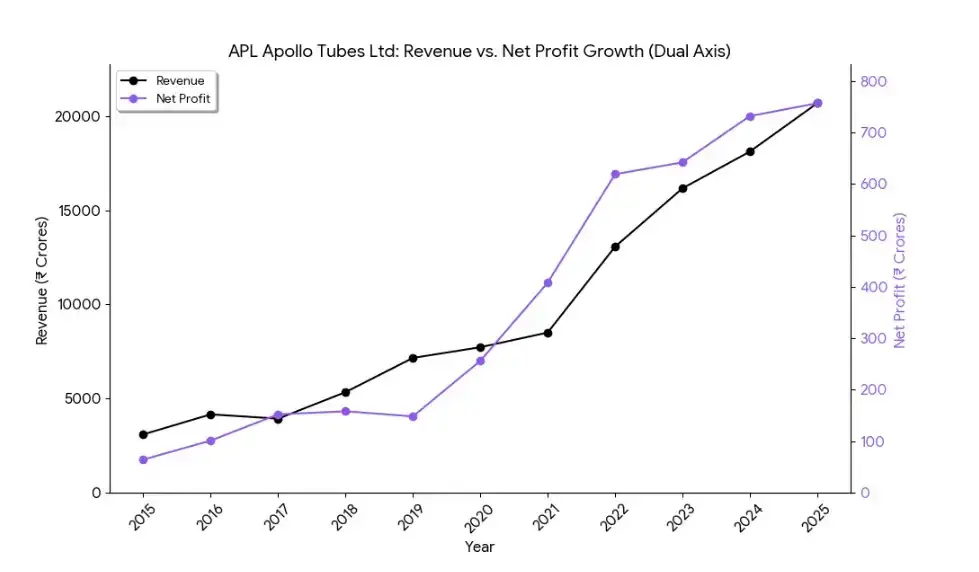
This graph shows how Profits are compounding faster than the revenue of APL Apollo, signalling improving margins and operating leverage — an early sign that the business is upgrading before the market notices.
Read more: How to Analyze a Mid-Cap Company – A Complete, Practical Framework
[Top Mid Cap Stocks with Strong Earnings Growth (2025 Picks)]
Trait 2: Brand Loyalty & Consumer Mindshare – Customers Who Keep Coming Back
Fevicol is a classic example of how a simple product can become a monopoly by owning consumer trust — “Fevicol hai?” became a standard request, giving Pidilite pricing power and repeat sales. The same pattern exists in other iconic Indian brands: Bisleri has become the default name for bottled water, where “Ek Bisleri dena” often means any mineral water bottle; and Maggi dominates instant noodles, where for millions of Indians, noodles simply mean Maggi. These brands don’t just sell products — they occupy a permanent space in the consumer’s mind, creating loyalty, habit-driven demand, and a moat that competitors struggle to break.

“
Your most unhappy customers are your greatest source of learning.” – Bill Gates
Trait 3: Leadership & Strategic Capital Allocation – Every Rupee Works Harder
Motherson Sumi is one of India’s most underrated case studies in smart capital allocation. Instead of chasing expansion blindly, the company built a reputation for turning around struggling auto-component makers across Europe and Japan — often when they were inches from bankruptcy.
Global giants trusted them because Motherson didn’t just buy assets cheaply. They fixed operations, upgraded technology, and plugged these companies into fast-growing Asian markets. Deals like Visiocorp in 2009 and PKC Group in 2017 turned loss-making firms into profitable global suppliers.

Here’s the unique part: Motherson never chases acquisitions — they wait for the customer to call. When an OEM like Mercedes or Toyota wants a supplier rescued, they ask Motherson to step in. This ensures the price is fair, the customer relationship deepens, and integration becomes smoother.
Each acquisition expanded product lines, added blue-chip clients, and reduced dependence on any one region. Over time, this transformed Motherson into one of the world’s top auto-component manufacturers — built not on hype, but on disciplined capital allocation.
But not every acquisition story is a success. Cases like Tata Steel–Corus or HUL–Modern Foods show how bad timing, overpaying, or weak integration can destroy shareholder wealth. That’s why leadership quality matters more than the target.
Great investors don’t bet on products alone.
They bet on leaders who know how to turn crises into compounding opportunities.
Trait 4: Structural Tailwinds & Growth Runway – Riding the Right Industry Waves
DMart spotted a major shift in India much earlier than most retailers — households were gradually moving away from local kirana shops toward organised retail, not just for better prices, but for a more reliable shopping experience. While many retail chains rushed into premium malls, expensive high-street locations, and flashy store formats, DMart took a completely different path — slow, disciplined, and execution-first instead of glamour-first.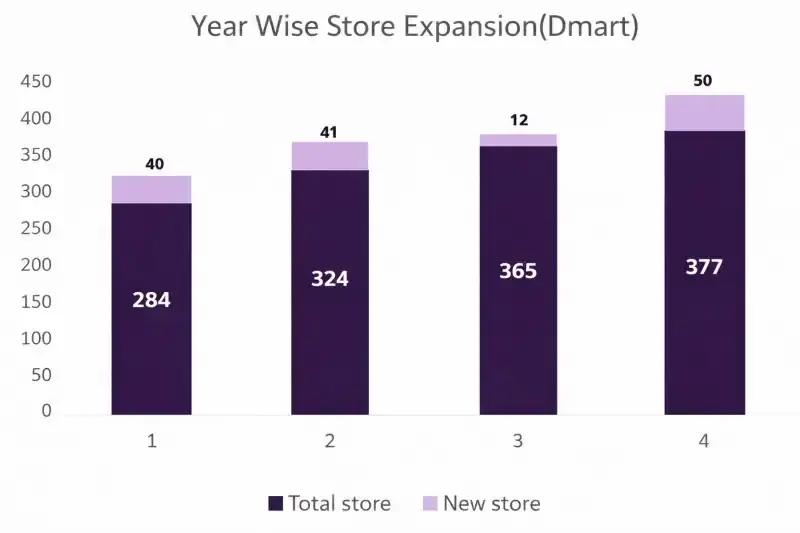
For almost a decade, the company expanded cautiously, opening only a small number of stores each year. This wasn’t due to lack of ambition — it was deliberate. DMart used this period to fine-tune its everyday-low-price model, negotiate stronger supplier terms, optimise store layouts, and build a backend that could run on thin margins without breaking. Once the model became repeatable and unit economics were proven, the company shifted gears — scaling to 100+ stores with confidence, while still preserving efficiency, customer loyalty, and pricing strength.
A better comparison than fast food: Walmart’s everyday-low-price strategy. Walmart avoided flashy “big sale days” and focused on consistent low prices year-round — a system built on strong sourcing, tight costs, and massive operational discipline. When demand rose, Walmart could expand fast without breaking its model.
DMart followed the same philosophy in India — master the operations first, then scale aggressively as the country shifted from unorganised to organised retail. As India continues formalising, DMart’s ultra-efficient model gives it a long growth runway, allowing revenues and profits to compound far ahead of competitors.
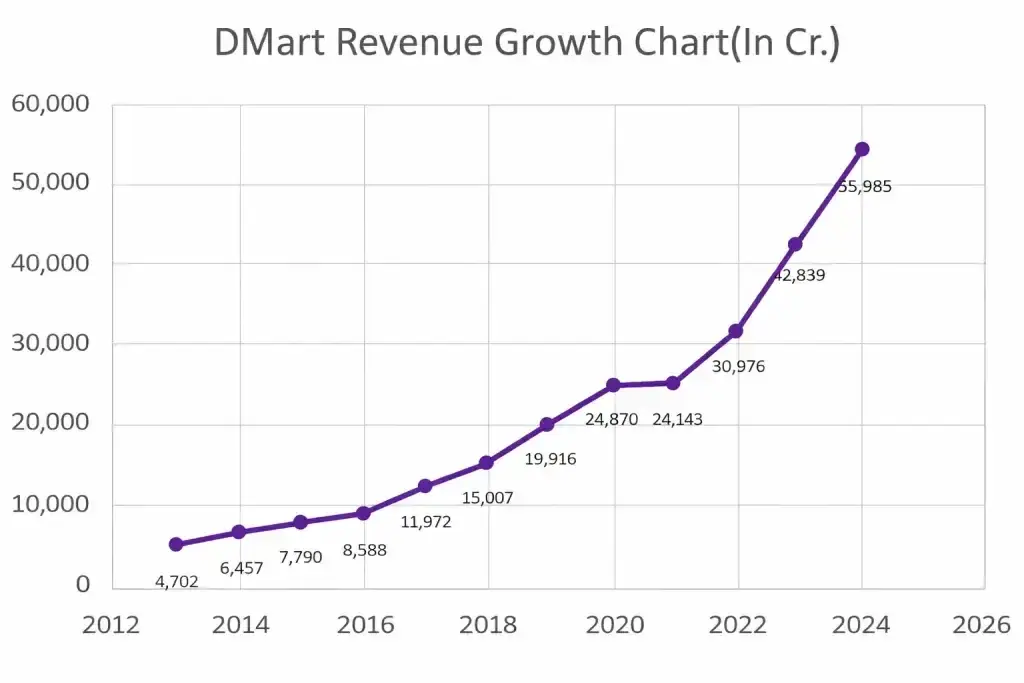
This graph shows DMart’s revenue compounding as India moved from unorganised kiranas to modern retail, highlighting how low-cost, efficient execution enabled faster scaling.
“The best businesses almost always emerge from trends that others ignore.” – Philip Fisher
Trait 5: Undervaluation & Late Market Recognition – Quiet Multibaggers
For a long time, Garware Hi-Tech Films was barely noticed by the market. Most investors saw it as just another commodity packaging film manufacturer — making regular BOPP and BOPET films, nothing special, nothing exciting. The company kept improving operations and building capability quietly in the background, but it didn’t really attract much attention.
Gradually, things began to change — not through flashy announcements, but through a clear strategic shift. Garware started moving away from low-margin commodity films and focused on high-value specialty products like paint-protection films, solar-control films, and automotive safety films. These products offered better pricing power, stronger margins, and deeper export potential.
As the product mix improved, so did the business quality. Earnings became more consistent, cash flows strengthened, and margins settled at structurally higher levels — not just in good years, but even when peers struggled through volatility and down-cycles.
Slowly, the market’s perception shifted too. What earlier looked like a cyclical, commodity-driven company was now being seen as a niche specialty materials player with differentiated capabilities. And once that recognition set in, the valuation followed — the stock moved from low multiples to a higher P/E range, reflecting stronger profitability, competitive positioning, and clearer long-term growth visibility.
In simple words — the story didn’t change overnight. The business became better first. The market noticed later.
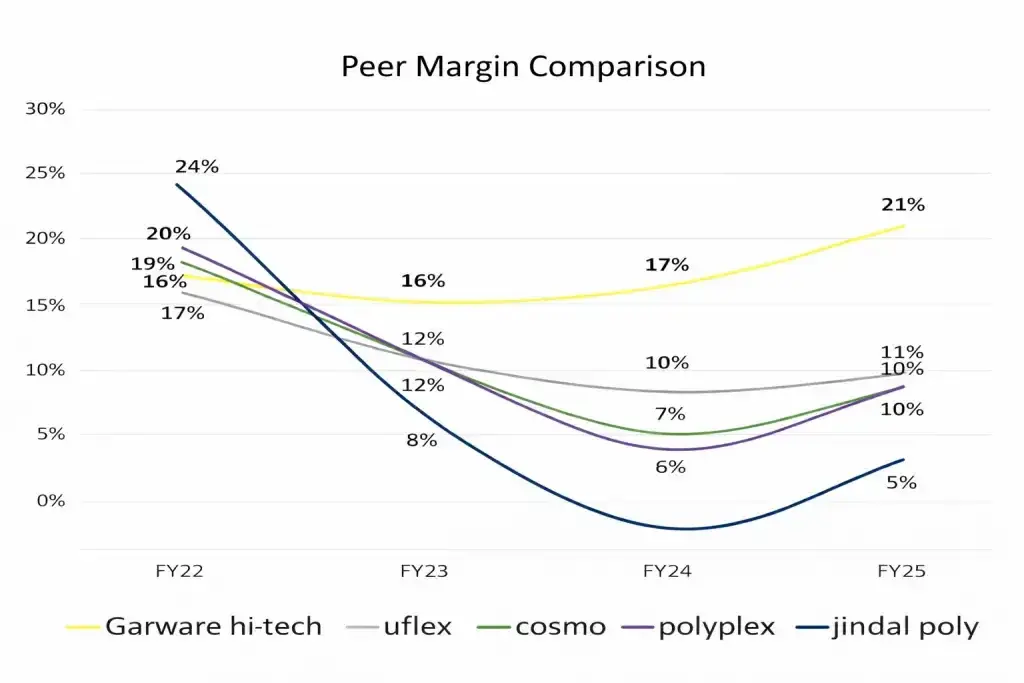
As earnings quality strengthened, cash flows became more predictable and margins stabilized at structurally higher levels. This gradually changed how the market looked at the company. What was once viewed as a cyclical, commodity-linked business began to be recognized as a niche specialty materials player — and as this shift in perception took hold, the stock moved from low valuation multiples to a higher P/E range, reflecting stronger profitability, competitive positioning, and long-term growth visibility.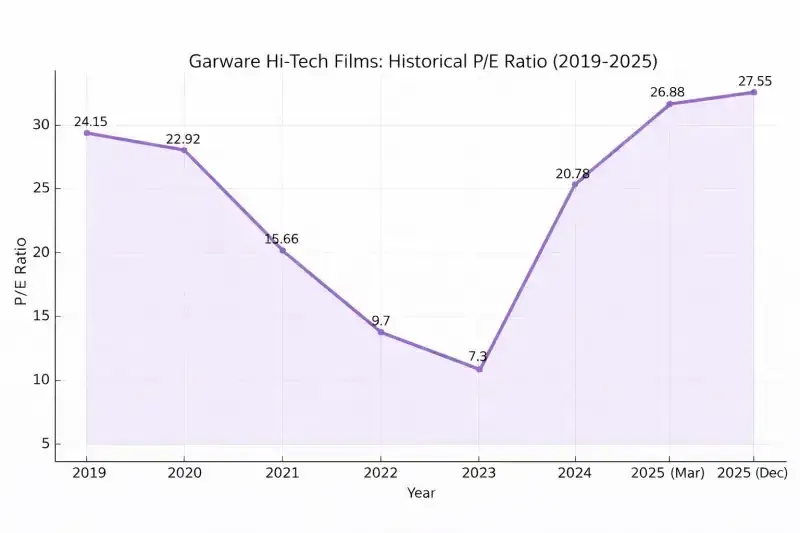
Garware Hi-Tech Films: Quiet Product Mix Upgradation Driving Re-rating
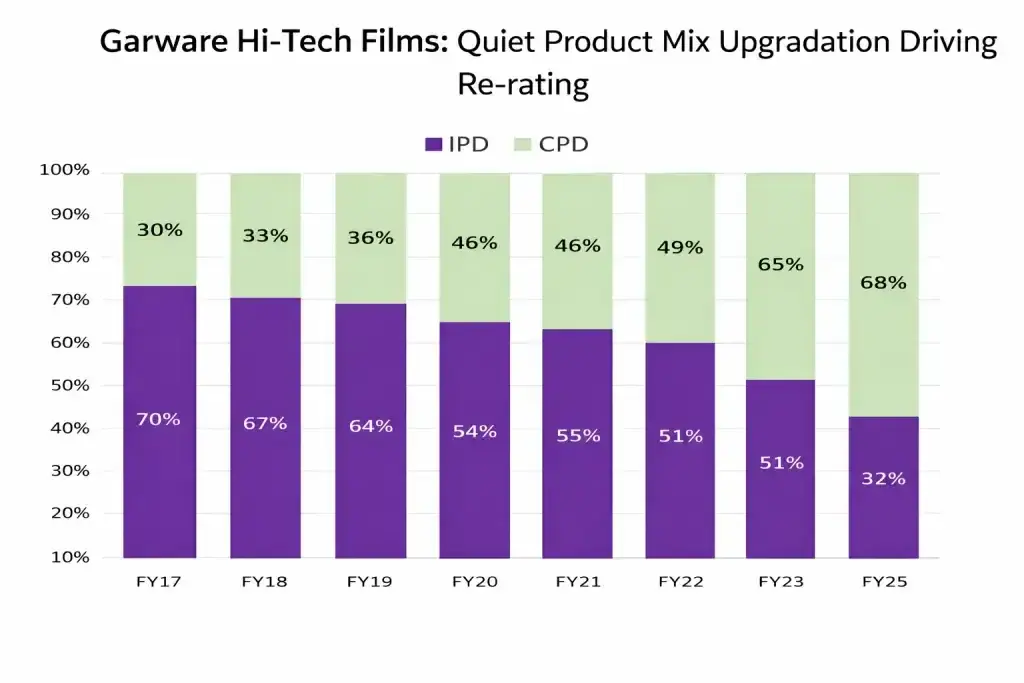
This graph shows profitability and valuations rising only after the shift to higher-margin specialty films, capturing the journey from underappreciated to multibagger.
Read more: Top Multibagger Stocks of the Last 10 Years – What We Can Learn
Trait 6: Technology & Operational Differentiation – Scaling Smarter
Jubilant FoodWorks (Domino’s India) didn’t just open more stores. It invested in real-time delivery tracking, insulated pizza boxes, and a smart app to monitor orders and customer behaviour. This allowed rapid expansion without compromising service quality, creating a durable moat. Smart operations and tech adoption turn good businesses into multibaggers.
Trait 7: Niche Dominance & Nationwide Expansion – From Leader to Category King
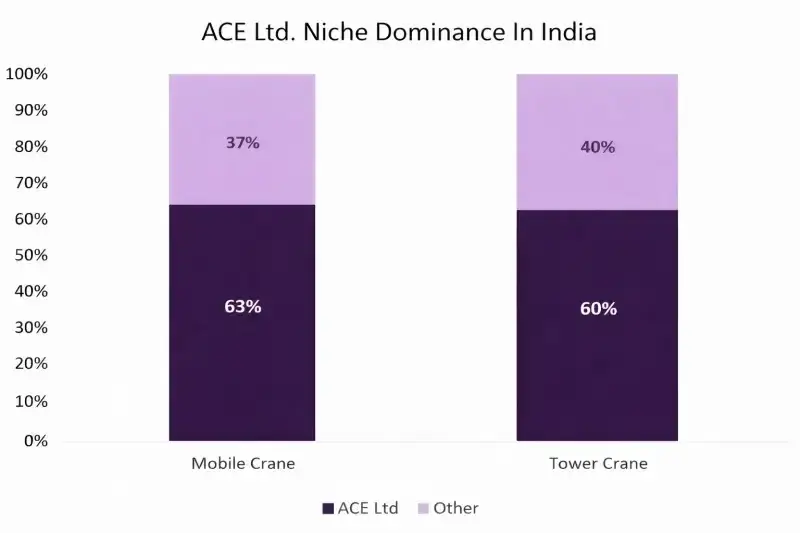
While global brands dominated heavy machinery, Action Construction Equipment (ACE) spotted a niche no one cared about — affordable, rugged mobile cranes built specifically for India. Instead of spreading itself thin, ACE focused on becoming the default choice at construction sites, making cranes that were cheaper to buy, easier to repair, and perfectly suited for India’s narrow, dusty conditions.Contractors quickly realised, “ACE works everywhere,” and the brand quietly captured 63%+ market share in mobile cranes. With trust and distribution already strong, ACE then smartly expanded into forklifts, backhoe loaders, and even agri machinery — selling more equipment to the same loyal customers.

A small niche became a nationwide infrastructure play. This is the power of dominating one category first: when a company becomes the go-to name for a critical product, scaling into related markets turns into a profit-compounding machine for years.
All seven traits, from profit compounding to operational differentiation, give a lens to spot potential multibaggers. But knowing them isn’t enough. The real skill lies in applying them early, before the market catches on. That’s where a practical toolkit comes in to turn lessons into action.
Practical Toolkit to Spot Future Multibaggers
Knowing the traits of multibaggers is one thing. Applying them early, before the market notices, is where real skill—and wealth creation—happens. Here’s a simplified toolkit to help you identify companies with multibagger potential, using the six traits we discussed.1. Operating Leverage & Profit Inflection – Where Growth Starts Compounding
What to measure: Compare Profit CAGR with Revenue CAGR over time. Ideally, profits should compound faster than revenues.
Why it matters: When earnings grow quicker than sales, it means the business is improving efficiency — fixed costs are getting absorbed better, margins are expanding, and every additional rupee of revenue is converting into a larger share of profit. That’s a strong signal of operating leverage working in the company’s favour.
Example —
Balkrishna Industries (BKT): Instead of competing in crowded mass-market tyres, BKT built a niche global franchise in off-highway and agriculture tyres, where customer relationships, reliability, and application performance matter more than price. Over time, this positioning led to structurally higher profitability — with net margins around ~15–16%, often more than double several peers — showing how a differentiated brand and focused market can compound profits far faster than topline growth.
APL Apollo: Profits grew faster than sales over the last decade.
Signal: A rising profit curve is often the first visible sign of a future multibagger.
2. Owning a Space in the Consumer’s Mind – Loyalty That Lasts
What to measure: Compare Gross and EBIT margins with peers, track how stable those margins are over time, and look for signals like brand recall, customer stickiness, and steady market-share gains.Why it matters: Strong brands don’t just sell products — they sell trust. When customers repeatedly choose the same brand without thinking twice, the company enjoys pricing power, repeat demand, and a moat that competitors can’t easily break through.
Examples
Fevicol — A simple adhesive turned into a symbol of reliability. Contractors, carpenters, and households buy it out of habit and confidence, not price comparison.
Maggi — What began as an instant noodle became an emotional comfort product. Even after setbacks, the brand regained leadership because the connection with consumers was deep and durable.
Bisleri — Packaged water transformed into a default choice for “safe drinking water.” The brand name itself became the category, reflecting trust built over years of consistency.
Signal: When customers return on their own — not because of discounts or advertising — the brand has crossed from being a product… to becoming a habit. That’s one of the strongest and most durable competitive advantages a company can have.
3. Leadership & Capital Allocation – Every Rupee Works Harder
What to measure: Return on Capital Employed (ROCE), debt levels and repayment discipline, promoter/insider ownership, and how management has allocated capital across cycles.Why it matters: Strong management teams don’t chase growth for the sake of growth — they reinvest only where returns stay high. They avoid unnecessary leverage, stay within their circle of competence, and build businesses that compound value steadily instead of taking risky shortcuts.
Examples:
Garware Hi-Tech Films: Moved from low-margin commodity films to high-margin specialty films exactly when the industry was expanding commodity capacity — a classic case of smart capital deployment against the herd.
APL Apollo: Shifted mix from basic tubes to premium structural products, turning scale and automation into sustained profit compounding.
Signal: Leaders who treat every rupee as strategic capital often turn small operational improvements into massive long-term value.
Read More : 7 Early Signals That a Stock Can Turn Multibagger
4. Structural Tailwinds & Growth Runway – Riding the Wave
What to measure: Industry growth rate, market size, penetration %, and long-term trends.Why it matters: Companies aligned with structural shifts—such as urbanisation, digitisation, and formalisation—get a head start, allowing their revenue and profits to compound faster than those of their peers.
Example:
DMart: Expanded into tier-2 and tier-3 cities early, capturing India’s shift from unorganised to organised retail.
Titan: Capitalised on growing demand for branded jewellery.
Signal: Strong alignment with long-term trends provides a runway for sustained growth.
5. Undervaluation / Late Recognition – The Quiet Multibagger
What to measure: P/E vs history/peers, rerating after profit acceleration.Why it matters: Many multibaggers start out ignored. Investors who notice improving profits before the market wakes up capture the steepest upside.
Examples:
Anup Engineering: Stayed under the radar for years, but once order wins scaled and margins improved, the stock rerated sharply as the market recognised its niche dominance in heat exchangers.
APL Apollo & BKT: Both saw meaningful rerating only after profit acceleration signalled a structural shift in the business.
Signal: Underappreciated companies with steadily improving fundamentals often become multibaggers once the market finally connects the dots.
6. Technology / Operational Differentiation – Scaling Smarter
What to measure: Operational efficiency, tech adoption, automation, and process innovation.Why it matters: Smart operations allow companies to grow faster without compromising quality or service. Tech and process innovations can create durable moats.
Example:
Jubilant FoodWorks (Domino’s India): Real-time tracking, insulated pizza boxes, and smart apps enabled rapid expansion without losing service quality.
Signal: Operational and technological advantage can turn good businesses into extraordinary wealth creators.
7. Dominating a Niche & Scaling It Nationwide
What to measure: Market share in one niche, expansion into nearby categories, repeat customers.Why it matters: Becoming the default choice gives pricing power and low-cost scaling.
Example: ACE — 63%+ share in mobile cranes → then expanded into forklifts & loaders using the same network.
Explore our Products
Research Framework

Emerging Titans
Combination of quantitative analysis, industry tailwinds, and management assessment - SPRINT investment philosophy

Tiny Titans
Heavy emphasis on scuttlebutt research, plant visits, and early on-ground signals
Conclusion
Multibagger stocks aren’t created by hype, luck, or market rumours. They are built slowly through better decisions, stronger execution, and smart capital use. When profits scale without unnecessary spending, when customers keep choosing the brand, and when institutions recognise the value early, wealth creation becomes a natural outcome.
Some multibaggers emerge from fast-growing industries. Others rise from ordinary sectors that nobody watches. But the common factor is always the same: the business quality keeps improving every year. The transformation happens quietly… and then the market suddenly pays attention.
The most successful investors don’t chase excitement; they follow evidence of progress. They look for companies where growth is predictable, margins expand, and competitive moats deepen with time. You don’t need a list of 50 stocks. You only need a few truly great businesses that compound for years.
If you want a ready-to-use stock checklist template + a detailed case study breakdown PDF of the companies discussed Comment “CHECKLIST”, and we’ll send it to you instantly.
Let’s build wealth the smart way one potential multibagger at a time.
FAQs ( Frequently Asked Questions )
What are the criteria for multibagger stocks?
+What is the best indicator of a multibagger stock?
+How to identify multibagger stocks in 2025?
+What is the biggest mistake investors make while hunting multibaggers?
+What are the warning signs to avoid in potential multibaggers?
+
High growth stock specialist, Value Educator
Shashank Mahajan is an equity research professional with over 12 years of experience in identifying high-potential SME and micro-cap stocks at an early stage. He follows a rigorous scuttlebutt research–driven approach, combining on-ground insights with deep financial analysis. Shashank specializes in uncovering under-researched and under-owned companies with strong management quality and long-term growth potential. Through disciplined research and early identification, he focuses on spotting tomorrow’s market leaders before they enter the mainstream investor radar.

Glenmark: The USD 700 Mn Cancer Deal and Its Brands

Pharma Stocks in India 2026: Generics, APIs and CDMOs

Granules India: From Paracetamol to a 65% Gross Margin

Natco Pharma: After Revlimid, 29 Patent Challenges

Shilpa Medicare: Cancer APIs, Films and Biosimilars

Alembic Pharma: US Plants Pay Back, Margin Hits 22.2%
Explore our Products
Research Framework
Emerging Titans
Combination of quantitative analysis, industry tailwinds, and management assessment - SPRINT investment philosophy
Tiny Titans
Heavy emphasis on scuttlebutt research, plant visits, and early on-ground signals



Modern Warfare to Multibaggers
Key Trends. Strategic Shifts. Opportunities Ahead.
Today at 7:00 PM IST. Room opens 30 minutes before.
Don't Miss This Exclusive Webinar!
Join Value Educator to decode the key trends shaping India's defence sector and learn how to identify tomorrow's potential leaders in the space.
- In-depth research on India's defence sector
- Live Q&A session
- Actionable takeaways for long-term investors

 Orders
 Subscription
 Share with friends


Required Details
₹23999.00
(12 month subscription)
As per SEBI regulations, all users are mandated to complete the KYC that is validated for 1 year. Post payment, you will be redirected to the KYC screen


No comments yet. Be the first to comment!