
ICICI Bank vs HDFC Bank: Which Is Better?
India is in a robust growth stage and its economy (GDP) would expand at a rate of approximately 6-8 percent per year in the next few years. This simply translates to the fact that the businesses are growing, incomes are growing and the total economic activity is growing. With this occurring the demand of loans be it in the form of homes, businesses, or infrastructure also increases which presents a huge growth opportunity to banks.
A major reason behind this trend is the low credit penetration (i.e. total loans in the economy in relation to the GDP) in India which today is approximately 55-60 percent which is quite low compared to 100 percent and above in the developed world. This gap means that growth in such areas as retail loans, MSME financing (loans to small businesses), and infrastructure lending is still a long way to go.
Simultaneously, the banks are finding it easier to attain customers and mobilize deposits due to such structural changes as digital banking, UPI adoption, and financial inclusion. (Deposits refer to money that the banks gather with the customers and lend to them.) This enhances efficiency and contributes to long-term growth.
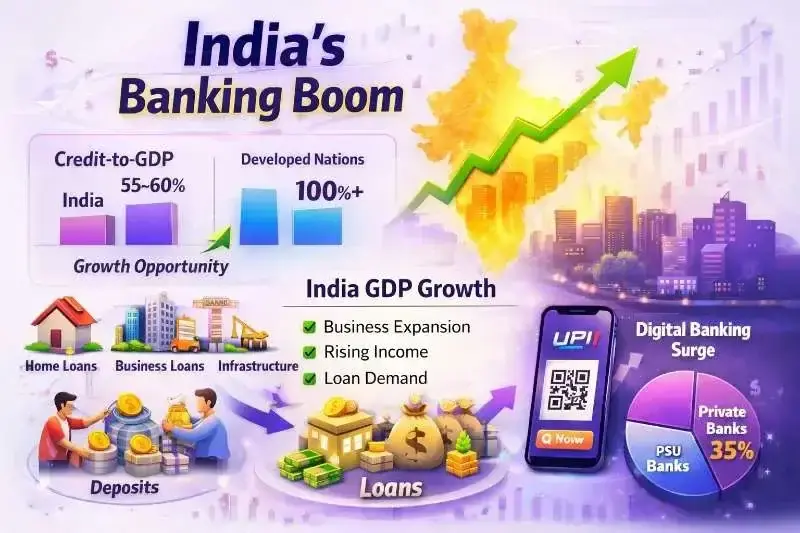
The other trend is the increasing presence of the banks of the private sector which today represent more than 35% of the total loans as compared to 10 years ago when they represented about 20%. Better risk management, superior technology, and efficient operations have made these banks gain market share over PSU banks.
Among them, two of the strongest and most well-managed players are the ICICI Bank and HDFC Bank. The two are regarded as the core long-term investments in the financial growth story of India and are therefore a popular investment decision among serious investors.
Having merged with HDFC Ltd, HDFC Bank has become a financial giant with a balance sheet of over 25 lakh crore. The bank has developed a reputation of steady performance, highest quality assets with GNPA of about 1.3% only, and a robust retail franchise that provides more than 55 percent of loans. It has historically provided consistent ROA of about 1.8- 2.0 percent and is a model of disciplined banking in India.
ICICI Bank, on the other hand, is a phenomenal turnaround case, as it has improved its GNPA by lowering the figure by approximately 8.8% in FY18 to about 2.3 in recent times.The bank has been moving towards a retail-oriented loan book, and its CASA ratio has improved to around 44 and today, the bank is providing an average ROE of 17-18. The changes have made it a high growth, high efficiency player in the private banking arena.
Banks are not just like any company and therefore cannot be measured on normal parameters such as revenue or profit margin. Rather, analysts pay attention to such parameters as quality of assets, capital strength, and deposit base to get to know their real performance.
If you are interested in knowing about penny stocks and understanding how they work, then read our article: What are penny stocks? The complete beginner's guide: pros & cons
This article will compare the two banks on 12 important parameters and come out with a combination of the data and insights in order to identify which bank is better placed in 2026.As Warren Buffett once remarked, it is much better to acquire a great company at a good price than a good company at a great price and this framework can be used to find just that.
1. Net Interest Margin (NIM)
The most significant profitability indicator of a bank is Net Interest Margin (NIM). Simply put, the difference between the interest that a bank will make on loans (home loans, personal loans) and the interest that it will pay on deposits (savings accounts, fixed deposits). The greater the NIM, the more the bank is making out of its lending business.
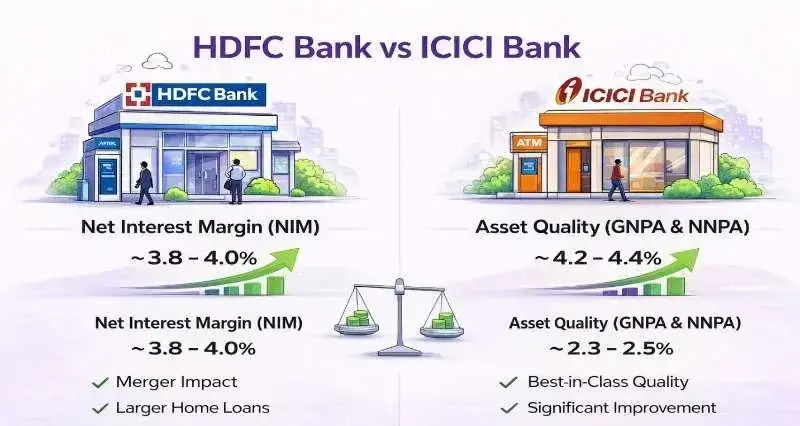
ICICI Bank is currently performing at a NIM of approximately 4.2-4.4% in FY26 which is one of the higher rates in the industry. This is largely due to the fact that it has more retail loans (personal loans and credit cards) that have higher interest rate than corporate loans.
The HDFC Bank has a NIM of about 3.8-4.0% which is slightly low because of the merger with HDFC Ltd. The introduction of a big home loan book (which attracts lower interest rates) and a short-term increase in funding costs has strained margins to some extent.
The other major factor is the cost of funds which just implies the amount of interest the bank has to pay in order to borrow money (deposits or borrowing). The large pool of low-cost deposits that ICICI bank has, enables it to maintain this low cost, which helps it to maintain superior margins. Here, HDFC bank has been under some pressure as the bank has been more dependent on more expensive funding, following the merger.
The NIM is also affected by interest rate cycles. As interest rates increase, those banks that are able to respond swiftly to raise their loan rates are the most beneficiaries. ICICI Bank has been comparatively quick in modifying its loan rates, a factor that has helped the margins.
In the future, the margins of HDFC Bank will be better as its deposits will get stronger and the pressure associated with mergers will decrease. But currently, the ICICI bank has a distinct lead in the NIM hence it is more powerful in terms of core profitability.
2. Asset Quality (GNPA & NNPA)
Asset quality remains the most critical parameter when evaluating a bank, as it directly impacts profitability, capital, and long-term survival. Gross Non-Performing Assets represent total stressed loans, while Net NPA accounts for provisions already made. Lower NPA levels indicate stronger underwriting standards and better risk management across economic cycles.
HDFC Bank continues to lead the industry with GNPA levels of ~1.2–1.4% and NNPA below ~0.4%. This consistency across multiple credit cycles highlights the bank’s conservative lending approach and disciplined credit appraisal systems. Even during periods of economic stress, HDFC has managed to maintain best-in-class asset quality.
ICICI Bank has shown remarkable improvement, reducing GNPA from ~8.8% in FY18 to ~2.3–2.5% currently. Its NNPA has also declined to below ~0.5%, indicating strong provisioning and recovery efforts. This turnaround reflects a significant shift in management strategy toward retail lending and tighter risk controls.
One of the key differences lies in historical consistency, where HDFC Bank has maintained low NPAs for over two decades, while ICICI Bank has experienced volatility in the past. This makes HDFC more predictable in terms of credit risk, which is a crucial factor for long-term investors seeking stability.
Sector exposure also plays a major role in asset quality, with corporate loans typically carrying higher default risk compared to retail loans. HDFC’s retail-heavy book provides better diversification, while ICICI’s earlier corporate exposure contributed to its past stress cycle, although this risk has now been significantly reduced.
Looking ahead, both banks are well-positioned with improved underwriting standards and a healthier economic backdrop. However, in a downturn scenario, HDFC Bank’s conservative DNA provides an additional margin of safety. ICICI Bank has caught up significantly, but HDFC still holds a slight edge in asset quality leadership.
3. Provision Coverage Ratio (PCR)
Provision coverage Ratio is used to show the amount of buffer that a bank has accumulated to cushion against possible losses due to bad loans. An increased PCR will make sure that even when NPAs increase, profitability will not be strongly affected. It is one of the major actions of prudence and financial discipline in the banking context.
ICICI Bank has a PCR of approximately 75-78 indicating a conservative provisioning practice after cleaning of its assets. This extensive coverage offers a good buffer against any future stress and lessens the volatility of earnings in times of downturn.
HDFC Bank has a PCR of around 70-75 which is a little less than that of ICICI Bank. This is in large part, however, because it already has low NPAs so that it does not have to do aggressive provisioning. The stability of the bank over time enables it to run effectively with a comparatively low coverage ratio.
To balance sector-specific risks, read: Portfolio Diversification – How Many Stocks Should You Hold?
The increased PCR is also crucial in the uncertain economic conditions where bursts of stress in loan portfolios can appear. The high coverage of ICICI Bank is a result of experience of previous cycles and a more conservative approach to risk management.
Conversely, the reduced NPAs coupled with sufficient provisioning makes HDFC Bank a balanced risk profile. The bank puts more emphasis on prevention by being stringent underwriting as opposed to provisioning extensively after the stress is evident.
Going prospectively, the two banks are well covered and the disparity in PCR is not something to worry a lot. Nevertheless, the higher buffer provides ICICI Bank with a minor advantage as far as the resilience in the event of credit shock is concerned.
4. Credit Growth (Loan Growth)
Growth rate of credit is a major contributor of earnings growth by banks as it indicates their capacity to seize the market opportunities.
ICICI Bank loan book has been expanding at a rate of about 16-18%/year, owing to the high momentum in retail loans, SME lending, and business banking. This aggressive expansion strategy has helped it to earn market share and increase operating leverage.
HDFC bank has also reported a growth in loans of about 12-14% a notch below that was in the end after the merger balance sheet adjustments. The merger with HDFC Ltd has stifled growth in the short run as the bank attempts to rationalize its asset-liability framework.
A high credit growth is usually an indication of high demand and positioning, but it also has risks in case the underwriting standards are compromised. The improvement of the quality of assets seems to support the improvement of the growth of Icici Bank, which is a positive indicator.
The fairly average growth of HDFC Bank is indicative of a more conservative strategy, where stability is placed more than expansion. This has been working to its advantage in the past, which has guaranteed steady performance through the cycles.
In the future, HDFC Bank will gain momentum as soon as the adjustments associated with the merger are stabilized, which may reduce the gap with ICICI Bank. In the meantime, ICICI is ahead of the growth momentum, but the most important aspect to observe is sustainability.

5. CASA Ratio
CASA ratio is the percentage of low cost deposits which directly affect the cost of funds and profitability of a bank. CASA plays an even more vital role in an environment of rising interest rates since it cushions margins against the pressure of rising funding costs.
ICICI bank registered a CASA ratio of approximately 39 percent in Q3 FY26, which is moderately lower than an approximation of 41-42 percent recorded in the previous quarters because of system-wide deposit repricing pressures. This loss indicates a trend within the industry as to how the industry competes over deposits and not necessarily as a weakness of the bank.
The CASA ratio of HDFC Bank is around 33-34 percent after the merger, which was affected by the merging of the balance sheet of HDFC Ltd that introduced costlier borrowings. This has diluted its CASA advantage structurally in the short term.
The relatively high CASA provides the ICICI Bank of a funding cost advantage which directly contributes to its excellent Net Interest Margins. This becomes one of the distinguishing factors in a narrowing liquidity market.
HDFC Bank on the other hand, has traditionally enjoyed a very robust liability franchise in India which has been anchored by a deep-rooted retail deposit base and a high brand trust.
In a prospective view, ICICI Bank has an obvious advantage in terms of CASA efficiency, but in the medium term, HDFC Bank has a good normalization curve.
6. Cost-to-Income Ratio
The cost-to-income ratio is a measurement of the efficiency and scalability of operations in that it shows how well a bank is able to transform costs into income. Smaller ratios indicate efficiency and high operating leverage.
ICICI Bank is currently working at a cost-to-income ratio of approximately 40-42, which is a result of digital adoption, rationalization of branch network, and economies of scale. This is much better than the levels of 45%+ that were experienced several years back.
The HDFC Bank ratio is approximately 42-45 in FY26, which is a bit higher owing to the cost of merger integration, technology investments, and expansion of branch to help it grow in the long term.
The fact that ICICI Bank has been able to keep its costs constant yet its loan growth is high points to its improving operating leverage. This is one of the factors which have contributed to an increase in its profitability indices over the past years.
The high cost structure of HDFC bank is mainly short-term since integration costs and investments become normalized in the next 2-3 years. It has been the most efficient bank in India in history.
At this point, ICICI Bank has a slight advantage in efficiency, and the difference is likely to be produced as HDFC Bank reaps merger synergies.

7. Return Ratios (ROA & ROE)
One of the most significant ratios of the profitability and efficiency of a bank are return ratios. Put simply, ROA (Return on Assets) is a measure of the amount of profit the bank is making off of its total assets (loans, investments) whereas ROE (Return on Equity) is a measure of the amount of profit the bank is making to its shareholders.
ICICI bank is in the process of providing ROA of around 2.2-2.3% and ROE of around 17-18% in FY26 and is already in the category of the most profitable large banks. This good performance is sustained by better margins, better quality of assets and effective control of costs.
The ROA of HDFC bank is around 1.8 to 2.0 percent and ROE is 15 to 17 percent, which is slightly low because of the effects of merger that increased its balance sheet and diluted returns in the short run.
Curious about what market cap actually means when it comes to stocks? Read our article on: What is Market Capitalization? Large, Mid, Small Cap Explained with Examples
Among the factors that have contributed to the high return ratios are higher Net Interest Margins (NIM), lower credit costs, and stricter cost control which have resulted in a robust and stable profitability cycle in ICICI Bank.
Although HDFC Bank is under pressure in the short term, the bank has been able to produce stable and healthy returns, and its profitability is likely to grow since merger synergies began to reflect within the next few years.
All in all, at present ICICI Bank is ahead of the pack in terms of returns, which makes it more appealing in terms of sheer profitability whereas HDFC Bank is not less strong with the returns potential getting better in the future.
8. Capital Adequacy Ratio (CAR)
Capital Adequacy Ratio (CAR) is a measure of the financial capacity and loss absorbing capacity of a bank. Simply put, it demonstrates the amount of safety buffer that a bank has relative to the loans it has issued. The RBI and other regulators have imposed a minimum CAR in banks of 9% to provide some stability in the financial system.
In FY26, ICICI bank recorded a CAR of approximately 17.3% which is well above the requirements by the regulatory authorities. This high buffer will provide sufficient room to the bank to expand its loan book without necessarily having to increase new capital.
With a powerful capital base and conservative strategies, particularly following the merger, HDFC Bank has a marginally better CAR of between 18-19. This offers further protection against unforeseen risks.
The increase in the capital levels also enables the banks to expand more vigorously because they will be able to lend more money without crossing the regulatory safety thresholds. Both banks have been in a good position to continue loan growth of about 12-15 without dilution.
The slightly greater CAR of HDFC bank allows it to have greater flexibility, especially in the case of growing the retail and housing loans, where capital requirement can be very high.
All in all, both banks are highly-capitalized and financially stable, yet HDFC Bank has a slight advantage in terms of capital strength and growth flexibility.

9. Slippages & Credit Cost
Slippages and credit cost are key indicators of a bank’s asset quality and risk management. In simple terms, slippages refer to loans that were previously healthy but have now turned bad (i.e., borrowers stopped repaying), while credit cost is the amount a bank sets aside as a buffer to cover potential loan losses.
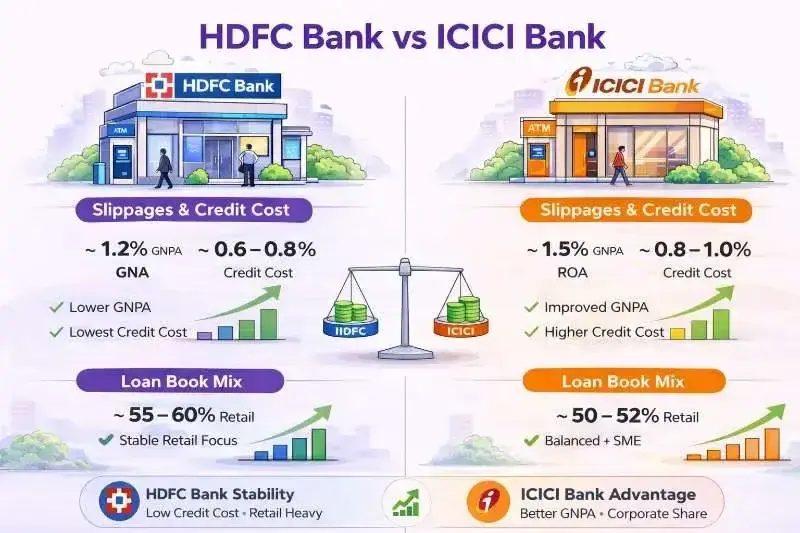
HDFC Bank continues to maintain credit cost at ~0.6–0.8%, among the lowest in the industry. This reflects strong underwriting standards, meaning the bank is very careful while giving loans and selects borrowers with high repayment capacity.
Explore our Products
Research Framework

Emerging Titans
Combination of quantitative analysis, industry tailwinds, and management assessment - SPRINT investment philosophy

Tiny Titans
Heavy emphasis on scuttlebutt research, plant visits, and early on-ground signals
ICICI Bank operates at a slightly higher credit cost of ~0.8–1.0%, but this is a significant improvement from its earlier levels of 2%+ during past stress cycles. This shows that the bank has strengthened its risk controls and cleaned up its loan book over time.
Looking at asset quality metrics, ICICI Bank’s GNPA (Gross Non-Performing Assets — total bad loans as a % of total loans) stands at ~1.5%, while NNPA (Net Non-Performing Assets — bad loans after provisions) is ~0.37% in FY26. This indicates a much healthier balance sheet compared to its past.
HDFC Bank continues to maintain slightly better numbers, with GNPA at ~1.2% and NNPA around ~0.4%, reflecting consistent asset quality and disciplined lending practices across cycles.
Curious to find what debt signifies for a company and how it can impact your long-term returns? Read our article: What is Debt to Equity Ratio? Why it Matters for Small Cap Investing.
Overall, HDFC Bank remains the benchmark for stability and risk control, while ICICI Bank has made remarkable progress and significantly narrowed the gap, reducing concerns around asset quality.
10. Loan Book Mix
Loan book mix is a critical driver of both growth and risk, as it determines how a bank is positioned across economic cycles. A higher retail mix typically offers stability and lower default risk, while corporate and SME exposure introduces cyclicality but can enhance growth during upcycles.
HDFC Bank maintains a retail-heavy portfolio, with ~55–60% of its loan book in retail segments such as housing finance, personal loans, and vehicle financing. This granular exposure reduces concentration risk and ensures relatively stable asset quality across different economic conditions.
ICICI Bank, in contrast, operates with a more balanced mix, with ~50–52% retail exposure and a meaningful share in corporate and SME lending. This diversified approach allows the bank to participate in both retail consumption trends and corporate credit demand.
The advantage of HDFC Bank’s strategy lies in its resilience, as retail loans tend to have lower volatility and more predictable repayment behavior, especially during economic slowdowns.
ICICI Bank’s approach, however, provides greater flexibility to capitalize on corporate lending cycles, particularly during periods of economic expansion when demand for large-ticket loans rises.
Overall, HDFC Bank holds an edge in stability and consistency, while ICICI Bank offers slightly higher growth optionality due to its diversified loan mix.
11. Deposit Growth vs Loan Growth
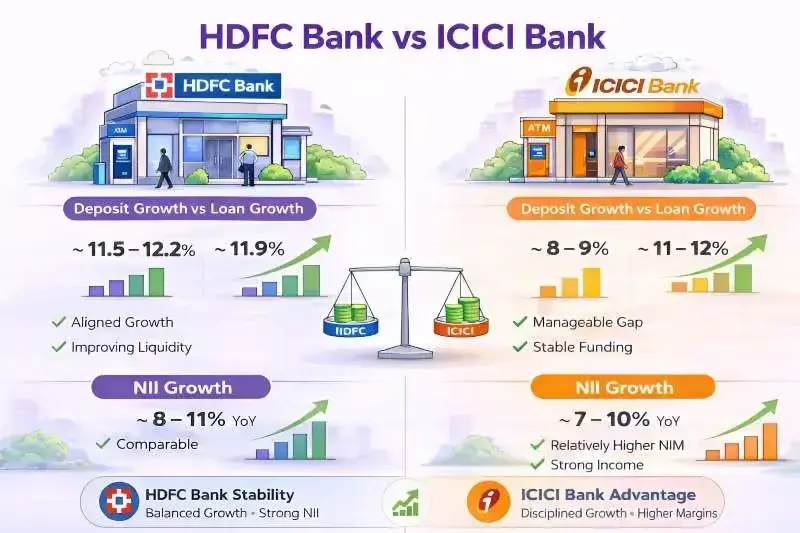
Maintaining a balance between deposit and loan growth is critical, as any mismatch can lead to liquidity stress and higher funding costs, ultimately impacting margins.
ICICI Bank reported deposit growth of ~8–9% and loan growth of ~11–12% in FY26, reflecting a manageable gap between assets and liabilities. This controlled divergence supports stable funding and limits pressure on cost of funds.
HDFC Bank has shown clear improvement post-merger, with deposits growing ~11.5–12.2% YoY and advances rising ~11.9% YoY to ~₹28.44–₹28.45 lakh crore. This near alignment has helped reduce earlier concerns around elevated loan-to-deposit ratios.
The improvement in deposit traction has allowed HDFC Bank to gradually ease reliance on high-cost funding sources, supporting better liquidity management.
Overall, ICICI Bank maintains slightly better funding discipline at present, while HDFC Bank is steadily normalizing and is likely to strengthen further over the next few years.
12. Net Interest Income (NII) Growth
NII growth reflects the core earning strength of a bank, driven by a combination of loan growth, Net Interest Margins (NIM), and funding efficiency. It is one of the most important indicators of sustainable profitability in a banking business.
ICICI Bank reported NII growth of ~7–10% YoY in FY26, with quarterly NII at ~₹21,900+ crore. Its relatively higher NIM of ~4.2–4.4% continues to support strong income generation, even as margins have moderated slightly from peak levels due to competitive deposit pricing.
HDFC Bank has delivered NII growth in the range of ~8–11%, with performance partly impacted by margin compression and integration-related adjustments following the merger. Elevated funding costs and balance sheet realignment have weighed on near-term income expansion.
While both banks are reporting comparable growth rates, ICICI Bank’s superior margin profile provides better visibility on sustaining NII growth, especially in a tight liquidity environment.
HDFC Bank’s NII growth is expected to gradually accelerate as deposit growth strengthens, cost of funds stabilizes, and merger synergies begin to reflect more meaningfully over the next few years.
Overall, ICICI Bank currently holds a slight edge in core income momentum, though HDFC Bank remains well-positioned to close the gap over the medium term.
Conclusion: Which Bank is Better for 2026?
ICICI Bank currently leads in key performance metrics such as margins, return ratios, efficiency, and growth momentum. Its transformation over the past decade has resulted in a strong, well-balanced franchise with improving consistency.
HDFC Bank remains the gold standard for stability, asset quality, and long-term compounding. Despite short-term pressures from the merger, its structural strengths remain intact and are likely to reassert over time.
From a 2026 perspective, ICICI Bank appears better positioned for higher returns driven by superior profitability and growth metrics. However, HDFC Bank offers unmatched predictability and lower risk, making it ideal for conservative investors.
As Peter Lynch famously said, “The key to making money in stocks is not to get scared out of them,” and both these banks represent long-term wealth creators in India’s financial growth story. Comment down “BANK” if you understood and loved our analysis . Share it with people who are always confused regarding the two financial institutions.
A balanced portfolio approach, holding both ICICI Bank for growth and HDFC Bank for stability, may be the most optimal strategy for long-term investors.
FAQs
How does the HDFC Ltd merger impact HDFC Bank’s future growth?
The merger has temporarily impacted margins and liquidity, but it also gives HDFC Bank a much larger loan book and cross-selling opportunities. Over the long term, this can drive stronger growth once integration stabilizes.
How do these banks compare in terms of digital banking capabilities?
Both banks are leaders in digital banking, but ICICI Bank has been more aggressive in leveraging technology for cost efficiency, while HDFC Bank focuses on scale and customer experience.
What risks should investors consider before investing in these banks?
Key risks include rising NPAs (bad loans), margin compression due to higher funding costs, and slower credit growth. For HDFC Bank, merger integration is a short-term risk, while ICICI Bank’s risk lies in maintaining asset quality during rapid growth.
How important is deposit growth for future performance?
Deposit growth is critical because banks rely on deposits to fund loans. Strong deposit growth ensures lower funding costs and supports sustainable expansion without impacting margins.
Are private banks still gaining market share over PSU banks?
Yes, private banks continue to gain market share due to better efficiency, technology adoption, and risk management. This trend is expected to continue over the next decade.

High growth stock specialist, Value Educator
Shashank Mahajan is an equity research professional with over 12 years of experience in identifying high-potential SME and micro-cap stocks at an early stage. He follows a rigorous scuttlebutt research–driven approach, combining on-ground insights with deep financial analysis. Shashank specializes in uncovering under-researched and under-owned companies with strong management quality and long-term growth potential. Through disciplined research and early identification, he focuses on spotting tomorrow’s market leaders before they enter the mainstream investor radar.

Zen Technologies: Revenue Fell After a Big Win




PNG Jewellers: A 194-Year-Old Name Goes National
Explore our Products
Research Framework
Emerging Titans
Combination of quantitative analysis, industry tailwinds, and management assessment - SPRINT investment philosophy
Tiny Titans
Heavy emphasis on scuttlebutt research, plant visits, and early on-ground signals


 Orders
 Subscription
 Share with friends


Required Details
₹23999.00
(12 month subscription)
As per SEBI regulations, all users are mandated to complete the KYC that is validated for 1 year. Post payment, you will be redirected to the KYC screen


No comments yet. Be the first to comment!