
Market Capitalization Explained

Have you ever looked at two stocks and wondered why one trades at ₹80 while another trades at ₹2,800? Which one has more risk? Which one has more growth potential?
Is the lower price really a better opportunity,
Or does that number tell you almost nothing about the business behind it?
These are the kinds of questions most investors ask themselves, especially in the early stages of learning the market. We compare prices, and usually the lower ones tend to look cheaper. But is that really the case?
But as Warren Buffett famously said,
“Price is what you pay. Value is what you get.”
And before you can even judge value, there’s a more fundamental question worth asking:
How big is the company you’re investing in?
Because in markets, a single share price doesn’t reveal size, scale, or economic weight.
There’s a concept that answers that question instantly, and once you understand it, comparing companies begins to make far more sense.
That concept is Market Capitalization.

What is Market Capitalization?
Think about this for a moment. When you look at a stock price on your screen, what are you really seeing? Just the cost of owning one tiny slice of a business. Nothing more. Nothing less.Yet we instinctively treat that number as if it tells the whole story. But does it really tell you how big the company is? Does it tell you whether you’re investing in a corporate giant or a relatively small player still finding its footing?
Reliance Industries Ltd has a market capitalization of about ₹19,63,000 crore across all its shares. This huge figure reflects how much investors collectively value Reliance as a business today.
Why is this number so large? Because Reliance isn’t just one business, it’s a giant conglomerate with big operations in:
- Oil refining and petrochemicals (including massive refineries like the one in Jamnagar)
- Telecommunications through Jio
- Retail across hundreds of stores and online commerce
Energy, media, and more

Market Cap = Share Price × Total Outstanding Shares.
The math is simple.
The perspective it gives you is powerful. Because once you start looking at companies through this lens, something shifts. You stop judging businesses by how affordable one share looks. You start seeing scale, reach, and economic weight. You begin noticing the difference between a firm that controls industries and one that is still trying to establish itself. And perhaps most importantly, comparison becomes meaningful.
There are 3 popular market caps - Large Cap, Mid Cap & Small Cap. To understand their risks, nature, and opportunities, we will go through each one of them.
Large Cap Stocks Explained
In India, large-cap companies are officially defined as the top 100 companies by market capitalization. They are businesses that already command scale, influence, and economic weight. Let's first have a look at NIFTY 100 returns since its inception.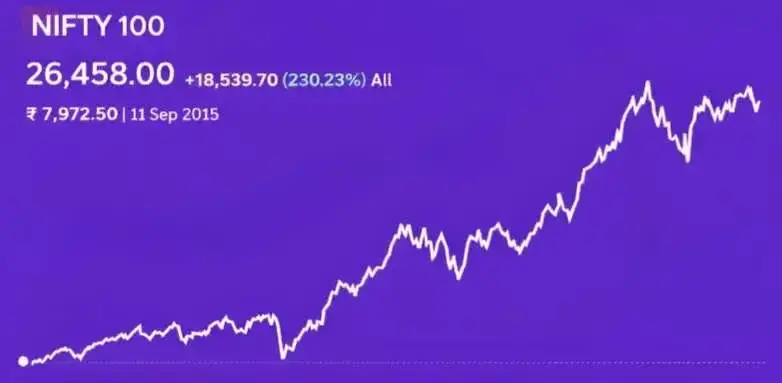
But what really makes them different? Let’s go deeper.
1) Stability and Reliability
Indian large-cap companies are typically businesses that have been around for years and have shown they can deliver results over time. Their size and financial muscle often help them stay steadier when markets get volatile, compared with other smaller companies.They’ve survived:
- Economic slowdowns
- Policy changes
- Currency shocks
- Global crises
2) Lower Volatility
Because of their established presence and multiple revenue streams, large-cap Indian stocks usually don’t swing as wildly in price. They do decline when markets correct, but the fall is often less sharp than that of mid- or small-caps.For investors who prefer stability over excitement, this smoother performance can offer both peace of mind and financial steadiness. These companies are like huge elephants, moving slowly but steadily, hence providing better stability.
3) Regular Dividend Payouts
Many large-cap Indian companies reward shareholders with regular dividends. For investors seeking passive income along with capital appreciation, large caps can offer a balanced approach.Dividends may not feel dramatic. But over long periods, they quietly add up.
4) Long-Term Growth Potential
Indeed, large caps rarely deliver explosive growth like smaller emerging companies.But they possess Deep financial resources, Industry leadership, Brand strength, & Access to capital
Large caps may grow more slowly, but they often grow longer. And long-term compounding often beats short-term market volatility.
5) Strong Liquidity
Large-cap stocks generally trade in high volumes. This means you can buy or sell easily and make entry and exit smoother. Liquidity may sound technical, but it matters.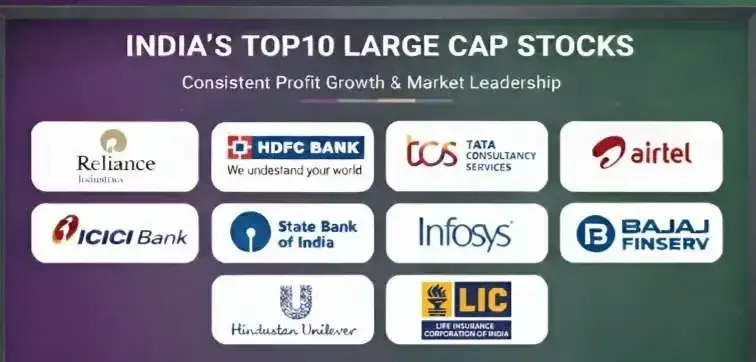
If your goal is steady compounding over 10, 15, or 20 years, large caps can form the backbone of your portfolio. Because in investing, survival and steady compounding usually matter more than excitement. And sometimes, the companies that look “boring” are the ones that quietly build wealth.
If market swings make you uneasy, large caps are often the comfort zone. Obviously, they don’t eliminate risk, but they tend to fluctuate less violently compared to smaller companies. Their diversified operations, stronger balance sheets, and established brands often help cushion sharp downturns.
Mid Cap Stocks Explained
Have you ever looked at a large, dominant company and thought, “I wish I had invested in this when it was still growing”?That space between already-established giants and fragile small companies is where mid-cap stocks live.
In India, mid-cap companies are officially those ranked 101 to 250 by market capitalization. They’re not tiny. They’re not dominant giants either. They’re businesses that have moved past survival… and are now pushing toward expansion. And that stage is often where interesting things happen.
Peter Lynch once said, “The key to making money in stocks is not to get scared out of them.” Mid-caps test that patience, but they also reward it when growth materializes.
Most mid-cap companies are in a growth phase. They may be:
- Expanding into new cities
- Launching new product lines
- Increasing market share
- Entering global markets
This stage often brings operational improvements, better margins, and stronger institutional interest.
Mid-caps are not as stable as large caps. They can react more sharply to earnings surprises and so move faster during market corrections. Hence, they face more competitive pressure.
Let's see the returns of the Mid Cap index since its inception to give you a fair idea.
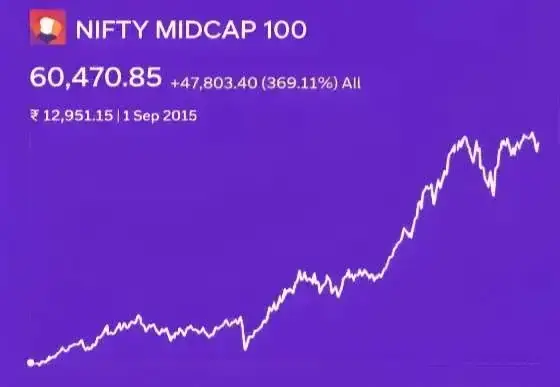
But they are typically more established than small caps, which reduces some early-stage business risk. Because mid-cap companies are still scaling, their growth runway can be longer; they can provide great opportunities at comparatively less risk.
If you’re someone who can handle a bit of market movement but doesn’t want to deal with extreme uncertainty, mid-caps often sit in that comfortable middle space. And when your focus is on building wealth over the long run, they can become the extra push that helps your portfolio grow.
If you’re curious, you can dive deeper in our article Why Mid Cap Stocks are the Sweet Spot for Long-Term Investors.
As Charlie Munger wisely said, “The big money is not in the buying or the selling, but in the waiting.”
Mid-caps demand waiting. They demand conviction during volatility. But when business execution matches growth potential, the compounding can be meaningful. Sometimes, the most interesting companies aren’t the biggest ones. They’re the ones still climbing.
Small Cap Stocks Explained
Have you ever seen a small company suddenly become the next big name or the next multi-bagger and think, “I wish I had spotted it earlier”?That’s the world of small caps.
In India, small-cap stocks are companies ranked 251 and beyond by market capitalization. They’re not industry leaders. They’re not fully established giants. They’re businesses still proving and transforming themselves.
They move fast & can surge dramatically when earnings surprise. They can fall sharply when expectations break. Small Caps possess the potential of multibagger growth and risk of crashing as well. This is why small caps are known for:
- High volatility
- High growth potential
- Business uncertainty
In small caps, compounding often gets interrupted by volatility and market fear, liquidity crunches, poor management decisions, and competitive pressure.
In the early 2000s, Eicher Motors was a small-cap stock trading at split-adjusted levels of around ₹20–₹30. As Royal Enfield scaled aggressively and profits compounded, the stock surged massively. From 2004 to 2024, it delivered roughly 35,000%+ total return, translating to a CAGR of around 35–40% over two decades.
That’s the power of a small company executing well over time. Small cap today, wealth creator tomorrow.

Peter Lynch said, “The person who turns over the most rocks wins the game.” It captures the essence of small-cap investing: doing the work, finding overlooked businesses early, and having the conviction to stay invested while they grow.
Read more about Small Cap Investing Mistakes in our article Common Mistakes Every Small-Cap Investor Makes (And How to Avoid Them).
The real opportunity in small caps isn’t finding “the next big thing.” It’s identifying:
- Strong management
- Clean balance sheets
- Scalable business models
- Sustainable competitive advantage
You can invest in Small Caps if volatility excites you more than it scares you, and if you understand that short-term drawdowns are part of the journey
Small Caps often require a long investment horizon. With time and discipline, they can become multibaggers.
Read more about identifying strong Small Caps in our article 7 Early Signals That a Stock Can Turn Multibagger
Without time, small caps become speculation.
However, these companies may help you generate extraordinary alpha. Sometimes, the companies that look insignificant today are the ones that dominate headlines tomorrow. The bet is on the potential.
Which One Should You Choose?

There isn’t a “best” category. There’s only what’s best for you. Because investing isn’t about picking the fastest horse. It’s about choosing the right vehicle for your journey. Basic things to look for before investing:
1) Your Age
Age influences the time horizon.
- Younger investors → More time to recover from volatility → Can allocate more to mid & small caps.
- Mid-career investors → Balanced growth + stability → Mix of large and mid caps.
- Near retirement → Capital protection matters more → Higher allocation to large caps.
Time is your biggest asset. The more you have, the more risk you can intelligently take.
2) Your Risk Tolerance
Ask yourself honestly:- Can you handle a 25–30% portfolio fall without panic?
- Do market corrections make you anxious?
- Can you hold through bad market cycles?
If volatility disturbs your peace of mind, heavy small-cap exposure may not suit you.
3) Your Financial Goals
Different goals require different strategies.- Long-term wealth creation → Mid & small caps add growth.
- Wealth preservation → Large caps bring stability.
- Short-term goals → Lower volatility matters more.
Your portfolio should match your goals and destination, not be influenced by others.
4) The Balanced or Diversified Portfolio Approach
Most experienced investors don’t choose one category. They blendRead more about Asset Allocation in our article Portfolio Diversification – How Many Stocks Should You Hold?
A simple allocation framework example:
- 50–60% Large Caps → Stability
- 25–35% Mid Caps → Growth engine
- 10–20% Small Caps → High-alpha potential
Explore our Products
Research Framework

Emerging Titans
Combination of quantitative analysis, industry tailwinds, and management assessment - SPRINT investment philosophy

Tiny Titans
Heavy emphasis on scuttlebutt research, plant visits, and early on-ground signals
Conclusion & CTA
Without really understanding how large, mid, and small caps differ, investors often end up chasing returns without direction, misjudging volatility, or playing it so safe that they miss out on growth. The outcome is usually the same - emotional decisions, inconsistent strategies, and portfolios that don’t truly reflect their financial goals. Simply putting money into the market isn’t enough; shaping your portfolio around your age, comfort with risk, and long-term plans is what helps discipline and performance move together.
If this guide helped you clearly understand how large, mid, and small caps differ and how to structure them wisely, then comment “MARKET CAP” below. Like if the comparison table clarified your allocation thinking, share this with someone building a long-term equity portfolio, and tell us: what percentage of your portfolio is in small caps right now?
The real edge in wealth creation isn’t going all-in on one segment. It’s building a balanced structure that allows you to grow, survive volatility, and compound steadily over time.
FAQs
Is one category better than the others?
+Can I invest only in small caps for higher returns?
+How often should allocation between large, mid, and small caps be reviewed?
+Do large caps always outperform during market crashes?
+Why does diversification across market caps matter?
+
High growth stock specialist, Value Educator
Shashank Mahajan is an equity research professional with over 12 years of experience in identifying high-potential SME and micro-cap stocks at an early stage. He follows a rigorous scuttlebutt research–driven approach, combining on-ground insights with deep financial analysis. Shashank specializes in uncovering under-researched and under-owned companies with strong management quality and long-term growth potential. Through disciplined research and early identification, he focuses on spotting tomorrow’s market leaders before they enter the mainstream investor radar.

Zen Technologies: Revenue Fell After a Big Win




PNG Jewellers: A 194-Year-Old Name Goes National

Explore our Products
Research Framework
Emerging Titans
Combination of quantitative analysis, industry tailwinds, and management assessment - SPRINT investment philosophy
Tiny Titans
Heavy emphasis on scuttlebutt research, plant visits, and early on-ground signals


 Orders
 Subscription
 Share with friends


Required Details
₹23999.00
(12 month subscription)
As per SEBI regulations, all users are mandated to complete the KYC that is validated for 1 year. Post payment, you will be redirected to the KYC screen


No comments yet. Be the first to comment!